The core software framework for the LHCb Upgrade
ConcezioBozzi1,2,∗,SébastienPonce1,∗∗and StefanRoiser1,∗∗∗ on behalf of the LHCb collaboration
1CERN, 1211 Genève 23, Switzerland
2Sezione INFN di Ferrara, Via Saragat 1, 44122 Ferrara, Italy
Abstract.The LHCb detector will be upgraded for the LHC Run 3. The new, full software trigger must be able to sustain the 30MHz proton-proton inelas-tic collision rate. The Gaudi framework currently used in LHCb has been re-engineered in order to enable the efficient usage of vector registers and of multi-and many-core architectures. This contribution presents the critical points that had to be tackled, the current status of the core software framework and an outlook of the work program that will address the challenges of the software trigger.
1 Introduction
The LHCb experiment will be upgraded in view of data taking during the LHCb Run 3 and beyond [1]. In addition to sub-detector elements and readout channels, the LHCb software and computing infrastructure [2–4] will undergo substantial modifications. In particular, the removal of the lowest-level hardware trigger implies that the High-Level software Trigger (HLT) must be able to cope with the inelastic collision rate of 30 MHz. Moreover, the in-stantaneous luminosity will increase by a factor 5 to 2∗1034cm−2 s−1, with a corresponding increase in pile-up, thereby increasing the processing time for a single event.
The development of high-throughput software, needed by the LHCb trigger to cope with the above conditions and provide a fast decision, has been the subject of an intense R&D program that ultimately relies on the better utilization of modern computing architectures. This paper reports the work that has been done in this respect. The main directions that have been explored are detailed in Sec. 2. The tools that have been put in place to monitor progress and the current results are reported in Sec. 3. An outlook towards the goal of sustaining software trigger capability at a 30 MHz rate is discussed in Sec. 4. Many of these aspects have been detailed in Ref. [2].
2 Main directions
Even though the number of transistors on integrated circuit chips has continued to follow Moore’s law over the last decade, and will probably for the next few years, the trend of ever faster single-threaded CPU performance has been broken about ten years ago. Instead, the
∗e-mail: [email protected] ∗∗e-mail: [email protected] ∗∗∗e-mail: [email protected]
additional transistors have been invested into multiple CPU cores on a die, and, within these cores, into wider execution units. Furthermore, the gap between the processing units (PUs) and memory has increased (Figure 1), and feeding the processing units with data is becoming more than ever a bottleneck.
1980 1981 1982 1983 1984 1985 1986 1987 1988 1989 1990 1991 1992 1993 1994 2002 2003 2004 2005 2006
Year
Performance
1 10 100 1000
…
Processor-Memory Performance Gap: (grows 50% / year)
DRAM 7%/year CPU 60%/year
«Moore’s Law»
DRAM CPU
Figure 1.Performance of processors and memory as a function of time [5, 6]. The gap between process and memory performance grows about 50% each year.
Besides, the amount of RAM available per core has been stable, if not going down, re-cently with typical setups of up to 40 or 64 virtual cores for 64 to 128GB of memory. There-fore the multi-process approach, where multiple instances of the same application are run in parallel, one per processing core, is no longer sustainable due to lack of RAM – a typical LHCb application needs 2-4GB to run.
The LHCb core software framework Gaudi [7] has thus been re-engineered towards multi-threading so that the parallelism in the processing cores is exploited. LHCb specifically takes benefit of the inter-event parallelism by running as many events in parallel as cores. This re-engineering process meant the implementation of thread-safety, by further developing pio-neering work previously done within Gaudi [8], via the definition offunctionalalgorithms [9], the implementation of a new scheduler [10], and the reliance on modern C++standards.
The LHCb software stack was then gone through step by step, first through small-scale tests in order to learn these new programming techniques and paradigms. Software optimiza-tion guidelines include:
• a careful usage of memory, in order to avoid costly cache misses, which this implies e.g. the redesign and slimming of data classes;
• the utilization of vector processing units, which requires the rethinking of data models and data preparation steps;
• the introduction of new C++features, in particular those related to optimization;
• the extensive use of constness throughout the code in order to ensure thread safety at com-pile time as much as possible.
additional transistors have been invested into multiple CPU cores on a die, and, within these cores, into wider execution units. Furthermore, the gap between the processing units (PUs) and memory has increased (Figure 1), and feeding the processing units with data is becoming more than ever a bottleneck.
1980 1981 1982 1983 1984 1985 1986 1987 1988 1989 1990 1991 1992 1993 1994 2002 2003 2004 2005 2006
Year Performance 1 10 100 1000 … Processor-Memory Performance Gap: (grows 50% / year)
DRAM 7%/year CPU 60%/year
«Moore’s Law»
DRAM CPUFigure 1.Performance of processors and memory as a function of time [5, 6]. The gap between process and memory performance grows about 50% each year.
Besides, the amount of RAM available per core has been stable, if not going down, re-cently with typical setups of up to 40 or 64 virtual cores for 64 to 128GB of memory. There-fore the multi-process approach, where multiple instances of the same application are run in parallel, one per processing core, is no longer sustainable due to lack of RAM – a typical LHCb application needs 2-4GB to run.
The LHCb core software framework Gaudi [7] has thus been re-engineered towards multi-threading so that the parallelism in the processing cores is exploited. LHCb specifically takes benefit of the inter-event parallelism by running as many events in parallel as cores. This re-engineering process meant the implementation of thread-safety, by further developing pio-neering work previously done within Gaudi [8], via the definition offunctionalalgorithms [9], the implementation of a new scheduler [10], and the reliance on modern C++standards.
The LHCb software stack was then gone through step by step, first through small-scale tests in order to learn these new programming techniques and paradigms. Software optimiza-tion guidelines include:
• a careful usage of memory, in order to avoid costly cache misses, which this implies e.g. the redesign and slimming of data classes;
• the utilization of vector processing units, which requires the rethinking of data models and data preparation steps;
• the introduction of new C++features, in particular those related to optimization;
• the extensive use of constness throughout the code in order to ensure thread safety at com-pile time as much as possible.
The above guidelines require extensive knowledge of modern programming techniques and thus a large software training effort within the LHCb collaboration. To this end, tutorial
sessions are held regularly on topics such as core C++programming, the LHCb framework,
coding practices, optimization tools and collaborative tools. Also, bi-monthly hackathons are held in order to pair code developers with software experts, and make rapid progress.
3 Monitoring the progress
As already mentioned, one of the main objectives of the LHCb upgrade for Run 3 is to process events from LHC collisions at a rate of 30 MHz by using a fully software trigger. In order to meet this objective the evolution of the HLT performance must be followed on a regular basis. In the case of a trigger farm consisting of 1000 nodes, this means that a single node should process about 30k events per second.
The first benchmark tests performed on the HLT1 application, the first HLT stage that runs upfront synchronously with data taking, showed an event processing rate of about 3k events per second only. Efforts were therefore prioritised to port the HLT1 algorithms to the
mod-ernized Gaudi framework sketched above, in order to better exploit the previously unused dimensions of computing resources. The HLT1 algorithms that perform the event recon-struction were reviewed and converted in order to be run in a fully multi-threaded approach. Then, profiling tools such as valgrind, callgind, and vtune were used to identify hotspots in the code and algorithmic improvements were subsequently implemented. The LHCb build infrastructure and continuous integration platform [2] is used (Figure 2) to nightly-build and -check code validity on all computing platforms, to check the overall code performance, and to record all performance indicators, including cache misses and vectorization levels. Trends can be extracted at the single algorithm level, an example being shown in Figure 3.
Figure 2.Snapshot of the outcome of a nightly build from the LHCb continuous integration platform. Software is organized in projects (rows), computing platforms correspond to columns.
Time (arbitrary units)
5 10 15 20 25 30 35
Ev
en
ts/
seco
nd
/node
/1000
14 15 16 17 18
Figure 3.Trend plot of the number of events processed per second by a given HLT1 algorithm.
Figure 4, taken from [2], shows the throughput of the HLT1 sequence as measured on a dedicated machine with 20 physical cores, on which the sequence is run multiple times, each time by varying the number of reconstruction processes and the number of threads in each process. At the time of this Conference, a throughput of 15k events per second on a
Figure 4.(Taken from [2]) Throughput of an HLT1 reconstruction sequence, measured on a dedicated machine with 20 physical cores, as a function of the product of the number of processes and number of threads, for different number of threads per process, as indicated in the legend. The throughput peak
performance is 12400 evt/s/node for 2 processes and 20 threads per process. The “Multi processes” line
indicates the performance that is achieved without multithreading.
Time (arbitrary units)
5 10 15 20 25 30 35
Ev
en
ts/
seco
nd
/node
/1000
14 15 16 17 18
Figure 3.Trend plot of the number of events processed per second by a given HLT1 algorithm.
Figure 4, taken from [2], shows the throughput of the HLT1 sequence as measured on a dedicated machine with 20 physical cores, on which the sequence is run multiple times, each time by varying the number of reconstruction processes and the number of threads in each process. At the time of this Conference, a throughput of 15k events per second on a
Figure 4.(Taken from [2]) Throughput of an HLT1 reconstruction sequence, measured on a dedicated machine with 20 physical cores, as a function of the product of the number of processes and number of threads, for different number of threads per process, as indicated in the legend. The throughput peak
performance is 12400 evt/s/node for 2 processes and 20 threads per process. The “Multi processes” line
indicates the performance that is achieved without multithreading.
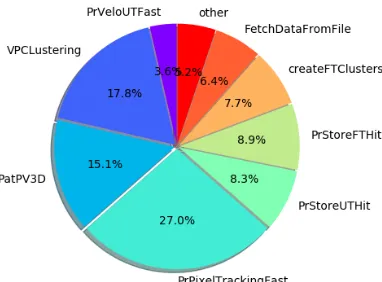
single computing node was obtained. A snapshot of the fraction of time spent in each HLT1 algorithm is shown in Figure 5.
July 10th2018 Software framework for the LHCb upgrade 10/ 17 Figure 5.Fraction (in percent) of time spent in each algorithm of an HLT1 application.
4 Conclusion and outlook
This paper has shown the infrastructure that has been put in place and that will allow the LHCb experiment to meet the ambitious target of building and operating a 30MHz software trigger. This includes in particular a substantial training effort in order to spread the
knowl-edge of new software engineering techniques and speed-up the work plan.
The efforts start to pay off: the performance of the HLT1 sequence, the first trigger stage
that has to cope with an input rate of 30MHz, has improved a lot from the original 3k to 15k events per node in the latest measurements. However the effort needs to continue and many
items have to be tackled, among which the trigger selections, the second trigger stage (HLT2) and a deep review of the internal event model.
References
[1] LHCb collaboration,Framework TDR for the LHCb Upgrade: Technical Design Re-port. LHCb-TDR-012
[2] The LHCb Collaboration,Upgrade Software and Computing Technical Design Report. CERN-LHCC-2018-007. LHCB-TDR-017
[3] The LHCb Collaboration,Computing Model of the Upgrade LHCb experiment Techni-cal Design Report. CERN-LHCC-2018-014, LHCb-TDR-018
[4] The LHCb Collaboration,LHCb Trigger and Online Technical Design Report. CERN-LHCC-2014-016, LHCb-TDR-016
[5] J.L. Hennessy, D.A. Patterson, Computer Architecture: A Quantitative Approach, 5th edn. (Morgan Kaufmann, Amsterdam, 2012), ISBN 978-0-12-383872-8
[6] J.D. McCalpin,Memory Bandwidth and System Balance in HPC Systems, Invited Talk, International Conference for High Performance Computing, Networking, Storage, and Analysis (2016)
[7] LHCb collaboration,LHCb computing: Technical Design Report. LHCb-TDR-011 [8] The Concurrent Framework Project (CF4Hep), http://concurrency.web.cern.ch/
GaudiHive (2012)
[9] M. Clemencic, B. Hegner, C. Leggett, Journal of Physics: Conference Series 898, 042044 (2017)
[10] R. Matev et al.,A 30 MHz software trigger for the LHCb upgrade, inthe procedings of this Conference(2018)
![Figure 1. Performance of processors and memory as a function of time [5, 6]. The gap between processand memory performance grows about 50% each year.](https://thumb-us.123doks.com/thumbv2/123dok_us/8000146.1328787/2.482.61.420.130.326/figure-performance-processors-memory-function-processand-memory-performance.webp)
![Figure 1. Performance of processors and memory as a function of time [5, 6]. The gap between processand memory performance grows about 50% each year.](https://thumb-us.123doks.com/thumbv2/123dok_us/8000146.1328787/3.482.63.426.387.612/figure-performance-processors-memory-function-processand-memory-performance.webp)
![Figure 4, taken from [2], shows the throughput of the HLT1 sequence as measured ona dedicated machine with 20 physical cores, on which the sequence is run multiple times,](https://thumb-us.123doks.com/thumbv2/123dok_us/8000146.1328787/4.482.98.380.373.561/throughput-sequence-measured-dedicated-machine-physical-sequence-multiple.webp)