Proposed Smooth-STC Algorithm for Enhanced
Coverage Path Planing Performance in Mobile Robot
Applications
Hai Van Pham 1,*, Philip Moore 2,and Dinh Xuan Truong3
1 2 3 4 5 6 7 8 9 10 11 12 13 14 15 16
1,3 SchoolofInformationTechnologyandCommunication,HanoiUniversityofScienceandTechnology,1
DaiCoViet,LeDaiHanh,HaiBaTrung,Hanoi,Vietnam;[email protected], [email protected]
2 SchoolofInformationScienceandEngineering,LanzhouUniversity,FeiyunBuilding,222TianshuiSRd,
ChengguanQu,LanzhouShi,Lanzhou730030,GansuSheng,China;[email protected] * Correspondence:[email protected];Tel.:(84-4)823727555
Abstract: Robotic pathplanning isafieldof research whichisgaining tractiongiventhe broad domainsofinteresttowhichpathplanningisan importantsystemicrequirement; theaimbeing tooptimisetheefficacyofroboticmovementsinadefinedoperationalenvironment.Forexample, robotshavebeenemployedinmanydomainsincluding:cleaningrobots(suchasvacuumcleaners), automatedpaintsprayingrobots,window cleaningrobots,forestmonitoringrobots,agricultural robots(oftendrivenusingsatelliteandgeostationarypositionalsatellitedata).Additionally,mobile roboticsystemshave beenutilisedindisasterareasandlocations hazardousto humans(suchas warzonesinmineclearance).Thecoveragepathplanningproblemdescribesanapproachwhichis designedtodeterminethepaththattraversesallpointsinadefinedoperationalenvironmentwhile avoidingstaticanddynamic(moving)obstacles. InthispaperwepresentourproposedSmooth-STC model,theaimofthemodelbeingtoidentifyanoptimalpath,avoidallobstacles,prevent(oratleast minimise)backtracking,andmaximisethecoverageinanydefinedoperationalenvironment.The experimentalresultsinasimulationshowthat,inuncertainenvironments,ourproposedsmoothSTC methodachievesanalmostabsolutecoveragerateanddemonstratesimprovementwhenmeasured againstalternativeconventionalalgorithms.
Keywords: Mobile robotic systems: Coverage Pathplanning; Smooth-STC algorithm; Robotic C-Spacepathplanning
17
1. Introduction
18
Robots have been employed in a diverse range of domains and systems; for example robotic
19
systems have addressed the demands of: cleaning robots (such as vacuum cleaners), automated paint
20
spraying robots, window cleaning robots, forest monitoring robots, agricultural robots (often driven
21
using geostationary positional satellite data), and in disaster areas and locations hazardous to humans
22
(such as war zones). The broad range of robot applications has driven interest in optimising the efficacy
23
of robots in operation, to address this challengeCoverage Path Planning(CPP) problem has gained
24
traction, CPP describes an approach which is designed to determine the path that traverses all points
25
in adefined operational environment(DOE) while avoiding static and dynamic (moving) obstacles within
26
a defined operational area [8].
27
An example of CPP is a automatic robotic domestic vacuum cleaner which, when activated using
28
CPP, can manoeuvre around a DOE (typically a room or on one level) to clean the area while avoiding
29
static (moving) obstacles (such as furniture) or dynamic (moving) objects (such as a domestic animal)
30
when traversing the DOE [20]. To solve this problem, it is necessary to build an algorithm to find
31
optimal coverage path for the DOE; in studies addressing CPP (for example see Cao et al. [3]) basic
32
standards for the robotic path coverage problem have been set (see Section2).
33
In this paper, to overcome the outstanding limitations in current coverage path planning
34
applications [and obtain maximum coverage of the DOE] we propose a new Smooth-STC (SmSTC)
35
algorithm based on the use of a spanning tree. Our proposed SmSTC model targets the identification
36
of optimal paths while avoiding all obstacles, preventing (or at least minimise) backtracking, and
37
maximising the coverage in any defined operational environment. The experimental results in a
38
simulation show that, in uncertain environments, our proposed smooth STC method achieves an
39
almost absolute coverage rate and demonstrates improvement when measured against alternative
40
conventional algorithms.
41
The remainder of this paper is structured as follows: Section 2 considers related research
42
addressing the CPP problem. CPP in unknown environments is addressed in Section3with CPP
43
environments considered in Section4. Section5sets out the proposed SmSTC algorithm with the
44
results and a discussion set out in Section6with an overview of potential future work. The paper
45
closes with concluding observations.
46
Figure 1.Composite classification showing the main approaches to the CPP problem. (source: [4] [8])
2. Related Research
47
In considering the CPP problem there are a number of basic standards for the robotic path
48
coverage problem have been identified, for example see Caoet al[3]); in practice it is not always
49
possible to satisfy all the basic standards and there is frequently a ‘trade-off’ to reach an optimal
50
domain-specific solution. The ‘trade-off’ is reflected in the current research where methods focus on
51
certain ‘specific’ constraints.
52
Over the past three decades, robotics research has mainly focused on solving the CPP and
53
coverage path optimisation problems in both static environments (environments where obstacles do
54
not move) and dynamic environments (environments in which there are both static and dynamic
55
(moving) obstacles). The CPP problem may be approached in two ways:classicalandheuristicmethods
56
(also identified as artificial intelligence (AI)); each of the approaches demonstrates specific strengths
57
and weaknesses [8,17]. In Figure1we present our graphical composite summary of the mainstream
58
approaches to CPP, namelyoff-lineandon-linemethods; the classification tree is drawn from related
59
research sources reviewed, principally [4] [8].
60
CPP algorithms are categorised ason-lineandoff-line, see Choset, 2001) [4]. Off-line algorithms
61
assume that the working environment (the DOE) is known, therefore the path of the robot can be
62
optimised. In contrast, on-line algorithms do not need to know the advance the DOE information,
63
the operation of a robot is based on information collected from ‘real-time’ sensors which read and
64
monitor the DOE and the location, shape, and size of the obstacles [6,21] thus providing a suitable path
to provide complete coverage of the DOE. On-line algorithms are generally known as sensor-based
66
coverage algorithms [1,8].
67
Moreover, dependent on the conditions of the DOE, it is possible to classify more detailed
68
problems based on static environments or dynamic environments; in this paper, the authors consider
69
static environments. Figure11 shows a graphical representation of the coverage path planing problem.
70
A simple approach to solving the CPP problem is a random algorithm. For example, consider a
71
cleaning robot where the cleaning is randomly executed without time restrictions, while the cleaning
72
may be effective the algorithmic approach is not efficient or reliable [3,7,8]. For example, some
73
commercial robots (such as Roomba by iRobot [20]) do not need to be equipped with complex sensors
74
to enable location determination and calculation (of the coverage path) and are therefore more simple.
75
Nonetheless, in a large area or a three-dimensional space [such as underwater or aerial DOE’s] the
76
operational costs of the robot (in energy and time) are very expensive, not feasible in reality, so need
77
other approaches [7,18]. First, it is necessary to divide the environment into small continuous areas
78
where the robot can completely move without colliding with obstacles. In this way, there are algorithms
79
such asTrapezoidalDecomposition,BoustrophedonDecomposition, and BSA, BA*, just to name a few
80
[9,11]. All of them need to have a mechanism for linking domains to achieve the best coverage. It
81
marks “backtracking” points and uses different algorithms to find the shortest path from the current
82
location to those backtracking points. The greater the number of backtracking points, the larger the
83
overlap area and the longer execution time for the robot. Moreover, the robot also requires a large
84
enough memory to store all of the backtracking points.
85
An alternative approach is to divide the environment into a grid equal size cells, the cells being
86
equal to the size of the robot. The Spanning Tree Covering (STC) algorithm (see Section 3) is a
87
significant example of this approach, it defines two types of cell: mega-cells and sub-cells that create
88
a spanning tree between mega-cells and a path covered [by a robot] over the sub-cells by moving
89
along the spanning tree. It has been proven to enable the coverage of the DOE with limited of no
90
overlapping. However, the major limitation [of the STC algorithm] lies in the coverage area not being
91
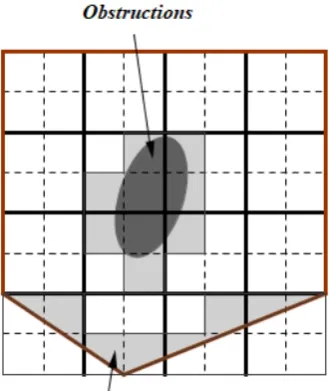
optimal. Figure2(see 2a) demonstrates the limitations of the STC Algorithm; if a mega-cell is occupied
92
by a part of an obstacle then the entire mega-cell is also seen as an obstruction occupied entirely by
93
an obstacle, as such a robot will consider the entire cell an obstruction and fail to cover the cell area.
94
Therefore, the DOE will not be entirely covered.
95
A proposed improvement in the STC algorithm is a Full-STC algorithm where a robot ignores
96
only sub-cells occupied by obstacles. In this case, an overlap in DOE coverage is accepted in exchange
97
for a large coverage area. The limitation of this algorithm is shown in Figure2(see 2b). Depending on
98
the shape and size of the obstruction, the cell coverage area also changes.
99
Research in [13] by Luo & Yang proposes a neural network based approach to CPP predicated on
100
grid maps along with other recent improvements in 2008 and 2015 [15,16]. The DOE is into grid cells
101
(similar to sub-cells in STC) called neurons. The possibility nodes can carry activate values (free cell) or
102
restrain values (fully occupied cell or partially occupied by obstacles). This approach is based on the
103
neural propagation model of Hodgkin-Huxley (1952) [12] in order to ensure high-positive neurons will
104
be propagated to the entire environment while restrained neurons will only spread within a narrow
105
range of its neighbours [14,15]. The robot determines the next position by selecting the proximity of
106
the highest positive neuron. The drawback of STC algorithms is that all cells that occupied partly by
107
obstacles are bypassed.
108
Our SmSTC method presented in this paper aims to address the limitations of the related research
109
considered by targeting the identification of optimal paths while avoiding all obstacles, preventing (or
110
at least minimise) backtracking, and maximising the coverage in any DOE. The SmSTC algorithm aims
111
to address:
Figure 2.The limitations of STC and Full-STC algorithm when robots ignored many areas.
3. Robot Coverage Path Planning in Unknown Environments
113
In a static known environment, obstacles are fixed and the robot will anticipate environmental
114
information before implementing coverage [23]. One of the classic methods to solve this problem is
115
divide the DOE into non-overlapping sub-domains (cells) that contain no obstacles which called cell.
116
These cells are easily covered with simple movements of robot like a zigzag line. Two cells are called
117
adjacent if they share the same edge. An adjacent graph is used to represent the relationship between
118
cells. The nodes represent the cells and the edges represent the links between the cells. The problem
119
now is finding a path through all the nodes of the graph. (Figure3shows an adjacent graph for the
120
algorithm).
121
Figure 3.The adjacent graph for Full-SmSTC algorithm.
Gabriely and Rimon (2002) [6] proposed the Spiral Spanning Tree Coverage (SSTC) algorithm
122
which is an on-line algorithm in which the path of the robot was built in a spiral; two SSTC algorithms
are introduced: SSTC and Full-STC. As with STC off-line, the entire grid is divided into mega-cells,
124
each of them contains four robot size smaller cells. However, the robot is equipped with two additional
125
sensors: a position-direction sensor and a sensor to detect obstacles [6,18]. Whenever the robot reaches
126
a certain mega-cell that will be marked "visited" and against the new cells marked "unvisited". The
127
robot will scan the clockwise direction to find the first neighbourhood marked "unvisited" in order to
128
create a spanning tree. Then the robot moves to the right edge from the current cell to the selected
129
neighbouring cell. The algorithm ends when the robot returns to its original position.
130
As with the off-line STC algorithm, SSTC will ignore the mega-cells that are partially or wholly
131
occupied by obstacles; therefore, it still carries the limitations of STC. Along with the Full-STC
132
algorithm, the SSTC algorithm ignores only the sub-cells occupied by obstacles and creates a pathway
133
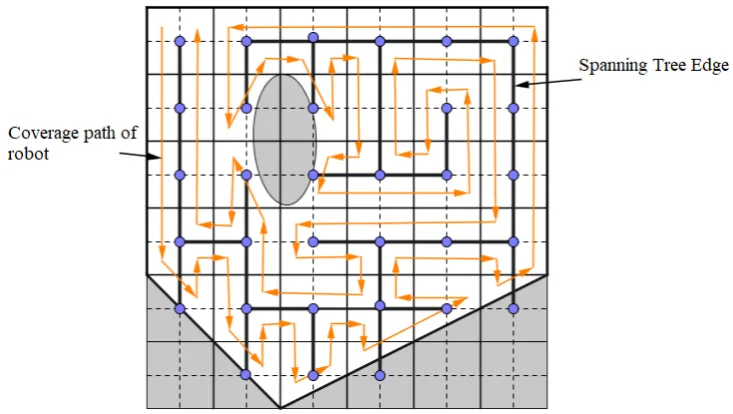
through the remaining free sub-cells. Figure3shows the path resulting from the use of the Full-STC
134
algorithm.
135
4. Robot Coverage Path Planning Environments
136
4.1. Conceptual cells of robot
137
Similar to the STC algorithms, the grid division uses two cell types which areDxD-sized sub-cells
138
and 2Dx2D-sized mega-cell ( D is the size of the robot). Each mega-cell will contain 4 sub-cells inside
139
and Figure4shows two types of cell.
140
Figure 4.Figures showing two types of cell in STC.
AssumeQis the workspace of robot. ConsiderQperforming in 2-dimensional space (Q⊂R2) and
141
QRis the smallest size rectangle that surrounds the Q. AssumeQRis the 2mDx2nD-sized (m,n∈N∗)
142
in other wordsQRis divided into(m x n)mxn mega-cells of(2D x2D)size.
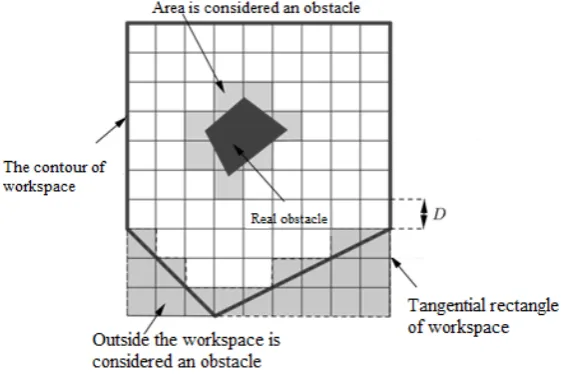
143
Suppose there areNobstructions inQwhich areO={O1,O2, ...,ON}. Each obstructionOican
144
occupy whole or part of the sub-cell. Space outside the work area ofQRwill be considered an obstacle.
145
An illustration of this division is shown in Figure5.
146
4.2. The Nodes in a Mega Cell and Sub Cells
147
Each mega-cell will be characterised by a node located centrally in the cell, the same configuration
148
will apply to each sub-cell. Figure6shows the location of the nodes in the centre of the cells. These
149
nodes play an important role in creating the spanning tree of the SmSTC algorithm.
150
Figure 6.Nodes in cells.
4.3. The C-Space in the World of the Mobile Robot
151
The C-Space simply considers an object of any shape in this space (the DOE) as a point. Assume
152
Cis a C-Space whereq = (x, y)are points in the DOE occupied by the robot. R(q)is a set of theq
153
points. ObstructionsOiin C-Space is a form in which robots intersect with a real obstacleWOiin the
154
workspace ie:Oi={q∈C|R(q)∩WOi 6=∅}. The free space also known as theCofree space which is
155
a set of areas in which robots do not intersect with any obstaclesWOi.
156
Considering a circular robot represented by a centre(x, y)in space. Knowing the r radius of
157
the robot can completely identify the set of pointsq = (x,y) in the space occupied by the robot.
158
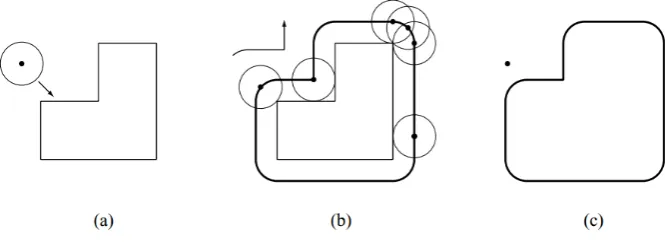
Rq={(x0,y0)|(x−x0)2+ (y−y0)2≤r2}. Suppose the workspace of robot has only one obstruction
159
(see Figure7). Figure7b showing the robot moves around an obstacle to determine the shape of an
160
obstacle in the C-Space. At that time, the robot can be viewed as a point in C-Space and it can move
161
arbitrarily without affecting obstacles (Figure 6c). Depending on the size of each robot that the shape
162
of the C-Space is different (see Figure7)
163
4.4. The adjacent graph
164
An adjacent graphG(V,E)has a set of vertices V which is the set of nodes in the mega-cells and
165
E is the connections between the nodes in two adjacent mega-cells. Smooth-STC uses this graph to
166
create a robot cover path.
167
Figure 8.Different forms of space correspond to sizes of robot
4.4.1. Connection Edge Between Two Nodes of Two Adjacent Mega-Cells
168
Where the edge between two adjacent mega-cells is completely free, a connected edge between the
169
corresponding nodes on the graph can be created and vice versa, then two nodes cannot be connected
170
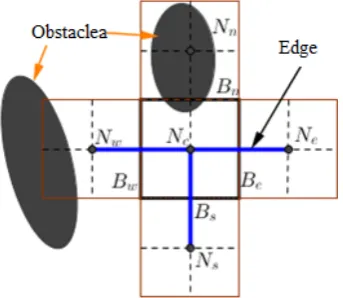
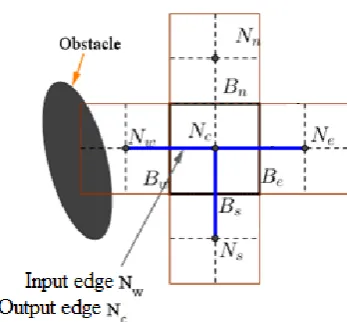
through this edge. Figure8shows the connections of adjacent mega-cells. NodeNccan create the
171
connect with nodesNe,NsandNwbecause the common edges between them (Be,BsandBw) are free.
172
NodeNcis not possible to create a connection toNnsince the common edgeBnis partially occupied
173
by the obstacle. Figure9models this condition.
174
Figure 9.Connection edge between adjacent mega-cells
4.4.2. Input and Output Edges
175
If nodeNican create a connected edgeEijto an adjacent node Nj, that edgeEij is termed the
176
input edge of nodeNjand output edge of nodeNi. In our proposed SmSTC algorithm, completely free
177
mega-cells may have either an input or an output edge. However, with mega-cells partly occupied
178
by an obstacle, they only have an output edge (i.e., there is no input edge). Mega-cells completely
179
occupied by obstacles of course there will be no connection edges. Figure10shows an example of the
180
input and output edge.
Figure 10.Input edge and output edge in Smooth-STC
4.5. The Proposed Smooth-STC algorithm
182
In the proposed algorithm to smooth the DOE and maximise the coverage area mega-cells
183
partially occupied by obstacles are converted into a C-Space. The authors propose two types of SmSTC
184
algorithms:off-lineandon-line.
185
4.5.1. Smooth-STC in a Known Environment
186
Input: Environmental information is divided into mega-cells and the starting cell positionSis
187
the starting point for the robot to traverse the DOE.
188
Output: the coverage path of robot.
189
Algorithm 1: SmSTC off-line.
190
1. Start from create spanning tree using DFS.
191
2. Implementation coverage: Starting from a sub-cell ofS.
192
2.1. If the current mega-cell has both input and output edges: Move to adjacent
193
sub-cells along the circumference of spanning tree in a anticlockwise direction.
194
2.2. If the current mega-cell only has an input edge: Follow the boundary of the
195
C-Space and return to the previous mega-cell.
196
In the SmSTCoff-linealgorithm, a spanning tree is created in step 1 using DFS algorithm. However,
197
depending on the characteristics of each mega-cell, the connection edge between nodes is different.
198
The execution of the robot in step 2 started from a sub-cell ofS. The robot performs the right-side
199
spanning tree to move around the spanning tree and ensure complete coverage (Step 2.1). Whenever
200
the centre of the robot is located on the boundary of the C-Space the robot will move on the boundary
201
from right to left and returns to the previous mega-cell (Step 2). The algorithm stops when the robot
202
returns to the original mega-cell S. Details of this algorithm are illustrated in Figure11.
203
4.5.2. The SmSTC algorithm in unknown environment
204
In the SmSTCon-linealgorithm, robots will have on knowledge in advance relating to information
205
in the DOE. They perform DOE coverage using sensors to detect obstructions. The SmSTCon-line
206
algorithm continuously divides the working area into mega-cells and ignores the mega-cells completely
207
occupied by obstacles. The remaining mega-cells will be used to create a graph called a spanning tree
208
that each node is the centre of the mega-cells and each side has the ability to connect the adjacent
209
mega-cells.
210
Each time the spanning tree is expanded, the robot divides the mega-cell into four sub-cells equal
211
size for the robot. For every free mega-cell, the robot follow the path through each sub-cell surround
212
the spanning tree. With mega-cells partially occupied by obstacles, robots perform calculations in
C-Space. Here, it performs a new border movement of C-Space of that mega-cell. The algorithm stops,
214
when all mega-cells are covered or robot returns to the start position. A mega-cell is called "unvisited"
215
if one of its 4 sub-cells has not been covered and vice versa mega-cell will be called "visited".
216
Figure 11.Input edge and output edge in SmSTC algorithm
SmSTCon-lineAlgorithm:
217
• Sensors: Position and direction sensors, detect obstacles in adjacent 4 mega-cell sensors.
218
• Input: Location of start mega-cell S and no information about the environment .
219
• Recursive function: SmoothSTC (w, x), where x is the current node, w is the parent node in
220
spanning tree.
221
• Initialisation: SmoothSTC (null, S).
222
Algorithm 2:
223
SmSTC(w,x):
224
1. Mark the current mega-cell x as "visited"
225
2. While x still has an "unvisited" adjacent that is not completely occupied by an obstacle.
226
2.1. Search for new neighbours of x in an anti-clockwise direction. Call y the first
227
neighbour of x.
228
2.2. Build a connection edge between x and y.
229
2.3. If y is completely free:
230
From x move to a sub-cell of y along the output edge of x.
231
2.4. If y is partially occupied by an obstacle:
232
2.4.1. Build C-Space space at y.
233
2.4.2. From x just moving along the new contour of C-Space at y has just
234
followed the access edge of y to return to x.
235
2.5. Call SmSTC (x, y)
236
3. End the loop.
237
4. If x differs from S, move back to x.
238
5. Returns results (SmoothSTC(w, x) stops).
239
• Finding adjacent mega-cells in the counter-clockwise direction at step 2.1 ensures the path of
240
robot when it encircles the spanning tree in a uniform direction (Figure12a;
• At step 2.2 if x is completely free and the robot is located at a certain sub-cell of x and it can move
242
to an "unvisited" mega-cell y;
243
• An edge of the spanning treexy~ will be created from the mega-cell x to y. This edge will be
244
treated as the output edge from x and the input edge in y. With the mega-cell x partially occupied,
245
it only has input edges;
246
• The coverage is carried out in steps 2.3 and 2.4 for two abilities to be completely free or partially
247
occupied by obstacles. If y is completely free then from the sub-cell position in x the robot can
248
move to a certain sub-cell in y by moving along the right side of thexy~ edge (Figure12b;
249
• Because y is not occupied by an obstacle, this coverage path is always guaranteed in one
250
direction (step 2.3). If y is partially occupied by an obstacle, the robot needs to calculate the
251
C-Space surrounding y (step 2.4);
252
• Assuming a robot with a circle of centre I that can see its movement as a movement of the centre
253
I. At this point, the robot still follows the edge to enter the y until its centre I lies on the road The
254
boundary of the space C-Space moves centre I on this boundary from right to left of thexy~ edge,
255
until the centre I is on the other side of edgexy~ then the robot follows the edge to return to x
256
(Figure12);
257
• Call recursively for the current nodeyand parent nodex(step 2.4). If the current mega-cellxo
258
has no neighbours marked as "unvisited" thenxois a leaf node when the robot will move back to
259
the parent node (Figure12c) orxois the start nodeS. So, robot has finished covering and the
260
algorithm ended. Figure12details the robot movement in the sub-cells of this algorithm.
261
Figure 12.Search and move steps of robot
5. The proposed algorithm
262
The implementation of algorithm is built in the Java language and program interface uses Swing
263
java library.
264
With the SmSTC algorithmoff-line, the robot hasa priori information relating to the DOE. Therefore,
265
before finding the path, the algorithm needs to build an optimal spanning tree that can use any tree
traversal algorithm, DFS is an example of such an algorithm. A spanning tree is generated that allows
267
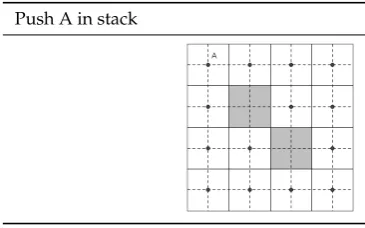
the robot to perform coverage by following this tree. The authors used a stack to save information
268
about the nodes after each robot visit.
269
1. Pushthe start button in the stack, from the current node found nodenwhich is the first unvisited
270
neighbour in a anticlockwise order;
271
2. If the n node is not empty, move the robot from the current node to noden. Mark the current
272
button as the previous node of noden(setPreNode is the current node). Mark the n button as
273
visited;
274
3. If the next nodenis empty, pop the current node off the stack.;
275
4. The robot moves from the current node to the stack top button. Mark the previous node of the
276
top of stack with the current node.
277
5. This process repeats until stack is empty. The stack operation illustration is shown below.
278
Table 1.SmSTC algorithmoff-line
Push B in stack
S A-B
. . . .
Push C in stack
S A-B-C
. . . .
Push M in stack
S A-B-C-D-E-F-G-H-I-K-L-M
Pop M off the stack
S A-B-C-D-E-F-G-H-I-K-L
Push N in stack
Pop N off the stack
S A-B-C-D-E-F-G-H-I-K-L
Pop F off the stack
S A-B-C-D-E
Push O in stack
S A-B-C-D-E-O
. . . .
Pop A off the stack
S Null
Finish
6. Experimental Results and Discussions
279
The evaluate our proposed SmSTC algorithm we conducted experimental testing using a
280
simulation, all experimental runs use the same size of robot, the same starting position, and the
281
starting time (the coverage ratio and the relationship to time for the Smooth-STC on-line algorithm is
282
greater than our SmSTC on-line and Full-STC algorithms as shown in Figure13.
283
During the first 6 seconds (of the experimental run) the coverage rates of all algorithms is the
284
same because in that time there are no obstacles. From the 7th second, there is a difference: the runtime
285
of SmSTC is shorter because of the shorter path travel distance resulting in reduced time to cover the
286
DOE. The runtime for the Full STC and Smooth-STC algorithms are very similar is not much different;
287
however, the achieved coverage rate of Smooth-STC is almost 100 % while this rate in Full STC is only
288
over 93%.
Figure 13.The coverage ratio depend on time of Smooth-STC, FullSTC and SmSTC
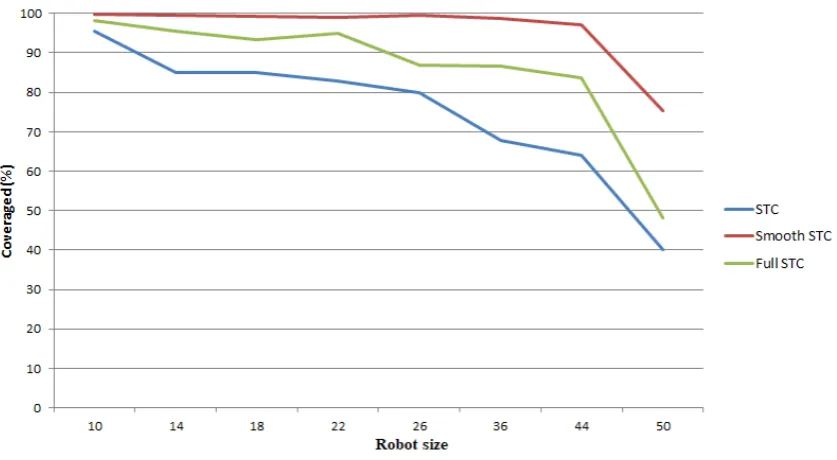
The influence of the robot size on the coverage ratio is realised by changing and gradually
290
increasing the robot size. The results in Figure14show that the coverage ratio depends on the robot
291
size and the bigger it’s size, the lower the ratio. This indicates that the SmSTC algorithm achieved
292
coverage ratio close to 100% in most cases and this result is an improvement over the alternative
293
algorithms considered, this is especially evident when the robot size is bigger.
294
Figure 14.Effect of robot size on coverage rate
In the same map with the same complexity when changing the size of the robot, the authors
295
obtained the overlap area ratio of those algorithms as shown in Figure15. The ratio of overlap area of
296
SmSTC proposed algorithm is still much larger than previous algorithms. The larger the robot size, the
297
larger the repeating area. However, these overlap areas are mainly located around the obstructions.
298
In fact, these areas have stain density more than areas far away from obstacles. So repeating in these
299
areas is also meant to be cleaner.
Figure 15.Overlap area ratio of algorithms when changing robot size
To compare the degree of influence of the complexity of the DOE to the coverage area, the
301
experimental testing evaluated the e algorithms on maps with increasing complexity. The complexity
302
of the map is objectively evaluated based on:
303
• Number of obstacles in the environment.
304
• The shape of each obstacle.
305
For a general robot with a size of 30, the experimental results are shown in Figure16. The results
306
results show that the higher the complexity of the environment, the better the STC and Full STC
307
algorithms coverage. While our SmSTC always maintains a coverage of over 95%, it shows that SmSTC
308
is effective in many different environments.
309
Figure 17.Path of Smooth STC compared to Full-STC
The proposed algorithm SmSTC algorithm generates a coverage path [for the robot] which avoids
310
path repetition, minimises overlap, and avoids any backtracking during the movement as shown in
311
Figure17. In testing the Full STC algorithm made 7 turns in traversing the DOE while our SmSTC
312
covered the DOE without any reversing or backtracking. In ‘real-world’ conditions, a sample test in a
313
real case study of the CIST* BK robot (in plan-forest areas in Moc Chau areas) is shown in Figures18and
314
19. The real case study has demonstrated the most influence using sensors in uncertain environments.
315
However, the coverage path along with the avoidance of multiple obstacles (in the fields of Moc Chau
316
hill forest) shows that a real robot can deal with a real-word problems in different areas as shown in
317
Figure19.
318
Figure 19.A sample of Robot implemented in Smooth STC algorithm
To enhance the running time and performance of the real robot, we have improved a robot design
319
with its smart sensors to capture paths while moving the fields of Moc Chau’s hill forest. In addition,
320
the robot has been faced with obstacles to identify trees or real obstacles. The experimental results
321
shown the the proposed algorithm can be used in ‘real-world’ conditions to monitor agriculture at hill
322
forest. The real robot has been implemented in square (DOE) of 60 x 40 m in Moc Chau’s hill forest.
323
An outstanding problem is the inclusion of input and output for the robot that helps ensure a
324
continuous path in coverage for monitoring in the forest. However, it also makes the total turning
325
angle of the robot increase sharply. Therefore, the rotation angle of the robot when moving through the
326
area around the obstacle changes constantly. This increases the time and cost of energy, to overcome
327
this, there must be solutions to smooth out the areas around the obstructions with smart camera and
328
the senses of the robot.
329
In considering potential directions for future research we contemplate further investigation into
330
updating the rules in the knowledge base. Also, we plan to investigate combining various data sets
331
from real case studies using data tracking logs, we consider that such data may be useful in finding
332
optimal solutions for of considered rules in inference of the proposed system performance together
333
with a robotic knowledge.
334
7. Conclusions
335
The proposed SmSTC algorithm solved the significant issue of finding an optimal coverage path
336
while avoiding backtracking and achieving maximum coverage of the DOE. Experimental results
337
indicate that the addition of C-space technique combined with the proposed model helps the robot
338
to traverse the DOE effectively while avoiding collisions when entering dangerous areas where
339
obstructions are located.
340
Our proposed SmSTC algorithm achieves an almost 100% coverage but still has overlap in areas
341
located around obstructions. However, in reality, there are often more stains around obstacles than
342
areas far away from obstacles. Therefore, repeating these areas also means cleaning the surface.
343
The proposed SmSTC algorithm achieves improved performance over the alternative algorithms
344
considered and presents a useful ‘real-world’ approach to managing robotic operations in uncertain
345
dynamic environments.
346
Acknowledgment
347
This work is supported by the Project No.T2018-PC-018, Hanoi University of Science and Technology.
348
Funding:This research is funded by Vietnam National Foundation for Science and Technology Development
349
(NAFOSTED) under grant number 102.01-XXX.
350
Conflicts of Interest:The authors declare no conflict of interest.
References
352
1. Acar, E.; Choset, H. Sensor-based coverage of unknown environments: Incremental construction of morse
353
decompositions.International Journal of Robotics Research,2002,21, 345-366.
354
2. Atkar, P.; Greenfield, A.; Conner, D.; Choset, H.; Rizzi, A. Hierarchical segmentation of surfaces embedded
355
in r3 for auto-body painting.Robotics and Automation,2005, 572-577.
356
3. Cao, Z. L.; Huang, Y.; Hall, E. L. Region filling operations with random obstacle avoidance for mobile
357
robotics.Journal of Robotic Systems1988,5, 87–102.
358
4. Choset, H. Coverage for robotics–a survey of recent results.Annals of Mathematics and Artificial Intelligence
359
2001,31, 113–126.
360
5. Farsi, M.; Ratcliff, K.; Johnson, J. P.; Allen, C. R.; Karam, K. Z.; Pawson, R. Robot control system for window
361
cleaning.American Control Conf,1994,1, 994-995.
362
6. Gabriely, Y.; Rimon, E. An online coverage algorithm of grid environments by a mobile robot.Proceeding of
363
the 2002 IEEE Robotics and Automation ICR,2002,1, 954-960.
364
7. Gage, D. W. Randomized search strategies with imperfect sensors.Mobile Robots,1994,8, 270-279.
365
8. Galceran, E; Carreras, M. A Survey on Coverage Path Planning for Robotics.Robotics and Autonomous Systems
366
2013,61, 1258–1276.
367
9. González, E.; Álvarez, O.; Díaz, Y.; Parra, C.; Bustacara, C. BSA: A Complete Coverage Algorithm.Mobile
368
Robots,2005,8, 270-279.
369
10. Hert, S.; Tiwari, S.; Lumelsky, V. A terrain-covering algorithm for an auv.Autonomous Robots,1996,3, 91-119.
370
11. Hoang, H. V,.; Dang, V. H.; Laskar, N. U.; Chung, T. BA*: an online complete coverage algorithm for cleaning
371
robots.Applied Intelligence,2013,39, 217-235.
372
12. Hodgkin, L.; Huxley, A. F. A quantitative description of membrane current and its application to conduction
373
and exitation in nerve.Journal of Physics London,1952,117, 500–544.
374
13. Luo, C.; Yang, S. A real-time cooperative sweeping strategy for multiple cleaning robots.Intelligent Control,
375
2002, 660 – 665.
376
14. Luo, C.; Yang, S. Approach to Complete Coverage Path Planning.IEEE Transactions on Systems, Man, and
377
Cybernetics, Part B (Cybernetics),2004,34, 718 - 724.
378
15. Luo, C.; Yang, S. A bioinspired neural network for real-time concurrent map building and complete coverage
379
robot navigation in unknown environments.Published 2008 in IEEE Transactions on Neural Networks,2008,19,
380
1279-1298.
381
16. Luo, C.; Yang, S. Safety Aware Robot Coverage Motion Planning with Virtual-obstacle-based
382
NavigationTransactions on Neural Networks,2015,19, 1279-1298.
383
17. Mohd, N. Z.; Mohanta, J. C. Methodology for Path Planning and Optimization of Mobile Robots: A Review.
384
Procedia Computer Science2018,133, 141-152.
385
18. Moravec, H.; Elfes, A. High resolution maps from wide angle sonarRobotics and Automation,1985,2, 116–121.
386
19. Najjaran, H.; Kircanski, N. Path planning for a terrain scanner robot.Robotics,2000, 132-137.
387
20. Palacin, J.; Palleja, T.; Valganon, I.; Pernia, R.; Roca, J. Measuring coverage performances of a floor cleaning
388
mobile robot using a vision system.Robotics and Automation,2005, 4236–4241.
389
21. Shivashankar, V.; Jain, R.; Kuter, U.; Nau, D. Real-time planning for covering an initially unknown spatial
390
environment.In Proceedings of the Twenty-Fourth International Florida Artificial Intelligence Research Society
391
Conference,2011.
392
22. Yasutomi, F.; Yamada, M.; Tsukamoto, K. Cleaning robot control.Autonomous Robots,1988, 1839–1841.
393
23. Zelinsky, A.; Jarvis, R. A.; Byrne, J. C.; Yuta, S. Planning paths of complete coverage of an unstructured
394
environment by a mobile robot.Proceedings of International Conference on Advanced Robotics,1993, 533-538.
![Figure 1. Composite classification showing the main approaches to the CPP problem. (source: [4] [8])](https://thumb-us.123doks.com/thumbv2/123dok_us/8014387.1332555/2.595.92.499.285.446/figure-composite-classication-showing-main-approaches-problem-source.webp)