Differential Analysis of the
LED
Block Cipher
∗Florian Mendel, Vincent Rijmen, Deniz Toz, Kerem Varıcı
KU Leuven, ESAT/COSIC and IBBT, Belgium
{florian.mendel,vincent.rijmen,deniz.toz,kerem.varici}@esat.kuleuven.be
Abstract. In this paper, we present a security analysis of the lightweight block cipherLEDproposed by Guo et al. at CHES 2011. Since the design ofLEDis very similar to the Even-Mansour scheme, we first review existing attacks on this scheme and extend them to related-key and related-key-cipher settings before we apply them toLED. We obtain results for 12 and 16 rounds (out of 32) for LED-64 and 16 and 24 rounds (out of 48) forLED-128. Furthermore, we present an observation onLEDin the related-key-cipher setting. For all these attacks we need to find good differentials for one step (4 rounds) of
LED. Therefore, we extend the study of plateau characteristics for AES-like structures from two rounds to four rounds when the key addition is replaced with a constant addition. We introduce an algorithm that can be used to find good differentials and right pairs for one step ofLED. To be more precise, we can find more than 210right pairs for one step ofLEDwith complexity of 216and memory requirement of 5×217. Moreover, a similar algorithm can also be used to find iterative characteristics forLED.
1
Introduction
Security in embedded systems, such as RFID and sensor networks, where the area is restricted is getting more and more important since people started interacting with them in daily life more often. Improving the efficiency while preserving the security is one of the main challenges in this area and it has been an ongoing research problem. Recently, many algorithms have been developed to address this problem: hash functions likeQuark [1],photon [13],spongent[3] as well as block ciphers like Piccolo [22],LED[14], TWINE [23] and Klein [12]. Each of them uses the advantage of the improved knowledge on the design and analysis of symmetric key components.
LED [14] is a lightweight block cipher proposed by Guo et al. at CHES 2011. While being dedicated to compact hardware implementation with one of the smallest area consumptions (among block ciphers with comparable parameters), LEDalso offers reasonable performance in software. The design bears some resemblance with the (generalized) Even-Mansour construction [4] with the difference that the same key is used in each step forLED-64 or every second step in the case of the larger variantLED-128. The step function is based on AES-like design principles that provide good bounds against large classes of attacks including differential and linear cryptanalysis. Additionally,LEDoffers strong security arguments against attacks even in the related-key model.
To the best of our knowledge, no external analysis of LEDwith respect to differential cryptanalysis has been published so far. The best existing differential attacks are distinguishers for 15 (out of 32) rounds of LED-64 and 27 (out of 48) rounds ofLED-128 in a hash setting, where the key is known to (or even chosen by) the attacker, described by the designers. Moreover, the security of LED against meet-in-the-middle attack has been investigated recently by Isobe et al. [16]. They describe attacks for 8 (out of 32) and 16 (out of 48) rounds forLED-64 andLED-128, respectively.
Our contribution. In this paper, we present the first external cryptanalysis of LEDwith respect to differ-ential cryptanalysis. First, we show attacks forLED-64 reduced to 12 and 16 rounds. Furthermore, we present an observation onLEDin the related-cipher setting [24]. All our attacks are based on the attack of Daemen [5] on Even-Mansour construction [11] that is extended in a straightforward way to the related-key setting.
∗
Secondly, we show how to improve the bound for the maximum expected differential probability (MEDP) for four rounds (onestep) of LEDfrom 2−32 to 2−41.75using mega-boxes and the result of Park et al. [19].
Furthermore, we present algorithms to find differential characteristics with high probability that can be used in our attacks. By using the ideas of plateau characteristics [9] and extending the work with mega boxes [6], we are able to obtain characteristics for four rounds of LED. We find more than 210 right pairs for a differential with a complexity less than 216 time and 5×217 memory and an iterative characteristic with six right pairs with the same complexities. We emphasize that our method is not specific to the block cipher LEDand it can be used in the analysis of any AES-like construction where the key addition is replaced with a constant addition.
Outline. This paper is organized as follows. In Section2we give a brief description ofLEDand introduce the required definitions for our analysis. In Section3, we describe the attacks on Even-Mansour construction and show how they can be extended to attackLED. We continue with differential analysis and give an algorithm to find the number of right pairs in a plateau characteristic in Section4. We generalize this algorithm to find characteristics for four rounds of LEDin Section 5 and we provide the results for characteristics with high probability and iterative characteristics that can be used in our attacks in Section6.
2
Description of
LED
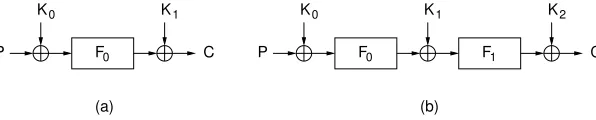
LED[14] is a conservative lightweight block cipher whose design can be seen as a special case of the generalized Even and Mansour construction [11] depicted in Figure1.
0
F
K K
P
0 1
C
(a)
K K
P
0 1
C K2
0
F F1
(b)
Fig. 1.Even-Mansour Construction with (a) t= 1 and (b)t= 2
LEDaccepts a 64-bit plaintext P, represented by a 4×4 array, and a 64-bit (or 128-bit) user key as inputs, and is composed of 8 (or 12)STEP functions preceded by a key addition. TheSTEP function is an AES-like design composed of four rounds. Each round is combination of Constant addition, S-boxes, ShiftRows, and (a variant of) MixColumns. LED uses the present S-box. In MixColumnsSerial, each column vector is multiplied by a matrix and replaced with the resulting vector. Note that the round constants for the second column are obtained from a linear shift register while the round constants for the remaining three columns do not change.
Key Schedule: LEDhas a simple key schedule where the 64-bit user keyK is used as it is in each round whereas the 128-bit key is divided into two parts,K=K0||K1, and used alternately. For the remainder of this paper, we refer to these two versions asLED-64 andLED-128. For more detail, please check the specification of LED[14].
One observation is that the S-boxes and linear transformations in the round function of the cipher can be described by structure of asuper box:
Definition 1 (Super box [9]).Asuper boxmaps an arrayaofmelementsai to an arrayeofmelements
ei. Each of the elements has size n. A super box takes a key k of size m×n = nb where nb is the block size. It consists of the sequence of four transformations (layers): Substitution, Mixing, Round Key Addition, Substitution.
classical 4-bit S-boxes, one can consider 16-bit super boxes each composed of two S-box layers surrounding oneMixColumnsSerial(MC) and oneAddConstants (AC) function.
Four rounds of LEDcan be described as a mega-box, where the elements are 16-bit words and theLED super boxes defined above are seen as S-boxes. The linear transformation in the middle is a combination of ShiftRows, MixColumnsSerialand ShiftRowsrespectively. We will refer to this linear transformation as SMS.
3
Attacks on the Even-Mansour Construction and Application to
LED
The Even-Mansour construction is a simple and yet provably secure block cipher construction. The designers have shown that the number of queries needed to break the scheme is bounded by 2n/2, where n is the blocklength (n= 64 for LED). A generic key recovery attack with chosen plaintexts showing that this bound is tight was introduced by Daemen [5]. Twenty years later, the construction was revisited. It was shown that the same bound applies to the known plaintext setting by using the slidex attack, an extended version of the slide attack [10].
Simultaneously, Bogdanov et al. generalized the construction in [4] to more steps and discussed its security. They even provided a security proof for the construction in the single-key setting. However, as pointed out by the authors, the scheme is insecure in the related-key setting. In this section, we focus on the attack of Daemen on the Even-Mansour construction, since it is the basis for all our attacks on LED. First we show how it can be extended to a related key attack on the generalized Even-Mansour construction. Then, we will use it to attack reduced versions of theLEDblock cipher.
3.1 Daemen’s Attack
At Asiacrypt 1991 Daemen presented a generic key-recovery attack with complexity of 2n/2 [5]. It can be summarized as follows.
1. Choose a difference ∆.
2. For`values ofacompute∆F0=F0(a)⊕F0(a⊕∆) and save the pair (∆F0, a) in a listL. 3. Choose an arbitrary plaintextP withP0 =P⊕∆ and ask for the ciphertextsCandC0 4. Compute∆C =C⊕C0 and check if∆C is in the list Lto geta.
– If∆Cis in the listLthen a candidate for the key is found. ComputeK0=a⊕P andK1=F0(a)⊕C.
– Else go back to Step 3.
After repeating steps 3−4 about 2n/`times one expects to find the correct key with complexity of about 2n/`+`. Obviously the attack has the best complexity by choosing ` = 2n/2 resulting in a final attack complexity of about 2n/2and similar memory requirements.
Note that, the attack can be applied in an iterative way to attack the Even-Mansour construction with t > 1 with complexity of 2t·n/2 and similar memory requirements. For instance, if t = 2 then we get a complexity of 2n.
3.2 Using Daemen’s Attack in a Related-Key Setting
In certain scenarios one considers also related-key attacks where the adversary is allowed to get encryptions under several related keys. In this setting Daemen’s attack can be adapted to attack t steps of the Even-Mansour construction with complexity oft·2n/2and similar memory requirements. For the sake of simplicity we first describe the attack fort= 2.
1. For`values ofacompute∆F1=F1(a)⊕F1(a⊕∆1) and save the pair (∆F1, a) in a listL. 2. Choose an arbitrary P andP0=P⊕∆0and ask for the ciphertextsC andC0
3. Compute∆C =C⊕(C0⊕∆2) and check if∆C is in the list Lto geta.
– If∆C is in the listLthen a candidate for K2 is found,K2=F1(a)⊕C.
– Else go back to Step 2.
After repeating steps 2−3 about 2n/`times, the expected number of matches in the listL(i.e., candidates for K2) is at least one. Note that, if we have more than one candidate for K2 then we have to repeat the attack to get new candidates for K2. The intersection of both sets of candidates gives us the correct key. Note that it is very unlikely that this intersection will have more than one solution.
OnceK2 is known one can apply the attack of Daemen to findK0 andK1. This results in a final attack complexity of about 2·2n/`+ 2`and memory requirements of`. Again, the attack has the best complexity by choosing ` ≈2n/2 resulting in a final attack complexity of about 2·2n/2 and memory requirements of 2n/2.
Related Key Attack witht >2. The related key attack can be extended to more steps by applying the attack fort= 2 iteratively using more related keys with certain properties. Assumet= 3 and there are two related keys K =K0kK1kK2kK3 and K0 =K0⊕∆0kK1kK2⊕∆2kK3⊕∆3, with arbitrary (but known) ∆0, ∆2, ∆3 and ∆2 6= 0. Then one can find K3 similar as in the attack on the Even-Mansour construction with t = 2 with a complexity of roughly 2n/2. Once K3 is found one can apply the attack for t = 2 with another pair of related keys to recover K0, K1 and K2. In general, one can find the key for t = i using i related keys with certain properties.
3.3 Attacks on Reduced LED
In this section, we will discuss the application of the attacks described in the previous section to theLED block cipher. Due to the fact that in LEDthe same key is used more than once the number of steps that can be attacked is significantly reduced. However, the attack can still be used in a straightforward way to break one and two steps of LED-64 in a single-key and related-key setting, respectively. Both attacks have a complexity of about 2n/2and similar memory requirements. Note that a similar related-attack was described recently in [4].
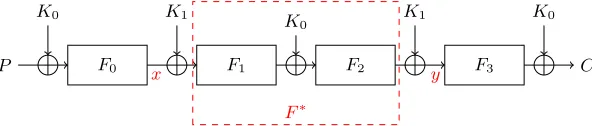
However, both attacks can be extended to more steps in the case of LED-128. In more detail, we can attack four and six steps ofLED-128 in the single-key and related-key setting, respectively. First, we describe an attack on four steps ofLED-128 based on Daemen’s attack. It is based on the following simple observation (cf. Figure2).
P F0 x
K0 K1
F1 K0
y F2
K1
F∗
C F3
K0
Fig. 2.Structure of LED-128 witht= 4.
AssumeK0is known, then one can peel off the first and last key addition. Thus, the attacker can remove one iteration at each side of the cipher with a complexity of about 264tries onK0. Moreover, assuming that K0 is known two steps of LED-128 can be viewed as one big iteration using only K1. In other words, we get a ‘new’ Even-Mansour construction witht= 1 and one keyK1where we can apply Daemen’s attack to recover the key. Using this, one can find K0 andK1 for four steps of LED-128 with a complexity of about 23n/2. It can be summarized as follows.
2. For 2n/2 valuesaand a fixed∆compute∆F∗=F∗(a)⊕F∗(a⊕∆) withF∗(a) =F2(F1(a)⊕K0) and save the pair (∆F∗, a) in a listL.
3. Choose an arbitrary P and computeP0=F0−1(x⊕∆)⊕K0withx=F0(P⊕K0). Ask for the ciphertexts C andC0.
4. Compute∆y=y⊕y0 withy=F−1
3 (C⊕K0) andy0=F3−1(C0⊕K0). Check if∆yis in the listLto get a.
– If∆yis in the listLthen a candidate for the key is found. ComputeK1=a⊕x.
– Else go back to Step 3.
5. Once K1 is found check if the keyK=K0kK1 is correct.
Since the expected number of K0 guesses that we need to make to find the correct key is 2n, we need to repeat the attack 2n times. Since for each guess of K0 we need about 2n/2 computations to find K1, the complexity of the attack is roughly 23n/2. Note that the above attack needs the whole codebook. However, at the cost of a higher attack complexity, the data complexity of the attack can be reduced. To be more precise, in step 3 of the attack we can always chooseP from a predefined subset and when computingP0 we
check if it is also in this subset, if not then we repeat this step. Thus, the data complexity of the attack can be reduced by simultaneously increasing the time complexity.
The attack can be extended to six steps of LED-128 using related keys as in the attack on the Even-Mansour construction witht= 2. The attack is very similar as the attack on four steps. Basically only steps 2−4 (Daemen’s attack) are replaced by the related key attack described in the previous section. The result is a key-recovery attack on six steps (24 rounds) of LED-128 with complexity of about 23n/2.Again, as in the attack on 4 steps the data complexity of the attack can be reduced on the cost of a higher attack complexity.
3.4 Extending the Attack to more Steps
In this section, we discuss how the attacks can be extended to more steps of LED. First, we show that by exploiting differential properties of theSTEP-functionF, it might be possible to extend the attacks onLED-64 by one or two steps. Moreover, the attack on 4 steps can also be used in related-cipher attack [24] with related key setting on fullLED-128. We call this a related-key-cipher attack. It is described in Appendix B.
∆⊕∆∗ F0
∆∗→∆
∆ ∆
F1 ∆
∆C F2
∆→?
∆
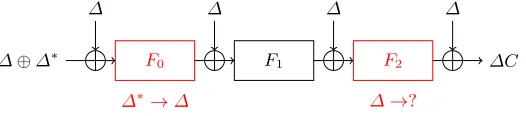
Fig. 3. Attack onLED-64 witht= 3.
In the following, we show how the attack can be extended to t steps of LED-64. The attack is based on the assumption that one can find a good related-key differential for the first t−2 steps such that one gets a zero difference after the key addition of stept−2. Then one can use Daemen’s attack on the last 2 steps to recover the key. For In the attack on 3 steps we a differential with good probability in F0 is used, see Figure3. The attack can be summarized as follows.
1. Assume we have given two related keysK0andK00 =K0⊕∆ and furthermore the differential∆∗→∆ forF0 holds with probabilityp2−64.
2. For 2n/2·(1/p)1/2 valuesacompute∆F2=F2(a)⊕F2(a⊕∆) and save the pair (∆F2, a) in a listL. 3. Choose an arbitrary P andP0=P⊕∆∗⊕∆and ask for the ciphertextsC andC0
4. Compute∆C =C⊕(C0⊕∆) and check if∆C is in the listLto geta.
– If∆C is in the listLthen a candidate for K0 is found,K0=F2(a)⊕C.
Table 1. Summary of the attacks onLED
algorithm #step time memory attack type reference functions complexity complexity
LED-64 3 2n/2·(1/p)1/2 2n/2·(1/p)1/2 related-key Section3.4
4 2n/2·(1/p)1/2 2n/2·(1/p)1/2 related-key Section3.4
LED-128 4 23n/2 2n/2 single-key Section3.3
6 23n/2 2n/2 related-key Section3.3 12 2n/2·(1/p)1/2 2n/2·(1/p)1/2 related-key-cipher AppendixB
After repeating steps 3−4 about 2n/2·(1/p)1/2 times, the expected number of matches in the list L (and hence candidates for the key K0) is 1/p. Since the differential in F0 will hold with probability p, for one of these matches we will have ∆F1 = 0. Hence, one will find the right key after testing all candidates forK0 resulting from the 1/pmatches in the listL. The complexity and memory requirements of the attack depends onp, i.e. 2n/2·(1/p)1/2.
The attack on three steps can be extended to four steps of LED-64. Assume we can find a good iterative differential forF1that holds with probabilityp. Then this differential can be easily extended to a differential for the first 2 steps with the same probability (see Figure4), resulting in an attack on 4 steps of LED-64 with complexity of 2n/2·(1/p)1/2and similar memory requirements.
∆ F0
∆ ∆
F1
∆→∆ ∆
F2 ∆
∆C F3
∆→?
∆
Fig. 4. Attack onLED-64 witht= 4.
In the Table 1, we summarize the attacks on LEDthat are given in Section3 and AppendixB. We will discuss in the following sections how to find good (iterative) differential characteristics for one step of LED that can be used in the attacks on three and four steps.
4
Differential Analysis and Plateau Characteristics
In this section, we start with some definitions that will be helpful to understand the rest of the paper. We then give an introduction of the previous work on AES [9] and describe how we can use this method to find two/four round characteristics efficiently (and the corresponding right pairs).
4.1 Characteristics and Differentials
Differential cryptanalysis [2] is one of the most powerful techniques used in analysis of block ciphers, hash functions, stream ciphers, etc. It investigates how an input difference (generally XOR) propagates through the target function. The concept of differential cryptanalysis starts with analyzing the components of the function, mostly focusing on S-boxes since they are the smallest nonlinear building block. In the analysis, we call an S-boxactive if it has a non-zero input difference, otherwise we call itpassive.
A differential characteristicQ= (∆0, ∆1,· · · , ∆m) is a sequence of differences through various stages of the encryption. The sequence consists of an input difference∆0, followed by the output differences of all the steps (∆1, ∆2,· · ·, ∆m).
For a keyed map, we can define differential probabilities DP[k](∆0, ∆m) and DP[k](Q) for each valuekof the key. Then, theexpected differential probability (EDP) is the average of the differential probability over all keys. Theweight of a differential or a characteristic is minus the binary logarithm of their EDP. Moreover, we define theheight of a possible differential or a characteristic as the binary logarithm of the number of their right pairs satisfying (∆0, ∆m) for a fixed key.
A differential characteristic through the AES-like (includingLED) super boxes consist of a sequence of four differences: the input differencea, the difference after the first substitutionb, the difference after the mixing step which is equal to the difference after the round (key) constant addition d, and the output difference after the second substitutione. These characteristics are denoted by Q= (a, b, d, e).
It can be shown thatSMSis a map whose branch number is 5. Therefore, a characteristic over a mega-box consists of 5 to 8 sub-characteristics, each over anLEDsuper box. We denote the characteristics over the first and the second layer of super boxes by (a, b, d, e) and (f, g, i, j), respectively.
4.2 The Maximum Expected Differential Probability of LED
Differential cryptanalysis plays a crucial role in the analysis of symmetric key components since most of the cryptanalysis techniques are based on it. Therefore, giving bounds for resistance against differential cryptanalysis is one of the first steps in the evaluation of a design. InLED, the AES-like structure in theSTEP function makes it possible to apply the previous work of [19] to bound the MEDP. By a straightforward computation of the formula stated in [19, Theorem 4], the designers compute the bound for the MEDP as 2−32. This bound can be improved by considering the
STEP function as a mega-box and then using [19, Theorem 1] to bound the MEDP of LEDas
max
max
1≤i≤8
1≤x≤216−1 216−1
X
y=1 n
DPsbi(x, y)o5, max
1≤i≤8
1≤x≤216−1 216−1
X
y=1 n
DPsbi(y, x)o5
= 2−41.75.
Here DPsbi(x, y) is the probability of the characteristic (x, y) for the i-th super box obtained from the Difference Distribution Table (DDT). This result improves the approximations used in [14, Table 1]. We provided the bound for the firstSTEPfunction; the results for the other super boxes are similar.
4.3 Planar differentials
Letγbe a map and letF(a,b),G(a,b)be the sets that contain the input values, respectively the output values, for the right pairs of the differential (a, b). i.e., F(a,b) ={x|γ(x) +γ(x+a) =b} and G(a,b) =γ(F(a,b)). A differential (a, b) is called aplanar differential, ifF(a,b)andG(a,b)form affine subspaces [9]. In that case, we can write:
F(a,b)=p+U(a,b)
G(a,b)=q+V(a,b),
whereU(a,b)andV(a,b)are uniquely defined vector spaces,pany element inF(a,b)andqany element inG(a,b). Note that, if a differential (a, b) has exactly two or four right pairs, then it is always planar [9].
Plateau characteristics [9] are a special type of characteristics whose probability for each valuek of the key,DP[k](Q), depends on the key and can have only two values. For a fraction 2nb−(weight(Q)+height(Q)) of
the keysDP[k](Q) = 2height(Q)−nb and for all other keys the it is zero. Note that the height is independent
of the key.
4.4 Algorithm for number of right pairs in a plateau characteristic
Here, we describe the algorithm to find the number of right pairs of a given characteristic Q= (a, b, d, e) through a super box. If the sub-characteristics (a, d) and (d, e) are planar then we can use the Two-Round Plateau Characteristic Theorem to compute the right pairs. Our aim in the algorithm is to build the matrix B containing the basis vectors of (M(V(a,b))) and U(d,e) where M is the mixing operation and M(V) = {M(v)|v∈V}. We denote vectors byrows ofnb bits.
The first step of our algorithm is to determineV(a,b)andU(d,e). Since, the super box is a set ofmparallel maps,V(a,b)andU(d,e)can be written as:
V(a,b)=V(a1,b1)×V(a2,b2)× · · · ×V(am,bm)
U(d,e)=U(d1,e1)×U(d2,e2)× · · · ×U(dm,em)
by using the Lemma 4 in [9]. Now, if|G(ai,bi)|>0, we are interested in the output values of the right pairs.
– If|G(ai,bi)|= 2, then the right pairs have input values in the set{q+{0, bi}}for someqinG(ai,bi), the
basis vector for V(ai,bi)being bi. – If |G(ai,bi)| = 2
k where 2 ≤ k < n, then V
(ai,bi) =< bi, β
1
i, . . . , βik > and hence V(ai,bi) is said to be
spanned bybi andβij’s.
– If (ai, bi) = (0,0) thenG(ai,bi)covers the whole space andV(ai,bi)=< w0, w1,· · ·, wn−1>wherewj is a
coordinate vector (i.e. a vector with 1 at positionj and zero at all other positions) andV is the standard basis.
Similarly, if|F(di,ei)|>0, we are interested in the input values of the right pairs. When we find the right
pairs for each parallel map we can compute the height by using Algorithm1. The number of dependent rows inB givesdim(M(V(a,b))∩U(d,e)) which is equal to the height.
Algorithm 1 calls the following subroutines. Add(v) adds the vector v as a new row to the matrix B. RowReduceis the Gaussian Elimination andRowCountgives the number of nonzero rows of a matrix.
The algorithm also gives us an insight on how to find the right pairs which can be determined by intersecting the affine spacesF(a,b)∩(G(b,c)⊕k). This can be efficiently done by preparing the set of linear equations to solve. We would like to emphasize that, for a fraction of the keys the right pairs exists and their values differ depending on the key. On the other hand, if the constant operation is used instead of the key addition operation in the cipher, then it is not guaranteed always to have a solution.
5
Non-plateau Characteristics:
LED
Mega-box
As we mentioned in Section2, two rounds ofLEDcan be considered as a super box and four rounds is defined as a mega-box. Let (a, b, d, e) and (f, g, i, j) denote the characteristic through the super boxes at the input and the output of SMSrespectively. Since the super boxes are key independent, we consider them as 16-bit S-boxes. This allows us to omit the middle values (b, d) and (g, i) and use the differentials (a, e) and (f, j) in our analysis.
In order to use the two-round plateau characteristic theorem, it is required that the set of output values G(a,e)and the set of input valuesF(f,j)for the right pairs must be affine spaces/planar. However, this is not always guaranteed when the number of right pairs is greater than 4. Although the difference between the values of each pair is known and constant, some extra conditions between the pairs are also required for a set to become affine/planar. Therefore, we have to work with a union of affine spaces in order to compute the number of right pairs of a given characteristic. In the following, we will denote by height∗ the binary logarithm of the maximum number of right pairs of a given characteristic, over all values of the key. For a plateau characteristic, height∗ equals the height.
Algorithm 1Algorithm to compute the height of a given plateau characteristic Input:CharacteristicQ= (a, b, d, e) withEDP(Q)>0
Output:height(Q)
1: procedureprecompute 2: fori= 1→mdo
3: ComputeV(ai,bi)=< bi, β
1 i, . . . , β
kv i
i >andU(di,ei)=< di, δ
1 i, . . . , δ
ku i
i > 4: end for
5: end procedure
6: procedureheight 7: //at the input of Mixing 8: fori= 0→mdo 9: if bi= 0then 10: forj= 0→ndo 11: Add(M(w4i+j)) 12: end for
13: else if bi>0then 14: Add(M(bi))
15: if |V(ai,bi)|>2then
16: forj= 1→kv i do 17: Add(M(βij)) 18: end for 19: end if 20: end if 21: end for
22: //at the output of Mixing 23: fori= 0→mdo 24: if di= 0 then 25: forj= 0→ndo 26: Add(w4i+j) 27: end for
28: else if di>0then 29: Add(di)
30: if |U(di,ei)|>2then
31: forj= 1→ku i do 32: Add(δij) 33: end for 34: end if 35: end if 36: end for
37: B’ = RowReduce (B).
38: return height(Q) = RowCount(B) - RowCount(B’) 39: end procedure
Precomputation: The first step of our algorithm is finding G(a,e) and F(f,j) for the given path, and the next step is obtaining the subspace decompositions of V(a,e) andU(f,j). IfV(ai,ei) is affine thenV(ai,ei) =<
e, ε1, . . . , εn >, otherwise it is a union of smaller vector spaces, i.e.V(ai,ei) =V
1
(ai,ei)∪V
2
(ai,ei)∪. . . V
m (ai,ei)
wherem≥2. Therefore, we have to find the corresponding basis vectors (εi’s) for each subspace. The results are then stored in a list,Li, for each active super box.
Analysis: We then use the Two-Round Plateau Characteristic Theorem to compute the height using the basis vectors obtained in the precomputation phase. Since the solution exist only for a fraction of the constant values, we check whether the given round constant is in the solution set or not. This step can also be done by solving a system of linear equations as in two-rounds, but this time the equations are obtained from the SMSlayer and the basis vectors of the super boxes.
Here, we would like to emphasize that the solution does not always exist for the round constant of LED. Denote byKq, the set of values,k, such that DP[k](q)>0. Since constants are used in the round function of LED, it is not guaranteed that the round constant,cr∈Kq for allq. Therefore, the algorithm gives an upper bound for height∗(Q). If the key addition was used in the round function rather than constant addition, it could be possible to find a key valuek∈Kq for allqsatisfying the upper bound.
On the other hand, if the key addition was used, the Algorithm2could not be applied immediately, since the listsLi would depend on the key values and would not be unique. This would require recomputation of the lists for each key value increasing the complexity of the algorithm.
Algorithm 2Algorithm to compute the height∗ of a four-round characteristic Input:CharacteristicQ= (a, e, f, j)
Output:Upper bound for height∗(Q)
1: procedureprecompute 2: L0=L1=. . .=L7= Ø 3: fori= 0→3do
4: ComputeG(ai,ei)andF(fi,ji)
[
m
V(ami,ei)= Decompose(V(ai,ei)) and< ε
m 1, ε
m 2 , . . . ε
m dm >=V
m
(ai,ei), dm=|V
m (ai,ei)|
[
n
U(fni,ji)= Decompose(U(fi,ji)) and< ε
n 1, ε
n 2, . . . ε
n dn>=V
n
(fi,ji), dn=|V
n (fi,ji)|
5: Store(Li,{(ai, ei), εm1 , ε m 2 , . . . ε
m
dm}) and Store(L4+i,{(fi, ji), ε
n 1, ε
n 2, . . . ε
n dn})
6: end for 7: end procedure
8: procedureanalyze 9: count = 0
10: for allq∈L0×L1×. . .×L7 do 11: h=height(q);
12: count = count + 2h 13: end for
14: return log2(count) 15: end procedure
In Algorithm 2, Store adds input/output differences and the basis vectors {ε1, ε2, . . .} to the list L. heightis given in Algorithm1used with parametersm= 4 andn= 16.
6
Application of the Algorithms
1
and
2
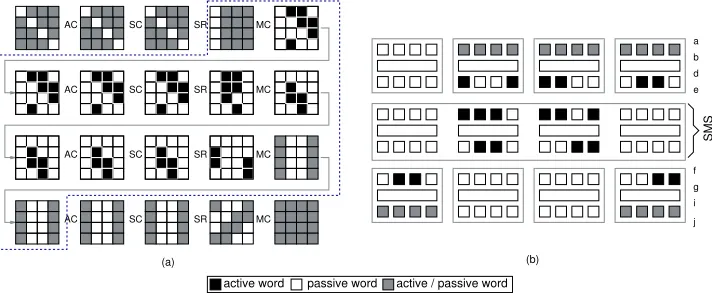
In this section, we give two examples to demonstrate how Algorithm 1 and Algorithm 2 work. These ex-amples can directly be used with attacks described in Section3.4. We do not claim that these are the best characteristics in terms of probability for theSTEPfunction of LEDthat one can find. For both examples, we fix the number of active S-boxes to 25 for four rounds of LED. Since, we know from previous work [9] that all the characteristics with high probability are expected to have a low weight and a low number of active S-boxes. This also allows us to reduce the time and memory complexities of our algorithm and make the computation feasible. (a) (b) SMS SC SC SC SC AC AC AC AC MC MC MC MC SR SR SR SR j i g f e d b a
Algorithm 3Compute iterative characteristics Input:Precomputed tablesLiwherei∈ {1,· · ·,5} Output:All the iterative characteristics with their height∗
1: for all(e, f)∈Sdo 2: if (f0, j0)∈L4 then 3: ∆=M C◦SR◦AC(j) 4: a=SR◦AC(∆)
5: if (ai, ei)∈Li for 1≤i≤4then 6: h=height∗(Q)
7: OutputQ= (a, e, f, j) andh 8: end if
9: end if 10: end for
6.1 Iterative Characteristics
Our aim is to find iterative characteristics (i.e., characteristics that have the same input and output difference) for the STEP function of the LED block cipher. We show that it is possible to obtain multiple iterative characteristics by using the 16-bit boxes and the two round plateau characteristic theorem in 216 time and around 5×217memory. In terms of efficiency, this computation can be compared with the inbound technique of the rebound attack [18]. The main advantage of our computation is that many characteristics can be found whereas with the rebound attack, the expected number of characteristics that we find, equals one, using the same time complexity and slightly less data complexity.
In our analysis we used the differential path given in Figure 5. It is possible to adopt the algorithm for the other possible differential paths. The algorithm is summarized as follows:
Precomputation: For each of the active super boxes, obtain the differentials (ai, ei) (or (fi, ji)) for the given path and find the corresponding right pairsG(ai,ei) (orF(fi,ji)). Then compute their affine subspace
decomposition and the corresponding basis vectors. Store the input/output differences together with the basis vectors in a list. We denote these lists as L0,L1, L2,L3 for the super boxes at the input andL4 for the super box at the output of theSMSlayer. Note that this calculation is done for all possible differentials. Each list has around 217 elements, therefore the total memory requirement of this step is 5×217.
Analysis: We start from the fourMixColumnsSerialoperations in theSMSlayer. Each of them has only one 4-bit word active at the output, hence we have 154≈216 possibilities for the differences atf (call the set of possibilitiesS). For each of these differences, we obtain the possible differences atjby using the precomputed listL4. Then, we compute (M C◦SR◦AC)(j) =∆which is the output difference after four rounds of the STEPfunction and is also equal to the input difference of theSTEPfunction since we are interested in iterative characteristics. We make one more computation (SR◦AC)(∆) to obtain the difference ata. Note that by choosing a difference forf, we have already fixed the difference ate. We then check whether (ai, ei) is in the listLi for 0≤i≤3. If it does for alli, we use the Algorithm2 to compute the height∗ and find the right pairs.
Results: In our analysis we found 240 iterative characteristics for the pattern given in Figure5 but not all of them have a solution for the round constants of theLEDblock cipher. One of these characteristics is given below. It has 6 right pairs and the corresponding right pairs are given in AppendixA.
a 0x6000 0x0003 0x0070 0x0C00 e 0x6962 0x5848 0x46A3 0x5CBF
AC SC
SC
SC AC
SC AC
MC
MC MC MC SR
SR SR
SR AC
SMS
(a) (b)
passive word
active word active / passive word
a b d e
f g i j
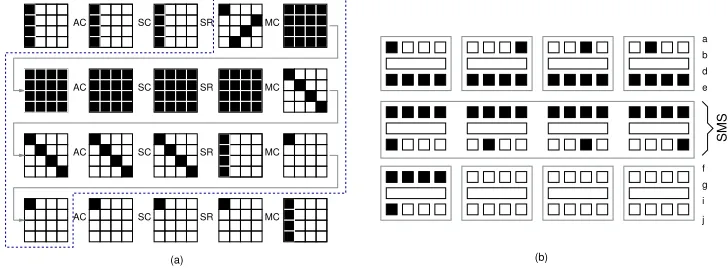
Fig. 6.(a)Characteristics of theLEDcipher with high height∗(b)Mega-box representation of the same char-acteristics
6.2 Characteristics with high height∗
In this section, our aim is to find characteristics with high height∗ for the STEP function of theLED block cipher. We show that it is possible to obtain such characteristics by using a similar algorithm to Algorithm3 with 216time complexity and 5×217memory complexity. In our analysis we focused on the differential path given in Figure6and searched for characteristics whose height∗ is greater than 5.
Precomputation: All possible differentials together with the basis vectors of their affine space decomposi-tion are stored in the listsL1,L2,L3for each of the the super boxes at the input and in the listsL4, L7for the super boxes at the output of theSMSlayer. Again, each list has around 217 elements, and the total the memory requirement of this step is 5×217.
Analysis: We start from the two activeMixColumnsSerialoperations in theSMSlayer. Each of them has two 4-bit words active at the output, hence we have (152)2 ≈216 possibilities for the differences at f. For each of these possibilities, we obtain the possible differences ataby using the precomputed listsL1, L2 and L3. Similarly, the possible differences atjare obtained by using the listsL4andL7. We then use Algorithm2 to compute the height and find the right pairs.
Results: Assume that dim(V(a,e)) > 0 and dim(U(f,j)) > 0, then we can write V(a,e) = S
mV m (a,e) and U(f,j) =S
nU n
(f,j). We define a partition byQmn whereQmn =SM S(V m (a,e))∩U
n
(f,j). Then we know that height∗(Q)≤log2(
X
m,n
2dim(Qmn)) (see Algorithm2). In our analysis we observed that it is not easy to find a
partition whose height is greater than six, but by combining all partitions, we were able to find characteristics which have height∗ greater than eleven or twelve. One example of such characteristics is provided below.
a 0x0000 0x0F91 0x2F0B 0x2803 e 0x0000 0xC00D 0x8F00 0x0F50
f 0x0CD0 0x0000 0x0000 0x00C8 j 0x8C07 0x0000 0x0000 0x50BF
The upper bound for height∗is computed as 12.16 by using the formula. However, not all partitions have a solution for the given round constant, and we obtain only 1026 right pairs for the round constants used in LED. We also computed the number of right pairs by changing the round constant used in round three of the STEPfunction. The number of right pairs is computed as 1024±where ≤116 for all constants.
7
Future Work and Open Problems
The analysis of super boxes and mega-boxes play an important role in the cryptanalysis of AES-like ciphers. In this paper, we focused on characteristics for the block cipherLEDwith 25 active S-boxes. Since it is not feasible to compute the whole distribution of the characteristics for four rounds of LED, we focus only on characteristics that may have many right pairs. Therefore, our results cover characteristics with high height∗ and iterative characteristics with a fixed pattern. The examples given in this paper are the best ones that we computed. But still, it is possible to cover other patterns with 25 active S-boxes and they might give better results and at the same time result in improvements of our attacks.
We want to note that the algorithms given in this paper can also be used to compute the differentials for constructions using four rounds of AES as internal building block such as Pelican [8] giving new insights on these designs. Moreover, these algorithms might also be used in the computation of the inbound phase of the rebound attack.
References
1. Aumasson, J.P., Henzen, L., Meier, W., Naya-Plasencia, M.: Quark: A Lightweight Hash. In: Mangard, S., Standaert, F.X. (eds.) CHES. Lecture Notes in Computer Science, vol. 6225, pp. 1–15. Springer (2010)
2. Biham, E., Shamir, A.: Differential cryptanalysis of des-like cryptosystems. In: Menezes, A., Vanstone, S.A. (eds.) CRYPTO. Lecture Notes in Computer Science, vol. 537, pp. 2–21. Springer (1990)
3. Bogdanov, A., Knezevic, M., Leander, G., Toz, D., Varıcı, K., Verbauwhede, I.: SPONGENT: A Lightweight Hash Function. In: Preneel and Takagi [21], pp. 312–325
4. Bogdanov, A., Knudsen, L.R., Leander, G., Standaert, F.X., Steinberger, J.P., Tischhauser, E.: Key-Alternating Ciphers in a Provable Setting: Encryption Using a Small Number of Public Permutations - (Extended Abstract). In: Pointcheval and Johansson [20], pp. 45–62
5. Daemen, J.: Limitations of the Even-Mansour Construction. In: Imai et al. [15], pp. 495–498
6. Daemen, J., Lamberger, M., Pramstaller, N., Rijmen, V., Vercauteren, F.: Computational aspects of the expected differential probability of 4-round AES and AES-like ciphers. Computing 85(1-2), 85–104 (2009)
7. Daemen, J., Rijmen, V.: The Design of Rijndael: AES - The Advanced Encryption Standard. Springer (2002) 8. Daemen, J., Rijmen, V.: The Pelican MAC Function. IACR Cryptology ePrint Archive 2005, 88 (2005) 9. Daemen, J., Rijmen, V.: Plateau characteristics. Information Security, IET 1(1), 11 –17 (March 2007)
10. Dunkelman, O., Keller, N., Shamir, A.: Minimalism in Cryptography: The Even-Mansour Scheme Revisited. In: Pointcheval and Johansson [20], pp. 336–354
11. Even, S., Mansour, Y.: A Construction of a Cipher From a Single Pseudorandom Permutation. In: Imai et al. [15], pp. 210–224
12. Gong, Z., Nikova, S., Law, Y.W.: KLEIN: A New Family of Lightweight Block Ciphers. In: Juels, A., Paar, C. (eds.) RFIDSec. Lecture Notes in Computer Science, vol. 7055, pp. 1–18. Springer (2011)
13. Guo, J., Peyrin, T., Poschmann, A.: The PHOTON Family of Lightweight Hash Functions. In: Rogaway, P. (ed.) CRYPTO. Lecture Notes in Computer Science, vol. 6841, pp. 222–239. Springer (2011)
14. Guo, J., Peyrin, T., Poschmann, A., Robshaw, M.J.B.: The LED Block Cipher. In: Preneel and Takagi [21], pp. 326–341
15. Imai, H., Rivest, R.L., Matsumoto, T. (eds.): Advances in Cryptology - ASIACRYPT ’91, International Con-ference on the Theory and Applications of Cryptology, Fujiyoshida, Japan, November 11-14, 1991, Proceedings, Lecture Notes in Computer Science, vol. 739. Springer (1993)
16. Isobe, T., Shibutani, K.: Security Analysis of the Lightweight Block Ciphers XTEA, LED and Piccolo. to appear in ACISP (2012)
17. Lai, X., Massey, J.L., Murphy, S.: Markov ciphers and differentail cryptanalysis. In: Davies, D.W. (ed.) EURO-CRYPT. Lecture Notes in Computer Science, vol. 547, pp. 17–38. Springer (1991)
18. Mendel, F., Rechberger, C., Schl¨affer, M., Thomsen, S.S.: The Rebound Attack: Cryptanalysis of Reduced Whirlpool and Grøstl. In: Dunkelman, O. (ed.) FSE. Lecture Notes in Computer Science, vol. 5665, pp. 260–276. Springer (2009)
20. Pointcheval, D., Johansson, T. (eds.): Advances in Cryptology - EUROCRYPT 2012 - 31st Annual International Conference on the Theory and Applications of Cryptographic Techniques, Cambridge, UK, April 15-19, 2012. Proceedings, Lecture Notes in Computer Science, vol. 7237. Springer (2012)
21. Preneel, B., Takagi, T. (eds.): Cryptographic Hardware and Embedded Systems - CHES 2011 - 13th International Workshop, Nara, Japan, September 28 - October 1, 2011. Proceedings, Lecture Notes in Computer Science, vol. 6917. Springer (2011)
22. Shibutani, K., Isobe, T., Hiwatari, H., Mitsuda, A., Akishita, T., Shirai, T.: Piccolo: An Ultra-Lightweight Blockcipher. In: Preneel and Takagi [21], pp. 342–357
23. Suzaki, T., Minematsu, K., Morioka, S., Kobayashi, E.: Twine: A Lightweight, Versatile Blockcipher. ECRYPT Workshop on Lightweight Cryptography (2011),http://www.uclouvain.be/crypto/ecrypt_lc11/static/post_ proceedings.pdf
24. Wu, H.: Related-cipher attacks. In: Deng, R.H., Qing, S., Bao, F., Zhou, J. (eds.) ICICS. Lecture Notes in Computer Science, vol. 2513, pp. 447–455. Springer (2002)
A
Right pairs for iterative characteristic of the first
step
function
{0x2CD65C01406D989B, 0x4CD69C01306DA89B},{0x4CD69C01306DA89B, 0x2CD65C01406D989B} {0x2DD65F71428EA8EF, 0x4DD69F71328E98EF},{0x4DD69F71328E98EF, 0x2DD65F71428EA8EF} {0x2FDE5CF1406098FB, 0x4FDE9CF13060A8FB},{0x4FDE9CF13060A8FB, 0x2FDE5CF1406098FB}
B
An Observation on the
LED-128
In this section, we discuss the extension of attack on four steps for LED-64 to LED-128. We observe that if the key value forLED-128 is of the formK=k||k for somek, then the first 8STEPs of LED-128 is identical toLED-64 with the key valuekand two ciphers differ only in fourSTEPfunctions. Therefore, in addition to previous attack settings, we need two additional assumptions to perform an attack. First, we assume that we have access toLED-64 decryption oracle under a key valuek. Secondly, the key value forLED-128 must be set toK=k ||kas described above.
Attack on LED-128 in the related-cipher model. The attack can be summarized as follows:
1. Find an iterative differential inF9 with high probability.
2. Assume we have given two related keys k, k0 =k⊕∆ and furthermore the differential ∆ →∆ for F9 holds with probabilityp2−64.
3. For 2n/2·(1/p)1/2valuesacompute∆F11=F11(a)⊕F11(a⊕∆) and save the pair (∆F11, a) in a listL. 4. Choose an arbitraryC64, set C640 =C64 and ask for the plaintextsP andP0 by usingLED-64. Then, ask
for corresponding ciphertextsC128,C1280 by usingLED-128.
5. Compute∆C128=C128⊕(C1280 ⊕∆) and check if∆C128 is in the listLto geta.
– If∆C128is in the list Lthen a candidate fork is found,k=F11(a)⊕C128.
– Else go back to Step 3.
The expected number of matches in the list L is 1/p and hence candidates for the key K = k || k after repeating steps 3−4 about 2n/2·(1/p)1/2 times. The complexity and memory requirements of the attack only depend onpand equal to 2n/2·(1/p)1/2.
∆
F9
∆ ∆
∆
10
F F11
∆ ?
P
∆ LED−64 C ∆ 64
C ∆ 128 8
F
∆ ∆
=0