Cloud Computing Paradigm and Current Trends
N.Subha Malar1 , .K.Vasantha Kokilam2,MCA.,PGDBA.,MPhil.,
1
Student , 2Assistant Professor
1,2
Dept of BCA & MSc SS
1,2
Sri Krishna Arts & Science College,Coimbatore, India
Abstract: Cloud computing is a technology that provides on demand services to the users for deploying their computational needs in a virtualized environment without the knowledge of technical setup. Because of trustworthiness, scalability, high functioning and lesser band width most of the organizations are running their diligences in cloud. The cloud service donors grant the services to the registered cloud users on payment basic through the gage. The cloud facilities are basically classified as SaaS, PaaS, and IaaS. The facilities are accessible to the users depending on cloud deployment and the SLA (service level agreements) between the service providers and the users. Cloud technology gives secure nature to the customers. Providing security to the users and trust into cloud environment is the responsibility of the cloud service providers. The main idea of this paper is to provide a clear view about the cloud service models, outline the security issues in the service models and also its characteristics.
Keywords - Cloud computing; Cloud computing models; Cloud Security Issues; Cloud Security Threats; SAAS; PAAS; IAAS.
INTRODUCTION:
Delivering of computing resources over the Internet is termed to be the role of cloud computing service. Instead of keeping data on our own hard drive or updating applications as per requirements, we use a facility over the Net, at a further location, to save our statistics or use its purposes. Performing so possibly will offer to secrecy implications.
Now a days, cloud computing has become widely liked. Cloud services provided by many famous troupes like Microsoft, Google, IBM, Yahoo etc particularly for corporate clients. These services installed on cloud provider’s virtualized servers are approached over the Internet. There is not necessary to own and maintain server infrastructure by the companies. The major differences of cloud computing to the classic rented servers are the contracts and defrayment patterns. In cloud facilities, consumer defrayments depending upon used resources, i.e. CPU-hours, data storage. Purchasing resources is determined by current need.
Cloud computing makes virtual server infrastructures available for companies. The biggest benefit is that the business authorities need not buy their own hardware to make services available for their clients. Consequently, end handlers employ derivational facility instead of raw cloud service [1].
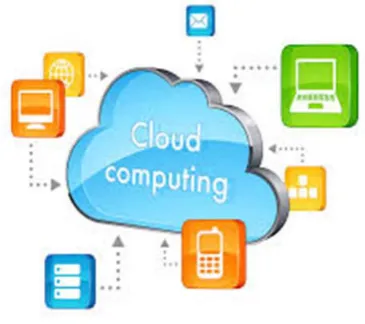
Fig 1:Cloud Computing
BASICS:
Cloud computing is a subscription-based service where we can obtain networked storage space and computer resources. Email is one good example considering cloud service nature . Our email client, if it is Gmail, Rediff, etc looks upon housing all of the hardware and software necessary to support our personal email account. When we want to access our email we open our web browser, go to the email user, and sign up. The very vital portion of the calculation is having internet access. Our email is not housed on our physical computer; we access it through an internet connection, and we can access it anywhere internet. Our email is different than software installed on computerized machine, much like the word administrating plan of action. While we create a document using word accessing computerized program, that manuscript leaves on the machine we utilize to make it unless we substantially transfer it. An email user is alike to as how cloud computing operates. Except instead of accessing just our email, we can choose what information we have access to within the cloud.
This is especially helpful for businesses that cannot afford the same amount of hardware and storage space as a larger organization. Small-scale business corporations can save their data in the cloud, getting rid the rate of buying and saving memory devices. Additionally, because we only need to buy the amount of storage space we will use, a business can purchase more space or reduce their subscription as their business grows or as they find they need less storage space.
One requirement is that we need to have an internet connection in order to access the cloud. This means that if we want to look at a specific document we have housed in the cloud, we must first establish an internet connection either through a wireless or wired internet or a mobile broadband linking. The advantage is that we can operate that same document from wherever we are with any device that can access the web. This device may be a Smartphone, laptop, tablet, i-phone. This may assist our business to function more smoothly because anyone who can connect to the eb and cloud can work on essential documents, gain access to software, and save information. Assume picking up our Smartphone and downloading a pdf document to review instead of having to stop by the office to print it or upload it to our laptop. This is the freedom nature that the cloud can provide for us [2].
CLOUD SERVICE MODELS:
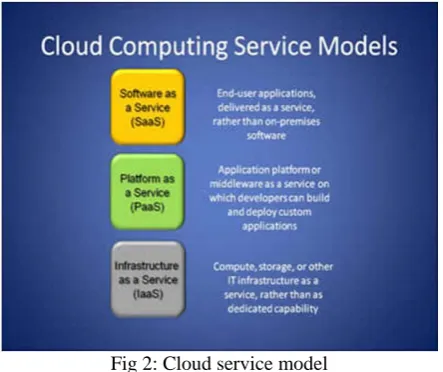
This section of the paper describes the various cloud delivery models. Cloud can be delivered in 3 patterns classified as SaaS, PaaS, and IaaS.
A. Software-as-a-Service (SaaS):
In a cloud-computing environment (SaaS) is a software distribution model in which applications are hosted by a vendor or service provider and made available to customers over a network, typically the web. SaaS in simple terms can be defined as Software deployed as a hosted service and accessed over the Internet. It offers scalability and shifts significant burdens from subscribers to sources, as a result in a various chances to greater efficiency and, in some cases, performance. The typical user of a SaaS offering usually has neither knowledge nor control about the underlying infrastructure [3].
B. Platform-as-a-Service(PaaS):
PaaS is a paradigm for delivering operating systems and associated services over the Internet without downloads or installation. Pass refers to providing platform panel stuffs, as well as operating system hold up and software modernize framework that can be used to build higher-level services[4].
C. Infrastructure-as-a-Service(IaaS): IaaS involves outsourcing the equipment used to hold on activities, as well as depository, hardware, porters and networking components. It is delivery of virtual CPUs, disk space. Other models of IaaS are: Database management system as a service (DBaaS), Data storage as a service (STaaS), and On-demand usage of computing capacity (CPUs) as a virtual service [5].
Fig 2: Cloud service model
CLOUD DEPLOYMENT MODELS:
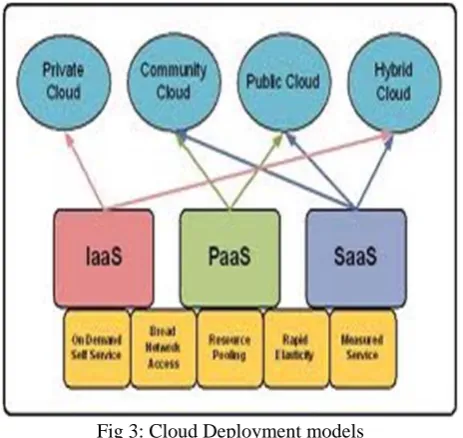
Clouds are implemented as Private, Public, Community or Hybrid.
Public Cloud:
The public cloud deployment model is what is most often thought similar as a cloud, in this it is multitenant efficient and which is shared by a number of customers/consumers who likely have not anything in well-known. Like Apple, Google, Amazon deals public cloud services. Public clouds are made available to the general public by a service provider who hosts the cloud infrastructure. These clouds are hosted and run fully on the premises of the provider. This is used widely by industries and businesses. Its advantages are cost-efficiency, flexibility, resilience and easy management but have deficiencies in security by way of malicious attacks and easy access.
Private Cloud:
Private cloud is cloud infrastructure dedicated to a particular organization. Private clouds are designed and managed within an organization usually by an internal IT unit or an external provider. It is not shared with other cooperatives, even if operated on the inside or by another unknown party, and it can be treated within or outside. Private clouds are devoid of network bandwidth constraints, security exposures and legal requirements and have high level of control over access with the ability to host and customize services to customer specifications.
Community Cloud:
Community cloud is shared among several or organizations and which is administered, handled and guarded generally via entirely the participating organizations or a third party managed service provider that come together around a common concern, such as security, policy or compliance. This model is predominant amongst governmental agencies, educational institutions and healthcare players operating under a common goal and also relies heavily on shared data.
Hybrid Cloud:
used in the combination. A common implementation of a hybrid cloud occurs in organizations where sensitive data are stored and managed on a private cloud whilst more general and non-critical processes are carried out in a public cloud[6].
Fig 3: Cloud Deployment models
CLOUD SERVICE PROVIDER:
Cloud computing is important to a range of existing service providers, including communications service provider (CSP), Internet service provider (ISP), and managed service provider (MSP) businesses. It is essential for service providers to understand how to effectively integrate cloud services to maintain and grow their business.
A CSP or ISP focused only on connectivity can include cloud computing as an additional set of services that operate over their network. Often, cloud services are general purpose and best effort services that use bandwidth from a fixed charge connection or consumption based allocation. Cloud services can also be more specialized services with discrete charges based on functions that are used or additional quality of service features.
Amazon was the first major cloud provider, with the 2006 offering of Amazon Simple Storage Service (Amazon S3). Other cloud providers include Apple, Cisco, Citrix, IBM, Joyent, Google, Microsoft, Rackspace, Salesforce.com and Verizon/Terremark.
Most CSP or ISP interests extend beyond just connectivity and include offering services. For these businesses and MSPs, cloud services are a new competitive category of services that use connectivity networks transparently. An example of this transparency is the delivery of the same cloud services that are operated by the CSP, ISP, or MSP to many different devices using the CSP or ISP only for transport to each device[7].
ADOPTION OF CLOUD COMPUTING: Amazon Elastic Compute Cloud (Amazon EC2):
Amazon Elastic Compute Cloud (Amazon EC2) is a web service that makes the availability of compute capacity to be resizable in the cloud. It is purpose to make web-scale
computing much easy for developers. Amazon EC2’s simple web service interface gives customers permissions to get and configure capacity with least conflict. It gives customers the ability of the complete control of their computing resources and allows them run on Amazon’s computing environment. Amazon EC2 minimize the time needed to get and boot new server instances to minutes, giving customers the ability to scale capacity without delay, both up and down, as their computing requirements change. Amazon EC2 alters the economics of computing by let customers to pay only for capacity that they really use. Amazon EC2 supplies developers the tools to build failure recovery applications and separate themselves from usual failure scenarios.
Amazon EC2 Functionality:
Amazon EC2 introduces a reliable virtual computing environment, giving customers permissions to use web service interfaces to start instances with a different type of operating systems, load them with their custom application environment, control the use of their network’s access permissions, and operate their image using as many or few systems as they request.
Services in Amazon EC2:
1. Elastic: increase or decrease capacity within minutes, not hours or days.
2. Completely Controlled:
• Complete control of instances. • Having root access to each one.
3. Flexible: having the choice of multiple instance types, operating systems, and software packages.
4. Designed for use with other Amazon Web Services. 5. Reliable: The Amazon EC2 Service Level Agreement
commitment is 99.95% availability for each Amazon EC2 Region.
6. Secure: provides numerous mechanisms for securing customer computer resources.
7. Inexpensive: paying a very low rate for the compute capacity consumed.
Features of Amazon EC2:
1. Amazon Elastic Block Store: offers persistent storage for Amazon EC2 instances.
2. Multiple Locations: place instances in multiple locations.
3. Elastic IP Addresses: static IP addresses designed for dynamic cloud computing associated with the account not a particular instance.
4. Amazon Virtual Private Cloud: secure and seamless bridge between a company’s existing IT infrastructure and the Amazon Web Service cloud.
5. Amazon CloudWatch: a web service that provides monitoring for AWS cloud resources.
6. Auto Scaling: scale capacity up or down.
7. Elastic Load Balancing: distributes incoming application traffic across multiple instances.
9. VM Import: virtual machine images will be imported from an existing environment to Amazon EC2 instances[1]
SECURITY AND PRIVACY CHALLENGES:
Cloud computing environments are multidomain environments in which each domain can use different security, privacy, and trust requirements and potentially employ various mechanisms, interfaces, and semantics. Such domains could represent individually enabled services or other infrastructural or application components. Service-oriented architectures are naturally relevant technology to facilitate such multi- domain formation through service composition and orchestration. It is important to leverage existing research on multidomain policy integration and the secure-service composition to build a comprehensive policy-based management framework in cloud computing environments[8].
CONCERNS AND CHALLENGES:
Perhaps the biggest danger that arises when a technology gains sufficient interest from enough people is that it will begin to be viewed as a panacea. While we believe that cloud computing can indeed be applied to many kinds of problems successfully, we also think that it’s necessary to consider carefully whether the problem needing to be solved could best be addressed by an existing technology. When we described Google’s Bigtable data storage system, we compared it to RDBMSs. There are many problems that are best solved using a relational database, and systems like Bigtable do not add value. For example, a fundamental requirement of a banking database is that information about how much money is in each customer’s bank account must be accurate at all times, even while money is being transferred between accounts or after a system has crashed. Such an application cries out for a transactional model that is part of an RDBMS, but not Bigtable. Being able to store petabytes of data is less important here than being able to execute transactions correctly.
ADVANTAGES:
Cloud computing offers numerous advantages both to end users and businesses of all sizes. The obvious huge advantage is that you no more have to support the infrastructure or have the knowledge necessary to develop and maintain the infrastructure, development environment or application, as were things up until recently. Cloud computing offers the following major advantages to the users:
1. The 3rd party provider owns and manages all the computing resources (servers, software, storage, and networking) and electricity needed for the services. The users only need to “plug into” the cloud. The users do not need to make a large upfront investment on computing resources; the space needed to house them; electricity needed to run the computing resources; and the cost of maintaining staff for administering the system, network, and database.
2. The users can increase or decrease the level of use of the computing resources and services flexibly and easily.
3. The users pay most likely much less for the services, because they pay only for the computing resources and services they use, and the subscription-based or pay- per-use charges are likely much lower than the cost of maintaining on-premises computing resources. If the users are to maintain on-premises computing resources, they also need to make the worst-case plan to account for the occasional or seasonal peak needs. 4. The users can in practice access the cloud for services
anytime from anywhere. The above advantages make cloud computing a compelling paradigm for servicing computing needs for both enterprises and end customers. As such, many players, both large and small, are now entering or planning to enter the emerging cloud computing market[9].
ADDITIONAL BENEFITS:
The following are some of the possible benefits for those who offer cloud computing-based services and applications:
• Cost Savings — Aside from storage and infrastructure costs, just think about all the other costs you can minimize with cloud services – updating and managing software or applications, hiring and training new staff and even decreased on-site energy costs.
• Scalability/Flexibility and Storage — Companies can start with a small deployment and grow to a large deployment fairly rapidly, and then scale back if necessary. Also, the flexibility of cloud computing allows business organization to use extra resources, to satisfy consumer demands. With the cloud, you basically have access to unlimited storage capability and scalability.
• Reliability — Services using multiple redundant sites can support business continuity and disaster recovery. • Maintenance — Cloud service providers do the
system maintenance, and access is through APIs that do not require application installations onto PCs, thus further reducing maintenance requirements.
• Mobile Accessible — Mobile workers have increased productivity due to systems accessible in an infrastructure available from anywhere[10].
CONCLUSION:
REFERENCES:
[1] Munther Abualkibash and Khaled Elleithy “Cloud computing : the future of IT industry” International Journal of Distributed and Parallel Systems, (IJDPS) Vol.3, No.4, July 2012
[2] Alexa Huth and James Cebula “The Basics of Cloud Computing”, 2011 Carnegie Mellon University. Produced for US-CERT, a government organization.
[3] J.Srinivas, K.Venkata Subba Reddy, Dr.A.Moiz Qyser “Cloud Computing basics” International Journal of Advanced Research in Computer and Communication Engineering Vol. 1, Issue 5, July 2012
[4] Keiko Hashizume, David G Rosado, Eduardo Fernandez-Medina, Eduardo B Fernandez “An analysis of security issue for cloud computing” Hashizume et al. Journal of Internet Service and Applications 2013,4:5.
[5] Eustace M. Dogo, Abdulazeez Salami, Salim I. Salman “Feasibility Analysis of Critical Factors Affecting Cloud Computing in Nigeria”
International Journal of Cloud Computing and Services Science (IJ-CLOSER) Vol.2, No.4, August 2013.
[6] Ezer Osei Yeboah-Boateng, 2 Kofi Asare Essandoh “Cloud Computing: The Level of Awareness amongst Small & Medium-sized Enterprises (SMEs) in Developing Economies” Journal of Emerging Trends in Computing and Information Sciences Vol. 4, No. 11 November 2013.
[7] Joe McIntyre “IBM SmartCloud: Becoming a Cloud Service Provider” IBM Corp. 2012.
[8] Hassan Takabi and James b.d. JosHi , Gail-Joon aHn “Security and Privacy Challenges in Cloud Computing Environments” copublished by the ieee computer and reliability societies november/December 2010
[9] Won Kim “Cloud Computing: Today and Tomorrow” Vol. 8,No. 1, January-February 2009