375
AI CART SYSTEM
Michael Raj SSRM Institute of Science and Technology
ABSTRACT
The AI CART SYSTEM is an innovation for improving customer buying experience that is intended
to enable customers to quick track their shopping background from the minute a customer expels a
thing from the store's rack, the Automated Shopping Cart gets the majority of the data to where the
last bill is determined and prepared for conclusive checkout. This drastically lessens shopping and
checkout time.
I. INTRODUCTION
A general store is where clients come to buy their day by day utilizing items and pay for that. So
there is a need to compute what number of items sold and create the bill for the client. When we go
to shopping store for shopping, we need to work for choosing the correct item. Additionally, from
that point onward, it is feverish to remain in line for charging each merchandise. Furthermore,
starting there ahead, it is hot to stay in line for charging all of the product. From this time forward,
we are proposing to develop an adroit shopping container structure that will screen gained things and
besides online trade for charging using RFID and ZigBee. The structure will in like manner give
recommendations for things to buy reliant on customer purchase history from a brought together
system. In this structure, everything in Bazaar will have RFID tag, and each truck will have RFID
reader and ZigBee associated with it. There will be a united structure for the proposition and online
trade. Also, moreover there will be RFID reader at the leave door for antagonistic to hostile to
burglary.
II. WORKING PRINCIPLE
Former model features -
Actuation: The "Shrewd Truck" must be enacted distinctly by a credit or charge card. Customers are
permitted to utilize their own credit/platinum card or a store issued card to enact the truck.
SHOPPING Rundown: The "Shopping Rundown" client support highlight enables customers to
IJISET - International Journal of Innovative Science, Engineering & Technology, Vol. 6 Issue 9, September 2019
ISSN (Online) 2348 – 7968 | Impact Factor (2019) – 6.248
www.ijiset.com
376
Spending Alert: With the "Spending Alert" include, customers can permit the "Keen Truck" to deal
with their shopping spending plan.
Product Area: Customers can look and find a specific thing.
Scanner: The separable scanner is accessible for use whenever a customer needs to check a cost or
the realities of a specific thing.
GPS Locator: The GPS customized framework inside the gadget. This enables the stores to
consistently have the area of the robotized truck upon evacuation.
RFID Peruse: New generational strategy to remotely follow the development of everything in stock.
Ultra Touchy Scale: With the ultra-delicate scale, the mechanized truck can precisely recognize the
product weight for increased enemy of burglary proficiency
Nourishment Certainties and Data: For the individuals who wish to pick up information of any
item.
Organization SHARING: At any point been to a store for a thing just to discover they have come
up short on stock? Utilizing the computerized truck, customers will almost certainly get to an index
of stores (same store or accomplice stores) in which have the thing.
Individual Stockpiling Rack: Stockpiling for individual things, for example, mobile phones,
satchels, individual packs, and so on… Essentially, whatever the customer has brought into the store.
Registration: Self-registration with versatility. Customers can buy things as they shop.
WHY RFID?
Passive and Active these are the two categories of RFID tags. Passive tags have no battery life and
Active tags have battery life. Through the RFID usage of mobile technological advances and
programmed recognition etc., become simpler for smart cart. With the assistance of wireless
377
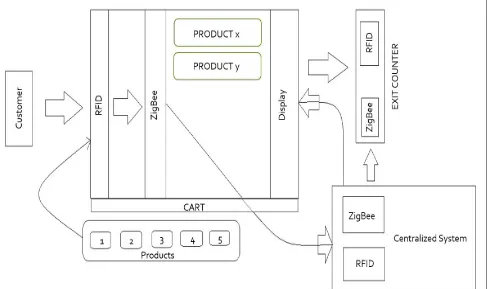
Figure 1Block Diagram
Proposed Framework:
1. Every item in the shop or a shopping center will have a RFID tag on it.
2. Each Truck will have a RFID peruse and ZigBee Tran recipient actualized on it
3. There will be a Brought together Server Framework.
4. After the installment of cash, the Truck must get reset. There will be online installment
method for charging.
5. If the item is expelled, it must get erased from bill as well.
6. There must be a RFID peruse at the leave entryway for hostile to burglary.
IJISET - International Journal of Innovative Science, Engineering & Technology, Vol. 6 Issue 9, September 2019
ISSN (Online) 2348 – 7968 | Impact Factor (2019) – 6.248
www.ijiset.com
378
Algorithms:
Bayesian Network
A Bayesian system, Bayes organize, conviction arrange, Bayes (ian) model or probabilistic
coordinated non-cyclic graphical model.
As per this measurable model that speaks to a lot of irregular factors and their restrictive conditions
by means of a coordinated non-cyclic chart (DAG). Officially, DAGs are the Bayesian systems
whose hubs speak to arbitrary factors in the Bayesian sense. They might be noticeable amounts,
obscure factors, theories. Edges speak to contingent conditions; factors that are restrictively
autonomous of one another spoke to utilizing hubs that are not associated. A likelihood capacity
related accepts every hub as info, a specific arrangement of qualities for the hub's parent factors, and
gives the likelihood circulation of the variable spoken to by the hub.
ID3
In decision tree learning, ID3 (Iterative Dichotomiser 3) is a calculation developed by Ross Quinlan
used to create a choice tree from a dataset. An ID3 calculation normally used in the AI and
characteristic language handling spaces. At first, the first set S was taken as the root hub in the ID3
calculation. On every emphasis of the calculation, it emphasizes through each unused trait of the set
S and computes the entropy H(S) or data picked up IG (An) of the quality.
Algorithm (Id,Set)
//Scan_list::List of Currently Scan Item //Bill_list::Bill id List
//Find_Newid::Compare two list and find //new id
//Fetch Data::Get Data from Server //Delete::Delete item
379 Repeat While set=1
{
Scan(); Scan_lis t();
If (Scan_list==Bill_List)then Don’t Do Anything Exit();
Else if (Scan_list>Bill_list)then Find_Newi
d(); Fetch_Dat a(); Display(); Add_Bill() ;
Update();
Else if (Scan_list<Bill_list)then Find_Newi
d(); Delete(); Update();}
IJISET - International Journal of Innovative Science, Engineering & Technology, Vol. 6 Issue 9, September 2019
ISSN (Online) 2348 – 7968 | Impact Factor (2019) – 6.248
www.ijiset.com
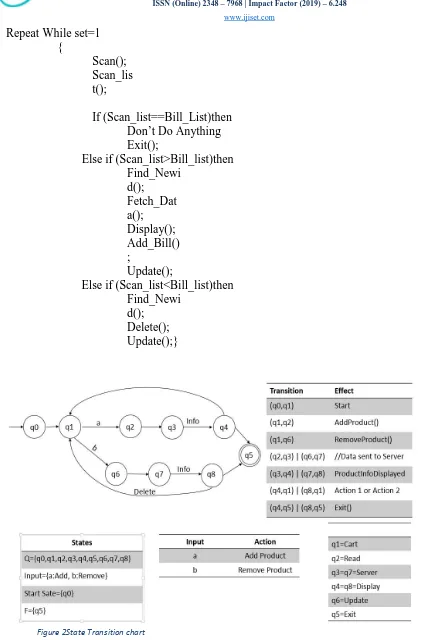
380 In state change chart q0, q1, … , q8 speak to the different states. As q0 is beginning state and q5 is
last state. All state related data appeared in the figure. Progress goes as per the information sources
and reaches to the last state. The client takes an item and put into the truck then every change goes as
indicated by the client choice right then and there.
1.Set Theory Analysis
a) Let ‘S’ be the | Smart Shopping Cart using RFID and
ZigBee as the final set S = {…………}
b) Identify the inputs as D, E,
A, Q, Z S = {D, E, A Q,
Z…}
c)
D = {D1, D2, D3, D4 …| ‘D’ given database updates}
E = {E1, E2, E3, E4 …| ‘E’ given product details with price to register.} A = {A1, A2, A3, A4 …| ‘A’ given RFID Reader and ZigBee
read Product tag.} Q= {Q1, Q2, Q3 … | ‘Q’ gives product tag to remove product from cart}
Z= {Z 1, Z 2, Z3 … | ‘Z’ given Bill to check all product at out time.}
d)Identify the outputs as O
S = {D, E, A Q, Z, N, B, L, R …|Sample space}
N = {N1, N2, N3, N4 …| ‘N’ is the Response as Generate RFID Tag to Product} B = { B 1, B 2, B 3, B 4, …| ‘B’ is the
Response as add product in Bill}
L = { L 1, L 2, L 3, L 4 …| ‘L’ Response as remove product in Bill} R= {R1, R2 …| ‘R’ is the Response bill validate}
e) Identify the functions as ‘F’
S = {D, E, A Q, Z, M, N, B, L, R, T, F…
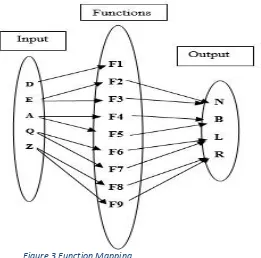
F = { F1(), F2(), F3(), F4(), F5() ,F6(),F7(),F8(),F9()} F1 (D): Update Database
F2 (E): Process Requests on product details with price to register F3 (E): Respond as Generate RFID Tag to Product
F4 (A): Procedure Demands on RFID Peruser and ZigBee read Item tag F5 (A): Reaction as include item in Bill.
381 F7 (Q): React to evacuate the item in Bill.
F8 (Z): Procedure Demands on Bill to look at all item at time. F9 (Z): Reaction Bill approve.
Subsequently, the usefulness can be appeared according to Fig. 3 The mapping of contribution to yield done utilizing capacities. The capacities play out the activity utilizing sources of info and give yield.
Technical and non-technical requirements:
Technical Non - technical
Internet Speed
Server Easy access
System (software & hardware) Secure
Equipment
(laptops/computers/tablets/mobile/CPU)
User friendly
External sources – TPS/market/competition etc. Storage
Accessibility
IJISET - International Journal of Innovative Science, Engineering & Technology, Vol. 6 Issue 9, September 2019
ISSN (Online) 2348 – 7968 | Impact Factor (2019) – 6.248
www.ijiset.com
382
Requirements Normal Hybrid Full automated
Technical requirement
Debit/credit card
Paypal
Search/features
Pricing
Categories
Cart/trolley
Discount/ promotions
Accept payment online
Display
Authentication
Purchase Cancellations / adjustments.
Non – technical requirements
Easy
Engaging
Security
Meaningful
Simple
Multiple reward/points
Serviceability
Regulatory
TYPICAL – highlights that are worked physically and doesn't require any manual book for working
it.
HYBRID – it's a blend of both physically worked and mechanized highlights.
FULL COMPUTERIZED – the activity is totally done and conveyed by programming and
383
Recommendation for introducing on-line ordering system & privilege card system -
Payment system
Paypal
Online ordering system
Security
Delivery processes
Debit/ credit/gpay/store wallet payment facilities
Cash on delivery
Transaction adjustments
Authentication
Purchasing products
Registration / signing in
Virtual cart
Search for product categories
Price range
Quantity & brand selection
Delivery time
Order cancellation
Order exchange
Privilege cards
Registration
Promotions & discounts
Sales
Reward points
Gift cards
Engaging
Special season deals & offers
Serviceability
Security
Authentication
Self-Scanning
During busy times queues build up at supermarket, customers may have to wait a long time to pay
IJISET - International Journal of Innovative Science, Engineering & Technology, Vol. 6 Issue 9, September 2019
ISSN (Online) 2348 – 7968 | Impact Factor (2019) – 6.248
www.ijiset.com
384 One method that can overcome the problem of long queues is scanning. By setting up a
self-scanning system customer scan the barcodes of products as they put them into a trolley using a mini
scanner on the trolley.
This scanner is connected to the supermarket stock database by a LAN using radio waves. As the
products are scanned the total price of the shopping is calculated using the prices in the database.
Once the customer has finished shopping the cost of the goods is transferred from his bank account
to the supermarket's.
Supermarket employees make occasional checks on the contents of trolleys to ensure that customers
are not tempted to put items into their trolleys without scanning them. Before customers can
self-scan they must register with the supermarket so that they can be identified
Comparing features between existing TPS/EPOS Vs proposed TPS –
Requirements
[Technical & non-technical]
Existing TPS – traditional EPOS
Proposed TPS
e-commerce Trolley
scanner
Reliability Yes Yes
Fast No Yes Yes
Ease of use Yes Yes Yes
Security Yes No No
Order cancellations, adjustments Yes Yes No
Payments – debit/credit/paypal Yes Yes Yes
Registration / sign up No Yes Yes
Display Yes No Yes
Promotions/ discounts Yes Yes Yes
Trolley Yes No Yes
Performance No Yes Yes
Durability / sustainability Yes Yes Yes
Operations effectiveness No Yes Yes
IMPROVEMENTS:
• More payment options.
385 • Showing different brands of the same product.
• Showing products exclusive for vegans, organic food consumers etc. • Transparency
• Improved security
Conclusion:
Every item in the shop or a shopping center will have a RFID tag on it. Each Truck will have a RFID
peruse and ZigBee Trans beneficiary actualized on it. There will be online installment methodology
for charging. In the event that the item is expelled, it must get erased from bill as well. There must be
a RFID peruse at the leave entryway for against burglary. Contingent on Client Purchasing
Propensities Show Offers/Rebate on screen, Display Item Data, Expiry Date, and Better Elective. So
by utilizing this, the general store shopping framework will wind up simpler. It will likewise give
hostile to burglary framework to a general store. It will empower online exchange strategy for
charging, and it will likewise offer proposals to the client for purchasing items, show offers, and so
on. Limitations: RFID labels and ZigBee should work appropriately.
References:
1. Birgit Mager.2008. Design Dictionary published by Birkhäuser, Basel URL: 32TU
http://uk.service-design-network.org/?page_id=257U32T
2. DeSai, J. 2008. Mastering innovation: Roadmap to sustainable value creation
3. Edgett, 1994; The traits of successful new service development, Journal of Services Mar-keting,
Vol. 8 No.
4. Edvardsson, 1997; Quality in new service development: Key concepts and a frame of reference,
Int. J. Production Economics 52 (1997), Elsevier Science
5. Egils Milbergs& Vonortas.2008. Innovation Metrics: Measurement to Insight, Center for
Accelerating Innovation2008, pp 2-3.
6. Fritillaria. 2010. Service design and the customer's journey [e-article]. Fritillaria blog [cited on
27.4.2012]. Available at: 32TU
http://fritillaria.blogspot.com/2010/04/service-design-and-customersjourney.htmlU32T.
7. Gube, J. What is User Experience Design? Overview, Tools and Resources [earticle]. UX
IJISET - International Journal of Innovative Science, Engineering & Technology, Vol. 6 Issue 9, September 2019
ISSN (Online) 2348 – 7968 | Impact Factor (2019) – 6.248
www.ijiset.com
386