Cache misses and the recovery of the full AES 256 key
Samira Briongos1 , Pedro Malagón1 Juan-Mariano de Goyeneche1 and Jose M. Moya1
1 Universidad Politécnica de Madrid; samirabriongos,malagon,goyeneche,[email protected]
* Correspondence: [email protected]
Abstract:In recent years, CPU cache memories have revealed themselves as one of the most powerful sources of information leakage. This information leakage affects any implementation whose memory accesses, to data or instructions, depend on sensitive information such as private keys. In most cases, side-channel cache attacks do not require any specific permission and just need access to a shared cache. This fact, combined with the spread of cloud computing, where the infrastructure is shared between different customers, have made these attacks quite popular. Traditionally, cache attacks against AES use the information about the victim accesses to an address. In contrast, we show that using non-access provides much more information. This novel approach is applicable to existing attacks:Prime+Probe,Flush+Reload,Flush+FlushandPrime+Abort. In all cases, using cache misses we are able to retrieve the 128-bit AES key with a reduction in the number of samples between the 93% and the 98%. Further, this attack is adapted and extended in what we call the encryption-by-decryption cache attack or EBD, to obtain a 256-bit AES key. In the best scenario, our approach obtains the 256 bits of the key of the OpenSSL AEST-table-based implementation using less than 10000 samples; that is, 135 milliseconds, proving that AES-256 is only about 3 times more complex to attack than AES-128 via cache attacks. The proposed approach is also successfully tested in a cross-VM scenario.
Keywords:side-channel cache attacks; cache misses; AES; cloud computing
1. Introduction
Cloud computing aims to provide its users with compute resources as they are required, eliminating the need of acquiring and maintaining expensive computing infrastructures. Its low cost, ease of use and on demand access to computing resources have made both, government and industry, to increasingly adopt these technologies. Major companies such as Amazon, Google and Microsoft have become Cloud Service Providers. Cloud providers offer computing capabilities at low prices because of economies of scale: by achieving high utilization of their servers they can divide costs between more customers. This means that multiple virtual machines (VMs) are co-hosted on a single physical host relying on a virtual machine manager (VMM) to provide logical isolation between them.
However, physical isolation between tenants does not exist, and as a consequence, shared hardware can create covert channels between different VMs. CPU caches are one of these shared resources which can be exploited to recover fine grain information from co-resident tenants. Well known attack techniques such as Evict+Time,Prime+Probe[1],Flush+reload[2],Flush+Flush[3] or the recently introducedPrime+Abort[4] allow to infer instructions or data accessed by a victim program. Thus, when these memory accesses depend on sensitive information, this information is leaked.
The most impressive demonstrations of the ability of such attacks to extract private information from their victims target both symmetric [1,5,6] and asymmetric [7–9] cryptographic implementations. Intel CPU caches have traditionally been victims of cache attacks, due to their inclusive architecture and replacement policies. However, several researchers [10–12] have also proven that AMD or ARM processors, which have different architectures and replacement policies, are also vulnerable to cache attacks.
Cache attacks require the victim and the attacker to share the cache. In cloud environments this means that, prior to the attack, the attacker must achieve co-residency with the victim. As first shown by Ristenpart et al. [13], co-residency is achievable and detectable in well-known cloud platforms (Amazon EC2). After this work was published, cloud providers obfuscated the techniques they employed. However, recent works [9,14] have
shown that it is still possible to determine if two VMs are allocated in the same physical machine. Once a VM is allocated in the same host as a target victim, its owner is ready to gain information about what the neighbors are doing.
Researchers have also become concerned that these attacks represent a serious threat. For this reason, many approaches have been proposed that try to avoid the leakage [15–17] or to detect attacks [18–21]. To the best of our knowledge, no hardware countermeasure is implemented in real cloud environments and no hardware manufacturer has changed the cache architecture. We believe that the main reason for this absence of countermeasures is the performance penalty they introduce. As a result, an attacker wishing to exploit side-channel cache attacks will only have to take into the account the countermeasures based on detection that can be implemented by users.
In this work we consider theT-table-based implementation of AES. This implementation is known to be vulnerable to cache attacks. However, it is commonly used for comparison, and to demonstrate different attack techniques. In this work, it serves to our purpose of showing the accuracy of the information gained from the non-accesses to memory and to quantify the improvement that this approach represents compared to the traditionally used approach based on accesses.
We are able to improve the results of previously published side channel attacks decreasing the number of samples required to retrieve the whole key by multiple orders of magnitude. Every known technique (Flush+Reload,Flush+Flush Prime+ProbeandPrime+Abort) can benefit from this approach. Moreover, the presented approach is less prone to consider false positives memory accesses. Regarding non-access, a false positive is considered if the data has been loaded into the cache and removed from the cache in a short period of time, which is unlikely to happen. Whereas a false positive in the traditional approach is considered whenever the data is loaded into the cache in any other round of the AES encryption, rather than the target round, or whenever this data is predicted to be used, so it is speculatively loaded into the cache, being both frequent options.
In summary, the main contributions of this work are the following
• We present a non-access attack, a novel approach to exploit information gained from the cache misses. • We show that our approach improves the performance of previous cache attacks and demonstrate its
effectiveness forFlush+Reload,Flush+Flush Prime+ProbeandPrime+Abort. We are able to reduce the amount of encryptions required to derive the key between a 93% and a 98%. That is if an access attack requires 100000 samples, our approach requires less than 3000, performed in a similar and real experimental setup.
• We extend the non-access attack to gain information from more rounds of the algorithm, introducing EBD, a practical attack implementation that provides the full 256-bit AES encryption key using cache side channel attacks.
• We show that the complexity of the attack doesn’t depend on the size of the key but on the number of rounds of each encryption. Passing from 10 rounds (AES-128) to 14 rounds (AES-256) increases the complexity by a factor around 3.
The remaining of this paper is organized as follows. In Section2, we provide information on the relevant concepts to understand the attacks. Section3describes AES implementations and the attacks we perform to extract the keys. In Section4, we provide a discussion of our results. Finally, in Section5we draw some conclusions.
2. Background and Related Work
In order to achieve a better understanding of side channel cache-attacks, we are going to give a basic introduction to some required architectural concepts followed by a description of existing cache attacks and their principles.
2.1. Architectural concepts
2.1.1. CPU caches
CPU caches are small and fast memories located between the CPU and main memory, specially designed to hide main memory access latencies. As the cost of memory is related to the speed, the cache memory is structured in a hierarchy of typically 3 levels. Level 1 is the smallest, fastest cache memory and similarly to level 2 is usually core private. Level 3 the biggest and slowest cache memory, commonly shared among processing cores. They hold a copy of recently used data which will be probably requested by the processor in a short period of time. If the data requested by the processor is not present in any level of the cache, this data is loaded from main memory and stored in the cache. If a cache level is completely filled at that point, some of the data currently contained in it will be replaced (evicted) to store the loaded data instead. The selection of the evicted data depends on the processor architecture. Processors including AMD, Intel and some ARM high-performance processors, typically use a policy related to least recently used (LRU). However, the replacement policy of most ARM processors is based in random replacement or round-robin replacement.
In Intel processors, as the one used for our experiments, caches are inclusive memories. This means that high level caches, as level 3 (L3) cache, have a copy of the data of lower level caches. In addition, what is more important and relevant to most attacks, L3 cache is shared among all cores. Consequently, a process being executed in a core, related to L3 cache data, may produce side effects in other core processes. Other processors use exclusive caches, where a memory block is present in only one level of the cache hierarchy.
Caches are usually set associative: they are organized asS sets ofWlines (also called ways) each holdingB bytes. It is common to name them asW-way set associativecache. Given a memory address, the less significant log2Bbits locate the byte on the line, the previouslog2Sbits do the same for the set and the remaining high-order bits are used as a tag for each line. The tag will be used to discern whether a line is already loaded or not in the cache. In modern processors, the last level cache (LLC) is divided into slices. Thus, it will be necessary to know the slice, and the set in which a data will be placed. The slice is computed as a hash function of the remaining bits of the address. If the number of cores is a power of two, the hash will be a function of the tag bits. Otherwise it will use all the bits of the address [22,23] Note that, as main memory is much larger than CPU caches, multiple memory lines map to the same cache set.
2.1.2. Shared memory
Memory is a limited resource whose lack negatively affects performance. It is natural that operating systems employ mechanisms such as memory sharing to reduce memory utilization. Whenever there are two different processes using the same library, instead of loading it twice into physical memory, sharing memory capabilities allow to map the same physical memory page into the address spaces of each process.
Deduplication is a concrete method of shared memory, which was originally introduced to improve the memory utilization of VMMs and was later applied to non-virtualized environments. The hypervisor or the operating system scans the physical memory and recognizes processes that place the same data in memory; that is, pages with identical content. When several pages happen to include the same content, all the mappings to these identical pages are redirected to one of them, and the other pages are released. However, if any change is performed by any process in the merged pages, memory is duplicated again.
The Linux memory deduplication feature implementation is called KSM (Kernel Same-page Merging) and appeared for the first time in Linux kernel version 2.6.32. KSM is used as a page sharing technique by the Kernel-based Virtual Machine (KVM) which we will be using as hypervisor within our experiments. KSM scans the user memory for potential pages to be shared, scanning only potential candidates instead of the whole memory continuously [24].
2.1.3. Transactional memory
When multiple threads are running in parallel and try to access a shared resource, a synchronization mechanism is required to avoid conflicts. Transactional memory is an attempt to simplify concurrent programming, avoiding common problems with mutual exclusion and improving the performance of other locking techniques. Transactional memory enables optimistic execution of the transactional code regions specified by the programmer. The processor executes the specified sections assuming that it is going to be possible to complete them without any interference. The programmer is no longer responsible for identifying the locks and the order in which they are acquired; he only needs to identify the regions which are going to be defined as part of the “transaction”.
During the execution of a transaction, the variables and the results of the operations are only visible for that thread; that is, any update performed in these regions is not visible to other threads. If the execution ends successfully, the processor commits all the changes as if they had occurred instantaneously, making them visible to any process. If, on the other hand, there is a conflict with another process, the transaction is unsuccessful and the processor aborts its execution. Consequently, the processor requires a mechanism to undo all the updates, discard all the changes and restore the architectural state to pretend that the execution never happened.
Intel Transactional Synchronization Extensions (TSX) are the Intel's implementation of hardware transactional memory. TSX provides two software interfaces: Hardware Lock Elision (HLE) and Restricted Transactional Memory (RTM).
2.2. Cache attacks
Cache memories create covert channels that can be exploited to extract sensitive information. When a process tries to access some data, if it is already loaded into the cache (namely a cache hit), the time required to recover this data is significantly lower than the access time in case the data has to be retrieved from main memory (cache miss). Therefore, if the execution time of a cryptographic process depends on the previous presence (or not) of the accessed data on the cache memory, this time information can be exploited to gain private information (such as secret keys) from cryptographic processes. Traditionally, cache attacks have been classified as:
• time driven attacks:the information is learned by observing the timing profile for multiple executions of a target cipher.
• trace driven attacks: the information is gained by monitoring the cache directly, considering that the attacker has access to the cache profile when running the target process.
• access driven attacks:the information is retrieved from the sets of the cache accessed during the execution of the target process
The cache memory was first mentioned as a covert channel to extract sensitive information by Hu [26] in 1992. Later on, in 1996, Kocher [27] introduced the first theoretical attacks, as did Kelsey [28] in 1998 describing the possibility of performing attacks based on cache hit ratios. Years later, in 2002, Page [29] studied a theoretical example of cache attacks for DES, which was also used by Tsunoo [30] to study timing side-channels created due to table lookups. In 2004, Bernstein [5] proposed the first time-driven attack after observing non-constant times when executing cryptographic algorithms. Although the attack he presented was not practical, his correlation attack has been investigated extensively and even retried between VMs recently [31]. Soon, another attack was proposed by Percival [32], who suggested that an attacker could determine cache ways occupied by other processes, measuring access times to all ways of a cache set. He found out that these times are correlated with the number of occupied ways.
2.2.1.Evict+Time
This technique consists of three steps: first, an encryption is triggered and its execution time measured; second, an attacker evicts some lines; third, the encryption time is measured again. By comparing the second time with the first measure, an attacker can decide whether the cache line was or not accessed, as higher times will be related to the use of the mentioned line.
2.2.2.Flush+Reload
This technique relies on the existence of shared memory: thus, when an attacker flushes the desired lines from the cache, he can be sure that, if the victim process needs to retrieve the flushed line, it will have to load it from main memory.Flush+Reloadalso works in three stages: first, the desired lines from the cache are flushed (reverse engineering may be required to determine the addresses which can leak information). Second, the victim runs its process or a fragment of it. Finally, the flushed line is accessed by the attacker, measuring the time required to do it. Depending on the reload time, the attacker decides whether the line was, or not, accessed.
This attack uses theclflushinstruction to remove the target lines from the cache in the initialization stage. It is easy to implement and quite resistant to micro-architectural noise, for this reasons it has become really popular. However, its main drawback is that it requires memory deduplication to be enabled. Deduplication is an optimization technique designed to improve memory utilization by merging duplicate memory pages. As a consequence, it can only recover information coming from statically allocated data. Shared memory also implies that the attacker and the victim have to be using the same cryptographic library. To eliminate the need of knowing the version of the algorithm attacked, Gruss et al. presented the Cache template attack [34], where they enforced the existence of shared memory between the attacking and the attacked processes.
The attack was first introduced in [33], and was later extended to target the LLC to retrieve cryptographic keys, TLS protocol session messages or keyboard keystrokes across VMs [2,34,35]. It has also demonstrated its power against AEST-table based implementations [36], RSA implementations [2], or ECDSA [37] among others, and also detecting cryptographic libraries [38]. Further, Zhang et al. [39] showed that it is applicable in several commercial PaaS clouds, where it is possible to achieve co-residency with a victim [13].
Relying on theclflushinstruction and with the same requirements asFlush+Reload, Gruss et al. [3] proposed theFlush+Flushattack. It was intended to be stealthy and bypass attack monitoring systems [19,20]. The main difference withFlush+Reloadis that this variant recovers the information by measuring the execution time of theclflushinstruction instead of the reload time, thus avoiding direct cache accesses. This was the key fact to avoid detection. However, recent works have demonstrated that it is detectable [21,40].
2.2.3.Prime+Probe
Shared memory is not always available through deduplication in virtual environments as most cloud providers turned offthis feature after several attack demonstrations. However,Prime+Probe[9,41] still works, and targeting the L3 cache an attacker is still able to extract sensitive information. SincePrime+Probeis agnostic to special OS features in the system, it can be applied in virtually every system.
Prime+Probeconsist of three steps: first, the attacker fills a cache set with known data, second the attacker triggers (or waits for) the victim to perform an encryption. Finally, after the encryption has finished, the attacker tries to access the known data place during the first step and measures the time it takes in order to determine if the previously loaded data has been evicted by the victim process. If so, the attacker discovers which lines the victim process has used.
These attacks highly rely on precise timers to retrieve the desired information about the victim memory accesses. In case a defense system tries to either restrict access to the timers or to generate noise that could hide timing information, the attack is less likely to succeed. Once again, attackers have been able to overcome this difficulty. ThePrime+Abortattack [4] exploits Intel’s implementation of Hardware Transactional Memory (TSX) so it does not require timers to retrieve the information. It first starts a transaction to prime the targeted set, waits and finally it may or may not receive and abort depending on whether the victim has or has not accessed this set. That is, no need for timers.
To summarize, the presented attacks target the cache, selecting one memory location that is expected to be accessed by the victim process. They consist of three stages:initialization(the attacker prepares the cache somehow),waiting(the attacker waits while the victim executes) andrecovering(the attacker checks the state of the cache to retrieve information about the victim). They differ in the implementation, requirements and achievable resolution.
3. Attacks on AES
In this Section we describe the fundamentals of AES encryption and decryption algorithms. We explain the insides of the attackedT-table-based OpenSSL AES implementation. We present the non-access cache attack against AES-128, which outperforms previously published cache attacks. Later we explain how the approach followed in this non-access attack can be extended to perform a practical attack on AES-256. We name it Encryption-by-Decryption Cache Attack, as we use the information from the encryption to obtain a decryption round key, which can be transformed into an encryption round key. This way, we are able to obtain information from two different and consecutive encryption rounds.
3.1. AES fundamentals
The AES algorithm is explained in [46]. It is a symmetric block cipher, that operates with data in blocks of 16-bytes. Both encryption and decryption behave similarly. They repeatedly apply a round transformation on the state, denotedS. The number of iteration rounds,Nr, depends on the size of the key: 10 rounds for 128-bits, 12 rounds for 192-bits and 14 rounds for 256-bits.
We denoteSr,0≤r≤Nrthe input state to roundr.Sris a 4x4 matrix of byte elementsSri,j,0≤i<4,0≤ j<4. iindicates the row of the state and jthe columns. We use only one subindex jto refer to a column of the stateSj. Considering a plaintext blockp0p1p2...p15, the elements of the initial stateS0of the algorithm are S0i,j= pi+4j. This data is then transformed and rearranged and finally xored with the corresponding round key to obtain the elements of the stateS1. The process is repeated again and again till the last round which is slightly different. In each round, the algorithm uses a different round keyKr, which is also a 4x4 matrix of byte elements Ki,j. TheNr+1 round keys are expanded from the algorithm key using a known and fixed scheme. Once a round key is known, there is a straight forward algorithm to recover the same amount of bits of the encryption key. In order to obtain a 256-bit AES key, we need to obtain at least 2 round keys.
We follow the terms used in [46] to describe the transformations performed on the state. The normal round transformation in the encryption process consists of four steps denoted:SubBytes,ShiftRows,MixColumns andAddRoundKey, beingSubBytesthe only non-linear transformation.SubBytesis an S-boxSRDapplied to the elements of the state.ShiftRowsis an element transposition that rotates the rows of the stateipositions to the left.MixColumnsoperates on the state column by column. The operation is a matrix multiplication of a 4x4 known matrix and each of 4 the original columns.AddRoundKeyis the addition (bitwise XOR in GF(2)) of the elements of the state with the corresponding element of the round key.
All these steps have an inverse step, which are used in the decryption process: InvSubBytes (using S-boxS−RD1),InvShiftRows(rotating to the right),InvMixColumns(multiplying by the inverse matrix) and AddRoundKey. The normal round transformation is applied in all but the first and last rounds. The first round applies only theAddRoundKeystep. The last round is a normal round without theMixColumnsstep.
steps equal to the encryption, by switching the order of application ofInvSubBytesandInvShiftRows(the order is indifferent) andInvMixColumnsandAddRoundKey. The round key of all but the first and last rounds needs to be adapted for this purpose, by appliyng theInvMixColumnsstep to it.
The key fact to understand the attack against AES-256 is that the stateSr can be reached in therround of the plaintext encryption process or in theNr+1−rround of the ciphertext decryption process.
3.2. AEST-table implementation
The steps of the round transformation include a non-linear S-box substitution and a matrix multiplication. In order to reduce the number of operations performed during each round and to improve performance, AES software implementations without special assembly instructions use tables (T-tables) with precalculated values for each of the possible 256 values of an input element. In this work, we evaluate theT-table-based implementation available in OpenSSL version 1.0.1f or newer versions when compiled with the no-asm flag.
In the aforementioned implementation, the state is represented by four 32-bit variables starting withsort, one for each column of the state. The name of the variable starts withsfor odd rounds and withtfor even rounds, considering the first round to be 0. The Most Significant Byte (MSB) of the variable represents the element in row 0, while the Least Significant Byte (LSB) represents the element in row 3. Encryption and decryption algorithms use 4 tables, each containing the result of S-box substitution and part of the matrix multiplication. The tables start withTefor encryption and withTdfor decryption. Generically, we denote each of the 4 tables Ti (TeiandTdi), whereiis the column of the multiplication matrix considered in the table. TableTicontains the contribution of the element in rowito each row of the resulting column state. That is, each of the 256 positions of the table (28) contains a 32-bit value, where each byte is the contribution to each row, aligned to perform the addition of the different contributions. The size of each table is 1024 bytes. The column state is calculated by adding (bitwise XOR in GF(2)) the contributions from the different rows and the round key. Therefore, the four tables are accessed for each output column state. An appropriate selection of the input variablesjfor the different rows is used to perform theShiftRowsstep; for the destination variabletj, variablesi+jis used for rowi(index of tableTi). In this example, and for the entire work, the addition in subindexesiand jis done modulus 4. For example, in round 1 we can obtaint0as follows:
t0=Te0[s024]⊕Te1[(s116)&0xff]⊕Te2[(s28)&0xff]⊕Te3[s3&0xff]⊕rk[4];
The last round does not include the matrix multiplication. A table forS−RD1 (onlyInvSubBytesstep) is required for decryption algorithm (table Td4). As there are coefficients with value 1 in the multiplication matrix of stepMixColumns, the table is not needed for the encryption algorithm. It is implicitly available in theTe tables. In this caseTe(i+2)mod4is used for rowi, because it has coefficient 1 for that row.
3.3. Attacking AES
As it can be inferred from the previous description of theT-table implementation, the accesses to eachTei depend on the key. Thus, cache hits and misses depend on the key. In the following section3.3.1we explain how to retrieve the 128 bits key using information about cache misses and the ciphertext.
We show that using cache misses we are not only able to recover an AES 128 bit key using significantly less samples than previous approaches, but also we can recover the 256 bits of an AES key. To this end, we need to recover information about two consecutive rounds. As we explain later, we perform this attack in two steps. The first one targets the last round and the second one the penultimate round. A direct cache attack to the penultimate round key is not feasible, so we use the equivalences between encryption and decryption to transform our data and to be able to use cache misses to retrieve the key.
When describing the attacks, we use a nomenclature which is consistent with the terms used when describing AES. The iteration variables, subindexes and superindexes follow this rules:
i is used to refer to the rows of the state or round key. As a subindex, it indicates the row of the element. As an iteration value, it is used for accesing elements related to a row (theT-tables).
j is used to iterate the columns of the state or round key. As a subindex, it indicates the column of an element.
l is the iteration variable for traversing the values of a Cache line.
r is used as superindex to indicate the round of a variable (state, round key). The elements used in the algorithm are represented by capital letters.
Sr represents the state of an AES encryption algorithm before roundr. The 16 bytes of the state can be accessed usingiandjsubindexes. The state is different for each encryption performed, and the arraySr represents the whole set.
Dr is the equivalent toS for the decryption algorithm.
Kr represents the encryption round key for round r. Each of the 16 bytes can be accessed usingiand j subindexes.
Kdr represents the decryption round key for roundr. It can be calculated from the corresponding encryption key KNr+1−rby applying theInvMixColumnsstep.
Xi is information on access (1) or non-access (0) to a subset of table Tei. The subset contains 16 values (64 bytes), which is the cache line length.Xirepresents the array containing the access information for each encryption performed in the experiment.
CKr is a set of arrays with 256 positions (the possible values), one for each round key byte. Each position represents the amount of discarding votes received by the candidate for that concrete key byte. The position with the minimum value after the analysis (we call the functionargmin) is the correct key byte value. Its elements can be accessed usingiand jsubindexes.
CKdr is the equivalent to CKrfor a decryption round key.
3.3.1. Attack on AES-128
We assume that the attacker shares the cache with the victim, which means he can monitor accesses to the cache with line granularity. We also assume that the attacker has access to the ciphertext. The attacker needs to recover information from each of the fourT-tables. To do so, he can monitor one line of one table, one line of eachT-table or even try to monitor the 16 lines of each of the 4 tables at a time (64 lines). The number of samples required to retrieve all the bits of the key will vary in each case as will do the effect of the attack observed by the victim [18]. The more lines monitored at a time, the more noticeable the attack will be. While a slight increase in the encryption time can be assumed to have been caused by other programs or virtual machines running on the same CPU, a higher increase in the encryption time would be quite suspicious.
For each of the evaluated techniques, i.e.Prime+Probe,Prime+Abort,Flush+ReloadandFlush+Flush, we use a similar process to retrieve the desired information. The process followed during the attack involves three steps and is the same in all cases:
1. Setup:Prior to the attack, the attacker has to retrieve the necessary information about where theT-tables are located in memory; that is, their virtual addresses or the cache set in which they are going to be loaded. This way he ensures that the cache is in a known state, ready to perform the attack.
2. Measurement collection:In this step the attacker monitors the desired tables, applying each technique between the requested encryptions and stores the gathered information together with the ciphertext. As explained in section2.2, this step can be subdivided into three stages:initialization,waitingand recovering.
3. Information processing:Finally, the attacker uses the information recovered in the previous steps and the information about theT-tables (the contents of the monitored line) to retrieve the secret key.
These main steps are equivalent to previous proposals [36,44]. Other proposals are also applicable to our non-access attack, as the one suggested by Gülmezoglu et al. [47] which aims to detect the bounds of the encryptions instead of triggering them. However, this approach also depends on the accuracy of the detection, which introduces a new variable to be considered when comparing the effectiveness of the attack approaches. In contrast, the aforementioned setup can be generalized for all the considered techniques, allowing a fair comparison.
running in the same OS as the victim. In the second one, the attacker runs in a VM and the victim runs in a different VM and they are both allocated in the same host. Table1includes the details of the machine in which the experiments are performed. The steps are equal in the two considered scenarios.
Table 1.Experimental platform details.
Processor Cores Frequency OS LLC slices LLC size LLC ways VMM Guest OS
Intel core i5-7600K 4 3.8 GHz CentOS 7.6 8 6 MB 12 ways KVM CentOS 7.6 minimal
Setup
The tasks required to performFlush+Reload andFlush+Flushare different than the required ones for Prime+ProbeandPrime+Abort. SinceFlush+Somethingattacks rely on shared memory, an attacker wishing to exploit this feature needs to do some reverse engineering on the library used by the victim to retrieve the target virtual addresses. Note that the offset between the addresses of the beginning of the library and the target symbol (the table) is constant. Thus, once this offset is known, the attacker can easily get the target address by adding this offset to the virtual address where the library is loaded.
In contrast,Prime+Something attacks require the physical address of the target; more accurately, it is necessary to know the set and the slice in which the data will be loaded. This information can be extracted from the physical address. Part of the physical address can be directly inferred from the virtual address. Indeed, the bits of the address that points to the elements withing a cache page are part of their physical address. For example, if the size of a cache page is 4 KB, the 12 lowest significant bits of the address will keep the same when translating the it from virtual to physical. However both virtual and physical addresses of the data that the victim is processing are unknown to the attacker. To overcome this difficulty, an attacker needs to create its own eviction set (a group ofWelements that map exactly to one set) and profile the whole cache looking for accesses being carried out by the victim.
Instead of recovering the complex address function of our processor, we create the eviction sets dynamically using the technique summarized in the Algorithm 1 of the work of Liu et al. [41]. We have also enabled hugepagesof 2MB in our system to work with 21 known bits. Since the number of cores of our processor is a power of two, we only need to obtain the mapping of one of the sets for each slice (the function that determines the slice in which the data is going to be placed only uses thetagbits). The remaining sets that will be used during the profiling phase and the attack itself can be constructed using this retrieved mapping.
Measurement collection
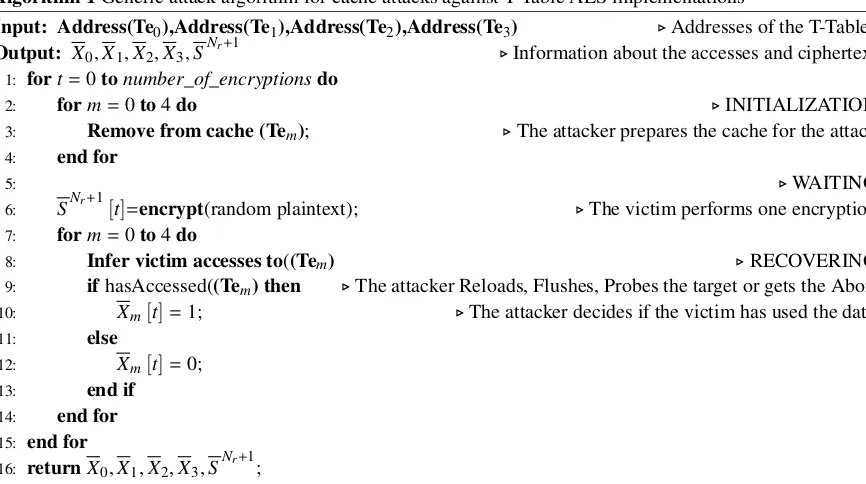
The measurement collection process is somehow similar for all the considered techniques. Algorithm1 summarizes the general method employed to acquire the necessary information about the victim accesses to the tables. This information will be later used to obtain the full key.
In the initialization, the attacker has to remove the data of one line of each Teitable from the cache. That is, the attacker ensures he knows the state of the cache before the victim uses it. Since each cache line holds 64 bytes, and each entry of the table has 4 bytes, it holds 16 of the 256 possible values of the table. Then, in the waiting stage, he triggers an encryption. Once it has finished, in the recovering stage, the attacker checks the state of the cache. If the cache state has changed, this means that it is likely that the victim had used the data of that T-Table. The different approaches considered in this work differ in the way they remove the data from the cache during the initialization and in the way they recover the information about utilization of the removed table line. In the initialization stage ofFlush+Something, the target lines are removed from the cache using thecl f lush instruction available in Intel processors. InPrime+Something, the attacker removes the target lines by accessing the data of the created eviction sets that map to the same region as the target lines. Intel implements a pseudo LRU eviction policy. As a result, accessingW elements that map to a set implies that any older data in the cache will be replaced with the attacker's data. InPrime+Abort, this operation is performed inside a transactional region defined using the Intel TSX extension.
Algorithm 1Generic attack algorithm for cache attacks against T-Table AES implementations
Input: Address(Te0),Address(Te1),Address(Te2),Address(Te3) .Addresses of the T-Tables Output: X0,X1,X2,X3,SNr+1 .Information about the accesses and ciphertext
1: fort=0tonumber_of_encryptionsdo
2: form=0to4do .INITIALIZATION
3: Remove from cache (Tem); .The attacker prepares the cache for the attack
4: end for
5: .WAITING
6: SNr+1[t]=encrypt(random plaintext); .The victim performs one encryption 7: form=0to4do
8: Infer victim accesses to((Tem) .RECOVERING
9: ifhasAccessed((Tem) then .The attacker Reloads, Flushes, Probes the target or gets the Abort
10: Xm[t]=1; .The attacker decides if the victim has used the data. 11: else
12: Xm[t]=0;
13: end if
14: end for
15: end for
16: returnX0,X1,X2,X3,S Nr+1
;
accessed it in any of the rounds.Flush+Flushdecides if the data has been used by measuring the time it takes to flush the line again. The flushing time depends on the presence of the line on the cache; it takes longer to flush data that is located in the cache. ThePrime+Proberecovers information on access by accessing the data from the eviction set and measuring the access time. As recommended in previous works [41], we access the data within the eviction set in reverse order in the Probe step. That is, the eviction set is read following a zig-zag pattern. If the data of the table is used by the encryption process, part of the attacker's data will be evicted; thus, the time it takes to “Probe” the set will be higher. In thePrime+Abort, as the eviction set was accessed inside a transaction, any eviction of the attacker's data from the cache causes an abort. The attacker defines a handler for this abort that evaluates its cause. There are different abort causes which are identified with an abort code [48]. This abort code is loaded into theeaxregister and it is read in the handler function to check if the abort was due to an eviction.
Figure1shows the distribution of the measured times during the Reload step (1a) and during the Probe step (1b). Note that it is easy to establish a threshold to distinguish between accesses and not-accesses to the monitored Te table.
0 50 100 150 200 250 300 350 Reload times
0 0.1 0.2 0.3 0.4 0.5 0.6 0.7
Probability
(a)Flush+Reload
400 600 800 1000 1200 1400 1600 1800
Probe time
0 0.05 0.1 0.15
Probability
(b)Prime+Probe
Information processing
This final step is common for all the attacks. In this stage our approach differs from previous attack strategies. Traditional approaches for the considered attacks take into account if the data stored in the monitored cache line has been used by the victim. In contrast, we consider the opposite situation, i.e. the victim has not used that data. Our approach is based on the following observations:
− Whenever the retrieved information shows that the victim has used the considered data, it could have been used during the last round or during any of the remaining ones. Thus, whenever the data is used in a different round, this approach introduces “noise”. On the other hand, if a monitored cache line has not been accessed during the encryption, neither has it been accessed in the last round nor in any other round.
− Speculative execution of pieces of code, or prefetching of the data that the processor believes it is going be used in the near future, may involve that the attacker sees in the cache data that has not been used by the victim (false positive). Nonetheless, in order to obtain a false positive in the non-access approach, the data has to be used during the last round of the encryption and then flushed away by other process during the short period of time after the end of the encryption and before the recovering step.
− Each non-access sample reduces the key search space discarding up ton4key values (nequals to 16 Table entries stored in the cache line which are used to obtain 4 output bytes). Thus, we obtain information from each of the samples. In contrast, when considering accesses, only when one candidate value towers over the rest, the retrieved information is useful to retrieve the secret key.
− The information obtained this way is more likely to be applicable to all the rounds of an encryption, or at least to the penultimate round, as it refers to the whole encryption, so we can use this information to retrieve longer keys (192 or 256 bits).
We have seen in section3.2that each tableTeis accessed 4 times during each round. Therefore, the probability of not accessing a concrete cache line within an encryption is provided by equation1, wheren represents the number of table entries a cache line can hold, andNr the number of rounds of the algorithm. Particularly in our case, where the size of a cache line is 64 bytes,nis 16 (each entry ofTehas 32-bits) and the number of rounds (Nr) for AES-128 is 10. Consequently, the probability of not accessing the cache line is 7,5%. This means that one of each fourteen encryptions performed gives us useful information.
Pr[no access T ei]=
1− n
256 Nr∗4
(1)
As stated before, we focus on the last round of the encryption process. This round includesSubBytes, ShiftRowsandAddRoundKeyoperations. Referred to the last round input state and theT-tables, we can express an output element bySNr+1
i,j =K Nr i,j⊕Tei+2
h sNr
i,j+i i
. When a cache line has not been used during the encryption, we can discard all the key values which, given an output byte, would have had to access any of the Te-table entries hold in the mentioned cache line. For example, given a ciphertext byte ’0F’ and a cache line holding ’01’ ’AF’ ’B4’ and ’29’, if this line remains unused after performing the encryption we discard the key byte values 0F⊕01, 0F⊕AF, 0F⊕B4 and 0F⊕29. As we have seen in Section3.2, the same table is used to obtain all the elements of the row of the output state. This means eachTeitable also discards theKi,jvalues with the same ivalue independently of thejindex.
A general description of the key recovery algorithm for the last round key is provided in algorithm2. Key
bytes of the last round,KNr
i,j, are recovered from the output stateS Nr+1
(ciphertext) and the information about the
accesses to each tableTei, which is stored inXiand was recovered using the algorithm1. The output state (S Nr+1
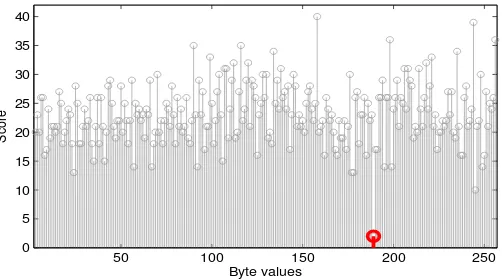
) is obtained by arranging the known ciphertext vector as a matrix as indicated in Section3.1. The algorithm first initializes an array of 256 elements for each of the 16 bytes of the key (Ki,j). This array (CKNi,rj) will contain the discarding votes for each key byte candidate. The candidate with less negative votes is the value of the secret key.
Figure2shows the values of one of the 16 CKNr
Algorithm 2Recovery algorithm for key byteKNr i,j
Input: X0,X1,X2,X3,S
Nr+1 .
Information about the accesses and ciphertext collected in the previous step. Output: KNr
i,j .Secret key values
1: forl=0to256do 2: CKNr
i,j[l]=0; .Initialization of the candidates array
3: end for
4: fort=0tonumber_of_encryptionsdo 5: ifXi+2[t]==0then
6: forl=0tondo .n stands for the number of entries that a cache line holds 7: CKNr
i,j
SNi,rj+1[t]⊕T ei+2[l]
+ +; .Vote for discard key candidate
8: end for
9: end if
10: end for
11: return argmin(CKNr
i,j); .The candidate with the fewest votes for discard is thesecret key.
secret key. This approach allows to recover the 128 bits of the key with less than 3000 encryptions on average in the best case. We present further results and provide further details in section4.
50 100 150 200 250
0 5 10 15 20 25 30 35 40
Byte values
Score
Figure 2.Key byte possible values with their associated discarding scores
3.3.2. Attack on AES-256
The attack against AES-256 comes as an extension of the previously explained attack on the last round of an encryption. There are no further assumptions than in the previous case. The setup and measurement collection steps are exactly the same for both attacks, and only the information processing phase is different since it includes an extra step. We retrieve 128 bits of the key using the algorithm2and use the guessed 128 bits of the key and the same information that has already been used (non-accesses and ciphertext) to derive the remaining 128 unknown bits of the key. We will similarly use information about the non-used cache lines to discard key values till we obtain the key. This is possible because this information refers to the whole encryption and, as previously stated, if a cache line has not been accessed within an encryption, it has not been accessed in any of its rounds.
Note that the probability of non-accessing one line when performing an AES-256 encryption, which is a function of the number of rounds, and is given by equation1, is 2.69% (14 rounds). As a consequence the attack on AES-256 will require more samples in order to successfully guess the whole key. In this case about 1 sample of each 37 carries useful information. This means we will need to collect at least the same number of useful samples than in the previous case.
If we analyze the AES encryption process, we see that the output of each round is used as an index to access theT-tables in the next round after aShiftRowsoperation. Taking into account the valuable information of the unused cache lines it is possible to figure out which are the state values that are not possible before the penultimate round,SNr−1. That is, if a cache line has not been accessed, all the state values that would have forced an access to this line can be discarded.
Once we know the last round key, it is straightforward to obtain the input to that round (SNr−1) only taking into the account the encryption function. However, because of theMixColumnsoperation which is performed in all the previous rounds (except for the initial one), the certainty about the non-usage of a cache line of one table and the knowledge of the encryption function are not enough to obtain information about the key of these rounds. But, if we use the decryption function and take into the account the equivalence between encryption and decryption, we can transform our data so we can derive information about an state of the decryption function which is equivalent to theSNr−1state in the encryption function.
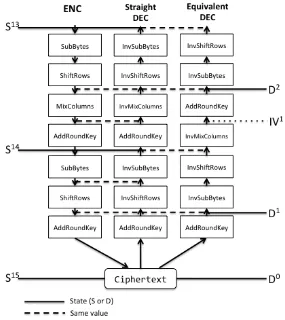
Figure 3.Relation between encryption, straight decryption and Equivalent decryption.
Figure3shows with dotted lines the instants where equivalent decryption and encryption algorithms have the same values. According to the figure, we establish a bidirectional relation between an encryption stateSr and a decryption stateDNr+1−rusingSubBytesandShiftRowssteps. The relations are defined in Equations 2aand2b. These relations and the knowledge of the values which are not possible in the stateSNr−1give us the values which are not possible in the stateD2. Since the value of what we call intermediate valueIV1can be easily obtained from the decryption function, our scenario is similar to the previous one (D2i,j=IVi1,j⊕CKd1i,j).
DNr+1−r=ShiftRows(S
RD(Sr)) (2a)
Sr =SRD(InvShiftRows(DNr+1−r)) (2b)
the encryption which was previously obtained using the non-access cache attack and targeting the last round (algorithm2). As we know both input data (ciphertext) and round key, we can perform the first round of the decryption algorithm and obtain the state of round 1, D1. Applying theTd-tables on the state we calculate an intermediate value of round 1,IV1. At this point if we perform theAddRoundKey, the next step of the decryption algorithm, the result would beD2, which can be transformed into the encryption S13 state as has just been explained using Equation2b.
In the T-table implementation, the state (includingSNr−1orS13for AES256) is used as index to access the Tetables. Note that not accessing a cache line holding one entry of the table also indicates which indexes of the table are not being used, which is similar to indicating which values of the state can be discarded. Then, we apply Equation2ato transform the discarded values for stateSNr−1to discarded values for stateD2. After this transformation, we have information on both sides of theAddRoundKeyin round 1 of the decryption sequence. We can vote to discard possible values of the decryption round key. We vote to those values which, once transformed the decryption state into the encryption state, would lead to a memory access on the unused lines.
The least voted value for each byte is the decryption round key. Both the encryption and decryption keys are related and one can be obtained from the other applying theInvMixColumnsoperation, or an equivalent operation depending on the direction of the conversion. As a result of this information processing, we know two consecutive round keys; that is, the full AES-256 key. This algorithm could be applied recursively for the whole encryption/decryption process, as the cache information is applicable to the whole encryption.
Using this encryption-by-decryption cache attack on AES-256 we obtain the key with less than 10000 samples in the best scenario. We provide further details in section4.
Algorithm 3Recovery algorithm for key byte Kd1i,j
Input: X0,X1,X2,X3,SNr+1andKNr .Information about the accesses, ciphertext and last round key.
Output: Kd1i,j .Secret decryption key values
1: Kd0=KNr
2: forl=0to256do
3: CKd1i j[l]=0; .Initialization of the candidates array 4: end for
5: fort=0tonumber_of_encryptionsdo 6: ifXi[t]==0then
7: D0=SNr+1[t]; 8: D1=D0⊕Kd0; 9: for j=0to4do 10: IV1j=Td0
h
D10,ji⊕Td1 h
D11,j−1i⊕Td2 h
D12,j−2i⊕Td3 h
D13,j−3i .Obtain intermediate value
11: end for
12: forl=0tondo .n stands for the number of entries that a cache line holds 13: CKd1i,j=hIV1i j⊕SRD[l]
i
+ +; .Vote for discard key candidate
14: end for
15: end if
16: end for
17: return argmin(CKd1i j); .The candidate with the fewest votes for discard is thesecret key.
4. Discussion of the results
Table 2.Mean number of samples required to retrieve the whole key in non virtualized environments
Flush+Reload Flush+Flush Prime+Probe Prime+Abort
AES 128 3000 15000 14000 3500
AES 256 8000 35000 38000 8000
Table 3.Mean number of samples required to retrieve the whole key in virtualized environments (cross-VM)
Flush+Reload Flush+Flush Prime+Probe
AES 128 10000 40000 45000
AES 256 28000 100000 110000
In the previous section, we have presented attacks that work for different lengths of AES keys (128 or 256 bits). These attacks assume the knowledge of unused cache lines to discard possible key values and that the ciphertexts are known by the attacker. We have performed the experiments in two different scenarios (virtualized and non virtualized environments) considering different techniques to retrieve information about the cache utilization (Prime+Probe,Prime+Abort,Flush+Reload andFlush+Flush) and different key lengths. Table 2shows the mean number of encryptions that have to be monitored to obtain the full key in non virtualized environments (the victim and the attacker processes run in the same OS). Similarly, table3shows the results for virtualized environments (the victim runs in one VM and the attacker in a different one sharing the same host).
When applying thePrime+Aborttechnique, we want to monitor 4 different lines. We need to define 4 transactional regions to distinguish between them, which also means we use more resources. Note that we do not include the results for thePrime+Aborttechnique in virtualized environments. The TSX instructions are virtualized, so it should be possible to performPrime+Abortin a cross-VM scenario. However, with our experimental setup consisting on an attacker preparing the cache, triggering an encryption and waiting for the result, we get too many aborts. Since all of them have similar causes, distinguishing between the aborts which are due to the encryption and the ones which are just noise is harder. For this reason, and since we consider that our point has already been proved, we have not evaluated the data collected with thePrime+Aborttechnique in the cross-VM scenario.
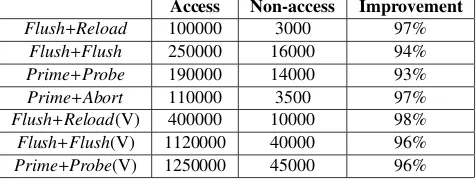
For a fair comparison between the access and our non-access approach, we have also retrieved the key for the access approach considering the key of 128 bits. Table4shows the results for both approaches and the percentage of improvement regarding the number of traces required to successfully retrieve the secret key. In all cases the number of samples is reduced significantly.
Table 4. Mean number of samples required to retrieve the whole 128 bits key with the access approach (first column), our approach (second column) and the improvement our approach means. (V) means virtualized scenario.
Access Non-access Improvement Flush+Reload 100000 3000 97%
Flush+Flush 250000 16000 94% Prime+Probe 190000 14000 93% Prime+Abort 110000 3500 97% Flush+Reload(V) 400000 10000 98% Flush+Flush(V) 1120000 40000 96% Prime+Probe(V) 1250000 45000 96%
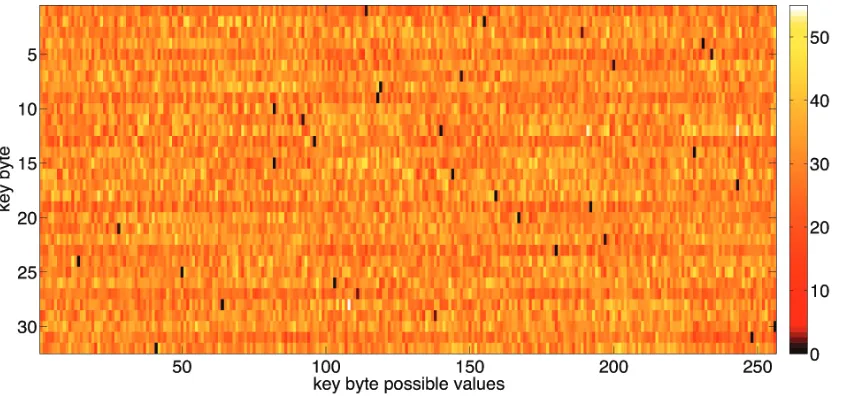
Figure 4.Color map of discarding scores distribution for the 32 bytes of the key retrieved with the Flush+Reload technique. Correct key values are the darkest ones.
We have been able to completely recover the full AES 256 key using the EBD attack. If we compare the number of traces required to obtain the 128 bit key and the number of traces required to obtain the 256 bit key, AES-256 happens to be only 3 times harder to attack with our approach. The different probabilities of non-accessing a line explain our results: 2.69% for AES-256 and 7.5% for AES-128, that is in theory 2,8x more encryptions are needed to get the same information. These results allow us to discuss the results in [49]. They state that although larger key lengths translate into an exponential increase in the complexity of a brute force approach this can not be applied to side-channel attacks. Also using the two last rounds of the encryption algorithm (a version that uses a different table for computing the last round of the encryption), they arrive at the conclusion that AES-256 only provides an increase in complexity of 6 to 7 compared to cache-based attacks on AES-128.
In the case of the EBD attack, we have not found similar results or experimental setups to compare with. All the studied attacks can be described as eminently theoretical. On the literature, Aciiçmez et al [50] stated that their attack can be applied to the second round of the encryption, but they do not provide experimental results. In 2009, Biryukov et al [51] presented a distinguisher and related key attack on AES-256 with 2131 data complexity. Later on, they slightly improved their results in [52], achieving 2119data complexity. In [53] they describe an attack using two related keys to recover the 256-bit key, but their target cipher was the 9-round version of AES-256 and uses chosen-plaintexts. Another attack [54] runs in a related-subkey scenario with four related keys targeting the 13-round AES-256, it has 276time and data complexity. Bogdanov et al. [55] presented a technique of cryptanalysis with bicliques, also leading to a non-practical complexity recovering the key. Kim [56] explained also theoretically how to apply differential fault analysis to reduce the required number of faults in AES-192 and AES-256.
0 0.5 1 1.5 2 2.5 3 x 10⁴ 0
20 40 60 80 100 120
Number of samples
Unknown bits
AES 128 AES 128 VM AES 256 AES 256 VM
Figure 5.Key bits that remain unknown after each encryption for the Flush+Reload technique
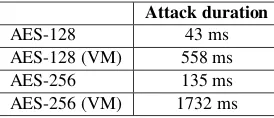
To put this data in context, we have also measured the time the two processes (victim and attacker) need to interact until we are able to obtain the full key. This time is referred to the measurement collection step, since the information processing is performed outline. Table5shows these mean times.
Table 5.Mean times required for gathering the data of figure5
Attack duration
AES-128 43 ms
AES-128 (VM) 558 ms
AES-256 135 ms
AES-256 (VM) 1732 ms
Assuming the number of collected samples varies linearly with the time, these results show that if we want to detect such attacks before they succeed it is necessary to act fast. Detection times have to be in the order of milliseconds. And even with detection times of 10ms, around half of the key will be leaked.
5. Conclusions
The massive adoption of cloud computing has introduced numerous advantages, but also new challenging security and privacy risks. One of these risks is the information leakage derived from resource sharing among VMs and, specifically, from the shared cache memory. This risk is also present in non-virtualized environments where all the running processes share the cache.
This work introduces a novel approach to exploit the information gained from the cache by means of existing cache attacks:Flush+Reload,Flush+Flush,Prime+ProbeandPrime+Abort. We focus on the cache lines that have not been used and target the AES T-Table implementation to prove our point. Even when the T-table version of the AES algorithm is known to be vulnerable to side-channel attacks, it is still available in newer OpenSSL versions (compiling with the no-asm flag). Using the non-access attack we demonstrate a reduction that varies from the 93% to the 98% in the amount of encryptions required to obtain an AES-128 key. This improvement is crucial in order to develop a practical attack on real servers, where the AES key is usually a session key; i.e. it is periodically renewed using key-exchange algorithms. Besides, we demonstrate that if there is a detection system trying to detect cache attacks running, the amount of leaked information will depend on the detection time, but our approach recovers information since the very beginning of the attack.
not been used. For the second stage, EBD takes the 128-bit subkey obtained in the first stage and uses it with the decryption function (perform part of an AES decryption) to reach an state equivalent to an encryption state from which the non-accessed lines can serve to obtain the remaining 128 bits of the key. Our results show that AES-256 is only 3 times harder to attack than AES-128.
Author Contributions: Conceptualization, Samira Briongos, Pedro Malagón, Juan-Mariano de Goyeneche and Jose M. Moya; Data curation, Samira Briongos; Funding acquisition, Samira Briongos and Jose M. Moya; Investigation, Samira Briongos; Methodology, Samira Briongos and Pedro Malagón; Software, Samira Briongos; Supervision, Jose M. Moya; Writing – original draft, Samira Briongos and Pedro Malagón; Writing – review & editing, Juan-Mariano de Goyeneche.
Funding:This research was funded by Spanish Ministry of Economy and Competitiveness grant numbers TIN-2015-65277-R, AYA2015-65973-C3-3-R and RTC-2016-5434-8.
Conflicts of Interest:The authors declare no conflict of interest.
1. Osvik, D.A.; Shamir, A.; Tromer, E. Cache Attacks and Countermeasures: The Case of AES. Topics in Cryptology -CT-RSA. Springer, 2006, Vol. 3860,LNCS, pp. 1–20. doi:10.1007/11605805_1.
2. Yarom, Y.; Falkner, K. FLUSH+RELOAD: A High Resolution, Low Noise, L3 Cache Side-Channel Attack. USENIX Security Symposium. USENIX Association, 2014, pp. 719–732.
3. Gruss, D.; Maurice, C.; Wagner, K. Flush+Flush: A Stealthier Last-Level Cache Attack.CoRR2015,abs/1511.04594. 4. Disselkoen, C.; Kohlbrenner, D.; Porter, L.; Tullsen, D. Prime+Abort: A Timer-Free High-Precision L3 Cache Attack using Intel TSX. 26th USENIX Security Symposium (USENIX Security 17); USENIX Association: Vancouver, BC, 2017; pp. 51–67.
5. Bernstein, D.J. Cache-timing attacks on AES2005.
6. Weiß, M.; Heinz, B.; Stumpf, F. A Cache Timing Attack on AES in Virtualization Environments. International Conference on Financial Cryptography and Data Security - FC. Springer, 2012, Vol. 7398,LNCS, pp. 314–328. doi:10.1007/978-3-642-32946-3_23.
7. Brumley, B.B.; Hakala, R.M. Cache-Timing Template Attacks. Advances in Cryptology - ASIACRYPT. Springer, 2009, Vol. 5912,LNCS, pp. 667–684. doi:10.1007/978-3-642-10366-7_39.
8. Chen, C.; Wang, T.; Kou, Y.; Chen, X.; Li, X. Improvement of trace-driven I-Cache timing attack on the {RSA} algorithm.Journal of Systems and Software2013,86, 100 – 107. doi:http://dx.doi.org/10.1016/j.jss.2012.07.020. 9. Inci, M.S.; Gulmezoglu, B.; Irazoqui, G.; Eisenbarth, T.; Sunar, B. Seriously, get offmy cloud! Cross-VM RSA Key
Recovery in a Public Cloud. Technical report, IACR Cryptology ePrint Archive, 2015.
10. Irazoqui, G.; Eisenbarth, T.; Sunar, B. Cross Processor Cache Attacks. IACR Cryptology ePrint Archive2015, 2015, 1155.
11. Lipp, M.; Gruss, D.; Spreitzer, R.; Mangard, S. ARMageddon: Last-Level Cache Attacks on Mobile Devices.CoRR 2015,abs/1511.04897.
12. Green, M.; Rodrigues-Lima, L.; Zankl, A.; Irazoqui, G.; Heyszl, J.; Eisenbarth, T. AutoLock: Why Cache Attacks on ARM Are Harder Than You Think. 26th USENIX Security Symposium (USENIX Security 17); USENIX Association: Vancouver, BC, 2017; pp. 1075–1091.
13. Ristenpart, T.; Tromer, E.; Shacham, H.; Savage, S. Hey, you, get offof my cloud: exploring information leakage in third-party compute clouds. ACM Conference on Computer and Communications Security, CCS. ACM, 2009, pp. 199–212. doi:10.1145/1653662.1653687.
14. Zhang, Y.; Juels, A.; Oprea, A.; Reiter, M.K. HomeAlone: Co-residency Detection in the Cloud via Side-Channel Analysis. IEEE Symposium on Security and Privacy, S&P, 2011, pp. 313–328. doi:10.1109/SP.2011.31.
15. Wang, Z.; Lee, R.B. New Cache Designs for Thwarting Software Cache-based Side Channel Attacks. Proceedings of the 34th Annual International Symposium on Computer Architecture; ACM: New York, NY, USA, 2007; ISCA ’07, pp. 494–505. doi:10.1145/1250662.1250723.
16. Kim, T.; Peinado, M.; Mainar-Ruiz, G. STEALTHMEM: System-Level Protection Against Cache-Based Side Channel Attacks in the Cloud. Presented as part of the 21st USENIX Security Symposium (USENIX Security 12); USENIX: Bellevue, WA, 2012; pp. 189–204.
18. Briongos, S.; Malagón, P.; Risco-Martín, J.L.; Moya, J.M. Modeling Side-channel Cache Attacks on AES. Proceedings of the Summer Computer Simulation Conference; Society for Computer Simulation International: San Diego, CA, USA, 2016; SCSC ’16, pp. 37:1–37:8.
19. Chiappetta, M.; Savas, E.; Yilmaz, C. Real time detection of cache-based side-channel attacks using hardware performance counters. Applied Soft Computing2016,49, 1162 – 1174.
20. Zhang, T.; Zhang, Y.; Lee, R.B., CloudRadar: A Real-Time Side-Channel Attack Detection System in Clouds. In Research in Attacks, Intrusions, and Defenses: 19th International Symposium, RAID 2016, Paris, France, September 19-21, 2016, Proceedings; Monrose, F.; Dacier, M.; Blanc, G.; Garcia-Alfaro, J., Eds.; Springer International Publishing: Cham, 2016; pp. 118–140. doi:10.1007/978-3-319-45719-2\_6.
21. Briongos, S.; Irazoqui, G.; Malagón, P.; Eisenbarth, T. CacheShield: Detecting Cache Attacks Through Self-Observation. Proceedings of the Eighth ACM Conference on Data and Application Security and Privacy; ACM: New York, NY, USA, 2018; CODASPY ’18, pp. 224–235. doi:10.1145/3176258.3176320.
22. Maurice, C.; Le Scouarnec, N.; Neumann, C.; Heen, O.; Francillon, A. Reverse Engineering Intel Last-Level Cache Complex Addressing Using Performance Counters. Research in Attacks, Intrusions, and Defenses; Bos, H.; Monrose, F.; Blanc, G., Eds.; Springer International Publishing: Cham, 2015; pp. 48–65.
23. Irazoqui, G.; Eisenbarth, T.; Sunar, B. Systematic Reverse Engineering of Cache Slice Selection in Intel Processors. 2015 Euromicro Conference on Digital System Design, DSD 2015, Madeira, Portugal, August 26-28, 2015, 2015, pp. 629–636. doi:10.1109/DSD.2015.56.
24. Arcangeli, A.; Eidus, I.; Wright, C. Increasing memory density by using KSM. OLS ’09: Proceedings of the Linux Symposium, 2009, pp. 19–28.
25. Kernel Samepage Merging. http://kernelnewbies.org/Linux_2_6_32#head-d3f32e41df508090810388a57efce73f52660ccb/, 2015.
26. Hu, W. Lattice scheduling and covert channels. IEEE Symposium on Research in Security and Privacy. IEEE Computer Society, 1992, pp. 52–61. doi:10.1109/RISP.1992.213271.
27. Kocher, P.C. Timing Attacks on Implementations of Diffie-Hellman, RSA, DSS, and Other Systems. Advances in Cryptology - CRYPTO. Springer, 1996, Vol. 1109,LNCS, pp. 104–113. doi:10.1007/3-540-68697-5_9.
28. Kelsey, J.; Schneier, B.; Wagner, D.; Hall, C. Side Channel Cryptanalysis of Product Ciphers. Journal of Computer Security2000,8, 141–158.
29. Page, D. Theoretical Use of Cache Memory as a Cryptanalytic Side-Channel.IACR Cryptology ePrint Archive2002, 2002, 169.
30. Tsunoo, Y.; Saito, T.; Suzaki, T.; Shigeri, M.; Miyauchi, H. Cryptanalysis of DES Implemented on Computers with Cache. Cryptographic Hardware and Embedded Systems - CHES. Springer, 2003, Vol. 2279,LNCS, pp. 62–76. doi:10.1007/978-3-540-45238-6_6.
31. Irazoqui, G.; Inci, M.S.; Eisenbarth, T.; Sunar, B. Fine grain Cross-VM Attacks on Xen and VMware are possible! IACR Cryptology ePrint Archive2014,2014, 248.
32. Percival, C. Cache missing for fun and profit. Proc. of BSDCan 2005, 2005.
33. Gullasch, D.; Bangerter, E.; Krenn, S. Cache Games - Bringing Access-Based Cache Attacks on AES to Practice. IEEE Symposium on Security and Privacy, S&P, 2011, pp. 490–505. doi:10.1109/SP.2011.22.
34. Gruss, D.; Spreitzer, R.; Mangard, S. Cache Template Attacks: Automating Attacks on Inclusive Last-Level Caches. USENIX Security Symposium, 2015, pp. 897–912.
35. Irazoqui, G.; Inci, M.S.; Eisenbarth, T.; Sunar, B. Lucky 13 Strikes Back. Proceedings of the 10th ACM Symposium on Information, Computer and Communications Security; ACM: New York, NY, USA, 2015; ASIA CCS ’15, pp. 85–96. doi:10.1145/2714576.2714625.
36. Irazoqui, G.; Inci, M.S.; Eisenbarth, T.; Sunar, B. Wait a Minute! A fast, Cross-VM Attack on AES. Research in Attacks, Intrusions and Defenses Symposium, RAID. Springer, 2014, Vol. 8688, LNCS, pp. 299–319. doi:10.1007/978-3-319-11379-1_15.
37. Yarom, Y.; Benger, N. Recovering OpenSSL ECDSA Nonces Using the FLUSH+RELOAD Cache Side-channel Attack.IACR Cryptology ePrint Archive2014,2014, 140.
38. Irazoqui, G.; Inci, M.S.; Eisenbarth, T.; Sunar, B. Know Thy Neighbor: Crypto Library Detection in Cloud. PoPETs 2015,2015, 25–40.
40. Kulah, Y.; Dincer, B.; Yilmaz, C.; Savas, E. SpyDetector: An approach for detecting side-channel attacks at runtime. International Journal of Information Security2018. doi:10.1007/s10207-018-0411-7.
41. Liu, F.; Yarom, Y.; Ge, Q.; Heiser, G.; Lee, R.B. Last-Level Cache Side-Channel Attacks are Practical. IEEE Symposium on Security and Privacy, S&P, 2015, pp. 605–622. doi:10.1109/SP.2015.43.
42. Acıiçmez, O.; Schindler, W. A Vulnerability in RSA Implementations Due to Instruction Cache Analysis and its Demonstration on OpenSSL. InTopics in Cryptology–CT-RSA 2008; Springer, 2008; pp. 256–273.
43. Yarom, Y.; Ge, Q.; Liu, F.; Lee, R.B.; Heiser, G. Mapping the Intel Last-Level Cache. IACR Cryptology ePrint Archive2015,2015, 905.
44. Apecechea, G.I.; Eisenbarth, T.; Sunar, B. S$A: A Shared Cache Attack That Works across Cores and Defies VM Sandboxing - and Its Application to AES. 2015 IEEE Symposium on Security and Privacy, SP 2015, San Jose, CA, USA, May 17-21, 2015, 2015, pp. 591–604. doi:10.1109/SP.2015.42.
45. ˙Inci, M.S.; Gulmezoglu, B.; Irazoqui, G.; Eisenbarth, T.; Sunar, B. Cache Attacks Enable Bulk Key Recovery on the Cloud. Cryptographic Hardware and Embedded Systems – CHES 2016: 18th International Conference, Santa Barbara, CA, USA, August 17-19, 2016, Proceedings; Gierlichs, B.; Poschmann, A.Y., Eds., 2016.
46. Daemen, J.; Rijmen, V.The Design of Rijndael: AES - The Advanced Encryption Standard; Information Security and Cryptography, Springer, 2002. doi:10.1007/978-3-662-04722-4.
47. Gülmezoglu, B.; Inci, M.S.; Irazoqui, G.; Eisenbarth, T.; Sunar, B. A Faster and More Realistic Flush+Reload Attack on AES. International Workshop on Constructive Side-Channel Analysis and Secure Design - COSADE. Springer, 2015, Vol. 9064,LNCS, pp. 111–126. doi:10.1007/978-3-319-21476-4_8.
48. Intel. Intel®64 and IA-32 Architectures Optimization Reference Manual (Section 2.1.1.2), 2017.https://software. intel.com/sites/default/files/managed/9e/bc/64-ia-32-architectures-optimization-manual.pdf.
49. Neve, M.; Tiri, K. On the complexity of side-channel attacks on AES-256 - methodology and quantitative results on cache attacks.IACR Cryptology ePrint Archive2007,2007, 318.
50. Aciiçmez, O.; Schindler, W.; Koç, Ç.K. Cache Based Remote Timing Attack on the AES. Topics in Cryptology – CT-RSA. Springer, 2007, Vol. 4377,LNCS, pp. 271–286. doi:10.1007/11967668_18.
51. Biryukov, A.; Khovratovich, D.; Nikoli´c, I. Distinguisher and Related-Key Attack on the Full AES-256. Annual International Cryptology Conference on Advances in Cryptology. Springer, 2009, CRYPTO, pp. 231–249. doi:10.1007/978-3-642-03356-8_14.
52. Biryukov, A.; Khovratovich, D. Related-key Cryptanalysis of the Full AES-192 and AES-256. Cryptology ePrint Archive, Report 2009/317, 2009.http://eprint.iacr.org/.
53. Biryukov, A.; Dunkelman, O.; Keller, N.; Khovratovich, D.; Shamir, A. Key Recovery Attacks of Practical Complexity on AES-256 Variants with up to 10 Rounds. Advances in Cryptology - EUROCRYPT. Springer, 2010, Vol. 6110, LNCS, pp. 299–319. doi:10.1007/978-3-642-13190-5_15.
54. Biryukov, A.; Khovratovich, D. Feasible Attack on the 13-round AES-256, 2010. [email protected], [email protected] 14734 received 5 May 2010.
55. Bogdanov, A.; Khovratovich, D.; Rechberger, C. Biclique Cryptanalysis of the Full AES. Advances in Cryptology -ASIACRYPT. Springer, 2011, Vol. 7073,LNCS, pp. 344–371. doi:10.1007/978-3-642-25385-0_19.