Project Watching the Sky: a playful and
constructivist approach in the practice of night
sky observation to 2
ndgrade elementary school
students in the city of Santo André
Marcos Rincon Voelzke¹,Rachel Zuchi Faria², Marcos Pedroso 2, Christiane Jacinto2, and Luiz Claudio Pereira da Silva2
¹Universidade Cruzeiro do Sul, 01506-000, Brasil & Institut für Geohysik und extraterrestrische Physik – Technische Universität Braunschweig, 38106, Germany
²Planetário Johannes Kepler, IPRODESC, 04542-000, Brazil
Abstract. Currently, the population shows a growing interest in astronomy-related content. The contact with informal spaces, such as planetariums and observatories, can help to better problematize the subject with children and adults. This paper presents the proposal made by the Johannes Kepler Planetarium to introduce astronomy in a playful way for elementary school students in the city of Santo André.
1 Introduction
Brazil’s population nowadays has shown an increasing interest in astronomy-related content. Individuals not only want to know better astronomical phenomena, but also to have personal explanations for what happens [1].
Knowledge about astronomy goes beyond the curiosity shown by the population, as it is a theme that presents diverse perspectives relevant to society itself. The technological frontier, the interface between the natural sciences and mathematics, and the cultural aspects are examples of these perspectives [2].
With such a wide range, astronomy learning and study becomes essential for the whole society. Astronomy teaching can take place in different ways, such as formal education, informal education and in activities denominated popularization of science [3].
Astronomy-related topics arouse many people’s interest, even those who have little scientific knowledge, so the dissemination and teaching of astronomy, with its interdisciplinary potential, becomes a relevant tool in what concerns knowledge areas [4].
As astronomy presents various and mostly complex themes, teaching the astronomy concept to children is a challenge. Children cannot connect this information with other experiences in the real world around them in order to create a coherent mental structure to explain the phenomena [1]. This kind of reality favors disinterest because it hinders the meaning and relation between scientific contents. This problem occurs among students [5].
unconventional of those found in formal spaces of education [6]. The informal spaces can, for example, assist a teacher to work in practice a theory studied in classroom [7]. These environments are the key element for astronomy dissemination, because even with the public showing great interest in the subject, the population is still unaware about the reasons for basic phenomena, such as the Earth-Moon-Sun system [8]. In this way, places that allow astronomy dissemination can also help with the education related to the subject, if they plan their participation in the teaching and learning process in an appropriate way. Considering the existing problem in the population regarding the understanding of astronomical issues, the current paper will present the proposal made by the Johannes Kepler Planetarium for introducing astronomy in a playful way to 2nd grade elementary school students in the city of Santo André in Brazil.
2 The Johannes Kepler Planetarium
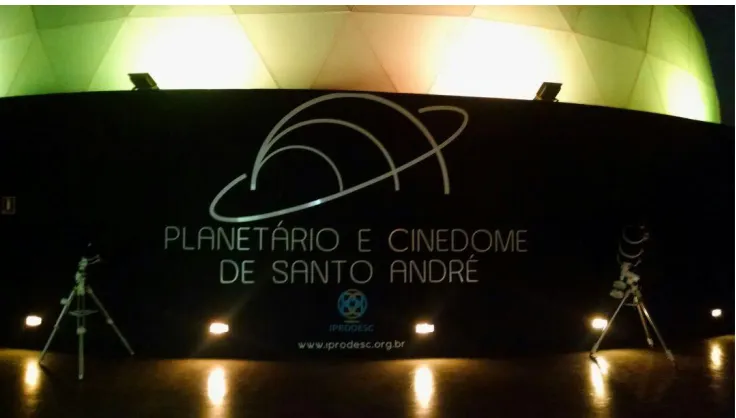
The Johannes Kepler Planetarium (Figure 1) is located at the SABINA Escola Parque do Conhecimento in the city of Santo André, Brazil. The planetarium has a projection room with a Star Master projector, manufactured by the German company Carl Zeiss, and two Sony digital projectors. Besides the projection room, it also has an Astronomic Laboratory divided by knowledge areas related to Astronomy and Astronautics content, which are: Sun-Earth-Moon System, Solar System, Space Age, Stellar Evolution, Brazilian Flag and Southern Cross Constellation.
Inaugurated on April 2012, the Johannes Kepler Planetarium has been playing a key role in the teaching and dissemination of astronomy in the city of Santo André and the surrounding region. Programs take place during the week for schools and on the weekends for the public.
unconventional of those found in formal spaces of education [6]. The informal spaces can, for example, assist a teacher to work in practice a theory studied in classroom [7]. These environments are the key element for astronomy dissemination, because even with the public showing great interest in the subject, the population is still unaware about the reasons for basic phenomena, such as the Earth-Moon-Sun system [8]. In this way, places that allow astronomy dissemination can also help with the education related to the subject, if they plan their participation in the teaching and learning process in an appropriate way. Considering the existing problem in the population regarding the understanding of astronomical issues, the current paper will present the proposal made by the Johannes Kepler Planetarium for introducing astronomy in a playful way to 2nd grade elementary school students in the city of Santo André in Brazil.
2 The Johannes Kepler Planetarium
The Johannes Kepler Planetarium (Figure 1) is located at the SABINA Escola Parque do Conhecimento in the city of Santo André, Brazil. The planetarium has a projection room with a Star Master projector, manufactured by the German company Carl Zeiss, and two Sony digital projectors. Besides the projection room, it also has an Astronomic Laboratory divided by knowledge areas related to Astronomy and Astronautics content, which are: Sun-Earth-Moon System, Solar System, Space Age, Stellar Evolution, Brazilian Flag and Southern Cross Constellation.
Inaugurated on April 2012, the Johannes Kepler Planetarium has been playing a key role in the teaching and dissemination of astronomy in the city of Santo André and the surrounding region. Programs take place during the week for schools and on the weekends for the public.
Figure 1. The Johannes Kepler planetarium.
3 Programs for schools
A script is created for the program and it may or not involve one or two areas of the Astronomic Laboratory, a planetarium session and a workshop. The script choice for the attendance considers the children’s age range.
Before implementing any kind of attendance for schools, a pilot project is conducted, where some municipal schools of the city of Santo André are invited to participate. The teachers of the participating schools make an evaluation of the project and, if it is well evaluated, it is implemented.
Hereafter one of these pilot projects is presented. This pilot project happened between September and November 2014 with 2nd grade students of the municipal schools of Santo André.
3.1 The project to 2nd grade students
From the fifty-one municipal schools, thirteen took part, sending twenty-one classes, totaling five hundred and twenty one students who attended the project.
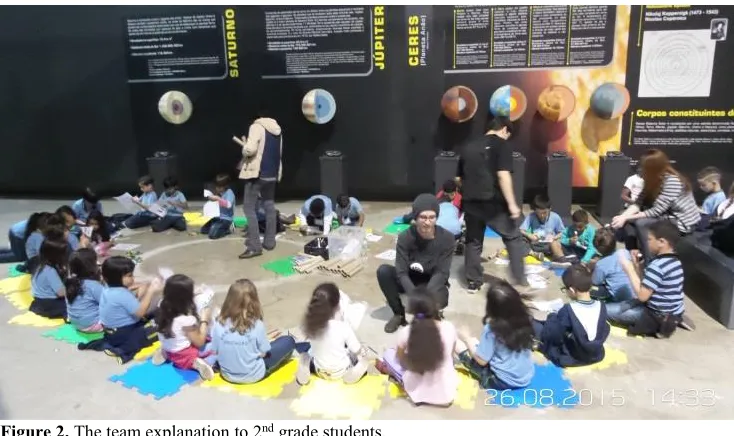
Upon arriving at the planetarium, as a conversation, the students receive a brief explanation about astronomy (Figure 2), mainly related to the subjects that they will see in the planetarium session, about of the some characteristics of the planets that are visible by the naked eye in the sky and which constellations represent each season of the year.
.
After the explanation, the students are invited to carry out two activities that allow a better visualization of the contents they just have met during the conversation and initial explanation. These activities are:
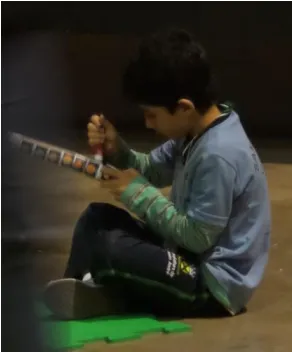
“My first spyglass” (Figure 3): Students receive a sheet containing astronomical images and a tube of cardboard. The planets visible at naked eye, the Moon and the Sun contained in the images are presented and briefly explained while the students are instructed to paint and cut them and then glue them as they prefer in the cardboard tube that thus will be transformed into an spyglass. After the discussion of the celestial objects and
the assembly of the spyglass the children will have the opportunity to use it inside the projection room;
“Creating my constellations” (Figure 4): on this activity some concepts about constellations are presented in a playful way to complement the contents that will be presented at the planetarium session. The students receive a book with images of the constellations that symbolize the year’s seasons for the southern hemisphere and can do the skeptical drawing of them (asterism) connecting the points that represent their stars. In addition, they will also have the opportunity to create their own constellations using the same configuration as the stars displayed.
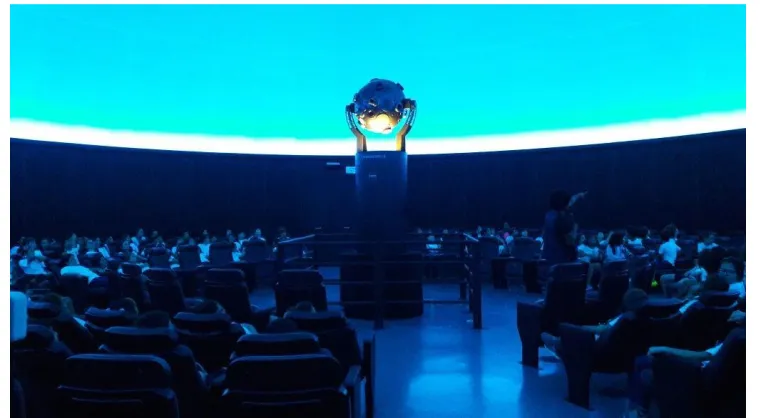
Once the activities have been completed, the students see the planetarium session “Watching the Sky” (Figure 5) to learn more about the sky observation. During the planetarium session the narrator will present the stars and planets and will invite the students to use their imaginary spyglass pointing to the indicated celestial objects and visualize them.
Figure 3. A student doing the activity
“my first spyglass”.
the assembly of the spyglass the children will have the opportunity to use it inside the projection room;
“Creating my constellations” (Figure 4): on this activity some concepts about constellations are presented in a playful way to complement the contents that will be presented at the planetarium session. The students receive a book with images of the constellations that symbolize the year’s seasons for the southern hemisphere and can do the skeptical drawing of them (asterism) connecting the points that represent their stars. In addition, they will also have the opportunity to create their own constellations using the same configuration as the stars displayed.
Once the activities have been completed, the students see the planetarium session “Watching the Sky” (Figure 5) to learn more about the sky observation. During the planetarium session the narrator will present the stars and planets and will invite the students to use their imaginary spyglass pointing to the indicated celestial objects and visualize them.
Figure 3. A student doing the activity
“my first spyglass”.
Figure 4. A student doing the activity “Creating my constellations”.
Figure 5. The students seeing the planetarium session “Watching the Sky”.
By the end of the session, the class is finished. During the schools visit to the planetarium, the teachers received a survey to evaluate the pilot project.
3.2 The surveys about the project
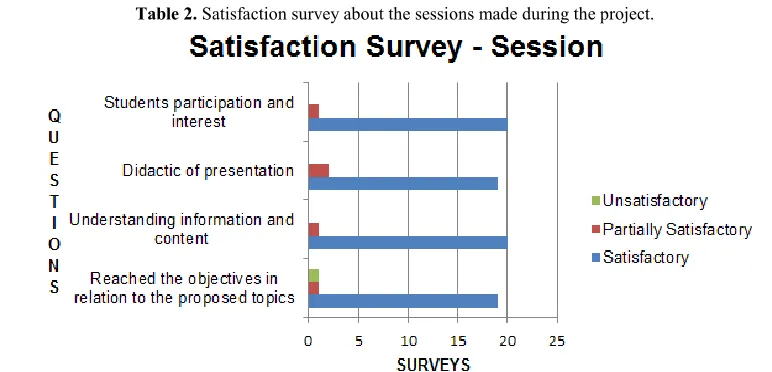
The evaluation of the research items classify them into satisfactory, partially satisfactory or unsatisfactory.
The results about the activities were a satisfactory rate of 100% considering the used resources; and 95% satisfactory, considering the others aspects (Table 1).
Table 1. Satisfaction survey about the activities did during the project.
Table 2. Satisfaction survey about the sessions made during the project.
Upon the approval, the pedagogical team included definitively this program into their agenda.
4 Conclusions
Nowadays it is known that the population has great curiosity on astronomy subjects and during the project execution, it was possible to see the children's interest in learning this theme.
Both the proposed activities and the session presented to the students created a greater involvement of the students and allowed learning in a playful and engaging way, especially when the students are invited during the session to use the spyglass they had done.
The possibility of making the spyglasses at the workshop allowed the students approach the developed contents, so they could appropriate the discussions and create a learning environment with meaning.
During the session the students had a practical contact with the astronomic phenomena, also developed the experience of celestial objects observation and contemplation. Besides the dynamics that happened at the planetarium the students had contact with every technological apparatus existing in that space.
The great satisfaction shown in the evaluations answered by the teachers reinforce the conclusions already pointed out, showing that the planetarium team managed to reach the objective of their project.
Since the beginning of this program, the contact with schools that realized this attendance at the planetarium was extremely restrict. However, starting in 2018, a new program that allow expand the contact with schools and improve the existing attendances will be implemented. In this new program, we will take actions guiding teachers to prepare the students for the lesson that will happen in the planetarium, suggesting videos and readings that should be done in classroom. During the students' stay at the planetarium the subjects raised in classroom will be reinforced and clarified when necessary by the team. After the visit to the space, the students will be invited to answer questions referring to the subject on an online platform so the planetarium team can have data to make an analysis if the applied model generates a meaningful learning.
Table 2. Satisfaction survey about the sessions made during the project.
Upon the approval, the pedagogical team included definitively this program into their agenda.
4 Conclusions
Nowadays it is known that the population has great curiosity on astronomy subjects and during the project execution, it was possible to see the children's interest in learning this theme.
Both the proposed activities and the session presented to the students created a greater involvement of the students and allowed learning in a playful and engaging way, especially when the students are invited during the session to use the spyglass they had done.
The possibility of making the spyglasses at the workshop allowed the students approach the developed contents, so they could appropriate the discussions and create a learning environment with meaning.
During the session the students had a practical contact with the astronomic phenomena, also developed the experience of celestial objects observation and contemplation. Besides the dynamics that happened at the planetarium the students had contact with every technological apparatus existing in that space.
The great satisfaction shown in the evaluations answered by the teachers reinforce the conclusions already pointed out, showing that the planetarium team managed to reach the objective of their project.
Since the beginning of this program, the contact with schools that realized this attendance at the planetarium was extremely restrict. However, starting in 2018, a new program that allow expand the contact with schools and improve the existing attendances will be implemented. In this new program, we will take actions guiding teachers to prepare the students for the lesson that will happen in the planetarium, suggesting videos and readings that should be done in classroom. During the students' stay at the planetarium the subjects raised in classroom will be reinforced and clarified when necessary by the team. After the visit to the space, the students will be invited to answer questions referring to the subject on an online platform so the planetarium team can have data to make an analysis if the applied model generates a meaningful learning.
This type of approach shows how important informal spaces, such as the planetarium, can be to help teachers in their teaching practice, as environments such as these provide a different interactivity allowing students an encouraging and challenging experience.
Planetariums and observatories can be entertaining, but they can also actively participate and contribute to student learning, especially with the astronomy teaching and related sciences.
References
1. A. L. Scarinci, J. L. A. Pacca, RBEF, 28, 89-99 (2006) 2. B. L’Astorina, Ciên. e Cult., 61, 50-50 (2009)
3. R .Langhi.; R Nardi, RBEF 31, 4402-1 – 4401-10 (2009)
4. E. A. M Gonzalez et al., A Astronomia como ferramenta motivadora no ensino das ciências. In: Congresso Brasileiro de Extensão Universitária, 2. 2004, Belo Horizonte.
Proceedings... Belo Horizonte UFMG, 2004. Available in:
<http://www.ufmg.br/congrext/Educa/Educa5.pdf>. 5. A.V. Maltese, R.H. Tai, IJSE. 32, 669-685 (2010) 6. L. D. Dierking, Hist., Ciênc., Saúde, 12, 145-160 (2005)
7. M. Marandino, (2001) O conhecimento biológico nos museus de ciências: análise do processo de construção do discurso expositivo. PhD.-thesis, University of São Paulo, São Paulo.