This is the Full Version of the Extended Abstract that appears
in the Proceedings of the 18th International Conference on Practice and Theory in Public-Key Cryptography (PKC ’15) (30 March – 1 April 2015, Gaithersburg, Maryland, USA)
Jonathan Katz Ed., Springer-Verlag, LNCS 9020, pages 77–100.
Divisible E-Cash Made Practical
S´ebastien Canard1, David Pointcheval2, Olivier Sanders1,2 and Jacques Traor´e1
1
Orange Labs, Applied Crypto Group, Caen, France 2 Ecole normale sup´´ erieure, CNRS, INRIA, and PSL, Paris, France
Abstract. Divisible E-cash systems allow users to withdraw a unique coin of value 2n from a bank, but then to spend it in several times to distinct merchants. In such a system, whereas users want anonymity of their transactions, the bank wants to prevent, or at least detect, double-spending, and trace the defrauders. While this primitive was introduced two decades ago, quite a few (really) anonymous constructions have been introduced. In addition, all but one were just proven secure in the random oracle model, but still with either weak security models or quite complex settings and thus costly constructions. The unique proposal, secure in the standard model, appeared recently and is unpractical. As evidence, the authors left the construction of an efficient scheme secure in this model as an open problem.
In this paper, we answer it with the first efficient divisible E-cash system secure in the standard model. It is based on a new way of building the coins, with a unique and public global tree structure for all the coins. Actually, we propose two constructions: a very efficient one in the random oracle model and a less efficient, but still practical, in the standard model. They both achieve constant time for withdrawing and spending coins, while allowing the bank to quickly detect double-spendings by a simple comparison of the serial numbers of deposited coins to the ones of previously spent coins.
1 Introduction
Electronic Cash (E-cash), introduced by Chaum [Cha82,Cha83], is the digital analogue of regular money. It allows users to withdraw coins from a bank and to spend them to merchants, in an anonymous way, thus perfectly emulating conventional cash transactions.
Unfortunately, with E-cash, as any digital data, coins can easily be duplicated, and thus spent several times. It is therefore essential to be able to detect double-spending and even to identify the defrauders. As for group signatures [BMW03,BSZ05], one solution could be to give to a specific entity the ability of revoking anonymity for any transaction of his choice. However, such an approach (called
fair E-cash [BGK95,SPC95]) weakens the anonymity of the scheme because, ideally, user’s privacy should be guaranteed as long as the user is honest. Moreover, such an entity should be trusted by all the users or distributed among a large group of authorities, which makes the tracing procedure, in case of fraud, quite costly.
E-cash systems achieve their ultimate goal when the user’s side of the protocol is implemented on a mobile device (e.g.a smartphone). However, the limited power of such devices along with the strong time constraints of electronic transactions require very efficient withdrawal and spending procedures. Moreover, even if the bank is more powerful than the users, it has to centralize a huge number of transactions, and thus double-spending detection should be made as efficient as possible. Reconciling security requirements with efficiency is therefore the main challenge when designing E-cash systems.
1.1 Related Work
Divisible E-Cash Systems. The purpose of divisible E-cash systems is to address this problem of splitting coins of large values. As above, users withdraw a large coin of value 2n (or withdraw 2n coins at once), but can spend it in several times by dividing it (or spend several coins at once): more concretely, one can spend a coin of value 2`, for any 0≤`≤n, at once, instead of spending 2` unitary coins, which is clearly much more efficient.
Since their introduction, many schemes have been proposed [OO91,Oka95,CFT98,NS00] but they only achieved quite weak levels of anonymity. Indeed, transactions involving the same coin (from the same withdrawal) were all linkable, except with [NS00], which however still reveals which part of the coin is spent (which is not compatible with the highest security notion) and in addition requires a trusted authority to recover spenders’ identities.
Canard and Gouget [CG07] introduced the first truly anonymous E-cash system. Unfortunately, it makes use of complex zero-knowledge proofs of knowledge (ZKPK) and of groups of different but related orders, whose generation requires a huge computational power. Despite its inefficiency (pointed out in [ASM08,CG10]) this system was a proof of concept: a “truly” anonymous divisible E-cash system is possible. Au, Susilo, and Mu [ASM08] proposed a more efficient scheme but at the cost of an unconventional security model where the bank is only ensured that it will not loose money on average (provided that it can legally impose fines on users, which is not necessarily the case). Canard and Gouget [CG10] later proposed another construction, but still with groups of different orders, leading to rather inefficient ZKPK. All these schemes were proven secure in the random oracle model (ROM) [BR93]. More recently, Izabach`ene and Libert [IL12] provided the first construction with security proven in the standard model. However their construction is rather inefficient, especially the deposit phase whose computational cost for the bank depends on the number of previously deposited coins with a pairing computation between every new coin and every past coin. Such a downside makes the scheme impractical, leading the authors to leave the construction of an efficient scheme secure in the standard model as an open problem.
1.2 Our Contribution
In this paper, we address this open problem, with the firstreally efficient divisible E-cash system. It can be designed either in the ROM or the standard model. Our main contribution is a new way for building the serial numbers. As noticed in [IL12], the use of serial numbers is indeed the best approach for the bank to quickly detect double-spending.
In previous solutions [CG07,ASM08,CG10], every divisible coin is associated with a binary tree whose nodes correspond to expendable amounts. When a user withdraws a coin, he selects a random number k associated with the root of the tree and then computes, for each internal node s, the corresponding numberks, usingkand a one-way function. The user then obtains signatures on these numbers (or on elements accumulating them) from the bank and defines the coin to be the binary tree along with the signatures. However, to ensure that the user will not spend more than the amount he has withdrawn, he will have to prove (either during the spending or the withdrawal protocol) that the tree (and so the numbersks) is well-formed. Unfortunately, the construction from [ASM08] is not compatible with any zero-knowledge proof construction because the numbersksare computed using a hash function, modeled as a random oracle. The authors therefore proposed acut-and-choose method to detect cheaters which leads to the problem mentioned above. Canard and Gouget [CG07,CG10] used groups of different orders which are compatible with zero-knowledge proofs in the ROM (although they are rather inefficient) but not in the standard model since the Groth-Sahai [GS08] methodology does no longer work in this setting.
In our construction, we use a totally different approach: instead of using one tree by coin, we define, in the public parameters, one single tree which will be common to all the coins. The key point of this solution is obvious: users no longer have to prove that the tree is well-formed. Moreover, it considerably alleviates the withdrawal procedure since the bank no longer has to certify each tree.
gs∈G1. In addition to these group elements, the public parameters also contain, for each leaff and
any nodeson the path tof, an elementegs7→f ∈G2 such thate(gs,egs7→f) =χf (a setup algorithm will
efficiently generate these parameters). When a user withdraws a coin, he gets a certificate on some random scalar x ∈ Zp, which will implicitly define all the serial numbers associated with this coin as χx
f for each leaf f. To spend a node s of height ` in the tree, corresponding to a value of 2`, the user can compute ts← gsx and prove that it is well-formed: such a proof can easily be done in either the ROM or the standard model. Informally, the unlinkability property follows from the fact that it is hard, given gx
s and gsx0 for two nodes s and s0, to decide whether they were computed using the samex (and thus belong to the same tree). However, using the elements egs7→f, the bank will be able
to recover the 2` serial numbers by computing e(ts,egs7→f) =χ
x
f for eachf in the subtree below s. A double-spending means that two transactions involve two nodessands0 with non-disjoint subtrees: a common leaff is in both subtrees issued fromsands0, and so the bank will detect a collision between the serial numbers sincee(ts,egs7→f) =χ
x
f =e(ts0,
e
gs07→f).
Of course, several problems have to be addressed to fulfill all the security requirements, but the above key idea allows to design a system with constant cost for both the withdrawal and spending protocols, which can be proven secure in either the random oracle and the standard models.
1.3 Organization
In Section 2, we review some classical definitions and notations. Section 3 describes the security model for divisible E-cash. We provide a high level description of our construction in Section 4, and a more detailed presentation in Section 5. Eventually, security proofs are given in Section 6.
2 Preliminaries
Bilinear Groups. Bilinear groups are a set of three cyclic groups G1,G2, andGT of prime order p along with a bilinear mape:G1×G2 →GT with the following properties:
1. for all g∈G1,eg∈G2 and a, b∈Zp,e(ga,egb) =e(g,eg)a·b; 2. forg6= 1G1 and eg6= 1G2,e(g,eg)6= 1GT;
3. eis efficiently computable.
Computational Assumptions. Our construction will rely on computational assumptions that have been considered reasonable in well chosen groups:
– theDL assumption holds in the groupGif it is hard, given (g, gx)∈G2, to output x; – theq−SDHassumption[BB08] holds in a groupGif it is hard, given a tuple (g, gx, gx
2
, . . . , gxq)∈
Gq+1, to output a pair (m, g
1 m+x).
However, according to the level of anonymity we want to achieve, our construction will also rely on one of the following new assumptions1, which can be seen as extended versions of cross-Diffie-Hellman decisional problems, hence the names:
– theWeak-EXDH assumptionholds in bilinear groups (G1,G2,GT) if it is hard, given (g, gx, ga,
gy·a, gz)∈G51 and (eg,eg
a,
e
gy)∈G32, to decide whetherz=x·y·aorz is random;
– theEXDHassumptionholds in bilinear groups (G1,G2,GT) if it is hard, given (g, h, gx, hx, ga, ha,
gy·a, hy·a, gz1, hz2) ∈ G10
1 and (eg,eg
a,
e
gy) ∈ G3
2, to decide whetherz1 = x·y·a =z2 or (z1, z2) is
random.
The latter EXDH assumption essentially claims that it is hard to decide whether (g, h, gz1, hz2) is a Diffie-Hellman tuple in G1 or not, but with additional information, hence the requirement of an
asymmetric pairing.
this assumption holds if Gz, Gz·a and Gz·y (where G = e(g,eg)) are indistinguishable from random elements of GT.
If z =x·y·a, then Gz =Gx·y·a,Gz·a =Gx·y·a2 and Gz·y =Gx·y2·a, and so all the exponents are polynomials of degree at least 3 whose variables are the unknown scalar x, y and a. However, every other combination leads to polynomials of degree≤2, excepte(gy·a,
e
ga) =Gy·a2 ande(gy·a,
e
gy) =Gy2·a which cannot help to distinguish the former.
One can note that the EXDH assumption is actually similar to its weaker variant, except that we provide, for every element u∈G1 of the weak-EXDHchallenge, the element ut for some unknown scalartsuch thath=gt. We can then show in the same way that no combination of challenge elements can be useful to solve the related problem.
Hence, even the strongerEXDHassumption also seems a reasonable assumption in pairing friendly groups, with a type-3 asymmetric pairing [GPS08].
Digital Signature Scheme. A digital signature schemeΣ is defined by three algorithms:
– the key generation algorithm Σ.Keygen which outputs a pair of signing and verification keys (sk,pk) – we assume that sk always containspk;
– the signing algorithm Σ.Sign algorithm which, on input the signing key sk and a message m, outputs a signature σ;
– and the verification algorithm Σ.Verifywhich, on input m, σ and pk, outputs 1 if σ is a valid signature on m underpk and 0 otherwise.
The standard security notion for a signature scheme is existential unforgeability under chosen message attacks (EUF-CMA) [GMR88] which means that it is hard, even given access to a signing oracle, to output a valid pair (m, σ) for a message m never asked to the oracle. In this paper we will also use two weaker different security notions for signature schemes. The former is the security against selective chosen message attacks, which limits the oracle queries to be asked before having seen the key pk. The latter is a strong one-time security notion where the adversary can ask only one query to the signing oracle, but strong means that an output with a new signature on an already signed message is also considered a forgery. In our instantiation in Appendix A, we use a deterministic one-time signature, and thus one-time security is equivalent to strong one-time security.
3 Divisible E-cash System
3.1 Syntax
As in [CG07,CG10], a divisible e-cash system is defined by the following algorithms, that involve at least three entities: the bankB, a userU and a merchantM. Although not necessary, it is often easier to assume that theSetup algorithm is run by a trusted entity (we refer to Remark 3 in Section 4 for more discussion).
– Setup(1k, V): On inputs a security parameter k and an integer V, this probabilistic algorithm outputs the public parametersp.p.for divisible coins of global valueV. We assume thatp.p.are implicit to the other algorithms, and that they include kand V. They are also an implicit input to the adversary, we will then omit them.
– BKeygen(): This probabilistic algorithm executed by the bank Boutputs a key pair (bsk,bpk). It also setsL as an empty list, that will store all deposited coins. We assume thatbskcontainsbpk.
– Keygen(): This probabilistic algorithm executed by a user U (resp. a merchantM) outputs a key pair (usk,upk) (resp. (msk,mpk)). We assume that usk(resp.msk) containsupk(resp. mpk).
– Withdraw(B(bsk,upk),U(usk,bpk)): This is an interactive protocol between the bankBand a user
U. At the end of this protocol, the user gets a divisible coinC of value V or outputs ⊥ (in case of failure) while the bank stores the transcriptTr of the protocol execution or outputs⊥.
– Spend(U(usk, C,bpk,mpk, v),M(msk,bpk, v)): This is an interactive protocol between a user U
and a merchant M. At the end of the protocol the merchant gets a master serial number Z of value v (the amount of the transaction they previously agreed on) along with a proof of validity
– Deposit(M(msk,bpk,(v, Z, Π)),B(bsk, L,mpk)): This is an interactive protocol between a mer-chantMand the bank B.Bchecks that Π is valid onv and Z and that (v, z, Π) has never been deposited (corresponding to the case of a cheating merchant). B then recovers the m (for some
m≥v) serial numbersz1, . . . , zm corresponding to this transaction and checks whether, for some 1≤i≤m,zi ∈L. If none of the serial numbers is inL, then the bank creditsM’s account of v, stores (v, Z, Π) and appends{z1, . . . , zm}toL. Else, there is at least an indexi∈ {1, . . . , m}and a serial numberz0 inLsuch thatz0=zi. The bank then recovers the tuple (v0, Z0, Π0) corresponding toz0 and publishes [(v, Z, Π),(v0, Z0, Π0)].
– Identify((v1, Z1, Π1),(v2, Z2, Π2),bpk): On inputs two different valid transcripts (v1, Z1, Π1) and
(v2, Z2, Π2), this deterministic algorithm outputs a user’s public key upk if there is a collision
between the serial numbers derived fromZ1 and fromZ2, and ⊥otherwise.
It is worthy to note that the Identify algorithm does not require knowledge of any secret element and can thus be run by anyone. So, there is no need for a VerifyGuilt algorithm (as provided in [CG07,CG10]) since any entity can be convinced of the culpability of a user by recovering his public key upkfrom the transcripts published by the bank.
3.2 Security Model
Besides the usual correctness property (informally meaning that an honest user running a Withdraw
protocol with an honest bank will receive a divisible coin accepted by any honest merchant), a secure e-cash system must achieve several security properties, defined through games between an adversary
A and a challengerC. Our security model makes use of the following oracles.
– OAdd() is an oracle used byAto register a new honest user (resp. merchant). The challenger runs theKeygen algorithm, storesusk(resp. msk) and returns upk (resp. mpk) toA. In this case, upk (resp. mpk) is saidhonest.
– OCorrupt(upk/mpk) is an oracle used by A to corrupt an honest user (resp. merchant) whose public key isupk(resp.mpk). The challenger then returns the corresponding secret key usk(resp. msk) to A along with the secret values of every coin withdrawn by this user. From now on, upk (resp. mpk) is saidcorrupted.
– OAddCorrupt(upk/mpk) is an oracle used byAto register a new corrupted user (resp. merchant) whose public key isupk(resp.mpk). In this case,upk(resp.mpk) is saidcorrupted. The adversary could use this oracle on a public key already registered (during a previous OAdd query) but for simplicity, we reject such case as it will gain nothing more than using theOCorruptoracle on the same public key.
– OWithdrawU(upk) is an oracle that executes the user’s side of the Withdrawprotocol. This oracle will be used byA playing the role of the bank against the user with public key upk.
– OWithdrawB(upk) is an oracle that executes the bank’s side of theWithdrawprotocol. This oracle will be used byA playing the role of a user whose public key isupk against the bank.
– OSpend(upk, v) is an oracle that executes the user’s side of theSpendprotocol for a value v. This oracle will be used by Aplaying the role of the merchantM.
In our experiments, we denote users by their public keys upk, the value spent by user upk during
OSpend queries by cupk, and the number of divisible coins withdrawn by this user by mupk. This
means that the total amount available by a user upkis mupk·V.
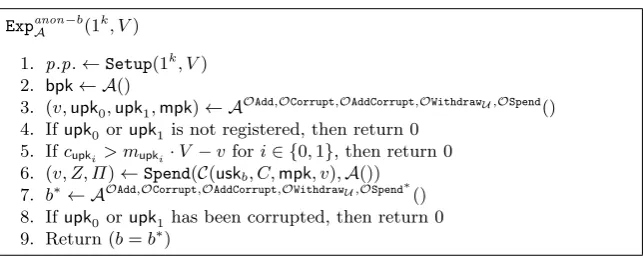
Anonymity. Informally, anonymity requires that the bank, even helped by malicious users and mer-chants, cannot learn anything about a spending other than what is available from side information from the environment. We define the anonymity experiments ExpanonA −b(1k, V) as described on Fig-ure 1. After the challenge phase, the OSpend queries are restricted to avoidA trivially wins:A then has access to a OSpend∗ oracle that is the same as theOSpend oracle except that it cannot be asked on upki ifcupki > mupki ·V −v, for i∈ {0,1}. Otherwise one can easily deduce which user has spent
We defineAdvanonA (1k, V) as Pr[ExpanonA −1(1k, V)]−Pr[ExpanonA −0(1k, V)]. A divisible e-cash system isanonymous if, for any probabilistic polynomial adversaryA, this advantage is negligible. Of course, the adversary must choose the users involved in the challenge phase among the registered users, and never corrupted, and cannot ask them to spend more than withdrawn, hence restrictions in steps 4, 5, and 8 respectively.
Remark 1. The scheme from [NS00] achieves an unlinkability property, meaning that it is hard to link two spendings from the same coin. This protocol makes use of a tree for the global coin, and each transcript reveals which part of the tree (i.e.which node) is spent. In some cases, this property can be enough (we describe informally in Section 4.2 a protocol fulfilling this property) but we stress that a scheme revealing the spent nodes in a tree structure is not anonymous (according to our above model) even if it is unlinkable (and our main scheme given in Section 5 is anonymous in the sense of the above definition). Indeed, to break the anonymity of such a scheme, the adversary can make one
OWithdrawU(bsk,uski) and then (V−1)OSpend(upki,1) queries, for each user (i∈ {0,1}). Therefore, it will only remain one unspent node supki for each user. If the nodes are randomly selected among
the unspent nodes during a spending (which is even worse if this is deterministic or chosen by the adversary), with overwhelming probability, the two unspent nodes will not be the same for the two usersupk0 and upk1:supk0 6=supk1. The node involved in the challenge phase will then reveal the user
identity.
Traceability. Informally, traceability requires that no coalition of malicious users can spend more than they have withdrawn, without revealing their identity. We define the traceability experiment
ExptraA (1k, V) as described on Figure 2. We denote by m the total number of coins withdrawn during the entire experiment. It is assumed that {(v1, Z1, Π1), . . . ,(vu, Zu, Πu)} is a set of different and valid transcripts (else, we do not consider the invalid or duplicated ones when computing the sum
v = P
vi). We define AdvtraA (1k, V) as Pr[ExptraA (1k, V) = 1]. A divisible e-cash system ensures the
traceability property if, for any probabilistic polynomial adversaryA, this advantage is negligible.
Remark 2. The E-cash systems from [CG07,ASM08,CG10,IL12] considered the balance property, re-quiring that no coalition of users can spend (and then later accepted for deposit) more than they have withdrawn, and theidentification property, requiring that no coalition of users can double-spend a coin without revealing their identity. We argue that traceability is enough. Indeed, an adversary against thebalance property must produce [(v1, Z1, Π1), . . . ,(vu, Zu, Πu)] (withPui=1vi > m·V) that the bank accepts as valid, not duplicated and not double-spent. This adversary can therefore be easily converted into an adversary against our traceability experiment.
Similarly, an adversary against the identification property must produce two valid transcripts (v1, Z1, Π1) and (v2, Z2, Π2) which are detected as a double-spending but such that the Identify
algorithm does not output one name from the collusion: either this is a name outside the collusion, we deal with this case below, with the exculpability, or Identify((v1, Z1, Π1), (v2, Z2, Π2)) =⊥. By
legally spending all the remaining parts of this coin, one breaks the traceability property too.
Exculpability. Informally, exculpability requires that the bank, even cooperating with malicious users and merchants, cannot falsely accuse honest users of having double-spent a coin. We define the exculpability experiment ExpexcuA (1k, V) as described on Figure 3. We emphasize that any adversary able to spend a coin of a honest user can easily break the exculpability property, by simple making a double-spending in the name of this honest user. We defineAdvexcuA (1k, V) as Pr[ExpexcuA (1k, V) = 1]. A divisible e-cash system isexculpableif, for any probabilistic polynomial adversaryA, this advantage is negligible.
4 Our Construction: Intuition
Expanon−bA (1 k
, V)
1. p.p.←Setup(1k, V) 2. bpk← A()
3. (v,upk0,upk1,mpk)← AOAdd,OCorrupt,OAddCorrupt,OWithdrawU,OSpend
() 4. Ifupk0 orupk1 is not registered, then return 0
5. Ifcupki> mupki·V −vfori∈ {0,1}, then return 0
6. (v, Z, Π)←Spend(C(uskb, C,mpk, v),A()) 7. b∗← AOAdd,OCorrupt,OAddCorrupt,OWithdrawU,OSpend∗
() 8. Ifupk0 orupk1 has been corrupted, then return 0 9. Return (b=b∗)
Fig. 1.Anonymity Security Game
ExptraA(1 k
, V)
1. p.p.←Setup(1k, V) 2. (bsk,bpk)←BKeygen() 3. [(v1, Z1, Π1), . . . ,(vu, Zu, Πu)]
$
← AOAdd,OCorrupt,OAddCorrupt,OWithdrawB,OSpend
(bpk) 4. IfPu
i=1vi> m·V and∀i6=j,Identify((vi, Zi, Πi),(vj, Zj, Πj)) =⊥, then return 1
5. Return 0
Fig. 2.Traceability Security Game
ExpexcuA (1 k
, V)
1. p.p.←Setup(1k, V) 2. bpk← A()
3. [(v1, Z1, Π1),(v2, Z2, Π2)]← AOAdd,OCorrupt,OAddCorrupt,OWithdrawU,OSpend() 4. IfIdentify((v1, Z1, Π1),(v2, Z2, Π2),bpk) =upkandupknot corrupted,
then return 1 5. Return 0
them (during the Withdrawprotocol) and more importantly, must prove (either during theWithdraw
protocol or the Spend one) that these elements are well-formed. This latter proof led to complex systems with either unconventional security properties [ASM08] or costly operations in groups of different orders [CG07,CG10].
In our system, there is only one tree, which is part of the public parameters. It allows us to avoid proving its well-formedness and so to achieve a better efficiency while working with zero-knowledge proofs compatible with the Groth-Sahai methodology [GS08]. In the following we first describe our
Setupalgorithm and then give a high level description of our divisible e-cash system.
4.1 Setup
0
00
... ... 0
01
010 0
011 1 1
0
1
... ... 1
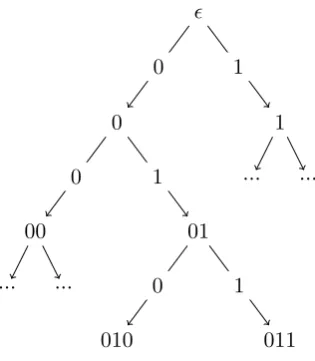
Fig. 4.Divisible coin
Notation. Let Sn be the set of bitstrings of size smaller than or equal to n and Fn be the set of bitstrings of size exactlyn. We then define, ∀s∈ Sn, the setFn(s) as {f ∈ Fn:sis a prefix of f}. For everys∈ Sn,|s| denotes the length ofs.
Intuitively, since we will make use of a tree of depth n for coins of value V = 2n, as illustrated on Figure 4, each node of the tree (or its path from the root) will refer to an element s ∈ Sn, the root to the empty string , and each leaf to an element of Fn. For any nodex∈ Sn,Fn(s) contains all the leaves in the subtree belows.
Public Parameters. Let (G1,G2,GT, e) be the description of bilinear groups of prime orderp,g, h, u1, u2, w(resp.eg) be
gen-erators of G1 (resp. G2), G=e(g,eg) is thus a generator of GT, and H :{0,1}
∗ →
Zp be a collision-resistant hash function. In addition, a trusted authority generates
– for each s∈ Sn,rs $
←Zp and (gs, hs)←(grs, hrs);
– for each f ∈ Fn,lf ←$ Zp;
– for each s∈ Sn, for each f ∈ Fn(s),egs7→f ←eg
lf/rs.
The public parameters p.p. are set as the bilinear groups (G1,G2,GT, e), with the generators
g, h, u1, u2, w,eg, andG, the hash function H, as well as all the above elements{(gs, hs), s∈ Sn} and {egs7→f, s ∈ Sn, f ∈ Fn(s)}. In addition, according to the setting, either the random oracle model or the standard model, we also have
– another hash functionH:{0,1}∗ →Zp, that will be modeled by a random oracle;
– or a CRS for the Groth-Sahai [GS08] proofs and a one-time signature scheme Σots (such as the one from [BB08]).
It is worthy to note that users and merchants need to know the groups and the generators, but then just{(gs, hs), s∈ Sn}(along with H, or CRS andΣots). The set{egs7→f,(s, f)∈ Sn× Fn}is only used
by the bank, while {lf, f ∈ Fn} is not useful anymore in the system.
Remark 3. An entity knowing the random scalars (rs, lf) used to generate the public parameters will be able to break the anonymity of our scheme. This problem already appears when generating the CRS from Groth-Sahai proofs (whose construction is not specified in [IL12]). To avoid the need of a trusted entity (although this last one would intervene only during theSetupphase) the public parameters can be cooperatively generated by the bank and a set of users. For example,
– one party can first generate as, cf $
← Zp for all s ∈ Sn and f ∈ Fn, compute As ← gas and
e
As7→f ←ge
cf/as, and prove knowledge of a
– the second party will then select random bs, df $
← Zp, compute Bs ← Asbs and Bes7→f ← Ae
df/bs
s ,
and prove knowledge of bs and df.
If the proofs are valid then gs←Bs and egs7→f ←Bes7→f.
4.2 High Level Description
The main challenge when designing a divisible e-cash system is to describe an efficient way for the bank to recover all the serial numbers of the spent coins without endangering the anonymity of the honest users. For the sake of clarity, we describe our construction in three stages.
– In the first one, we describe a system fulfilling a weak anonymity property (called unlinkability, see Remark 1, in Section 3.2) meaning that no one can decide, given two transcripts of theSpend
protocol, whether they were produce by using the same global coin but where the spent part (i.e.
the node) of the coin can be revealed;
– In the second stage, we show how to increase the level of anonymity, reaching a stronger version of unlinkability (that we callstrong unlinkability) meaning that it is now impossible to decide which node was spent. However, the level of the node is inevitably revealed since it corresponds to the amount paid by the user.
– Eventually, it remains to explain how to recover the identity of a double-spender without the help of a trusted entity. This is done in our third stage where we describe the construction of a security tag which, added to the scheme from the second stage, leads to an anonymous divisible e-cash system in the sense of the definition given in Section 3.2.
All our three stages use the same idea: each divisible coin is associated with a secret scalar x ←$ Zp,
known to the user only, and certified by the bank during the Withdrawprotocol.
Unlinkability. To spend a value of v = 2`, the user first selects an unspent node s at level n−`, computes ts ← gxs and proves in a zero-knowledge way that ts is well-formed and that x is certified. This can be efficiently performed in either model: the random oracle model or standard model.
Since we consider here the unlinkability property, the user can reveal the chosen s so thatB can compute, for each f ∈ Fn(s), the 2` elements Sf(x) ← e(ts,egs7→f) = e(gs,egs7→f)
x = Gx·lf which
actually are the 2` serial numbers. Indeed, these elements only depend on (i) the spent leaves and (ii) the secret of the coin, which makes the bank able to detect double-spending (i.e.two identical spent leaves, which equivalently means that two nodessands0 are such that one of them is the prefix of the other): the bank simply checks whether for somef, there aresand s0 such thate(ts,egs7→f) =G
x·lf =
e(ts0,
e
gs07→f).
For honest users, the unlinkability property follows from the fact that it is hard, knowinggs,gs0 and
gxs, to decide whether an element of G1 is random or equal to gxs0 under the weak-EXDH assumption.
Strong Unlinkability. We now want to leak less information about the node s: actually, just its level can be leaked, since it corresponds to the value of the transaction. To address this issue, the bank will now certify every elementgs, using a different key for each level of the tree (and so according to the value), and publish all certificates. To prove thatts is well-formed, the user now has to prove that he used a certified value gsof the appropriate level, which is still possible in either the random oracle model or the standard model, with a slight increase of the size of the proof. Since the bank does not know the exact node s, but only its level n−`, given ts, it now needs to compute and stores all the elements e(ts,egs07→f) for every leaf f and every node s
0 of the same level n−`. Of course, some of
these elements (and maybe most of them) do not correspond to any valid serial number, but the point is that all the 2` valid serial numbers will be among them, making the bank able to detect double spendings.
Remark 4. One has to take care of additional false positive cases for a leaf f: for two distinct coins whose associated secrets are x1 and x2 respectively (x1 =6 x2), there exist four scalars rs1, rs01 and
rs0
2, rs02 such that e(g x1rs1,
e
glf/rs01) = e(gx2rs2,
e
glf/rs02), and thus x
1rs1rs0
Anonymity. Once a double-spending is detected, the procedure for recovering the user’s identity depends on the kind of opening we want. In the case of fair e-cash systems, an opening authority uses, as for group signatures schemes, the knowledge of some trapdoor to recover the identity of the user from any valid transaction. Such system can be used in association with the above strongly unlinkable solution to provide identification of the double spender. However, to reach the true anonymity property we must avoid such a powerful authority and then allow anyone to recover this identity from any double-spent coins, and only in case of fraud.
Let usk ∈ Zp be the secret key of a user and upk ← gusk his public key. When spending a node
s, each user will also compute and send a security tag vs ← upkr ·hxs, where r is deterministically obtained by hashing some public information info related to the transaction (amount, date, public key of the merchant, etc). Of course, it will also have to prove that this tag is well formed (xand upk are certified and hs corresponds to the same node as gs).
If the bank detects a double-spending, it means that there are two transcripts containing (ts, vs) and (ts0, vs0) such that there exists f ∈ Fn which is a descendant of both s and s0. Therefore, we have both e(ts,egs7→f) = e(ts0,egs07→f) = G
x·lf and e(h
s,egs7→f) = e(hs0,egs07→f) = e(h,eg)
lf. Anyone
can then compute, from the involved transcripts and the public parameters, T ← e(vs,egs7→f) and
T0 ←e(vs0,
e
gs07→f). Using the bilinearity of the pairing we get:
T·T0−1 =e(upkr,egs7→f)·e(hxs,egs7→f)·e(upk
−r0,
e
gs07→f)·e(hx
s0,egs07→f)−1 =e(upk,eg
r s7→f ·eg
−r0 s07→f).
It remains to check, for each registeredupki, whetherT·T0−1=e(upki,eg
r s7→f·eg
−r0
s07→f). We recall thatr and r0 are scalar deterministically computed from the transaction informationinfo, and thus publicly computable.
TheIdentifyalgorithm thus has a linear cost in the number of registered users, but we can argue that this is not a major drawback because it will be runoffline and double-spending should not occur too often: the possibility of tracing back defrauders is an incentive not to try to cheat. Note that this algorithm does not make use of any private information, it can thus be run in parallel by many users, as for the public traceability in broadcast encryption [CPP05].
5 Our Divisible E-Cash System
5.1 The protocol
In this section, we focus on the anonymous version of our solution. We then describe all the algorithms in more details, except theSetupone, already fully described above. OurSpendprotocol will make use of non-interactive zero-knowledge (NIZK) proofs which can be provided either in the random oracle model (using the Fiat-Shamir heuristic [FS86]) or in the standard model (using the Groth-Sahai proof systems [GS08], since we are in a bilinear setting). Even if the frameworks are similar, some algorithms differ according to the model. We provide in Appendix A some instantiations of our protocol.
– BKeygen(): Upon receiving the public parameters, the bank will select two different signatures schemes:
• Σ0= (Keygen,Sign,Verify), whose message space isG21, to sign some elements of the public
parameters. We can use the structure preserving construction from [AGHO11]. But we stress that we do not need the EUF-CMA security. A signature scheme secure against selective chosen-message attacks would be enough.
• Σ1= (Keygen,Sign,Verify), whose message space depends on the security model.
∗ ROM:The message space isZ2p. But we additionally require thatΣ1 is compatible with
a protocol Σ1.SignCommit which, given (ux1, u
y
2) for some (x, y) ∈ Z2p (and so a kind of commitment of (x, y)), outputs a valid signatureσ on (x, y) (we can then use the scheme from [CL04] or a variant of [BB08]).
∗ Standard Model:The message space isG21, and we can then use again the scheme from
The bank will then get (sk1,pk1) ← Σ1.Keygen(p.p.) and (sk(0i),pk (i)
0 ) ← Σ0.Keygen(p.p.) for
each level of the tree, 0 ≤ i≤ n, and compute, for every s∈ Sn,τs ← Σ0.Sign(sk (|s|)
0 ,(gs, hs)). Eventually, it will setbskassk1 and bpkas ({pk(0i)}i,pk1,{τs}s∈Sn).
– Keygen(): Each user (resp. merchant) selects a randomusk←Zp (resp.msk) and gets upk←gusk
(resp. mpk ← gmsk). In the following we assume that upk (resp. mpk) is public, meaning that
anyone can get an authentic copy of it.
– Withdraw(B(bsk,upk),U(usk,bpk)): To withdraw a divisible coin, the user first selects a random
x∈Zp and computes uusk1 and ux2. He then sends upk, uusk1 , ux2 and proves, using for example the
Schnorr’s interactive protocol [Sch89], knowledge ofx and usk. If the proof is valid and ifux2 was not previously used, the bank
• ROM:runs theΣ1.SignCommiton (uusk1 , ux2) and sends the resulting signatureσ to the user
who setsC ←(x, σ).
• Standard Model: computes σ ←Σ1.Sign(sk1,(uusk1 , ux2)) and sends it to the user who sets
C←(x, σ).
– Spend(U(usk, C,bpk,mpk,2`),M(msk,bpk,2`)): To spend a value 2`, the user selects an unspent node s of level n−` and computes r ← H(info) and (ts, vs) ← (gxs,upkr ·hxs). He must then prove thattsand vs are well-formed,i.e.that he used values certified during a withdrawal, hence a proof of knowledge of σ, and that he used a valid pair (gs, hs), hence a proof of existence of τs. The protocol in the ROM differs from the one in the standard model.
• ROM: The user provides a zero-knowledge proof of knowledge of usk, x, gs, hs, τs, and σ such that:
ts=gsx∧vs= (gr)usk·hxs ∧ Σ1.Verify(pk1,(usk, x), σ) = 1
∧ Σ0.Verify(pk(n
−`)
0 ,(gs, hs), τs) = 1.
Using appropriate signature schemes, as shown in Appendix A, such zero-knowledge proofs of knowledge ‘`a la Schnorr’ can be done. The global proof is then converted into a signature of knowledge Π on the message r, using the Fiat-Shamir heuristic [FS86].
• Standard Model:The user first generates a new key pair (skots,pkots) ← Σots.Keygen(1k)
and computes µ ← w
1
usk+H(pkots). He then computes Groth-Sahai commitments tousk, x, g s,
hs, τs, σ, µ, U1 = uusk1 , U2 = ux2 and provides a NIZK proof π that the committed values
satisfy:
ts=gsx∧vs= (gr)usk·hxs ∧U2 =ux2∧U1=uusk1 ∧µ(usk+H(pkots))=w
along with a NIWI proofπ0 that the committed values satisfy:
1 =Σ0.Verify(pk(n
−`)
0 ,(gs, hs), τs) ∧ 1 =Σ1.Verify(pk1,(U1, U2), σ)
Again, using appropriate signature schemes, as shown in Appendix A, the Groth-Sahai method-ology [GS08] can be used. Finally, the user computesη←Σots.Sign(skots, H(ts||vs||π||π0||r)) and sends it toMalong with ts, vs,pkots, π, π0.
In both cases, the merchant checks the validity of the proofs and of the signatures and accepts the transaction if everything is correct. In such a case, he storesZ ←(ts, vs) and either the signature of knowledge Π in the ROM orΠ ←(π, π0,pkots, η) in the standard model.
– Deposit(M(msk,bpk,(2`, Z, Π)),B(bsk, L,mpk)): Upon receiving a transcript, the bank will check that it was not previously deposited and verify its validity. Then, for each s0 of level n−` and
f ∈ Fn(s0) it will compute zi ← e(ts,egs07→f) and check whether zi ∈ L. If ∀i, zi ∈/ L then the
bank will add these elements to this list (see Remark 5) and store the transcript (2`, Z, Π). Else, there is an element z0 ∈L such that zi =z0. The bank will recover the corresponding transcript (2`0, Z0, Π0) and output [(2`, Z, Π),(2`0, Z0, Π0)].
– Identify((2`1, Z1, Π1),(2`2, Z2, Π2),bpk): To recover the identity of a double-spender, the
en-tity running this algorithm will first check the validity of both transcripts and return ⊥ if one of them is not correct. He then computes, for i ∈ {1,2} and for every leaf f, the lists
collision between S1,f and S2,f for any leaf f. Else, we can assume (see Remark 4) that we have
e(ts1,egs17→f) = e(ts2,egs27→f) with ts1 = g
x
s1 and ts2 = gs2x for some s1, s2 ∈ Sn. As explained in section 4.2, e(vs1,egs17→f)·e(vs2,egs27→f)
−1 = e(upk, e
gsr7→f ·ges−07→r0f) so it remains to compute
e(upki,egsr7→f·egs−07→r0f) for each public keyupki until we get a match, in which case one outputsupki.
Remark 5. Since the node used to spend a coin C is not known, the bank has to store 2n elements
zi each time a transcript is deposited by a merchant, even if the amount deposited is 2` with` ≤n: one for each leaf f. In the worst case scenario (if the user only spends values of 1), a divisible coin of 2n will require that the bank stores 22n elements. However, the bank does not need to store the elements zi ∈GT, it may only storeH0(zi) (for some hash functionH0) and so compare the (smaller) hash values. If a collision is found, the bank will first recover and compare the elements zi from the involved transcripts to ensure that this collision was not due to the function H0 (which would anyway be quite unlikely). Hash tables or Bloom filters can be used to improve on the storage efficiency.
Even if the constructions in both models are quite similar, there are some necessary differences, especially in theSpendprotocol. Our results concerning the security of our scheme will then also differ according to each model. The security proofs of the following theorems are provided in Section 6.
Theorem 6. In therandom oracle model, assuming that the hash functionH is collision-resistant, our divisible e-cash system is anonymous under theEXDHassumption, traceable ifΣ0 is secure against selective chosen-message attacks and Σ1 is an EUF-CMA secure signature scheme, and achieves the exculpability property under the DL assumption.
Theorem 7. In the standard model, assuming that the hash function H is collision-resistant, our divisible e-cash system is anonymous under the EXDH assumption, traceable if Σ0 is secure against selective chosen-message attacks and Σ1 is an EUF-CMA secure signature scheme, and achieves the exculpability property under the q−SDH assumption if Σots is a strong one-time signature scheme.
5.2 Efficiency
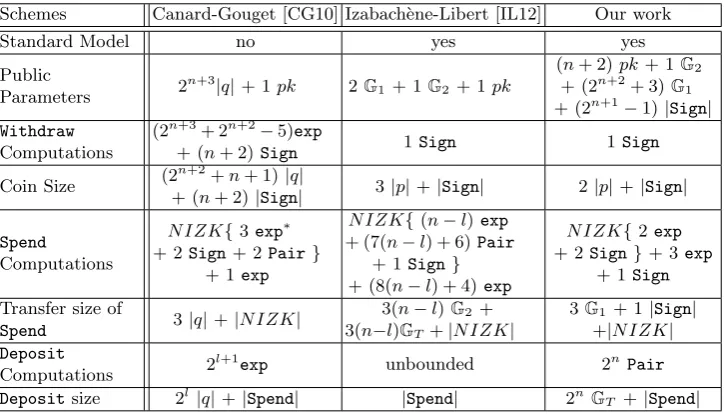
We compare in Figure 5 the efficiency of our construction with the one of [CG10], which is the most efficient protocol in the ROM, and the one of [IL12], which is the only construction in the standard model.
The different settings of these constructions make this comparison difficult but this table can still be useful to compare the asymptotic complexity of the different algorithms. We refer to Appendix A for instantiations of our construction. One may note some differences between our table and the one provided in [CG10]. They are due to the fact that the authors of [CG10] denote the computations of accumulators by Acc. Since these accumulators can store up to 2n+2 elements their computations actually involve up to 2n+2 exponentiations (during the creation of these accumulators inside the withdrawal protocol) while their definitions significantly increase the size of the public parameters (hence the 2n+3 elements).
The scheme from [CG10] uses subgroups of Zri for some primes ri and bilinear groups of similar orders for their accumulators. Assuming that the parameters of the accumulators (which are elliptic curve points) are provided in a compressed way (i.e. only one coordinate by point) and that q is an approximation of the orders of the different groups, we will consider that each element involved in their protocol has a|q|-bit representation. The scheme from [IL12] and the one described in this paper use bilinear groups of prime order p. For a 128-bits security level, we have |p|= 256, |G1|= 256 and
|G2|= 512 by using Barreto-Naehrig curves [BN05] whereas|q|must be greater than 3072 for [CG10]
(see [GPS08]).
Schemes Canard-Gouget [CG10] Izabach`ene-Libert [IL12] Our work
Standard Model no yes yes
Public
Parameters 2 n+3|
q|+ 1pk 2G1+ 1G2 + 1pk
(n+ 2)pk+ 1G2 + (2n+2+ 3)G1 + (2n+1−1)|Sign|
Withdraw
Computations
(2n+3+ 2n+2−5)exp
+ (n+ 2)Sign 1Sign 1Sign
Coin Size (2 n+2
+n+ 1)|q|
+ (n+ 2)|Sign| 3|p|+|Sign| 2|p|+|Sign|
Spend
Computations
N IZK{3exp∗
+ 2Sign+ 2Pair}
+ 1exp
N IZK{(n−l)exp
+ (7(n−l) + 6)Pair
+ 1Sign}
+ (8(n−l) + 4)exp
N IZK{2exp
+ 2Sign}+ 3exp
+ 1Sign
Transfer size of
Spend 3|q|+|N IZK|
3(n−l)G2 + 3(n−l)GT+|N IZK|
3G1 + 1|Sign| +|N IZK|
Deposit
Computations 2 l+1
exp unbounded 2nPair
Depositsize 2l|q|+|Spend| |Spend| 2nGT +|Spend|
Fig. 5.Efficiency comparison between related works and our construction for coins of value 2n andSpendandDeposit
of value 2l. The space and times complexities are given from the user’s point of view.exp refers to an exponentiation,
pair to a pairing computation,Signto the cost of the signature issuing protocol, from the user point of view, whose public key ispk.N IZK{exp}denotes the cost of aN IZKproof of a multi-exponentiation equation,N IZK{pair}the one of a pairing product equation andN IZK{Sign}the one of a valid signature.N IZK{exp∗}refers to the cost of a proof of equality of discrete logarithms in groups of different orders.
Our parameters (see Appendix A) require then less storage space than the ones of [CG10] (since 210+3· |q|= 3.1 MBytes). For the bank, the additional cost of storing the elements{˜gs7→f} is only 721 KBytes.
Withdrawal and Spending. The strong time constraints of electronic transactions require very efficient withdrawal and spending protocols. Compared to any paper in the literature with similar security level (especially [CG10] and [IL12]), our protocol is the only one to achieve constant time for both the Withdraw and the Spend protocols. Moreover, even if the Spend protocol from [CG10] can be performed in constant time, it involves zero-knowledge proofs in groups of different orders which are rather complex, even in the ROM.
Deposit. Unfortunately, ourDepositprotocol involves up to 2npairings and so is less efficient than the one from [CG10]. Forn= 10 it means that the bank must compute 1024 pairings. Even if they can be computed in parallel and even if each of them can be performed on a computer in less than 1 ms [BGM+10], the computational cost is significant. However, since this protocol is run offline (without the strong time constraints of the previous protocols) and since the computational power of a bank can be assumed to be far more important than the one of a computer, we argue that the cost for the bank remains reasonable. Regarding the storage size, the bank must store 2n serial numbers by transaction. As explained in Remark 5, the bank does not need to store the elements zi but only their hash values H0(zi) for some hash function H0 whose output space can be rather small since, in the event of a collision, the bank will first recompute the elements zi before running the Identify algorithm. For example, considering that the output space ofH0 has a 80 bits size, the space required to store the serial numbers of one million transactions is about 10 GBytes, which is still practical for the bank.
6 Security Proofs
The proofs of anonymity and traceability are similar in the ROM and in the standard model so we only describe one proof for both models. This is no longer the case for the exculpability property which requires two different proofs.
6.1 Proof of Anonymity
LetA be an adversary against the anonymity with advantage. We construct a reduction Rusing A
against theEXDHproblem. Let (g, h, gx, hx, ga, ha, gy·a, hy·a, gz1, hz2)∈G10
1 and (eg,eg
a,
e
gy)∈G3 2 be an
EXDH challenge,Rrandomly selectss∗ ∈ Sn and generates the public parameters as follows.
– (u1, u2)←(gd1, gd2) for some d1, d2
$
←Zp
– For eachf ∈ Fn,lf $
←Zp
– For eachs∈ Sn,rs $
←Zp
– For the specific nodes∗:
• (gs∗, hs∗)←((gy·a)rs∗,(hy·a)rs∗);
• egs∗7→f ←
e
g
lf
rs∗ for everyf ∈ Fn(s∗):e(g s∗,
e
gs∗7→f) =e(gy·a·rs∗,
e
glf/rs∗) =e(g,
e
g)a·y·lf.
– For eachs∈ Sn\{s∗}:
• ifs∗ is a prefix of s, then (gs, hs)←((gy·a)rs,(hy·a)rs);
• ifsis a prefix of s∗, then (gs, hs)←((ga)rs,(ha)rs);
• Else, (gs, hs)←(grs, hrs).
– For eachs∈ Sn\{s∗} and each f ∈ Fn(s):
• ifs∗ is a prefix of s, then egs7→f ←eg
lf/rs:e(g
s,egs7→f) =e(g
y·a·rs,
e
glf/rs) =e(g,eg)
a·y·lf;
• ifsis a prefix of s∗ and f ∈ Fn(s∗), thenges7→f ←(eg
y)lf/rs:
e(gs,egs7→f) =e(g
a·rs,
e
gy·lf/rs) =e(g,
e
g)a·y·lf;
• ifsis a prefix of s∗ and f /∈ Fn(s∗), thenges7→f ←ge
lf/rs:
e(gs,egs7→f) =e(g
a·rs,
e
glf/rs) =e(g,eg)a·lf;
• else,egs7→f ←(eg
a)lf/rs:e(g
s,ges7→f) =e(g
rs,
e
ga·lf/rs) =e(g,
e
g)a·lf;
The simulation of the parameters is correct since, for every s∈ Sn and for everyf ∈ Fn(s), we have:
– e(gs,egs7→f) =e(g,eg)
a·y·lf iff ∈ Fn(s∗);
– e(gs,egs7→f) =e(g,eg)
a·lf otherwise.
In the standard model,Ralso generates a simulated common reference string. Letqw be a bound on the number ofOWithdrawqueries,Rrandomly selectsi∗ from [0,qw] and answers to the oracle queries as follows:
– OAdd() queries: Rruns the Keygenalgorithm and returns upk(or mpk).
– OWithdrawU(bsk,upk) queries: When the adversary makes theithquery to theOWithdrawUoracle, the reduction acts normally ifi6=i∗ and as if the secret value of the coin isxotherwise (by sending (gx)d2 and simulating the proof of knowledge, sincexis not known byR). The chosen public key corresponding to this last case will be denoted upk∗.
– OCorrupt(upk/mpk) queries: Racts normally if the query was not made onupk∗. Else, it aborts the experiment.
– OAddCorrupt(upk/mpk) queries: Rstores the public key which is now considered as registered.
– OSpend(upk,2`) queries: R is able to deal with any of these queries if upk 6= upk∗. Else, the reduction is able to answer as long ascupk∗ ≤mupk∗·2n−2`−2n−|s
∗|
During the challenge phase,Aoutputs{upk0,upk1}along with a value 2`. Of course, it is assumed that none of these users has spent more than mupkb ·2
n−2`. If upk∗ ∈ {/ upk
0,upk1} or` > n− |s∗|,
thenRaborts. Else, it selectssof lengthn−`, such thats∗ is a prefix ofs(ors←s∗ if`=n− |s∗|), which cannot have been spent, by the assumption made on the OSpend queries: we thus know that in the simulation of this node s, (gs, hs) ← ((gy·a)rs,(hy·a)rs). We thus have to return (ts, vs) ← ((gx·y·a)rs,(upk∗)r·(hx·y·a)rs), which is exactly ((gz1)rs,(upk∗)r·(hz2)rs), iff z1 =x·y·a=z2.R also
provides a simulated proof and then answers the oracle queries as previously. In this situation, the simulation is perfect. In the random case for z1 and z2, which is indistinguishable under the EXDH
assumption, the identity upk∗ is perfectly hidden.
However, some guesses have to be correct: whenAselects the users involved in the challenge phase, it actually selects the two subsets S0 and S1 of the withdrawn coins belonging to these users. The
condition on the challenge phase implies that there is at least one coin in each subset which still contains a value 2`. Rwill not abort if the coin withdrawn during the i∗th query is one of them and if its guess on the level of s∗ is correct, i.e. if`=n− |s∗|. Indeed, if` < n− |s∗|, then Rmay abort during OSpend queries and if` > n− |s∗|, thenR will abort during the challenge phase.
Remark 8. One may note that the elements (h, hx, ha, hy·a, hz2) ∈G5
1 are only useful to compute the
double-spending tags and so to achieve the anonymity property. If we only need the unlinkability or the strong unlinkability property, then we could rely on the weak-EXDHassumption.
6.2 Proof of Traceability
Let A be an adversary against the traceability. We construct a reduction R using A against the unforgeabiliy of Σ0 or Σ1.R generates the public parameters as in the Setup algorithm and selects
0≤i∗ ≤n. It then generates nkeys pairs (sk(0i), pk0(i))←Σ0.Keygen(1k) for 1≤i6=i∗ ≤n and uses
sk0(i)to sign (gs, hs) such that|s|=i. Finally, it sends (gs, hs) for everys∈ Snsuch that|s|=i∗ to the
Σ0.Sign oracle which returns the signaturesτs along with the verification key pk(i ∗)
0 .R also receives
the public key pk1 from the challenger of the experiment of the EUF-CMA security of Σ1 and sets
its public key as ({pk(0j)}j, pk1,{τs}s∈Sn). The reduction will proceed as usual when it receives OAdd,
OCorrupt, OAddCorrupt and OSpend queries and uses its Σ1.Sign oracle to answer OWithdrawB queries.
Letqw be the number of withdrawn queries. In order to succeed,Amust outputuvalid transcripts (2`j, Zj, Πj) such thatP2`j > qw·2nand such thatIdentify((2`i, Zi, Πi),(2`j, Zj, Πj)) =⊥for every 1 ≤i6=j ≤n. The perfect soundness of the proof implies that each transcript (2`j, Zj, Πj) involves a pair (gj, hj) and a signatureτj such thatΣ0.Verify((gj, hj), τj, pk
(n−lj)
0 ) = 1. We may then assume
that (gj, hj) = (gsj, hsj) for somesj ∈ Sn such that |sj|=n−lj. Else, ((gj, hj), τj) is a valid forgery which breaks the security ofΣ0 with probability n+11 (i.e.ifi∗=n−lj).
Let x1, ..., xqw be the qw secret values (one for each withdrawn coin). Since an amount ofP2`j >
qw ·2n has been deposited, the bank has computed P2`j elements zi ← e(tsj,egsj7→f). If {zi}i ⊂ {e(g,eg)
lf·xi}
f∈Fn,1≤i≤qw then there is at least one couple (i, j) such thati6=j andzi =zj, because the size of the last set is qw·2n. Such a collision implies (see remark 4) that the security tagsvsi andvsj have been produced with the same secretxand so with the same public keyupkwhich would have been returned by the Identifyalgorithm. We can therefore assume that {zi}i *{e(g,eg)
lf·xi}
f∈Fn,1≤i≤qw, implying that at least one of the element tsj is equal to gxsj for some x /∈ {x1, ..., xqw}. We can then extract, from the corresponding spending, a valid forgeryσ on (usk, x) in the ROM and on (uusk1 , ux2) in the standard model and so breaks the security of Σ1.
6.3 Proof of Exculpability
We distinguish the proof in the ROM from the one in the standard model.
as in theSetupalgorithm and selects 1≤i∗≤qawhereqais a bound on the number of OAddqueries.
Rwill answer the oracle queries as follows.
– OAdd() queries: When the adversary makes thei-thOAddquery to register a user,Rwill run the
Keygenalgorithm if i6=i∗ and set upk∗ ←gα otherwise.
– OCorrupt(upk/mpk) queries: Rreturns the secret key if upk6=upk∗ and aborts otherwise.
– OAddCorrupt(upk/mpk) queries: Rstores the public key which is now considered as registered.
– OWithdrawU(bsk,upk) queries:R acts normally ifupk6=upk∗ and simulates the interactive proof of knowledge ofα otherwise.
– OSpend(upk,2`) queries: R acts normally if upk6= upk∗ and simulates the non-interactive proof of knowledge ofα otherwise.
The adversary then outputs two valid transcripts (2`1, Z1, Π1) and (2`2, Z2, Π2) which accuse upk of
double-spending. If upk6=upk∗ then Raborts. Else, at least one of this transcript was not produced by R (else it would have double-spent its own coins). The soundness of the signature of knowledge implies then that we can extract α from this forged transcript. R is then able to solve the discrete logarithm problem inG1 since it will not abort with probability 1/qa.
Standard Model: An adversaryAagainst the exculpability property outputs two transcripts accus-ing an honest user upk of double-spending. As explained above, at least one of these transcripts was not produced byR. Let pk0ots be the one-time signature key used in this forged transcript, there are two kinds of attacks that can be mounted byA:
– Type-1 Attack:pk0ots is one of the key used by R to answer aOSpendquery.
– Type-2 Attack:pk0ots was not used by Rto answerOSpendqueries.
Clearly, an adversary succeeding in a Type-1 attack with non-negligible probability can be used to break the security of the one-time signature scheme Σots. We therefore only consider Type-2 attacks in what follows.
Let (g, gα, ..., gαqs) be a SDH-challenge where qs is a bound on the number of OSpend queries, R generates the public parameters as in the Setup algorithm (except that it sets u1 as gt for some
random t ∈ Zp) and selects 1 ≤ i∗ ≤ qa where qa is a bound on the number of OAdd queries.
R computes qs key pairs (skots(i), pk
(i)
ots) ← Σots.Keygen(1k) and sets w as g
Qqs
i=1(α+H(pk (i)
ots)) (which is possible using the SDH challenge [BB08]). The reduction will answer the oracle queries as follows.
– OAdd() queries: When the adversary makes thei-thOAddquery to register a user,Rwill run the
Keygenalgorithm if i6=i∗ and set upk∗ ←gα otherwise.
– OCorrupt(upk/mpk) queries: Rreturns the secret key if upk6=upk∗ and aborts otherwise.
– OAddCorrupt(upk/mpk) queries: Rstores the public key which is now considered as registered.
– OWithdrawU(bsk,upk) queries:R acts normally ifupk6=upk∗ and simulates the interactive proof of knowledge ofα otherwise.
– OSpend(upk,2`) queries: R acts normally if upk 6= upk∗. Else, to answer the j−th query on
upk∗, it will recover the pair (sk(otsj), pkots(j)) and computes µ ← g Qqs
i=1,i6=j(α+H(pk (i)
ots)) which verifies
µ=w
1
α+H(pk(j)ots). It then uses sk(j)
ots as in theSpend protocol.
The adversary then outputs two valid transcripts (2`1, Z1, Π1) and (2`2, Z2, Π2) which accuse upk of
double-spending. If upk 6= upk∗ then R aborts. The soundness of the proof implies that the forged
transcript was signed using a key skots and so that the proof involves an element µ = w 1 α+H(pkots). Since here we consider Type-2 attacks, pkots ∈ {/ pk
(i)
ots}i, so R extracts from the proof the element µ which can be used to break the qs-SDH assumption in G1 (as in [BB08]).
7 Conclusion
In this work, we have proposed the first practical construction of divisible E-cash which can be in-stantiated and proven secure in both the random oracle and standard models. Our Withdraw and
Spend protocols are efficient and can be performed in constant times. Moreover, the bank can detect double-spendings by comparing the serial numbers of deposited coins to the ones of previously spent coins. Our protocol thus answers the problem left open by Izabach`ene and Libert. However, the com-putational cost and the storage space of ourDepositprotocol remains important but we argue that it is reasonable to assume that the bank has enough storage capacity and computational power. Finally, the way we build our tree is also compatible with divisible E-cash systems achieving weaker notions of anonymity (such as unlinkability) leading to very efficient protocols without these downsides (see Appendix A.2).
Acknowledgments
We are grateful to Patrick Maertens for pointing out an error in a previous version of this paper. This work was supported in part by the French ANR Project ANR-12-INSE-0014 SIMPATIC and ANR-11-INS-0013 LYRICS, and in part by the European Research Council under the European Community’s Seventh Framework Programme (FP7/2007-2013 Grant Agreement no. 339563 – Cryp-toCloud).
References
[AGHO11] Masayuki Abe, Jens Groth, Kristiyan Haralambiev, and Miyako Ohkubo. Optimal structure-preserving signatures in asymmetric bilinear groups. In Phillip Rogaway, editor,CRYPTO 2011, volume 6841 ofLNCS, pages 649–666. Springer, August 2011.
[ASM08] Man Ho Au, Willy Susilo, and Yi Mu. Practical anonymous divisible e-cash from bounded accumulators. In Gene Tsudik, editor,FC 2008, volume 5143 ofLNCS, pages 287–301. Springer, January 2008.
[BB08] Dan Boneh and Xavier Boyen. Short signatures without random oracles and the SDH assumption in bilinear groups. Journal of Cryptology, 21(2):149–177, April 2008.
[BFG+13] David Bernhard, Georg Fuchsbauer, Essam Ghadafi, Nigel P. Smart, and Bogdan Warinschi. Anonymous attestation with user-controlled linkability. Int. J. Inf. Sec., 12(3):219–249, 2013.
[BGK95] Ernest F. Brickell, Peter Gemmell, and David W. Kravitz. Trustee-based tracing extensions to anonymous cash and the making of anonymous change. In Kenneth L. Clarkson, editor, 6th SODA, pages 457–466. ACM-SIAM, January 1995.
[BGM+10] Jean-Luc Beuchat, Jorge E. Gonz´alez-D´ıaz, Shigeo Mitsunari, Eiji Okamoto, Francisco Rodr´ıguez-Henr´ıquez, and Tadanori Teruya. High-speed software implementation of the optimal Ate pairing over Barreto-Naehrig curves. In Marc Joye, Atsuko Miyaji, and Akira Otsuka, editors, PAIRING 2010, volume 6487 ofLNCS, pages 21–39. Springer, December 2010.
[BMW03] Mihir Bellare, Daniele Micciancio, and Bogdan Warinschi. Foundations of group signatures: Formal defi-nitions, simplified requirements, and a construction based on general assumptions. In Eli Biham, editor,
EUROCRYPT 2003, volume 2656 ofLNCS, pages 614–629. Springer, May 2003.
[BN05] Paulo S. L. M. Barreto and Michael Naehrig. Pairing-friendly elliptic curves of prime order. In Bart Preneel and Stafford Tavares, editors,SAC 2005, volume 3897 ofLNCS, pages 319–331. Springer, August 2005. [BR93] Mihir Bellare and Phillip Rogaway. Random oracles are practical: A paradigm for designing efficient protocols.
In V. Ashby, editor,ACM CCS 93, pages 62–73. ACM Press, November 1993.
[BSZ05] Mihir Bellare, Haixia Shi, and Chong Zhang. Foundations of group signatures: The case of dynamic groups. In Alfred Menezes, editor,CT-RSA 2005, volume 3376 of LNCS, pages 136–153. Springer, February 2005. [CFT98] Agnes Hui Chan, Yair Frankel, and Yiannis Tsiounis. Easy come - easy go divisible cash. In Kaisa Nyberg,
editor,EUROCRYPT’98, volume 1403 ofLNCS, pages 561–575. Springer, May / June 1998.
[CG07] S´ebastien Canard and Aline Gouget. Divisible e-cash systems can be truly anonymous. In Moni Naor, editor,
EUROCRYPT 2007, volume 4515 ofLNCS, pages 482–497. Springer, May 2007.
[CG08] S´ebastien Canard and Aline Gouget. Anonymity in transferable e-cash. In Steven M. Bellovin, Rosario Gennaro, Angelos D. Keromytis, and Moti Yung, editors, ACNS 08, volume 5037 ofLNCS, pages 207–223. Springer, June 2008.
[CG10] S´ebastien Canard and Aline Gouget. Multiple denominations in e-cash with compact transaction data. In Radu Sion, editor,FC 2010, volume 6052 of LNCS, pages 82–97. Springer, January 2010.
[Cha82] David Chaum. Blind signatures for untraceable payments. In David Chaum, Ronald L. Rivest, and Alan T. Sherman, editors,CRYPTO’82, pages 199–203. Plenum Press, New York, USA, 1982.
[Cha83] David Chaum. Blind signature system. In David Chaum, editor,CRYPTO’83, page 153. Plenum Press, New York, USA, 1983.
[CHL05] Jan Camenisch, Susan Hohenberger, and Anna Lysyanskaya. Compact e-cash. In Ronald Cramer, editor,
EUROCRYPT 2005, volume 3494 ofLNCS, pages 302–321. Springer, May 2005.
[CL04] Jan Camenisch and Anna Lysyanskaya. Signature schemes and anonymous credentials from bilinear maps. In Matthew Franklin, editor,CRYPTO 2004, volume 3152 ofLNCS, pages 56–72. Springer, August 2004. [CLM07] Jan Camenisch, Anna Lysyanskaya, and Mira Meyerovich. Endorsed e-cash. In 2007 IEEE Symposium on
Security and Privacy, pages 101–115. IEEE Computer Society Press, May 2007.
[CPP05] Herv´e Chabanne, Duong Hieu Phan, and David Pointcheval. Public traceability in traitor tracing schemes. In Ronald Cramer, editor,EUROCRYPT 2005, volume 3494 ofLNCS, pages 542–558. Springer, May 2005. [FS86] Amos Fiat and Adi Shamir. How to prove yourself: Practical solutions to identification and signature problems.
In Andrew M. Odlyzko, editor,CRYPTO’86, volume 263 ofLNCS, pages 186–194. Springer, August 1986. [GMR88] Shafi Goldwasser, Silvio Micali, and Ronald L. Rivest. A digital signature scheme secure against adaptive
chosen-message attacks. SIAM J. Comput., 17(2):281–308, 1988.
[GPS08] Steven D. Galbraith, Kenneth G. Paterson, and Nigel P. Smart. Pairings for cryptographers.Discrete Applied Mathematics, 156(16):3113–3121, 2008.
[GS08] Jens Groth and Amit Sahai. Efficient non-interactive proof systems for bilinear groups. In Nigel P. Smart, editor,EUROCRYPT 2008, volume 4965 ofLNCS, pages 415–432. Springer, April 2008.
[IL12] Malika Izabach`ene and Benoˆıt Libert. Divisible E-cash in the standard model. In Michel Abdalla and Tanja Lange, editors,PAIRING 2012, volume 7708 ofLNCS, pages 314–332. Springer, May 2012.
[NS00] Toru Nakanishi and Yuji Sugiyama. Unlinkable divisible electronic cash. In Josef Pieprzyk, Eiji Okamoto, and Jennifer Seberry, editors,Information Security, Third International Workshop, ISW 2000, Wollongong, NSW, Australia, December 20-21, 2000, Proceedings, volume 1975 of Lecture Notes in Computer Science, pages 121–134. Springer, 2000.
[Oka95] Tatsuaki Okamoto. An efficient divisible electronic cash scheme. In Don Coppersmith, editor,CRYPTO’95, volume 963 ofLNCS, pages 438–451. Springer, August 1995.
[OO91] Tatsuaki Okamoto and Kazuo Ohta. Universal electronic cash. In Joan Feigenbaum, editor, CRYPTO’91, volume 576 ofLNCS, pages 324–337. Springer, August 1991.
[Sch89] Claus-Peter Schnorr. Efficient identification and signatures for smart cards. In Gilles Brassard, editor,
CRYPTO’89, volume 435 ofLNCS, pages 239–252. Springer, August 1989.
[SPC95] Markus Stadler, Jean-Marc Piveteau, and Jan Camenisch. Fair blind signatures. In Louis C. Guillou and Jean-Jacques Quisquater, editors, EUROCRYPT’95, volume 921 of LNCS, pages 209–219. Springer, May 1995.
A Implementations
We describe in this section the implementations of two divisible E-cash systems. The first one is an implementation, secure in the standard model, of the protocol described in section 5. The second one is an implementation, secure in the ROM, of an unlinkable E-cash system derived from the high level description of section 4.2. Although this last implementation does not fulfil the anonymity requirement (as defined in our security model), it still fulfils the unlinkability property with a remarkable efficiency.
A.1 An Anonymous E-cash System in the Standard Model
For sake of clarity, we first recall the AGHO signature scheme from [AGHO11] that we will use to instantiate bothΣ0 andΣ1. This signature scheme makes use of Type-3 groups (G1,G2,GT) [GPS08] which offer the most efficient instantiations of pairings and of Groth-Sahai proofs since the SXDH assumption [GS08] holds in this setting.
For all the proofs of knowledge that users will have to produce in the various protocols, we will give the relations to be proven, and underline the variables that are private to the prover, and for which he wants to prove his knowledge.
Optimal Structure-Preserving Signatures for messages in G21 [AGHO11].
– Keygen: Setsk= (α, β, γ1, γ2)
$
←Z4
p andpk= (ev1,ve2,we1,we2)←(eg
α,
e
gβ,geγ1,egγ2)
– Sign(sk,(m1, m2)) : To sign a pair of messages (m1, m2)∈G21, select a randomr
$
←Zp and return
σ= (z1, z2,ze)←(g
r, gβ−rα·m−γ1
1 ·m
−γ2
2 ,ge
1 r)
– Verify(pk,(m1, m2), σ) : Accept ife(z1,ev1)·e(z2,eg)·e(m1,we1)·e(m2,we2) =e(g,ev2) ande(z1,ez) =