Cryptanalysis on ‘Robust Biometrics-Based
Authentication Scheme for Multi-server Environment’
Vanga Odelu1,?, Ashok Kumar Das2, and Adrijit Goswami3 1
Department of Mathematics
Indian Institute of Technology, Kharagpur 721 302, India
[email protected], [email protected] 2
Center for Security, Theory and Algorithmic Research
International Institute of Information Technology, Hyderabad 500 032, India
[email protected], [email protected] 3
Department of Mathematics
Indian Institute of Technology, Kharagpur 721 302, India
Abstract. Authentication plays an important role in an open network environ-ment in order to authenticate two communication parties among each other. Au-thentication protocols should protect the sensitive information against a mali-cious adversary by providing a variety of services, such as authentication, user credentials’ privacy, user revocation and re-registration, when the smart card is lost/stolen or the private key of a user or a server is revealed. Unfortunately, most of the existing multi-server authentication schemes proposed in the liter-ature do not support the fundamental security property such as the revocation and re-registration with same identity. Recently, in 2014, He and Wang proposed a robust and efficient multi-server authentication scheme using biometrics-based smart card and elliptic curve cryptography (ECC). In this paper, we analyze the He-Wang’s scheme and show that He-Wang’s scheme is vulnerable to a known session-specific temporary information attack and impersonation attack. In addi-tion, we show that their scheme does not provide strong user’s anonymity. Fur-thermore, He-Wang’s scheme cannot support the revocation and re-registration property. Apart from these, He-Wang’s scheme has some design flaws, such as wrong password login and its consequences, and wrong password update during password change phase.
Keywords:Security, Credentials privacy, Smart card, Revocation and re-registration, Authentication.
1
Introduction
of mobile devices, such as laptops, smart cards and smart phones [2]. Thus, the authen-tication protocols become the trusted components in a communication system in order to protect the sensitive information against a malicious adversary, by means of provid-ing confidentiality as well as authentication. We consider the followprovid-ing two real-life scenarios for the smart card based authentication schemes in which the registered users may revoke and re-register with the same identity:
– when unexpectedly the secret token of a legal user is revealed [3].
– if the smart card of a legal user is stolen or lost [4].
Hence, the authentication schemes must support the user revocation [5] and re-registration with the same identity [6]. The user revocation and re-registration with the same iden-tity may cause the user impersonation attack, when an authentication scheme distributes the static secret tokens [7], [8]. Therefore, designing an efficient approach to tackle the problem of user revocation while supporting a strong user untraceability becomes a challenging problem [9]. As a result, the user revocation and re-registration with the same identity is identified as a fundamental security functionality for the smart card-based authentication schemes.
After conception of Lamport’s seminal authentication scheme in 1981 [26], several two-party authentication schemes have been proposed in the literature (for example, [1],[4]-[9]). In a single-server environment, a user needs to register with each server separately. However, it is impossible to apply two-party authentication methods in a single server environment directly to a multi- server environment. To handle this prob-lem, several multi-server authentication schemes [27]-[39] have been proposed in the literature. Yoon and Yoo [40] proposed a multi-server authentication scheme using the biometrics-based smart card and ECC. However, Kim et al. [41] pointed out that if the smart card is lost, Yoon-Yoo’s scheme cannot prevent the offline password guessing attack. Further, they proposed an enhanced scheme in order to withstand the security flaw found in Yoon-Yoo’s scheme. Later, He [42] proved that Yoon-Yoo’s scheme is also insecure against the privileged insider attack and impersonation attack. He [42] showed that their proposed attacks are also valid for Kim et al.’s scheme. Recently, He and Wang [11] proposed a robust biometrics-based authentication scheme for multi-server environment in order to withstand these security issues, and claimed that their scheme is secure against all possible known attacks. However, in this paper, we show that He-Wang’s scheme fails to prevent known session temporary information attack, and as a result, their scheme cannot prevent the reply attack and impersonation attack. In addition, we show that their scheme cannot provide the strong users’ anonymity.
2
Mathematical preliminaries
In this section, we briefly discuss the following mathematical preliminaries to review and analyze He-Wang’s scheme [11].
2.1 Elliptic curve over a prime fieldGF(p)
A non-singular elliptic curvey2 = x3+ax+bover the finite fieldGF(p)is the set Epof solutions(x, y)∈Zp×Zpto the congruencey2=x3+ax+b(modp), where a, b ∈ Zp are constants such that4a3+ 27b2 6= 0 (modp), together with a special pointOcalled the point at infinity or zero point,Zp = {0,1, . . . , p−1}andp > 3 be a prime. The set of elliptic curve pointsEpforms an abelian group under addition modulopoperation [45].
LetGbe the base point onEp(a, b), whose order ben, that is,nG=G+G+. . .+ G(n times) = O. Assume thatP = (xP, yP)andQ = (xQ, yQ)are two points on elliptic curvey2=x3+ax+b(modp). ThenR = (x
R, yR) =P +Qis computed as follows [45]:
xR= (δ2−xP−xQ)(modp), yR= (δ(xP−xR)−yP)(modp),
whereδ=
( yQ−yP
xQ−xP (modp),ifP 6=Q 3xP2+a
2yP (modp),ifP=Q.
In elliptic curve cryptography, multiplication is defined as the repeated additions. For example, ifP ∈Ep(a, b), then4Pis computed as4P=P+P+P+P( modp).
Definition 1 (Elliptic curve discrete logarithm problem (ECDLP)).ComputingQ= kP is relatively easy for given k ∈ Zp andP ∈ G. However, givenP and Q, it is computationally hard to compute the scalarksuch thatQ=kP.
Definition 2 (Computational Diffie-Hellman problem (CDHP)).GivenP, xP, yP ∈
G, it is computationally hard to computexyP ∈Gwithout the knowledge ofx∈Zp∗ ory∈Zp∗, whereZp∗={a|0< a < p, gcd(a, p) = 1}={1,2,3, . . . , p−1}.
Definition 3 (Collision-resistant one-way hash function).A collision-resistant one-way hash functionH : X →Y, whereX ={0,1}∗andY ={0,1}n, is considered as a deterministic algorithm that takes an input as an arbitrary length binary string x ∈ {0,1}∗ and outputs a binary stringy ∈ {0,1}n of fixed-lengthn[42], [43]. If AdvHASH
A (t)is an adversary (attacker)A’s advantage in finding collision, we then
have
AdvAHASH(t) =P r[(x, x0)⇐RA:x6=x0and H(x) =H(x0)],
whereP r[E]denotes the probability of a random eventE, and(x, x0)⇐RAdenotes the pair (x, x0)is selected randomly byA. In this case, the adversary Ais allowed to be probabilistic and the probability in the advantage is computed over the random choices made by the adversary Awith the execution timet. A hash functionH(·)is called collision-resistant, ifAdvHASH
2.2 Biometrics and fuzzy extractor
A fuzzy extractor(Υ, m, l, t, ) extracts a nearly random stringσfrom its biometric characteristic inputω in an error-tolerant way [22]. If an input changes but it remains close toω, then the extractedσremains the same. To assist in recoveringσfrom the biometric characteristic inputω0, a fuzzy extractor outputs an auxiliary stringθ. How-ever,σ remains uniformly random for a givenθ. The fuzzy extractor is given by the following two procedures, calledGenandRep:
– Genis a probabilistic generation procedure, which on (biometric characteristic) inputω∈Υ, outputs an extracted stringσ∈ {0,1}land auxiliary stringθ. For any distributionW on metric space Υ of mini-entropym, ifhσ, θi ← Gen(W), the static distanceSD(hσ, θi,hUl, θi)≤, whereUldenotes the uniform distribution onl-bit binary strings.
– Repis a deterministic reproduction procedure that allows to recoverσfrom the corresponding auxiliary stringθand any vectorω0 close toω. For allω, ω0 ∈ Υ satisfyingdis(ω, ω0)≤t, ifhσ, θi ←Gen(W), thenRep(ω0, θ) =σ.
The uniqueness property of a biometric allows its applications in authentication pro-tocols. As compared to the low-entropy password, the biometric keys has more ad-vantages [12]-[14] such as biometric keys cannot be lost or forgotten, hard to forge or distribute, difficult to copy or share, and as a result, guessing the biometric keys is a hard problem.
3
Review of He-Wang’s scheme
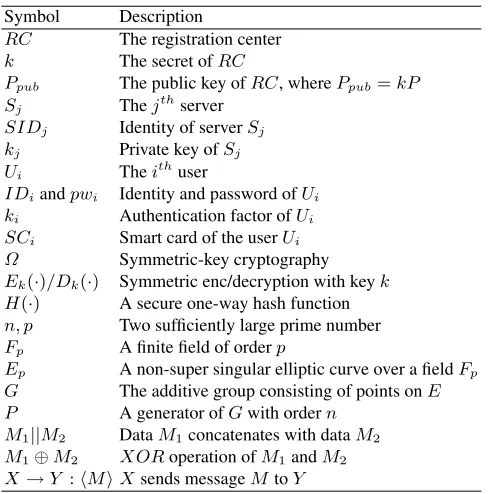
In this section, we review the recently proposed He-Wang’s scheme [11]. For the con-venience, in this paper we use the notations listed in Table 1.
3.1 Registration phase
This phase consists of the server registration phase and the user registration phase.
Server registration phase In this phase, server Sj chooses its identity SIDj and sends it toRC via a secure channel. Upon receiving the request,RC computeskj = H(SIDj||k)and then sends it toSjvia a secure channel. After receivingkjfromRC, Sjkeeps it secret.
User registration phase In this phase,Ui sends a request and obtains the smart-card SCiwith authentication parameter as follows:
Table 1.Notations used in this paper
Symbol Description
RC The registration center
k The secret ofRC
Ppub The public key ofRC, wherePpub=kP
Sj Thejthserver
SIDj Identity of serverSj
kj Private key ofSj
Ui Theithuser
IDiandpwi Identity and password ofUi ki Authentication factor ofUi SCi Smart card of the userUi
Ω Symmetric-key cryptography
Ek(·)/Dk(·) Symmetric enc/decryption with keyk H(·) A secure one-way hash function
n, p Two sufficiently large prime number
Fp A finite field of orderp
Ep A non-super singular elliptic curve over a fieldFp G The additive group consisting of points onE
P A generator ofGwith ordern
M1||M2 DataM1concatenates with dataM2 M1⊕M2 XORoperation ofM1andM2 X→Y :hMiXsends messageMtoY
Step R2. After receiving the registration requestReg fromUi, RC computes ki = H(IDi||k),zi =ki⊕H(pwi||σi)and storesziinto a smart-cardSCi. Finally,RC issuesSCitoUiface to face.
Step R3. After receivingSCi,Uistoresθiin it.
3.2 Authentication and key establishment phase
In this phase,UiandSj mutually authenticate each other and establish the session key as follows:
Step A1. UiinsertsSCiinto a card reader and inputspwi,IDiand imprints personal biometrics Bi0 at the sensor. Ui then generates a random number x ∈ Zn∗ and computesRep(B0i, θi) = σi, ki = zi⊕H(pwi||σi),X = xP,K1 = xPpub, CIDi =IDi⊕H(K1), andh1=H(IDi||SIDj||ki||X||K1). Finally,Uisends the messageM1={CIDi, X, h1}toSjvia a public channel.
Step A2. After receiving messageM1,Sj randomly choosesy ∈ Zn∗ and computes Y =yP,K2=yPpub,h2=H(CIDi||X||h1||SIDj||kj||Y||K2), andCSIDj= SIDj⊕H(K2). Finally,Sjsends the messageM2={CIDi, X, h1, CSIDj, Y, h2}
toRCvia a public channel.
Step A3. Upon receivingM2 fromSj,RC computesK3 = kY (= K2),SIDj = CSIDj⊕H(K2), andkj=H(SIDj||k). ThenRCchecks whetherh2=H(CIDi
session. Otherwise,RC computesK4 = kX(= K1),IDi = CIDi⊕H(K4), andki=H(IDi||k).RCthen checks whetherh1=H(IDi||SIDj||ki||X||K4) holds or not. If it does not hold, it terminates the session. Otherwise,RC com-putesT IDi =IDi⊕H(Y||K3||kj),h3 =H(IDi||T IDi||X||SIDj ||Y||kj), T SIDj =SIDj⊕H(X||K4||ki), andh4=H(IDi||X||K4||SIDj||Y ||ki). Fi-nally,RC sends the messageM3 = {T IDi, h3, T SIDj, h4} toSj via a public channel.
Step A4. After receivingM3fromRC,Sj computesIDi =T IDi⊕H(Y||K2||kj) and checks whetherIDiis valid or not. If it is not valid,Sjterminates the session. Otherwise,Sjchecks whether the conditionh3=H(IDi||T IDi||X||SIDj||Y||kj) holds or not. If it does not hold,Sjterminates the session. Otherwise,Sjcomputes the session keySK = yX = xyP andh5 = H(IDi||SIDj||X||Y||SK||h4). Finally,SjsendsM4={T SIDj, Y, h4, h5}toUivia a public channel.
Step A5. Upon receivingM4fromSj,UicomputesSIDj =T SIDj⊕H(X||K1||ki) and then checks whetherh4 = H(IDi||X||K4||SIDj||Y ||ki)holds or not. If it does not hold,Ui stops the session. Otherwise, Ui computes the session key SK = xY = xyP, and checks whetherh5 = H(IDi||SIDj||X||Y||SK||h4) holds or not. If it does not hold,Uiterminates the session. Otherwise,Uicomputes h6=H(SIDj||IDi||X||Y||SK||h4)and sendsM5={h6}toSj.
Step A6. After receivingM5fromUi,Sjchecks whether the conditionh6=H(SIDj
||IDi||X||Y||SK||h4)holds or not. If it holds true,Sj confirms thatUi is legiti-mate. Otherwise,Sjstops the session immediately.
3.3 Password change phase
In this phase,Uichanges his/her password as follows:
Step P1. UiinsertsSCiinto a card reader and inputspwi,IDi and imprints personal biometricsB0iat the sensor.Uialso inputs the new passwordpwinew.
Step P2. SCithen computesRep(Bi0, θi) = σi,ki =zi⊕H(pwi||σi), andznew
i =
ki⊕H(pwnew
i ||σi). Finally,SCireplacesziwithzinew.
4
Cryptanalysis on He-Wang’s scheme
In this section, we show that He-Wang’s scheme [11] is vulnerable to various well-known attacks, which are outlined in the following subsections.
4.1 Known session-specific temporary information attack
According to [16]-[20], all the session keys must be secured even if the session ran-dom numbers of the user are compromised to an adversaryA. Assume that the session random numberxchosen byUiis unexpectedly revealed to an attackerA. Then, He-Wang’s scheme has the following drawback:
– SinceUiandSjcomputes a session keySKasSK=xY =xyP, an attackerA
– AdversaryAintercepts the messageM1={CIDi, X, h1}sent to the serverSj(in Step A1 of the authentication and key establishment phase), and checks whetherxP matches withX. If it matches,Aconfirms thatxcorresponds toM1and computes K1 andIDi asK1 = xPpub andIDi = CIDi⊕H(K1)(this may cause user anonymity violation). The adversaryAsends reply messageM1toSjwithout any modifications. In this case, neitherSj norRC can identify the messageM1 as a replied one. From the messageM4={T SIDj, Y, h4, h5}, the adversaryAknows Y andh4, and he/she can computeSKasSK =xY usingxand then compute the validh6 =H(SIDj||IDi||X||Y||SK||h4)forSj without knowledge ofUi’s authentication parameterki. As a result,Acan successfully impersonate the legal userUi.
– One more drawback is thatRC cannot identify the userUi and the serverSj sep-arately when they want to establish the session key. In this case, a legal serverSj may act as legal user [10] and enjoy the services from the other serversSl’s.
4.2 Impersonation attack
In He-Wang’s scheme [11], during the registration phase of a userUi, the registration centerRC computes the authentication parameterkiof Ui using the identityIDi of Ui and secret keykofRCaski =H(IDi||k). Clearly, the authentication parameter is static and the registration phase has no ability to detect re-registration with old iden-tity. Thus, the userUi can not re-register with the same identityIDi in future for the following two genuine cases:
– whenUi’s smart-cardSCiis lost/stolen, and
– unexpectedlyUi’s authentication parameterkiis revealed.
Hence, an adversaryAcan easily obtain the authentication parameter by performing re-registration with the legal userUi’s identityIDibecauseRCdoes not maintain any user identity information table. Moreover, the servers’ authentication parameter are also static andRCdoes not maintain any identity information of the servers. Therefore, the second case is also applicable to the servers. As a result, an attackerAcan obtain the authentication parameter of a legal user (or a server), and then successfully imperson-ate the user (or a server). Moreover, the server is a semi-trusted party and He-Wang’s authentication scheme cannot protect the user’s identity from the server. It also causes the user’s anonymity violation. As a result, He-Wang’s scheme fails to protect user im-personation attack.
4.3 Wrong password login and its consequences
k0i =zi⊕H(pw0i||σi)instead ofki =zi⊕H(pwi ||σi). In this case,Uiwill send a wrong login request messageM10 instead of valid messageM1. Thus, the authentica-tion test fails and as a result, He-Wang’s scheme [11] falls under the denial-of-service (DoS) to the legal userUi, which must not happen in sensitive applications. Moreover, an adversary can create denial of service problem by keep on sending the login request message using the legal userUi’s smart-cardSCiand wrong credentials.
4.4 Drawback in password change phase
In the password change phase of He-Wang’s [11] scheme, a legal userUiinputsIDi, old passwordpwold
i , biometricsBi∗and new passwordpwinewinto the smart cardSCi. As discussed in Section 4.3, even ifUi enters his/her wrong passwordpw0iinstead of old correct passwordpwold
i (pw0i 6= pwiold), SCi still computes r0i =zi ⊕H(pw0i
||σi)and updateszi withzi0 =r0i⊕H(pwnew
i ||σi), wherer0i 6= ri, using the wrong computedr0iwithout verifying the validity of old passwordpwold
i . After updatingSCi with wrong password entry,Uiwill never pass the authentication test and the repetition of authentication may cause prolonged/permanent failures to login. As a result, the wrong password update may also cause the denial-of-service to the legal users in such a specific case.
4.5 No provision for revocation and re-registration
In order to provide the strong security to the user, revocation of lost/stolen smart-card is one of the fundamental security requirement of smart-smart-card based authentica-tion schemes. If a legal userUi’s smart-cardSCiis lost or stolen, there must be some mechanism to prevent the misuse of lost/stolen smart-cardSCi. Otherwise, an adver-sary Acan impersonate the legal user Ui as the registration phase has no ability to detect the re-registration with old identity. To cope with this problem, the smart-card based authentication schemes need to store the identity information table in theRC’s database, based on which the invalid smart-card will be detected [3]-[9]. However, most of the existing multi-server authentication schemes including the He-Wang’s scheme do not consider the fundamental security feature for revocation and re-registration in their schemes in the multi-server environment.
5
Conclusion
References
1. J. L. Tsai and N. W. Lo and T. C. Wu, “Novel Anonymous Authentication Scheme Using Smart Cards”, IEEE Transactions on Industrial Informatics, vol. 9, no. 4, pp. 2004–2013, 2013.
2. S. Abolfazli, Z. Sanaei, E. Ahmed, A. Gani and R. Buyya, “Cloud-Based Augmentation for Mobile Devices: Motivation, Taxonomies, and Open Challenges”, IEEE Communications Survey & Tutorial, vol. 16, no. 1, 2014.
3. E. Brickell and J. Li, “Enhanced Privacy ID : A Direct Anonymous Attestation Scheme with Enhanced Revocation Capabilities”, IEEE Transactions on Dependable and Secure Comput-ing, Vol. 9, No. 3, PP. 345-360, 2012.
4. X. Huang, X. Chen, J. Li, Y. Xiang and L. Xu, “Further Observations on Smart-Card-Based Password-Authenticated Key Agreement in Distributed Systems”, IEEE Transactions on Par-allel and Distributed Systems, vol. 25, no. 7, pp.1767-1175, 2014.
5. D. Wang, D. He, P. Wang and C. H. Chu, “Anonymous Two-Factor Authentication in Dis-tributed Systems: Certain Goals Are Beyond Attainment”, IACR Cryptology ePrint Archive, vol. 2014, pp. 135, 2014. This paper appeared at IEEE Transactions on Dependable and Secure Computing, pp. 1-15, Aug. 24, 2014.
6. S. Wu, Y. Zhu and Q. Pu, “Robust smart-cards-based user authentication scheme with user anonymity”, Security and Communication Networks, vol. 5, no. 2, pp. 236-248, 2012. 7. S. Kumari and M. K. Khan, “Cryptanalysis and improvement of a robust smart-card-based
remote user password authentication scheme”, International Journal of Communication Sys-tems, 2013. DOI: 10.1002/dac.2590.
8. M. K. Khan and S. Kumari, “Cryptanalysis and Improvement of An Efficient and Secure Dy-namic ID-based Authentication Scheme for Telecare Medical Information Systems”, Security and Communication Networks, vol. 7, no. 2, pp. 399-408, 2014.
9. D. He, J. Bu, S. Chan, C. Chen and M. Yin, “Privacy-Preserving Universal Authentication Protocol for Wireless Communications”, IEEE Transactions on Wireless Communications, vol. 10, no. 2, pp. 431-436, 2011.
10. R. C. Wang, W. S. Juang and C. L. Lei, “User Authentication Scheme with Privacy-Preservation for Multi-Server Environment”, IEEE communication letters, vol. 13, no. 2, pp. 157–159, 2009.
11. D. He and D. Wang, “Robust Biometrics-Based Authentication Scheme for Multi-server Environment”, IEEE System journal, pp. 1-8, 2014.
12. A. Jain, L. Hong and S. Pankanti, “Biometric identification”, ACM Communications, vol. 43, no. 2, pp. 90-98, 2000.
13. N. K. Ratha, J. H. Connell and R. M. Bolle, “Enhancing security and privacy in biometrics-based authentication systems”, IBM Systems Journal, vol. 40, no. 3, pp. 614-634, 2001. 14. A. K. Das, “Analysis and improvement on an efficient biometric based remote user
authenti-cation scheme using smart cards”, IET Information Security, vol. 5, no. 3, pp. 145-151, 2011. 15. K. Lauter, “The advantages of elliptic curve cryptography for wireless security”, IEEE
Wire-less Communications, vol. 11, no. 1, pp. 62-67, 2004.
16. S. H. Islam, “Design and analysis of an improved smartcard-based remote user pass-word authentication scheme”, International Journal of Communication Systems, 2014. DOI: 10.1002/dac.2793.
17. D. He, N. Kumar, M. K. Khan and J. H. Lee, “Anonymous Two-factor Authentication for Consumer Roaming Service in Global Mobility Networks Anonymous”, IEEE Transactions on Consumer Electronics, vol. 59, no. 4, pp.811-817, 2013.
19. Z. Cheng, M. Nistazakis, R. Comley and L. Vasiu, “On the indistinguishability-based se-curity model of key agreement protocols-simple cases”, Cryptology ePrint Archieve, Report 2005/129, 2005.
20. D. Mishra, A. K. Das and S. Mukhopadhyay, “A secure user anonymity-preserving biometric-based multi-server authenticated key agreement scheme using smart cards”, Expert Systems with Applications, vol. 41, no. 18, pp. 8129-8143, 2014. http://dx.doi.org/10.1016/j.eswa.2014.07.004.
21. M. Burrows, M. Abadi and R. Needham, “A logic of authentication”, ACM Transactions on Computer Systems, vol. 8, no. 1, pp. 18-36, 1990.
22. Y. Dodis, L. Reyzin, and A. Smith, “Fuzzy Extractors: How to generate strong keys from biometrics and other noisy data”, In Advances in cryptology-Eurocrypt 2004, pp. 523-540. Springer Berlin Heidelberg, 2004.
23. T. A. ElGamal, “A public-key cryptosystem and a signature scheme based on discrete loga-rithms”, IEEE Transactions on Information Theory, vol. 31, no. 4, pp. 469-472, 1985. 24. H. Kilinc and T. Yanik, “A survey of SIP authentication and key agreement
schemes”, IEEE Communications Surveys & Tutorials, pp. 1-19, 2013. DOI: 10.1109/SURV.2013.091513.00050.
25. X. Huang, Y. Xiang, A. Chonka, J. Zhou and R. H. Deng, “A generic framework for three-factor authentication: preserving security and privacy in distributed systems”, IEEE Transac-tions on Parallel and Distributed Systems, vol. 22, no. 8, pp. 1390-1397, 2011.
26. L. Lamport, “Password authentication with insecure communication”, ACM Communica-tions , vol. 24, pp. 28-30, 1981.
27. L. Li, I. Lin and M. Hwang, “A remote password authentication scheme for multi-server architecture using neural networks”, IEEE Transactions on Neural Networks, vol. 12, no. 6, pp. 1498-1504, 2001.
28. I. C. Lin, M. S. Hwang and L. H. Li. “A new remote user authentication scheme for multi-server architecture”, Future Generation Computer Systems, vol. 19, no. 1, pp. 13-22, 2003. 29. W. S. Juang, “Efficient multi-server password authenticated key agreement using smart
cards”, IEEE Transactions on Consumer Electronics, vol. 50, no. 1, pp. 251-255, 2004. 30. C. C. Chang and J. S. Lee, “An efficient and secure multi-server password authentication
scheme using smart cards”, In International Conference on Cyberworlds, pp. 417-422. IEEE, 2004.
31. J. L. Tsai, “Efficient multi-server authentication scheme based on one-way hash function without verification table”, Computers & Security, vol. 27, no. 3, pp. 115-121, 2008. 32. Y. P. Liao and S. S. Wang, “A secure dynamic ID based remote user authentication scheme
for multi-server environment”, Computer Standards & Interfaces, vol. 31, no. 1, pp. 24-29, 2009.
33. H. C. Hsiang and W. K. Shih, “Improvement of the secure dynamic ID based remote user authentication scheme for multi-server environment”, Computer Standards & Interfaces, vol. 31, no. 6, pp. 1118-1123, 2009.
34. X. Li, Y. Xiong, J. Ma and and W. Wang, “An efficient and security dynamic identity based authentication protocol for multi-server architecture using smart cards”, Journal of Network and Computer Applications, vol. 35, no. 2, pp. 763-769, 2012.
35. Y. P. Liao and C. M. Hsiao, “A novel multi-server remote user authentication scheme using self-certified public keys for mobile clients”, Future Generation Computer Systems, vol. 29, no. 3, pp. 886-900, 2013.
37. Y. Lee, J. Kim and D. Won, “Countermeasure on Password-Based Authentication Scheme for Multi-server Environments”, In Multimedia and Ubiquitous Engineering, pp. 459-466. Springer Berlin Heidelberg, 2014.
38. X. Li, J. Niu, S. Kumari, J. Liao and W. Liang, “An Enhancement of a Smart Card Authenti-cation Scheme for Multi-server Architecture”, Wireless Personal CommuniAuthenti-cations, pp. 1-18, 2014.
39. T. Y. Chen, C. H. Ling and M. S. Hwang, “Weaknesses of the Yoon-Kim-Yoo remote user authentication scheme using smart cards”, In Electronics, Computer and Applications, 2014 IEEE Workshop on, pp. 771-774, 2014.
40. E. Yoon and K. Yoo, “Robust biometrics-based multi-server authentication with key agree-ment scheme for smart cards on elliptic curve cryptosystem”, Journal of Supercomputing, vol. 63, no. 1, pp. 235-255, 2013.
41. H. Kim, W. Jeon, K. Lee, Y. Lee, and D. Won, “Cryptanalysis and improvement of a biometrics-based multi-server authentication with key agreement scheme”, In Computational Science and Its Applications (ICCSA 2012), pp. 391-406. Springer Berlin Heidelberg, 2012. 42. D. He, “Security flaws in a biometrics-based multi-server authentication with key
agreement scheme”, Tech. Rep. 2011/365, ePrint Archive. [On-line]. Available: http://eprint.iacr.org/2011/365.pdf
43. P. Sarkar, “A Simple and Generic Construction of Authenticated Encryption with Associated Data”, ACM Transactions on Information and System Security (TISSEC), vol. 13, no. 4, 2010. 44. D. R. Stinson, “Some Observations on the Theory of Cryptographic Hash Functions”,
De-signs, Codes and Cryptography, vol. 38, no. 2, pp. 259-277, 2006.