© 2015, IRJET.NET- All Rights Reserved
Page 2336
Architecture of Multicast Network Based on Quantum Secret Sharing
and Measurement
Ahmed F. Metwaly
1, M. Z. Rashad
2, Fatma A. Omara
3, Adel A. Megahed
41 Senior lecturer, Information Technology Department, AL-Zahra College for women, Oman
2 Professor of Computer Sciences , Faculty of Computer and Information Sciences, Mansoura University, Egypt
3 Professor of Computer Sciences, Faculty of Computer and Information Sciences , Cairo University, Egypt
4 Professor of Engineering Mechanics, Faculty of Engineering, Cairo University, Egypt
---***---Abstract -
Multicast Classical transmission meansthat the channels and transmitted messages are both classical. This type of transmission deteriorate from many difficulties, the most important is network cryptography problems. For solving multicast classical
network cryptography problems’, the quantum
approach has been investigated but Quantum approach requires additional resources to work in an effective way. In this paper, Generation and measuring shared entangled pair keys between the communicated peers in a multicast network is achieved by Quantum Multicast shared distribution and measurement centre
“ “ and quantum gates. Encoding of transmitted
quantum messages is handled by the basis of quantum teleportation. Teleportation or encoding at sender side
will be accomplished by and a gates.
Decoding the teleported message is achieved by performing the correction action on received entangled pair. On the receiver side decoding will be accomplished by and gates. If two members within the same multicast group need to communicate, they can by using entangled shared key pair. If two members in a different groups need to communicate, they can by
complete or partial support of . By full support of
the responsibility of is decoding
/encoding the teleported / original transmitted
quantum message between the communicated
members. Optical clock synchronization is used for improving the transmission of generated entangled keys as well key update.
Key Words:
Quantum Key Distribution, Teleportation,
Measurement, Secret Sharing
1. Introduction
The pioneering work of Bennett and Brassard [2] has been developed for the purpose of quantum cryptography.
© 2015, IRJET.NET- All Rights Reserved
Page 2337
introduced for directly decrypted the transmitted encodedbits between the communicated participants in every corresponding transmission without the need of . In [40] enhances the capability of ping pong protocol by adding two more unitary operations. In [19] a two-step quantum secure direct communication is proposed for transferring of quantum information by utilizing pair blocks for secure the transmission. In [8] the authentication and communication process performed using states. Firstly, states are used for authentication purpose then the remaining will be used for directly transmitting the secret message. In [31] architecture of centralized multicast scheme is proposed based on hybrid model of quantum key distribution and classical symmetric encryption. The proposed scheme solved the key generation and management problem using a single entity called centralized Quantum Multicast Key Distribution Centre. In [32] a novel multiparty concurrent quantum secure direct communication based on states and dense coding is introduced. In [11] a managed quantum secure direct communication protocol based on quantum encoding and incompletely entangled states. Different quantum authentication approaches have been developed for preventing various types of attack and especially man in the middle attack [26, 27, 28, 29, 30]. In this paper, Generation and measuring shared entangled pair keys between the communicated peers in a multicast network is achieved by Quantum Multicast shared distribution and measurement centre “ “ and quantum gates. Encoding of transmitted quantum messages is handled by the basis of quantum teleportation. Teleportation or encoding at sender side will be accomplished by and a gates. Decoding the teleported message is achieved by performing the correction action on received entangled pair. On the receiver side decoding will be accomplished teleported / original transmitted quantum message between the communicated members.
2. Quantum State and Entanglement
The classical bit is the fundamental element of information. It is used to represent information by
which well known as Dirac notation [5, 7]. In classical computer all information is expressed in terms of classical bit. Classical bit can be either 0 or 1 at any time. On the other hand quantum computer uses quantum bit rather than a bit. It can be in a state of 0 or 1, also there is usage of a form of linear combinations of state called superposition state. Quantum bit can take the properties of 0 and 1 simultaneously at any one moment.
Quantum bit definition is described as follow: Definition: A quantum bit, or qubit for short, is a 2 dimensional Hilbert space . An orthonormal basis of is specified by { , }. The state of the qubit is an associated unit length vector in . If a state is equal to a basis vector then we say it is a pure state. If a state is any other linear combination of the basis vectors we say it is a mixed state, or that the state is a superposition of and [8, 9]. In general, the state of a quantum bit is described by Eq. (1) Where is a quantum state, and β are complex numbers:
(1) The quantum bit can be measured in the traditional basis equal to the probability of effect for in direction quantum state in a 3-dimension Hilbert space (see Eq. (3, 4))
(3)
(4)
For a quantum system consists of multi-particle, the mixture system is equal to the tensor product of the physical elements of system state space. So, if we have two quantum states are denoted by Eq. (3, 4)
(5)
(6)
© 2015, IRJET.NET- All Rights Reserved
Page 2338
(7)
If the decomposition of the multi-particle quantum system is unachievable, in this case the quantum system can be referred as entanglement state. The well-known two particles entanglement states are called Bell states. The Bell states are one of the main theories in quantum information processing which denote the entanglement concept [12, 13, 14, 18]. Bell states are certain extremely entangled quantum states of two particles denoted by . As the two entangled particles will have interrelated physical characteristics even though they’re disjointed by distance. Bell states are entitled in many applications but the most useful examples are quantum teleportation and dense coding [4, 5].
The four Bell states ( pairs) are defined by (Eq. (8))
(8)
Bell states can be generated by utilizing the properties of
both gate and gate. The
four possibilities of Bell states (EPR) according to the input bits. While the input bits are 00, 01, 10 and 11 then the generated EPR states given by (Eq. (9))
,
,
,
(9)
As well the well-known three particles entanglement state is called given by (Eq. (10))
(10)
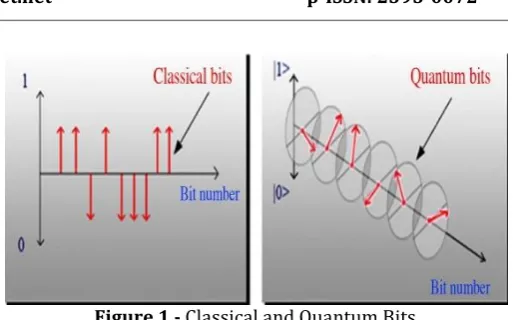
Figure 1 - Classical and Quantum Bits
3. Generate Shared Asymmetric Keys
This process consists of the steps required for generating and distributing shared Asymmetric keys between two members. The process begins with generating public and private keys as string of and through . Therefore, the circuit selects a single public key quantum bit from the upper input and generates a single quantum bit output. The circuit operates public key as control input to affect the private key which is target quantum bit. If the public key is then the private key output is as same as private key input. If the public key is then the private key output is the private key input flip-flopped as shown in Fig. 2 and given by (Eq. (11)).
= ( )
= ( )
= ( )
= ( )
© 2015, IRJET.NET- All Rights Reserved
Page 2339
Figure 2 - Generate Shared Asymmetric Keys4. Measuring Generate Shared Asymmetric Keys
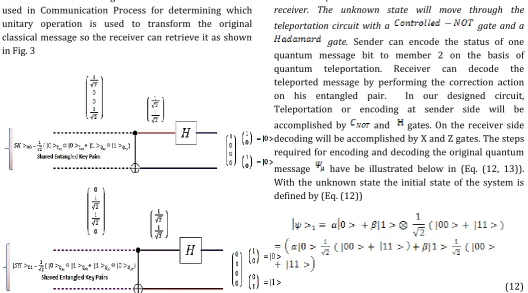
This process consists of the steps required by Member 2 for measuring received generated Asymmetric keys. Measuring is achieved by performing gate and a gate receptively. Result of measuring is a couple of classical bits , so Member 2 can detect which one of the four bell states is used to generate Asymmetric keys. The really essential phase for quantum teleportation and dense coding is Bell measurement. The outcome of Bell measurement is a couple of classical bits, which can be used for retrieve the original state. Bell measurement is used in Communication Process for determining which unitary operation is used to transform the original classical message so the receiver can retrieve it as shown in Fig. 3
Figure 3 - Measuring Generated Shared Asymmetric Keys
5. Encoding and Decoding of Transmitted
Quantum Messages by Partial Support
Teleportation approaches are not restricted to two-communicator teleportation, but also generalized to
Subsequently, if the sender succeeds for teleporting the unknown quantum state to both the receiver and trusted center, afterward only one of them can create a copy of the transmitted unknown quantum state with the support of the other. As a consequence, the transmitted information is fragmented between the sender and the trusted center, so both will cooperated together for retrieving the transmitted unknown state by the sender. Meanwhile, the trusted center control the whole teleportation process the protocol is denoted as controlled teleportation (CT).
In Fig.3 shows an illustrative example of perfect
teleportation as is used as a
quantum channel of Asymmetric keys between sender and receiver. Currently, sender would like to transmit the
unknown quantum state to
receiver. The unknown state will move through the
teleportation circuit with a gate and a
gate. Sender can encode the status of one
quantum message bit to member 2 on the basis of quantum teleportation. Receiver can decode the teleported message by performing the correction action on his entangled pair. In our designed circuit, Teleportation or encoding at sender side will be accomplished by and gates. On the receiver side decoding will be accomplished by X and Z gates. The steps required for encoding and decoding the original quantum message have be illustrated below in (Eq. (12, 13)). With the unknown state the initial state of the system is defined by (Eq. (12))
(12)
© 2015, IRJET.NET- All Rights Reserved
Page 2340
(13)
Since sender transmits the first quantum bit of the quantum state over the gate. So the state of overall system can be transformed as shown in (Eq. (14))
(14)
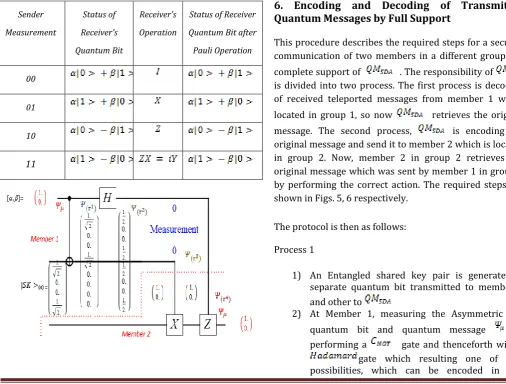
Table 1- Relationship between Sender Measurement and
Receiver’s Operation
Sender
Measurement
Status of
Receiver’s
Quantum Bit
Receiver’s
Operation
Status of Receiver
Quantum Bit after
Pauli Operation
00
01
10
11
Figure 4 - Encoding and Decoding of Transmitted Quantum Messages by Partial Support
Afterward, sender computes the first two quantum bits and publish the result of his measurement through the classical channel. When receiver receives the two classical bits, he will conclude which unitary operation should be applied for restructuring the transmitted original unknown quantum state sent by sender as shown in Table.1
6. Encoding and Decoding of Transmitted
Quantum Messages by Full Support
This procedure describes the required steps for a secured communication of two members in a different groups by complete support of . The responsibility of is divided into two process. The first process is decoding of received teleported messages from member 1 which located in group 1, so now retrieves the original message. The second process, is encoding the original message and send it to member 2 which is located in group 2. Now, member 2 in group 2 retrieves the original message which was sent by member 1 in group 1 by performing the correct action. The required steps are shown in Figs. 5, 6 respectively.
The protocol is then as follows:
Process 1
1) An Entangled shared key pair is generated, a separate quantum bit transmitted to member 1 and other to
© 2015, IRJET.NET- All Rights Reserved
Page 2341
perform the correct action on his entangled pairwith X and Z operations. So, the result is a quantum bit identical to the message which was chosen to be teleported.
Figure 5 - Encoding and Decoding of Transmitted Quantum Messages by Full Support
Figure 6 - Full Support Process 1
Process 2
1) The input is the retrieved quantum message from process 1. An Entangled shared key pair is generated , a separate quantum bit transmitted to
and other to member 2
2) At , measuring the Entangled shared key quantum bit and quantum message by performing a gate and thenceforth with a gate which resulting one of four possibilities, which can be encoded in two classical bits of information (00, 01, 10, and 11).
removes both quantum bits.
the original quantum message which was chosen to be teleported by member 1
Figure 7 - Full Support Process 2
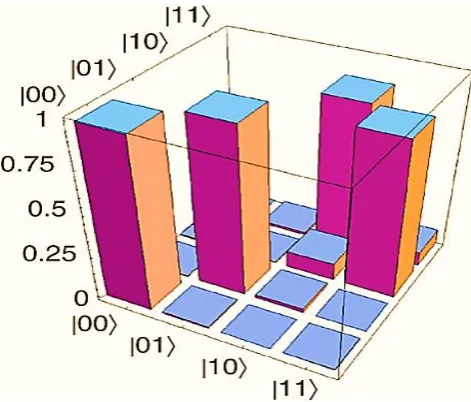
Truth Table for measuring received generated Asymmetric keys. Measuring is achieved by performing CNOT gate and a gate receptively. Result of measuring is a couple of classical bits and probabilities for retrieving each state according to results are shown in Fig. 8.
Figure 8 - Truth Table for measuring received generated Asymmetric keys
© 2015, IRJET.NET- All Rights Reserved
Page 2342
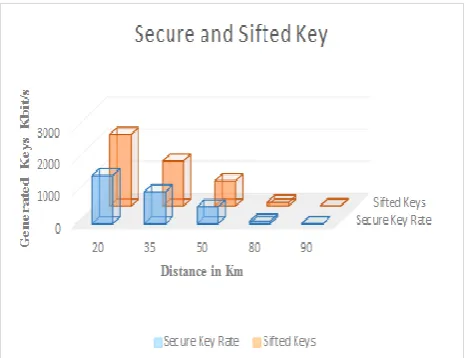
(15)Where is the approximate secured entangled shared key rate between and communicated members, represents the estimation amount of sifted keys by a single photon form to communicated members, represents the estimation amount of errors which generated by a single photon , represents the total number of sifted generated keys between and communicated members , represents the probability of the error correction efficiency , represents the estimation amount of sifted keys by a 0 photon pulses form to communicated members , and represent the binary entropy function and t represent the duration of established sessions between and communicated members. The relation between generated entangled shared and purified keys rated in Kbits/s as function of the distance between communicated peers in km is illustrated in Fig.9. The relation between key rate and distance is conversely which implies as long distance enlarged the key rate is reduced.
Figure 9 - The relation between generated Asymmetric keys rated in Kbits/s as function of the distance between communicated peers in km
Conclusion
A proposed architecture for public quantum cryptography is investigated. The proposed architecture focus on Generation and measuring shared entangled pair keys
between the communicated peers in a multicast network by Quantum Multicast shared distribution and measurement centre “ “ and quantum gates. Encoding of transmitted quantum messages is handled by the basis of quantum teleportation. Teleportation or encoding at sender side will be accomplished by and a gates. Decoding the teleported message is achieved by performing the correction action on received entangled pair. On the receiver side decoding will be accomplished by and gates. If two members within the same multicast group need to communicate, they can by using entangled shared key pair. If two members in a different groups need to communicate, they can by complete or partial support of . By full support of
the responsibility of is decoding /encoding the teleported / original transmitted quantum message between the communicated members. Optical clock synchronization is used for improving the transmission of generated entangled keys as well key update.
REFERENCES
1. Wootters, W., & Zurek, W. (1982). A single quantum cannot be cloned. Nature, 299(5886), 802-803. doi:10.1038/299802a0
2. Bennett, C., & Brassard, G. (2014). Quantum cryptography: Public key distribution and coin tossing. Theoretical Computer Science, 560, 7-11. doi:10.1016/j.tcs.2014.05.025
3. Liang, H., Liu, J., Feng, S., & Chen, J. (2013). Quantum teleportation with partially entangled states via noisy channels. Quantum Inf Process, 12(8), 2671-2687. doi:10.1007/s11128-013-0555-3
4. Nielsen, M., & Chuang, I. (2000). Quantum computation and quantum information. Cambridge: Cambridge University Press.
5. Zeng, G.H. (2006) Quantum cryptology : Science Press
6. Van Assche, G. (2006). Quantum cryptography and secret-key distillation. Cambridge: Cambridge University Press.
7. Zeng, G. (2010). Quantum private communication. Beijing: Higher Education Press.
8. Barenco, A., Bennett, C., Cleve, R., DiVincenzo, D., Margolus, N., & Shor, P. et al. (1995). Elementary gates for quantum computation. Physical Review
A, 52(5), 3457-3467.
doi:10.1103/physreva.52.3457
© 2015, IRJET.NET- All Rights Reserved
Page 2343
11. Jin, X. M., Ren, J. G., Yang, B., Yi, Z. H., Zhou, F., Xu,X. F., ... & Pan, J. W. (2010). Experimental free-space quantum teleportation. Nature Photonics, 4(6), 376-381.
12. Bell, J. S. (1964). On the einstein-podolsky-rosen paradox. Physics, 1(3), 195-200.
13. Aspect, A., Dalibard, J., & Roger, G. (1982). Experimental test of Bell's inequalities using time-varying analyzers. Physical review letters, 49(25), 1804.
14. Shimizu, K., & Imoto, N. (1999). Communication channels secured from eavesdropping via transmission of photonic Bell states. Physical Review A,60(1), 157.
15. Einstein, A., Podolsky, B., & Rosen, N. (1935). Can quantum-mechanical description of physical reality be considered complete?. Physical review, 47(10), 777.
16. Boström, K., & Felbinger, T. (2002). Deterministic secure direct communication using entanglement. Physical Review Letters, 89(18), 187902.
17. Deng, F. G., & Long, G. L. (2004). Secure direct communication with a quantum one-time pad. Physical Review A, 69(5), 052319.
18. Man, Z. X., Xia, Y. J., & An, N. B. (2006). Quantum secure direct communication by using GHZ states and entanglement swapping. Journal of Physics B: Atomic, Molecular and Optical Physics, 39(18), 3855.
19. Deng, F. G., Long, G. L., & Liu, X. S. (2003). Two-step quantum direct communication protocol using the Einstein-Podolsky-Rosen pair block.Physical Review A, 68(4), 042317.
20. Lucamarini, M., & Mancini, S. (2005). Secure deterministic communication without entanglement. Physical review letters, 94(14), 140501.
21. Yan, F. L., & Zhang, X. Q. (2004). A scheme for secure direct communication using EPR pairs and teleportation. The European Physical Journal B-Condensed Matter and Complex Systems, 41(1), 75-78.
22. Cai, Q. Y. (2004). The Ping-Pong protocol can be attacked without eavesdropping. arXiv preprint quant-ph/0402052.
23. Zhu, A. D., Xia, Y., Fan, Q. B., & Zhang, S. (2006). Secure direct communication based on secret
25. Lee, H., Lim, J., & Yang, H. (2006). Quantum direct communication with authentication. Physical Review A, 73(4), 042305.
26. Curty, M., & Santos, D. J. (2001). Quantum authentication of classical messages. Physical Review A, 64(6), 062309.
27. Dušek, M., Haderka, O., Hendrych, M., & Myška, R. (1999). Quantum identification system. Physical Review A, 60(1), 149.
28. Zeng, G., & Zhang, W. (2000). Identity verification in quantum key distribution. Physical Review A, 61(2), 022303.
29. Ljunggren, D., Bourennane, M., & Karlsson, A. (2000). Authority-based user authentication in quantum key distribution. Physical Review A, 62(2), 022305.
30. Biham, E., Huttner, B., & Mor, T. (1996). Quantum cryptographic network based on quantum memories. Physical Review A, 54(4), 2651. 31. Metwaly, A. F., Rashad, M. Z., Omara, F. A., &
Megahed, A. A. (2014). Architecture of multicast centralized key management scheme using quantum key distribution and classical symmetric encryption. The European Physical Journal Special Topics, 223(8), 1711-1728.
32. Ying, S., Qiao-Yan, W., & Fu-Chen, Z. (2008). Multiparty Quantum Chatting Scheme. Chinese Physics Letters, 25(3), 828.
33. Metwaly, A. F., & Mastorakis, N. E. (2015). Architecture of Decentralized Multicast Network Using Quantum Key Distribution and Hybrid WDM-TDM. Advances In Information Science And Computer Engineering, 504-518.
34. Metwaly, A., Rashad, M. Z., Omara, F. A., & Megahed, A. A. (2012, May). Architecture of point to multipoint QKD communication systems (QKDP2MP). In Informatics and Systems (INFOS), 2012 8th International Conference on (pp. NW-25). IEEE.
35. Farouk, A., Omara, F., Zakria, M., & Megahed, A. (2015). Secured IPsec Multicast Architecture Based on Quantum Key Distribution. In The International Conference on Electrical and Bio-medical Engineering, Clean Energy and Green Computing (pp. 38-47). The Society of Digital Information and Wireless Communication. 36. Ting, G., Feng-Li, Y., & Zhi-Xi, W. (2005). A
© 2015, IRJET.NET- All Rights Reserved
Page 2344
communication scheme between the central partyand other M parties.Chinese Physics Letters, 22(10), 2473.
37. Wang, C., Deng, F. G., & Long, G. L. (2005). Multi-step quantum secure direct communication using multi-particle Green–Horne–Zeilinger state. Optics communications, 253(1), 15-20. 38. Wang, J., Zhang, Q., & Tang, C. J. (2006). Quantum
secure direct communication based on order rearrangement of single photons. Physics Letters A, 358(4), 256-258.
39. Qing-Yu, C., & Bai-Wen, L. (2004). Deterministic secure communication without using entanglement. Chinese Physics Letters, 21(4), 601.
40. Cai, Q. Y. (2006). Eavesdropping on the two-way quantum communication protocols with invisible photons. Physics Letters A, 351(1), 23-25.
41. Long, G. L., Deng, F. G., Wang, C., Li, X. H., Wen, K., & Wang, W. Y. (2007). Quantum secure direct communication and deterministic secure quantum communication. Frontiers of Physics in China, 2(3), 251-272. member for prestigious journals published by Springer, IEEE, Nature, indersciences, IAENG, and SDIWC. He also members in many prestigious association like IEEE and IACSIT. His interests are
Quantum Communication,
Quantum Cryptography and Cloud Computing.
Prof. Magdi Z. Rashad is Professor in the Computer Science published over 100 research
papers in prestigious
international journals, and conference proceedings. He has served as Chairman and member of Steering Committees and Program Committees of several national Conferences. He has supervised over 50 PhD and M. Sc thesis.
Prof. Fatma A. Omara is Professor in the Computer Science conference proceedings. She has served as Chairman and member of Steering Committees and Program Committees of several national Conferences. She has supervised over 30 PhD and M. Sc thesis. Prof. Omara is a member of the IEEE and the IEEE Computer Society. Prof. Omara interests are Parallel and