R E S E A R C H
Open Access
A fourth order non-polynomial quintic spline
collocation technique for solving time
fractional superdiffusion equations
Muhammad Amin
1, Muhammad Abbas
2*, Muhammad Kashif Iqbal
3, Ahmad Izani Md. Ismail
4and
Dumitru Baleanu
5,6,7*Correspondence:
[email protected] 2Department of Mathematics, University of Sargodha, Sargodha, Pakistan
Full list of author information is available at the end of the article
Abstract
The purpose of this article is to present a technique for the numerical solution of Caputo time fractional superdiffusion equation. The central difference approximation is used to discretize the time derivative, while non-polynomial quintic spline is employed as an interpolating function in the spatial direction. The proposed method is shown to be unconditionally stable andO(h4+
t2) accurate. In order to check the feasibility of the proposed technique, some test examples have been considered and the simulation results are compared with those available in the existing literature.
Keywords: Non-polynomial quintic spline; Finite central difference approach; Superdiffusion equation; Caputo time fractional derivative
1 Introduction
In this article, we consider the following time fractional fourth order superdiffusion equa-tion [1]:
∂αy
∂tα +γ
∂4y
∂z4 =f(z,t), 0≤z≤L, 0≤t≤T, (1)
with the initial/end conditions
y(z, 0) =φ(z), yt(z, 0) =ψ(z),
y(0,t) =y(L,t) = 0,
yzz(0,t) =yzz(L,t) = 0,
whereα∈(1, 2] denotes the order of time fractional derivative,γ is a constant, andφ(z) is continuous on [0,L].
Fourth order time fractional partial differential equations (PDEs) arise in mathemati-cal modeling of several plate-like objects [2]. Most of the analytimathemati-cal techniques for solv-ing fractional order PDEs are based on Laplace and Fourier transforms, while others in-volve the separation of variables technique [3,4]. Some semi-analytic methods have also
been employed to explore series solution for fractional order PDEs. These included ho-motopy analysis method [5], Adomian decomposition method [6,7], homotopy perturba-tion method [8], variaperturba-tional iteraperturba-tion method [9], and fracperturba-tional differential transforma-tion method [10].
In recent years, spline functions have also been frequently employed for the numerical solution of fractional order PDEs. These functions have advantages over the usual finite difference methods as they can provide a continuous differentiable approximation to the unknown function in the spatial domain with good accuracy. The simple and straight-forward application of spline functions provides enough motivation to employ them for the numerical study of fractional PDEs. Zahra and Elkholy [11] employed cubic spline functions combined with shooting method for solving fractional Bagley–Torvik equation. Talaat and Danaf [12] applied the quadratic spline method for numerical investigation of fractional diffusion equation. Siddiqi and Arshed [13] used the quintic B-spline collo-cation method for numerical solution of time fractional fourth order PDEs. In [14], the authors introduced new fractional order spline functions to study the numerical solution of fractional Bagely–Torvik equation. Mohyu-Dinet al.[15] investigated the extended B-spline solution of time fractional advection diffusion equation by means of a fully implicit finite difference scheme. Liet al.[16] developed a non-polynomial spline scheme to solve time fractional nonlinear Schrodinger equation. In [17], Pezza and Pitolli used a fractional spline collocation Galerkin scheme to develop series solution for time fractional diffusion equation. Khalidet al.[18] utilized the non-polynomial quintic spline collocation method to explore the numerical solution of fourth order fractional boundary value problem, in-volving product terms. In [19], Aminet al.employed the quintic non-polynomial spline collocation scheme for solving time fractional fourth order PDEs.
There are several techniques to deal with the fractional differentiation but Riemann– Liouville’s and Caputo’s approaches are the most common. Here, we utilize Caputo’s def-inition as it allows us to use the ordinary initial/boundary constraints. The Caputo time fractional derivative of orderαis expressed as
∂αy(z,t)
∂tα =
⎧ ⎨ ⎩
1 Γ(2–α)
t
0 ∂2y(z,s)
∂s2 (t–sds)α–1, 1 <α< 2, ∂2y(z,t)
∂t2 , α= 2.
This paper aims to develop a spline collocation approach for numerical solution of fourth order time fractional superdiffusion problem. For spatial discretization, a non-polynomial quintic spline interpolant, composed of trigonometric and polynomial components, is used. For temporal discretization, a central difference approximation is used.
The outline of this paper is as follows: A short description of the non-polynomial quintic spline technique is given in Sect.2. The consistency relations between the spline approx-imation and its spatial derivatives at the grid points are derived in this section. In Sect.3, the application of Caputo’s definition and finite central difference formulation for tempo-ral discretization is shown. The stability and convergence of the proposed problem is dis-cussed in Sect.4. The discretization in space direction is given in Sect.5. The approximate results are discussed in Sect.6, and the conclusion of the proposed study is given in Sect.7.
2 Non-polynomial quintic spline functions
2.1 Formulation
Letzi=a+ihbe the grid points of a uniform partition of [0,L] dividing it into the
subin-tervals [zi,zi+1], whereh= NL and 0≤i≤N. We consider thaty(z) is sufficiently
differ-entiable in [0,L] andY(z) is its quintic non-polynomial spline approximation. Let each non-polynomial spline segmentSi(z) have the following form [18,19]:
Si(z) =aicosη(z–zi) +bisinη(z–zi) +ci(z–zi)3
+di(z–zi)2+ei(z–zi) +fi, 0≤i≤N, (2)
whereai,bi,ci,di,ei, andfiare constants to be determined andηdenotes the frequency
of the trigonometric functions. Moreover,
Si(z)∈C∞[0,L]
and
Y(z) =Si(z), ∀z∈[zi,zi+1],i= 0, 1, 2, . . . ,N. (3)
Let
Yi=Si(zi), Mi=Y(zi), Fi=Y(4)(zi).
The constants involved inSi(z) can be expressed as follows:
ai=
h4
θ4Fi,
bi=
h4
θ4sin(θ)
Fi+1–Ficos(θ)
,
ci=
1
6h(Mi+1–Mi) + h
6θ2(Fi+1–Fi),
di=
1 2Mi+
h2
2θ2Fi,
ei=
1
h(Yi+1–Yi) +
h3
θ4 –
h3
3θ2 Fi–
h3
θ4, +
h3
6θ2 Fi+1–
h
6(Mi+1+ 2Mi),
fi=Yi–
h4
θ4Fi,
whereθ =ηhandi= 0≤i≤N. Using 1st and 3rd derivative continuities at the knots, S(τi–1)(zi) =Si(τ)(zi) forτ= 1, 3, the following important relations can be derived:
Mi+1+ 4Mi+Mi–1=
6
h2(Yi+1– 2Yi+Yi–1) +
6h2
θ2
1
θsin(θ)– 1
θ2 –
1
6 (Fi+1+Fi–1)
+6h
2
θ2
2
θ2–
2cos(θ)
θsin(θ)– 4
6 Fi (4)
and
Mi+1– 2Mi+Mi–1=h2
1
θsin(θ)– 1
θ2 (Fi+1+Fi–1) + 2h 2
1
θ2 – cos(θ)
Solving (4) and (5) yields
Using (5) and (6), we obtain the following consistency relation involvingFiandYifori=
2, 3, . . . ,N– 2:
Similarly, using (5), the following two expressions can be derived withi= 1, 2:
Similarly, using (9) and (11), we obtain
Substituting (12) and (13) into (8) fori= 1 yields
2Y0– 5Y1+ 4Y2–Y3=h2M0–h4(0F0+1F1+2F2+3F3). (14)
Also, fori=n, the following relation can be established:
Comparing the coefficients ofy(τi )forτ= 4, 5, 6, 7, we obtain
Following [19], the formulation and truncation error given in Sects.2.1and2.2 respec-tively are reproduced here for the sake of completeness.
3 Time discretization
Lettm=mt, wheret=KT is the step size in the time direction form= 0, 1, 2, . . . ,K.
To discretize the Caputo fractional time derivative att=tm+1, the usual central difference
approach is used as follows [20]:
∂αy(z,t
Now, introduce a fractional differential operatorΩα
Equation (18) can be rewritten as follows:
∂αy(z,tm+1)
∂tα =Ω α
ty(z,tk+1) +lmt+1. (19)
Here,lm+1
t denotes the truncation error between ∂
α
∂tαy(z,tm+1) andΩtαy(z,tm+1). Equation
(1) can be written as
Ωtαy(z,tm+1) +γ
∂4
∂z4y(z,tm+1) =f(z,tm+1), (20)
where Ωα
ty(z,tm+1) denotes the Caputo fractional time derivative approximation at t=
tm+1. Using (18), expression (20) takes the following form:
ym+1(z) +βγym+1
xxxx= –dmy–1(z) + (2dm–dm–1)y0(z) +
m–1
k=1
(–dk–1+ 2dk–dk+1)ym–k(z)
+ (2d0–d1)ym(z) +βfm+1(z), m= 1, 2, 3, . . . ,K– 1, (21)
whereβ=Γ(3 –α)tαandym+1(z) =y(z,tm+1) and the initial conditions are imposed as
follows:
y(z,t0) =φ(z), 0≤z≤L, (22)
∂y(z,t0)
∂t =ψ(z), 0≤z≤L. (23) Moreover, the constantsdksappearing in (18) possess the following properties:
• d0= 1and∀k,dks> 0,
• (2 –d1) –
m–1
k=1(dk+1– 2dk+1+dk–1) + (2dm–dm–1) –dm= 1.
The truncation error in (19) is bounded, i.e.,
lmt+1≤ζ t2. (24)
Here,ζ is a constant depending ony.
To implement this scheme, first we calculatey–1as follows:
y–1(z) =y(z,t0) –tyt(z,t0),
y–1(z) =φ(z) –tψ(z).
Form= 0, (21) takes the following form:
y1(z) +βγy1zzzz= –d0y–1(z) + 2d0y0(z) +βf1(z). (25)
Now, Eqs. (21) and (25) together with initial/boundary conditions become a complete set of semi-discrete problem for (1).
Also,lm+1, the error att=t
m+1, is given by [21]
lm+1=β
∂α
∂tαy(z,tm+1) –G α
From Eqs. (19) and (24), the above expression can be written as
lm+1=lmt+1≤ζ t2. (27)
Some relevant functional spaces, their inner product and standard norms are defined as follows:
Υ2(η) =u∈L2(η),uz,uzz∈L2(η)
,
Υ02(η) =u∈Υ2(η),u|∂η= 0,uz|∂η= 0
,
Υn(η) =u∈L2(η),u(zr),∀r≤N,
whereL2(η) denotes the space of those measurable functions whose squares are Lebesgue
integrable inη. The norm and inner product ofL2(η) are given by
v,u=
η
vu dz, u0= u,u12.
Also, forΥ2(η), we take
v,u2= v,u+ vz,uz+ vzz,uzz, u2=
u,u2.
The norm · of the spaceΥN(η) is defined as
uN=
N
r=0
u(xr)
2
0. (28)
· 2is defined as
u2=
u2 0+βγu
(2)
x
2
0. (29)
Now, to carry out the stability and convergence analysis, we need to findym+1∈Υ2 0(η)
such that∀u∈Υ02(η). From (21) and (25), we have
ym+1,u+βγymzzzz+1,u = –dm
y–1,u+ (2dm–dm–1)
y0,u
+
m–1
k=1
(–dk–1+ 2dk–dk+1)
ym–k,u+ (2d0–d1)
ym,u+βfm+1,u (30)
and
y1,u+βγy1zzzz,u= –d0
y–1,u+ 2d0
y0,u+βf1,u. (31)
Definition 1 Letgmandhm,m= 1, 2, . . . ,N, be the sequences which satisfy the inequality
gm≤
m–1
i=1
gihi+κ
wheregm≥0,κ≥0, then the following discrete Gronwall inequality holds:
gm≤κ.exp
m–1
i=1
gi
, m= 1, 2, . . . ,N. (32)
4 Stability and convergence
The approach used in this section follows the general approach used in [19]. The stability and convergence analysis for semi-discrete problem are described in the following Theo-rems1and2, respectively.
Theorem 1 ∀t> 0,the semi-discrete problem is unconditionally stable if
ym+12≤cφ0+tψ0+βfk+10, 0≤m≤K– 1. (33)
Proof We apply mathematical induction to prove this theorem. Form= 0 andu=y1, Eq. (30) can be expressed as
y1,y1+βγy1xxxx,y1= –d0
y–1,y1+ 2y0,y1+βf1,y1 or
y1,y1+βγy1zz,y1zz= –d0
y–1,y1+ 2d0
y0,y1+βf1,y1. (34) Here, all the boundary related contributions vanish because of the boundary constraints onu. Usingu0≤ u2and Schwarz’s inequality, Eq. (34) becomes
y122≤y–10y10+ 2y00y10+βf10y10
≤y–10y12+ 2y00y12+βf10y12, y12≤y–10+ 2y00+βf10,
y12≤φ0–tψ0+ 2φ00+βf10, y12≤3φ0–tψ0+βf10.
Hence
y12≤cφ0–tψ0+βf10.
We assume that the result is true foru=yk, i.e.,
yk2≤cφ00+tψ00+βfk0, k= 2, 3, . . . ,m. (35)
Letu=ym+1in Eq. (30)
ym+1,ym+1+βγymzzzz+1,ym+1 = –dm
y–1,ym+1+ (2dm–dm–1)
y0,ym+1
+
m–1
k=1
(–dk–1+ 2dk–dk+1)
ym–k,ym+1+ (2d0–d1)
Integrating by parts gives
ym+1,ym+1+βγymzz+1,ymzz+1 = –dm
y–1,ym+1+ (2dm–dm–1)
y0,ym+1
+
m–1
k=1
(–dk–1+ 2dk–dk+1)
ym–k,ym+1+ (2d0–d1)
ym,ym+1+βfm+1,ym+1. (37)
Usingu0≤ u2and Schwarz’s inequality, the above expression then takes the following form:
ym+122≤dmy–10ym+10+ (2dm–dm–1)y00ym+10+
m–1
k=1
(–dk–1+ 2dk
–dk+1)ym–k0ym+10+ (2d0–d1)ym0ym+10+βfk+10ym+10,
or
ym+122≤dmy–10ym+12+ (2dm–dm–1)y00ym+12+
m–1
k=1
(–dk–1+ 2dk
–dk+1)ym–k0ym+12+ (2d0–d1)ym0ym+12+βfk+10ym+12,
ym+12≤dmy–10+ (2dm–dm–1)y00+
m–1
k=1
(–dk–1+ 2dk–dk+1)ym–k0
+ (2d0–d1)ym0+βfk+10.
Using (32), the above relation can be written as follows:
ym+12≤(2dm–dm–1)y00+dmy–10+βfm+10
exp
(2d0–d1)
+
m–1
k=1
(–dk–1+ 2dk–dk+1)
,
ym+12≤y00+y–10+βfk+10exp(1 +dm–1–dm),
ym+12≤φ0+φ0–tψ0+βfk+10exp(1 +dm–1–dm),
ym+12≤cφ0–tψ0+βfk+10.
Theorem 2 The numerical solution obtained by the proposed method converges to the exact solution if the following relation holds:
y(tm) –ym2≤ζ t2, m= 1, 2, . . . ,K, (38)
whereζ is constant andζ= (1 +dm–1)exp(1 +dm–1–dm).
Proof Considerem=y(z,t
m) –ym(z) form= 1, using Eqs. (1) and (30), we have
e1,u+βγe1zz,uzz
=e–1,u+ 2d0
Again usingu0≤ u2, Schwarz’s inequality,u=e1, ande0= 0, we get
e122≤e–10+e10+l10e10, e122≤e–10+e12+l10e12, e12≤e–10+l10.
Sincee–1 ≤t2, using Eq. (27) leads to y(t1) –y12≤2t2,
y(t1) –y12≤ζ t2.
Form= 1, Eq. (38) is true.
Now, consider (38) is satisfied form= (1)r, i.e.,
y(tm) –ym2≤ζ t2. (39)
Using (1), (29), (30) and form=r+ 1, the error equation is derived as follows:
em+1,u+βγemzz+1,uzz
= –dm
e–1,u+ (2dm–dm–1)
e0,u
+
m–1
k=1
(–dk–1+ 2dk–dk+1)
em–k,u+ (2d0–d1)
em,u+lm+1,u. (40)
Now, using the induction assumption and takingu=em+1, Eq. (40) can be written as fol-lows:
em+122≤–dme–10em+10+ (2dm–dm–1) +e00em+10
+
m–1
k=1
(–dk–1+ 2dk–dk+1)em–k0em+10+ (2d0–d1)em0em+10
+lm+10em+10,
em+12≤–dme–10+ m–1
k=1
(–dk–1+ 2dk–dk+1)em–k2+ (2d0–d1)em2+lm+10.
Using (34), we have
em+12≤dme–10+lm+10
exp
m–1
k=1
(–dk–1+ 2dk–dk+1) + 2d0–d1
,
or
em+12≤dme–10+lm+10
exp(1 +dk–1–dk),
em+1 2≤
dmt2+t2
+exp(1 +dk–1–dk),
em+12≤ζ t2.
5 Spatial discretization
The approach used in this section follows the general approach used in [19].
Let (zi,tm) be the grid points of a uniform mesh to discretize the region [0,L]×[0,T],
wherezi=ih,i= 0, 1, 2, . . . ,N, andh=NL. The spatial discretization of Eq. (21) using quintic
non-polynomial spline is formulated as follows:
Yim+1(z) +βγFm+1
= –dmY–1(z) + (2dm–dm–1)Y0(z) +
m–1
k=1
(–dk–1+ 2dk–dk+1)Ym–k(z)
+ (2d0–d1)Ym(z) +βfm+1(z), m= 1, 2, 3, . . . ,K– 1. (41)
The operatorϕis defined as
ϕYk=μ1Yk–2+ν1Yk–1+κ1Yk+ν1Yk+1+μ1Yk+2. (42)
Now, Eq. (7) takes the following form:
ϕFi=
1
h4(Yi–2– 4Yi–1+ 6Yi– 4Yi+1+Yi+2). (43)
Applyingϕon Eq. (41), we obtain
μ1Yim–2+1+ν1Yim–1+1+κ1Yim+1+ν1Yim+1+1+μ1Yim+2+1
+βγ
h4
Yim–2+1– 4Yim–1+1+ 6Yim+1
– 4Yim+1+1+Yim+2+1
= –dm
μ1Yi–1–2+ν1Yi–1–1+κ1Yi–1+ν1Yi–1+1+μ1Yi–1+2
+ (2dm
–dm–1)
μ1Yi0–2+ν1Yi0–1+κ1Yi0+ν1Yi0+1+μ1Yi0+2
+
m–1
k=1
(–dk–1+ 2dk–dk+1)
μ1Yim–2–k
+ν1Yim–1–k+κ1Yim–k+ν1Yim+1–k+μ1Yim+2–k
+ (2d0–d1)
μ1Yim–2+ν1Yim–1+κ1Yim+ν1Yim+1
+μ1Yim+2
+βμ1fim–2+1+ν1fim–1+1+κ1fim+1+ν1fim+1+1+μ1fim+2+1
,
1≤m≤K– 1. (44)
After simplification, (44) takes the following form:
μ1+
βγ
h4 Y
m+1
i–2 +
ν1– 4
βγ
h4 Y
m+1
i–1 +
κ1+ 6
βγ
h4 Y
m+1
i
+
ν1– 4
βγ
h4 Y
m+1
i+1 +
μ1+
βγ
h4 Y
m+1
i+2
where
We extract two more equations from boundary conditions as follows:
N–1]T are required. Solving (25) and utilizing the quintic non-polynomial spline,Y1is
where
We extract two more equations from the end conditions as follows:
Here, A,B, and C are square matrices of ordern– 1.
C= ⎛ ⎜ ⎜ ⎜ ⎜ ⎜ ⎜ ⎜ ⎜ ⎜ ⎜ ⎜ ⎝
0 0 0 0 0 0 0 · · · 0
1 0 0 0 0 0 0 · · · 0
0 0 0 0 0 0 0 · · · 0
. .. . .. . ..
0 · · · 0 0 0 0 0 0 0
0 · · · 0 0 0 0 0 0 1
0 · · · 0 0 0 0 0 0 0
⎞ ⎟ ⎟ ⎟ ⎟ ⎟ ⎟ ⎟ ⎟ ⎟ ⎟ ⎟ ⎠ .
D=#–M0h2, 0, 0, 0, . . . , –MNh2
$T
.
6 Numerical results and discussion
In this section, we present the simulation results for two test examples in order to validate the proposed numerical algorithm. All calculations are performed in Mathematica 10.0. The accuracy of the current scheme is verified by the error normsL∞,L2and experimental
order of convergence (EOC) [22,23]:
L∞=max|yj–Yj|, L2=
Nj=0|yj–Yj|2
N j=0|yj|2
, EOC= 1
log(2)log %
L∞(2N)
L∞(N)
& ,
where yj,Yjare the exact analytical and quintic non-polynomial spline solutions atjth
nodal point respectively.
Problem 1 Consider problem (1) withγ = 0.05 [1]. The exact analytical solution of this problem is
y(z,t) = 2(t+ 1)sin2(z).
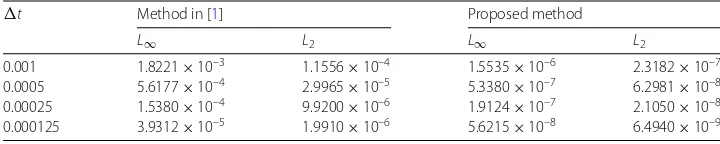
The maximum and Euclidean error norms corresponding to four different values oft are reported in Table1usingN= 100 andα= 1.75. It is clear that the presented scheme approximates the exact analytical solution more precisely as compared to the method used
Table 1 Error norms for Problem1att= 1 withN= 100,α= 1.75
t Method in [1] Proposed method
L∞ L2 L∞ L2
0.001 1.8221×10⁻³ 1.1556×10⁻⁴ 1.5535×10⁻⁶ 2.3182×10⁻⁷
0.0005 5.6177×10⁻⁴ 2.9965×10⁻⁵ 5.3380×10⁻⁷ 6.2981×10⁻⁸
0.00025 1.5380×10⁻⁴ 9.9200×10⁻⁶ 1.9124×10⁻⁷ 2.1050×10⁻⁸
0.000125 3.9312×10⁻⁵ 1.9910×10⁻⁶ 5.6215×10⁻⁸ 6.4940×10⁻⁹
Table 2 Error norms for Problem1, withN= 80 andt= 0.001
α t= 0.25 t= 0.5 t= 1
1.25 L2 2.5869×10⁻⁷ 2.0680×10⁻⁷ 1.5465×10⁻⁷
L∞ 2.0113×10⁻⁶ 1.4491×10⁻⁶ 9.9176×10⁻⁷
1.50 L2 2.4923×10⁻⁷ 2.2555×10⁻⁷ 1.9223×10⁻⁷
L∞ 2.0700×10⁻⁶ 1.6562×10⁻⁶ 1.2714×10⁻⁶
1.75 L2 2.3392×10⁻⁷ 2.3887×10⁻⁷ 2.3182×10⁻⁷
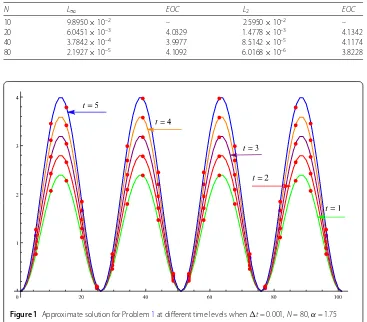
Table 3 Experimental order of convergence for Problem1, whenα= 1.50,N= 80,t= 0.001
N L∞ EOC L2 EOC
10 9.8950×10⁻² – 2.5950×10⁻² –
20 6.0451×10⁻³ 4.0329 1.4778×10⁻³ 4.1342
40 3.7842×10⁻⁴ 3.9977 8.5142×10⁻⁵ 4.1174
80 2.1927×10⁻⁵ 4.1092 6.0168×10⁻⁶ 3.8228
Figure 1Approximate solution for Problem1at different time levels whent= 0.001,N= 80,α= 1.75
Figure 2Exact and numerical solution for Problem1withN= 80,t= 0.001, andα= 1.50
in [1]. In Table2, the error normsL∞andL2are listed att= 0.25, 0.5, 1 using different
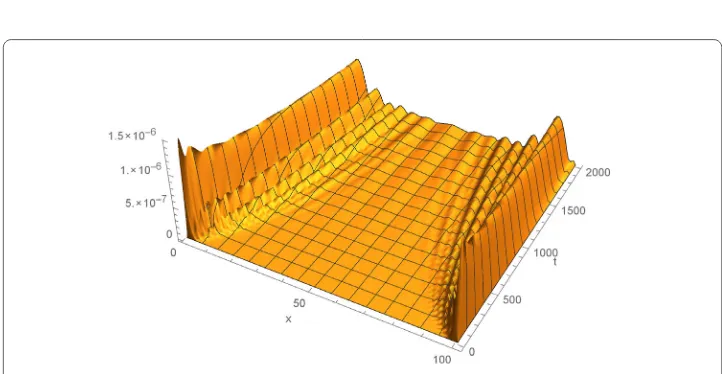
Figure 3Absolute error for Problem1whenN= 100,α= 1.75, andt= 0.0005
Figure 4Absolute error for Problem1whenN= 100,α= 1.5 andt= 1
with the exact solution, which indicates that the proposed method is effective. Figure3 displays the absolute error att= 1 withα= 1.75 andN= 100, whereas Fig.4represents 3D error plot usingN= 100,α= 1.5, andt= 0.001.
Problem 2 As a second experiment, consider the following fourth order superdiffusion equation [1]:
∂αy
∂tα +γ
∂4y
∂z4 =f(z,t), z∈[0, 1],t∈[0,T],
the initial/end conditions are
y(z, 0) = 1
π5
π10sin(πz) +cos(πz) –cos(3πz), y(0,t) =y(1,t) = 0,
yzz(0,t) =
1
π38(1 +t), yzz(1,t) = –
1
Table 4 Error norms for Problem2att= 1 withN= 80,α= 1.50
t Method in [1] Proposed method
L∞ L2 L∞ L2
0.001 1.8221×10⁻³ 1.1556×10⁻⁴ 7.4454×10⁻⁸ 5.2661×10⁻⁸
0.0005 5.6177×10⁻⁴ 2.9965×10⁻⁵ 2.1479×10⁻⁸ 1.6911×10⁻⁸
0.00025 1.5380×10⁻⁴ 9.9200×10⁻⁶ 5.4476×10⁻⁹ 5.1349×10⁻⁹
0.000125 3.9312×10⁻⁵ 1.9910×10⁻⁶ 1.9831×10⁻⁹ 1.4734×10⁻⁹
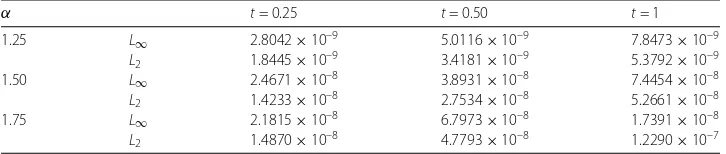
Table 5 Error norms for Problem2, whenN= 80 andt= 0.001
α t= 0.25 t= 0.50 t= 1
1.25 L∞ 2.8042×10⁻⁹ 5.0116×10⁻⁹ 7.8473×10⁻⁹
L2 1.8445×10⁻⁹ 3.4181×10⁻⁹ 5.3792×10⁻⁹
1.50 L∞ 2.4671×10⁻⁸ 3.8931×10⁻⁸ 7.4454×10⁻⁸
L2 1.4233×10⁻⁸ 2.7534×10⁻⁸ 5.2661×10⁻⁸
1.75 L∞ 2.1815×10⁻⁸ 6.7973×10⁻⁸ 1.7391×10⁻⁸
L2 1.4870×10⁻⁸ 4.7793×10⁻⁸ 1.2290×10⁻⁷
Table 6 Experimental order of convergence for Problem2, whenN= 80,α= 1.50,t= 0.001
N L∞ EOC L2 EOC
10 4.2119×10⁻⁴ – 1.6769×10⁻⁴ –
20 2.2034×10⁻⁵ 4.2566 9.9991×10⁻⁶ 4.0678
40 1.8694×10⁻⁶ 4.1846 6.9693×10⁻⁷ 3.8452
80 7.4454×10⁻⁸ 4.0245 5.2661×10⁻⁸ 3.8605
The exact analytical solution to this problem is
y(z,t) = 1
π5
π10sin(πz) +cos(πz) –cos(3πz)(t+ 1).
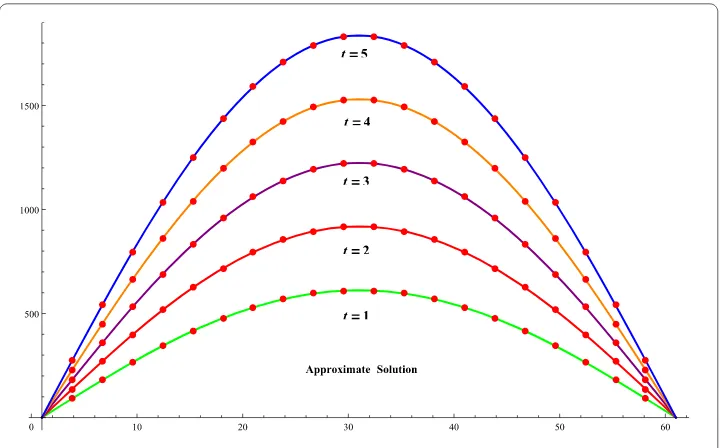
The computational error norms corresponding to four different selections of t are given in Table4withγ = 0.05 andN= 80. It can be seen that our presented computa-tional strategy yields more accurate solutions as compared to the technique used in [1]. Table5shows the maximum and Euclidian error norms at different time levels. The ex-perimental rate of convergence is tabulated in Table6when error norms are calculated forN= 80,α= 1.50, andt= 0.001. It is clear that the experimental results support the theoretical estimation. Figure5displays the approximate solution att= 1, 2, 3, 4, 5. The three-dimensional plots of analytical exact and numerical solutions are portrayed in Fig.6 in order to showcase their physical behaviour. In Fig.7, the absolute computational error is presented att= 1 usingα= 1.50 andN= 80.
7 Conclusion
1. An algorithm utilizing quintic non-polynomial spline functions has been developed for the numerical treatment of time fractional fourth order superdiffusion equation. 2. The discretization in space and time directions has been achieved by using quintic
non-polynomial spline functions and finite central difference formulation respectively.
3. The unconditional stability of the proposed scheme in temporal direction has been proved.
Figure 5Approximate solution for Problem2at different time levels whent= 0.001,N= 60,α= 1.25
Figure 6Exact and numerical solution for Problem2whenN= 80,α= 1.25,t= 0.001
Figure 7Absolute error for Problem2whenN= 80,
t= 0.001 andα= 1.25
5. The experimental order of convergence is found to conform with the theoretical expectations.
Acknowledgements
The authors are also indebted to the anonymous reviewers for their helpful, valuable comments and suggestions in the improvement of this manuscript. This research was financial supported by Research University grant
(1001/PMATHS/8011013) from School of Mathematical Sciences, Universiti Sains Malaysia.
Funding
All the financial support for publishing this paper is funded by Universiti Sains Malaysia.
Availability of data and materials
Not applicable.
Competing interests
The authors declare that they have no competing interests.
Authors’ contributions
All authors equally contributed to this work. All authors read and approved the final manuscript.
Authors’ information
Muhammad Amin is PhD scholar, Muhammad Abbas is Associate Professor, Muhammad Kashif Iqbal is Assistant Professor, Ahmad Izani Md. Ismail and Dumitru Baleanu are Professors.
Author details
1Department of Mathematics, National College of Business Administration & Economics, Lahore, Pakistan.2Department
of Mathematics, University of Sargodha, Sargodha, Pakistan. 3Department of Mathematics, Government College
University, Faisalabad, Pakistan.4School of Mathematical Sciences, Universiti Sains Malaysia, Penang, Malaysia. 5Department of Mathematics, Faculty of Arts and Sciences, Cankaya University, Ankara, Turkey.6Department of Medical
Research, China Medical University Hospital, China Medical University, Taichung, Taiwan. 7Institute of Space Sciences,
Magurele-Bucharest, Romania.
Publisher’s Note
Springer Nature remains neutral with regard to jurisdictional claims in published maps and institutional affiliations.
Received: 19 September 2019 Accepted: 2 December 2019 References
1. Arshed, S.: Quintic b-spline method for time-fractional superdiffusion fourth-order differential equation. Math. Sci.
11(1), 17–26 (2017)
2. Tariq, H., Akram, G.: Quintic spline technique for time fractional fourth-order partial differential equation. Numer. Methods Partial Differ. Equ.33(2), 445–466 (2017)
3. Podlubny, I.: Fractional Differential Equations: An Introduction to Fractional Derivatives, Fractional Differential Equations, to Methods of Their Solution and Some of Their Applications. Mathematics in Science and Engineering, vol. 198. Academic Press, San Diego (1998)
4. Miller, K.S., Ross, B.: An Introduction to the Fractional Calculus and Fractional Differential Equations. Wiley, New York (1993)
5. Jafari, H., Golbabai, A., Seifi, S., Sayevand, K.: Homotopy analysis method for solving multi-term linear and nonlinear diffusion–wave equations of fractional order. Comput. Math. Appl.59(3), 1337–1344 (2010)
6. Dhaigude, D., Birajdar, G.A.: Numerical solution of system of fractional partial differential equations by discrete Adomian decomposition method. J. Fract. Calc. Appl.3(12), 1–11 (2012)
7. El-Sayed, A., Gaber, M.: The Adomian decomposition method for solving partial differential equations of fractal order in finite domains. Phys. Lett. A359(3), 175–182 (2006)
8. Momani, S., Odibat, Z.: Homotopy perturbation method for nonlinear partial differential equations of fractional order. Phys. Lett. A365(5–6), 345–350 (2007)
9. Turut, V., Güzel, N.: On solving partial differential equations of fractional order by using the variational iteration method and multivariate Padé approximations. Eur. J. Pure Appl. Math.6(2), 147–171 (2013)
10. Secer, A., Akinlar, M.A., Cevikel, A.: Efficient solutions of systems of fractional PDEs by the differential transform method. Adv. Differ. Equ.2012(1), 188 (2012)
11. Zahra, W.K., Elkholy, S.M.: The use of cubic splines in the numerical solution of fractional differential equations. Int. J. Math. Math. Sci.2012, Article ID 638026 (2012)
12. El Danaf, T.S.: Numerical solution for the linear time and space fractional diffusion equation. J. Vib. Control21(9), 1769–1777 (2015)
13. Siddiqi, S.S., Arshed, S.: Numerical solution of time-fractional fourth-order partial differential equations. Int. J. Comput. Math.92(7), 1496–1518 (2015)
14. Hamasalh, F.K., Muhammad, P.O.: Generalized quartic fractional spline interpolation with applications. Int. J. Open Problems Compt. Math.8(1), 67–80 (2015)
15. Mohyud-Din, S.T., Akram, T., Abbas, M., Ismail, A.I., Ali, N.H.: A fully implicit finite difference scheme based on extended cubic b-splines for time fractional advection–diffusion equation. Adv. Differ. Equ.2018(1), 109 (2018)
16. Li, M., Ding, X., Xu, Q.: Non-polynomial spline method for the time-fractional nonlinear Schrödinger equation. Adv. Differ. Equ.2018(1), 318 (2018)
18. Khalid, N., Abbas, M., Iqbal, M.K.: Non-polynomial quintic spline for solving fourth-order fractional boundary value problems involving product terms. Appl. Math. Comput.349, 393–407 (2019)
19. Amin, M., Abbas, M., Iqbal, M.K., Baleanu, D.: Non-polynomial quintic spline for numerical solution of fourth-order time fractional partial differential equations. Adv. Differ. Equ.2019(1), 183 (2019)
20. Khalid, N., Abbas, M., Iqbal, M.K., Baleanu, D.: A numerical algorithm based on modified extended B-spline functions for solving time-fractional diffusion wave equation involving reaction and damping terms. Adv. Differ. Equ.2019, 378 (2019)
21. Lin, Y., Xu, C.: Finite difference/spectral approximations for the time-fractional diffusion equation. J. Comput. Phys.
225(2), 1533–1552 (2007)
22. Iqbal, M.K., Abbas, M., Wasim, I.: New cubic b-spline approximation for solving third order Emden–Flower type equations. Appl. Math. Comput.331, 319–333 (2018)