R E S E A R C H
Open Access
Reliable design for virtual network requests
with location constraints in edge-of-things
computing
San-mei Zhang
1*and Arun Kumar Sangaiah
2Abstract
How to efficiently map virtual networks (VNs) onto a shared physical network is a challenging issue in the field of network virtualization in edge-of-things computing. Since an efficient VN mapping approach can reduce network resource consumption, lower latency, and enhance service reliability, it is important for both customers and network service providers. In this paper, we study the problem of mapping multiple VNs with geographic location constraints onto a physical network while considering the survivability and reliability requirements of each VN request in edge-of-things based data centers. We present the model of this problem and propose a Geographic-Guided Survivable Multiple VN Mapping (GG-SMVNM) algorithm to efficiently solve this problem, which simultaneously considers resource sharing and mapping VN links and nodes in edge-of-things computing. Furthermore, we conduct a large amount of simulations to validate and evaluate our proposed approach. The simulation results show that the proposed method is superior to the existing solution.
Keywords:Network virtualization, Reliability, Mapping, Edge-of-things computing
1 Introduction
The emerging edge computing technologies [1–3], Inter-net of Things (IoT) [4, 5], and rich cloud services [6, 7] are used to create novel edge-of-things computing. In it, the data processing occurs in part at the network edge or between the cloud-to-end that can best meet customer necessities rather than entirely processing the data in a comparatively fewer number of massive clouds. Operators use the edge-of-things computing paradigm to provide network and computing services in a flexible and resource-efficient way [8–11]. Network virtualization is one of the main technologies and pro-moters of edge-of-things computing. Network virtualization allows multiple heterogeneous virtual networks (VNs) to share the same physical network in edge-of-things comput-ing [12–16]. Due to the increasing popularity of edge-of-things computing, a great deal of research has been conducted on network virtualization and virtual network mapping technology [17–24].
A network virtualization environment (NVE) [25] is composed of shared resources (i.e., physical network with resource capacity) and virtual network (VN) re-quests in edge-of-things computing. A set of VN links and VN nodes makes up a VN request. Every VN node needs a fixed amount of nodal resources (i.e., storage re-sources, CPU and memory) to execute the edge-of-things computing services and applications, and each VN link that connects two VN nodes needs a great deal of communication bandwidth to exchange the data and information between the connected VN nodes. The pro-gress of virtual network (VN) mapping is quite compli-cated because of the constraints of virtual links and nodes, despite knowing all VNs in advance. The VN mapping process is composed of two steps: the mapping of VN nodes and the mapping of VN links. Even if the mapping of all the virtual nodes is accomplished, the mapping of virtual links is still complicated. As a result, there are many VN mapping algorithms that can map as many VNs onto the physical network of edge-of-things computing as possible and minimize the VN mapping costs [26–30]. The VN mapping algorithm proposed in [26] maps the VNs under the guidance of minimizing * Correspondence:[email protected]
1China West Normal University, Nanchong, China
Full list of author information is available at the end of the article
mapping costs. However, it does not take the nodal sur-vivability into consideration. The author comes up with the multiple VN mapping problems that consider surviv-ability in [29], which introduces the VN mapping algo-rithm that considers the circumstance of physical network link failures. Research in [27] studies the VN mapping problem. It shares the backup resource among different VNs without considering the backup resource sharing of a single VN during the mapping process. The author in [28] researched the redeployment and migration problem of the dynamic VN. The authors in [29,30] study the prob-lem of VN mapping while considering the local failures of the physical network in edge-of-things computing.
Although many algorithms for VN mapping in edge-of-things computing have been designed, few of these algorithms take the effect of VN nodes’geographic con-straints into account. Moreover, no contribution has been made on the backup resource sharing among multiple VNs arriving simultaneously when node survivability is taken into consideration. For example, the 1-redundant method and theK-redundant method introduced in [31] can realize working and backup link resource sharing when mapping backup nodes and links, although they only apply for a single VN. Meanwhile, the working and backup link resource sharing can be achieved among multiple VNs arriving spontaneously when at most one physical node fails at a certain time. Moreover, nodal resource sharing can be realized thanks to the geo-graphic constraint, which is left to further exploration and research.
In this paper, we study the problem of resource effi-ciency and reliable VN mapping/deployment in edge-of-things computing. In our research, we take the geographic constraint of each VN node into consideration. We realize the resource sharing inside every VN and the resource sharing link among VNs while mapping multiple VNs arriving spontaneously on the premise that virtual nodes’ survivability is guaranteed in edge-of-things computing applications. The main contributions of this paper are as follows:
We study the problem of reliable mapping for VN requests with location constraints in edge-of-things computing.
We propose the model and design an efficient algorithm for the studied problem.
We conduct extensive simulations to evaluate the performance of our proposed algorithms.
The remainder of the paper is arranged as follows. Section5outlines the problem statements and is followed by the heuristic algorithms in Section 3. Section 4 gives the detailed simulation results. Finally, Section5gives the conclusion of this paper.
2 Problem statement and formulation 2.1 Virtual network request
In this work, we research the issue of mapping multiple VN requests that guarantees the nodes’ survivability while at most only one node of physical network (PN) fails at any time in edge-of-things computing and while considering the geographic location constraints of VN nodes.
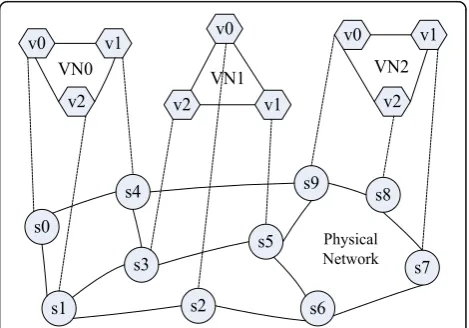
Figure1gives an example of three VNs simultaneously arriving. Note that, in practice, the number of simultan-eously arriving VNs is random. Every VN can be de-scribed as Gv= (Nv, Lv), where Nv represents the set of
virtual nodes with resource requirements corresponding to each node (such as the CPU and the memory capacity of physical nodes) and Lv represents the set of virtual
links. Every link has a bandwidth requirement for physi-cal links to guarantee the communication between two VN nodes connected by a virtual link. Additionally, every node of the VN request has a geographic coordin-ate constraint. For example, the coordincoordin-ate (x,y) beside the virtual node v0 in the virtual network VN0 means
the geographic position of virtual node v0, thus
con-straining the range of physical nodes that v0 can be
mapped onto. Every virtual node of each VN has its own geographic position constraint in Fig. 1, while only the coordinate ofv0is labeled in Fig.1.
2.2 Physical network in edge-of-things computing The physical network of edge-of-things computing is composed of multiple data centers that are dispersed across multiple geographical locations interconnected by a network. Like the VN request, a physical network model can be represented as GS= (NS, LS), where NS
represents the set of physical nodes of the physical net-work (every node of which provides a physical resource such as CPU and memory capacity with corresponding geographic coordinates) and LS represents the set of
physical links of the physical network (with every physical link providing physical bandwidth resources to satisfy the communication demand between physical nodes). Fur-thermore, when a physical node fails, the corresponding physical links also fail. Hence, the virtual nodes mapped onto the failed physical node need to be migrated to another physical node that is not failed, and the corre-sponding virtual links also need to migrate. In this paper, there is at most only one physical node that fails at all times in the physical network of edge-of-things computing.
2.3 Reliable virtual network provisioning
2.3.1 Given
A substrate edge-of-things computing physical network PN is represented as GS= (NS, LS), and several virtual
network requests arrive simultaneously.
2.3.2 Mapping constraints
They include the geographical position constraints of virtual nodes, the resource demands of virtual links, and the resource demands of virtual nodes.
2.3.3 Precondition
There is at most one physical node failure at any time, and if there is a virtual node mapped onto it, the virtual node and adjacent links need to be migrated and recovered.
2.3.4 Problem
Under the precondition above with the mapping con-straints, the problem is how to design and realize a map-ping algorithm that can map several VNs arriving simultaneously onto the physical network and guarantee the survivability of virtual nodes. It must realize the re-source sharing in every VN and also the rere-source sharing among VNs to save the physical resources of edge-of-things computing, with the aim of minimizing the mapping costs and getting a generally comparatively good multiple VN mapping result.
2.4 Problem formulation
2.4.1 Residual resources
The residual resources include the residual bandwidth of every physical link and the residual node resource of every physical node in edge-of-things computing. The residual bandwidth capacityRl(ls) of physical linklsrepresents the
total amount of bandwidth available on linkls.
Rlð Þ ¼ls Capð Þls − X
lv∈Sls
reqð Þlv ð1Þ
where Cap(ls) denotes the resource capacity of physical link ls, req(lv)represents the amount of link resource
requirements of VN link lv, and Slsindicates the set of VN links mapped on the physical linkls.
The residual node resource capacity Rn(ns) of physical
nodenscan be computed as follows:
Rnð Þ ¼ns Capð Þns − X
nv∈Sns
reqð Þnv ð2Þ
where Cap(ns) shows the resource capacity of physical node
ns, req(nv) represents the amount of VN nodenv’s require-ment for nodal resources, and Sns indicates the set of VN nodes that have been mapped onto physical nodens.
2.4.2 Objective
We define the costs C(GV) of the mapping VN request
GVas all of the costs of physical resources (i.e., physical
link and nodal resources) in edge-of-things computing allocated toGV.
lv denotes the amount of resources that physical link ls assigned to virtual link lv and rnnsv denotes the amount of nodal resources that physical node ns assigned to virtual node nv. The symbols p(ls) and p(ns) respectively represent the costs of per unit of the phys-ical link and nodal resources.
Our objective is to minimize the VN mapping costs:
Minimize C Gvð Þ ð4Þ
3 Algorithm design
To achieve the survivable VN mapping in a reasonable time, we design an effective heuristic to solve the prob-lem that we researched in the paper. The Geographic-Guided Survivable Multiple VN Mapping (GG-SMVNM) algorithm is detailed in this section.
nodes while also realizing the nodal and link resource sharing among spontaneously arriving VNs and the re-source sharing in VNs. The GG-SMVNM algorithm works with the following steps (Fig.2).
3.1 Step 1: successively map all the simultaneously arriving VNs onto the physical network of edge-of-things computing
When mapping the VN requests, we aim to map the vir-tual nodes of different VNs to the same substrate node to make the newly generated VN more concise. The map-ping results satisfying the geographic location constraints of VN0, VN1, and VN2are shown in Fig.1. Figure1only
depicts the mapping of virtual nodes, but the correspond-ing mappcorrespond-ings of virtual links are not shown here. We map the virtual node v1from VN0and node v0from VN1to
the same substrate node s4. Therefore, the capacity
de-mand of the new virtual node generated based ons4is the
total amount of the resource demands of v1 from VN0
and v0from VN1when the new virtual network is
gener-ated from the physical mapping topology. Similarly, the resource demand of the new virtual node generated by physical nodes2 is the total demand of the resource
de-mands ofv2from VN0andv2from VN1. The
correspond-ing links also satisfy this demand if two or more virtual links are mapped onto the same physical link. Then, the resource requirement of the new virtual link generated by
the physical link is the sum of the resource requirements of these virtual links. If there are several mapping results of the virtual nodes belonging to different VNs due to the geographic constraint, then we need to choose the best one with the minimum mapping costs. For example, in Fig.1,v1from VN0and v0from VN1can both be mapped
onto the physical nodes4, while nodev1of VN0andv2of
VN1can both be mapped ontos4as well. Then, we chose
the mapping solution with minimum mapping costs.
3.2 Step 2: when all the virtual nodes are mapped, generate a new virtual network according to the mapping results
The new VN generated based on the mapping result of Fig.1is shown in Fig. 3. The virtual node v0in Fig.3is
reversely generated due to the physical nodes0in Fig.1
with the same resource requirement as the resource re-quirement of v0from VN0mapped onto s0. The virtual
nodev1in Fig.3is generated due to the physical nodes4
in Fig.1with the resource requirement equal to the sum of resource requirements of v1 from the original VN0
and v0 from VN1 mapped onto s4. The other virtual
nodes in Fig. 3 are generated in a similar way. The vir-tual links in Fig. 3 are also generated according to the mapped paths on the physical network such that if two or more virtual links are mapped onto the same physical path on the physical network, then the resource demand of the virtual link above is the sum of these virtual links’ resource requirements.
3.3 Step 3: enhance the newly generated virtual network This step is similar to the K-redundant scheme. The GG-SMVNM algorithm adds a backup node for each virtual node and adds the corresponding backup links as well. The enhanced newly generated virtual network with backup nodes and links is shown in Fig. 4. b0, b1,
b2,b3,b4, andb5are backup nodes, and the dashed lines
represent the backup links.
3.4 Step 4: map the extra backup links and nodes
We apply the strategy similar with [31] to map backup links and nodes in order to decrease the costs of backup
nodal mapping. Moreover, resource sharing of working links and backup links during the backup link and node mapping process leads to the resource sharing of links and nodes among original VNs, which will reduce the mapping costs as much as possible.
The detailed pseudo code of the GG-SMVNM algo-rithm is described in Table1.
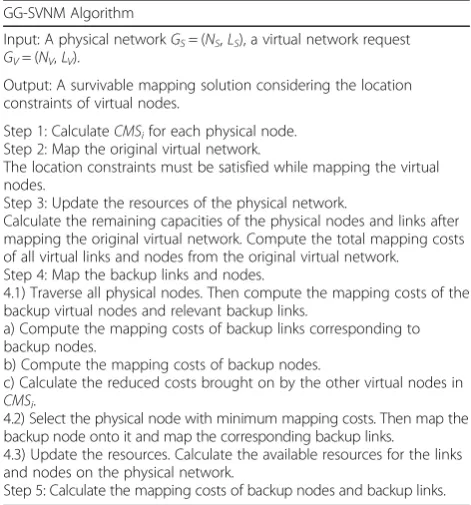
Next, we provide the GG-SVNM algorithm that does not consider the resource sharing among different VNs. The detailed pseudo code of the GG-SVNM is shown in Table2.
In this, CMSi means the set of virtual nodes which
physical nodesican host.
4 Simulations and results
We first introduce the environment of our simulation in the section, and then we give the results. Last, we analyze the results of simulation.
4.1 Simulation environment
4.1.1 Physical network
In the simulations, we use two different networks as the physical network of edge-of-things computing with 46 nodes and 55 nodes, respectively. Each node has a real geographic coordinate presented by a longitude and lati-tude. In the two different networks, we assume that the bandwidth capacities of each link follow a uniform dis-tribution from 500 to 1000 and the resource capacities of each node are uniformly distributed from 200 and 400, respectively. The topologies of the physical net-works used in our simulations are shown in Fig.5.
4.1.2 Virtual network configuration
In the case of multiple VNs mapping, the number of VNs simultaneously arriving is random in real applica-tions. In our simulations, without the loss of generality, the number of arriving VNs is randomly distributed from
Fig. 4Enhanced new virtual network
Table 1Pseudo code of the GG-SMVNM algorithm
GG-SMVNM Algorithm
Input: A physical networkGS= (NS,LS); the arrived VN requestsVN0, VN1…VNX.
Output: A survivable mapping solution considering the location constraints of virtual nodes.
Step 1: Map the VNs that are arriving simultaneously.
The geographic locations constraints of the virtual node must be considered while mapping the VNs, and we should map the virtual nodes that belong to different VNs to the same substrate node. Step 2: Update the resources of the physical network.
Compute the remaining recourses of physical nodes and links and calculate the costs of mapping multiple VNs.
Step 3: Generate a new virtual network based on the mapping results. 3.1) Traverse the nodes of the physical network and record the amount of resources allocated to virtual nodes. Add the virtual nodes to the set of virtual nodes from the new VN, and the capacity demand of these virtual nodes are the amount of recourses on corresponding physical nodes. Take the geographic locations of the corresponding physical nodes as the location constraints of the newly generated virtual nodes. 3.2) Traverse the routing table of the physical network. If the IDs of the corresponding substrate nodes of the virtual nodes in the set mentioned in 3.1 match the routing table, then there is a virtual link between these two virtual nodes.
Step 4: Map the backup nodes and links of the enhanced newly generated VN.
Traverse every backup node that needs to be mapped in descending order of resource demands and map the backup nodes and corresponding links onto the physical network.
4.1) Traverse the physical network nodes and compute the mapping costs of backup nodes and corresponding links.
4.2) Select a physical node with the minimum costs. Map the backup node onto it and map the corresponding backup links.
4.3) Update the resources and record the remaining capacities of the physical nodes and links.
Step 5: Compute the mapping cost of backup nodes and links.
Table 2Pseudo code of GG-SVNM algorithm
GG-SVNM Algorithm
Input: A physical networkGS= (NS,LS), a virtual network request
GV= (NV,LV).
Output: A survivable mapping solution considering the location constraints of virtual nodes.
Step 1: CalculateCMSifor each physical node. Step 2: Map the original virtual network.
The location constraints must be satisfied while mapping the virtual nodes.
Step 3: Update the resources of the physical network.
Calculate the remaining capacities of the physical nodes and links after mapping the original virtual network. Compute the total mapping costs of all virtual links and nodes from the original virtual network. Step 4: Map the backup links and nodes.
4.1) Traverse all physical nodes. Then compute the mapping costs of the backup virtual nodes and relevant backup links.
a) Compute the mapping costs of backup links corresponding to backup nodes.
b) Compute the mapping costs of backup nodes.
c) Calculate the reduced costs brought on by the other virtual nodes in
CMSi.
4.2) Select the physical node with minimum mapping costs. Then map the backup node onto it and map the corresponding backup links.
4.3) Update the resources. Calculate the available resources for the links and nodes on the physical network.
1 to 4, and each VN randomly consists of 3 or 4 nodes. The resource demand of each node is a variable that is ran-domly generated between 20 and 30, and its geographic co-ordinate is also generated randomly with the longitude and latitude whose values fall into a specific range. The possi-bility that there exists a virtual link between two virtual nodes is 50%. The bandwidth demand of the virtual link is randomly generated between 50 and 80.
Parameter g represents the ratio of the unit node re-source overhead to the unit bandwidth overhead. Differ-ent values of g can compare the effects that different ratios of the unit node resource costs to unit bandwidth costs on VN mapping costs. We set the parametergto 5 in the simulations.
In our simulations, we presume that zero or one substrate node fails at any time and several VNs arrive simultaneously. For evaluating our proposed algo-rithm, we compare the mapping performances of our GG-SMVNM and GG-SVNM algorithms with the EVPF approach proposed in [32] and consider the geo-graphic location constraints of virtual nodes. Further-more, we vary the number of simultaneously arriving VNs (the number of nodes on each VN is 3 or 4) on the premise that the physical resources are abundant
and compare the total mapping costs, backup node mapping costs, and backup link mapping costs of these two algorithms.
We used Microsoft Visual Studio 2008 and C++ programming language to implement the compared algorithms.
4.2 Performance metrics
We define some metrics for evaluating the performance of our proposed algorithm in the simulation.
1. The total VN mapping cost: the total expenses of using physical network resources to provide all VN requests. It can be calculated as follows:
Mtotalcost ¼XjArrivedVNj
i¼1 M
i
c; ð5Þ
where Mic represents the mapping cost of i-th VN de-mand and ArrivedVN denotes the set of arrived VN demand.
a
b
Fig. 5Physical networks used in our simulations.aNet-1: a network with 46 nodes.bNet-2: a network with 55 nodes
a
b
2. The backup node mapping cost: the total expenses of using physical node resources to host the backup virtual nodes. It can be calculated as follows:
MbakNodecost ¼XjbakNodej
i¼1 M
i
node; ð6Þ
where Minode denotes the mapping cost of the i-th backup virtual node and bakNode represents the set of backup virtual nodes.
3. The backup link mapping cost: the total expenses of using physical link resources to host the backup links. It can be defined as follows:
MbakLinkcost ¼XjbakLinkj
i¼1 M
i
link; ð7Þ
where Milink denotes the mapping costs of the i-th backup virtual link and bakLink represents the set of backup virtual links.
4.3 Simulation results and analysis
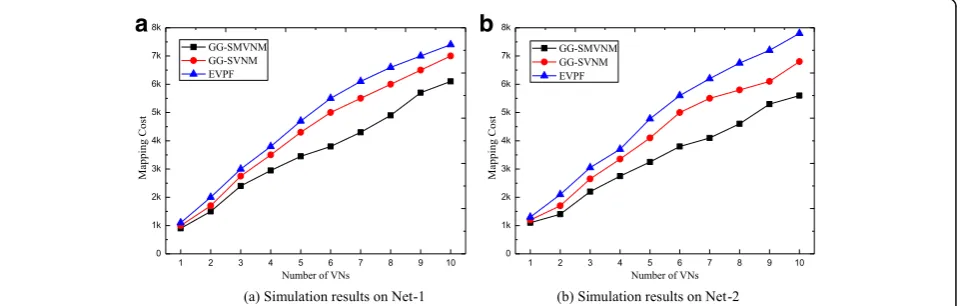
We can see from Fig. 6 that the total mapping costs of our proposed GG-SMVNM and GG-SVNM algorithms are lower than that of the existing EVPF approach [32]. Furthermore, the total mapping costs of multiple VNs of the GG-SMVNM is less than the GG-SVNM and that the advantage of the GG-SMVNM on mapping costs gets more obvious with the increase in the number of simultaneously arriving VNs. This is because when there are several VNs simultaneously arriving, one physical node may host more than one virtual node because of the geographic location constraints of virtual nodes. Therefore, while using the GG-SMVNM for mapping the multiple arrived VNs, the new VN generated accord-ing to the mappaccord-ing solutions for mappaccord-ing multiple VNs onto the physical network is simpler than the multiple original VNs. Furthermore, the resource sharing in every VN and the node and link resource sharing across VNs can be realized when the GG-SMVNM performs the mapping of backup nodes and links while at most one node fails in the physical network, whereas the node and link resource sharing only occurs in each VN in the GG-SVNM algorithm. Therefore, the mapping costs of
a
b
Fig. 7Mapping costs vs. different reliability requirements.aSimulation results on Net-1.bSimulation results on Net-2
a
b
multiple VNs achieved by using the GG-SMVNM algo-rithm are less than that of the GG-SVNM algoalgo-rithm.
Furthermore, Fig. 7 shows the simulation results on total mapping costs under various reliability require-ments. For a specific reliability requirement, our pro-posed algorithms have lower total mapping costs than the existing approach since our approaches can effi-ciently deploy the arrived virtual network requests and thus consume less physical network resources. More-over, the mapping costs of the compared algorithms in-crease with the increasing reliability requirements since it is necessary to allocate greater and more expensive re-sources for a VN request with higher reliability demand to guarantee the reliability.
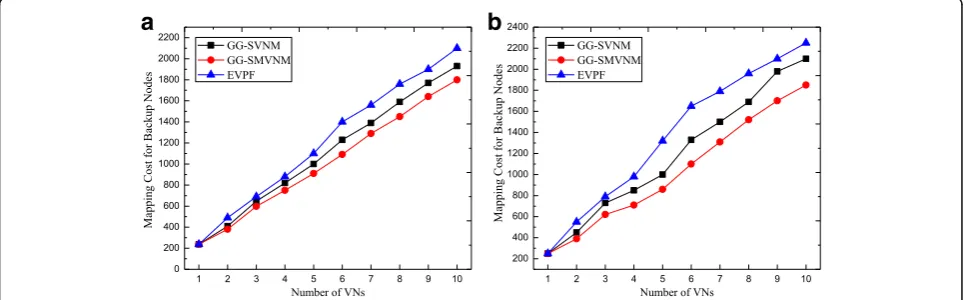
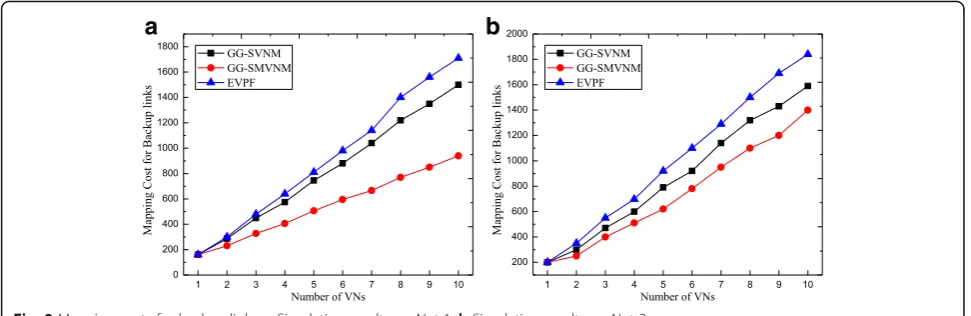
Figure 8 depicts the backup nodes’ mapping costs in the GG-SVNM, GG-SMVNM, and EVPF algorithms for multiple VNs. Figure9shows the physical resource costs for mapping the backup links of VNs using the EVPF, GG-SVNM, and GG-SMVNM algorithms, respectively. We can see from Figs.8and9that the GG-SMVNM al-gorithm achieves the lowest costs as the number of VNs increases. Furthermore, compared with the advantage in backup node mapping costs, the advantage in backup
link mapping costs is more obvious. By analyzing the reason for this simulation result, as we said before, the resource sharing is in each VN, and the node and link resource sharing occurs across VNs while using the GG-SMVNM algorithm. Since the geographic location con-straints and virtual nodes from different VNs may be abstracted to a new virtual node, the backup node re-source sharing in VNs can be realized. In comparison, the backup link mapping is much more complicated and the probability of sharing resources among backup links of different VNs is much higher. Therefore, more re-source sharing opportunities exist in the GG-SMVNM algorithm than in the GG-SVNM algorithm, which leads to lower mapping costs.
Figure10shows the simulation results on the average deployment time of the GG-SVNM, GG-SMVNM, and EVPF algorithms for multiple VN requests. In this set of simulations, we evaluate the performance of the com-pared algorithms under different numbers of VN re-quests and calculate the average value to eliminate the randomness and output it as the result. From the figure, we can see that our proposed GG-SMVNM algorithm has the lowest time complexity, whereas the EVPF has
a
b
Fig. 9Mapping costs for backup links.aSimulation results on Net-1.bSimulation results on Net-2
a
b
the worst time efficiency. Since an efficient routing strat-egy is used in our proposed algorithm, it can be used to quickly map a VN link onto a feasible physical path.
The simulation results shown in Fig. 11 evaluate the blocking ratios of the compared algorithms in different scenarios. The blocking ratio is defined as the number of blocked/rejected virtual network requests to the number of total arrived VN requests. The blocking ratios in-crease with the growth of the number of arrived VNs, since more VN requests means more resource consump-tion. However, the blocking ratios remain stable when the number of arrived VN requests is more than 4000. The blocking ratio of our proposed algorithm is lower than that of the existing approach EVPF, since our ap-proaches consume less physical network resources while guaranteeing the same level of reliability of VN requests, thus lowering the blocking ratio.
5 Conclusions
In this paper, we propose a survivable VN mapping algo-rithm (GG-SMVNM) that considers the geographic loca-tion constraints of virtual nodes for efficiently mapping multiple VNs in edge-of-things computing. We intro-duce the resource sharing strategy in VNs and also across multiple VNs to save the physical resources of edge-of-things computing and reduce the mapping costs. Furthermore, the geographic location constraints are considered in both original virtual nodes mapping and backup node mapping, which makes significant sense in real edge-of-things computing applications. We conduct extensive simulations on different networks to evaluate our proposed algorithms. The simulation results show that our proposed algorithm has better performance than existing approaches.
In this research, we mainly focus on the problem of provisioning VN requests with location constraints in an autonomous domain network in edge-of-things comput-ing. However, in practical applications, there are some
VNs need to be deployed onto multiple autonomous do-main networks. Therefore, in our future research, we are going to study and solve the problem of reliable VN mapping in multiple domains while considering the quality of service (QoS) requirements.
Acknowledgements Not applicable.
Funding
This research was partially supported by the Fundamental Research Funds of China West Normal University (No.17D075).
Availability of data and materials Not applicable.
Authors’contributions
SZ is in charge of the major theoretical analysis, algorithm design, and numerical simulations. AKS is in charge of part of the theoretical analysis and algorithm design. Both authors read and approved the final manuscript.
Competing interests
Both authors declare that they have no competing interests.
Publisher’s Note
Springer Nature remains neutral with regard to jurisdictional claims in published maps and institutional affiliations.
Author details
1
China West Normal University, Nanchong, China.2School of Computing Science and Engineering, Vellore Institute of Technology (VIT), Vellore, Tamil Nadu 632014, India.
Received: 24 January 2018 Accepted: 9 March 2018
References
1. W Shi, J Cao, Q Zhang, et al., Edge computing: vision and challenges. IEEE Internet Things J3(5), 637–646 (2016)
2. TX Tran, A Hajisami, P Pandey, et al., Collaborative mobile edge computing in 5G networks: new paradigms, scenarios, and challenges. IEEE Commun. Mag.55(4), 54–61 (2017)
3. S Sardellitti, G Scutari, S Barbarossa, Joint optimization of radio and computational resources for multicell mobile-edge computing. IEEE Trans Signal Inf Proc Over Netw1(2), 89–103 (2015)
4. G Sun, V Chang, M Ramachandran, et al., Efficient location privacy algorithm for internet of things (IoT) services and applications. J. Netw. Comput. Appl. 89, 3–13 (2017)
a
b
5. X Sun, N Ansari, EdgeIoT: mobile edge computing for the Internet of Things. IEEE Commun. Mag.54(12), 22–29 (2016)
6. J Li, X Huang, J Li, et al., Securely outsourcing attribute-based encryption with checkability. IEEE Trans Parallel Syst25(8), 2201–2210 (2014) 7. X Chen, X Huang, J Li, et al., New algorithms for secure outsourcing of
large-scale systems of linear equations. IEEE Trans Inf Forensics Secur10(1), 69–78 (2015)
8. J Li, J Li, X Chen, et al., Identity-based encryption with outsourced revocation in cloud computing. IEEE Trans. Comput.64(2), 425–437 (2015) 9. G Sun, D Liao, D Zhao, et al., Live migration for multiple correlated virtual
Machines in Cloud-based Data Centers. IEEE Trans. Serv. Comput., 1–14 (2016) 10. J Li, J Li, D Xie, et al., Secure auditing and deduplicating data in cloud. IEEE
Trans. Comput.65(8), 2386–2396 (2016)
11. P Li, J Li, Z Huang, et al., Privacy-preserving outsourced classification in cloud computing. Clust. Comput., 1–10 (2017)
12. J Li, Y Zhang, X Chen, et al., Secure attribute-based data sharing for resource-limited users in cloud computing. Comput Secur72, 1–12 (2018) 13. G Sun, D Liao, D Zhao, et al., Towards provisioning hybrid virtual networks in federated cloud data centers. Futur. Gener. Comput. Syst. (2017) Available online 18 October
14. Y Zhang, X Chen, J Li, et al., Ensuring attribute privacy protection and fast decryption for outsourced data security in mobile cloud computing. Inf. Sci. 379, 42–61 (2017)
15. G Sun, V Anand, D Liao, et al., Power-efficient provisioning for online virtual network requests in cloud-based data centers. IEEE Syst. J.9(2), 427–441 (2015) 16. P Li, J Li, Z Huang, et al., Multi-key privacy-preserving deep learning in cloud
computing. Futur. Gener. Comput. Syst.74, 76–85 (2017)
17. S Su, Z Zhang, A Liu, et al., Energy-aware virtual network embedding. IEEE/ ACM Trans. Networking22(5), 1607–1620 (2014)
18. R Mijumbi, JL Gorricho, J Serrat, et al., A neuro-fuzzy approach to self-management of virtual network resources. Expert Syst. Appl.42(3), 1376– 1390 (2015)
19. J Li, X Chen, X Huang, et al., Secure distributed deduplication systems with improved reliability. IEEE Trans. Comput.64(12), 3569–3579 (2015) 20. G Sun, V Chang, G Yang, et al., The cost-efficient deployment of replica
servers in virtual content distribution networks for data fusion. Inf. Sci.432, 495-515 (2017) Available online 10 August
21. J Li, Y Li, X Chen, et al., A hybrid cloud approach for secure authorized deduplication. IEEE Trans Parallel Distrib Syst26(5), 1206–1216 (2015) 22. G Sun, D Liao, V Anand, et al., A new technique for efficient live migration
of multiple virtual machines. Futur. Gener. Comput. Syst.55, 74–86 (2016) 23. H Yu, T Wen, H Di, et al., Cost efficient virtual network mapping across
multiple domains with joint intra-domain and inter-domain mapping. Opt. Switch. Netw.14, 233–240 (2014)
24. J Li, Z Liu, X Chen, et al., L-EncDB: a lightweight framework for privacy-preserving data queries in cloud computing. Knowl.-Based Syst.79, 18–26 (2015) 25. G Sun, H Yu, V Anand, et al., A cost efficient framework and algorithm for
embedding dynamic virtual network requests. Futur. Gener. Comput. Syst. 29(5), 1265–1277 (2013)
26. NMK Chowdhury, MR Rahman, R Boutaba, Virtual network embedding with coordinated node and link mapping. IEEE Infocom, 783–791 (2009) 27. WL Yeow, C Westphal, UC Kozat, Designing and embedding reliable virtual
infrastructures. ACM Sigcomm Comput Commun Rev41(2), 57–64 (2011) 28. Z Cai, F Liu, N Xiao, et al., Virtual network embedding for evolving networks.
IEEE Globecom, 1–5 (2010)
29. H Yu, C Qiao, V Anand, et al., Survivable virtual infrastructure mapping in a federated computing and networking system under single regional failures. IEEE Globecom, 1–6 (2010)
30. G Sun, H Yu, L Li, et al., The framework and algorithms for the survivable mapping of virtual network onto a substrate network. IETE Tech. Rev.28(5), 381–391 (2011)
31. H Yu, V Anand, C Qiao, et al., Cost efficient design of survivable virtual infrastructure to recover from facility node failures. IEEE ICC, 1–6 (2011) 32. G Sun, D Liao, S Bu, et al., The efficient framework and algorithm for