Volume 2011, Article ID 980430,12pages doi:10.1155/2011/980430
Research Article
On Channel Estimation for Analog Network Coding in
a Frequency-Selective Fading Channel
Haris Gacanin,
1Tomas Sj¨odin,
2and Fumiyuki Adachi
31Motive Division, Alcatel-Lucent Bell NV, 2018 Antwerp, Belgium
2Department of Computing Science, Ume˚a University, 901 87 Ume˚a, Sweden
3Department of Electrical and Communication Engineering, Tohoku University, Sendai 980-8579, Japan
Correspondence should be addressed to Haris Gacanin,[email protected]
Received 4 August 2010; Revised 7 November 2010; Accepted 11 January 2011
Academic Editor: Ashish Pandharipande
Copyright © 2011 Haris Gacanin et al. This is an open access article distributed under the Creative Commons Attribution License, which permits unrestricted use, distribution, and reproduction in any medium, provided the original work is properly cited.
Recently, broadband analog network coding (ANC) was introduced for high-speed transmission over the wireless (frequency-selective fading) channel. However, ANC requires the knowledge of channel state information (CSI) for self-information removal and coherent signal detection. In ANC, the users’ pilot signals interfere during the first slot, which renders the relay unable to estimate CSIs of different users, and, consequently, four time-slot pilot-assisted channel estimation (CE) is required to avoid interference. Naturally, this will reduce the capacity of ANC scheme. In this paper, we theoretically analyze the bit error rate (BER) performance of bi-directional broadband ANC communication based on orthogonal frequency division multiplexing (OFDM) radio access. We also theoretically analyze the performance of the channel estimator’s mean square error (MSE). The analysis is based on the assumption of perfect timing and frequency synchronization. The achievable BER performance and the estimator’s MSE for broadband ANC is evaluated by numerical and computer simulation. We discuss how, and by how much, the imperfect knowledge of CSI affects the BER performance of broadband ANC. It is shown that the CE scheme achieves a slightly higher BER in comparison with ideal CE case for a low and moderate mobile terminal speed in a frequency-selective fading channel.
1. Introduction
Future wireless communication networks are envisaged to provide multimedia broadband services to wireless users. The network capacity must be increased to accommodate these high bandwidth demanding services. Network coding [1] has been used in wired networks to increase the network capacity while its application in wireless relay-assisted net-works [2,3] can exploit the broadcast nature of the wireless medium and further increase the capacity. The relaying can be used to enable bidirectional communication between two users without a direct link between them. The conventional relaying requires four time slots to exchange information between the users, and, consequently, the spectrum efficiency is low.
Network coding at the physical layer (PNC) has been proposed to improve the spectrum efficiency (i.e., dou-bles the network capacity) of bidirectional relay-assisted
communication over the conventional relaying in a flat (i.e., frequency-nonselective) fading channel [4,5]. Henceforth, we refer to these schemes as narrowband PNC. The scheme enables the users to exchange the information within three time slots in comparison with conventional relaying. Two-slot narrowband analog network coding (ANC) introduced in [6] for bidirectional communication, where the user’s signals are mixed in the wireless medium, is an extension of narrowband PNC. Recently [7], broadband ANC based on orthogonal frequency division multiplexing (OFDM) in a frequency-selective fading channel was introduced based on the assumption of perfect knowledge of channel state information (CSI). However, coherent detection and self-information removal in broadband ANC requires accurate amplitude and phase offset estimation (i.e., channel estima-tion (CE)).
scheme based on OFDM in a frequency-selective fading channel. We theoretically analyze and discuss the perfor-mance of broadband ANC with imperfect CSI in terms of the estimator’s mean square error (MSE) and bit error rate (BER). The theoretical analysis is based on the assumption that the guard interval (GI) is long enough to avoid the tim-ing problem (i.e., perfect time synchronization) and perfect frequency synchronization. The performance of broadband ANC with imperfect knowledge of CSI is evaluated by Monte Carlo numerical computation method using the derived theoretical expressions and computer simulation. It is shown that the BER performance with imperfect self-information removal for the higherEb/N0becomes more sensitive to the
estimation errors. The CE error may degrade the BER per-formances of PNC and ANC differently (since PNC performs digital encoding at the packet level), but in this work, we only consider ANC since it is more spectrum efficient. Moreover, our interest lies on the physical layer techniques design, and the routing problem for ANC is out of the scope of this work. The reminder of the paper is organized as follows.
Section 3gives an overview of the network model with pilot-assisted CE scheme for ANC in a frequency-selective fading channel. InSection 4, the theoretical BER performance anal-ysis is presented. Numerical results and discussions are pre-sented inSection 5. We summarize our findings inSection 6.
2. Related Work
The motivation for ANC is its higher spectrum efficiency in comparison with the conventional relaying and PNC since the bidirectional communication between two users is done via the relay within two time slots. Moreover, ANC has a lower computational complexity since there is no processing at the relay terminal.
The performance of an opportunistic network coding scheme that exploits interference (as in [6]) at the receivers by interpreting it as a form of a network code was inves-tigated in [8]. In [9], the network coding for a multiuser communication problem has been presented and analyzed. The authors in [10] present and analyze an idea to decode the sum of the code-words at the relay followed by a broadcast phase which performs Slepian-Wolf coding with structured codes. The study on wireless multicasting in multiuser network (i.e., two sources to two destinations) with the assistance of a single half-duplex relay was investigated in [11], where the throughput and error performance of different analog and digital relay schemes has been presented. In [12], achievable rates for traditional multihop routing and network coding and various physical-layer network coding (PNC) approaches are considered, and a new method of PNC inspired by Tomlinson-Harashima precoding (THP), where a modulo operation is used to control the power at the relay, was introduced. The outage performance is investigated in [13], where the time-varying nature of the direct link is taken into consideration, and the outage regions of various PNC schemes are theoretically analyzed, and, then, the best combined strategies are derived in terms of the maximum goodput and robustness against the imperfect knowledge
of CSI. However, coherent detection and self-information removal in broadband ANC requires accurate amplitude and phase offset estimation (i.e., channel estimation (CE)).
Unlike conventional (without relay) and cooperative (with relay) networks, where signals from different users are separated in time or frequency to avoid interference, in ANC the users’ signals interfere in the same time slot. Hence, in the case of pilot transmission, the relay cannot estimate the CSIs of different users. To avoid this problem, a straightforward method is to allocate four time slots for pilot-assisted CE, which reduces the network throughput of ANC scheme. In [14], a complex maximum likelihood (ML) CE for narrowband ANC was presented based on a priori knowledge of the noise variance and the channel cross-correlation coefficients. However, the achievable estimator’s MSE is high while the BER performance was not considered at all. Moreover, in [14], a simple symmetric Gaussian channel is assumed. However, in broadband wireless communications networks, the channel frequency selectivity is present due to many propagation paths having different time delays. In [15], the complex maximum likelihood channel estimation is presented for narrowband channels, where the channel gains for the both users are estimated at the relay, and, then, the power allocation algorithm is applied to allocate the power to different channel components so that the detection or CE at the user terminals is optimized. We note that the scheme in [15] requires the knowledge of the noise variance and the channel cross-correlation coefficients of the narrowband channels. In [16], tensor-based CE is presented to obtain the channel gains at both user terminals by solving a complex nonlinear least square problem in an iterative fashion based on a priori known identical and invariant channels over the two time-slots. Note that the design rules in [16] are derived without the effect of noise, which if taken into consideration must be available a priori similar to [14, 15], that may degrade the channel estimator’s performance.
For broadband channels, in [17], a two-slot pilot-assisted CE scheme for ANC was presented. In the first slot, both users transmit their pilots to the relay, where one of the pilot signals is cyclically shifted [18] to allow the relay to separate and estimate the CSIs from both users. This stage is named multiple-input single-output channel estimation (MISO-CE) due to its analogy to input multiple-output (MIMO) OFDM systems [18]. During the second slot, the relay broadcast its pilot signal to the users, which estimate the corresponding CSIs. This stage is named single-input single-output channel estimation (SISO-CE). We note here that only BER performance has been evaluated by computer simulation in [17]. Therefore, in this work, we focus our attention to investigate and analyze the achievable performance of low-complexity pilot-assisted CE for broad-band ANC in a frequency-selective fading channel.
3. Network Model
R
U0 U1
First slot Second slot
Coverage ofU0 Coverage ofU1 Coverage ofR
h0,0(τ) h0,1(τ)
h1,0(τ) h1,1(τ)
Figure1: Network model.
diag[·], · , Tr{A}, and · ∞denote transpose, complex
conjugate, the ensemble average, diagonal matrix, Euclidean, the trace of the matrixA, and maximum norm operations, respectively [19]. A complex Gaussian distribution with meanμand varianceσ2 is denoted byCN(μ,σ2). [a]
i and
[A]i j denote theith element of the vectoraand element in
theith row andjth column ofA, respectively. Finally,0andIn
denote all zero entry and then×nidentity matrix if otherwise not defined.
3.1. Transmission Signal Representation. We consider a two-way relay network with the users,U0andU1, and the relayR
as shown inFigure 1. The users and the relay communicate using time division duplex (TDD) in two slots; (1)U0andU1
transmit their respective signals to the relay, and (2) the relay broadcasts the received signal to the users using an amplify-and-forward protocol (AF-P).
First Slot. The jth userUj data-modulated symbol vector
is represented by dj = [dj(0),dj(1),. . .,dj(Nc−1)]T for
j ∈ {0, 1}. The jth userUj symbol vector is fed to anNc
-point inverse fast Fourier transform (IFFT) to generate the OFDM signal waveform sj = [sj(0),sj(1). . . sj(Nc−1)]T.
An Ng-sample guard interval (GI) is inserted, and, then,
the signals from the users are transmitted over a frequency-selective fading channel.
The propagation channel can be expressed by the discrete-time channel impulse response given by
hm,j(τ)= L−1
l=0
hl,m,jδ(τ−τl), (1)
whereL,hl,m,j,τl, andδ(τ−τl) denote the channel number of
paths, thelth path gain between thejth userUjand the relay
Rduring themth slot, thelth path time delay normalized by the sampling period of IFFT (i.e.,Tc), and the delta function,
respectively.
The signal received at the relay, rr = [rr(0),
rr(1). . . rr(Nc−1)]T, can be expressed in the frequency
domain as
rr=
S
1
j=0
H0,jdj+nr, (2)
whereS(=Es/Tc),Hm,j=diag[Hm,j(0),Hm,j(1),. . .,Hm,j(Nc−
1)] and nr = [nr(0),nr(1),. . .,nr(Nc−1)]T, respectively,
denote the transmit signal power, the channel gain matrix between the juserUj and the relayRat themth slot with
Hm,j(n)=FFT{hm,j(τ)}and the noise vector which elements
are modeled as CN(0,σ2
n) with σn2 = N0/Tc. Es and N0
denote the data-modulated symbol energy and the single-sided noise power spectral density. Note that the frequency domain signal representation at the relay is used for the sake of consistency with the following analysis.
Second Slot. The relay amplifies the received signal by√Sand broadcastsrr =
√
Srr. After GI removal and Nc-point FFT,
the signal received at thejth userUjcan be expressed as
rj=H1,jrr+nj. (3)
The jth userUjfirst removes its self-information as
rj=rj−H1,jH0,jdj, (4)
where dj denotes the jth user Ujs data-modulated
self-information vector. Then, one-tap zero forcing frequency domain equalization (ZF-FDE) is applied as
rj=Wjrj. (5)
The jth userUjequalization weight matrixWjis chosen to
satisfy the conditionH1,jH0,jWj=INcand it is given by
Wj=diag
1
H0,j(0)H1,j(0)
, 1
H0,j(1)H1,j(1)
,. . .,
1
H0,j(Nc−1)H1,j(Nc−1)
,
(6)
where the bar over j signifies the unitary complement operation (i.e., “NOT” operation) that performs logical negation ofj.
Estimates of the channel gains are required to perform self-information removal and equalization given by (4) and (5), respectively. The channel gain matrixHm,j is replaced
in (4) and (5) by the channel gain estimate matrixHem,j for
m,j∈ {0, 1}.
3.2.1. Problem Statement. If a classical CE approach is to be used with ANC scheme the following problems arise.
(i) In both conventional (without relaying) and cooper-ative (relay-assisted) networks, different users’ pilot signals are separated by orthogonal frequencies or different time slots to avoid interference as shown in [20, 21]. However, in ANC, the users transmit simultaneously during the first time slot, and, as a result of this, the pilot signals interfere with each other. Consequently, the relay cannot estimate the CSIs of different users.
(ii) To estimate all CSIs in bidirectional ANC scheme, a conventional method is to allocate four time slots to separate different users’ pilot signals. However, this significantly reduces the network throughput since additional two slots must be added for pilot-assisted CE.
(iii) The channels between the users and the relay are estimated at the relay during the first slot. These estimated CSIs have to be fed back to the user ter-minals, which additionally reduces the throughput. The problem of CSI feedback is not considered in this work, and it is left as an interesting future work. We note that we theoretically analyze the channel estimator’s performance in terms of MSE and BER (see Sections4.1and4), and, thus, the assumption of an ideal feedback channel simplifies the analysis (if a nonideal feedback channel is assumed, the theoretical analysis may become very difficult if not impossible). To address the above-mentioned problems (1) and (2) the proposed CE is presented below.
3.2.2. Two-Slot CE for Broadband ANC [17]. Unlike the con-ventional approach, where four time slots must be allocated to support bidirectional communication, we present a two-slot pilot-assisted CE scheme for bidirectional ANC with two users assisted by a relay.
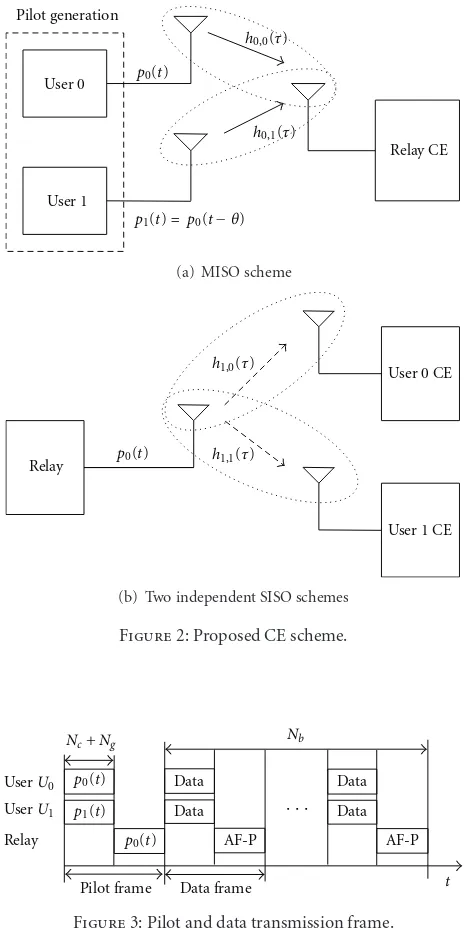
The channel estimation scheme for broadband ANC network is illustrated in Figure 2. The figure shows that ANC scheme can be seen as a multiple-input single-output (MISO) system during the first slot and two independent single-input single-output (SISO) systems during the second slot. Consequently, the first slot of the CE process, illustrated inFigure 2(a), is based on the MISO-CE principle since the signals from two users’ antennas are received by a single antenna at the relay. The second slot of the CE process, illustrated inFigure 2(b), is based on two independent SISO-CE schemes. It is assumed that the users are out of each others coverage area, and, consequently, the signals received by each user’s antenna are independent. Thus, we refer to the second CE stage as SISO-CE rather than a single-input multiple-output- (SIMO-) CE. Note that in the first CE stage, both user signals arrive at the relay’s antenna at the same time, and, thus, we refer to this stage as MISO-CE.
Figure 3illustrates the pilot and data transmission frame structure of the two users,U0andU1, and the relayR. The
pilot and data frames are divided in two time slots, where
Relay CE User 0
User 1 Pilot generation
h0,0(τ)
h0,1(τ)
p1(t)= p0(t θ)
p0(t)
−
(a) MISO scheme
p0(t) Relay
User 0 CE
User 1 CE
h1,0(τ)
h1,1(τ)
(b) Two independent SISO schemes
Figure2: Proposed CE scheme.
UserU0
UserU1
Relay
p0(t)
p1(t)
p0(t) Data
Data
AF-P Data
Data
Data frame
Nc+Ng
Pilot frame t
AF-P
Nb
· · ·
Figure3: Pilot and data transmission frame.
each slot has a length ofNc +Ng samples, where Nc and
Ng, respectively, denote the number of subcarriers and the
GI length. The first slot of the pilot frame corresponds to the MISO-CE, which is used to transmit the pilot signals,
p0(t) andp1(t), fromU0and U1, respectively, as illustrated
inFigure 2(a). The second slot is used by the relay during the SISO-CE to broadcast its pilot signal p0(t) to the users
as illustrated inFigure 2(b). The pilot frame transmission is followed byNbdata frames as shown inFigure 3.
MISO-CE. The users,U0andU1, transmit their pilots to the
After GI removal and Nc-point FFT, the pilot signal
received at the relayRcan be represented as
rr,p=
S
1
j=0
H0,jPj+nr, (7)
wherePj =diag[Pj(0),Pj(1),. . .,Pj(Nc−1)] withPj(n)=
FFT{pj(t)}. To avoid overlapping of the CSIs from different
users during the first slot, the pilot signal{p1(t)}of U1 is
cyclicly shifted byθsamples relative to the pilot signal{p0(t)}
ofU0;{p1(t)=p0((t−θ) modNc);t=0∼Nc−1}as used
in MIMO-OFDM systems [18].
Using the time-shifting property of Fourier transform applied to{p1(t) = p0((t−θ) modNc);t = 0 ∼ Nc−1}
[22] in (7) we obtain
rr,p(n)=
SH0,0P0+SH0,1ΘfP0+nr, (8)
where Θf = diag[1, exp(−j2π(θ/Nc)),. . ., exp(−j2π(Nc −
1)(θ/Nc))]. To avoid overlapping of different users CSIs the
time shiftθ is chosen to be larger than the GI length since we assume that the channel number of paths L does not exceeds the GI. The estimate of the channel gain is obtained by reverse modulation as
Hr,e=rr,pP−10 =
SH0,0+
SH0,1Θf +nr, (9)
where nr = nrP−10 . Then, Nc-point IFFT is applied to
transform the estimated channel gain into the estimated CSI vector,hr,e=[hr,e(0),. . .,hr,e(τ),. . .,hr,e(Nc−1)]T, given by
hr,e=FHHr,e=
Sh0,0+Sh0,1+FHnr, (10)
whereF andh0,1, respectively, denote the FFT matrix [19] and the time domain shifted CSI vector ofh0,1. The estimated CSI vector hr,e is illustrated in Figure 4(a). A filter QNjc is
used to separate the jth user’s (Uj’s) estimated CSI vector,
he0,j=[he0,j(0),. . .,he0,j(τ),. . .,he0,j(Nc−1)]T, during the first
slot represented as
he0,j=QNjchr,e, (11)
with
Q0Nc =
⎛ ⎝ INg
0Nc−Ng×Nc
⎞ ⎠
Q1
Nc=
⎛ ⎝ Aθ×Nc
B(Nc−θ)×Nc
⎞ ⎠ ⎛ ⎜ ⎜ ⎜ ⎝
0θ×Nc CNg×Nc 0(Nc−Ng−θ)×Nc
⎞ ⎟ ⎟ ⎟ ⎠,
(12)
where 0, A, B, and C, respectively, denote all zero entry, the matrix represented by the rows from θ until θ +
Ng of INc, the matrix represented by the last Nc − θ
rows of INc, and the matrix represented by the first Ng
rows of INc. The jth user Uj filtered CSI vector estimate he
0,j = [he0,j(0),. . .,he0,j(τ). . .,he0,j(Nc−1)]T for j ∈ {0, 1}
is illustrated in Figures 4(b) and 4(c), respectively. After
hr,e(τ)
0 Ng θ θ+Ng τ
Noise
h0,0(τ) h0,1(τ)
(a) Estimated channel impulse responsehr,e(τ)
0 Ng
τ
Noise
he 0,0(τ)
(b)hr,e(τ) after filtering by (13)
0 θ θ+Ng
τ
Noise
he 0,1(τ)
(c)hr,e(τ) after filtering by (13)
Figure4: Estimation of the channel impulse responses (he
0,0and
he
0,1between the relay and the first and second user during the first
transmission stage).
filtering, the estimated CSI vectorh0,1is shifted byθsamples as shown inFigure 4(c).
Finally, anNc-point FFT is applied tohe0,jto obtain the
estimate of the channel gainHe
0,jbetween the relayRand the
jth userUjduring the first slot given by
He
0,j=FQ j NcF
HH r,e=
SH0,j+FQ j NcF
Hn
r. (13)
Note that (13) holds as long asθis chosen to be larger than the channel number of pathsL.
SISO-CE. The relayRbroadcasts its pilot sequence,p0(t), to
both users, U0 and U1, during the second slot of the pilot
frame as shown inFigure 3. Without loss of generality, we focus on the processing of the jth userUj for j ∈ {0, 1}as
presented below.
The pilot signal received at the jth userUj can be
ex-pressed as
rj,p=
SH1,jP0+nj. (14)
The estimate of the channel gain matrixHe1,jis obtained as
[20]
Hj,e=rj,pP−10 =
SH1,j+nj, (15)
where j ∈ {0, 1} and nj(n) = njP−10 . Then, Nc-point
vector hj,e between the relay R and the jth user Uj. The
estimated CSI vector is filtered by Q0
Nc for j ∈ {0, 1} as he
1,j = Q0Nchj,e. Finally, the filtered signal is fed toNc-point
FFT to obtain the channel gain matrix estimate He
1,j =
diag[He
1,j(0),H1,ej(1),. . .,H1,ej(Nc −1)] between the relay R
and thejth userUjduring the second slot.
The estimates of CSI during the MISO-CE stage are required at the users terminals. In this paper, we assume that the channel gains,He0,jforj∈ {0, 1}, are sent from the relay
to the users by an ideal feedback channel. The channel gain matrix{Hme,j(n)}form,j∈ {0, 1}is used by the usersU0and
U1to remove self-information and detect the signal from the
partner as described inSection 3.
4. Performance Analysis
This section is devoted to theoretical analysis of broadband ANC with imperfect knowledge of CSI. We first derive the channel estimators MSE, and, then, the expressions for decision variables with the conditional BER expressions are presented. Note that the analysis is based on the assumption of perfect timing and frequency synchronization, and their impacts on the performance of bidirectional broadband ANC are left as an interesting future work.
4.1. Channel Estimator’s MSE. Here, we evaluate the MSE of the CE scheme. For convenience, we assume that the propagation channels between the users and relayRhave the equal number of pathsL. The MSE of the estimated channel gainHem,jduring themth slot is defined by
MSEm=E
He
m,j−Hm,j
2
, (16)
whereHem,j denotes the estimated channel matrix between
the relayRand thejth user at themth slot.
MIMO-CE. The channel gain estimate He
0,j is an unbiased
estimation ofH0,jsinceE[He0,j]=H0,j. Using (13) and (16),
the MSE of the estimated channel gainHe
0,j for j ∈ {0, 1}
during the first slot is given by
MSE0=E
FQNjcF
Hn r
2
=σn2
NcTr
TTH=Ng
Ncσ
2
n, (17)
where we assumed PH0P0 = INc and T = FNg. Although
different CE schemes (i.e., MISO-CE and SISO-CE) are applied for different users, the MSE is not a function of the user parameterjas shown by (17).
SISO-CE. The channel gain estimate He1,j is an unbiased
estimation ofH1,jsinceE[He1,j]=H1,j. Using (15) and (16),
the MSE of the estimated channel gainHe1,j for j ∈ {0, 1}
during the second slot is given by
MSE1=E
FQ0
NcF
Hn r
2
= σn2
Nc
TrTTH=Ng
Nc
σ2
n. (18)
This confirms that the MSE of the channel estimator for MISO-CE and SISO-CE are the same. Finally, the average MSE is given by MSE=1/21m=0MSEm.
−40
−30
−20
−10 0
0 5 10 15 20 25 30
AverageEb/N0(dB)
A
ver
age
M
SE
(dB)
Proposed method CE method in [14]
Figure5: Average MSE versusEb/N0.
The theoretical average MSE of the proposed CE scheme and the estimator presented in [14] are illustrated inFigure 5. It can be seen from the figure that the proposed channel estimator achieves a lower MSE in comparison with the estimator in [14].
4.2. Decision Variables. We begin by developing a general mathematical model for decision variables in three cases; (1) effect of imperfect knowledge of CSI, (2) effect of self-information removal due to imperfect knowledge of CSI, and (3) perfect knowledge of CSI and self-information removal. We note here that imperfect self-information removal may be caused by different factors such as imperfect synchroniza-tion, carrier frequency offset, imperfect knowledge of CSI, and so forth. In this paper, we only consider the impact of imperfect knowledge of CSI on the self-information removal.
For the sake of brevity, we focus only on the jth userUj
and define diagonal matrixHj = H0,jH1,j. We assume that
channel estimation error of the jth userUjcan be modeled
as
Hej=Hj+Ej, (19)
where Ej = diag[Ej(0),Ej(1),. . .,Ej(Nc − 1)] denote
the the channel estimation error matrix of the jth user
Uj. It is assumed that elements of Ej are modeled as
CN(0,σ2
e), where elements of Ej and Hj are statistically
4.2.1. Effect of Imperfect Knowledge of CSI. Substituting (3), (4), and (19) into (5), the decision variable with imperfect knowledge of CSI can be represented as
where Ej denotes the channel estimation error matrix of
H1,jH0,j.
Using (19) and the Sherman-Morisson formula [19], (20) can be rewritten as where the first term denotes the desired signal; the second term denotes the effect of imperfect knowledge of CSI on the desired signal; the third term denotes the interference due to imperfect self-information removal; the last term denotes the noise. Next, we derive the signal and interference powers due to channel estimation errors.
The signal power is given by
Pj,I=E
The interference power of the desired signal due to imperfect knowledge of CSI is given by (Appendix A)
Pj,II=E
The interference power due to imperfect self-information removal is given by (Appendix B)
Pj,III=E
Finally, the noise power is given by (Appendix C)
Pj,IV=E Next, we present the decision variables in the case of imperfect self-information removal due to imperfect knowledge of CSI at the relay and destination terminals.
4.2.2. Effect of Self-Information Removal due to Imperfect Knowledge of CSI. Here, we only consider the effect of imperfect self-information removal resulting from imperfect knowledge of CSIs. Thus, (21) can be rewritten as
where the first denotes the desired signal power given by (22); the second term denotes the interference power due to imperfect self-information removal given by (25); the third term denotes the noise power given by
Pj,IV=E
Note that in this casePj,II=0. Next, we present the decision
variables in the case of perfect knowledge of CSI at the relay and destination terminals.
4.2.3. Perfect Knowledge of CSI. In this case, the channel estimation errorEj=diag[0] and (21) can be rewritten as
where the first and second terms denote the desired signal and the noise, respectively. The desired signal powerPj,I is
given by (22) while the noise power is given by (29). Note that in this casePj,II=Pj,III=0.
4.3. BER. We assume all “1” transmission without loss of generality and quaternary phase shift keying (QPSK) data-modulation (i.e.,dj(n) = (1 +j)/
√
2, wherejdenotes the complex operator). Thejth userUjinstantaneous
signal-to-interference plus noise ratio (SINR)γj(i) of theith symbol in
the transmitted data vectordjis given as
The conditional BER of theith data symbol for the givenHm,j
is given by
Pj,b
Es
N0
,Hm,j,i
=1
2erfc
⎛ ⎜ ⎜ ⎝ ! " " #γj
Es/N0,Hm,j,i
2
⎞ ⎟ ⎟ ⎠, (32)
where Erfc(·) is the complementary error function [22]. The theoretical average BER of the jth userUj transmitted data
vectordjis numerically evaluated by averaging (32) over all
possible realizations ofHm,jfor allias
Pj,b
Es
N0
= 1 Nc
Nc−1
i=0
E
Pj,b
Es
N0
,Hm,j,i
. (33)
The evaluation of the theoretical average BER is done by Monte-Carlo numerical computation method based on the analysis presented inSection 4as follows. A set of path gains{hm,l;l =0 ∼L−1}is generated using (1) to obtain
the channel gain matrix Hm,j for j ∈ {0, 1}, and, then,
the equalization matrixWj is computed using (6) for each
source terminal. The conditional BER as a function of the average signal energy per symbol-to-AWGN power spectrum density ratioEs/N0is computed using (32) for the given set of
path gains{hm,l;l=0∼L−1}. This is repeated a sufficient
number of times to obtain the theoretical average BER given by (33).
5. Numerical Results and Discussions
The parameters used for numerical evaluation are sum-marized in Table 1. We assume the OFDM system with
Nc = 256-subcarriers, Ng = 32 and ideal coherent QPSK
modulation and demodulation withE[|dj(n)|2] = 1. The
propagation channel is L = 16-path block Rayleigh fading channel, where {hl,m,j;l = 0 ∼ L −1} are zero-mean
independent complex variables withE[|hl,m,j|2] = 1/L. We
assumeτ0 =0< τ1 <· · ·< τL−1and that thelth path time
delay isτl = lΔ, where Δ(≥1) is the time delay separation
between the previous and following path. The maximum channel time delay is less than the GI length, and all channel paths are independent of each other. fDTs represents the
normalized Doppler frequency, where 1/Ts = 1/[Tc(1 +
(Ng/Nc))] is the transmission symbol rate (fdTs = 10−4
corresponds to a mobile terminal speed of approximately 19 km/h for a transmission data rate of 100 Msymbols/s and a carrier frequency of 2 GHz). We assume error-free feedback channel from the relayRto the users and no shadowing nor path loss. As a pilot, we use a Chu-sequence given by{p0(t)=
exp{jπt2/N
c};t=0∼Nc−1}[23]. In this work, we assume
that the GI is long enough to avoid the timing problem (i.e., perfect time synchronization) and perfect frequency synchronization.
5.1. Effect of Imperfect Knowledge of CSI and Self-Information Removal. First, we discuss the overall impact of channel estimation error σ2
e on the achievable BER performance.
Later we investigate the effect of self-information removal,
1E−05 1E−04 1E−03 1E−02 1E−01
15 20 25 30 35 40 45 50
AverageEb/N0(dB)
Av
er
ag
e
B
E
R
Ideal CE
σe2=10−3
σe2=10−5
σe2=10−6
σe2=10−7 QPSK,L=16
Figure6: Impact ofσ2
e on average BER.
when the effect of imperfect CSI on the desired signal is not taken into consideration.
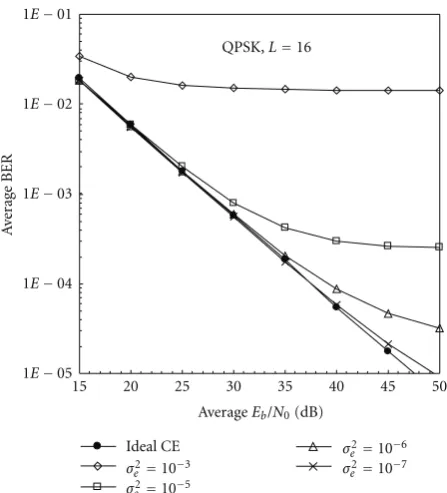
Figure 6illustrates the BER performance as a function of the average signal energy per bit-to-AWGN power spectrum density ratioEb/N0(= 0.5×(Es/N0)×(1 + (Ng/Nc))) with
the channel estimation error varianceσ2
e as a parameter. The
figure shows that the BER performance of broadband ANC scheme degrades as the channel estimation error variance
σ2
e increases from 10−7. On the other hand, to evaluate
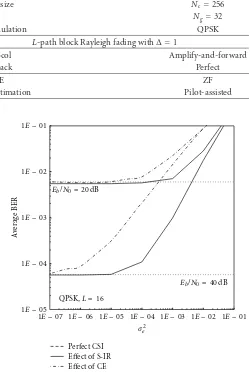
the impact of self-information removal due to imperfect knowledge of CSI, we plot the BER performance as a function of the channel estimation error varianceσ2
e is illustrated in
Figure 7.
The figure illustrates the achievable BER performance as a function of the channel estimation error varianceσ2
e with
Eb/N0 as a parameter. The terms “Perfect CSI”, “Effect of
S-IR”, and “Effect of CE” in Figure 7, respectively, denote the BER performance with perfect knowledge of CSI at all terminals given by (30), the effect of self-information removal due to imperfect knowledge of CSI given by (28) and the overall performance degradation due to imperfect knowledge of CSI given by (21). The figure shows that the BER performance with imperfect knowledge of CSI at the destination and relay terminals is sensitive on the channel estimation error varianceσ2
e depending on the level ofEb/N0;
for higher value ofEb/N0, the system becomes more sensitive
to the channel estimation error. The figure confirms that the BER performance with imperfect self-information removal for the higher Eb/N0 becomes more sensitive to the CE
error. This is because the small value ofσ2
e during the
Table1: Simulation parameters.
Transmitter (U0,U1)
Block size Nc=256
GI Ng=32
Data modulation QPSK
Channel L-path block Rayleigh fading withΔ=1
Relay Protocol Amplify-and-forward
Feedback Perfect
Receiver (U0,U1) FDE ZF
Channel estimation Pilot-assisted
signal at a high Eb/N0 level, which significantly affects the
BER performance.
5.2. BER Performance. Figure 8illustrates the BER perfor-mance as a function of the average signal energy per bit-to-AWGN power spectrum density ratio Eb/N0(= 0.5 ×
(Es/N0)×(1 + (Ng/Nc))×(1 + (1/Nb))) with the number
of data frames Nb as a parameter. The power loss due
to GI and pilot insertion is taken into consideration. The term “Pilot-assisted CE (w/o noise)” inFigure 8denotes the proposed pilot-assisted CE without the noise effect during the estimation process (only tracking errors due to channel time selectivity are taken into consideration).
It can be seen from the figure that the two-slot pilot-assisted CE scheme achieves a satisfactory performance while allocating only two slots for the proposed CE, which main-tains a higher transmission data-rate in comparison with four-slot pilot-assisted CE schemes. The BER performance of the proposed channel estimator for broadband ANC degrades in comparison with the perfect CSI case; for BER
=10−3 the Eb/N0 degradation is about 5, 4, 4.5, and 7 dB
whenNb=3, 15, 47, and 79, respectively. This performance
degradation is due to three factors: (i) the CE errors, (ii) the tracking errors, and (iii) imperfect self-information removal due to CE errors. In the case of CE without noise (long-dotted lines inFigure 8), where only the propagation errors due to the channel time selectivity are considered, theEb/N0
degradation, for BER = 10−3, is about 3.5, 3.7, 3.8, and 4 when Nb = 3, 15, 47, and 79, respectively. The figure
shows that the BER performance with proposed CE scheme, irrespective of Nb, is the same forEb/N0 < 25 dB since the
performance improvement is limited by the CE errors and the tracking errors.
5.3. Impact of Channel Time-Selectivity. The impact of fDTs
on the BER performance with proposed CE scheme is discussed below. As fDTs increases, the tracking ability
against the channel fading variations tends to be lost.
Figure 9 illustrates the BER performance as a function of
fDTs for Eb/N0 = 15 dB, 30 dB, and 40 dB with Nb as a
parameter.
It can be seen from the figure that for fDTs = 10−5
(which corresponds to about 2 km/h mobile terminal speed) almost the same BER performance is achieved irrespective of Nb. In the case of fDTs = 10−4 (which corresponds to
about 19 km/h mobile terminal speed), the BER performance
1E−07 1E−06 1E−05 1E−04 1E−03 1E−02 1E−01 1E−05
1E−04 1E−03 1E−02 1E−01
σ2 e
Av
er
ag
e
BER
QPSK,L=16
Eb/N0= 20 dB
Eb/N0=40 dB
Perfect CSI Effect of S-IR Effect of CE
Figure7: Effect of channel estimation errorσ2
e.
slightly degrades irrespective ofNbandEb/N0. On the other
hand, as fDTsincreases to 10−3, which corresponds to about
190 km/h mobile terminal speed, the BER performance with
Nb = 16 severely degrades since the tracking ability of the
channel estimator against the channel time selectivity is lost.
6. Conclusion
20 25 30 35 40 45 50
Perfect CSI
Pilot-assisted CE (w/o noise) Pilot-assisted CE
Figure8: BER performance.
1E−05
moderate mobile terminal speed in a frequency-selective fading channel.
The feedback of the estimated CSIs at the relay terminal was not considered in this paper. Time and frequency synchronization problems are a major design challenge for relay-assisted networks due to simultaneous signal reception from different users. Moreover, to provide bidirectional
communication for more than two users either time division multiple access (TDMA), frequency division multiple access (FDMA), or code division multiple access (CDMA) can be used. These are left as an interesting future work. The performance analysis and comparison among digital network coding (i.e., PNC) and ANC with pilot-assisted CE are also left as an interesting future work.
Appendices
A. Interference Power of Desired Signal
The interference power of the desired signal due to imperfect knowledge of CSI is given by
Pj,II=E
Applying the Sherman-Morisson formula [19], from (A.1) we obtain
If we assume that the signal power is much larger than the channel estimation error variance (i.e., σ2
s σe2), we can We assume that Ej(i) is a zero-mean Gaussian random
With reasonable small error, we can truncate the series in (A.4) only to its first two terms, and, then, the approximated expression forΓ(i) is given by
B. Interference Power due to Imperfect
Self-Information Removal
Interference power due to imperfect self-information removal resulting from imperfect knowledge of CSI is given by
After some manipulations using the Sherman-Morisson formula [19], we obtain
Using the same procedure as in Appendix A, we expand
Υ(i)=E[|Ej(i)/(Hj(i) +Ej(i))|2|Ej(i)|2] into a polynomial
sum and consider only the first two terms. Thus,Υ(i) is given by
Υ(i)≈2σ2
eΓ(i). (B.3)
Finally, combining (B.1) and (B.3), we obtain (25).
C. Noise Power
The total noise power for broadband ANC scheme with imperfect knowledge of CSI can be obtained as
Pj,IV=E
Using the Sherman-Morisson formula [19], (C.1) can be written as
sum and taking the expectation of its individual terms, we obtain (26).
Acknowledgment
This paper was supported, in part, by 2010 KDDI Founda-tion Research Grant Program.
References
[2] R. Ahlswede, N. Cai, S. Y. R. Li, and R. W. Yeung, “Network information flow,”IEEE Transactions on Information Theory, vol. 46, no. 4, pp. 1204–1216, 2000.
[3] S. Y. R. Li, R. W. Yeung, and N. Cai, “Linear network coding,” IEEE Transactions on Information Theory, vol. 49, no. 2, pp. 371–381, 2003.
[4] S. Zhang, S. C. Liew, and P. P. Lam, “Hot topic: physical-layer network coding,” in Proceedings of the 12th Annual International Conference on Mobile Computing and Networking (MOBICOM ’06), pp. 358–365, Los Angeles, Calif, USA, September 2006.
[5] P. Popovski and H. Yomo, “Wireless network coding by amplify-and-forward for bi-directional traffic flows,” IEEE Communications Letters, vol. 11, no. 1, pp. 16–18, 2007. [6] S. Katti, S. S. Gollakota, and D. Katabi, “Embracing wireless
interference: analog network coding,” Tech. Rep., MIT Press, Cambridge, Mass, USA, February 2007.
[7] H. Gacanin and F. Adachi, “Broadband analog network coding,”IEEE Transactions on Wireless Communications, vol. 9, no. 5, pp. 1577–1583, 2010.
[8] I. Mari´c, A. Goldsmith, and M. M´edard, “Information-theoretic relaying for multicast in wireless networks,” in Proceedings of the IEEE Military Communications Conference (MILCOM ’07), Orlando, Fla, USA, October 2007.
[9] Y. E. Sagduyu, D. Guo, and R. Berry, “On the delay and throughput of digital and analog network coding for wireless broadcast,” inProceedings of the 42nd Annual Conference on Information Sciences and Systems (CISS ’08), pp. 534–539, Princeton, NJ, USA, March 2008.
[10] K. Narayanan, M. P. Wilson, and A. Sprintson, “Joint physical layer coding and network coding for bi-directional relaying,” inProceedings of the Allerton Conference on Communication, Control, and Computing, Chicago, Illinois, USA, September 2007.
[11] M. Riemensberger, Y. E. Sagduyu, M. L. Honig, and W. Utschick, “Comparison of analog and digital relay methods with network coding for wireless multicast,” in Proceedings of the IEEE International Conference on Communications (ICC ’09), Dresden, Germany, June 2009.
[12] Y. Hao, D. Goeckel, Z. Ding, D. Towsley, and K. K. Leung, “Achievable rates for network coding on the exchange chan-nel,” in Proceedingsof the IEEE Military Communications Conference (MILCOM ’07), Orlando, Fla, USA, October 2007. [13] E. S. Lo and K. B. Letaief, “Network coding versus superpo-sition coding for two-way wireless communication,” in Pro-ceedings of the IEEE Wireless Communications and Networking Conference (WCNC ’09), Budapest, Hungary, April 2009. [14] F. Gao, R. Zhang, and Y.-C. Liang, “On channel estimation for
amplify-and-forward two-way relay networks,” inProceedings of the IEEE Global Telecommunications Conference (GLOBE-COM ’08), pp. 3670–3674, New Orleans, La, USA, December 2008.
[15] B. Jiang, F. Gao, X. Gao, and A. Nallanathan, “Channel estimation and training design for two-way relay networks with power allocation,”IEEE Transactions on Wireless Commu-nications, vol. 9, no. 6, pp. 2022–2032, 2010.
[16] F. Roemer and M. Haardt, “Tensor-based channel estimation and iterative refinements for two-way relaying with multiple antennas and spatial reuse,” IEEE Transactions on Signal Processing, vol. 58, no. 11, pp. 5720–5735, 2010.
[17] T. Sjodin, H. Gacanin, and F. Adachi, “Two-slot channel estimation for analog network coding based on OFDM in a frequency-selective fading channel,” in Proceedings of the
IEEE 71th Vehicular Technology Conference (VTC ’10), Taipei, Taiwan, May 2010.
[18] Y. Li, J. H. Winters, and N. R. Sollenberger, “Simplified channel estimation for OFDM systems with multiple transmit antennas,”IEEE Transactions on Wireless Communications, vol. 1, no. 1, pp. 67–75, 2002.
[19] C. D. Meyer,Matrix Analysis & Applied Linear Algebra, Society forIndustrial and Applied Mathematics, 2001.
[20] S. Coleri, M. Ergen, A. Puri, and A. Bahai, “Channel estimation techniques based on pilot arrangement in OFDM systems,”IEEE Transactions on Broadcasting, vol. 48, no. 3, pp. 223–229, 2002.
[21] A. S. Lalos, A. A. Rontogiannis, and K. Berberidis, “Channel estimation techniques in amplify and forward relay networks,” in Proceedings of the IEEE Workshop on Signal Processing Advances in Wireless Communications (SPAWC ’08), pp. 446– 450, Recife, Brazil, July 2008.