R E S E A R C H
Open Access
A performance analysis on packet
scheduling schemes based on an
exponential rule for real-time traffic in LTE
Ee Mae Ang
1, KuokKwee Wee
1*, Ying Han Pang
1and Keat Keong Phang
2Abstract
Long-Term Evolution (LTE) was implemented to fulfill and satisfy users’needs as well as their demands for an improvised, fast and efficient Quality of service (QoS). A minimal aggregate of waiting time in return would give users a better Quality of experience (QoE). Real-time service packet scheduling is an important process in allocating resources to users. An efficient packet scheduling scheme will be able to cater fairly and efficiently to its users in the LTE network. Hence, studies are performed focusing on real-time traffic which includes video as well as Voice over Internet Protocol (VoIP) transmissions. In this work, the existing exponential rule (EXP rule) is utilized to benchmark our proposed packet scheduling techniques so that we are able to further evaluate the scheduling performance. In response to the increasing likelihood of losing packets in the EXP rule’s algorithm and maximizing the throughput rate, several schemes have been experimented with. The proposed schemes include 1) simplified EXP rule (sEXP Rule), 2) modified EXP rule (mEXP Rule), 3) EXP rule with maximum throughput (MT) (EXP_MT Rule), and 4) enhanced EXP rule with MT (E2M). By adding MT as a weight to the EXP rule, the throughput is maximized, thus providing higher throughput rates for real-time and non-real-time traffic. The simulation results show that the sEXP rule has a better performance in throughput, packet loss rate (PLR), and spectral efficiency for video traffic. Aside from this, our proposed E2M rule performs better than the benchmark EXP rule and outperforms the other proposed schemes, as well. It is observed that the E2M rule has better QoS support for real-time transmission in terms of delay, packet loss, throughput and spectral efficiency, within the LTE network. Hence, our proposed E2M rule is an enhancement of the benchmark EXP rule, which is commonly used in LTE packet scheduling.
Keywords:Downlink; Scheduler; LTE network; Quality of service; Exponential function; Real-time transmission
1 Introduction
The future fourth generation wireless network, which is known as the Long-Term Evolution (LTE) network, sup-ports devices which utilize high-speed data, and at the same time it targets to provide users with better wireless network experience while maintaining minimal com-plexity [1]. Transmissions are categorized into real-time and non-real-time traffic. Real-time traffic includes video and Voice over Internet Protocol (VoIP) traffic, whereas non-real-time traffic consists of best-effort traffic.
People are looking forward to more advanced devices that can meet their desires and needs. A survey in [2]
mentioned that in several upcoming years, mobile data’s growth is anticipated to double yearly. Based on the in-creasing demand of the Internet Protocol-based services on the wireless network like Voice over Internet Proto-col (VoIP), website browsing, video streaming, online games and etc., requirements of the Quality of service (QoS) has to be assured as it is of utmost importance in the wireless network [3–5]. The functionality of QoS is rather appealing in metrics computation, which is used for packet scheduling in the media access control (MAC) layer as well as packet routing in the physical layer [6, 7]. This is especially so for real-time traffic QoS demands which include the requirement of having a lower packet loss rate (PLR) and delay, whereas non-real-time traffic QoS demands are more geared toward throughput rate. However, despite the fact that resource * Correspondence:[email protected]
1
Faculty of Information Science and Technology, Multimedia University, Jalan Ayer Keroh Lama, Bukit Beruang, Malacca 75450, Malaysia
Full list of author information is available at the end of the article
allocation is handled in MAC layer, there is no guarantee that data has been successfully transmitted and received [8]. Hence, the evolution of managing radio resource distribution is necessary in various scenarios in the LTE environment [9]. At present, a network engineer’s tasks tend to be more challenging in terms of managing net-works resources [7].
In contrast to satisfying users’demands and serving all users fairly, the LTE network was developed to provide much more reliable performance in terms of its spectral efficiency, fairness measures, throughput rate, less idle time, and minimal PLR [10]. Packet schedulers play a role in the MAC layer of the LTE environment. Hence, its function is to select and schedule packets based on the QoS requirements [11, 12]. For example, QoS is used to determine performance trade-offs [13, 14]. Traffic scheduling is associated with channel management to at-tain high-performance networks, which guarantee QoS requirements of prioritized real-time traffic [15].
This paper emphasizes the packet scheduling schemes for real-time applications in LTE systems’network, inclu-sive of aware/QoS-aware strategies and channel-aware/QoS-unaware strategies. Our focus is on prioritizing real-time applications using the channel-aware/QoS-aware strategies. Based on our studies, we have chosen the expo-nential (EXP) rule, which is most commonly referenced by researchers due to the fact that this scheme is able to guar-antee delay requirements and it is aware of channels condi-tions as well as QoS. In order to determine the reliability of the packet scheduling scheme, the QoS performance is evaluated. Although the EXP rule is a popular scheme, we have observed that there is still room to improve it in terms of its throughput, PLR, and delay. As mentioned above, our focus is on real-time services as these are more challenging compared to serving non-real-time services. Real-time services include video and VoIP traffics. Apart from this, this study also addresses the issue of heavy traf-fic, including real-time services, which require less delay and PLR in order to receive the information in good qual-ity on time. Priorqual-ity should be given to real-time services, which is then followed by the non-real-time services.
Our paper proposes several packet scheduling tech-niques for the LTE network based on the EXP function. Currently, it can be seen that the EXP function is able to exaggerate a value and hence prioritize it [16]. The EXP rule is not only robust in terms of its growth compared to the EXP/proportional fairness (PF) rule packet sched-uling scheme, but is also an enhancement based on EXP/PF rule [10]. The EXP rule is known for having low delay and a high measure of fairness as well as through-put [17]. Furthermore, while the EXP rule takes account of the comprehensive network status, it does not con-sider packets that are lost due to the packet expiration dateline.
Simulations are performed prior to downlink schedul-ing in the LTE network. Downlink schedulschedul-ing is whereby packets are scheduled to transmit from eNodeB (eNB) to user equipments (UE) [9, 18]. Based on the simulation results, it has been demonstrated that our proposed al-gorithm for packet scheduling is able to provide a better QoS performance, especially for multimedia applications. This in return will raise user satisfaction as users’ Qual-ity of experience (QoE) increases [19]. Our algorithm not only provides a more reliable wireless network, but also a more efficient one, which is thus able to satisfy users’demands. Our proposed scheme is able to increase the chance of packets being sent within the time frame, ensuring less delay and PLR, while having a higher throughput rate. This is especially for real-time applica-tions, such as live video. One of the several schemes we have proposed outperforms the existing benchmark EXP rule, i.e., the enhanced EXP rule with MT (E2M) rule, as it contributes to a much lower PLR, and delay while pro-viding an increment in the system’s throughput value. Essentially, real-time packets are prioritized before the packet expiration dateline. More details are provided in Section II.
This paper is arranged as follows: Section II gives a brief elaboration on the existing schemes available for LTE networks packet scheduling. In Section III, a de-tailed elaboration on our proposed schemes is given. Section IV provides an overview of the simulation pa-rameters that are used to carry out the experiments. In addition, the results that are obtained from the experi-mental test are provided in the same section, along with a brief discussion based on our findings. In the last sec-tion, we conclude the paper.
2 Literature review
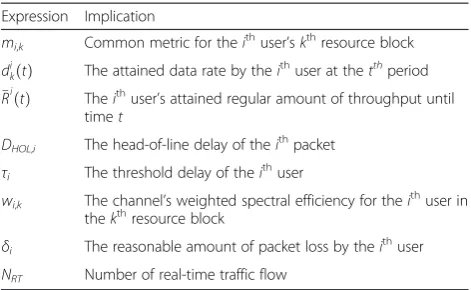
This section briefly elaborates on several downlink scheduling schemes, which have been proposed by other researchers and also frequently used for the analysis and comparison of LTE networks. These schemes have simi-lar strategies, whereby they are aware of their channels conditions. Table 1 shows several notations along with their representations.
A.Proportional fairness (PF)
In [10] and [21], it is shown that PF is suitable to schedule best-effort (BE) traffic. By paying attention to the channel’s quality with regard to the preceding user’s throughput rate, PF is able to prioritize channels that have a much better traffic constraint from the source [22, 23].The metric for PF is given asmPF
i;k. It is expressed
ð Þ is the forecasted attainable throughput rate at the period of theith transmission time interval (TTI) that is anticipated for the ith user equipment grounded by the total amount of bandwidth along with its respective RB [10]. The disadvantage of this scheme is that it is incap-able of prioritizing traffic with critical conditions [24]. Hence, traffic may encounter an amount of delay which may lead to packet loss if packets are not served before packet expiry [25]. Moreover, PF is also unable to pro-vide the highest throughput nor best fairness measure.
B.Maximum throughput (MT)
This scheduling technique falls under the same classi-fication as PF, which is a channel-aware but QoS-unaware strategy [11]. In [26], it is stated that MT is able to exploit overall available resources to attain a higher throughput rate in the network’s system. Throughout the fixed TTI, the server shall transmit a maximum number of packets to the terminal [27]. The MT’s metric,mMT
i;k , is shown in Eq. 2 [21, 26]:
mMTi;k ¼dikð Þt ð2Þ
where the MT’s metric is equivalent to the attainable amount of information at theithuser for thekthRB. The signal-to-interference-plus-noise ratio (SINR) is used in
the computation of the throughput value. The expres-sion is shown in Eq. 3 [10]:
dkið Þ ¼t log1þSIN Rikð Þt ð3Þ
MT is unable to provide fairness measures in terms of resource sharing [28]. Packets that consist of a low-priority level may undergo resource starvation when the requested requirements, based on the overall bandwidth, are unsatisfied [21, 28].
C.Modified largest weighted delay first (M-LWDF)
M-LWDF is an extension of LWDF [10]. LWDF is a channel-unaware scheduling scheme which has been modified to become aware of its channels conditions and provisions for delays in bounded packet transmis-sions. M-LWDF is channel-aware/QoS-aware and is able to provide good performance in terms of fairness mea-sures, spectral efficiency, and less PLR. Moreover, in [29], the authors mention that this scheme has the best performance in video transmissions during UE move-ment at a minimal speed.
In the implementation of this scheme, the method dis-tinguishes between non-real-time and real-time traffic. This is in order for the real-time packets to be able to be prioritized, using the packets head-of-line (HOL) delay. The metric is computed as described in Eq. 4 [11]:
mMi;k−LWDF ¼βiDHOL;imPFi;k ð4Þ
where βi is computed by the mathematical equation −
logδi
τi , in which it is functioned to weigh two flows which consists of the same HOL delay. Its decision is based on legitimate requirements of acceptable PLR and packet expiry deadlines [10].
In the MAC queue, packets which are an associate of real-time services and have not been transmitted by the time of its expiry date shall be removed from the queue [11]. This is performed to avoid the consumption of bandwidth.
D.Exponential/proportional fairness rule (EXP/PF rule)
According to [4], the EXP/PF rule was implemented with the purpose of offering QoS promises over a shared wireless connection. The basic EXP was created to im-prove the real-time flow’s priority prior to the associ-ation of non-real-time flows [30, 31]. This is where the packet delay at the starting line is rather close to the thresholds delay [10]. EXP/PF not only guarantees a bounded delay but also maximizes the systems throughput
Table 1Notations for scheduling metrics
Expression Implication
mi,k Common metric for thei th
user’skthresource block dikð Þt The attained data rate by theithuser at thetthperiod
Rið Þt Theithuser’s attained regular amount of throughput until timet
DHOL,i The head-of-line delay of theithpacket
τi The threshold delay of theithuser
wi,k The channel’s weighted spectral efficiency for theithuser in
thekthresource block
δi The reasonable amount of packet loss by thei th
user
at the same time ensuring proportional fairness between UEs [32].
The scheduling computation metric’s computation is given in Eq. 5 [11]:
value is given as an element of the set 5 0:99τi ð Þ; 0:1099τi
h i
.τi
symbolizes the packet’s waiting time’s threshold value. DHOL,irepresents the delay for HOL at the ith user, and
The symbol Nrt is the value of real-time flows which
are active in the downlink. In [31], analysis showed that EXP/PF is able to support the performance on real-time traffics in terms of average throughput and PLR, al-though a portion of the system throughput is forfeited.
E. Logarithm rule (LOG rule)
The LOG rule contributes in giving much more effi-cient QoS support to the network by maintaining an average amount of delay. In [4], it was stated that to some degree this scheme’s approach in allocating resources, is identical to the EXP rule, which is elaborated on in the next section. It functions to exploit the structures throughput whereby the traffic arrival as well as the condi-tion of the channels is known. The computacondi-tion metric for the LOG rule is given asmLOG Rule
i;k in Eq. 7 [10, 33]:
mLOG Rulei;k ¼bilog c þ αiDHOL;i
Γi
k ð7Þ
Several parameters in Eq. 7 are adjustable, including
αi, bi, and c. As for Γik, it signifies the channels spectral
efficiency with theithuser at thekthRB, where 1≤i≤N. However, based on a test performed by [10], it was found that by declaring these constraints, given in Eq. 8, the scheduling performance is much better.
αi¼
Arithmetically, the EXP and logarithm functionality is somewhat similar. The variance is that in which the logarithmic function implements the inverse perform-ance of the EXP function [34].
3 Proposed methodology
The packet scheduling schemes are studied using the LTE-Simulator, which is also known as LTE-Sim [35]. It is an open-source simulator which enables the perform-ance of simulations in an LTE network [11].
Both the EXP rule and the M-LWDF scheduler are bounded delay schemes. The EXP rule is an improvisa-tion of the aforemenimprovisa-tioned EXP/PF scheduler [10]. The EXP rule is known to be more robust based on its growth and the fact that it monitors the entire network’s status. Hence, it is categorized under the channel-aware and QoS-aware strategy for packet scheduling. [10] stated that every user’s delay is normalized against the overall amount of delay that has been experienced by all the users.
The metric for the EXP Rule, mEXP Rule
i;k , is given in
c are provided in (10). The constraint’s values are the same as the Log Rule’s parameters in Section II:
αi∈
Based on some indirect measures, the EXP rule sched-uler is found to have improvements in delay, fairness measures, and throughput [37, 38]. In [11], it was stated that this scheme prioritizes real-time traffic with regard to non-real-time traffic. In short, it supports both appli-cation services [39]. Similarly to M-LWDF, packets that are not served before their expiration date shall be re-moved from the queue.
Based on experimental tests, the EXP rule outperforms the most frequently used M-LWDF scheduling scheme in terms of delay and PLR in real-time traffic. Hence, further research has been performed on the EXP Rule scheduling scheme.
In the following subsections, several packet scheduling schemes are proposed. This includes the EXP with MT rule (EXP_MT rule), the simplified EXP rule (sEXP rule), the modified EXP rule (mEXP rule), and the en-hanced EXP rule with MT (E2M rule).
A.Simplified EXP rule (sEXP rule)
Hence, the sEXP rule’s metric,msEXP Rule
i;k , is left with the
mathematical equation given in Eq. 11:
msEXP rulei;k ¼exp DHOL;i
mPFi;k ð11Þ
As mentioned above, the denominator of the EXP rule (refer to Eq. 6), which consists of a computation on the average HOL delay, is taken out due to the fact that it does not show much significance as it is canceled out by the HOL delay at the numerator of the EXP rule. Ad-justable numerical figures, such as the fixed constraints given by the author in [10], are not included in our pro-posed sEXP rule.
B.Modified exponential rule (mEXP rule)
The mEXP rule is based on the existing EXP rule and somewhat similar to the proposed sEXP rule. mEXP consists of several optimal parameters which are absent in the EXP rule’s equation, as well as its numerator, which makes it distinguishable from the EXP rule. As for the difference between the mEXP rule and the sEXP rule, this is where there is an additional element inserted into the mathematical expression. This would increase the metrics value as well as the metrics priority. After modifying the expression, the mEXP rule’s metric, mmEXP Rule
applied in the M-LWDF scheduling scheme [10, 20]. Hence, the modified version is given as shown in Eq. 13:
γi ¼ −ln
on the optimal parameter that was suggested in [10]’s work. The probability value for packet loss has been in-creased by replacing log with the ln function. This is so that the chance of losing a packet is smaller.
C.EXP rule with MT (EXP_MT rule)
Based on the EXP rule computation in Eq. 6, a change to the metrics weight is made. Instead of using PF, MT is used as a substitute in this scheme in order to provide the channel with a higher throughput during packet trans-mission, thus reducing the fairness measures [10, 20]. As mentioned above, MT functions to maximize the through-put value.
The mathematical computation of the EXP_MT rule’s metric,mEXPMT Rule
where, with reference to parameter αi of Eq. 6, whereδi
is an integer with a value of 6, whereas c is an integer with value 1, as it is mentioned that the values are fixed as such to provide a much more efficient scheduling per-formance.mMTi;k is the MT scheme is used as the weight-ing factor. As mentioned above, our objective is toward real-time services. MT has the ability to obtain a higher significance in the amount of traffic delivered [10] com-pared with PF which provides fairness measures and effi-cient use of bandwidth. We assume that if more packets were delivered, this would mean less packet loss, thus contributing to better QoE and QoS.
D.Enhanced EXP rule with MT (E2M rule)
The E2M rule scheduler is derived from the EXP rule, the EXP_MT rule, and the mEXP rule. This scheme uti-lizes the EXP function, at the same time maximizing the packet transmission’s throughput rate at the same time using an ln function which increases the probability of packet being loss. This is performed by applying the EXP rule with MT as the metric’s weight, and alsoγias
mentioned previously in Eq. 13. Hence, Eq. 15 shows the mathematical computation of the E2M’s metric,mE2M
i;k .
By usingγito increase the probability of the packet
be-ing lost, fewer packets will be lost, which in turn increases the priority of the packets to be delivered before the packets’ expiration date. This will improve the packet scheduling’s QoS performance. The improvement is in re-gard to several QoS parameters in relation to real-time services, which include PLR, delay, and throughput rate.
4 Simulation results
In the LTE-Sim [11], stated that the value of the metric determines which packet is to be scheduled first and so on. Metrics consisting of a greater value are to have a higher prioritization and be scheduled first, and are then followed by the next highest metric value and so on. This is performed until each and every single packet on the list that is to be scheduled is served [11].
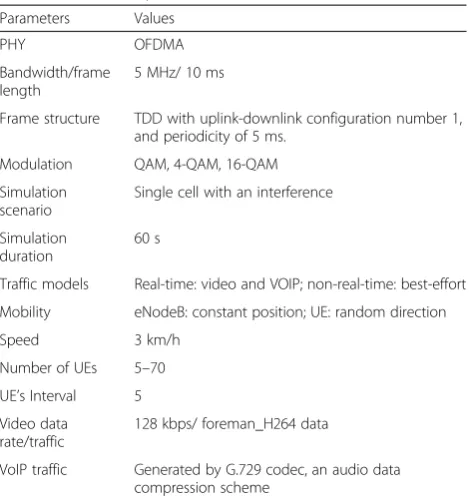
A.Simulation parameters
Each transmission consists of video, VoIP,and BE traffic [35, 40]. An average result from the five sets of simulations is obtained. Further details of the parameters customized for the simulation are stated in Table 2.
B. Results and discussion
Based on our findings, the EXP rule outperforms the most frequently used M-LWDF scheduling scheme in terms of delay and PLR for real-time services. Thus, the results that were obtained from the simulations of our
proposed schemes were analyzed in comparison to the existing EXP rule scheduling algorithm which we use as our benchmark scheme. Hence, our findings are de-duced as follows.
As seen in Fig. 1, the EXP_MT rule, E2M, and sEXP rule have less PLR from 20 UEs onwards for video traf-fic. In addition, the EXP_MT rule outperforms all the scheduling schemes in terms of PLR for video traffic starting from 20 UEs onwards which has a packet loss ranging from 0.26 to 16.23 %. The percentage of change is computed and ranges from 60.49 to 99.08 %. E2M is the second best algorithm, as, when compared with the existing EXP rule, there are improvements in term of PLR from 20 UEs onwards that vary in a percentage ran-ging from approximately 30 to 90 %. In the sEXP rule, its performance outperforms the EXP rule from the count of 5 UEs right up to 70 UEs. However, the per-centage of change is not as drastic as that of the EXP_MT rule, as it ranges from 0 to approximately 39 %. Furthermore, it is observed that for all schemes, PLR increases as the number of UEs increases.
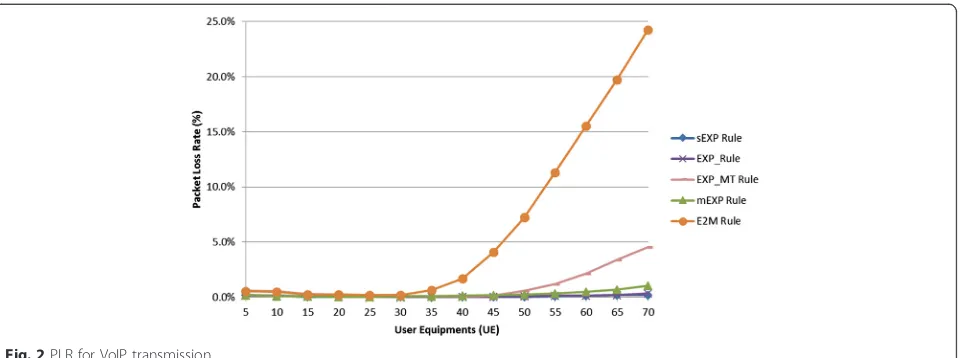
Figure 2 illustrates the PLR for VoIP traffic in the LTE network. According to the figure, it can be observed that PLR gradually rises as the number of UEs increases. Overall, it can be seen that there is a slight improvement in terms of the traffic loss of packets for the sEXP rule scheme in comparison to the EXP rule. This is especially so for 50 to 70 UEs where the improvements change in percentage ranges in between 4.69 and 38.96 %. The highest change in percentage would be at 35 UEs with a change of 50 %. In addition to that, at 35 UEs, the PLR is the lowest in the case of the sEXP rule with an ap-proximate PLR value of 0.01 %. In fact, based on the re-sults that were obtained, the sEXP rule and the EXP rule PLR values lie below 0.22 % and 0.32 %, respectively.
Table 2Simulation parameters
Parameters Values
PHY OFDMA
Bandwidth/frame length
5 MHz/ 10 ms
Frame structure TDD with uplink-downlink configuration number 1, and periodicity of 5 ms.
Modulation QAM, 4-QAM, 16-QAM
Simulation scenario
Single cell with an interference
Simulation duration
60 s
Traffic models Real-time: video and VOIP; non-real-time: best-effort
Mobility eNodeB: constant position; UE: random direction
Speed 3 km/h
Number of UEs 5–70
UE’s Interval 5
Video data rate/traffic
128 kbps/ foreman_H264 data
VoIP traffic Generated by G.729 codec, an audio data compression scheme
However, in regards to the mEXP rule, the EXP_MT rule, and the E2M, the percentage of change is rather drastic as many packets are lost during VoIP packet transmission. One of the reasons that packets are lost is due to overflowing queues. In addition, the output qual-ity in VoIP transmissions is determined by the number of packets sent on time. Hence, packets that arrive late are meaningless to the user.
Figure 3 shows the PLR for BE traffic. Based on the re-sults that were obtained, E2M outperforms the EXP rule by having less packet loss from 45 to 70 UEs with a change in percentage ranging between 0.6 and 3.6 %. The reason for this is that in E2M an increase in PLR probability ensures that packets are sent before their ex-piry. As for the sEXP rule, the percentage of change fluctuates as the number of users increases. The highest PLR is 3.2 % for 10 UEs, while the lowest PLR is 2.8 % for 65 UEs. In the case of the EXP_MT rule, the PLR is slightly higher than the benchmark EXP rule with a
change in percentage that ranges between 0.20 and 6.66 % as packets are discarded due to their lapse period. However, the mEXP rule has a much lower percentage of change in PLR compared to the EXP_MT rule, as the difference in change is from 0 to 3.83 %.
In the communication channel, the proportion of suc-cessful packets sent for the video transmission has to satisfy the users need to obtain the information. As can be seen, throughput for the mEXP rule scheduler is the lowest of all the schemes. This is due to the fact that many packets are loss during video transmission, which in turn, assigns the resources to the BE. On the other hand, the sEXP rule, E2M, and the EXP_MT rule schemes have much better throughput performance in contrast to the EXP rule. Comparing the sEXP rule, as shown in Fig. 4, the throughput result is slightly higher than that for the EXP rule. The gap between the sEXP rule and the EXP rule has a percentage of change of which the highest is 8.12 % at 50 UEs. Both the sEXP
Fig. 2PLR for VoIP transmission
rules and the EXP rules throughput rate drops little by little starting from 40 UEs onwards. The next scheme above the sEXP rule is the E2M rule, which has an in-creasing progress in its throughput rate from 15 UEs on-wards. The incremental value’s percentage of change, when compared to the existing scheme, ranges from 0.04 to 96.85 %. Lastly, the EXP_MT rule consists of a much better throughput rate compared to all the schemes, and therefore the best throughput rate for video transmission. Both E2M and the EXP_MT rule uses MT as their weight, thus enabling full utilization of the networks throughput. Similarly to the E2M rule, the rate increases as the number of UEs increases. In con-trast to the existing EXP rule scheme, the EXP_MT rules percentage of change lies between 0.07 and 131.98 %. The throughput rate is affected by the PLR rate, hence the higher the amount of packet loss, the fewer packets there are transmitted over the communication channel (and vice versa).
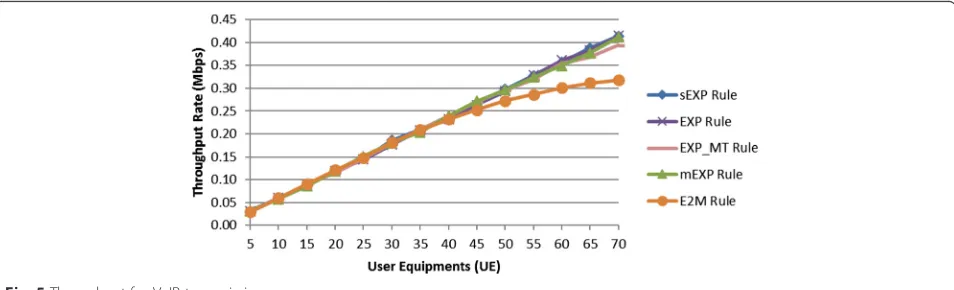
In Fig. 5, VoIP throughput rises steadily with some very minor fluctuations as the number of UEs increases. Based on the variation in percentage calculations, changes are less than 7 % for the sEXP rule, the EXP_MT rule, and the mEXP rule relative to the EXP rule. The sEXP rule has an improvement in throughput rate between 0.7 and 2.73 % in terms of percentage changes from 25 to 50 UEs. As for the E2M rule, Fig. 5 illustrates that from 40 to 70 UEs, the throughput rate increases little by little, unlike the other experimented scheduling schemes. In addition to the E2M rule, the E2M rule has a slightly better throughput rate from 10 to 35 UEs, showing a change between 0.16 and 2.83 % compared to EXP rule.
The amount of successful packet transmission for BE is computed and illustrated in Fig. 6. Based on the illus-tration, it can be observed that all of the proposed schemes outperform the EXP rule scheduling scheme. Just above the EXP rule is the sEXP rule, where the
Fig. 4Throughput for video transmission
throughput value ranges between approximately 0.4 and 2.2 Mbps, and the percentage of change increases from 5 to 50 UEs. Its changes vary from 0.02 to 8.04 %. As for the EXP_MT rule, the throughput gradually increases as the number of UEs increases. The throughput rate ranges between 0.4 and slightly below 5.0 Mbps for 5 to 70 UEs. In the E2M rule and the mEXP rule, the throughput rate slightly decreases as the number of UEs increases throughout the simulation process. At the point of approximately 40 UEs, the EXP_MT rule super-sedes the E2M rule with a difference of less than 1 Mbps. Overall, the mEXP rule shows the best through-put performance for the BE traffic transmission despite the gradual decrease in throughput value. Using PF for its weighting helps to provide fairness in distributing re-sources among its users. It throughput rate is somewhat consistent, between approximately 3 and 7 Mbps. This is due to the small amount of packet loss and constant delay threshold value in the BE traffic.
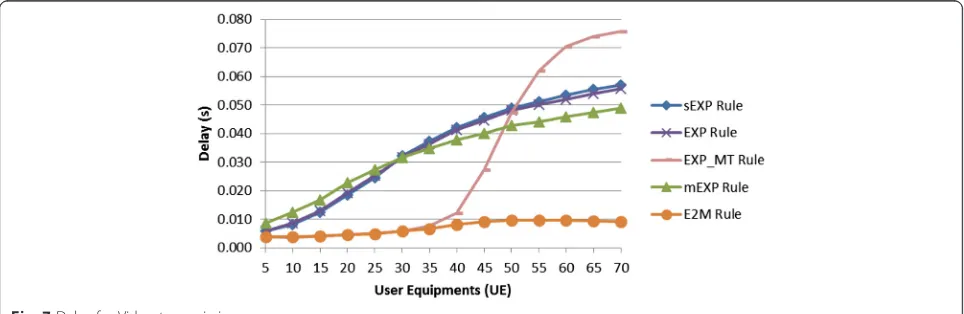
In Fig. 7, video transmission delay is illustrated. The lowest amount of delay is with the E2M rule. It outper-forms not only the existing EXP rule, but also the other proposed schemes, as well. In addition, it is fairly con-sistent as the delay is between 0 and 0.01 s. In contrast with the EXP rule, the E2M rule has an enhancement of approximately 35 to 84 %. This may be due to the fact that there is a sudden increase in PLR at 30 UEs on-wards in the video transmission due to congestion, which in turn contributes to a slight increase in delay. The EXP_MT rule has a lower delay than our bench-mark EXP rule scheduler, especially from 5 to 50 UEs. From 5 to 15 UEs, the delay for the EXP_MT rule is below the E2M rule, with a change of 0.25 to 1.33 %. However, there is sudden spike in delay from 30 UEs on-wards due to the throughput rate being prioritized which leads to the loss of packets as the number of UEs grows bigger. This is due to there being more packets in the queue that are waiting to be sent successfully. Initially,
Fig. 6Throughput for BE transmission
the mEXP rule’s delay is higher than the benchmark scheduler, which is until the 30 UEs. In between 30 to 70 UEs, the delay gradually falls to a minimum, indicat-ing that improvement lies between of 4 and 12 %. The sEXP rule is initially much better than the benchmark at a very small change in percentage which ranges between 2 and 5 % from 5 to 25 UEs. However, from 30 UEs on-wards there is no significant improvement as the delay increases between differences of 1 to 3 %. Hence, it can clearly be seen that the E2M rule has an outstanding re-sult in terms of delay in video transmission. Packets are sent before their expiry dateline, in return reducing delay time as well.
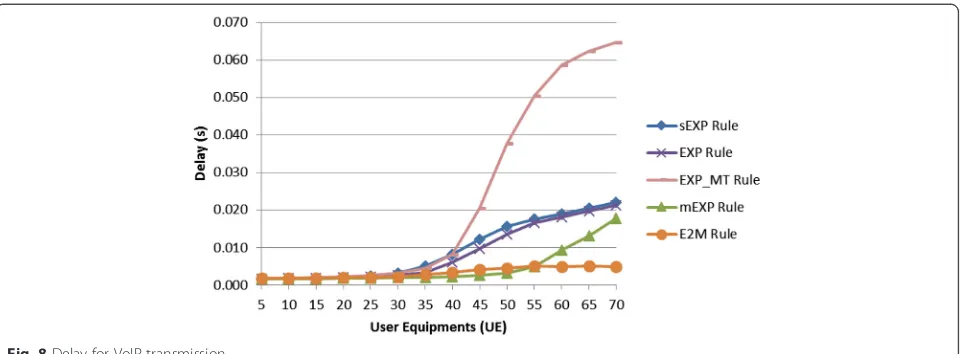
Figure 8 illustrates the amount of delay obtained from the VoIP transmission. The delay in the EXP_MT rule is the highest compared to other schemes, followed by the sEXP rule. Both schemes have a higher amount of delay
in contrast to the benchmark EXP rule. Even though the PLR soars for the EXP_MT rule from 40 UE onwards, as can be seen the delay has a steep curve. This is due to the fact that priority is given to the video transmission. Based on the figure, it is derived that the mEXP rule and the E2M rule have much better performance in terms of the amount of delay these schemes face. This is due to them having a combination of higher probability of packet being loss and HOL delay as a guide. Compared to the benchmark EXP rule, the mEXP rule’s change in percentage initially increases from 5 to 50 UEs in an ap-proximate range of 2.41 to 76.66 %. The amount of delay then begins to rise, which then gradually decreases the change in percentage as the number of UEs increases. The most striking change can be seen at 50 UEs where the proportion variation is the highest with a value of 76.66 %. As for the E2M rule, the delay remains
Fig. 8Delay for VoIP transmission
averagely consistent between 0.001 to 0.005 s from 5 to 70 UEs. This is due to the increasingly large number of packets that are lost from 35 UEs onwards.
Figure 9 illustrates the spectral efficiency of the com-munication channel during the transmission flows. It can be seen that the mEXP rule transmits information at a faster rate over the given bandwidth of 5 MHz in comparison to the benchmark EXP rule at UEs ranging from 10 to 35 and 55 to 70. The highest bandwidth effi-ciency is at approximately 1.59 bps. This is succeeded by mEXP for 10 UEs, and the E2M rule for 70 UEs, re-spectively. The E2M rule starts with a lower spectral ef-ficiency, below the benchmark rule, but then rises from 50 UEs onwards with a change ranging from approxi-mately 1 to 13 %. However, the sEXP and EXP_MT rule have a lower bandwidth efficiency as can be seen in the Fig. 9 where these schemes are situated below the benchmark rule.
5 Conclusions
The focus of this study is on real-time applications, which includes video and VoIP traffic transmission. Based on the findings, the E2M rule has a much better performance compared to the other four proposed scheduling schemes, the existing EXP rule (which was used as the benchmark), the sEXP rule, the mEXP rule, and the EXP_MT rule which were tested in a simula-tion. The E2M rule stands out in terms of PLR, throughput rate, and delay. This is the case for real-time application, especially for video traffic flows. The E2M rule also has the highest efficiency in bandwidth from the 50 UEs onwards. This is followed by the EXP_MT rule, which has very good throughput values
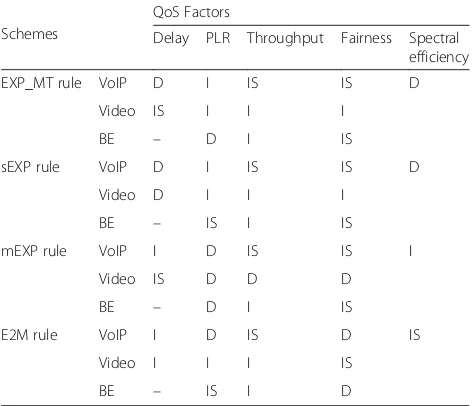
in BE, video and VoIP traffic flows. The simulation re-sults show that the sEXP rule has better performance in throughput, PLR, and spectral efficiency for video traffic. Lastly, the mEXP rule shows improvements in terms of delay for all traffic flows. An overview of the obtained results is given in Table 3. The symbol“I” rep-resents improvement, “IS” for slight improvement, and “D” for degraded performance, respectively. Thus, it can be concluded that the E2M rule outperforms the benchmark EXP rule as well as the other proposed schemes. Apart from that, based on the results and ob-servations, the E2M rule is suitable for real-time traffic, especially for the video traffic transmissions.
Competing interests
The authors declare that they have no competing interests.
Authors’contributions
EMA proposed the scheduling algorithms, conducted simulation experiments, simulation analysis and drafted the paper. KKW participated in research supervision and direction,contributed in discussion and interpretation of the simulation results, as well as revising the manuscript. YHP has participated in equation analysis, mathematical computation in the simulation. KKP contributed in simulation model design and development, besides the traffic modelling. All authors have read and approved the final manuscript.
Author details 1
Faculty of Information Science and Technology, Multimedia University, Jalan Ayer Keroh Lama, Bukit Beruang, Malacca 75450, Malaysia.2Department of
Computer System & Technology, Faculty of Computer Science & Information Technology Building, University of Malaya, Kuala Lumpur 50603, Malaysia.
Received: 2 April 2015 Accepted: 22 July 2015
References
1. N Magdalena,3GPP A global initiative, 2013. http://www.3gpp.org/LTE 2. M Yang, Y Li, D Jin, L Zeng, X Wu, AV Vasilakos, Software-defined and
virtualized future mobile and wireless networks: a survey. J Mobile Netw Appl20(1), 4–18 (2014). doi:10.1007/s11036-014-0533-8
3. X Zhang, Y Zhang, F Yan, AV Vasilakos, Interference-based topology control algorithm for delay-constrained mobile Ad hoc networks. IEEE Trans Mobile Comput14(4), 742–753 (2015). doi:10.1109/TMC.2014.2331966
4. B Sahoo, Performance Comparison of packet scheduling algorithms for video traffic in LTE cellular network. Int J Mobile Netw Commun Telematics
3(3), 9–18 (2013)
5. P P Demestichas, VG Stavroulaki, LMI Papadopoulou, AV Vasilakos, ME Theologou, Service configuration and traffic distribution in composite radio environments. IEEE Transactions on System Management Cybernetics. Part C: Applications and Reviews, 34(1), 69–81 (2004). doi:10.1109/TSMCC.2003.818500 6. YS Yen, HC Chao, RS Chang, AV Vasilakos, Flooding-limited and
multi-constrained QoS multicast routing based on the genetic algorithm for MANETs. Math Comput Model53(11–12), 2238–2250 (2011). doi:10.1016/j.mcm.2010.10.008
7. AV Vasilakos, C Ricudis, K Anagnostakis, W Pedryca, A Pitsillides, Evolutionary-fuzzy prediction for strategic QoS routing in broadband networks, in Proceedings of IEEE International Conference Fuzzy System IEEE World Congress Computational Intelligence, vol. 2, 1998, pp. 1488–1493.
doi:10.1109/FUZZY.1998.686339
8. AA Helen Tang, AV Vasilakos, FR Yu, VCM Leung, A survey of security challenges in cognitive radio networks: solutions and future research directions. Proc IEEE
100(12), 1558–2256 (2012). doi:10.1109/JPROC.2012.2219194
9. D Lopez-Perez, X Chu, AV Vasilakos, H Claussen, Power Minimization based resource allocation for interference mitigation in OFDMA femtocell networks. IEEE J Sel Areas Commun32(2), 333–344 (2014). doi:10.1109/JSAC.2014.141213
Table 3Experimental results overview
Schemes
QoS Factors
Delay PLR Throughput Fairness Spectral efficiency
10. F Capozzi, G Piro, LA Grieco, G Boggia, P Camarda, Downlink Packet scheduling in LTE cellular networks: Key design issues and a survey. IEEE Trans Veh Technol15(2), 678–700 (2012). doi:10.1109/SURV.2012.060912.00100 11. G Piro, LA Grieco, G Boggia, F Capozzi, P Camarda, Simulating LTE Cellular
systems: an open source framework. IEEE Trans Veh Technol60(2), 498–513 (2011). doi:10.1109/TVT.2010.2091660
12. E Dahlman, S Parkvall, J Sköld, 4G: LTE/LTE-Advanced for Mobile Broadband (Elsevier Ltd., UK, 2014), p. 321–346.
13. PBF Duarte, ZM Fadlullah, AV Vasilakos, N Kato, On the partially overlapped channel assignment on wireless mesh network backbone: a game theoretic approach. IEEE J Sel Areas Commun30(1), 119–127 (2012).
doi:10.1109/JSAC.2012.120111
14. P Li, S Guo, S Yu, AV Vasilakos, CodePipe: an opportunistic feeding and routing protocol for reliable multicast with pipelined network coding, in Proceedings of IEEE INFOCOM, 2012, pp. 100–108.
doi:10.1109/INFCOM.2012.6195456
15. IE Kassotakis, ME Markaki, AV Vasilakos, A hybrid genetic approach for channel reuse in multiple access telecommunication networks. IEEE J Sel Areas Commun18(2), 234–243 (2000). doi:10.1109/49.824804
16. J Max Magalhães Hofmann, P Roberto Guardieiro, A Downlink Scheduling based on Earliest Deadline First Discipline for Real-Time Traffic in LTE Networks. Int Work Telecommun. 1–7 (2013). http://www.inatel.br/iwt2013/ index.php?option=com_content&view=article&id=84
17. CK Chakravarthy, PVGD Prasad Reddy, Modified Queue-based exponential rule scheduler for improved QoS in OFDMA. Int J UbiComp1(2), 34–43 (2010)
18. D Lopez-Perez, X Chu, AV Vasilakos, H Claussen, On Distributed and coordinated resource allocation for interference mitigation in self-organizing LTE networks. IEEE/ACM Trans Netw21(4), 1145–1158 (2013).
doi:10.1109/TNET.2012.2218124
19. T Jiang, H Wang, AV Vasilakos, QoE-driven channel allocation schemes for multimedia transmission of priority-based secondary users over cognitive radio networks. IEEE J Sel Areas Commun30(7), 1215–1224 (2012). doi:10.1109/JSAC.2012.120807
20. EM Ang, KK Wee, YH Pang, SH Lau, Two-level scheduling framework with frame level scheduling and exponential rule in wireless network, in Proceedings of International Conference on Information Science and Applications (ICISA 2014), 2014, pp. 47–50. doi:10.1109/ICISA.2014.6847476 21. A Mae, WK Kwee, PY Han, OS Yin, A Performance analysis on enhanced
Two-level scheduling framework for real-time traffic in LTE. Acad J Sci3(3), 213–222 (2014)
22. A Alfayly, I-H Mkwawa, L Sun, E Ifeachor, QoE-based performance evaluation of scheduling algorithms over LTE, in2012 IEEE Globecom Work, 2012, pp. 1362–1366. doi:10.1109/GLOCOMW.2012.6477781
23. J-G Choi, S Bahk, Cell-throughput analysis of the proportional fair scheduler in the single-cell environment. IEEE Trans Veh Technol56(2), 766–778 (2007). doi:10.1109/TVT.2006.889570
24. G Piro, N Baldo, M Miozzo, An LTE module for the ns-3 network simulator, inProceedings of the 4th International ICST Conference on Simulation Tools and Techniques, 2011, pp. 415–422. doi:10.4108/icst.simutools.2011.245571 25. G Piro, LA Grieco, G Boggia, P Camarda, A Two-level scheduling algorithm for QoS support in the downlink of LTE cellular networks, inProceedings of European Wireless Conference (EW), 2010, pp. 246–253.
doi:10.1109/EW.2010.5483423
26. D Singh, P Singh, Radio Resource scheduling in 3GPP LTE : a review. Int J Eng Trends Technol (IJETT)4(6), 2405–2411 (2013)
27. LIU Gan, Z Xin, ZHU Guang-xi, A scheduling algorithm for maximum throughput based on the link condition in heterogeneous network. J Commun Comput4(3), 33–37 (2007)
28. H Ekstrom, Ericsson, QoS Control in the 3GPP evolved packet system. IEEE Commun Mag47(2), 76–83 (2009). doi:10.1109/MCOM.2009.4785383 29. N Saed, K Wee, TH Liew, SY Ooi, Video and voice transmission over LTE
networks, inProceedings of IEEE International Conference on Control System, Computing and Engineering, 2013, pp. 259–263.
doi:10.1109/ICCSCE.2013.6719970
30. G Aiyetoro, F Takawira, A Cross-layer based packet scheduling scheme for multimedia traffic in satellite LTE networks, inProceedings of 6th International Conference on New Technologies, Mobility and Security (NTMS), 2014, pp. 1–6. doi:10.1109/NTMS.2014.6813994
31. R Basukala, HAM Ramli, K Sandrasegaran, Performance analysis of EXP/PF and M-LWDF in downlink 3GPP LTE system, inProceedings of First Asian
Himalayas International Conference on Internet (AH-ICI 2009), 2009, pp. 1–5. doi:10.1109/AHICI.2009.5340336
32. A Biernacki, K Tutschku, Comparative Performance study of LTE downlink schedulers. 12th IEEE Int Symp Netw Comput Appl74(2), 585–599 (2013). doi:10.1007/s11277-013-1308-4
33. B Sadiq, SJ Baek, G De Veciana, Delay-optimal opportunistic scheduling and approximations: the log rule. IEEE/ACM Trans Netw19(2), 405–418 (2011). doi:10.1109/TNET.2010.2068308
34. N Marcus, SOS Mathematics. (MathMedics, LLC), http://www.sosmath.com/ algebra/logs/log4/log4.html
35. G Piro, LTE Simulator. (The LTE Simulator, 2007), http://telematics.poliba.it/ index.php/en/lte-sim.
36. B Sadiq, SJ Baek, G de Veciana, Delay-optimal opportunistic scheduling and approximations: the Log rule. IEEE/ACM Trans Netw19(2), 405–418 (2010). doi:10.1109/TNET.2010.2068308
37. S Ali, M Zeeshan, A Naveed, A capacity and minimum guarantee-based service class-oriented scheduler for LTE networks. EURASIP J Wirel Commun Netw67(1), 1–15 (2013)
38. S Ali, M Zeeshan, A Utility based resource allocation scheme with delay scheduler for LTE service-class support, inProceedings of Wireless Communications and Networking Conference (WCNC), 2012, pp. 1450–1455. doi:10.1109/WCNC.2012.6214009
39. M Iturralde, A Wei, T Ali-Yahiya, A-L Beylot, Resource Allocation for real time services in LTE networks: resource allocation using cooperative game theory and virtual token mechanism. Wirel Pers Commun72(2), 1415–1435 (2013). doi:10.1007/s11277-013-1086-z
40. MA Khan, H Tembine, AV Vasilakos, Game dynamics and cost of learning in heterogeneous 4G networks. IEEE J Sel Areas Commun30(1), 198–213 (2012). doi:10.1109/JSAC.2012.120118
Submit your manuscript to a
journal and benefi t from:
7 Convenient online submission
7 Rigorous peer review
7 Immediate publication on acceptance
7 Open access: articles freely available online
7 High visibility within the fi eld
7 Retaining the copyright to your article