© 2015, IRJET.NET- All Rights Reserved
Page 487
A proficient process for Dynamic Location Management
in Wireless Communication Networks
Manu Srivastava
1, Rajesh Kumar Yadav
21
M.Tech. Scholar, Department of Computer Engineering, Delhi Technological University, Delhi, India
2Asst. Prof., Department of Computer Engineering, Delhi Technological University (Formerly DCE), Delhi
---***---Abstract -
Every aspect of our lives have been touchedby recent advances in cellular mobile. Mobile terminals (MTs) move randomly from one place to another inside a distinct environmental region. To provide appropriate services to mobile users, a demanding task is to track the location of the mobile successfully, so that the connection establishment delay is low. Typically, the network uses paging to decide the precise location of the mobile and this takes somewhere between 500ms to several seconds. The time factors for LU and paging are often reciprocally contradictory.
In this paper, we productively set up a new analytical representation available for the analysis of the significant dynamic movement-based location management method for wireless networks with HLR/VLR architectures with intelligent paging scheme , to determine the total cost, comprise of paging cost and LU cost. Analytical results show that projected integrated new scheme, it reduces the total cost for location management compared to the preceding scheme, and obtain the improved performance, , thus reducing the call setup time. .
Key Words:
HLR, VLR, LA, LU, MSC, BS, CMR
1. INTRODUCTION
Service area in wireless cellular networks is partitioned into location areas, and each location area contains a number of cells, as illustrated in Fig. 1 [5]. An mobile terminal is able to travel liberally within the location areas devoid of updating its location information and would just need to perform an location updates when it enters a new location areas. When an incoming call arrives, the network locates the mobile terminal by paging all cells within the location areas. A cell, usually represented with a hexagon, is served by a base station that transmits paging messages to all mobile terminals within the cell over a common broadcast channel. All BSs of the location areas are openly
connected to the mobile switching centre (MSC) via the backbone network. MSCs are telephone exchanges which act as boundary between the mobile terminal and the PSTN/Internet. The LM system resides in the MSCs. While the MT-BS links are wireless, BS-MSC links are usually fixed and wired.
1.1
Location update schemes
There are two essential operations in location management: location update and paging. Location update is the procedure through which system tracks the location of mobile terminals that are not in conversations. The mobile terminal reports its current location information dynamically. A paging area (PA) may include one or more cells. When the incoming call arrives, the system searches for the mobile terminal by sending polling signals to cells in the Paging area. This searching process is referred to as paging. Performing location update or paging will acquire a major amount of cost (e.g., wireless bandwidth and processing power at the mobile terminals, the base stations, and databases), which must be minimized in the systems.
Fig 1: The LM architecture of existing 2G cellular mobile networks. [5]
© 2015, IRJET.NET- All Rights Reserved
Page 488
been planned [4], namely, distance based, movementbased, and time based.
To implement the dynamic location update scheme in a actual PCS network, we have to consider the real network architectures with HLR-VLR databases. The location management have a bold task to design a high-quality strategy that can decrease the cost of the location update and paging at the identical time. In this paper, we test the obstacle of the performance assessment of the dynamic movement-based location management process for wireless networks with the HLR- VLR architectures all along with intelligent paging scheme.
1.2 Paging
Paging is performed at the onset of an incoming call and involves transfer a query message over the downlink signaling channel to every cell in the LA. All MTs keep an eye on the common control channel regularly to check whether it has been paged or not. When an MT finds a paging signal for itself, it thus responds by sending an acknowledgement note over the uplink signaling channel. The entire area to be paged (i.e., the PA), in its basic form, equals the LA and depends on the exactness and frequency of LU. A straightforward trade-off exists here - the enhanced the location prediction through LU, the smaller is the size of PA. A smaller PA results in a compact paging cost as the paging cost is comparative to the number of paged cells. To decrease the paging cost additional, as an alternative of paging all the cells within the LA at one go, the LA can be partitioned into several PAs that will be polled in succession.
Intelligent paging: The design of selective paging can be carried forward with more intelligent paging strategy. By intelligent paging, we refer to a group of schemes where the sequential paging scheme is further customized by computing the paging order of the different PAs based on pre-established probability metrics. The key goal is to poll the correct PA in the first pass with a high degree of success. As expected, intelligent strategies require even more computational overhead.
1.3 CMR
An added significant characteristic in the current topic is the call to mobility ratio (CMR). CMR is computed by dividing the average number of incoming calls by the average number of cell crossings the user makes in a given period of time. Users with lesser CMR values have need of more frequent location updates than users having higher CMRs.
The novel scheme could decrease the total LU cost drastically for high CMR, and thereby reduce the total cost. The rest of this paper is structured as follows. In section II, we present the related work. In section III, we discuss location update and paging strategy. Performance
comparison is addressed in section IV. Finally, we present the conclusion in section V.
Fig 2 : The PA for movement-based LU with d =3 [5]
2. Related work
The wireless networks coverage area is separated into LAs, each one of which consists of tens or hundreds of cells and is serviced by a VLR. A mobile terminal resides in a cell it visits for a random time interval and moves on to the next cell.
In the movement-based location update scheme, the mobile terminal registers at a new VLR and its new location is reported to HLR when it moves across cells since the last location update, where ‘d’ is a threshold value. For ease, a location data update in HLR is referred to as a HLR location update and a set of registration and deregistration operations in VLRs is referred to as a VLR location update.
We define the center cell to be the cell where the last VLR location registration took place, for the movement-based location update method. The network initiates the terminal paging process to locate the called mobile terminal, as soon as a call for a mobile terminal arrives. The PA is the covering area within a distance from the centre cell. The PA is the same as an LA, for the system with the static location update scheme. [3]
In the dynamic movement-based location management with HLR/VLR architecture, there are costs for location update and paging. Furthermore, in the HLR/VLR network architectures, there are two kinds of location updates: HLR location updates that update the location data in HLRs and VLR location updates that update the location data in VLRs.
© 2015, IRJET.NET- All Rights Reserved
Page 489
TCmb = Chlr + Cvlr + Cp(1)
The costs function of location update in database HLR [3]: Chlr = δhlr . (λm / λc) (2) The expected cost function of location updates in VLRs per call arrival is obtained as follows [3]:
(3)
Here,d = cell boundaries ( d=1 to d=15) δhlr = HLR update cost
δvlr = VLR update cost
In the analysis, it is supposed that the residence time of a mobile terminal in an LA is an exponentially scattered random variable with rate λm and the call arrival to each mobile terminal is a Poisson process with rate λc
Further, we have
ρmc = (λm)/( λm+ λc) ρsc = (λs)/( λs+ λc) ρsm = (λs)/( λs+ λm) where,
λm = 1/ Tm λs = 1/ Ts λc = 1/ Tc
Tm is mean LA residence time, Ts is mean cell residence time and Tc is mean time betweenconsecutive phone calls to mobile handset. For brevity, we skip the part of derivation
.
When there is a call to arrive the mobile terminal, the network will hunt all the range in the LA to found the mobile terminal [7]. In the RBPS strategy, the paging strategies can be either sequential paging or blanket paging. Both strategies have benefit and drawback. In the sequential paging [8] Search speed is sluggish but the paging load is very little. Blanket paging [8]: Search speed is quick but the paging load is very vast. Apart from these two, intelligent paging method has rapid search speed as blanket paging and the paging load is little just like the sequential paging
.
The cost of the selective paging is as follows [2] :
(4) where
,
ρi,x,j = probability for an MT to move from ith PA to xth PA.
nc_PAx = Number of cells in the xth PA
λc = inverse of the mean time between two consecutive phone calls to MT
3. PROPOSED METHOD
In the previous strategy, the location update is done when the mobile terminal move across periphery of cell threshold d. If the quantity of crossing the boundary surpasses the earlier defined threshold value, the mobile terminal would carry out a LU.
In this section, we set collectively the dynamic movement-based location management with HLR/VLR architecture with the selective paging approach together. Under the joint scheme, the total cost could be represented as:
TC = { δhlr . (λm / λc) } +
{
}
+
{
}
(5)In this paper, the size and shape of a cell are in some way reflecting by the cell residence time value. In the small cell size, the mean residence time will be relatively small and vice versa. In the live cellular phone systems, all cells in the Paging area or the location area are paged every time when an incoming call arrives, but the intelligent paging scheme are being used here.
The different parameters are used to analyze the materialization of the new scheme and evaluated the results with the previous scheme, and the total cost obtained from the new proposal and the previous method is compared. The wireless network with widespread hexagonal cell configurations shown in Fig. 3. For the hexagonal cell formation, cells are hexagonal shaped and each cell has six neighbors. There are many rings of cells in the hexagonal cell formation. The innermost ring (i.e., ring “0”) consists of only the center cell in the movement-based location update scheme. Ring “1” surrounds ring “0”, which in turn is surrounded and so on.
© 2015, IRJET.NET- All Rights Reserved
Page 490
4. PERFORMANCE COMPARISION
In the proposed scheme, the dynamic movement-based location management cost with HLR/VLR architecture is added with the scheme of selective paging together. Thus, under the combined scheme, the total cost is represented as in (5)
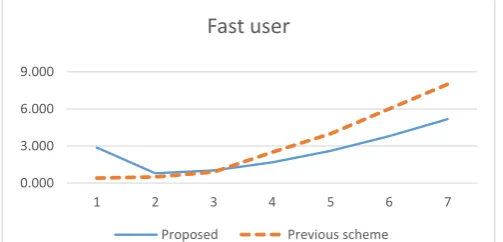
The total cost obtained from the new scheme and the previous schemes are compared here. The costs of various boundary crossing threshold d are evaluated when λc=0.1 & 1 i.e. Tc (time elapsed between termination of a call &
Fig 4: Cost at various boundaries when λc=0.1
Figure 4 shows that when the value of d is 1 i.e. the location update count, the high location update cost is high. When d ranges from 2 to 7, there is decrease in the number of location updates. With the increase in the d value, there is reduction in the number of location update and there is drop in the location update cost step by step. However, increase in the value of d would cause the paging area to increase also, and thus increase the paging cost. The proposed scheme still has good performance in d = 2 to 7. Moreover, the numerical results show that the proposed scheme outperforms the previous scheme. But when the threshold d ranges from 2 to 7, it is obvious that the paging cost of new strategy is lower than the previous scheme. decreases). It is usual because with the lower mobility (i.e., the larger value of Tc), it is better to not perform the registration operation frequently and vice versa. From the graphs it is evident that as the cost decreases, the value of d also decreases. It is expected because an increase in the movement threshold results in an increase of the PA of the
mobile terminal and, thus, decreases the HLR and VLR update costs
.
The numerical experiments with different system parameters are broadly conducted. Due to the limitation of space, we provide the typical results here.
0.000
Fig 5: Cost at various boundaries when λc=1
5. CONCLUSION
In this paper, an analytical model to study the dynamic movement-based location management for wireless networks with HLR/VLR architectures is developed. The paging scheme with movement based location update scheme is combined, where different movement threshold value d was selected.
© 2015, IRJET.NET- All Rights Reserved
Page 491
REFERENCES
[1] Jian-Ming Chang, Chi-Yuan Chang, Tzu- Hua Lin,Han- Chieh Chao, “Using a Novel Efficient Location Management Approach in Cellular Networks”, 2008 IEEE
[2] Madhubanti Maitra, Debashis Saha, Partha S. Bhattacharjee, Amitav Mukherjee, “A Rule-based Paging Technique for Cellular Wireless Networks” 2004 IEEE
[3] Jie Li, Yi Pan, and XiaohuaJia, “Analysis of Dynamic Location Management for PCS Networks”, IEEE Transactions on Vehicular Technology (2002), Vol. 51, No. 5, pp. 1109-1119.
[4] A. Bar-Noy, I. Kessler, and M. Sidi, “Mobile users: To update or not to update?,” ACM-Baltzer J. Wireless Networks, vol. 1, no. 2, pp. 175–186, July 1995
[5] Aniruddha Chandra, Poulami Das, "Location management in cellular mobile networks", IEEE Communications Letters 2014
[6] Prem Nath, Rajesh Kumar Yadav, “Replication strategy using Huffman tree like structure”, Proc. of the Intl. Conf. on Advances in Electronics, Electrical and Computer Science Engineering— EEC 2012
[7] Ian F. Akyildiz and Wenye Wang, “A Dynamic Location Management Scheme for Next Generation Multi-tier PCS Systems”, IEEE Transactions on Wireless Communication, Jan2002.
[8] G. L. Lyberpoulos, J. G. Markoulidakis, D.V.Polymeros, D.F.Tsirkas, E. D. Sykas, “Intelligent Paging Strategies for Third Generation Mobile Telecommunication Systems”, ACM, Wireless networks, vol. 44, No 3, pp 543-554, Aug 1995.
[9] Q. Alejandro, G. Oscar, P. Samuel, “An alternative strategy for location update and paging in Mobile networks”, Computer Communication 27 (2008), pp. 1509–1523.
[10] Ing-Ray Chen and BaoshanGu, “Quantitative Analysis of a Hybrid Replication with forwarding Strategy for efficient and Uniform Location Management in Mobile Wireless Networks”, IEEE Transactions on Mobile Computing (2003), Vol. 2, No. 1, pp. 3-15
BIOGRAPHIES
Author is M.Tech. Research scholar, completed B.E. in Telecommunication Engineering, 11 years of industry experience in Telecommunication domain in India and Europe. Worked in Mobile protocol validations, Inter operability testing, GCF verification, Anite test equipment & RFI
![Fig 1: The LM architecture of existing 2G cellular mobile networks. [5]](https://thumb-us.123doks.com/thumbv2/123dok_us/973014.1119588/1.595.309.554.519.668/fig-lm-architecture-existing-g-cellular-mobile-networks.webp)
![Fig 2 : The PA for movement-based LU with d =3 [5]](https://thumb-us.123doks.com/thumbv2/123dok_us/973014.1119588/2.595.310.557.136.291/fig-pa-movement-based-lu-d.webp)
![Fig 3 : The hexagonal configuration [3]](https://thumb-us.123doks.com/thumbv2/123dok_us/973014.1119588/3.595.312.561.248.326/fig-the-hexagonal-configuration.webp)