CSEIT172158 | Received: 20 Feb 2017 | Accepted: 28 Feb 2017 | January-February-2017 [(2)1: 271-275 ]
International Journal of Scientific Research in Computer Science, Engineering and Information Technology © 2017 IJSRCSEIT | Volume 2 | Issue 1 | ISSN : 2456-3307
271
A Review on PMSG Based Wind Energy Conversion System
Anupam
1, Prof. S. U. Kulkarni
2, Tripti Gupta
31Department of Electrical Engineering, Bharati Vidyapeeeth Deemed University College of Engineering, Pune,
Maharashtra, India
2Department of Electrical Engineering, Bharati Vidyapeeeth Deemed University College of Engineering, Pune,
Maharashtra, India
3Department of Electrical Engineering, Bharati Vidyapeeeth Deemed University College of Engineering, Pune,
Maharashtra, India
ABSTRACT
Due to the increasing concern about the various aspects of conventional generating units such as depleting fossil fuel, environment issues like release of pollutants in the air have forced the research companies to exploit the renewable energy resources using small generating units. Researchers have been trying to develop ways to take advantage of different types of clean and renewable energy sources. Wind energy production, in particular, has been growing at an increasingly rapid rate, and will continue to do so in the future. In fact, it has become an integral part in supplying future energy needs, making further advancements in the field exceedingly critical. Basically the work reviewed in this paper is the performance analysis of PMSG based wind energy conversion system during the different operating conditions. PMSG has been utilized in this system due to its various advantages over other generators. The model based on wind energy system has been implemented into the Matlab software and simulation result regarding the performance of the system is studied.
Keywords : PMSG - Permanent magnet synchronous generator
I.
INTRODUCTION
In the field of renewable energy generation has been observed in wind energy. Where the technology plays the major role in generation. Meeting the future energy demand and to provide a quality and pollution free supply to the growing conscious population the present world attention is to go for natural, clean and renewable energy sources. It also attracts attention as one of the most effective ways in terms of the cost of generating electricity from renewable energy sources. As the penetration level of wind power in the grid is extremely growing it is important to analyze its impact on the power grid, as well as the impacts of grid disturbances on wind farm generators. Different types of generator systems used in wind farms, among which the variable speed direct-driven Permanent Magnet Synchronous Generator (PMSG) is found to be more attractive. In a permanent magnet synchronous generator the excitation field is provided with a permanent magnet
II.
METHODS AND MATERIAL
1. Wind Energy Conversion System
Wind means air in motion. Wind is nothing but Earth’s rotation and the uneven heating of Earth’s surface by sunrays. The sunrays cover a much greater area at the equator than at the poles. The hot air rises from the equator and expands toward the poles that cause wind. Air has a mass and mass in motion has a momentum. Momentum is a form of energy that can be utilized. Aerodynamic wind turbine power is given by
= 0.5 *ρ*A* * (λ,β)
Here, ρ is the air density, A= π* , is the blades swept of the turbine, V is wind speed, and (λ,β) is the power coefficient, which expresses the relationship between the tip speed ratio λ and the pitch angle β.
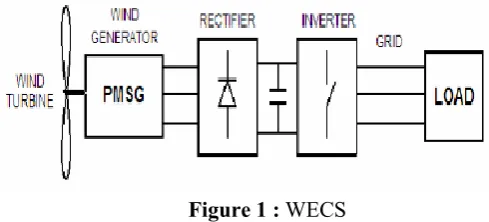
Renewable energy resources, especially wind energy, become attracting great attention due to the depletion of existing fossil fuel deposits and increasing concerns about CO2 emissions. Since the late 1990s, variable speed constant frequency (VSCF) wind energy conversion systems (WECS) have been widely adopted in order to maximize the utilization of wind energy. The doubly-fed induction generator (DFIG) and direct-drive permanent magnet synchronous generator (PMSG) are the most popular systems for wind energy conversion. The direct-drive PMSG has attracted more and more attention due to its advantages of high efficiency and reliability. The configuration of a typical direct-drive WECS with PMSG is shown in Figure 1.
Figure 1 : WECS
The PMSG converts the mechanical power from the wind turbine into ac electrical power, which is then given to the grid through a power electronic converter. Figure 1 shows the general configuration of a PMSG
based WECS. The main components of a wind energy conversion system are wind turbine, generator, rectifier, inverter and grid.
2. Mathematical model of PMSG:
The PMSG wind power system consist of wind turbine, generator, converters and controllers. The full scale back-to-back converter is connected between the generator and the grid. In the d-q reference frame rotating at the synchronous speed is as shown in Figure 1, the model of PMSG is presented on a per unit basis. The rotor-flux-oriented control strategy which makes the d-axis of the reference frame align along the permanent magnet flux position is adopted. The equations are in accordance with generator convention, which means that the generator current is positive when flowing towards the grid.
Figure 2 : The space relationship between d-q axis and x-y axis
The space relationship between d-q axis and x-y axis as follows
respectively; Ld and Lq are d-axis and q-axis inductance, respectively; ids and iqs are generator-side current in d-q axis, respectively; uds and uqs are generator-side voltage in d-q axis, respectively; is generator electrical angular speed; Rs is stator resistance.
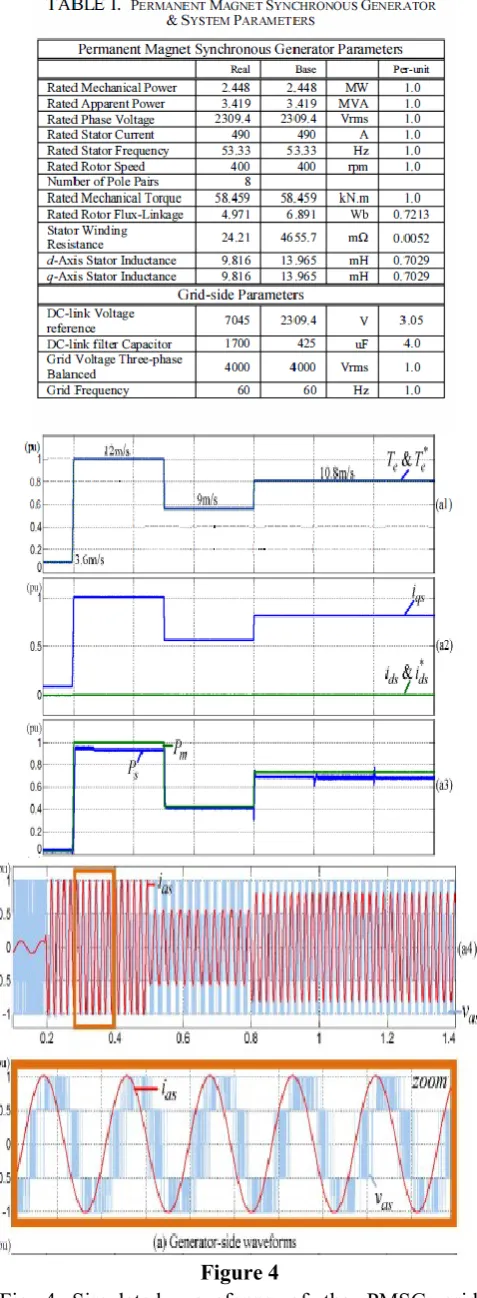
In [1], a modeling of stator current control of PMSG for grid-connected systems is proposed. The modeling of the power circuit and control-side was performed and implemented on the MATLAB/Simulink. To minimize the winding losses Zero d-axis stator current is used in the generator. Thus, generator-side converter is used for optimization of the PMSG and was achieved for the generator-side converter. Besides, the voltage-oriented control is used to maintain the DC-link voltage and independent active and reactive powers flow to the grid. Simulation performances showed fast, accurate, and effective responses to changes in the operating conditions with good dynamics that maintained the demand active and reactive powers to the grid.
Figure 3
Fig. 3. Configuration of PMSG-based WECS with a control of the generator-side converter using d-axis stator current control scheme and a control of the grid-side using voltage oriented control scheme.
Figure 4
power, (a4) phase-A stator voltage and current, (b) dc-link voltage waveform,
In the simulation, the turbine model receives the wind speed and provides an optimized reference torque ' to control the system. In order to simulate the transient response of the propose control system, wind speed is assumed to have stepped-up from 3.6 m/s to 12 m/s at O.2sec and stepped down to 9 m/s at O.Ssec and then rose slightly reaching around 10.8 m/s at 0.8sec then remained stable. As a result, the optimal reference torque ' for MPPT is changed accordingly and the generator torque also indicated good dynamics to the tracking responded to its reference In the simulation, the turbine model receives the wind speed Vw and provides an optimized reference torque to control the system. In order to simulate the transient response of the propose control system, wind speed is assumed to have stepped-up from 3.6 m/s to 12 m/s at 0.2sec and stepped down to 9 m/s at O.Ssec and then rose slightly reaching around 10.8 m/s at 0.8sec then remained stable. As a result, the optimal reference torque for MPPT is changed accordingly and the generator torque also indicated good dynamics to the tracking responded to its reference.
In [2] focus is given on the comprehensive review on study of modeling and simulation of permanent magnet synchronous generator which is based on WECS. the MPPT concept details is provided for variable speed operation. The PMSG is introduced as construction and model with some information about generators already available in market. Different types of wind turbine generator is also explained, the mathematical equation of PMSG which is established in d-q reference frame is also provided here, and concept about the drive train, its types ,configurations of the possible power converters have been presented and discussed as well the semiconductor power switches used in converters. Wind turbine controls is considered as pitch control and stall control.
Figure 5 : View of Control System
Control of the Generator side converter
= * * = - * *
Where the phase angle θ is
= ( – f)
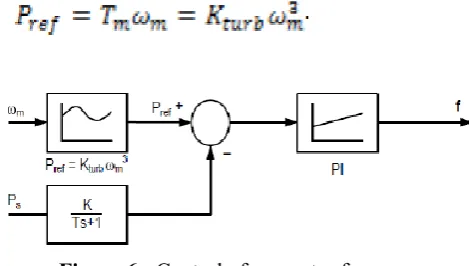
The reference power to archive the maximum efficiency of a wind turbine is given by
Figure 6 : Control of generator frequency
III.
RESULTS AND DISCUSSION
1. Maximum Power Point Tracking System
The MPPT (maximum power point tracking) function is to automatically adjust the generator speed to converge to the optimum one where the generated power is maximized. This can be obtained using PI control with the use of the electrical power at the grid-side instead of the mechanical power of wind turbine. With this option, the losses of both generators and converters will also be taken into consideration and, the overall energy conversion can then be optimized.
2. Tip Speed Control
wind speed hence resulting the complexity of the similar to MPPT scheme used in photovoltaic system. When the wind turbine speed increases, the output energy source. The permanent magnet synchronous generator (PMSG) is mostly applied for variable-speed wind energy conversion system (WECS) because of the higher efficiency. PMSG based WECS is controlled using Zero d axis stator control. Simulation result shows the effective and fast response of PMSG corresponding to changes in operating condition, so as to maintain the demand of active and reactive power to the grid. Wind turbine control includes the pitch control and stall control for the control of delivering high quality power to the grid. Various analysis like load flow studies, short circuit and harmonic studies can also considered for analysing the performance of PMSG.
V.
REFERENCES
[1] K. Bunjongjit and Y. Kumsuwan. 2014, IEEE - Proceedings of the International Electrical Engineering Congress 2014, ISSN NO: 978-1-4799-3174-3/14.
[2] Dhirendra Deode and Mr Nand Kishore Meena. 2016, Volume 5, International Journal of Engineering and Innovative Technology (IJEIT), ISSN: 2277-3754.
[3] A. Grauers, "Efficiency of three wind energy generator systems," IEEE Trans. Energy Convers., voL II, no. 3, pp. 650-657, Sep. 1996. [4] S. Toumi, S.E. Ben Elghali, M. Trabelsi, E.
Elbouchikhi, M.E.H. Benbouzid, M.F. Mimouni“Robustness analysis and Evaluation of a PMSG-based Marine Current Turbine System under Faulty Conditions” IEEE. Proceedings of the IEEE STA 2014, Dec 2014, Hammamet, Tunisia. IEEE, Proceedings of the IEEE STA 2014, pp.631-636, 2014.
[5] Sasi. C, G.Mohan, “Performance Analysis of Grid Connected Wind Energy Conversion System with a PMSG during Fault Conditions,”in International Journal of Engineering and Advanced Technology (IJEAT) ISSN: 2249 – 8958, Volume-2, Issue-4, April 2013.
[6] S. A. Saleh, and R. Ahshan, "Resolution-level-controlled WM inverterfor PMG-Based wind energy conversion system" IEEE Trans. Ind. Industry Applications., vol. 48, no. 2, pp. 750-763, March 2012.