Article
The Average Lower 2-Domination Number of Wheels
Related Graphs and an Algorithm
Tufan Turaci
Department of Mathematics, Faculty of Science, Karabük University, Karabük 78050, Turkey * Correspondence: [email protected]; Tel.: +90-370-433-8374 (ext. 1229)
Abstract: The problem of quantifying the vulnerability of graphs has received much attention nowadays, especially in the field of computer or communication networks. In a communication network, the vulnerability measures the resistance of the network to disruption of operation after the failure of certain stations or communication links. If we think of a graph as modeling a network, the average lower 2-domination number of a graph is a measure of the graph vulnerability and it is
defined by 2 ( ) 1 ( ) 2 ( ) ( )
av G V G v V G∈ v G
γ = γ , where the lower 2-domination number, denoted by γ2v( )G ,
of the graph G relative to v is the minimum cardinality of 2-domination set in G that contains the vertex v. In this paper, the average lower 2-domination number of wheels and some related networks namely gear graph, friendship graph, helm graph and sun flower graph are calculated. Then, we offer an algorithm for computing the 2-domination number and the average lower 2-domination number of any graph G.
Keywords: graph vulnerability; connectivity; network design and communication; domination number; average lower 2-domination number
2010 Mathematics Subject Classification: 05C40, 05C69, 68M10, 68R10.
1. Introduction
Graph theory has seen an explosive growth due to interaction with areas like computer science, operation research, etc. In particular, it has become one of the most powerful mathematical tools in the analysis and study of the architecture of a network. The most common networks are telecommunication networks, computer networks, road and rail networks and other logistic networks [20]. In a communication network, the measures of vulnerability are essential to guide the designers in choosing a suitable network topology. They have an impact on solving difficult optimization problems for networks [21,27].
The graph vulnerability relates to the study of a graph when some of its elements (vertices or edges) are removed. The measures of graph vulnerability are usually invariants that measure how a deletion of one or more network elements changes properties of the network [24]. In the literature, various measures have been defined to measure the robustness of a network and a variety of graph theoretic parameters have been used to derive formulas to calculate network vulnerability. The best known measure of reliability of a graph is its connectivity. The connectivity is defined to be the minimum number of vertices whose deletion results in a disconnected or trivial graph [15].
The connectivity of a graph G is denoted by k G( ) and it is defined as follows:
{
}
( ) m in : ( ) 1
k G = S S ⊂V and w G−S >
where w G( −S) is the number of components of the graph
G S
−
.[10], the average lower connectivity number [1] and the average lower bondage number [24] have been defined.
Let G=( ( ), ( ))V G E G be a simple undirected graph of order n. We begin by recalling some standard definitions that we need throughout this paper. For any vertex v V G∈ ( ), the open neighborhood of v is N vG( ) {= u V∈ | uv∈E G( )} and closed neighborhood of v is N vG[ ]=N vG( ) { }∪ v . The degree of vertex v in G denoted by dG( )v , that is, the size of its open neighborhood [16]. The minimum degree of graph G is denoted by δ( )G . A set S⊆V G( ) is a dominating set if every vertex in
( )
V G −S is adjacent to at least one vertex in S. The minimum cardinality taken over all dominating sets of G is called the domination number of G and denoted by γ( )G [16]. Another domination concept is 2-domination number. A 2-dominating set of a graph G is a set D⊆V G( ) of vertices of graph G such that every vertex of V G( )−D has at least two neighbors in D. The 2-domination number of a graph G, denoted by γ2( )G , is the minimum cardinality of a 2-dominating set of the graph G [9,12,14,16].
In 2004, Henning introduced the concept of average domination and average independence in [17]. Moreover, the average lower domination and average lower independence number are the theoretical vulnerability parameters for a network that modeled a graph [4,7]. The average lower domination number of a graph G, denoted by γav( )G , is defined as follows:
( ) 1
( ) ( )
( )
av G V G v V G∈ v G
γ = γ (1)
where the lower domination number, denoted by γv( )G , is the minimum cardinality of a dominating set of the graph G that contains the vertex v [11,17]. In [7], an algorithm is given for computing the average lower domination number of any graph G.
In 2015, a new graph theoretical parameter namely the average lower 2-domination number was defined in [25,26]. The average lower 2-domination number of a graph G, denoted by γ2av( )G , is defined as follows:
2 ( ) 2
1
( ) ( )
( )
av G V G v V G∈ v G
γ = γ (2)
where the lower 2-domination number, denoted by γ2v( )G , is the minimum cardinality of a dominating set of the graph G that contains the vertex v [25,26].
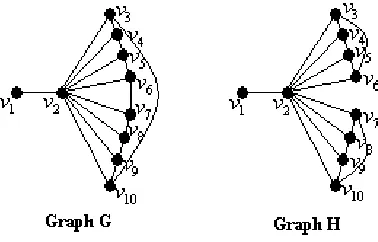
If we think of a graph as modeling a network, then the average lower 2-domination number can be more sensitive for the vulnerability of graphs than the other known vulnerability measures of a graph [25]. We consider two connected simple graphs G and H in Figure 1, where V G( ) = V H( ) =1 0 and
( ) ( ) 1 7
E G = E H = . Graphs G and H have not only equal the connectivity but also equal the domination number, the average lower domination number and the 2-domination number such as
( ) ( ) 1
k G =k H = , γ( )G = γ( ) 1H = , γav( )G = γav( )H =19 5 and γ2( )G = γ2( )H =5. The results can be checked by readers. So, how can we distinguish between the graphs G and H ?
Figure 1. Graphs G and H.
The wheel graph has been used in different areas such as the wireless sensor networks, the vulnerability of networks, and so on. The wheel graph has many good properties. From the standpoint of the hub vertex, all elements, including vertices and edges, are in its one-hop neighborhood, which indicates that the wheel structure is fully included in the neighborhood graph of the hub vertex. Furthermore, wheel graphs are important for localizability because they are globally rigid in 2D space, which indicates an approach to identifying localizable vertices [29]. Moreover, the wheels and various related graphs have been studied for many reasons. The gear graphs, the friendship graph, the helm graphs and the sun flower graphs are among such graphs. The definitions of these graphs will be given in Section 3. In [3], Aytac and Odabas compute the residual closeness for wheels and related graphs. In [18], Javaid and Shokat give upper bounds for the cardinality of vertices in some wheel related graphs with a given partition dimension k.
Our aim in this paper is to study a new vulnerability parameter, called the average lower 2-domination number. In Section 2, well-known basic results are given for the average lower 2-domination number, the average lower 2-domination number and the 2-domination number. In Section 3, we compute the average lower 2-domination numbers of wheels and some related graphs. Finally, an algorithm is proposed for computing the 2-domination number and the average lower 2-domination numbers of any given graph in Section 4.
2. Basic Results
In this section, well known basic results are given with regard to the average lower domination number, the average lower 2-domination number and the 2-domination number.
Theorem 2.1. [17] Let G be any graph of order n with the domination number γ( )G , then ( )
( ) ( ) 1
av
G
G G
n
γ
γ ≤ γ + −
with equality if and only if G has a unique γ( )G -set.
Theorem 2.2. [17] If K1,n−1 is a star graph of order n, where
n
≥
3
, then 1, 1 1( ) 2
av K n− n
γ = − .
Theorem 2.3. [17] If Pn is a pathgraph of order n, then
2 2
, 2(mod3);
3 3
( )
2
, .
3
av n n
if n n P
n
otherwise +
− ≡
γ =
+
Theorem 2.4. [17] If Cn is a cycle graph of order n, then γav(Cn)=2. Theorem 2.5. [17] If Kn is a complete graphof order n, then γav(Kn) 1= .
Observation 2.1. If Wn is a wheel graph of order n+1, then
2 1 ( )
1
av n
n W
n
+
γ =
Theorem 2.8. [19] If Kn is a complete graph of order n, then γ2(Kn) min{2, }= n . Theorem 2.9. [19] If Pn is a pathgraph of order n, then γ2(Pn)=n 2+1.
Theorem 2.10. [19] If Cn is a cycle graph of order n, where
n
≥
3
, then γ2(Cn)=(n+1) / 2.Theorem 2.11. [19] If Wn is a wheel graph of order n+1, where
n
≥
3
, then2
2 , 3, 4;
( )
( 1) 3 1 , .
n
if n W
n otherwise
=
γ = + +
Theorem 2.12. [25] Let G be any connected graph of order n. If γ2( )G -set is unique, then
2
2 2
( )
( ) ( ) 1
av
G
G G
n
γ
γ = γ + −
Theorem 2.13. [25] Let G be any connected graph of order n. If δ( ) 2G ≥ , then
2
2 2
( )
( ) ( ) 1
av
G
G G
n
γ
γ ≤ γ + −
Theorem 2.14. [25] Let G be any connected graph of order
n
≥
2
. Then, 21
2 av( )G n 1
n
≤ γ ≤ − + .
Theorem 2.15. [25] If Pn is a pathgraph of order n, then
2
2 1
2 2 , ;
( )
2 1 , .
av n
n
n If n is odd
P n
n If n is even
+
+ −
γ =
+
Theorem 2.16. [25] If Cn is a cycle graph of order n, then γ2av(Cn)=(n+1) 2.
Theorem 2.17. [25] If Kn is a complete graph of order n, then γav(Kn)=2.
Theorem 2.18. [25] If K1,n−1 is a star graph of order n, where
n
≥
3
, then 2 1, 11
( ) 1
av K n− n n
γ = − + .
3. The Average Lower 2-Domination Number of Wheels Related Graphs
In this section, we have calculated the average lower 2-domination number of wheels and related graphs such as the wheel graph Wn, the gear graph Gn, the friendship graph fn, the helm graph
n
H and the sun flower graph Sfn. Now, we recall the definitions of these graphs.
Definition 3.1. [3] The wheel graph Wn with n spokes is a graph that contains an n-cycle and one additional central vertex vc that is adjacent to all vertices of the cycle. Wheel graph Wn has (n+1) -vertices and
2
n
-edges.Definition 3.2. [4] The gear graph Gn is a wheel graph with a vertex added between each pair adjacent graph vertices of the outer cycle. The gear graph Gn has (2n+1)-vertices and
3
n
-edges.Definition 3.3. [3] The friendship graph fn is collection of n triangles with a common vertex. The
friendship graph fn has (2n+1)-vertices and
3
n
-edges.Definition 3.4. [18] The helm graph Hn is the graph obtained from an n-wheel graph by adjoining a
Definition 3.5. [18] The sun flower graph Sfn the graph obtained from an n-wheel graph with central vertex vc and n-cycle v v v0, , ,...,1 2 vn−1 and additional n vertices w w w0, 1, 2,...,wn−1 where wi is joined by edges to v vi, i+1 for i∈{0,1,...,n−1} where (i+1) is taken modulo n. The sun flower graph Sfn has (2n+1)-vertices and
4
n
-edges.We display the graphs W G f H4, 4, 4, 4 and Sf4 in Figure 2.
Figure 2. Graphs W G f H4, 4, ,4 4 andSf4.
Theorem 3.1. If Wn is a wheel graph of order
n
+
1
, wheren
≥
5
, then γ2av(Wn)= +1 n 3.Proof of Theorem 3.1. The γ2(Wn)- set of a graph Wn,
n
≥
5
, is a set with the vertex vc and n 3 vertices from the set V W( n) \ { }vc . So, γ2(Wn)= +1 n 3 . Thus, γ2(Wn)= +1 n 3 is obtained forevery vertex v V W∈ ( n). As a result, we get γ2av(Wn)= +1 n 3.
Remark 3.1. Let W3 and W4 be wheels graph with order 3 and 4, respectively. Then, γ2av(W3) 2= and 2av(W4) 11 5
γ = .
Remark 3.2. If W2n is a wheel graph of order
2
n
+
1
, then γ2a v(W2n)= +1 2n 3.Theorem 3.2. If Gn is a gear graph of order
2
n
+
1
, then2 2
2 2 1
( )
2 1
av n
n n
G
n
+ +
γ =
+ .
Proof of Theorem 3.2. We partition the vertices of graph Gn into three subsets V1, V2 and V3 as follows:
1 { c ( n) | Gn( )c }
V = v ∈V G d v =n
2 { i ( n) | Gn( )i 3, {1, 2, ..., }}
V = v ∈V G d v = i∈ n
3 { i ( n) | Gn( )i 2, { 1, 2, ..., 2 }}
V = v ∈V G d v = i∈ n+ n+ n
When the γ2av(Gn) is calculated for all vertices v in the graph Gn, each vertex satisfies one of the three cases below.
Case1. Let vc be the vertex of V1 . The center vertex vc is adjacent to n vertices in V2. Thus, all vertices of V2 are 1-dominated. By the definition of gear graphs, the whole vertex set V2 (or V3) is taken toγ2( )Gn -set, then γ2vc(Gn)= +n 1 is obtained.
Case2. Let vi be the vertex of V2 . Clearly every vertex of the graph Gn is 2-dominated by the vertices of V2. As a result, we have γ2vi(Gn)=n, where i∈{1, 2,..., }n .
Case3. Let vi be the vertex of V3. The γ2( )Gn -set including vertex vi is similar to γ2( )Gn -set in the Case 1. So, we have γ2vi(Gn)= +n 1, where i∈ +{n 1,n+2,..., 2 }n .
By the Cases 1, 2 and 3, we have:
1 2 3
2 2 2 2
1
( ) ( ) ( ) ( )
( )
av n v n v n v n
v V v V v V
n
G G G G
V G ∈ ∈ ∈
2 3
1 1 ( 1)
2 1 v V v V
n n
n n n
n ∈ ∈
= + + + +
+ (4)
2
2 2 1
2 1
n n
n + + =
+ (5)
Theorem 3.3. If fn is a friendship graph of order
2
n
+
1
, then γ2av( )fn = +n 1.Proof of Theorem 3.3. By the definition of the friendship graph and 2-domination number, a γ2( )fn -set must include the vertex vc whose degree is 2n. Thus, 2n-vertices are 1-dominated by the vertex
c
v . Furthermore, n-disjoint graphs K2 are formed by these 2n-vertices in the graph fn\ { }vc . When any vertex of each graph K2 is taken to a γ2( )fn -set, γ2( )fn = +n 1 is obtained. It is easy to see that
2v( )fn n 1
γ = + for every vertex v V f∈ ( )n . Thus, we get γ2av( )fn = +n 1.
Theorem 3.4. If Hn is a helm graph of order
2
n
+
1
, then2 2
2 4 1
( ) 2 1 av n n n H n + + γ = + .
Proof of Theorem 3.4. Since the γ2(Hn) -set is unique in the graph Hn , we have
( )
2av(Hn) n 2 (n 1) (2n 1)
γ = + − + + by the Theorem 2.12. As a result,
2 2
2 4 1
( ) 2 1 av n n n H n + + γ =
+ is
obtained.
Theorem 3.5. If Sfn is a sun flower graph of order
2
n
+
1
, then2 2
2 2 1
( ) 2 1 av n n n Sf n + + γ = + .
Proof of Theorem 3.5. The proof follows directly from the Theorem 3.2.
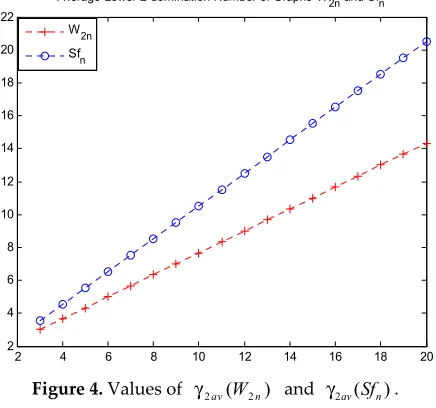
It is point out that the gear graph Gn is tougher than the friendship graph fn and the helm graph Hn , where V G( n) = V f( n) = V H( n) and E G( n) = E f( n) = E H( n) . Similarly, the wheel
graph W2n is tougher than the sun flower graph Sfn , where V W( 2n) = V S f( n) and
2
( n) ( n)
E W = E S f . Readers can see that these results are shown in Figures 3 and 4.
Figure 3. Values of γ2av(Gn), γ2av( )fn and γ2av(Hn).
2 4 6 8 10 12 14 16 18 20
2 4 6 8 10 12 14 16 18 20 22
Average Lower 2-domination Number of Graphs Gn, fn and Hn
Figure 4. Values of γ2av(W2n) and γ2av(Sfn).
4. An Algorithm for Computing the Average Lower 2-Domination Number
In this section, the algorithm in [22] which finds the domination number and all the minimal dominating sets of a graph is improved. The improved algorithm also computes the 2-domination number and the average lower 2-domination number of a graph. The definitions used in the algorithm below are found in [22].
2
, , , , , , min :
i j n γ es top positive integer :
f element of L n( ) , :
D W array n+ of L n( )
2a v
γ : real number
BEGIN
for j←1 to n do begin
D j[ ]← 0;
if dG[v ] 0j = then D j[ ]← D j[ ]+vj end if;
if dG[v ] 1j = then D j[ ]← D j[ ]+vj
ELSE
D j[ ]← D j[ ]+vj
for
i
←
1
ton
−
1
do beginfor k← +i 1 to n do begin
if
( )
j
=
^i
and(
j
=
^k)
and(
v Ev
j i)
and(
v E vk j)
then D j[ ]← D j[ ]+v vi k end if;end; {for k} end; {for i} end if; end; {for j}
1 f ←
for j←1 to ndo begin
f ← f*D j[ ]; end;
{ }
2 minx f∈ x
γ ← ;
2 4 6 8 10 12 14 16 18 20
2 4 6 8 10 12 14 16 18 20 22
Average Lower 2-domination Number of Graphs W2n and Sfn
0
es
←
; for x∈ f do1
es
← +
es
;0
top← ;
for
i
←
1
to n do begin
S
←
0
;for j←1 to e s do begin
if vi∈f j[ ] then
S
← +
S
1
end if; if (S=1) then m in ← f j[ ] end if; if(
f j[ ]<min)
then m in← f j[ ] end if; end; {for j}top←top+min; end; {for i}
γ2av ←top n/ ; END.
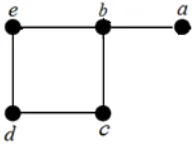
Example 4.1. Compute the 2-domination number and the average lower 2-domination number of graph G in Figure 5.
Figure 5. Graph G with 5-vertices and 5-edges. Firstly, we must find function f as follows:
( )( )( )( )( )
f = a b+ec c+bd d+ec e bd+
Then, two mathematical logic functions are used as follows:
( ) . ( )
i x x x
ii x xy x
=
+ =
Thus, we have
( )( )( )( )
f = ab+aec c+bd d+ec e+bd
( )( )( )
f = abc+abd+a ec d +ec e+bd
( )( )
f = abd +aec e+bd
( ).
f = abd+aec
Furthermore, we have f = abd+aec .
Clearly, the 2-domination sets {a b d, , } and {a e c, , } have been found by the algorithm. Thus, we
get γ2( )G = γ2av( ) 3G = .
5. Conclusions
paper we have studied the average lower 2-domination number for graph vulnerability. The average lower 2-domination number can be more sensitive than the other measures of vulnerability like connectivity, domination number, average lower domination number and 2-domination number. We have also studied wheel graphs and wheels related graphs. Finally, an algorithm is proposed for computing the 2-domination number and the average lower 2-domination numbers of any given graph G.
Acknowledgments: The author is grateful to the editors and the anonymous referees for their constructive comments and valuable suggestions which have helped me very much to improve the paper.
Conflicts of Interest: The author declares no conflicts of interest. References
1. Aslan, E. The Average Lower Connectivity of Graphs. J. Appl. Math.2014, 2014, doi:10.1155/2014/807834. 2. Aslan, E.; Kırlangıç, A. The Average Lower Domination Number of Graphs. Bull. Int. Math. Virtual Inst.
2013, 3, 155–160.
3. Aytaç, A.; Odabaş, Z.N. Residual Closeness of Wheels and Related Networks. Int. J. Found. Comput. Sci.
2011, 22, 1229–1240.
4. Aytaç, A.; Turacı, T. Vertex Vulnerability Parameter of Gear Graphs. Int. J. Found. Comput. Sci.2011, 22, 1187–1195.
5. Aytaç, A.; Turacı, T.; Odabaş, Z.N. On the Bondage Number of Middle Graphs. Math. Notes2013, 93, 803– 811.
6. Aytaç, A.; Odabas, Z.N.; Turacı, T. The Bondage Number for Some Graphs. C. R. Lacad. Bulg. Sci.2011, 64, 925–930.
7. Aytaç, V. Average Lower Domination Number in Graphs. C. R. Lacad. Bulg. Sci.2012, 65, 1665–1674. 8. Barefoot, C.A.; Entringer, R.; Swart, H. Vulnerability in graphs-a comparative survey. J. Combin. Math.
Combin. Comput.1987, 1, 13–22.
9. Bauer, D.; Harary, F.; Nieminen, J.; Suffel, C.L. Domination alteration sets in graph. Discrete Math.1983, 47, 153–161.
10. Beineke, L.W.; Oellermann, O.R.; Pippert, R.E. The Average Connectivity of a Graph. Discrete Math.2002, 252, 31–45.
11. Blidia, M.; Chellali, M.; Maffray, F. On Average Lower Independence and Domination Number in Graphs. Discrete Math.2005, 295, 1–11.
12. Chellali, M. Bounds on the 2-Domination Number in Cactus Graps. Opusc. Math.2006, 26, 5–12. 13. Chvatal, V. Tough graphs and Hamiltonian circuits. Discrete Math.1973, 5, 215–228.
14. Fink, J.F.; Jacobson, M.S. n-Domination in Graphs. In Graph Theory with Applications to Algorithms and Computer Science; Alavi, Y., Schwenk, A.J., Eds.; Wiley: New York, NY, USA, 1985; pp. 283–300.
15. Frank, H.; Frisch, I.T. Analysis and design of survivable Networks. IEEE Trans. Commun. Technol.1970, 18, 501–519.
16. Haynes, T.W.; Hedeniemi, S.T.; Slater, P.J. Advanced Topic. In Fundamentals of Domination in Graphs; Marcel Dekker, Inc.: New York, NY, USA, 1998.
17. Henning, M.A. Trees with Equal Average Domination and Independent Domination Numbers. Ars Comb.
2004, 71, 305–318.
18. Javaid, I.; Shokat, S. On the Partition Dimension of Some Wheel Related Graphs. J. Prime Res. Math.2008, 4, 154–164.
19. Krzywkowski, M. 2-Bondage in graphs. Int. J. Comput. Math.2013, 90, 1358–1365.
20. Mishkovski, I.; Biey, M.; Kocarev, L. Vulnerability of complex Networks. Commun. Nonlinear Sci. Numer Simulat.2011, 16, 341–349.
21. Newport, K.T.; Varshney, P.K. Design of survivable communication networks under performance constraints. IEEE Trans. Reliab.1991, 40, 433–440.
22. Prather, R.E. Discrete Mathematical Structures for Computer Science; Houghton Mifflin: Boston, MA, USA, 1976.
24. Turaci, T. On the Average Lower Bondage Number a Graph. RAIRO-Oper. Res. 2015, in press, doi:10.1051/ro/2015062.
25. Turaci, T. On the Average Lower 2-domination Number a Graph. 2015, to appear.
26. Turaci, T. The Concept of Vulnerability in graphs and Average Lower 2-domination Number. In Proceedings of the 28th National Mathematics Conference, Antalya, Turkey, 7–9 September 2015.
27. Turaci, T.; Okten, M. Vulnerability of Mycielski Graphs via Residual Closeness. Ars Comb.2015, 118, 419– 427.
28. Turaci, T.; Okten, M. The edge eccentric connectivity index of hexagonal cactus chains. J. Comput. Theor. Nanosci.2015, 12, 3977–3980.
29. Yang, Z.; Liu, Y.; Li, X.Y. Beyond trilateration: On the localizability of wireless ad-hoc networks. In Proceedings of the IEEE INFOCOM 2009, Rio de Janeiro, Brazil, 19–25 April 2009.