Western University Western University
Scholarship@Western
Scholarship@Western
Electronic Thesis and Dissertation Repository
9-15-2010 12:00 AM
Spatial and Temporal Risk Assessment for Water Resources
Spatial and Temporal Risk Assessment for Water Resources
Decision Making
Decision Making
Shohan S. Ahmad
University of Western Ontario Supervisor
Slobodan P. Simonovic
The University of Western Ontario
Graduate Program in Civil and Environmental Engineering
A thesis submitted in partial fulfillment of the requirements for the degree in Doctor of Philosophy
© Shohan S. Ahmad 2010
Follow this and additional works at: https://ir.lib.uwo.ca/etd
Recommended Citation Recommended Citation
Ahmad, Shohan S., "Spatial and Temporal Risk Assessment for Water Resources Decision Making" (2010). Electronic Thesis and Dissertation Repository. 20.
https://ir.lib.uwo.ca/etd/20
This Dissertation/Thesis is brought to you for free and open access by Scholarship@Western. It has been accepted for inclusion in Electronic Thesis and Dissertation Repository by an authorized administrator of
SPATIAL AND TEMPORAL RISK ASSESSMENT FOR
WATER RESOURCES DECISION MAKING
(Spine title: Spatial & Temporal Water Resources Risk Assessment)
(Thesis format: Monograph)
By
Shohan S. Ahmad
Graduate Program in Engineering Sciences Department of Civil and Environmental Engineering
A thesis submitted in partial fulfillment of the requirements for the degree of
Doctor of Philosophy
The School of Graduate and Postdoctoral Studies The University of Western Ontario
London, Ontario, Canada
THE UNIVERSITY OF WESTERN ONTARIO
FACULTY OF GRADUATE STUDIES
CERTIFICATE OF EXAMINATION
Supervisor Examining Board
Dr. Slobodan P. Simonovic Dr. Raouf E. Baddour
Dr. Craig Miller
Dr. Micha Pazner
Dr. Niru Nirupama
The Thesis by
Shohan S. Ahmad
entitled:
SPATIAL AND TEMPORAL RISK ASSESSMENT
FOR WATER RESOURCES DECISION MAKING
is accepted in partial fulfillment of the
Requirements for the degree of
Doctor of Philosophy
Date : 15th September 2010 Lisa Hodgetts
ABSTRACT
Water resources systems are vulnerable to natural disasters such as floods, wind storms,
earthquakes, and various meteorological events. Flooding is the most frequent natural
hazard that can cause damage to human life and property. A new methodology presented
in this thesis is capable of flood risk management by: (a) addressing various uncertainties
caused by variability and ambiguity; (b) integrating objective and subjective flood risk;
and (c) assisting the flood risk management based on better understanding of spatial and
temporal variability of risk. The new methodology is based on the use of fuzzy reliability
theory. A new definition of risk is used and described using three performance indices (i)
a combined fuzzy reliability-vulnerability, (ii) fuzzy robustness and (iii) fuzzy resiliency.
The traditional flood risk management relies on either temporal or spatial variability, but
not both. However, there is a need to understand the dynamic characteristics of flood risk
and its spatial variability. The two-dimensional (2-D) fuzzy set that relates the universe of
discourse and its membership degree, is not sufficient to address both, spatial and
temporal, variations of flood risk. The theoretical contribution of this study is based on
the development of a three dimensional (3-D) fuzzy set.
The spatial and temporal variability of fuzzy performance indices – (i) combined
reliability-vulnerability, (ii) robustness, and (iii) resiliency – have been implemented to
(i) river flood risk analysis and (ii) urban flood risk analysis. The river flood risk analysis
is illustrated using the Red River flood of 1997 (Manitoba, Canada) as a case study. The
urban flood risk analysis is illustrated using the residential community of Cedar Hollow
The final results of the fuzzy flood reliability analysis are presented using maps that show
the spatial and temporal variation of reliability-vulnerability, robustness and resiliency
indices. Maps of fuzzy reliability indices provide additional decision support for (a) land
use planning, (b) selection of appropriate flood mitigation strategies, (c) planning
emergency management measures, (d) selecting an appropriate construction technology
for flood prone areas, and (e) flood insurance.
Key Words: Water resources, flood risk analysis, flood management, uncertainty
analysis, fuzzy sets, spatial and temporal fuzzy performance indices, floodplain mapping,
DEDICATION
I dedicate this thesis to my wonderful wife, Twiggy and my baby girl, Ereen who make
ACKNOWLEDGEMENTS
I wish to express my deepest appreciation to Professor Slobodan P. Simonovic, the
person that made all this research possible. He has provided an exceptional level of
guidance and supervision throughout the years, and for that I am most grateful. His
invaluable guidance and inspiration helped me grow confidence and develop both
academically and personally. Thank you very much Professor.
I would like to thank the Department of Civil and Environmental Engineering at the
University of Western Ontario, including faculty, staff, friends in the FIDS office, and
fellow graduate students. Away from school my wife, Twiggy reminded me that there is
life outside school, and kept me healthy and happy. Without her encouragement and
support, this achievement could not have been possible. I would like to thank my parents,
Dr. Sohrabuddin Ahmad and Mrs. Chaman Ara Ahmad; and Twiggy’s parents, Dr. Md.
Nurul Islam and Mrs. Saki Nazrin, who have always been a great encouragement for this
great achievement. Special thanks to Taufiq and Tansu.
Finally, I am grateful to the Natural Sciences and Engineering Research Council
(NSERC) of Canada for their very generous scholarships, which funded me throughout
my time in Civil and Environmental Engineering at the University of Western Ontario.
TABLE OF CONTENTS
CERTIFICATE OF EXAMINATION... I
ABSTRACT ... II
DEDICATION ...IV
ACKNOWLEDGEMENTS ... V
TABLE OF CONTENTS...VI
LIST OF FIGURES ... X
LIST OF TABLES ... XII
1 INTRODUCTION... 1
1.1 WATER RESOURCES MANAGEMENT UNDER UNCERTAINTY... 1
1.2 OBJECTIVE AND SUBJECTIVE UNCERTAINTY ... 6
1.3 SPATIAL AND TEMPORAL CHARACTERISTICS OF FLOOD RISK... 7
1.4 OBJECTIVES OF THE RESEARCH... 8
1.5 RESEARCH CONTRIBUTIONS ... 9
1.6 ORGANIZATION OF THE THESIS ... 9
2 LITERATURE REVIEW ... 12
2.1 WATER RESOURCES MANAGEMENT UNDER UNCERTAINTY... 13
2.2 TYPES OF UNCERTAINTY... 14
2.3 MODELING DYNAMIC PROCESS OF RIVER AND URBAN FLOODING... 16
2.3.1 HYDRODYNAMIC MODELING ... 17
2.3.2 SYSTEM DYNAMICS (SD) MODELING ... 21
2.4 DEFINITION OF RISK ... 25
2.5 RISK IDENTIFICATION... 26
2.6 PERFORMANCE INDICES... 27
2.7 RELIABILITY ANALYSIS IN ENGINEERING SYSTEMS... 27
2.7.1 PROBABILISTIC APPROACH IN WATER RESOURCES MANAGEMENT... 28
2.8 RELIABILITY ANALYSIS OF WATER RESOURCES SYSTEMS USING FUZZY
PERFORMANCE INDICES ... 36
2.8.1 DEFINITION OF FAILURE... 37
2.8.2 DEFINITION OF FUZZY SYSTEM STATE ... 41
2.8.3 DEFINITION OF COMPATIBILITY ... 43
2.8.4 COMBINED RELIABILITY-VULNERABILITY INDEX ... 44
2.8.5 ROBUSTNESS INDEX ... 46
2.8.6 RESILIENCY INDEX ... 46
3 METHODOLOGY FOR RIVER AND URBAN FLOOD RISK ANALYSIS ... 49
3.1 RIVER FLOOD RISK ANALYSIS ... 50
3.1.1 MODELING DYNAMIC PROCESSES OF RIVER FLOODING... 51
Hydrodynamic Modeling Approach... 51
System Dynamics Modeling Approach... 55
3.1.2 RIVER FLOOD DAMAGE ANALYSIS... 59
Agricultural Damage... 59
Residential Damage... 61
3.1.3 SPATIAL AND TEMPORAL VARIABILITY OF RIVER FLOOD RISK... 63
3.1.4 A NEW METHODOLOGY FOR FUZZY RIVER FLOOD RISK ANALYSIS... 65
Definition of Partial Failure... 66
Spatial and Temporal Variability of Fuzzy Flood Damage... 70
Total Flood Damage... 79
Fuzzy Flood Compatibility... 80
Fuzzy Combined Reliability-Vulnerability Index... 85
Fuzzy Flood Recovery Time... 92
Fuzzy Resiliency Index... 93
3.2 URBAN FLOOD RISK ANALYSIS... 96
3.2.1 MODELING DYNAMIC PROCESSES OF URBAN FLOODING – HYDRODYNAMIC MODELING APPROACH ... 96
3.2.2 URBAN FLOOD DAMAGE ANALYSIS ... 100
3.2.3 SPATIAL AND TEMPORAL VARIABILITY OF URBAN FLOOD RISK... 105
3.2.4 A NEW METHODOLOGY FOR FUZZY URBAN FLOOD RISK ANALYSIS ... 106
Definition of Partial Failure... 106
Total Urban Flood Damage... 116
Fuzzy Flood Compatibility... 117
Fuzzy Combined Reliability-Vulnerability Index... 118
Fuzzy Robustness Index... 119
Fuzzy Resiliency Index... 121
4 CASE STUDY ... 124
4.1 RIVER FLOOD RISK ANALYSIS: THE RED RIVER BASIN CASE STUDY ... 124
4.1.1 2D HYDRODYNAMIC MODELING OF THE RED RIVER CASE STUDY... 130
4.1.2 SPATIAL AND TEMPORAL RISK ANALYSIS OF THE RED RIVER FLOOD OF 1997 134 4.1.3 RESULTS AND DISCUSSIONS... 136
Spatial and Temporal Variation of Water Surface Elevation... 136
Verification of Result Obtained from MIKE 21 Model Simulation... 138
Spatial and Temporal Variability of Flood Damage... 141
Combined Fuzzy Flood Reliability-Vulnerability Index... 144
Sensitivity Analysis of Combined Fuzzy Reliability-Vulnerability Index... 146
Fuzzy Robustness Index... 150
Fuzzy Resiliency Index... 152
4.1.4 SYSTEM DYNAMICS MODELING OF THE RED RIVER CASE STUDY ... 156
4.1.5 SPATIAL AND TEMPORAL FUZZY RISK ANALYSIS OF THE RED RIVER FLOOD OF 1997... 163
4.1.6 RESULTS AND DISCUSSIONS... 164
Spatial and Temporal Variation of Flood Damage... 164
Combined Fuzzy Flood Reliability-Vulnerability Index... 166
Fuzzy Robustness Index... 168
Fuzzy Resiliency Index... 170
4.2 URBAN FLOOD RISK ANALYSIS: CEDAR HOLLOW CASE STUDY... 172
4.2.1 COUPLED 1D HYDRAULIC AND 2D HYDRODYNAMIC MODELING... 173
4.2.2 URBAN FLOOD DAMAGE ANALYSIS ... 175
4.2.3 SPATIAL AND TEMPORAL URBAN FLOOD RISK ANALYSIS ... 178
4.2.4 RESULTS AND DISCUSSION: ... 179
Spatial and Temporal Variability of Water Surface Elevations... 179
Combined Fuzzy Flood Reliability-Vulnerability Index... 185
Fuzzy Robustness Index... 187
Fuzzy Resiliency Index... 189
5 SUMMARY AND CONCLUSIONS... 190
5.1 FLOOD RELIABILITY ANALYSIS ... 191
5.1.1 RIVER FLOOD RISK ANALYSIS ... 194
2D Hydrodynamic Modeling... 194
System Dynamics Modeling... 197
5.1.2 URBAN FLOOD RISK ANALYSIS... 200
5.2 THE USE OF SPATIAL AND TEMPORAL FUZZY RELIABILITY ANALYSIS IN PRACTICE ... 202
5.3 RECOMMENDATIONS FOR FUTURE WORK ... 205
5.3.1 INTELLIGENT DECISION SUPPORT SYSTEM ... 205
5.3.2 APPROPRIATE SHAPE OF FUZZY MEMBERSHIP FUNCTION... 205
5.3.3 MULTI-OBJECTIVE DECISION SUPPORT SYSTEM ... 206
REFERENCES ... 207
APPENDIX: A (COMPUTATIONAL TOOLS FOR THE IMPLEMENTATION OF RIVER FLOOD RISK ASSESSMENT METHODOLOGY)... 220
APPENDIX: B (COMPUTATIONAL TOOLS FOR THE IMPLEMENTATION OF URBAN FLOOD RISK ASSESSMENT METHODOLOGY)... 239
LIST OF FIGURES
FIGURE 1.1: GREAT NATURAL DISASTERS 1950-2009, NUMBER OF EVENTS (AFTER
MUNICH RE, NATCATSERVICE, 2010) ... 2
FIGURE 1.2: GREAT NATURAL DISASTERS 1950-2009, OVERALL AND INSURED LOSSES (AFTER MUNICH RE, NATCATSERVICE, 2010) ... 2
FIGURE 1.3: GREAT NATURAL DISASTERS 1950-2009, PERCENTAGE DISTRIBUTION (AFTER MUNICH RE, NATCATSERVICE, 2010) ... 3
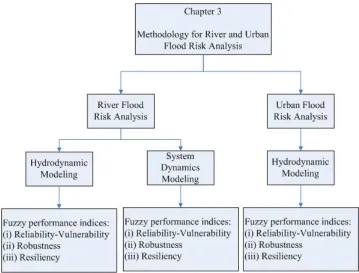
FIGURE 1.4: SCHEMATIC OF CHAPTER 3... 10
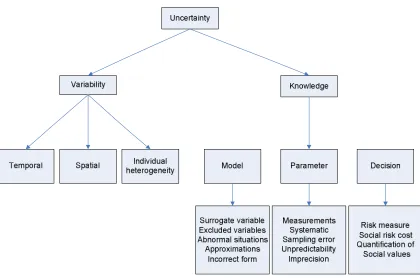
FIGURE 2.1: MAJOR SOUCES OF UNCERTAINTY (AFTER SIMONOVIC, 1997) ... 15
FIGURE 2.2: DEFINITION OF PROBABILISTIC RISK (AFTER GANOULIS 1994) ... 29
FIGURE 2.3: DIFFERENT PERCEPTION OF FAILURE (AFTER EL-BAROUDY AND SIMONOVIC, 2004) ... 38
FIGURE 2.4: FUZZY REPRESENTATION OF ACCEPTABLE FAILURE REGION (AFTER EL-BAROUDY AND SIMONOVIC, 2004) ... 39
FIGURE 2.5: TRIANGULAR SYSTEM-STATE MEMBERSHIP FUNCTION ... 42
FIGURE 2.6: TWO COMPLIANCE CASES (EL-BAROUDY AND SIMONOVIC, 2004) ... 43
FIGURE 2.7: COMPATIBILITY WITH DIFFERENT LEVELS OF PERFORMANCE MEMBERSHIP FUNCTIONS (EL-BAROUDY AND SIMONOVIC, 2004)... 45
FIGURE 2.8: FUZZY REPRESENTATION OF MAXIMUM RECOVERY TIME ... 47
FIGURE 3.1: SCHEMATIC OF (I) RIVER, AND (II) URBAN FLOOD RISK ANALYSIS... 50
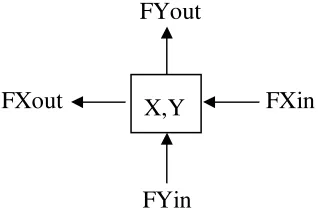
FIGURE 3.2: SINGLE CELL WITH INFLOW AND OUTFLOW. ... 58
FIGURE 3.3: GRAPHICAL RELATIONSHIP OF PERCENTAGE OF AVERAGE YIELD AND SEEDING DATE... 60
FIGURE 3.4: DEPTH-DAMAGE RELATIONSHIP FOR A RING DIKED COMMUNITIES... 63
FIGURE 3.5: 2-D FUZZY REPRESENTATION OF SPATIAL VARIABILITY IN ACCEPTANCE LEVEL OF PARTIAL FLOOD DAMAGE (AHMAD AND SIMONOVIC, 2007) ... 68
FIGURE 3.6: 3-D FUZZY REPRESENTATION OF SPATIAL AND TEMPORAL VARIABILITY IN ACCEPTANCE LEVEL OF PARTIAL FLOOD DAMAGE ... 68
FIGURE 3.7: 2-D FUZZY SET FOR TEMPORAL VARIABILITY OF FLOOD DAMAGE... 72
FIGURE 3.8: 2-D FUZZY SET FOR SPATIAL VARIABILITY OF FLOOD DAMAGE... 74
FIGURE 3.9: 3-D JOINT FUZZY SET OF FLOOD DAMAGE ... 75
FIGURE 3.10: CENTER OF GRAVITY OF THE 2-D FUZZY SET FOR TEMPORAL VARIABILITY... 77
FIGURE 3.11: 2-D FUZZY SET FOR SPATIAL VARIABILITY OF FLOOD DAMAGE AT G i D ... 78
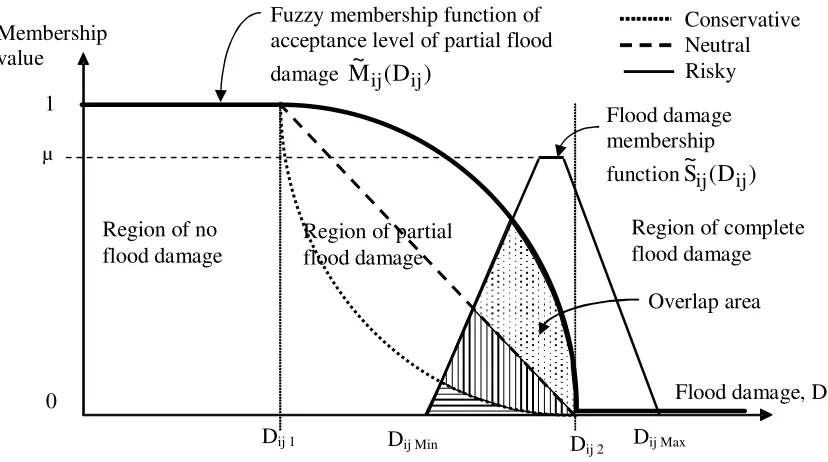
FIGURE 3.13: OVERLAP AREA BETWEEN FLOOD DAMAGE MEMBERSHIP FUNCTION AND
ACCEPTANCE LEVEL OF PARTIAL FLOOD DAMAGE MEMBERSHIP FUNCTION... 81
FIGURE 3.14: WEIGHTED AREA CALCULATION FOR THE FLOOD DAMAGE MEMBERSHIP FUNCTION ... 83
FIGURE 3.15: FLOW CHART OF FUZZY COMBINED RELIABILITY-VULNERABILITY INDEX 88 FIGURE 3.16: FLOW CHART OF FUZZY ROBUSTNESS INDEX ... 90
FIGURE 3.17: FUZZY MEMBERSHIP FUNCTION OF RECOVERY TIME ... 94
FIGURE 3.18: LAYOUT OF PIPE AND STREET SYSTEM (AFTER MARK ET AL., 2004)... 98
FIGURE 3.19: FLOW FROM THE STREET SYSTEM INTO A PARTLY FULL PIPE (AFTER MARK ET AL.,2004)... 98
FIGURE 3.20: FLOW TO THE STREETS FROM A PIPE SYSTEM WITH INSUFFICIENT CAPACITY (AFTER MARK ET AL., 2004) ... 99
FIGURE 4.1: CANADIAN PORTION OF THE RED RIVER BASIN (AFTER WINNIPEG FREE PRESS)... 125
FIGURE 4.2: SCHEMATIC DIAGRAM OF THE FLOOD CONTROL STRUCTURES... 129
FIGURE 4.3: SCHEMATIC DIAGRAM OF THE INFRASTRUCTURE IN THE STUDY AREA... 130
FIGURE 4.4: TOPOGRAPHIC DATA OF THE RED RIVER CASE STUDY ... 132
FIGURE 4.5: SCHEMATIC DIAGRAM OF 2-D MODELING APPROACH... 133
FIGURE 4.6: GUI WITH PREDEFINED PARTIAL LEVEL OF FLOOD DAMAGE FOR RED RIVER FLOOD 1997 ... 135
FIGURE 4.7: WATER SURFACE ELEVATION (M) IN RED RIVER FLOOD IN 1997... 137
FIGURE 4.8: SATELLITE IMAGE (LEFT) AND SIMULATED FLOODED AREA (RIGHT) ON MAY 1, 1997... 138
FIGURE 4.9: COMPARISON OF OBSERVED AND SIMULATED WATER ELEVATIONS (IN METER) AT RED RIVER NEAR ST ADOLPHE ... 139
FIGURE 4.10: COMPARISON OF OBSERVED AND SIMULATED WATER LEVELS AT FLOODWAY INLET... 139
FIGURE 4.11: SPATIAL AND TEMPORAL VARIATION OF FLOOD DAMAGE ($ PER 625 SQ. METER) ... 142
FIGURE 4.12: FUZZY COMBINED RELIABILITY-VULNERABILITY INDEX ... 145
FIGURE 4.13: SENSITIVITY ANALYSIS ON COMBINED RELIABILITY-VULNERABILITY INDEX TO THE SHAPE ... 149
FIGURE 4.14: FUZZY ROBUSTNESS INDEX ... 151
FIGURE 4.15: FUZZY RESILIENCY INDEX... 155
FIGURE 4.16: TOPOGRAPHIC DATA OF THE RED RIVER CASE STUDY ... 156
FIGURE 4.17: STUDY AREA DIVIDED INTO CELLS. ... 159
FIGURE 4.19: CONTROL SCREEN OF THE RED RIVER SECTION SIMULATION MODEL. ... 163
FIGURE 4.20: GUI WITH PREDEFINED PARTIAL LEVEL OF FLOOD DAMAGE ... 164
FIGURE 4.21: SPATIAL AND TEMPORAL VARIATION OF FLOOD DAMAGE ($ PER 4 SQ. KM) ... 165
FIGURE 4.22: FUZZY COMBINED RELIABILITY-VULNERABILITY INDEX ... 167
FIGURE 4.23: FUZZY ROBUSTNESS INDEX ... 169
FIGURE 4.24: FUZZY RESILIENCY INDEX... 171
FIGURE 4.25: LOCATION OF CEDAR HOLLOW, LONDON, ON... 172
FIGURE 4.26: 500 YEAR 6-HOUR DESIGN RAINFALL ... 175
FIGURE 4.27: FIA BASED STRUCTURE DEPTH-DAMAGE CURVE, TWO OR MORE STORIES WITH BASEMENT (SCAWTHORN, 2006)... 176
FIGURE 4.28: ROAD BLOCKAGE VS. PERCENT DAMAGE RELATIONSHIP ... 177
FIGURE 4.29: GUI WITH PREDEFINED PARTIAL LEVEL OF FLOOD DAMAGE FOR CEDAR HOLLOW... 178
FIGURE 4.30: SPATIAL AND TEMPORAL VARIATION OF WATER SURFACE ELEVATION (METER)... 180
FIGURE 4.31: SPATIAL AND TEMPORAL VARIATION OF DIRECT DAMAGE ... 182
FIGURE 4.32: SPATIAL AND TEMPORAL VARIATION OF INDIRECT DAMAGE ... 183
FIGURE 4.33: SPATIAL AND TEMPORAL VARIATION OF TOTAL FLOOD DAMAGE ... 184
FIGURE 4.34: FUZZY COMBINED RELIABILITY-VULNERABILITY INDEX ... 186
FIGURE 4.35: FUZZY ROBUSTNESS INDEX ... 188
LIST OF TABLES
TABLE 4.1: COMPARISON OF RECORDED AND MODELED PEAK WATER LEVELS (FT) FOR 1997... 140TABLE 4.2: AREA IN SQUARE KM CORRESPONDING TO VALUES OF COMBINED RELIABILITY-VULNERABILITY INDEX ... 148
1
INTRODUCTION
1.1 WATER RESOURCES MANAGEMENT UNDER UNCERTAINTY
Uncertainty can have important implications on water resources management. All water
management decisions should take uncertainty into account. The diversity of sources of
uncertainty in water resources management pose a great challenge to ensure a satisfactory
and reliable system performance. Sometimes the implications of uncertainty are the risks
associated with the potential and significant effects of poor water resources system
performance. Adopting high safety factors by considering all unknown sources of risk
(standard-based engineering practice) is one of the ways to avoid uncertainty. However, a
high safety factor without quantifying different sources of uncertainty would make the
solution infeasible. Therefore it is necessary to quantify known sources of uncertainty.
Managers need to understand the nature of the underlying threats in order to identify,
assess and manage the risks associated with uncertainty. The inability to do so is likely to
result in adverse impacts on systems performance, and in extreme cases such as natural
hazards, i.e. floods, cyclones, tsunamis etc, this can result in catastrophic performance
failures. Quantification of uncertainty in natural hazard risk management can reduce the
loss of lives and damage to properties. According to Simonovic (2011) the longer time
period records (traced back to 1900 while more reliable after 1950) show an increasing
trend in the number of disasters (Figure 1.1), their overall and insured losses (Figure 1.2),
Figure 1.1: Great natural disasters 1950-2009, number of events (after Munich Re,
NatCatService, 2010)
Figure 1.2: Great natural disasters 1950-2009, Overall and insured losses (after Munich
Figure 1.3: Great natural disasters 1950-2009, percentage distribution (after Munich Re,
NatCatService, 2010)
In 2000, Mozambique was affected by a devastating flood that made half a million people
homeless and caused 700 deaths (Wheater, 2005). The devastating flood of Central
Europe in 2002 required the widespread evacuation of many towns and cities, with
property damage estimated at 21.5 billion euros (Kron, 2005; Wheater, 2010). On July
26, 2005, the flooding that took place in Mumbai (Bombay) affected approximately 5
million people and led to 1000 deaths. 940 millimeters of rainfall was recorded in this
single event. Flooding in Central Europe in August 2005 caused fatalities in Germany,
Switzerland, Austria, Romania and Bulgaria (Wheater, 2010). Among recent incidents, a
flood of southern China in June 2010 affected more than 29 million people and inundated
1.6 million hectares of agricultural land. More than two million people were evacuated
and 195,000 houses collapsed, with direct economic losses amounting to approximately
Central Europe affected Austria, the Czech Republic, Germany, Hungary, Poland,
Slovakia, Serbia and Ukraine. Poland was the worst affected and the city of Kraków
declared a state of emergency. As a result of the devastating flood 37 people were killed
and approximately 23,000 people were evacuated. Poland estimated an economic loss of
2.5 billion euros (Euronews, 2010).
Urban flooding also poses a major threat to many cities around the world. Higher
frequency of urban flooding, which occurs mostly in developing countries, has made it
necessary for the development of a more efficient urban flood management plan. Heavy
rainfall, combined with an insufficient capacity of sewer systems, can cause urban
flooding. In February 2002, 50 people were killed and 200,000 people made homeless in
Indonesia as a result of heavy rainfall that led to urban flooding (Mark et al., 2004). In
2000, Mumbai experienced a major flooding event in which 15 lives were lost and that
caused immeasurable inconveniences for many people living in that region. In Dhaka
City (Bangladesh), due to an insufficient capacity of storm sewer systems, a small rainfall
event can cause serious problems. In September 1996, Dhaka City was paralyzed as a
result of urban flooding. In 1983, Bangkok (Thailand) remained flooded for almost 6
months and reported infrastructure damage was approximately $146 million (Mark et al.,
2004). On August 19, 2005, a two to three hour period of extremely heavy rainfall hit the
Greater Toronto Area and quickly caused an accumulation of storm water in the storm
sewer systems, which resulted in flooding across the city. This single rain event cost the
city an estimated $34 million. In addition, the Insurance Bureau of Canada estimated that
caused by this single storm event (River Sides, 2005). Toronto was not alone in
experiencing first hand the destructive potential of flooding. In February 2010, heavy rain
lashed the Portuguese resort island of Madeira, turning some streets in the capital,
Funchal, into raging rivers of mud, water and debris. The mudslides and flooding killed
at least 42 people and more than 120 other people were reported as injured (CBC news,
2010). In April, 2010, landslides and floods set off by the heavy rains killed at least 95
people in the city of Rio de Janeiro. In addition to obstructing roads and other
infrastructure, the devastation caused by this flood resulted in hundreds of people
becoming homeless, virtually paralyzing the economic activity of Brazil’s second largest
city (Reuters, 2010).
Ganoulis (1994) argues that engineering risk assessment and reliability analyses provide
a general methodology for the quantification of uncertainty and, as a result, should be
used to determine the safety of an engineering system. Risk assessment is an essential
component of sustainable flood management, and is becoming more important with the
increase in population density and the intensifying effects of climate change. There is a
scientific consensus that climate change is resulting in higher average temperatures,
rising sea levels, change in precipitation patterns and change in frequency and severity of
extreme hydrological conditions – floods and droughts. A larger population affects the
sustainability of land use, safe economic development in flood prone areas, and in
general leads to greater flood vulnerability.
floods: (a) structural measures; and (b) non-structural measures (Simonovic, 1999 among
others). The most common structural interventions used today are: (i) levees or flood
walls; (ii) diversion structures; (iii) channel modifications; and (iv) flood control
reservoirs. For management of urban floods, the structural measures now deal with
efficient storm sewer system and infiltration basin. Furthermore, the structural measures
are becoming more frequently combined with non-structural measures, such as flood
zoning, flood warning, waterproofing, and flood insurance. Levy and Hall (2005)
introduced the important concept of “living with flood”, which requires a high public
awareness of actual flood risks. The quantification of all uncertainties and the spatial and
temporal representation of flood risk contributes to a higher level of awareness and may
reduce the effects of flood damage to both people and material.
1.2 OBJECTIVE AND SUBJECTIVE UNCERTAINTY
There are many types of uncertainty in the flood management process, ranging from
hydrologic, hydraulic, geotechnical, and structural uncertainty, to economic,
environmental, ecological, social and political uncertainty. According to Slovic (2000)
and Simonovic (2002) a major part of the confusion implicit in flood risk analysis relates
to an inadequate distinction between three fundamental concepts of probability and risk:
(i) Objective risk (real, physical), Ro, and objective probability, po, which is the property
of real physical systems; (ii) Subjective risk, Rs, and subjective probability, ps; and (iii)
Perceived risk, Rp, which is related to an individual’s feeling of fear in the face of an
undesirable and possible event. Probability is here defined as the degree of belief in a
may be some function of Ro and po). Similarly, Rp is not a property of the physical
systems but is related to fear of the unknown. Moreover, Rp may be a function of Ro, po,
Rs, and ps . Because of the confusion between the concepts of objective and subjective
flood risk, many characteristics of subjective risk are also believed to be valid for
objective risk. Indeed, it is almost universally assumed that the imprecision of human
judgment is equally prominent and destructive for all water resources risk evaluations and
all risk assessments. The popular methods used by society to manage flood risk appear to
be dominated by considerations of perceived and subjective risks, while it is the objective
risks that kill people, damage the environment and create property loss (Simonovic and
Ahmad, 2007).
1.3 SPATIAL AND TEMPORAL CHARACTERISTICS OF FLOOD RISK
Flood risk assessments have three main characteristics: (i) spatial structure and
relationships among risk characteristics; (ii) interactions among the spatial risk
characteristics; and (iii) changes or alterations in temporal risk characteristics. Any effort
to understand and describe the dynamics of flood risk assessment requires the ability to
deal with these interrelated aspects. Traditional modeling approaches focus on either
temporal or spatial variation, but not both. There is an important feedback between time
and location in space, i.e., temporal variability of risk is affected by the change of spatial
characteristics of risk. To understand risk dynamics, patterns in time and location in
space need to be examined together. Therefore, to better understand dynamic
characteristics of flood risk, a new modeling framework is required that not only captures
tools required for solving complex flood risk management problems. Modeling
environments that can link social, economic, and environmental consequences of flood
risks are fundamental to an understanding of the impacts of proposed management
decisions. An integrated modeling framework can enhance our ability to understand
complex flood management processes, and can also assist in generating adequate
information/scenarios in order to help decision-making.
1.4 OBJECTIVES OF THE RESEARCH
The main objectives of the research presented here are (a) to provide the methodology for
flood risk assessment while taking into consideration the spatial and temporal variability
of various objective and subjective uncertainties in flood management, and (b) to provide
a methodology possessing the capability to spatially and temporally represent integrated
flood risk. The presented research develops three fuzzy performance indices: (1)
combined reliability-vulnerability index, (2) robustness index, and (3) resiliency index,
for spatial and temporal reliability analysis of riverine and urban floods. This new
methodology is not limited by the shape of the membership function in any way. The
shape of the membership function that best represents the flood damage should be
selected on the basis of the available damage information and the stakeholder’s domain
knowledge. The existing literature offers various methods for the development of
appropriate membership functions that combine data, expert opinion and stakeholder’s
preferences. Despic and Simonovic (2000) provide a methodology for developing an
appropriate membership function for flooding. Since the main focus of this thesis is on
a triangular fuzzy membership function is used for the purposes of illustration. Sensitivity
analyses are also performed using a trapezoidal membership function to emphasize the
importance on choosing the right membership function.
1.5 RESEARCH CONTRIBUTIONS
The traditional two-dimensional (2-D) fuzzy set representation is not sufficient to handle
both spatial and temporal information. The theoretical foundation of this study is based
on the development of a three dimensional (3-D) fuzzy set representation of the flood risk
that includes spatial and temporal variability. In order to describe the spatial and temporal
variability in the risk preferences of decision makers, the proposed methodology extends
the partial flood damage concept (El-Baroudy and Simonovic, 2004) to a 3-D
representation. The practical contribution of this research is the development of a flood
risk management approach capable of:
addressing uncertainty caused by spatial and temporal variability and ambiguity;
integrating objective and subjective risks; and
assisting flood management decision making by providing a better understanding
of spatial and temporal variability of risk.
1.6 ORGANIZATION OF THE THESIS
This thesis contains five chapters. The first chapter is a general introduction to flood risk
assessment. The second chapter contains a literature review on water resources
management (mainly focusing on floodplain management) under uncertainty, modeling
performance indices developed by El-Baroudy and Simonovic (2004) that forms the basis
of the research presented in this thesis. The third chapter provides the methodology
adopted for the spatial and temporal extension of the fuzzy reliability analysis of flood
risk. The third chapter presents the mathematical formulation in two parts:
Figure 1.4: Schematic of Chapter 3
(a) the first part describes the methodology of spatial and temporal reliability analysis
for river flooding. The dynamic process of overland flooding is addressed using
two modeling tools: (i) hydrodynamic modeling, and (ii) system dynamics (SD)
modeling. The results of these two models are water surface elevations for
different time steps and locations in space. The presented methodology then uses
damage, and develops the fuzzy performance indices to spatially and temporally
represent reliability-vulnerability, robustness and resiliency for river flood risk.
(b) the second part describes the methodology used for the spatial and temporal
reliability analysis for urban flooding. The dynamic interaction between the storm
sewer network and overland flow is addressed using a hydrodynamic modeling
tool. Due to the inadequate capability of the SD approach to dynamically link a
storm sewer model with an overland flow model, SD modeling is inappropriate to
address overland flooding for an urban flood context. As such, the hydrodynamic
modeling is used to simulate the dynamic process of overland urban flooding. The
hydrodynamic model generates water surface elevations for different time steps
and locations, which are used to determine the spatial and temporal variation of
flood damage. The methodology then develops the fuzzy performance indices to
spatially and temporally represent reliability-vulnerability, robustness and
resiliency of urban flood risk.
Chapter four demonstrates the applicability of the proposed approach for two case
studies: (i) Red River flood risk analysis, Manitoba, Canada, and (ii) Urban flood risk
analysis for London, Ontario, Canada. Finally, summaries and conclusions of the
2
LITERATURE REVIEW
Engineering risk and reliability analysis is a general methodology for the quantification
of uncertainty and the evaluation of its consequences for the safety of engineering
systems (Ganoulis, 1994). Risk identification is the first step in any risk analysis, where
all sources of uncertainty are clearly detailed. Quantification of risk is the second step,
where uncertainties are measured using different system performance indices and figures
of merit such as reliability, vulnerability, robustness and resiliency. The existence of
different types of uncertainty creates many challenges in water resources planning, design
and management. Therefore reliability analysis in water resources management relies
greatly on the proper quantification of different sources of uncertainty.
This chapter first introduces different types of uncertainty, i.e. inherent spatial and
temporal variability associated with water resources management. The chapter then
focuses on different modeling approaches to address the dynamic process of water
resources system (such as flood risk), and their spatial variability. The dynamic
characteristics of flood risk and its spatial variability are difficult to understand due to the
inherent complexity of human and natural systems. Traditional modeling approaches
focus on either temporal or spatial variation, but not both. There is a need to understand
the dynamic processes and their interaction in time and location in space. In case of water
resources systems, particularly for flood processes, different modeling tools are required
that capture dynamic processes in time and location in space. The dynamic process of
overland flooding is presented in this research using two modeling tools: (i)
reviews different approaches used in the framework of reliability analyses of engineering
systems. The chapter focuses on the fundamentals of the probabilistic reliability analysis.
This part focuses on the use of performance indices for evaluating risk and reliability in
water resources management. Since the probabilistic approach faces great challenges in
addressing uncertainty related to human subjectivity and ambiguity, this chapter sheds
light on the importance of subjective uncertainty in water resources management and
shows the capability of different methods to overcome the shortcomings and limitations
of probabilistic reliability analysis. Next, this chapter introduces the fuzzy set theory as a
complementary approach for assessing uncertainty related to water resources systems and
focuses on the use of fuzzy performance indices for reliability analysis.
2.1 WATER RESOURCES MANAGEMENT UNDER UNCERTAINTY
Tung and Yen (2005) define uncertainty as “the occurrence of uncontrollable events”.
Decisions in engineering-based systems design, planning, and management are made
with uncertainty, the sources of which are many and diverse. Ang and Tang (1984) point
out that there is uncertainty in all engineering-based systems because these systems rely
on the modeling of physical phenomena that are either inherently random or difficult to
model with a high degree of accuracy. All water management decisions should take
uncertainty into account. Implications of uncertainty may be risks in the sense of
significant potential unwelcome effects of water resources system performance.
Accordingly, if analysis of the performance of a water resources system does not
adequately consider different types and sources of uncertainty, the extent of damage
these in mind, managers need to understand the nature of the underlying threats in order
to identify, assess and manage risk. Failure to do so is likely to result in adverse impacts
on performance, and in extreme cases, major performance failures.
2.2 TYPES OF UNCERTAINTY
Different classifications of types and sources of uncertainty exist in the literature
depending on the considered aspect of uncertainty. For example, uncertainty in water
resources systems can be attributes to hydrologic, structural, environmental, social,
economical, and operational aspects. Tung and Yen (2005) list some of those
classifications. According to Simonovic (1997) and NRC (2000) the taxonomy of
uncertainty includes: (1) natural variability and (2) knowledge uncertainty (Figure 2.1).
Natural variability deals with variability inherent to the physical world, viz. events that
can be described as “random”. Simonovic (1997) further categorized natural variability,
i.e. randomness, into i) temporal variability, ii) spatial variability, and iii) individual
heterogeneity. Temporal variability describes the time dependent fluctuations, while
spatial variability describes the space dependent fluctuations. In this thesis spatial
variability refers to location dependent fluctuations. Individual heterogeneity includes all
other sources of variability. The second type of uncertainty, knowledge uncertainty, deals
with a lack of understanding of events or processes. According to Simonovic (1997),
knowledge uncertainty reflects our limited ability to represent real world phenomena
with a mathematical model for effective analysis, which can have an effect on i) model
formulation, ii) parameter estimation, and iii) decision-making. Knowledge uncertainty
processes (NRC, 2000).
Figure 2.1: Major souces of uncertainty (after Simonovic, 1997)
In flood risk management variability is mainly associated with the spatial and temporal
variation of the main hydrologic variables (precipitation, river flow, etc). The temporal
variability of flow results in variations of flood water level. The shape of the hydrograph
can have a significant impact on the extent of flood damage. Depending on the rainfall
intensity, rainfall duration, and the direction of storm movement, there can be a wide
range of hydrograph shapes. Spatial and temporal variability of these factors may
augment or reduce peak flow, cause either a gradual or rapid rise to peak value, and also
result in gradual or rapid recession of the hydrograph. Gradual recession of the
to agricultural crops, infrastructure and property. In flood risk management spatial
variability is also associated with floodplain characteristics such as land-use, terrain
elevation, channel network, vegetation, roughness, soil characteristics, porosity, etc. For
example, areas closer to the river and with a lower elevation are highly prone to
significant flood damage compared to areas further away from the river with higher
elevations. As floods recede, areas with higher elevation are more quickly dried and are
ready to seed before areas closer to the river and with lower elevations. Uncertainty in
spatial and temporal variability arises due to our inability to accurately measure, calculate
or estimate the value of such factors.
In flood risk management, the uncertainty pertaining to the physical characteristics of the
water resources system is partly about variability. Uncertainty is, in part, also about lack
of knowledge or ambiguity. Both variability and ambiguity are associated with a lack of
clarity, which arises because of the typical lack of system performance history and
records, human error, subjectivity, faulty assumptions, bias and ignorance.
2.3 MODELING DYNAMIC PROCESS OF RIVER AND URBAN FLOODING
Risk in water resources management requires the understanding of three main
characteristics: (i) spatial structure and the relationships among risk characteristics; (ii)
interactions among the spatial risk characteristics; and (iii) changes or alterations in risk
characteristics over time (Simonovic, 2007). In order to deal with the dynamic
characteristics of flood, it is essential to understand and describe all of its interrelated
characteristics of flood risk have not been fully considered in traditional modeling
approaches. Normally such approaches focus on either temporal or spatial variation, but
not both. There is a need to understand the important interactions between time and
location in space, i.e., how the temporal variability of risk is affected by a change in the
spatial characteristics of risk. Therefore in order to properly address risk dynamics, the
spatial and temporal characteristics of risk need to be examined together. The work
presented in this thesis focuses on the development of a new modeling framework that
not only captures dynamic processes in time and location in space but also integrates
different modeling tools required for solving complex river and urban flood management
problems. Ahmad and Simonovic (2004) introduced three modeling paradigms: (i)
cellular automata (CA), (ii) geographic information system (GIS), and (iii) system
dynamics (SD), which exhibit the potential for describing dynamic processes in time and
location in space. In this research, system dynamics (SD) is presented as a strong
modeling tool for modeling the spatial and temporal characteristics of overland flooding.
This research also introduces hydrodynamic modeling as another strong tool capable of
modeling the dynamic interactions on the propagation of river and urban flooding, and
also for addressing the spatial and temporal variability of overland flow. The following
sections provide a brief description of the strengths, weaknesses and applicability of these
two modeling approaches - (i) hydrodynamic modeling, and (ii) system dynamics
modeling – for addressing overland flooding in flood risk management.
2.3.1 HYDRODYNAMIC MODELING
water depth, velocity, and the extent of inundation of a flooding event, all of which are
very important in flood risk analysis. Flows for which flood water depth and velocity
vary, not only with location in space but also with time, are considered as transient or
unsteady flow. In rivers and floodplains, flows can be considered as steady for the
purposes of an approximate representation of overland flooding in time and location in
space. However, for more accurate modeling, the analysis of overland flooding requires
considering the flow as unsteady or transient. In 1871, Barrède Saint-Venant formulated
the basic theory that considered the analysis of unsteady flow through the coupling of the
continuity and momentum equations. Modeling of fluid flow is possible either as
one-dimensional, where the direction of flow is predetermined and thereby making
approximation or as two-dimensional, where the direction of flow is not predetermined,
and is therefore not restricted.
The hydrodynamic modeling used in this research is presented as a powerful tool for
addressing river and urban flooding and also for modeling spatial and temporal variability
in flood water level, discharge, velocity, etc. Flow in rivers and through pipes can be
accurately modeled considering one-dimensional representation. However, consideration
of one-dimensional representation will not accurately model overland flooding. Therefore
the flow should be considered as unsteady or transient while modeling overland flooding
in two-dimensions. Since an analytical solution of the Saint-Venant equations is not
possible, the complete Saint-Venant equations must be solved numerically for overland
flooding. The most common numerical solutions to the Saint-Venant equations are the
There are a number of studies that compare one-dimensional (1-D) and two-dimensional
(2-D) approaches in river flood modeling (Horritt and Bates, 2002; Lin et. al., 2006). In
confined channels, such as pipe networks, the 1D sewer model can provide acceptable
results as long as the water is contained within the street network (Mark et. al., 2004). If
the water overflows the curbs and flows overland, the flow may change direction. Under
these circumstances the 1D model should not be used, and the 2D model becomes the
preferred choice. Leandro, et al. (2009) also concluded that 1D models can provide an
adequate approximation of flow in confined channels (such as rivers, pipes and streets),
however 2D models give better results for the flow over terrain. Early urban hydrologic
models did not have the capability to model the excess flow from the manholes as
overland flooding. The surcharged flow remained atop of the manholes until the capacity
of the sewer networks was at a maximum. When sewer network capacity became
available, the excess water was allowed to drain back into the storm sewer network
(Rossman, 2005; Zhong, 1998). This shortcoming in the earlier storm sewer models was
overcome by introducing links between surface networks and pipe networks (Leandro et
al., 2009).
The use of hydrodynamic modeling in river and urban flooding is becoming very
common as the result of: (i) the time needed for the numerical modeling of full Saint
Venant equations has become more acceptable, (ii) an increased availability of high
resolution topographic data, such as LIDAR, which is required as input into the 2D
hydrodynamic model, and (iii) the accumulation of more detailed and accurate results of
investigation (Smith, et. al., 2006).
Some examples of the commercial tools used for 1D river modeling are HEC-RAS
(Hydraulic Engineering Center, 2010), MIKE 11 (DHI, 2008,(a)) and SOBEK (WL|Delft
Hydraulics, 2005). For 1D pipe flow modeling, examples include MOUSE (DHI, 2004),
MIKE URBAN (DHI, 2009), XP-SWMM (XP Software, 2010), EPA SWMM (EPA,
1995) and PC-SWMM (CHI, 2006). For 2D overland flow modeling examples include
MIKE 21 (DHI, 2008,(b)), TUFLOW (Phillips et. al., 2005), SOBEK, GSSHA (Charles
et. al., 2006), RMA2 (Barbara et. al., 2006). The commercial hydraulic/hydrodynamic
models, such as MIKE URBAN (DHI, 2009) or Infoworks CS (Wallingford Software,
2006) have the capability to model the dynamic interactions between surface networks
and pipe/sewer networks by using a weir or an orifice equation (Kawaike and Nakagawa,
2007; Mark et al., 2004; Nasello and Tucciarelli, 2005, Leandro et. al., 2007). Recently
there has been a growing trend towards integrating two or more hydrodynamic models to
overcome the weakness in linkage between two models. Examples of such models are
(1D/2D) MOUSE-MIKE21, which couples the 1D MOUSE pipe/sewer model with the
2D MIKE21 overland model (Carr and Smith, 2006); the (1D/2D) SOBEK Urban, which
couples the 1D SOBEK flow with 2D Delft FLS (Bolle et al., 2006); or TUFLOW. The
current trend in river flood modeling is to couple a 1D river model with a 2D
overland/surface flow model, and in the case of urban flood modeling, a 1D pipe flow
model is coupled with a 2D overland flow model. In certain cases all of the three models
– (i) 1D river model, (ii) pipe flow model, and (iii) overland flow model – may be
models (Kaushik, 2006; Chen et al., 2007). More recently, Leandro, et. al. (2009)
provided a comparison between a 1D sewer model coupled with a 1D surface network
model (1D/1D) and a 1D sewer model coupled with a 2D overland/surface flow model
(1D/2D).
There are certain limitations in 2D hydrodynamic modeling, such as computation time,
requirement of more data, etc. The computation time in 2D modeling is significantly
higher compared to 1D modeling (Paquier et al., 2003; Lhomme et al., 2006). However,
it should be noted that the 1D hydrodynamic model does not provide satisfactory results
for solving overland flow, in which case 2D hydrodynamic modeling is required.
2.3.2 SYSTEM DYNAMICS (SD) MODELING
System Dynamics (SD) is a rigorous method of system description, which facilitates
feedback analysis via a simulation model of the effects of alternative system structures
and the control policies of system behaviour (Simonovic, 2009). The advantages of
system dynamics simulation include: (a) facilitating the simplicity of use of system
dynamics applications; (b) a greater applicability of the general principles of system
dynamics to social, natural, and physical systems; (c) the ability to address how
structural changes in one part of a system might affect the behaviour of the system as a
whole; (d) a combined predictive (determining the behaviour of a system under
particular input conditions) and learning (the discovery of unexpected system behaviour
under particular input conditions) functionality; and (e) an active involvement of
largely in representing temporal processes. SD models, however, do not adequately
represent spatial processes. For example, SD models can be used for the analysis of
different flood management policies and the estimation of flood damages (as a function
of time). However, SD modeling provides no easy way to represent damage
topographically. A simple SD model is therefore inadequate for developing an overland
flood model that can capture both spatial and temporal variability in the propagation of
flood flows. Given that SD is adept at representing temporal processes (with a limited
capacity for spatial modeling), and GIS is useful for spatial modeling (with a limited
capacity for temporal representation), the logical step in the development of a more
comprehensive methodology is the integration of SD with GIS to model the
spatio-temporal dynamics of engineering systems.
System dynamics has a long history as a modeling paradigm with its origin in the work of
Forrester (1961), who developed the subject to provide an understanding of strategic
problems in complex dynamic systems. System dynamics is grounded in control theory
and the modern theory of nonlinear dynamics. More details on SD modeling can be found
elsewhere (Sterman, 2000; Ford, 1999; and Coyle, 1996). System Dynamics is a
promising approach for modeling complex dynamic systems. SD has been successfully
applied to policy analysis in the area of business (Sterman, 2000), health care (Royston et
al., 1999), and environmental management (Ford, 1999; and Sudhir et al., 1997). The
concepts and applications of system dynamics approaches to a variety of problems have
been discussed by several authors (Sterman, 2000; Forrester, 1961; and Coyle, 1996).
Palmer (1998) has done extensive work in river basin planning using SD. Keyes and
Palmer (1993b) used SD simulation modeling for drought studies. Matthias and Frederick
(1994) have used SD techniques to model sea-level rise in coastal areas. Fletcher (1998)
has used system dynamics as a decision support tool for the management of scarce water
resources. Simonovic, et. al., (1997) and Simonovic and Fahmy (1999) have used a SD
approach for long-term water resources planning and in policy analysis for the Nile River
Basin in Egypt. The SD approach has been used to model reservoir operation for flood
control (Ahmad and Simonovic, 2000a), operation of multiple reservoirs for hydropower
generation (Teegavarapu and Simonovic, 2000), calculation of flood damages (Ahmad
and Simonovic, 2000b), and analysis of the economic aspects of flood management
policies (Ahmad and Simonovic, 2000c). Simonovic (2002) has used SD to develop a
world water model. Li and Simonovic (2001) have developed a SD model for predicting
floods from snowmelt in North American prairie watersheds. Ahmad and Simonovic
(2001c) used SD as a decision support tool for the evaluation of impacts of flood
management policies. The spatial system dynamics approach (SSD) developed by Ahmad
and Simonovic (2004) can model dynamic processes in time and location in space with
certain limitations.
The strength of the system dynamics approach is in its ability to represent temporal
processes. SD models are excellent tools for planning and policy analysis. SD models,
however, do not adequately represent spatial processes. For example, system dynamics
models can be used for the analysis of different flood management policies and the
representing temporal processes with restricted spatial modeling capabilities, and the
competency of GIS for spatial modeling with limited representation of temporal aspects,
a logical alternative is the integration of system dynamics with GIS to model spatial
dynamic systems. Attempts have been made to add spatial dimensions to system
dynamics models. These attempts can be divided into two categories: (a) introducing
spatial dimensions into the system dynamics model (implicit approach) or (b) translating
system dynamics model equations to run in GIS. The first approach does not represent
spatial dimensions in an explicit manner. The Mono Lake model is an example of this
approach (Ford, 1999). In this model spatially important features of the system are
represented with one or two aggregate relationships. The complex shape of the Mono
basin affects the water flow, which is modeled by two non-linear functions: (a) surface
area – volume curve; and (b) elevation - volume curve. The second approach of adding a
spatial dimension to the system dynamics models involves translating SD model
equations into a programming language and interfacing with GIS. For instance, Costanza
et al. (1990) combined a GIS with a system dynamics model for ecological modeling.
They used Stella (HPS Inc., 2001) to develop ecological models and then translated the
model into Fortran through a separate program to interface with the GIS. To study the
effects of fire on landscape patterns Baker (1992) interfaced four models with a GIS to
control the simulation, data handling, and display. A decision support software package,
Extend and EML (Environmental Modeling Language), were used by Theobald and
Gross (1994) to explore landscape dynamics (a fire spread and population model). They
combined SD, GIS and CA to provide spatial-temporal modeling capabilities for
reported by Westervelt and Hopkins (1999) using software packages IMPORT/ DOME,
GRASS, and SME (Spatial Modeling Environment). In these studies, the work is focused
on spatial modeling (emphasis on GIS) and SD is used to bring the dynamic modeling
(temporal aspect) capability into the GIS environment. Since system dynamics model
equations are translated to run within a GIS, a drawback of the approach used in these
studies is the loss of the interactive power of SD (changes cannot be made during
simulation). The main limitation in all the attempts that have been made so far for a
combined spatio-temporal dynamic modeling, is that the relationship between time and
location in space is not explicit.
2.4 DEFINITION OF RISK
A standardized and overarching definition of risk is perhaps unachievable. Numerous
definitions can be found in the relevant literature as authors continue to define risk in
their own way. Simonovic (1997) defined risk as a measure of the probability and
severity of adverse effects. Simonovic and Ahmad (2007) further defined risk as the
“significant potential unwelcome effect of water resources system performance or the
predicted or expected likelihood that a set of circumstances over some time frame will
produce some harm that matters”. Haimes (1998) defines the risk analysis process as “a
set of logical, systematic and well-defined activities that provide the decision maker with
a sound identification, measurement, quantification, and evaluation of the risk associated
with certain natural phenomena or man made activities.” Normally, risk is equated with
the probability of failure or the probability of load exceeding resistance. Other symbolic
hazards divided by safeguards (Lowrance, 1976). According to Simonovic and Ahmad
(2007) there are three cautionary measures surrounding risk that must be taken into
consideration: (i) risk cannot be represented objectively by a single number alone, (ii)
risk cannot be quantified on strictly objective grounds, and (iii) risk should not be
labeled as real. Regarding the caution of viewing risk as a single number, the
multidimensional character of risk can only be aggregated into a single number by
assigning implicit or explicit weighting factors to various numerical measures of risk.
Since these weighting factors must rely on necessarily biased value judgments, the
resulting single metric for risk cannot therefore be deemed objective. Since risk cannot be
expressed objectively by a single number, it is not possible to rank risks on strictly
objective grounds. Finally, since risk estimates are evidence-based, risks cannot be
strictly labeled as real. Rather, they should be labeled as inferred, at best.
2.5 RISK IDENTIFICATION
Risk identification is the first step in any risk analysis, where all sources of uncertainty
are clearly detailed. Risk and reliability analysis can be used to assess the safety of any
engineering system (Ganoulis, 1994). Classical reliability analysis uses the
load-resistance approach (which is widely used in structural reliability analysis). Load, l, is a
variable that reflects the behaviour of the system under certain external conditions of
stress loading, while resistance, r, is a characteristic variable which describes the capacity
of the system to resist an external load. Failure occurs when the load exceeds the
resistance, while the system is considered safe if resistance exceeds or is equal to the load
FAILURE or INCIDENT : l > r
SAFETY or RELIABILITY : l ≤ r
The quantification of risk is the second step in any risk analysis, whereby uncertainties
are measured using different system performance indices such as reliability, vulnerability,
robustness and resiliency. Importantly, the quantification of uncertainties involved in
floodplain management can be used to mitigate the risks of flood damage.
2.6 PERFORMANCE INDICES
Performance Indices (PI) are measures of how well a system performs under various
loading conditions. Safety of the system under uncertainty can be represented by the
performance indices. Hashimoto et al. (1982a and 1982b) suggest reliability, resiliency,
vulnerability and robustness as performance indices to evaluate the performance of water
resources systems. Duckstein et al. (1987) mention incident-related performance indices
such as grade of service, quality of service, speed of response, incident period,
availability, economic index vector, in addition to the PIs suggested by Hashimoto et al.
(1982a and 1982b).
2.7 RELIABILITY ANALYSIS IN ENGINEERING SYSTEMS
Probability theory and fuzzy set theory are the main approaches used in the risk and
reliability analysis of engineering systems. The probabilistic approach and the fuzzy
2.7.1 PROBABILISTIC APPROACH IN WATER RESOURCES
MANAGEMENT
Analysis in the probabilistic approach involves describing load and resistance as
belonging to respective possible probability distributions. Uncertainty in both load and
resistance is introduced through the use of random variables. Therefore, the system
reliability is realistically measured in terms of probability. The principal objective of the
probabilistic reliability analysis is to ensure, in terms of probability, that load does not
exceed resistance throughout a specified time horizon in terms of probability.
Ganoulis (1994) states that by considering the system variables as random, uncertainties
can be quantified on a probabilistic framework. Load, l, and resistance, r, are taken as
random variables L and R, with the following probability distribution and probability
density distribution functions:
FL(l), fL(l) : load
FR(r), fR(r) : resistance
In the probabilistic framework, the simple definition of failure is when the load exceeds
the resistance. Thus probability of failure or risk is defined by the following relation:
PF = P(R<L) (2.1)
The quantity PF is obtained by the joint probability density function fLR(l,r) of the
random variables R and L. Figure 2.2 shows the risk PF above the bisectrice line L=R
PF = P(L>R) = ∫ ∫
α
0 0
) ) , (
(l fLR l r dr dl (2.2)
Equation (2.2) is a general expression to quantify the risk in a probabilistic framework.
Figure 2.2: Definition of probabilistic risk (after Ganoulis 1994)
The intensive calculations involved in this approach require prior knowledge of the
probability density functions of both load and resistance and/or their joint probability
distribution functions. The amount of data required to perform such calculations is
usually insufficient and even if data are available to estimate these distributions,
approximations are almost always necessary to calculate system reliability, (Ang and r = 0
L = R
r = l L > R
L < R
FLR(l.r)
l
Tang, 1984).
In flood risk analysis the probabilistic (stochastic) risk analysis approach has been
extensively used. Normally, expected annual flood loss computation (HEC, 1989) is used
to address the hydrologic (flood-frequency analysis), hydraulic (rating curve
development) and economic uncertainties (stage damage analysis) in flood risk analysis.
Quite often this analysis is subject to data insufficiency and inaccuracy; knowledge
uncertainty in selecting an appropriate modeling tool and model parameters; and
complete ignorance of subjective and perceived aspects of flood risk.
There are several approximate methods available to overcome the problem of data
insufficiency and consideration of objective and subjective uncertainties at the same time.
For example, researchers (Tung and Yen, 2005) have suggested that in some cases it is
possible to use the normal representation of non-normal distributions as a practical
alternative that is based on the central limit theory. In this case, data requirements for
estimating the first two moments of the assumed normal distribution are very high.
Another approach to avoid the problem of data insufficiency is the use of subjective
judgment of the decision-maker to estimate the probability distribution of a random
event, i.e. subjective probability (Vick, 2002). The third approach is the integration of
judgment with the observed information using Baye’s theory (Ang and Tang, 1984). The
problem with Bayesian reliability analysis is that the selection of prior distribution does
not often reflect the true uncertainty inherent to the system. The choice of subjective
prior knowledge into meaningful probability distribution, especially for multi-parameter
problems (Press, 2003). Therefore, accuracy of the derived distributions is strongly
dependent on the realistic estimation of the decision-maker’s judgment (El-Baroudy and
Simonovic, 2004).
The probabilistic approach usually fails to address subjective and perceived risks. People
utilize the concept of risk to increase their understanding of various uncertainties and to
develop their capacity to cope with the negative impacts of disasters. The concepts of
failure and risk imply different meanings for different people. Slovic (2000) stresses the
difference in risk perception, i.e. acceptance of failure, or judgmental and heuristics
beliefs. Studies of the probabilistic information processing show that people do not use
the proper probabilistic principles in judging the likelihood of a certain event. However,
subjective probability is used to quantify engineering judgment about the likelihood of
the occurrence of an uncertain event, the existence of an unknown condition, or the
confidence in the truth of a proposition, (Vick, 2002).
An innovative framework is proposed in this work for: (a) integrating different
perspectives of flood risk; (b) performing flood risk assessments; and (c) developing
flood risk management strategies for an entire river basin. It is typically the case that the
public awareness of flood disasters is generally quite low, owing largely to the fact that
people tend to underestimate or ignore entirely the extent to which they are financially
and personally vulnerable to the effects of flooding. This phenomenon can be explained