Volume 4, No. 2, Jan-Feb 2013
International Journal of Advanced Research in Computer Science
RESEARCH PAPER
Available Online at www.ijarcs.info
ISSN No. 0976-5697
Medical Image Compression using Modified Curvelet Transform
Saravanan.S*
Dept of Information Technology, Karunya University, Coimbatore, India
D.Sujitha Juliet
Dept of Information Technology, Karunya University, Coimbatore, India
K. Shiby Angel
Dept of Information Technology, Karunya University, Coimbatore, India
Abstract: An adaptive image-coding algorithm for compression of medical images in the wavelet domain is determined using a modified curvelet transform with a SPIHT encoder. The objective results tested for different medical images show that the proposed scheme attains high PSNR and high compression ratio as compared with existing image compression methods.
Keywords: Haar Wavelet transform, Curvelet transform, Medical Image compression, SPIHT
I. INTRODUCTION
Medical images are much important in the field of medicine.The trend in medical imaging is increasing toward direct digital image acquisition. Currently, many modalities such as CT (computed tomography), MRI (magnetic resonance imaging), PET (positron emission tomography) and SPECT (single-photon emission computed tomography) produce images directly in digital form. These digital images carry prohibitive amounts of data. For storage and communication purposes, compression is necessary.
Image compression research aims at reducing the number of bits needed to represent an image by removing the spatial and spectral redundancies as much as possible. Many current compression schemes provide a very high compression rate but with considerable loss of quality. But in the case of medical field there is a need to achieve no deterioration in image quality. Since there are many schemes which provides lossless compression for medical images, modified curvelet transform is able to efficiently represent two dimensional (2D) singularities along arbitrarily shaped curves [1]. In this paper an efficient method for compression of medical images is proposed, which uses a modified curvelet transform with a SPIHT encoder.
II. REVIEWOFLITERATURE
Compression is meant for storage and communication purposes. Even though there are many compression schemes which provide a very high compression rate but there is considerable loss of quality. Medical imaging which has a great impact on the diagnosis of diseases and surgical planning need long-term storage and efficient transmission.
Wavelet transform is able to efficiently represent a function with 1D singularities. Although the discrete wavelet transform (DWT) has established an excellent reputation for mathematical analysis and signal processing, the typical wavelet transform is unable to resolve two dimensional (2D) singularities along arbitrarily shaped curves. The curvelet transform has been very efficient for many different applications in image processing because it can resolve 2D singularities along smooth curves. It uses parabolic scaling law to achieve anisotropic directionality. The first 3D discrete Curvelet transform preserves the important properties, such as parabolic scaling, tightness and sparse representation for singularities of codimension one [1]. It is evident that curve functions are effective in representing functions that have discontinuities along straight lines [2]. Normal wavelet transforms fail to represent such functions effectively. A multiresolution geometric analysis (MGA), named Curvelet transform [6], was proposed in order to overcome the drawbacks of conventional two-dimensional discrete wavelet transforms.
The introduction of wavelets gave a different dimension to the compression. But there are some limitations of wavelets while handling the line and curve singularities in the image [3]. Wavelet performs the least and is also affected by the blocking artifacts. Curvelet Transform gives the best performance for PSNR [3,4] and the subjective visual inspection shows that the Curvelet is the best for Compression when compared to wavelet [4].Curvelet Transforms are more suitable for the image data to represent the singularities over geometric structures in the image.
M.J. Fadili and J.L. Starck have analyzed an image with different block sizes, using curvelet transform [7]. This analyses imposes a relationship between the width and length of the important frame elements so that they are anisotropic and obey approximately the parabolic scaling law width ≈ length2 [7,8]. Thus Curvelets are a multiscale system [10, 9] in which the elements are highly anisotropic at fine scales, with effective support shaped according to the parabolic scaling principle. An extension to the 2D transform was developed recently known as the 3D curvelet transform. This resulting curvelet frame preserves the important properties, such as parabolic scaling, tightness and sparse representation for singularities [11].
Over the past few years, a variety of sophisticated wavelet-based methods for image compression have been developed and implemented. Haar wavelet transform is simplest wavelets transform [12]. Compression with this wavelet transform is scalable as the transform process can be applied to an image as many times as wanted and hence very high compression ratios can be achieved [13]. . It bears various properties like orthogonality, linear phase, compact support, perfect reconstruction, high imperceptibility and robustness [14,24].
Set partitioning in hierarchical trees (SPIHT), an efficient implementation of EZW [16] provides even better performance [15] than the other extensions of EZW. The main advantage of SPIHT is that it is fully progressive [17]. It provide significantly better quality and compression with spatial scalability [19]. In the recent years a 3D lossless SPIHT encoder was developed which produces up to 30-38% decrease in compressed file sizes compared to 2D lossless image compression algorithms [18]. SPIHT provides salient features such as better quality, visually superior and low computational effect when compared with other encoding algorithms such as JPEG, EBCOT, and BISK [20,21,22]. Thus SPIHT encoder provides features for simple and effective method for grayscale image compression [23].
III. BACKGROUND
A. Haar Transform:
The Haar transform proposed in 1910 by a Hungarian mathematician Alfred Haar [25] is one of the earliest transform functions used in image processing. The haar transform (HT) is one of the simplest and basic transformations from a space domain are a local frequency domain. This method reduces the calculation work and it is compact, dyadic and orthonormal [26].HT decomposes each signal into average and difference components. The first
level of approximation is
defined as
orthogonality, linear phase, compact support, perfect reconstruction.
B. Modified Curvelet Transform:
Curvelet, a multiscale transformation is to represent a curve as a superposition of functions of various lengths and widths obeying the parabolic scaling law width » length2[7,8].Curvelet transform works by first decomposing the image into sub bands, i.e., separating the object into a series of disjoint scales and each scale is then analyzed by means of a local ridgelet transform.
In the modified curvelet transform this decomposing is done with a haar wavelet where the image is decomposed into approximation and detail. These sub bands are then analyzed by ridgelet transform. Haar transform is the simplest of the wavelet transforms. Decomposing with haar wavelet transform is scalable and hence very high compression ratios can be achieved.
C. SPIHT Encoding:
Once the decomposition using modified curvelet is done, the next phase is to code the resulting coefficients into an efficient result. Even though there are many encoding algorithms for image compression, one of the most efficient algorithms that provides salient features such as better quality, visually superior, fast coding and decoding, low computational effect and low-bit rate performance, is SPIHT algorithm .
The coefficients are further encoded using SPIHT algorithm which exploits the dependencies between the location and value of the coefficients across sub bands. The sub band coefficients are then grouped into sets known as spatial-orientation trees, which exploits efficiently over the correlation between the frequency bands. Then the coefficients in each spatial orientation tree are then progressively coded from the most significant bit-planes (MSB) to the least significant bit-planes (LSB), starting with the coefficients with the highest magnitude and at the lowest pyramid levels. This pyramid structure is commonly known as spatial orientation tree. The SPIHT algorithm proceeds the top coefficients in the pyramid structure using a progressive transmission scheme. This method allows obtaining a high quality version of the original image from the minimal amount of transmitted data.
IV. PROPOSEDMETHOD
is classified into three sets, namely the list of insignificant points (LIP), the list of significant points (LSP), and the list
of insignificant sets (LIS) based on the threshold value.
Figure 1.The block diagram of the proposed compression method
V. PERFORMANCEEVALUATION
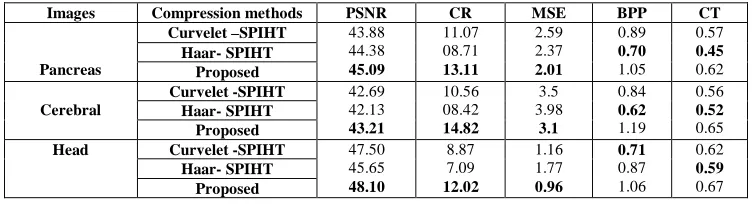
The performances are evaluated for the proposed algorithm using a set of 3 medical images of size (256X256).The quality of the compressed images has been attained using different metrics and the efficiency of the proposed method is evaluated by comparing it with Curvelet SPIHT [2]method and Haar SPIHT [26] based compression method. Peak Signal to Noise Ratio (PSNR), Mean Square Error (MSE), Bits per Pixel (BPP), Compression ratio (CR) and Computational time (CT) are used as different metrics. Table1 shows the performance comparison of different parameters for various techniques. Original and compressed images are shown in Figure 2.
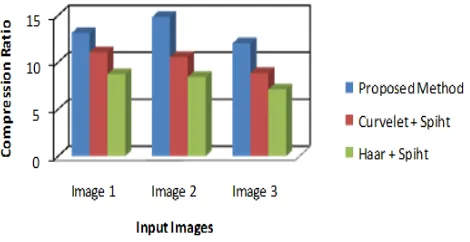
Figure 4 and Figure 5 show the average values of PSNR (dB) and MSE (dB) obtained for the several medical images as stated in Table 1. Figure 6 depicts the CR of compressed images obtained using the proposed and existing techniques.
a) Original Image b)compressed Image
i) Sagittal MRI of Head
a) Original Image b)compressed Image
ii) Sagittal STIR –axial View of cerebral
a) Original Image b)compressed Image
iii) Pancreas
Figure 2 shows the Set of medical images used for evaluation. i) Sagittal MRI of Head. ii) Sagittal STIR –axial View of cerebral. iii) Axial CT Image of Pancreas.
Table 1 Performance comparison of different parameters for various techniques
Images Compression methods PSNR CR MSE BPP CT
Pancreas
Curvelet –SPIHT 43.88 44.38
45.09
11.07 08.71
13.11
2.59 2.37
2.01
0.89
0.70
1.05
0.57
0.45
0.62
Haar- SPIHT Proposed
Cerebral
Curvelet -SPIHT 42.69 42.13
43.21
10.56 08.42
14.82
3.5 3.98
3.1
0.84
0.62
1.19
0.56
0.52
0.65
Haar- SPIHT Proposed
Head Curvelet -SPIHT 47.50 45.65
48.10
8.87 7.09
12.02
1.16 1.77
0.96
0.71
0.87 1.06
0.62
0.59
0.67
Figure 4 Comparison of PSNR’s of compressed images obtained using the proposed and existing techniques
Figure 5 Comparison of MSE’s of compressed images obtained using the proposed and existing techniques
Figure 6 Comparison of CR values of compressed images obtained using the proposed and existing techniques
VI. CONCLUSION
An efficient method for compression of medical images is proposed. From the experimental results it is clear that the optimal sparse representation of objects with edges is well defined and the resulting image is visually superior. The proposed method is compared with other efficient methods and
VII.REFERENCES
[1] Lexing Ying, Laurent Demanet and Emmanuel Candes, “3D Discrete Curvelet Transform”,Proceedings of the SPIE, Vol. 5914, pp. 351-361,2005.
[2] K. Siva Nagi Reddy, B. Raja Sekher Reddy, G. Rajasekhar and K. Chandra Rao, “A Fast Curvelet Transform Image Compression Algorithm using with Modified SPIHT” , International Journal of Computer Science and Telecommunications,Vol 3, Issue 2,pp 1-8, February 2012.
[3] Nilima D. Maske, Wani V. Patil, “Comparison of Image compression using Wavelet for Curvelet transform & Transmission over Wireless Channel”, International Journal of Scientific and Research Publications, Vol 2, Issue 5, pp 1-5 May 2012.
[4] Shadi AlZubi, Naveed Islam, and Maysam Abbod, “Multiresolution Analysis Using Wavelet, Ridgelet, and Curvelet Transforms for Medical Image Segmentation” International Journal of Biomedical Imaging , Article No. 4 January 2011.
[5] Emmanuel J. Candes and David L. Donoho, “ Curvelets - A Surprisingly Effective Nonadaptive Representation For Objects with Edges” vol 2 (4) 1999.
[6] Jianwei Ma and Gerlind Plonka, “A Review of Curvelets and Recent Applications” IEEE Signal Processing Magazine 27(2) 118-133. March 2010.
[7] M.J. Fadili , J.L Starck, ”Curvelets and Ridgelets” october 2007.
[8] Emmanuel J. Candes , David L. Donoho, ”Curvelets, Multiresolution Representation, and Scaling Laws, Wavelet Applications” Signal and Image Processing VIII, 1 December 4, 2000.
[9] Candes, E.J.Guo, “New multiscale transforms, minimum total variation synthesis” Applications to edge-preserving image reconstruction. Signal Processing vol 82 pp.1519–1543, 2002
[10] Candes, E. J. Donoho, D. L., “New tight frames of curvelets and optimal representations of objects with piecewise C2 singularities” Comm. on Pure and Appl. Math. 57 , pp. 219– 266, 2004.
[11] Lexing Ying, Laurent Demanet and Emmanuel Candes, “3D Discrete Curvelet Transform”, Applied and Computational Mathematics, Proc. SPIE 5914, Wavelets XI, 591413 , September 17, 2005.
[12] Anuradha , Rudresh Pratap Singh, “DWT Based Watermarking Algorithm using Haar Wavelet” International Journal of Electronics and Computer Science Engineering , Vol 1, 1, June 2012.
[14] Nidhi Sethi, Ram Krishna, R.P. Arora, “Image Compression Using Haar Wavelet Transform”, International institute of Science Technology and Research Vol 2, No 3 , 2011.
[15] Said, A.; Pearlman, W.A., ”A New Fast and Efficient Image Codec Based on Set Partitioning in Hierarchical Trees” , IEEE Transactions on Circuits and Systems for Video Technology, Volume : 6 Issue : 3, pp 243 – 250, 1996.
[16] J. M. Shapiro, “Embedded Image Coding Using Zerotrees of Wavelet Coefficients,” IEEE Trans. on Signal Processing, Vol. 41, No. 12, pp. 3445 – 3462, Dec. 1993.
[17] Todd Owen, Scott Hauck , “Arithmetic Compression on SPIHT Encoded Images“ : http://www.ee.washington.edu, May 2002.
[18] Young-Seop Kim ;William A. Pearlman, “Lossless Volumetric Medical Image Compression“ ,Applications of Digital Image Processing XXII, 305, October , 1999.
[19] Bibhuprasad Mohanty, Abhishek Singh & Sudipta Mahapatra, “A High Performance Modified SPIHT for Scalable Image Compression ” International Journal of Image processing ,Volume 5 : Issue 4 : 2011.
[20] Zhai Liang. A , Tang Xinming , Zhang Guo , Wu Xiaoliang, ” Effects of Jpeg2000 and Spiht Compression on Image Classification ,The International Archives of the Photogrammetry, Remote Sensing and Spatial Information Sciences. Vol. XXXVII. Part B7. 2008.
[21] David Taubman, “High Performance Scalable Image Compression With Ebcot” Ieee Transactions On Image Processing, Vol. 9, No. 7, Pp: 1158-1170, July 2000.
[22] Rucker, J.T., “Shape-Adaptive Embedded Coding of Ocean-Temperature Imagery “Signals, Systems and Computers, pp : 1887 – 1891, 2006.
[23] S.Narasimhulu, Dr.T.Ramashri, “Gray-Scale Image Compression Using DWT-SPIHT Algorithm”, International Journal of Engineering Research and Applications Vol. 2, Issue 4, pp.902-905, , July-August 2012.
[24] S. Maheswari, Member, K. Rameshwaran, “Robust Blind Complex Double Haar Wavelet Transform Based Watermarking Algorithm for Digital Images” IACSIT International Journal of Engineering and Technology, Vol. 3, No. 6, December 2011.
[25] Sadashivappa, Mahesh Jayakar, Anand K V S Babu , Dr. Srinivas K., “ Color Image Compression using SPIHT Algorithm”, International Journal of Computer Applications , 16(7), pp: 34–42, February 2011.