O R I G I N A L R E S E A R C H
Convergent Validity and Minimal Clinically Important
Difference of the Maugeri Foundation Respiratory
Failure Questionnaire (MRF-28) and the Chronic
Obstructive Pulmonary Disease-Speci
fi
c
Health-Related Quality of Life questionnaire (VQ11)
This article was published in the following Dove Press journal: International Journal of Chronic Obstructive Pulmonary Disease
Jérémy B Coquart 1
Natacha Heutte 1
Gaelle Terce2
Jean-Marie Grosbois3
1Université de Rouen-Normandie, UFR
STAPS, CETAPS, EA 3832, Mont Saint Aignan F-76821, France;2Centre
Hospitalier de Béthune, Service de Pneumologie et de Réhabilitation Respiratoire, Beuvry F-62660, France;
3FormAction Santé, Pérenchies F-59840,
France
Purpose: Short and easy questionnaires have been developed to assess the health-related quality of life (HRQoL) in patients with chronic obstructive pulmonary disease (COPD), such as the Maugeri Foundation Respiratory Failure Questionnaire (MRF-28) and the COPD-specific HRQoL Questionnaire (VQ11). Both are valid, reliable, and sensitive, but their minimal clinically important differences (MCID) are unknown. Consequently, this study aimed to confirm the convergent validities of the MRF-28 and VQ11 and establish their MCID. A retrospective design was used to evaluate the effect of individual home-based pulmonary rehabilitation (PR) in 400 COPD patients.
Patients and methods: Exercise tolerance, anxiety and depression based on the Hospital Anxiety and Depression Scale (HADS), and HRQoL using three questionnaires (MRF-28, VQ11, and the Visual Simplified Respiratory Questionnaire: VSRQ) were assessed before and after an individualized home-based PR program (5 sessions of 30–45 mins/week for 8 weeks, including a weekly session supervised by a team member).
Results:PR improved all measured variables (p< 0.0001). The correlations were significant (p< 0.0001) between VSRQ and MRF-28 (r =−0.685 at baseline and r =−0.686 after the PR program), and between VSRQ and VQ11 (r =−0.691 at baseline and r =−0.753 after the PR program). Moreover, changes in score (delta between after and before PR program) of VSRQ were also significantly correlated (p< 0.0001) to changes in score of MRF-28 (r =−0.372) and VQ11 (r =−0.423). Last, we calculated MCID of−5.2 and−2.0 units for MRF-28 and VQ11, respectively.
Conclusion:The MRF-28 and VQ11 can be used in routine practice to evaluate the effects of PR on the HRQoL of COPD patients, with MCID of−5.2 and−2.0, respectively.
Keywords: visual simplified respiratory questionnaire, VSRQ, home-based pulmonary rehabilitation
Introduction
Chronic obstructive pulmonary disease (COPD) is associated with progressive dyspnea and reduced exercise tolerance, both of which encourage sedentary lifestyles and cause
considerable deterioration of health-related quality of life (HRQoL).1Symptom relief and
improved HRQoL should be major goals of COPD treatment.2–4Among the non-drug
Correspondence: Jérémy B Coquart Université de Rouen-Normandie, UFR STAPS, CETAPS, EA 3832, Mont Saint Aignan F-76821, France
Tel +33 235 146 775
Email [email protected]
International Journal of Chronic Obstructive Pulmonary Disease
Dove
press
open access to scientific and medical research
Open Access Full Text Article
International Journal of Chronic Obstructive Pulmonary Disease downloaded from https://www.dovepress.com/ by 118.70.13.36 on 22-Aug-2020
treatments, pulmonary rehabilitation (PR), a comprehensive personalized intervention including physical activities, health education and psychological support, has been shown to be beneficial, regardless of age, sex, severity of airflow limitation or place where it is performed (hospital, outpatient clinic, or
home).2 Indeed, recent studies have confirmed that
home-based PR is safe and effective and improves HRQoL in these patients.2,4–7
Although generic questionnaires can be used to assess
HRQoL in COPD patients, disease-specific tools may be
more appropriate to obtain better responsiveness.8,9Among
respiratory disease-specific HRQoL questionnaires, the St
George’s respiratory questionnaire (SGRQ)10 and the
chronic respiratory questionnaire (CRQ)11 are frequently
used for COPD patients.4 However, the length of the
SGRQ (more than 50 items generally requiring 20 mins)8
limits its routine use, and the individualization of the dyspnea domain of the CRQ likely increases its complexity for both
patients and interviewers.12 Therefore, a COPD-specific
questionnaire was developed for quick and easy (ie,
approxi-mately 3–4 mins)13 assessment of HRQoL in outpatient
settings, real-life studies, and/or routine individual care: the
visual simplified respiratory questionnaire (VSRQ).3 The
validity (comparison to SGRQ), reliability, and responsive-ness of the VSRQ in COPD patients have already been
demonstrated.3,14 Nevertheless, in the past few years, two
other respiratory disease-specific questionnaires have been
increasingly used in PR centres: the Maugeri Foundation
respiratory failure questionnaire (MRF-28)5,15–20 and the
COPD-specific HRQoL questionnaire (VQ11).5,13,19,21The
interest in both, compared to the VSRQ, is that they provide a global score of HRQoL but also and most importantly, they evaluate special dimensions of HRQoL.
The MRF-28 is composed of 28 items covering three theoretical components (daily activity, cognitive function,
and invalidity).15 Its validity and reliability were
con-firmed in 81 patients treated with home mechanical
venti-lation for chronic respiratory failure but only 12 of the
patients had COPD.15 The validity therefore needs to be
confirmed in a larger sample of COPD patients. Moreover,
to our knowledge, the minimal clinically important differ-ence (MCID) of the MRF-28 is unknown. The VQ11 comprises 11 items distributed across three components (functional: 3 items, psychological: 4 items, social: 4
items) and a top level combining them.13 The VQ11 is
valid and reliable,13,21 but its responsiveness for
home-based PR needs to be determined, as does its MCID.13
In this study, we therefore assessed the validity, respon-siveness, and MCID of the MRF-28 and the VQ11 in a retrospective study designed to evaluate the effect of individual home-based PR on HRQoL in COPD patients.
The VSRQ, which is valid, reliable, sensitive,3and
speci-fically developed for COPD patients, was taken as the
reference. We hypothesized that home-based PR would be feasible and effective in improving HRQoL in COPD patients, and that the MRF-28 and VQ11 would be useful
tools to evaluate these benefits.
Materials and Methods
Study Design
This 6-year monocentric observational study, which included consecutive COPD patients managed by
outpati-ent PR, respects the“strengthening the reporting of
obser-vational studies in epidemiology”(STROBE) statement.22
All data were collected prospectively and were entered into our rehabilitation computerized medical records (according to the routine/standard management of patient). Retrospective analysis was executed from data collected between 2012 and 2017. All patients were following a home-based PR program.
Briefly and as described elsewhere, this individualized
home-based PR program consisted of a 90 min session once a week for 8 weeks, based on an educational needs
assessment.5,19 It comprised endurance exercise, the
resumption of the physical activities of daily living, ther-apeutic education, psychosocial support, and motivational communication to encourage health behavior changes and self-management. This weekly session was conducted under the direct supervision of a team member. Patients were expected to continue performing the endurance exer-cises on their own the other days of the week, according to a personalized action plan.
Initially, individual endurance exercise on a cycle erg-ometer was performed in sequences of 10 mins or less. They were asked to exercise at least 5 days per week, with the goal being to reach 30 to 45 mins per day, in one or
several sessions.5,19,23 The exercise intensity was
pre-scribed on the basis of dyspnea symptoms (generally 3–4
on Borg’s category scale with ratio properties) or effort
perception (generally 11–13 on Borg’s rating of perceived
exertion scale). The patients were encouraged to increase the time spent in daily living activities. In addition, three muscle strengthening exercises for the upper and lower
limbs were systematically proposed, lasting 10–15 mins
International Journal of Chronic Obstructive Pulmonary Disease downloaded from https://www.dovepress.com/ by 118.70.13.36 on 22-Aug-2020
per day and using weights and dumbbells and/or elastic bands. Each exercise comprised 10 repeated movements. A 1 min recovery period was observed between exercises. Warm-up and stretching exercises were also recommended together with balance exercises whenever necessary.
The PR agreement given to the patients before PR
included an accident protocol. An accident was defined
as death, hospitalization or emergency care required for heart or orthopedic incidents during the 8 weeks of PR. The patient and/or the physical therapist could declare the accident. Patients were asked to interrupt all physical activities in the case of any abnormal sensations, espe-cially chest or joint pain, and to contact both the rehabili-tation team and the attending physician.
Participants
In this observational study, 485 patients with COPD who were following home-based PR were consecutively
included. COPD diagnosis was confirmed according to
international guidelines.24 COPD patients were excluded
if they had dementia or poorly controlled psychiatric ill-ness, neurological sequelae, or bone and joint diseases preventing physical activity.
Assessments
Patients were evaluated at home just before (ie, T0) and
after PR (ie, T2). During a medical consultation at baseline,
sociodemographic (ie, age, sex, body mass, height, body mass index and socioeconomic deprivation score) and
spirometric data (ie, forced expiratory volume in
one second: FEV1, forced vital capacity: FVC, FEV1/FVC
and the severity of airflow limitation), as well as treatment
(ie, long-term oxygen therapy: LTOT, non-invasive ventila-tion: NIV, continuous positive airways pressure: CPAP)
were collected. As described elsewhere,5,19the evaluation
of exercise tolerance included a 10 times sit-to-stand test (10STS), a timed up-and-go test (TUG), and a 6 min stepper test (6MST). The 10STS consists of standing up until reach-ing full knee extension and sittreach-ing back down 10 times as fast as possible while seated at the front of a 42-cm-high
chair.25During the TUG, patients stand up from a standard
armchair, walk 3 m, turn, walk back, and sit down again as
quickly as possible.26Last, the number of steps taken in 6
mins was collected during a 6MST as previously
described.27 The stepper (Go Sport®, Grenoble, France),
with a step height fixed at 20 cm, was placed near a wall
to support patients if they became unbalanced or exhausted.
The patients could freely regulate their stepping rate to reach the highest number of strokes.
Psychological status was assessed by the hospital
anxi-ety and depression (HAD) scale,28 and HRQoL was
assessed by the MRF-28,15 VQ11,21 and VSRQ.3 The
HAD scale determined the patient’s psychological state
in terms of anxiety and depression.28 This questionnaire
has 14 items (7 items for each psychological state), with
responses scored on a scale of 0–3 to indicate symptom
frequency (the higher the frequency, the higher the score is). The MRF-28 is composed of 28 items covering three theoretical components (daily activity, cognitive function,
and invalidity) and gives a final score ranging from 0 to
100, with higher scores reflecting a higher degree of
impairment.15 The VQ11 comprises 11 items distributed
across three components (functional: 3 items, psychologi-cal: 4 items, social: 4 items) and a top level combining
these three components.21 Higher scores indicate less
favorable quality of life. Last, the VSRQ is a valid, reli-able, and sensitive questionnaire to assess HRQoL,
spe-cially developed for patients with COPD.3 It comprises
eight visual analog scales ranging from 0 to 10, with a total score ranging from 0 to 80. Higher scores indicate better HRQoL. The MCID of the VSRQ is known: +3.4
units.3Consequently, the VSRQ was taken as a reference
for comparison with the MRF-28 and VQ11.
Ethical Approval
All procedures performed in this study were in accordance with the Helsinki declaration and its amendments. Moreover, the research protocol was approved by the Observational Research Protocol Evaluation Committee of the French-language Society of Pulmonology (CEPRO 2017-007), and written informed consent was obtained from each participant.
Statistical Analysis
Descriptive statistics included the number of cases and per-centages for categorical variables, and median, range or means and standard deviations (SD) for continuous
vari-ables. Normal Gaussian distribution of the data was verified
by the Shapiro-Wilk test. At the baseline (T0), the participant
characteristics included in the statistical analysis were com-pared to those of nonparticipants (ie, patients excluded because of refusal to participate or lost to follow-up) from
Student's t-tests or Mann–Whitney U-tests for continuous
data. For categorical data, the frequencies were compared
using Pearson’s Chi-squared test or Fisher’s exact test when
International Journal of Chronic Obstructive Pulmonary Disease downloaded from https://www.dovepress.com/ by 118.70.13.36 on 22-Aug-2020
appropriate. To test the effect of PR, paired Student'st-tests or Wilcoxon matched pairs tests were used.
Spearman correlation coefficients were calculated to
examine the convergent validity between the VSRQ (ie, the anchor) and the other questionnaires (ie, MRF-28 and
VQ11). These correlation coefficients were classed as
“very high”(r≥ 0.90),“high”(0.70 ≥r ≤0.89),“
moder-ate”(0.50≥r≤ 0.69), or“low”(0.26≥r≤0.49).29
As triangulation is recommended to measure MCID,30
both anchor-based (using the VSRQ as the anchor) and distribution-based (half a standard deviation and a small
Cohen’s effect size) methods were used to calculate the
MCID for MRF-28 and VQ11. According to Cohen,31the
magnitude of the difference can be considered to be trivial (ES < 0.2), small (0.2≥ES < 0.5), moderate (0.5≥ES < 0.8),
or large (ES≥0.8). A receiver operating characteristic (ROC)
curve approach was used, with dichotomized VSRQ responses (less than 3.4 units vs 3.4 units or more, as
pro-posed by Perez et al3) as dependent variables, and the change
score for each questionnaire as independent.32An optimal
cut-off value for each questionnaire‒ie, the one that
max-imized Youden’s index (maximizes both sensitivity and
spe-cificity)‒was identified.
Results
Description of Sample
A total of 485 patients were solicited to participate in the study,
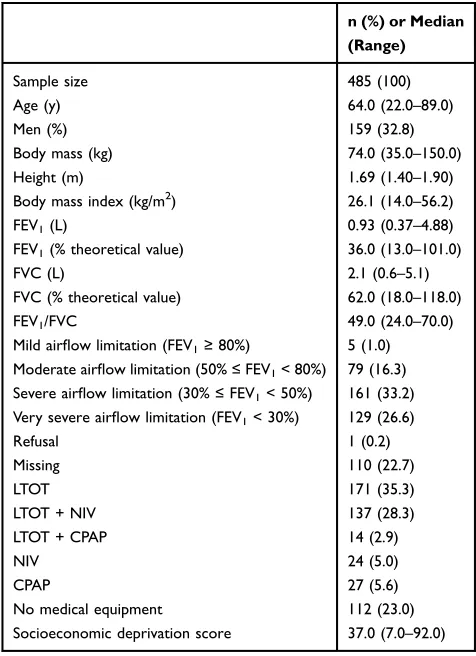
and 7 of them refused (Figure 1). The sociodemographic and
medical characteristics at inclusion are summarized inTable 1.
Differences between participants (n = 400) and nonparticipants
(n = 78) are presented inTable 2. Mainly, the nonparticipants
were excluded because of physical incapacity (n = 21), hospi-talization (n = 16), stopping the home-based PR without expla-nation (n = 13), or loss of motivation to continue the program (n = 10,Figure 1). The nonparticipants were significantly older
(68.3 ± 10.9 vs 63.5 ± 11.1 years) and had lower FEV1(34.3 ±
13.5 vs 40.1 ± 17.8%) and FVC (56.0 ± 18.7 vs 65.2 ± 20.0%) compared to participants (p≤0.01,Table 2).
Effects of Home-Based PR
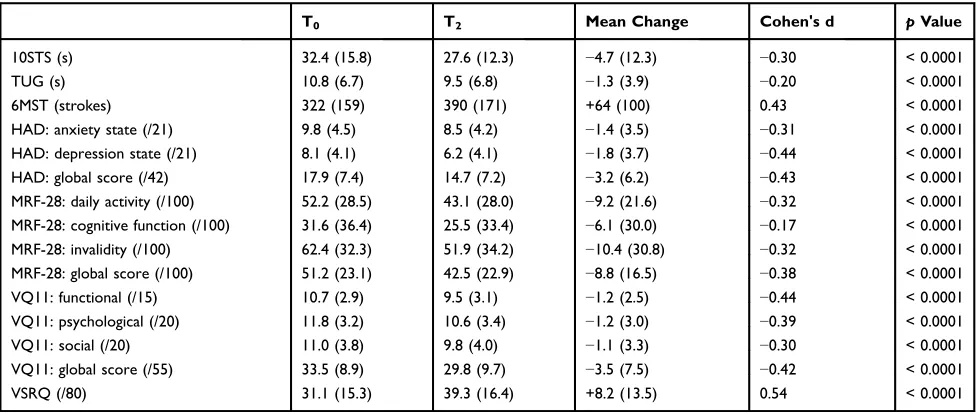
The effects of the home-based PR on exercise tolerance (ie, 10STS, TUG, and 6MST) psychological status (ie, anxiety and depression from the HAD questionnaire), and HRQoL (ie, from each dimension of the MRF-28,
VQ11 and VSRQ) are summarized in Table 3. All
mea-sures were significantly improved after the program (p <
0.0001, Table 3), except for the dimension of cognitive
function on the MRF-28 (for which only a trivial effect
was noted); all other measures showed small (but signifi
-cant) or moderate effects (Table 3).
Convergent Validity of HRQoL
Questionnaires
The associations between the anchor (ie, VSRQ) and
HRQoL (ie, MRF-28 and VQ11) at T0 and T2 and the
delta (ie, T2-T0) were all significant (p< 0.0001,Table 4).
The correlation coefficients ranged from r = −0.372 to
−0.686 for MRF-28, and r = −0.423 to−0.753 for VQ11
(Table 4).
Figure 1Flow diagram of patients with chronic obstructive pulmonary disease managed by home-based pulmonary rehabilitation program.
International Journal of Chronic Obstructive Pulmonary Disease downloaded from https://www.dovepress.com/ by 118.70.13.36 on 22-Aug-2020
Determination of MCID
As the lower limit of the area under the ROC curve was sometimes < 0.5 (0.481 for MRF-28 and 0.436 for VQ11), the relationship between the change score and the anchor
was considered insufficient to estimate the MCID from
this statistical analysis (ie, ROC curve). Therefore, distri-bution-based (half a standard deviation and a small
Cohen’s effect size) methods were used to determine it
(Table 5). For each variable, the mean was calculated from
these two methods. The MCID were−5.2 units for
MRF-28,−2.0 units for VQ11, and +3.4 units for VSRQ.
Discussion
This study shows that 16.1% of the patients did not com-plete the home-based PR. The two main reasons, physical
incapacity (26.9%) and hospitalization (20.5%, Figure 1)
explained 47.4% of PR abandonment. At baseline, these
nonparticipants were significantly older and had lower
FEV1 than the participants (Table 2). These results are
unsurprising since body mass index (non-significantly
decreased in the current study, p= 0.184, Table 2), age,
and FEV1 are predictors of hospitalization and death in
COPD patients.33Moreover, FEV1is known to be signifi
-cantly associated with COPD exacerbations.34To
summar-ize, the nonparticipants did not complete the PR because
they were older and had greater airflow limitation, which
is known to lead to physical incapacity, exacerbations, and thus hospitalizations and death in COPD patients.
In line with the literature,5,19,35this study confirms that a personalized and comprehensive home-based PR (with one visit per week for 8 weeks) including physical train-ing, health education, psychological support, and motiva-tional communication is feasible and effective in COPD
patients and can significantly improve exercise tolerance,
anxiety and depression, and HRQoL (Table 3). As
pre-viously indicated,5 home-based PR is therefore an
alter-native to outpatient or inpatient rehabilitation and may make it easier for a greater number of patients worldwide
to benefit from PR.
The VSRQ is used to measure HRQoL in patients with
pulmonary disease,14,36especially when PR is executed at
home.5,16,19,23,35 It is a valid, reliable, and sensitive
questionnaire,3,14 and thus it was our reference (ie, the
anchor) to confirm the convergent validity of the
MRF-28 and VQ11. The results showed a significant
improve-ment in VSRQ, MRF-28, and VQ11 after PR (Table 3).
Moreover, significant correlations (Table 5) were found
between the VSRQ and the other HRQoL questionnaires at
T0(r =−0.685 and−0.691 for MRF-28 and VQ11,
respec-tively) and T2 (r = −0.686 and −0.753 for MRF-28 and
VQ11, respectively). Significant correlations were also
noted for the delta (T2-T0) between VSRQ and the other
HRQoL questionnaires (Table 5). According to the
literature,13,15,21these results together confirm the conver-gent validity of the MRF-28 and VQ11. The validity of the
MRF-28 has already been reported, with a significant
cor-relation with the SGRQ (r = 0.78) in patients treated for
chronic respiratory failure by home mechanical
ventilation.15 The convergent validity (p< 0.05, r = 0.71)
between the VQ11 and SGRQ was also reported in COPD
patients.21 Therefore, the MRF-28 and VQ11 have good
measurement properties and are useful tools to measure
COPD-specific HRQoL in routine practice.21
The present study suggests that MRF-28 and VQ11 could be used alone or as an adjunct to VSRQ to assess the global HRQoL. However, as VSRQ includes no subscale (and pro-vides only global score of HRQoL), MRF-28 and VQ11 could
Table 1Characteristics of Patients Solicited to Participate in the Study
n (%) or Median (Range)
Sample size 485 (100)
Age (y) 64.0 (22.0–89.0)
Men (%) 159 (32.8)
Body mass (kg) 74.0 (35.0–150.0)
Height (m) 1.69 (1.40–1.90)
Body mass index (kg/m2) 26.1 (14.0–56.2)
FEV1(L) 0.93 (0.37–4.88)
FEV1(% theoretical value) 36.0 (13.0–101.0)
FVC (L) 2.1 (0.6–5.1)
FVC (% theoretical value) 62.0 (18.0–118.0)
FEV1/FVC 49.0 (24.0–70.0)
Mild airflow limitation (FEV1≥80%) 5 (1.0)
Moderate airflow limitation (50%≤FEV1< 80%) 79 (16.3)
Severe airflow limitation (30%≤FEV1< 50%) 161 (33.2)
Very severe airflow limitation (FEV1< 30%) 129 (26.6)
Refusal 1 (0.2)
Missing 110 (22.7)
LTOT 171 (35.3)
LTOT + NIV 137 (28.3)
LTOT + CPAP 14 (2.9)
NIV 24 (5.0)
CPAP 27 (5.6)
No medical equipment 112 (23.0)
Socioeconomic deprivation score 37.0 (7.0–92.0)
Abbreviations:CPAP, continuous positive airways pressure; FEV1, forced expira-tory volume in one second; FVC, forced vital capacity; LTOT, long-term oxygen therapy; NIV, non-invasive ventilation.
International Journal of Chronic Obstructive Pulmonary Disease downloaded from https://www.dovepress.com/ by 118.70.13.36 on 22-Aug-2020
be preferred. Indeed, the MRF-28 covers 3 subcomponents of
HRQoL (ie, daily activity, cognitive function and invalidity)15
and the VQ11 also provides scores from 3 subcomponents (ie,
functional, psychological, and social).21Previously, Mahler37
indicated that HRQoL refers to 3 components of health: phy-sical (eg, phyphy-sical capacity), psychological (eg, self-esteem,
Table 2Differences Between Participants and Nonparticipants
Non-Participant Patients (n = 85)
Participant Patients (n = 400)
All Patients (n = 485)
pValue
Age (y) 68.3 (10.9) 63.5 (11.1) 64.3 (11.2) 0.0003
Men (%) 56 (65.9) 270 (67.5) 159 (32.8) 0.7729
Body mass (kg) 72.8 (22.0) 77.8 (22.3) 76.9 (22.3) 0.0638
Height (m) 1.67 (8.7) 1.69 (8.6) 1.68 (8.6) 0.0510
Body mass index (kg/m2) 26.1 (7.5) 27.3 (7.6) 27.1 (7.6) 0.1843
FEV1(L) 0.87 (0.40) 1.12 (0.57) 1.08 (0.56) 0.0002
FEV1(% theoretical value) 34.3 (13.5) 40.1 (17.8) 39.2 (17.4) 0.0053
FVC (L) 1.9 (0.9) 2.2 (0.9) 2.2 (0.9) 0.0300
FVC (% theoretical value) 56.0 (18.7) 65.2 (20.0) 63.9 (20.0) 0.0120
FEV1/FVC 45.7 (11.3) 49.5 (12.8) 49.0 (12.7) 0.1039
Mild airflow limitation (FEV1≥80%) 0 (0.00) 5 (1.3) 5 (1.0) < 0.0001
Moderate airflow limitation (50%≤FEV1< 80%) 8 (9.4) 71 (17.8) 79 (16.3)
Severe airflow limitation (30%≤FEV1< 50%) 22 (25.9) 139 (34.8) 161 (33.2)
Very severe airflow limitation (FEV1< 30%) 26 (30.6) 103 (25.8) 129 (26.6)
Refusal 1 (1.8) 0 (0.0) 1 (0.2)
Missing 28 (33.0) 82 (20.5) 110 (22.7)
LTOT 39 (45.9) 132 (33.0) 171 (35.3) 0.0570
LTOT + NIV 25 (29.4) 112 (28.0) 137 (28.3)
LTOT + CPAP 4 (4.7) 10 (2.5) 14 (2.9)
NIV 3 (3.5) 21 (5.3) 24 (5.0)
CPAP 3 (3.5) 24 (6.0) 27 (5.6)
No medical equipment 11 (12.9) 101 (25.3) 112 (23.0)
Socioeconomic deprivation score 38.4 (16.9) 37.7 (18.0) 37.8 (17.8) 0.7636
Abbreviations:CPAP, continuous positive airways pressure; FEV1, forced expiratory volume in one second; FVC, forced vital capacity; LTOT, long-term oxygen therapy; NIV, non-invasive ventilation.
Table 3Effect of the Pulmonary Rehabilitation Program
T0 T2 Mean Change Cohen's d pValue
10STS (s) 32.4 (15.8) 27.6 (12.3) −4.7 (12.3) −0.30 < 0.0001
TUG (s) 10.8 (6.7) 9.5 (6.8) −1.3 (3.9) −0.20 < 0.0001
6MST (strokes) 322 (159) 390 (171) +64 (100) 0.43 < 0.0001
HAD: anxiety state (/21) 9.8 (4.5) 8.5 (4.2) −1.4 (3.5) −0.31 < 0.0001
HAD: depression state (/21) 8.1 (4.1) 6.2 (4.1) −1.8 (3.7) −0.44 < 0.0001
HAD: global score (/42) 17.9 (7.4) 14.7 (7.2) −3.2 (6.2) −0.43 < 0.0001
MRF-28: daily activity (/100) 52.2 (28.5) 43.1 (28.0) −9.2 (21.6) −0.32 < 0.0001 MRF-28: cognitive function (/100) 31.6 (36.4) 25.5 (33.4) −6.1 (30.0) −0.17 < 0.0001 MRF-28: invalidity (/100) 62.4 (32.3) 51.9 (34.2) −10.4 (30.8) −0.32 < 0.0001 MRF-28: global score (/100) 51.2 (23.1) 42.5 (22.9) −8.8 (16.5) −0.38 < 0.0001
VQ11: functional (/15) 10.7 (2.9) 9.5 (3.1) −1.2 (2.5) −0.44 < 0.0001
VQ11: psychological (/20) 11.8 (3.2) 10.6 (3.4) −1.2 (3.0) −0.39 < 0.0001
VQ11: social (/20) 11.0 (3.8) 9.8 (4.0) −1.1 (3.3) −0.30 < 0.0001
VQ11: global score (/55) 33.5 (8.9) 29.8 (9.7) −3.5 (7.5) −0.42 < 0.0001
VSRQ (/80) 31.1 (15.3) 39.3 (16.4) +8.2 (13.5) 0.54 < 0.0001
Abbreviations:HAD, hospital anxiety and depression questionnaire; MRF-28, Maugeri Foundation respiratory failure questionnaire; TUG, timed up-and-go test; VQ11, COPD specific HRQoL questionnaire; VSRQ, visual simplified respiratory questionnaire; 6MST, 6 min stepper test; 10STS, 10 times sit-to-stand test.
International Journal of Chronic Obstructive Pulmonary Disease downloaded from https://www.dovepress.com/ by 118.70.13.36 on 22-Aug-2020
and), and social (eg, social relationship). Thus, an instrument dedicated to measure HRQoL needs to provide a global score, as well as evaluation of different subcomponents. Indeed, as
indicated by Janssens et al,15these subcomponents may be
contributive to afiner analysis of the impact of PR on HRQoL
in respiratory disease.
As noted by Smid et al,38 the MCID is the smallest
difference in a measurable clinical parameter perceived by the patient or clinician that indicates a meaningful change in the condition for better or worse. It can thus be used to
assess the effect of therapies like home-based PR. MCID of−4
units has frequently been found for the SGRQ39and even +3.4
for the VSRQ.3 Therefore, using anchor-based (with the
VSRQ as anchor) and distribution-based methods, the MCID
for MRF-28 and the VQ11 were calculated and identified as
−5.2 units and −2.0 units, respectively. Consequently, as
MCID is patient derived scores that reflect changes in
a clinical intervention that are meaningful for the patient,40
future studies in PR could also determine the number of responders (ie, patients with HRQoL score superior to MCID), rather than only raw data (ie, score of HRQoL).
Limitations
The cut-off points of MCID (ie, −5.2 and −2.0 units for
MRF-28 and VQ11, respectively) were established from distribution-based methods rather than anchor-based meth-ods because the area under the ROC curve was slightly less than 0.5 (0.481 for MRF-28 and 0.436 for VQ11), which raised the question of whether these two question-naires are able to make sensitive distinctions between
COPD patients who improved by at least −3.4 units on
the VSRQ and those who did not.38 The current study
therefore gives only an indicative value of the MCID of the MRF-28 and VQ11, rather than exact cut-off points. Moreover, 16.1% of patients did not complete the home-based PR. This result is close to that of previous studies (dropout ranged from 0 to 36%) that proposed PR for
COPD patients.41 These nonparticipants had worse
base-line values (ie, older and greater airflow limitation) than
those who completed PR. As Smid et al38noted, this may
well have affected the current results. Furthermore, the participants were all COPD patients and this should be considered when generalizing the results to other
popula-tions. Last, although significant correlations (p< 0.0001)
with moderate to high coefficients of correlation were
found between the VSRQ and the other questionnaires
(MRF-28 and VQ11) at T0 (ie, r = −0.685 and −0.691,
respectively) and T2 (ie, r = −0.686 and−0.753,
respec-tively), lower significant coefficients of correlation
between deltas were noted (ie, r = −0.372 and −0.423,
respectively,p< 0.0001, Table 5). Despite thefindings of
similar coefficients of correlation,38 moderate correlation
coefficients (r≥0.5) are ideally needed to prevent a wide
range in MCID.42 These observations therefore suggest
that the MCID of our study are indicative values and
specifically adapted for PR in COPD patients.
Conclusion
This study shows that home-based PR is an efficient
non-pharmacological therapy that improves exercise tolerance, HAD, and HRQoL in COPD patients. Moreover, the results
confirm (from VSRQ) the convergent validity of the MRF-28
and VQ11. Therefore, both questionnaires have good mea-surement properties and are useful tools to measure
COPD-Table 4 Correlations Between VSRQ and the Other Questionnaires at T0and T2and the Deltas (T0-T2)
MRF-28: Global Score
VQ11: Global Score
T0 Correlation coefficient −0.685 −0.691
pvalue < 0.0001 < 0.0001
T2 Correlation coefficient −0.686 −0.753
pvalue < 0.0001 < 0.0001
Delta Correlation coefficient −0.372 −0.423
pvalue < 0.0001 < 0.0001
Abbreviations:MRF-28, Maugeri Foundation respiratory failure questionnaire; T0, baseline (ie, before pulmonary rehabilitation); T2, after pulmonary rehabilitation; VQ11, COPD specific HRQoL questionnaire; VSRQ, visual simplified respiratory questionnaire.
Table 5Determination of Minimal Clinically Important Difference Using Two Statistical Methods
Method MRF-28:
Global Score
VQ11: Global Score
VSRQ: Global Score
Anchor based
ROC curve derived (Youden) 28 5 5
ROC curve derived (“Minimax”: minimizes the most frequent error)
24 1 2
Distribution based
Half Standard deviation 5.77 2.22 3.83 Small Cohen’s effect size (0.2) 4.62 1.77 3.06
MCID proposed −5.2 −2.0 +3.4
Abbreviations: MRF-28, Maugeri Foundation respiratory failure questionnaire; ROC, receiver operating characteristics; VQ11, COPD specific HRQoL question-naire; VSRQ, visual simplified respiratory questionnaire.
International Journal of Chronic Obstructive Pulmonary Disease downloaded from https://www.dovepress.com/ by 118.70.13.36 on 22-Aug-2020
specific HRQoL in routine practice. Last, we suggest MCID
of −5.2 units and −2.0 units for the MRF-28 and VQ11,
respectively, to assess the effect of PR in COPD patients.
Acknowledgements
The authors would like to thank the rehabilitation team who managed the patients: S. Duriez, M. Grosbois, M. Lambinet, G. Tywoniuk, F. Urbain, and V. Wauquier. The authors also
express their thanks to the ‘Institut de Recherche
Interdisciplinaire Homme Société (Université de
Rouen-Normandie)’for their contribution in this study.
Disclosure
JMG received financial support from Adair, Aeris Santé,
Bastide, France Oxygène, Homeperf, LVL, Medopale, NorOx, Orkyn, Santélys, SOS Oxygène, Sysmed, VitalAire, and ARS Hauts-de-France for the home-based PR program.
The remaining authors report no conflicts of interest in this
work.
References
1. Barreiro E, Gea J. Respiratory and limb muscle dysfunction in COPD. COPD.2015;12(4):413–426. doi:10.3109/15412555.2014.974737 2. Spruit MA, Singh SJ, Garvey C, et al. An official American Thoracic
Society/European Respiratory Society statement: key concepts and advances in pulmonary rehabilitation.Am J Respir Crit Care Med. 2013;188(8):13–64. doi:10.1164/rccm.201309-1634ST
3. Perez T, Arnould B, Grosbois JM, et al. Validity, reliability, and responsiveness of a new short Visual Simplified Respiratory Questionnaire (VSRQ) for health-related quality of life assessment in chronic obstructive pulmonary disease. Int J Chron Obstruct Pulmon Dis.2009;4:9–18.
4. Mc Carthy B, Casey D, Devane D, Murphy K, Murphy E, Lacasse Y. Pulmonary rehabilitation for chronic obstructive pulmonary disease. Cochrane Database Syst Rev.2015;2:1–209.
5. Coquart JB, Le Rouzic O, Racil G, Wallaert B, Grosbois JM. Real-life feasibility and effectiveness of home-based pulmonary rehabilita-tion in chronic obstructive pulmonary disease requiring medical equipment.Int J Chron Obstruct Pulmon Dis.2017;12:3549–3556. doi:10.2147/COPD.S150827
6. Liu XL, Tan JY, Wang T, et al. Effectiveness of home-based pulmon-ary rehabilitation for patients with chronic obstructive pulmonpulmon-ary disease: a meta-analysis of randomized controlled trials. Rehabil Nurs.2014;39(1):36–59. doi:10.1002/rnj.112ISTEX
7. Wuytack F, Devane D, Stovold E, et al. Comparison of outpatient and home-based exercise training programmes for COPD: a systematic review and meta-analysis.Respir.2018;23(3):272–283. doi:10.1111/resp.13224 8. Lareau SC, Breslin EH, Meek PM. Functional status instruments:
outcome measure in the evaluation of patients with chronic obstruc-tive pulmonary disease. Heart Lung. 1996;25(3):212–224. doi:10.1016/S0147-9563(96)80032-X
9. Glaab T, Vogelmeier C, Buhl R. Outcome measures in chronic obstructive pulmonary disease (COPD): strengths and limitations. Respir Res.2010;11:79. doi:10.1186/1465-9921-11-79
10. Jones AM.St George’s Respiratory Questionnaire: Manual. London, GB: University of London;2009.
11. Guyatt GH, Berman LB, Townsend M, Pugsley SO, Chambers LW. A measure of quality of life for clinical trials in chronic lung disease. Thorax.1987;42(10):773–778. doi:10.1136/thx.42.10.773ISTEX 12. Schunemann HJ, Puhan M, Goldstein R, Jaeschke R, Guyatt GH.
Measurement properties and interpretability of the Chronic respiratory disease questionnaire (CRQ). COPD.2005;2(1):81–89. doi:10.1081/ COPD-200050651
13. Ninot G, Soyez F, Fiocco S, Nassih K, Morin AJS, Prefaut C. Le VQ11, un questionnaire de qualité de vie spécifique à la BPCO utilisable en clinique. Rev Mal Respir. 2010;27(5):472–481. doi:10.1016/j.rmr.2010.03.020
14. Tillie-Leblond I, Masure F. “EXACO”: four year follow-up of exacerbations in a cohort of patients with COPD.Rev Mal Respir. 2006;23(4):377–384. doi:10.1016/S0761-8425(06)71607-2 15. Janssens JP, Heritier-Praz A, Carone M, et al. Validity and reliability of
a French version of the MRF-28 health-related quality of life questionnaire.Respiration.2004;71(6):567–574. doi:10.1159/000081756 16. Coquart JB, Grosbois J-M, Olivier C, Bart F, Castres I, Wallaert B. Home-based neuromuscular electrical stimulation improves exercise tolerance and health-related quality of life in patients with chronic obstructive pulmonary disease. Int J Chron Obstruct Pulmon Dis. 2016;11:1189–1197. doi:10.2147/COPD.S105049
17. Vivodtzev I, Pepin JL, Vottero G, et al. Improvement in quadriceps strength and dyspnea in daily tasks after 1 month of electrical stimu-lation in severely deconditioned and malnourished COPD. Chest. 2006;129(6):1540–1548. doi:10.1378/chest.129.6.1540
18. Carone M, Patessio A, Ambrosino N, et al. Efficacy of pulmonary rehabilitation in chronic respiratory failure (CRF) due to chronic obstructive pulmonary disease (COPD): the Maugeri study. Respir Med.2007;101(12):2447–2453. doi:10.1016/j.rmed.2007.07.016 19. Grosbois J-M, Gicquello A, Langlois C, et al. Long term evaluation
of home-based pulmonary rehabilitation in patients with chronic obstructive pulmonary disease. Int J Chron Obstruct Pulmon Dis. 2015;25(10):2037–2044.
20. Vitacca M, Kaymaz D, Lanini B, et al. Non-invasive ventilation during cycle exercise training in patients with chronic respiratory failure on long-term ventilatory support: a randomized controlled trial.Respir.2018;23(2):182–189. doi:10.1111/resp.13181
21. Ninot G, Soyez F, Prefaut C. A short questionnaire for the assessment of quality of life in patients with chronic obstructive pulmonary disease: psychometric properties of VQ11. Health Qual Life Outcomes.2013;11:179. doi:10.1186/1477-7525-11-179
22. Von Elm E, Altman DG, Egger M, Pocock SJ, Gotzsche PC, Vandenbroucke JP. The Strengthening the Reporting of Observational Studies in Epidemiology (STROBE) statement: guide-lines for reporting observational studies. Int J Surg. 2014;12 (12):1495–1499. doi:10.1016/j.ijsu.2014.07.013
23. Olivier C, Grosbois JM, Cortot AB, et al. Real-life feasibility of home-based pulmonary rehabilitation in chemotherapy-treated patients with thoracic cancers: a pilot study.BMC Cancer.2018;18 (1):178. doi:10.1186/s12885-018-4102-6
24. Vogelmeier CF, Criner GJ, Martinez FJ, et al. Global strategy for the diagnosis, management, and prevention of chronic obstructive lung disease 2017 report. GOLD executive summary.Am J Respir Crit Care Med.2017;195(5):557–582. doi:10.1164/rccm.201701-0218PP 25. Netz Y, Ayalon M, Dunsky A, Alexander N.‘The
multiple-sit-to-stand’field test for older adults: what does it measure?Gerontology. 2004;50(3):121–126. doi:10.1159/000076769
26. Mesquita R, Wilke S, Smid DE, et al. Measurement properties of the timed up & go test in patients with COPD. Chronic Respir Dis. 2016;13(4):344–352. doi:10.1177/1479972316647178
27. Grosbois J-M, Riquier C, Chehere B, et al. Six-minute stepper test: a valid clinical exercise tolerance test for COPD patients. Int J Chron Obstruct Pulmon Dis.2016;11:657–663. doi:10.2147/ COPD.S98635
International Journal of Chronic Obstructive Pulmonary Disease downloaded from https://www.dovepress.com/ by 118.70.13.36 on 22-Aug-2020
28. Zigmond AS, Snaith RP. The hospital anxiety and depression scale. Acta Psychiatr Scand.1983;67(6):361–370. doi:10.1111/acp.1983.67. issue-6
29. Munro BH.Statistical Methods for Health Care Research. 3th ed. Philadelphia: Lippincott;1997.
30. Revicki D, Hays RD, Cella D, Sloan J. Recommended methods for determining responsiveness and minimally important differences for patient-reported outcomes.J Clin Epidemiol. 2008;61(2):102–109. doi:10.1016/j.jclinepi.2007.03.012
31. Cohen J.Statistical Power Analysis for the Behavioral Sciences. 2nd ed. Hillsdale, NJ: Erlbaum;1988.
32. Copay AG, Subach BR, Glassman SD, Polly DW, Schuler TC. Understanding the minimum clinically important difference: a review of concepts and methods. Spine J. 2007;7(5):541–546. doi:10.1016/j.spinee.2007.01.008
33. Schembri S, Anderson W, Morant S, et al. A predictive model of hospitalisation and death from chronic obstructive pulmonary disease. Respir Med.2009;103(10):1461–1467. doi:10.1016/j.rmed.2009.04.021 34. Schonmann M, Sievi NA, Clarenbach CF, et al. Physical activity and the frequency of acute exacerbations in patients with chronic obstruc-tive pulmonary disease. Lung. 2015;193(1):63–70. doi:10.1007/ s00408-014-9673-7
35. Grosbois JM, Le Rouzic O, Monge E, Bart F, Wallaert B. La réhabilitation respiratoire: évaluation de deux types de prise en charge, ambulatoire versus domicile. Rev Pneumol Clin. 2013;69 (1):10–17. doi:10.1016/j.pneumo.2012.11.003
36. Tonnel AB, Perez T, Grosbois JM, Verkindre C, Bravo ML, Brun M. Effect of tiotropium on health-related quality of life as a primary efficacy endpoint in COPD.Int J Chron Obstruct Pulmon Dis.2008;3 (2):301–310. doi:10.2147/COPD.S2463
37. Mahler DA. How should health-related quality of life be assessed in patients with COPD? Chest. 2000;117(2):54–57. doi:10.1378/ chest.117.2_suppl.54S
38. Smid DE, Franssen FM, Houben-Wilke S, et al. Responsiveness and MCID estimates for CAT, CCQ, and HADS in patients with COPD undergoing pulmonary rehabilitation: a prospective analysis.J Am Med Dir Assoc.2017;18(1):53–58. doi:10.1016/j.jamda.2016.08.002 39. Jones PW. St. George’s respiratory questionnaire: MCID. Copd.
2005;2(1):75–79. doi:10.1081/COPD-200050513
40. Cook CE. Clinimetrics corner: the minimal clinically important change score (MCID): a necessary pretense. JMMT. 2008;16 (4):82–83. doi:10.1179/jmt.2008.16.4.82E
41. Bjoernshave B, Korsgaard J, Nielsen CV. Does pulmonary rehabilita-tion work in clinical practice? A review on selecrehabilita-tion and dropout in randomized controlled trials on pulmonary rehabilitation. Clin Epidemiol.2010;2:73–83. doi:10.2147/CLEP.S9483
42. Schunemann HJ, Griffith L, Jaeschke R, Goldstein R, Stubbing D, Guyatt GH. Evaluation of the minimal important difference for the feeling thermometer and the St. George’s respiratory questionnaire in patients with chronic airflow obstruction.J Clin Epidemiol.2003;56 (12):1170–1176. doi:10.1016/S0895-4356(03)00115-X
International Journal of Chronic Obstructive Pulmonary Disease
Dove
press
Publish your work in this journal
The International Journal of COPD is an international, peer-reviewed journal of therapeutics and pharmacology focusing on concise rapid reporting of clinical studies and reviews in COPD. Special focus is given to the pathophysiological processes underlying the disease, inter-vention programs, patient focused education, and self management
protocols. This journal is indexed on PubMed Central, MedLine and CAS. The manuscript management system is completely online and includes a very quick and fair peer-review system, which is all easy to use. Visit http://www.dovepress.com/testimonials.php to read real quotes from published authors.
Submit your manuscript here:https://www.dovepress.com/international-journal-of-chronic-obstructive-pulmonary-disease-journal
International Journal of Chronic Obstructive Pulmonary Disease downloaded from https://www.dovepress.com/ by 118.70.13.36 on 22-Aug-2020