An Efficient Storage Routing In Future
Mobile Architecture
S.Sumithra
1, A.Hena Rubavathy
2Assistant Professor, Dept. of ECE, Pavendar Bharathidasan College of Engineering and Technology, Trichy, Tamilnadu, India1
PG Student [CN], Dept. of ECE, Pavendar Bharatidasan College of Engineering and Technolog, Trichy, Tamilnadu, India2
ABSTRACT:This thesis presents an investigation of the designand evaluation of the generalized storage aware routing
(GSTAR) protocol proposed for use in the Mobility First future Internet architecture. The GSTAR protocol uses in-network storage to improve service quality and throughput in wireless access in-networks with varying radio link quality and/or disconnection. These gains are achieved using a combination of short-term buffering at routers to smooth out fluctuations in path quality along with delay-tolerant storage, to overcome total disconnection of the mobile device. The performance of the GSTAR protocol is evaluated for exemplary wireless access network scenarios using ns-3 based simulation models, and key design parameters are investigated. Each node in GSTAR maintains two kinds of topology information. The intrapartition graph contains information about path quality between no des in the current partition of the network. The path quality is determined using two metrics: short term and long term expected transmission time. Every no de compares these two metrics using the store/forward decision threshold and stores the data on finding that the path is degraded with the expectation that it may improve in the future. Inter-partition graph gives a probabilistic view of the connection patterns between no des in the network. It is used in the event of disconnections or partitions. The results show that if link quality fluctuations are random, the moving average scheme works well, while an exponentially weighted moving average is recommended for on-off channels with periodic outages. Simulation results are provided in each case, showing the benefit of adaptive threshold settings over the baseline non-adaptive case considered in earlier work.
KEYWORDS:Storage Aware Routing, DTN, Routing.
I.INTRODUCTION
The current internet architecture considers mobile devices as end hosts and not a part of core Internet. But, with the recent proliferation of wireless and mobile devices, the future Internet would be highly heterogeneous with no strict characterization of c ore vs. access, wired vswireless , ad-hoc vs managed etc. This brings about some interesting challenges like host and network mobility, variable link quality and connectivity, network partitions and multi-homing. The future Internet requires an efficient and robust support for handling these mobility related challenges. Since most of the interesting mobility related challenges will occur relatively close to end users, it is critical for future protocols to support a flexible, robust, and unified means of exchanging routing information in a local area through many different types of environment. To this end, we present GSTAR, a generalized storage-aware intradomain routing protocol capable of high performance in a variety of mobility-driven environments, including wired, wireless mesh, wireless ad-hoc, and DTN. GSTAR is a local, or intra-domain, routing protocol based on the Mobility First architecture. At a high level, GSTARmaintains time-sensitive information about links within its currently connected component (e.g., all nodes to which an instantaneous end-to-end path exists from the node in question) and time-insensitive information about general connection patterns between all nodes in the network. It attempts to use the time sensitive information when possible, and fall back on the connection patterns when needed. In this way, it can be thought of as a MANET+DTN protocol that is easily extended to more stable, perhaps wired, environments.
and simply bridged by DTN nodes. With GSTAR, we envision both DTN and MANET capabilities in all no des, allowing them to appropriately choose techniques in a more fluid manner with no reliance on the stability of a local cluster. For no des that it has an instantaneous end-to-end path to, it makes both path selection and transmission decisions based on factors such as link quality and storage availability. It temporarily and proactively stores data when a problem is detected with the upstream path, in an attempt to not add to the congestion or make unnecessary retransmissions. Furthermore, if the destination is detected to be outside of partition, it will utilize connection probability information that is proactively disseminated throughout the network to progress the message, relying on routers’ ability to store. Thus, with GSTAR, all thesemobility related challenges are handle at the network layer.
In prioritizes mobility and trustworthiness. Specifically, we present the design of a novel host protocol stack and network API, which when working with Mobility First in-network services (incl. fast mobility tracking, multipoint delivery, in-network cache and computing) offers intrinsic support for host mobility, eases simultaneous access to multiple networks (multi-homing), and enables the content and context centric applications. To address poor performance in wireless environments of end-to-end transport protocol like TCP, Mobility First proposes reliable data transfer service in a hop-by-hop manner. Here application messages are segmented into large blocks (a megabyte or larger), with each block transferred reliably from node to node. Lost packets need not be retrieved from end hosts, but rather from previous hop, with significant savings especially with intermittent problems in wireless access networks. At the same time, a generalized storage-aware routing (GSTAR) approach exploits router storage to temporarily store data blocks to overcome intermittent link quality fluctuations. Earlier work on such a Cache-and-Forward (CNF) architecture, demonstrated the benefit of storage-aware routing algorithms which consider long- and short-term path quality metrics while making forwarding decisions.GSTAR further integrates DTN capabilities with CNF-like storage routing to provide a seamless solution for a wide range of wireless access scenarios.
GSTAR is a proactive link state protocol, with added DTN capabilities. It is a combination of MANET and DTN routing techniques with in-network storage. The Internet is quickly approaching an historic inflection point with mobile devices projected to far outnumber fixed/wired devices. The fixed-host model, the basis of network design since the Internet’s inception, has resulted in architecturalchoices and protocols that have proven inadequate in supporting known and emerging challenges of mobile devices and applications. For example, the dominant Internet protocol TCP/IP, performs poorly under variable link quality and intermittent disconnection, which commonly occur in wireless access networks. Similarly, the difficulty for a single device to attach to different networks and simultaneously use them is an increasingly serious limitation. Mobility First, a clean-slate Internet architecture proposal, argues for several key design principles - quitedifferent from today’s Internet - to fundamentally addresschallenges of a predominantly mobile Internet.
Each node in the network periodically broadcasts link probe message every 1 second. A node on receiving this link probe, probes its link layer with the IP address of the neighbor for the transmission rate. This transmission rate is used for calculation of ETT. Every no de maintains a neighbour table with the IP address of the neighbor with the corresponding SETT and LETT. This table is up dated every time a new link probe is received. A node also maintains a timer of 5 seconds with each entry in the neighbor table. This timer is restarted on receiving a new link problem from the neighbor. If a link problem is not received for 5 seconds, it is assumed that the node is not reachable anymore and the corresponding neighbor entry is deleted Delay and Disruption Tolerant Network (DTN) is used to establish communication between heterogeneous networks. In this paper DTN is used for establishing communication between underwater acoustic sensor networks and RF (Radio Frequency) communication. In this layer storage aware DTN routing enables the access of the data from underwater and transmits the required information to the base station center hop by hop transmission. DTN routing protocols are considered to support network storage when essential to overwhelmed connection quality variations and disconnections. GNRS is used to mapping between the GUIDs to corresponding NAs. Mobility First intra domain routing protocols are used to support store and forward mechanism when fluctuations and disconnections occur.
II. RELATED WORK
continue to refresh FIND and to educate new researchers on how to design, build and deploy new large-scale architectures and systems.In between the extremes of simply looking at lower layer or edge technologies and new hour glasses that support multiple networks are projects that propose new approaches to architectural components such as new naming (e.g., handles, naming for small devices,)addressing, routing (e.g., user controlled routes),and service schemes. FIND projects also explore architecture building principles such compos able architectural building blocks and a recursive network architecture using a single, tunable protocol for different layers of the protocol stack.
Crucial to the third phase of FIND, as mentioned above, is the existence of a national-scale networking research facility for the deployment, experimentation and testing of Future Internet architectures resulting from the FIND research program. The National Science Foundation in partnership with the research community has launched an initiative, called the Global Environment for Networking Innovations (GENI), to create such a national-scale research facility. This facility will be a powerful resource on which to deploy and experiment with a large range of computer science and engineering research projects, including FIND projects. A description of GENI is expected to be a subject of a future CCR article.NSF and others around the world realize that it is important to be part of an international effort that engages governments, academics, and industry. There are an increasing number of efforts to work together on Future Internet projects. The FIND community has issued two calls for white papers as a way to identify and invite researchers who are currently working in FIND-like projects at universities and industry in the US and from other nations to join the FIND researchers in creating new network architectures. The first phase projects primarily focus on components or parts of architecture such as new schemes for security, naming, or routing.FIND is in its second year of its first phase and is now at the stage of selecting new projects for funding.
FIND will continue soliciting component projects, but the program will enter its second phase of the program during which researchers will be asked to form teams and propose overarching network architectures using research and knowledge gained from the first phase. NSF, with input from the FIND research community, is in the initial planning stage for this phase of FIND with active discussions, for example, about the best way to develop full scale Future Internet architectures and what the evaluation criteria for architecture-design proposals shouldentail.The third phase of FIND involves implementing overarching research network architectures, creating code and testing them first through emulation and simulation and then by experimenting with them on national-scale network infrastructures with real users and real data.The disadvantage of existing system is that Efforts like FIND should not be judged against a single criterion but against a variety of success criteria .FIND doesnot have to build a new Internet that totally replaces the current Internet to have a major impact on improving networking in the world. The proposed system has the main contributions of this work are three-fold:1. and exploration of why, fundamentally, current Internet design fails to handle the challenges brought about by mobile devices, which results in the extraction of the guiding principles in our design.2. A global-scale routing approach that works on names and addresses by utilizing both low-level routing protocols and higher-level network services.3. A local-scale routing approach, including intelligent buffer management that utilizes in-network storage to dynamically adjust to varying link-quality and disconnection.
While there has been some work on merging DTN and MANET proto cols, they usually consider DTN no des as specialized entities useful only for extending MANET proto cols, or consider MANET clusters to be relatively static and simply bridged by DTN nodes. With GSTAR, we envision both DTN and MANET capabilities in all no des, allowing them to appropriately choose techniques in a more fluid manner with no reliance on the stability of a local cluster. For no des that it has an instantaneous end-to-end path to, it makes both path selection and transmission decisions based on factors such as link quality and storage availability.It temporarily and proactively stores data when a problem is detected with the upstream path, in an attempt to not add to the congestion or make unnecessary retransmissions. Furthermore, if the destination is detected to be outside of partition, it will utilize connection probability information that is proactively disseminated throughout the network to progress the message, relying on
Fig 2.1DTN-graph Routing
The advantage of the proposed system is that, Globally, routers utilize information obtained from dynamically querying the global name service as well as querying low-level routing tables to progress data.The use of network services allows challenges such as mobility, disconnection, and multi-homing to be handled in the network itself. Locally, routers utilize both storage-aware routing and DTN techniques to forward data in an efficient and timely fashion, even across partition boundaries
Fig 2.2 block diagram
III.GSTAR PROTOCOL
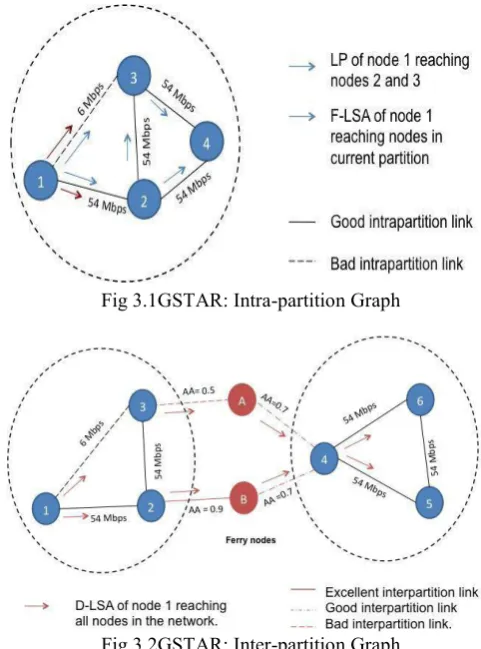
Existing ad-hoc and DTN routing protocols handle some of the challanges inherent with mobile devices. But, a uni_ed approach for dealing with all kinds of network environments within a future Internet framework has yet to be explored.GSTAR is a proactive link state protocol, with added DTN capabilities. It is a combination of MANET and DTN routing techniques with in-network storage. Basically,GSTAR aims at overcoming the following three challenges associated with mobile devices:
Fluctuations in link quality
Varying levels of connections and disconnections
Partitions in the network
GSTAR to maintain an up-to-date view of the ne-grained changes in the network.
Fig 3.1GSTAR: Intra-partition Graph
Fig 3.2GSTAR: Inter-partition Graph
IV.MOBILITY FIRST ROUTING LAYER
In this section, we utilize these principles 1The actual sizes of the memory stores would need to be scaled depending on transit block sizes and the general network load. PDU structure (data size can be large)to show how both global and local scale routing can be efficiently done in the MobilityFirst network. To achieve a scalable, mobility-centric solution, our system utilizes both names (i.e., GUIDs) and addresses cooperatively. Since we envision a purely packet-switching architecture, the header containing name and address information may be larger than current IPv4 packet headers.
Fig 4.1 PDU structure (data size can be large)
3 presents a high-level illustration of MobilityFirst routing PDUs.With the previously mentioned principles in mind, we now discuss how GUIDs and network addresses are used in combination to route data through MobilityFirst networks. To illustrate the fact that our approach can be implemented as a “clean-slate” architecture or integrated with
current IP,IP addresses are used as the low-level network addresses in this section.
V. RESULT
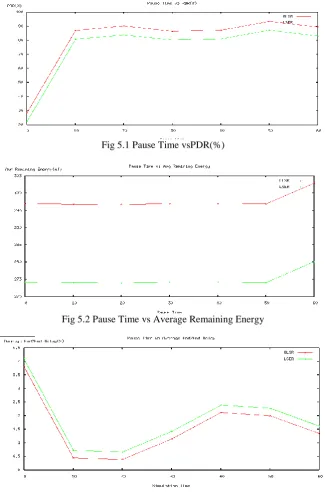
In the fig 5.1, it shows the graph of pause time vsPDR(%) and fig 5.2 shows pause time vs average remaining energy.
Fig 5.1 Pause Time vsPDR(%)
Fig 5.2 Pause Time vs Average Remaining Energy
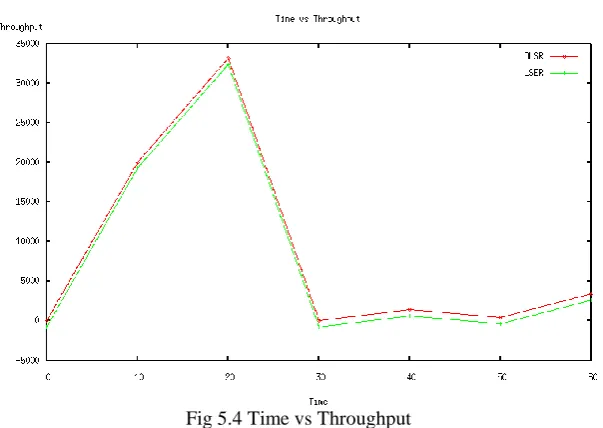
Fig 5.4 Time vs Throughput
VI.CONCLUSION
In this paper we present the design and implementation of a host stack for a future Internet architecture, Mobility First, to address many challenges faced by today’s IP stack. The novel design features ofMobility First include: location independent naming for network objects; simultaneous and converged access to multiple networks for mobile hosts; robust and efficient data delivery to mobile hosts despite unreliable access networks; and native support for new generation of content and context applications. The evaluation of the host stack supporting these features shows significant performance improvement (e.g. 30% reliable file transfer compared against/IP) and flexible in-network mobility support (e.g. multihoming with user-configurable mobility policies). We would like to direct you to for more recent progress and findings about Mobility First project. In the future, we plan to explore context centric applications including for vehicular contexts. Extensions to interface sensor platforms are also being pursued. The prominence of wireless, mobile devices on the Internet today has motivated numerous protocols and architectures, such as the Mobility First Future Internet Architecture project. In this work, we present a robust, local-scale, storage-aware routing approach, called GSTAR, for use in Mobility-First networks. GSTAR unifies techniques from MANET and DTN routing protocols. This unification with in-network storage enables it to overcome mobility-related challenges such as link quality variation, node disconnection, and network partitioning. Through NS3-based simulation, we show that GSTAR outperforms traditional link-state protocols for both wireless and hybrid wired-wireless network environments.
REFERENCES
[1] G. Bhanage, A. Chanda, J. Li, and D. Raychaudhuri. Storage aware routing protocol for the mobilityfirst network architecture. In European Wireless,DTN Session, 2011.
[2] S. Gopinath, S. Jain, S. Makharia, and D. Raychaudhuri. An experimental study of the cache-and-forward network architecture in multi-hop wireless scenarios. In Proc. of LANMAN, 2010.
[3] R. Ramanathan, R. Hansen, P. Basu, R. Rosales-Hain, and R. Krishnan. Prioritized epidemic routing for opportunistic networks. In Proc. of MobiOpp, 2007.
[4] M. R. Ra, J. Paek, A. B. Sharma, R. Govindan, M. H. Krieger, and M. J. Neely. Energy-delay tradeoffs in smartphone applications. In Proc. of MobiSys, 2010.
[5] J. Whitbeck and V. Conan. HYMAD: Hybrid DTN-MANET routing for dense and highly dynamic wireless networks. Comp. Commun., 33, August 2010.
[6] M. Li, D. Agrawal, D. Ganesan, and A. Venkataramani. Block-switched networks: a new paradigm for wireless transport. In Proc. of NSDI, 2009.