Throughput Maximization Using Spatial
Reusability in Multi-Hop Wireless
Prerna Borane, V. K. Patil
ME Student, Department of Electronics and Telecommunication, D. N. Patel College of Engineering Shahada,
Nandurbar, MH, India.
Professor, Department of Electronics and Telecommunication, D. N. Patel College of Engineering Shahada, Nandurbar,
MH, India.
ABSTRACT: Proposed system spatial reusability aware, the difficulty of routing in multi-hop wireless networks, to achieve high end-to-end throughput, it is adamantine to discover the optimal path from the source node to the destination node.However a large number of routing protocols has been implemented to find the path with minimum transmission time for sending a single packet, such transmission time reduces protocols cannot be guaranteed to derive high end-to-end throughput. Spatial reusability aware routing in multi hop wireless network is present by considering spatial reusability of the wireless communication media. Spatial reusability-aware single-path routes and any path routing protocols, and compare them with existing single-path routing and any path routing protocols, respectively. Our appraisal results show that our protocols significantly improve the end-to-end throughput compared with previous protocols. In proposed system security technique is used for key generation and also sink node share i.e. acoustic mode. Specifically, for single-path routing, the median throughput gain is up to 70 percent, and for each source-destination pair, the throughput gain is as high as 6.8x; for anypath routing, the maximum per-flow throughput gain is 80 percent, while the median gain is up to 15 percent.
KEYWORDS- Hop to Hop to communication, Protocol design, Routing, Wireless network, Security, Throughput Maximization.
I. INTRODUCTION
II. REVIEW OF LITERATURE
1. An Optimization Framework for Opportunistic Multipath Routing in Wireless Mesh Networks.
Refer Points-
This paper proposes an optimization framework for addressing questions of multi-path routing in wireless mesh networks. We have extended existing work by incorporating the broadcast nature of wireless.
2.An Interference-Aware Channel Assignment Scheme for Wireless Mesh Networks.
Refer Points-
In this paper, we discover the problem of finding the largest number of links that can be activated one by one in a Wireless Mesh Network subject to interference, radio and connectivity constraints. Our goal is to activate all such links and we current an interference aware channel assignment algorithm that realizes this goal.
3.Model-Driven Optimization of Opportunistic Routing. Refer Points-
In this paper, we present the first protocol that can correctly optimize the performance of opportunistic routing in IEEE 802.11 networks. Our framework consists of three key components: 1) a simple, however effective, wireless network model to support optimization; 2) a novel algorithm for optimizing several performance objectives; and 3) an opportunistic routing protocol that effectively maps solutions resulted from our optimization into practical routing configurations.
4.Physical Carrier Sensing and Spatial Reuse in Multirate and Multihop Wireless Ad Hoc Networks.
Refer Points-
In this paper, we discover the impacts of these factors as well as different other crucial factors, such as SINR (signal to interference plus noise ratio), node topology, hidden/exposed terminal problems and both direction handshakes, on finding the optimum carrier sensing range to maximize the throughput through both analysis and simulations.
5.A High-Throughput Routing Metric for Reliable Multicast in Multi-Rate Wireless Mesh Networks.
Refer Points-
In this paper, we have proposed EMTT as a robust metric for derive high-performance multicast routing in multi-rate WMNs. EMTT captures the collected effects of 1) MAC-layer retransmission-based reliability, 2) transmission rate diversity. 3) Wireless broadcast advantage and 4) link quality awareness.
6.Estimation of Link Interference in Static Multi-hop Wireless Networks. Refer Points-
7.CodeOR: Opportunistic Routing in Wireless Mesh Networks with Segmented Network Coding.
Refer Points-
Opportunistic routing significantly enhance unicast throughput in wireless mesh networks by effectively using the wireless broadcast medium. With network coding, opportunistic routing can be implemented in a simple and practical route without resorting to a complicated scheduling protocol.
IIII. SOFTWARE REQUIREMENT SPECIFICATION
Software:-
Operating System : XP, Windows7 Coding language : JDK7.0 Tool : Eclipse Luna Non-Functional Requirement
1 Performance
There are many different ways to measure the performance of a network, as each network is different in nature and design. Performance measuring in bandwidth, throughput, latency, jitter and error rate etc.
2 Scalability
Scalability is the capability of a system, network, or process to handle a growing amount of work, or its potential to be
enlarged in order to accommodate that growth.For example, it can refer to the capability of a system to increase its total output under an increased load when resources (typically hardware) are added.
3 Capacity
Wireless carriers are pushed to increase network capacity to accommodate user demand for high-bandwidth services. 4 Availability
When data is not secure and easily available, information security is affected, i.e., top secret security clearances. Another factor affecting availability is time.
5 Reliability
A reliable protocol provides reliability properties with respect to the delivery of data to the intended recipient(s), as opposed to an unreliable protocol, which does not provide notifications to the sender as to the delivery of transmitted data.
6 Security
Network security involves the authorization of access to data in a network, which is controlled by the network administrator.
IV. MATHEMATICAL MODEL
Let us consider S as a set Spatial reusability aware routing ….
Let be the link delivery probability from node i to node j, i.e., if a packet is transmitted from node i to node j, then with probability the packet can be decoded. That is to say, to deliver a packet from node i to node j, node i is expected to do
= ×
Let and Tack denote the transmission time of a data packet and an acknowledgment, respectively. Then, the expected time to deliver a packet from node i to node j is
= × =
∈ ( )
Given a set of non-interfering hyperlinks , which can work simultaneously without any interference, we can calculate the fused cost of set as the largest expected hyperlink delivery time in the set:
c( ) = max { ̅ |( , ) }
Consequently, given a collection I of all the sets of non interfering hyperlinks, the total cost for delivering a packet from the source to the destination is:
= ∑ ( ).
1. Network Creation
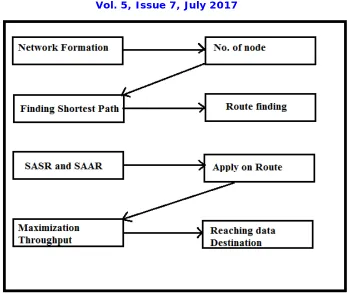
Network Creation is first module in this module system perform is that network formation with the help of input like no. of nodes, source node and destination node, message etc.
2. Shortest Path
This is second module system perform find shortest path with help of shortest path
3. SASR and SAAR
In this module find multiple shortest paths.
4. Throughput
2,000 meter area, and considered two data rates of 802:11, including 11 and 54 Mbps. We used CBR to generate 1; 500-byte packets at high enough rates. In addition, RTS/CTS is turned off in all the simulations.
Number of flows (a) Data Rate: 28 Mbps
Number of flows (b) Data Rate: 60 Mbps
Fig. Average throughputs with multiple concurrent flows.
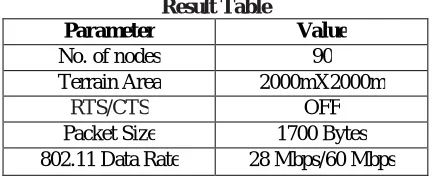
Result Table
Parameter Value
No. of nodes 90
Terrain Area 2000mX2000m
RTS/CTS OFF
Packet Size 1700 Bytes
VI. COMPARISON WITH SIMILAR SYSTEM
Existing System
In An ad hoc network wireless sensor nodes dynamically forming a network without the use of any existing network infrastructure administration. Which limit transmission range of wireless network devices, multiple networks "hops" may be needed for one node to exchange data with another across the network. So existing work proposed, a variety of new routing protocols targeted specifically at this environment have been developed, but little performance information on each protocol and no realistic performance comparison between them is available.
Disadvantage of Existing system
1) Energy consumption was bigger challenge to wireless sensor network.
2) In multi hop communication secure data transmission with less cost is ignored.
3) Existing infrastructure is expensive or inconvenient to use, wireless mobile users may still be able to communicate through the formation of an ad hoc network.
VII. PROPOSED SYSTEM
In this paper, the spatial reusability concept novel method is discovering with the spectrum spatial reusability in any path routing. In our paper using several algorithms such as SASR, SAAR and euclidean distance algorithm, and AES for key generation algorithm. Propose SAAR algorithm for participating node selection, cost calculation, and forwarding list determination. We have designed SASR algorithms and SAAR algorithm with different data rates in network simulator. The evaluation results show that our algorithms works improvement to end-to-end throughput compared with existing ones. Specifically, for single-path routing, a throughput gain up to 6.4x with a median of more than 70 percent is achieved in the case of single-flow, and an average gain of more than 20 percent is achieved with multiple flows; for any path routing, a median gain of 14.6 percent and the maximum gain up to 81.6 percent can be realized. Proposed work presents the results of a detailed packet-level simulation comparing four multi-hop wirelesses ad hoc network routing protocols that cover a range.
Advantages of Proposed System
1. Increase overhead deduction in multi-hop wireless networks.
2. Key generation for security during packet transmission.
Fig. System Architecture
Efficiency
Consequently, given a collection I of all the sets of non interfering hyperlinks, the total cost for delivering a packet from the source to the destination is:
= ∑ ( ).
In this system, main aim is that throughput maximization with help of SASR and SAAR algorithm for single path and any path finding and increase throughput.
VIII. CONCLUSION
REFERENCES
[1] A. Adya, P. Bahl, J. Padhye, A. Wolman, and L. Zhou, “A multi radio unification protocol for IEEE 802.11 wireless networks,” in Proc. 1st Int. Conf. Broadband Netw.,2004, pp. 344–354.
[2] K. N. Ramachandran, E. M. Belding, K. C. Almeroth, and M. M. Buddhikot, “Interference-aware channel assignment in multiradio wireless mesh networks,” in Proc. 25th IEEE Int. Conf. Comput. Commun., 2006, pp. 1–12.
[3] E. Rozner, M. K. Han, L. Qiu, and Y. Zhang, “Model-driven optimization of opportunistic routing,” IEEE/ACM Trans. Netw., vol. 21, no. 2, pp. 594–609, Apr. 2013.
[4] H. Zhai and Y. Fang, “Physical carrier sensing and spatial reuse in multirate and multihop wireless ad hoc networks,” in Proc. IEEE 25th IEEE Int. Conf. Comput. Commun., 2006, pp. 1–12.
[5] X. Zhao, J. Guo, C. T. Chou, A. Misra, and S. Jha, “A high-throughput routing metric for reliable multicast in multi-rate wireless mesh networks,” in Proc. INFOCOM, 2011, pp. 2042–2050.
[6] J. Padhye, S. Agarwal, V. N. Padmanabhan, L. Qiu, A. Rao, and B. Zill, “Estimation of link interference in static multi-hop wireless networks,” in Proc. Internet Meas. Conf., 2005, p. 28.
[7] Y. Lin, B. Li, and B. Liang, “Codeor: Opportunistic routing in wireless mesh networks with segmented network coding,” in Proc. IEEE Int. Conf. Netw. Protocols, 2008, pp. 13–22.
[8] R. P. Laufer, H. Dubois-Ferri_ere, and L. Kleinrock, “Multirate anypath routing in wireless mesh networks,” in Proc. INFOCOM, 2009, pp. 37– 45.
[9] T.-S. Kim, J. C. Hou, and H. Lim, “Improving spatial reuse through tuning transmit power, carrier sense threshold, and data rate in multihop wireless networks,” in Proc. 12th Annu. Int. Conf. Mobile Comput. Netw., 2006, pp. 366–377.