Scholarship@Western
Scholarship@Western
Electronic Thesis and Dissertation Repository
6-13-2014 12:00 AM
Protecting Personal Private Information in Collaborative
Protecting Personal Private Information in Collaborative
Environments
Environments
David S. Allison
The University of Western Ontario Supervisor
Miriam Capretz
The University of Western Ontario
Graduate Program in Electrical and Computer Engineering
A thesis submitted in partial fulfillment of the requirements for the degree in Doctor of Philosophy
© David S. Allison 2014
Follow this and additional works at: https://ir.lib.uwo.ca/etd
Part of the Electrical and Computer Engineering Commons
Recommended Citation Recommended Citation
Allison, David S., "Protecting Personal Private Information in Collaborative Environments" (2014). Electronic Thesis and Dissertation Repository. 2105.
https://ir.lib.uwo.ca/etd/2105
This Dissertation/Thesis is brought to you for free and open access by Scholarship@Western. It has been accepted for inclusion in Electronic Thesis and Dissertation Repository by an authorized administrator of
Protecting Personal Private Information in Collaborative
Environments
(Thesis format: Monograph)
By
David S. Allison
Graduate Program in Engineering
Department of Electrical and Computer Engineering
A thesis submitted in partial fulfillment
of the requirements for the degree of
Doctor of Philosophy
The School of Graduate and Postdoctoral Studies
Western University
London, Ontario, Canada
ii
The ability to collaborate has always been vitally important to businesses and enterprises. With the availability of current networking and computing power, the creation of Collaborative Working Environments (CWEs) has allowed for this process to occur anytime over any geographical distance. Sharing information between individuals through collaborative environments creates new challenges in privacy protection for organizations and the members of organizations. This thesis confronts the problems when attempting to protect the personal private information of collaborating individuals.
iii
collaborators are provided these privacy protections in a way that is easy to use and understand and use.
iv
Keywords
v
Acknowledgements
This thesis has been a long journey that has spanned continents, and would not have been possible without the great help of many people. I would like to first acknowledge and thank my supervisors, Dr. Miriam Capretz, Dr. Saïd Tazi, and Dr. Khalil Drira.
Dr. Capretz is an Associate Professor at Western University and my original supervisor. Dr. Capretz has impacted my university career more than anyone else, and is a constant source of inspiration to me. Dr. Capretz has always been there to encourage, push and challenge me. I have learned what a great researcher, professor and mentor should be from her example.
Dr. Tazi is an Associate Professor at the University Toulouse1 Capitole, and research senior at LAAS-CNRS laboratory in Toulouse, France. Dr. Drira is the Research Director at the French National Center for Scientific Research. Both Dr. Tazi and Dr. Drira
became my co-supervisors when I began my cotutelle program. I have learned a great deal from both of them, and have been humbled by their generosity, patience and support. I had many questions and required much assistance when I first moved to France, and both Dr. Tazi and Dr. Drira always found time to help. To Dr. Tazi, with whom I worked alongside in our lab on a daily basis, I learned much from you and thank you for your ideas, assistance and encouragement.
I also thank Aymen Kamoun, a fellow researcher at LAAS-CNRS with whom I worked closely during my time spent in France. Aymen's input was invaluable and his assistance significantly improved my own research and the work presented in this thesis. Outside of research, Aymen was a great assistance and friend during my stay in France, assisting me in many tasks, small and large. Aymen was working on his own Ph.D. thesis during my time in France, yet he was always available to help and this will always be appreciated. I thank Dr. Hany ElYamany, Assistant Professor at Suez Canal University who I was fortunate to have visit during my final year as a visiting professor at Western University. I had previously worked with Dr. ElYamany and found we always make a good team. This turned out to be the case once again, and I will always be thankful for his support, input and judgment.
I would like to thank Ellen Coker for her love and support. I also would like to thank her for agreeing for some reason to become my wife during the writing of this thesis. I would not have been able to complete this thesis or have journeyed to France without her. It has not been the easiest of experiences and she has sacrificed many things to help me, all of which I have noticed and will always appreciate. I could not have asked for a better partner in life, I love you and would like to dedicate this work to you.
vi
I also thank my brother Kevin Allison, for his love and support as well. Kevin has always been there for me and during this thesis was no exception. During the time it took to complete this thesis I have watched you start and raise your own great family, which I think is even more impressive.
I thank Bill and Jane Coker for so warmly welcoming me into the Coker family. They both provided so much help and encouragement over the course of this thesis and have always treated me like their own son. To the late, great Bill Coker, I will always
remember the encouragement you gave me to pursue this degree and the stories of your own Ph.D. experience. Ellen and I both love you and miss you.
I would also like to thank at LAAS-CNRS Ernesto Exposito, Codé Diop and Mohamed Zouari for their friendship and assistance, as they were all a great help to my research and to my adjustment to life in France.
Katarina Grolinger and Vinson Wang are other colleagues at Western University who I would like to give recognition to for their assistance in making this work possible. Thank you as well to the many professors and teachers who have helped and educated me over the many years, each of you played a part in this thesis as well.
vii
Table of Contents
Abstract ... ii
Keywords ... iv
Acknowledgements ... v
Table of Contents ... vii
List of Figures ... xi
List of Appendices ... xiii
List of Abbreviations ... xiv
Chapter 1 ... 1
Introduction ... 1
1.1 Motivation ... 2
1.2 Thesis Contributions ... 3
1.3 The Organization of the Thesis ... 6
Chapter 2 ... 9
Literature Review... 9
2.1 Collaboration Work Environments ... 9
2.2 The Evolving Definition of Privacy ... 10
2.3 Privacy in Legislation... 12
2.3.1 Organization for Economic Co-operation and Development ... 13
2.3.2 Canada ... 15
2.3.3 Europe ... 17
2.4 Privacy in Collaboration... 18
2.5 Collaboration as a Tool ... 20
2.6 Other Attempts at Privacy for CWEs ... 22
2.7 Addressing Privacy Challenges ... 25
2.7.1 Domain Specific Legislation ... 25
2.7.2 Safeguarding Personal Information ... 26
2.7.3 Providing Transparency ... 27
2.7.4 The Right to be Informed ... 27
2.8 Architectural Impacts on Privacy ... 28
2.9 Approaches for Separate Issues of Privacy ... 30
2.10 Summary ... 31
viii
Collaborative Privacy Architecture ... 33
3.1 Interacting Actors ... 34
3.2 Privacy Layer ... 35
3.2.1 Privacy Elements, Rules and Policies... 36
3.2.2 Generic Privacy Ontology (GPO) ... 39
3.2.3 Conflict Engine Rules ... 46
3.2.4 Collaborative Privacy Manager Definition ... 47
3.2.5 Privacy Guidelines ... 48
3.3 Collaboration Layer... 48
3.3.1 Generic Collaboration Ontology (GCO) ... 49
3.4 Application Layer ... 51
3.4.1 Domain Collaboration Application ... 52
3.4.2 Domain Ontology ... 52
3.4.3 Domain Collaborative Privacy Manager ... 54
3.4.4 Conflict Engine ... 55
3.5 Reasoning Layer ... 55
3.6 Messaging Layer ... 58
3.6.1 Deployment Service Manager ... 58
3.6.2 Session Manager ... 58
3.6.3 Channel Manager ... 59
3.7 Infrastructure Layer ... 59
3.7.1 Environment Configuration ... 59
3.7.2 Message Catalogue ... 59
3.7.3 Ontology Repository... 60
3.7.4 Service Catalogue ... 60
3.8 Summary ... 61
Chapter 4 ... 62
Collaborative Privacy Architecture Design ... 62
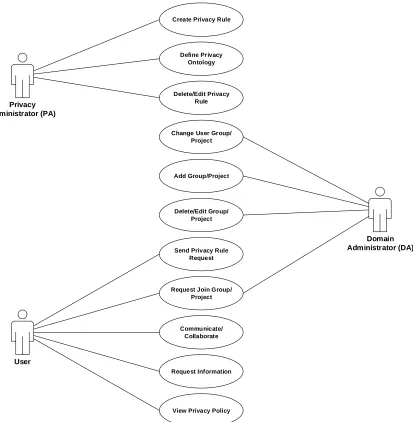
4.1 Use Case ... 62
4.1.1 Use Case: Create Privacy Rule ... 63
4.1.2 Use Case: Define Privacy Ontology ... 64
4.1.3 Use Case: Delete/Edit Privacy Rule ... 65
4.1.4 Use Case: Change User Group/Project ... 66
ix
4.1.6 Use Case: Delete/Edit Group/Project ... 67
4.1.7 Use Case: Send Privacy Rule Request ... 68
4.1.8 Use Case: Request Join Group/Project ... 68
4.1.9 Use Case: Communicate/Collaborate ... 69
4.1.10 Use Case: Request Information ... 69
4.1.11 Use Case: View Privacy Policy ... 71
4.2 Use Case Scenarios ... 72
4.2.1 Initial Domain Setup ... 72
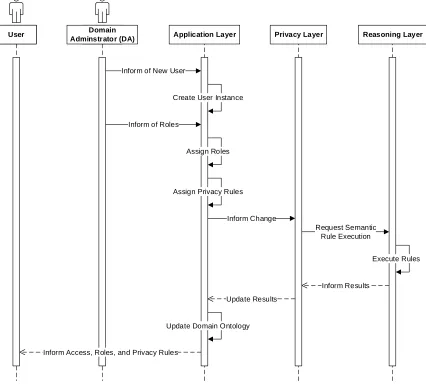
4.2.2 Addition of New User... 74
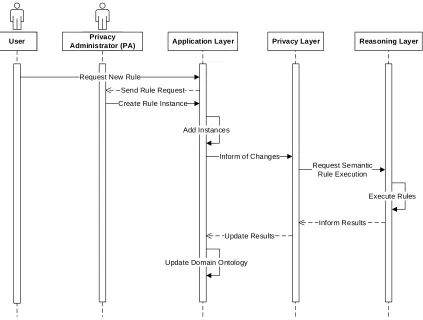
4.2.3 Addition of a New Privacy Rule ... 76
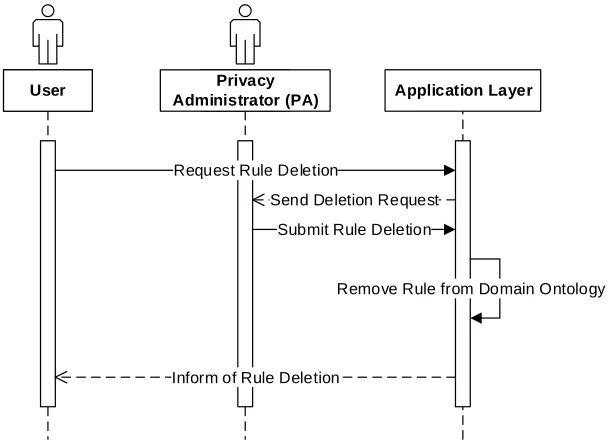
4.2.4 Deletion of a Privacy Rule ... 77
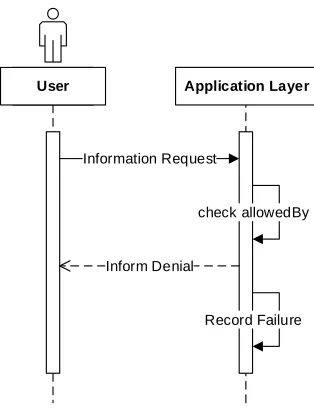
4.2.5 Information is Denied, Not the Correct Allowance ... 77
4.2.6 Information is Denied, Not the Correct Conditions ... 78
4.2.7 Information Request is Accepted ... 79
4.2.8 User is Added to a Group or Project ... 80
4.3 Summary ... 82
Chapter 5 ... 83
Collaborative Privacy Manager ... 83
5.1 Collaborative Privacy Manager Architecture ... 83
5.1.1 User Interface ... 84
5.1.2 Domain Ontology ... 85
5.1.3 Privacy Management Level ... 85
5.1.4 Application Requirements Level ... 87
5.1.5 Enforcement Environment Level... 87
5.2 Summary ... 88
Chapter 6 ... 89
Case Study and Implementation ... 89
6.1 Case Study ... 89
6.1.1 Privacy Ontology Creation ... 91
6.1.2 Collaborative Privacy Manager ... 92
6.1.3 FIPPA ... 94
6.1.4 PHIPA ... 96
6.1.5 Privacy Policies ... 99
x
6.2.1 Scenario One - Collaborative Domain Creation ... 101
6.2.2 Scenario Two - Requesting Private Information ... 108
6.2.3 Scenario Three - Addition of New Privacy Rule ... 110
6.2.4 Scenario Four - Removal of Privacy Rule ... 113
6.3 Experimental Evaluation ... 114
6.3.1 Increasing Number of Users ... 115
6.3.2 Concurrent Projects ... 118
6.4 Summary ... 122
Chapter 7 ... 123
Conclusions and Future Work ... 123
7.1 Conclusions ... 123
7.2 Future Work ... 126
Bibliography ... 131
Appendix A ... 137
Appendix B ... 138
xi
List of Figures
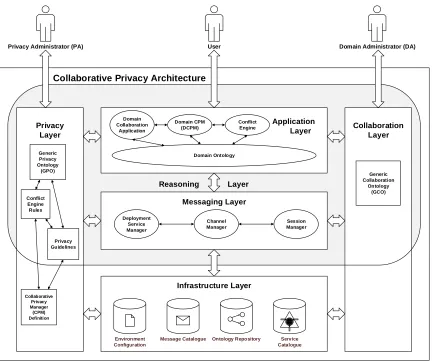
3.1 Layers, Components and Actors within the Collaborative Privacy Architecture..34
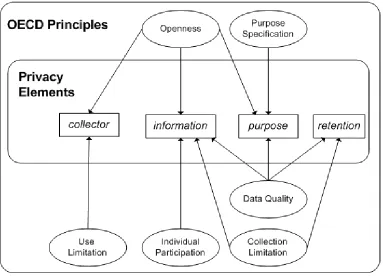
3.2 Selection of Privacy Elements from OECD Principles………37
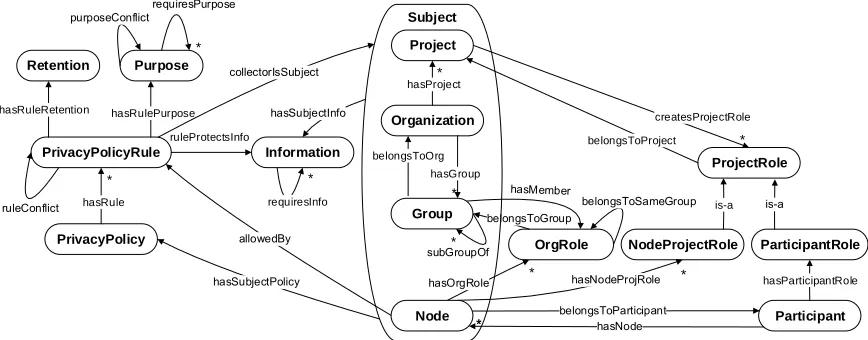
3.3 Concepts and Relations of the Generic Privacy Ontology (GPO)………39
3.4 Concepts and Relations of the Generic Collaboration Ontology (GCO)………51
4.1 Available Use Cases for Actors within Collaborative Privacy Architecture.……63
4.2 Sequence of Events during an Initial Domain Setup.………74
4.3 Sequence of Events during the Addition of a New User...………75
4.4 Sequence of Events during the Addition of a New Privacy Rule..………76
4.5 Sequence of Events during the Deletion of a New Privacy Rule..………77
4.6 Sequence of Events when Information is Denied due to Incorrect Allowance.…78 4.7 Sequence of Events when Information is Denied due to Incorrect Conditions.…79 4.8 Sequence of Events during a Successful Information Request..………80
4.9 Sequence of Events when a User is Added to a Project………81
5.1 Architecture of the Domain Collaborative Privacy Manager………84
6.1 CWE Scenario involving a University and a Hospital...………91
6.2 Software Packages Present within the CPM..………92
6.3 Snapshot of a Privacy Rule in the Protégé Editor………100
6.4 University and Hospital Example Domain Ontology Part 1………102
6.5 University and Hospital Example Domain Ontology Part 2………102
6.6 Privacy Policy Examples from the University and Hospital Scenario…………106
6.7 SWRL Rule Determining Access via Privacy Rule, According to Project.……106
xii
6.9 SWRL Rule Determining Access via Privacy Rule, According to Node………107
6.10 Results from Node Level Access SWRL Rule………107
6.11 Information Request Business Process Diagram.………109
6.12 Add Privacy Rule Request Business Process Diagram………110
6.13 Updated Privacy Policy Examples from the University and Hospital Scenario..112
6.14 Updated Results from Node Level Access SWRL Rule..………112
6.15 OWL Rule Allowing Access to Research of GraduateStudent_A...………114
6.16 Time to Export vs. Total Users………116
6.17 Time to Execute Rule Engine vs. Total Users………117
6.18 Time to Transfer Inferred Axioms to OWL Model, Users………118
6.19 Time to Export vs. Total Projects………119
6.20 Time to Execute Rule Engine vs. Total Projects………120
xiii
List of Appendices
xiv
List of Abbreviations
API Application Programming Interface BSCW Basic Support for Cooperative Work CPM Collaborative Privacy Manager CPU Central Processing Unit
CWE Collaborative Working Environment DA Domain Administrator
DCPM Domain Collaborative Privacy Manager EU European Union
FIP Fair Information Practices
FIPPA Freedom of Information and Protection of Privacy Act GCO Generic Collaboration Ontology
GDPR General Data Protection Regulation GPO Generic Privacy Ontology
GUI Graphical User Interface
IDE Integrated Development Environment IP Internet Protocol
NIST National Institute of Standards and Technology
OECD Organisation for Economic Co-operation and Development OWL Web Ontology Language
P3P Platform for Privacy Preferences PA Privacy Administrator
PbD Privacy by Design
PHI Personal Health Information
PHIPA Personal Health Information Protection Act PIA Privacy Impact Assessment
PIAF Privacy Impact Assessment Framework PII Personally Identifiable Information
PIPEDA Personal Information Protection and Electronic Documents Act RBAC Role-Based Access Control
Chapter 1
Introduction
The ability to create dynamic, collaborative environments is essential to highly networked organizations. Pooling together the resources and talents of a group of people allows for complex problems and projects to be completed. The current state of networking and software technology allows this collaborative process to extend beyond the traditional common workplace. Collaborative Working Environments (CWEs) are distributed software applications and platforms that support both individual and group shared work in many areas, including research, business and learning [41]. CWEs allow for collaboration between individuals over vast geographical distances, and between individuals of differing enterprises. Within the CWE, individuals can be organized into groups and projects in order to complete tasks.
these privacy policies to be processed during the collaboration. CWEs are dynamic environments, where an individual collaborator can change their role, task or who they are collaborating with during runtime. This dynamicity requires that any privacy protection system for CWEs must be able to determine and infer how information should be shared as the situation changes. This thesis focuses on providing a privacy solution that can determine how information is to be shared in collaborative working environments.
1.1 Motivation
Identifiable Information (PII). PII is defined as any information that uniquely and directly identifies an individual [51]. Such information provides a one-to-one relationship between the information and the individual to whom it relates, such as an employee, credit card or social insurance number.
Protecting privacy in a collaborative environment produces unique challenges, different from a typical privacy scenario. Traditional privacy protection solutions focus on one-to-one, or one-to-many situations where a single large entity uses the information of an individual or group of individuals. Such situations are typical in a consumer-provider scenario, where it is often adequate to only be concerned with privacy violations made by the larger collecting entity. This singular focus is no longer sufficient when dealing with a collaborative environment [64]. Collaborative environments are many-to-many situations where every individual poses a possible privacy risk. An additional challenge with collaborative environments is that the individuals collaborating are dynamic. This dynamicity allows a collaborating individual to enter and exit the CWE, and change their roles, groups and projects while collaborating. A solution for privacy in CWEs must be able to maintain its ability to determine who has access to what information and why, as the environment changes. The solution should also be able to detect any conflicts that may occur between privacy rules that are created.
1.2 Thesis Contributions
new knowledge within the domain. This new knowledge is stored within the domain ontology in the form of new relationships between instances of the domain concepts. A privacy ontology is able to model the relationships between collaborating individuals and their private information according to privacy policies. This privacy ontology also contains a definition of what these privacy policies should be. Privacy policies allow individuals, through a set of privacy rules, to properly outline how their private information should be accessed and used by others. Each privacy rule consists of privacy elements that describe how each piece of private information may be used by another individual. What elements are required for information within a collaborative environment and why they are required is presented and explained. This ontology should be able to accommodate privacy guidelines and legislations in order to satisfy real world conditions placed on organizations. The creation of a privacy ontology will allow our solution to be integrated with an ontology for collaborative communication through sessions [32], to create a solution for enabling collaborative work while taking privacy principles into account. To the best of our knowledge, ontologies have not been used before to express concepts and relations amongst privacy and collaboration.
individual does not become overwhelmed by the privacy solution, as this occurrence can cause individuals to abandon the collaboration.
These goals are provided through the creation of a collaborative privacy architecture. This architecture provided in this thesis must be able to operate in dynamic, many-to-many environments, and be compatible with any implementation standard. Dynamicity is a strength of collaboration, as it allows new projects to be worked on and completed during runtime. Maintaining privacy as the situation changes is important to maintain this strength. Allowing the use of any standard approach in implementing this solution allows the solution to reach a wider audience, and ensures compatibility for many different domains. The solution provided in this thesis allows services to be used within the architecture to provide the collaborators with different functionalities according to the requirements of the domain. These abilities allow the solution to operate in collaborative environments with varying size and complexity.
In this thesis, a focus is placed on dynamic adaptation in collaborative environments where the collaborators can play one or more roles and belong to one or more groups or projects. The communication of the collaborators are organized depending on their current roles, both within an organization and within projects. A set of interconnected components are deployed for use by the individuals in a flexible way so that the individual collaborators can dynamically change their roles during the collaborative activity. To assist with the managing of privacy within this dynamic activity, another goal of this thesis is to introduce and describe the Collaborative Privacy Manager (CPM) service [3]. The CPM is designed to provide a set of privacy management functions that assist collaborators within organizations, groups and projects. The architecture of the CPM, consisting of several levels and modules, is introduced. As collaborative environments depend on the interaction between many individuals, the proper protection of private information within a collaborative environment is vital. This thesis presents a generic collaborative privacy architecture that provides organizational systems with the ability to allow for: (1) the collaboration of individuals that is domain independent, and (2) the protection of private information both within an organization and between different organizations.
1.3 The Organization of the Thesis
This thesis is divided into several chapters as follows:
collaborative environments is also presented. This chapter also contains a review of current approaches of privacy protection, both inside and outside the domain of collaborative environments. Initial research that examines the problem of providing privacy in collaborative environments is first presented. This is followed by works that use collaboration itself as a solution to providing privacy protection in some domains. Next, other solutions to providing privacy in collaborative environments are presented, and how these approaches differ from the work in this thesis. Finally, this chapter concludes with an examination of how privacy is dealt with in the legal domain by different countries around the world.
conflicts can be dealt with in policies, and what reasoning abilities the architecture contains.
Chapter 4 explains the behaviour of the collaborative privacy architecture. This is presented through a set of use cases and scenarios. This chapter presents the important ideas of how the layers within the architecture communicate and interact.
Chapter 5 describes the Collaborative Privacy Manager (CPM). The architecture for this service is shown and detailed to highlight what components it consists of and how these components interact, along with the base functionality of the CPM. This chapter serves to describe why the CPM is an important part of the collaborative privacy architecture and how it assists in the protection of privacy within a collaborative environment.
Chapter 6 contains a case study and implementation details of the collaborative privacy architecture. This case study involves the collaboration of a university and hospital for the purposes of medical research and is presented and explained in order to highlight how the architecture works in conjunction with a collaborative environment to protect the privacy of collaborating individuals. Results and measurements from the operation of the architecture are presented in this chapter.
Chapter 2
Literature Review
In this chapter a literature review is presented focusing on the relevant concepts and ideas of this thesis. This review includes looking individually at collaborative working environments and privacy, in order to demonstrate how these concepts are currently being considered. Other approaches for providing privacy in collaborative environments are also presented. The interaction between collaboration and privacy are examined in related fields, in order to provide further ideas and context. For example, collaboration has been used as a means to provide privacy and this provides a useful example of how the fields of privacy and collaboration can be tied together. Many techniques used for providing privacy through collaboration are used in creating a privacy solution for collaboration. As well, much research has been done into the issue of privacy in other areas, and from this work many important ideas and lessons can also be learned. To this end, some works outside the domain of collaborative environments are also examined in this chapter.
2.1 Collaboration Work Environments
inter-organization boundaries [66]. This interaction within a CWE can unite individuals over large geographical distances, as well as uniting individuals who work for separate organizations. Within the CWE, groups and sub-groups can be used to bring together individuals with a common specialization or function. Projects can be used to bring together diverse individuals to tackle specific tasks.
As with any software system, a CWE must meet many functional and non-functional requirements in order to be successful and productive. Functional requirements are needs that define what the CWE is required to do, such as being able to share a specific file, or being able to support synchronous communication. Non-functional requirements define constraints and qualities upon the CWE, such as the environment's availability or reliability. When comparing functional to non-functional requirements, the problems surrounding non-functional requirements often require more thought and planning to solve, as these issues can be vague and difficult to quantify. This thesis focuses on one such non-functional requirement of CWEs, that of providing privacy protection and control for the collaborating individuals. Managing privacy is an important but challenging part of collaborative work [50]. With estimates saying that by 2015 there will be 1.3 billion mobile workers worldwide all requiring some form of CWE [30], the ability to protect privacy in CWEs is quickly becoming essential.
2.2 The Evolving Definition of Privacy
some description of the information owner. For an individual, the most concerning type of private information is Personally Identifiable Information (PII). PII is the most concerning, because the sharing of a single piece of information is enough to directly identify the individual. Groups, projects and organizations must be concerned with the private information of their members.
Further complicating the issue is the subjective nature inherent to privacy. What an individual considers to be private can vary over time, region and between different cultures. What one individual considers private is often not the same as what a different individual would consider as private. Context is very important to privacy; even the same information may require different privacy protection in different contexts [62]. As interactions through networked machines become increasingly commonplace, the easier it becomes to share information between other individuals and parties. The usage of collected information is also a concern of privacy, as privacy requires that information owners have a say over how their personal information is used [82]. Therefore, in this thesis privacy is defined as follows:
Privacy is the ability to keep secret the information about oneself that one does
not wish to share, as well as the ability to retain some level of control over other
personal information that has been willingly shared.
information. Privacy however must also be concerned with how information will be used. Access control can be an important tool in helping to protect privacy, but it is not a complete solution to the problem. One example of how access control fails to provide privacy protection is the ability to infer personal information [31]. Given access to some personal information, it is possible to accurately infer other pieces of personal information. Therefore a straight access control model is not sufficient when attempting to protect specific pieces of information. A proper privacy solution should have the ability to allow individuals to provide only the characteristics they wish to share. Another issue with privacy as access control is that individuals are often unable to predict what the consequences of their privacy policy will be. As such, they are unprepared or unqualified to make every privacy related decision on their own. Traditional access control models do not explicitly handle privacy issues and fail to model the sharing relationships between individuals in a collaborative environment [43].
The idea of some level of control in my presented definition of privacy is described in this thesis as allowing the user to provide notice and choice over how their information will be used. This includes the ability for the information owner to state how the information should be used, and how long it can be used for.
2.3 Privacy in Legislation
where work can take place between different countries. A great many countries around the world contain their own privacy legislation. To place some constraints on the size of the scope presented in this thesis, a focus will be placed on the laws of Canada and the European Union. These two locations were selected as this thesis was created as a joint venture between universities in Canada and France.
2.3.1 Organization for Economic Co-operation and Development
Collection Limitation Principle
This principle states that there must be limits placed on the collection of any personal information. Any information that is collected must be gathered lawfully, with the permission and knowledge of the information subject.
Data Quality Principle
The data quality principle states that personal information may only be collected if the gathered information is relevant to the purpose for which it is required. Any gathered information must also be current, correct and complete.
Purpose Specification Principle
This principle outlines that the reasons for why any personal information is being collected must be specified by the information collector before or at the time of the information collection. If there are any changes to these reasons in the future, the information collector is obligated to inform the information subject.
Use Limitation Principle
The Use Limitation Principle states that any personal information that is collected will only be used for the purposes specified by the Purpose Specification Principle. The only exceptions to this rule are if consent has been given by the information subject, or if a request for the information has been made with the authority of law.
Security Safeguards Principle
Openness Principle
This principle states that the information collector must provide a level of transparency to the information subject regarding the information collection process. Information subjects should also be provided by the collector with a method to inquire about the information that has been collected. These inquiries should allow for the discovery of what personal information has been collected, what kind of information has been collected, the purpose for the information collection, the identity of the information collector, and the location of the information.
Individual Participation Principle
This principle states that the information subjects should be able to determine if any of their information has been collected by an information collector. If information on an individual has been collected, that individual should have the ability to request for their information to be sent to them in an understandable format, in a reasonable amount of time. An information subject should be provided with the ability to challenge the accuracy of the information that has been gathered on them, and if proven correct, this information should be edited or deleted.
Accountability Principle
The Accountability principle states that the information gatherer must be held responsible for ensuring all the above stated principles are followed.
2.3.2 Canada
(PIPEDA) [55] and the Privacy Act [17]. PIPEDA applies to organizations that operate in the private sector, while the Privacy Act applies to federally regulated organizations. PIPEDA was created in the year 2000 and includes ten principles of privacy that were created based on the FIP of the OECD. The data protection requirements of public sector organizations in Canada are covered by provincial legislation, such as the Freedom of Information and Protection of Privacy Act (FIPPA) [22] in Ontario. Private information that is related to health care is covered under a separate act in Canada, the Personal Health Information Protection Act (PHIPA) [23]. Each of these acts outline how private information should be collected, used and disclosed in their respective domain. In a country such as Canada, where more than one piece of privacy legislation are in effect, it is possible for a collaborative environment to join organizations that are covered under different legislations. As such, it is important that a privacy solution include the ability to consider different guidelines and legislations.
2.3.3 Europe
Data privacy legislation for the European Union (EU) is defined according to "Directive 95/46/EC on the protection of individuals with regard to the processing of personal data and on the free movement of such data," [18] more commonly referred to as the Data Protection Directive. The Data Protection Directive was enacted in 1995, and incorporates all eight FIP of the OECD, as described in Section 2.3.1. As with all EU Directives, the Data Protection Directive is not directly binding, but instead it has been used by member countries as a basis to create and enact their own data privacy legislations. The Data Protection Directive once again highlights the importance and influence of the OECD FIP.
that processes data of EU citizens, even if that organization is located in another country. Other changes in the GDPR include that individuals must be able to opt-in to allowing their data to be collected, rather than opt-out. There must be a standard approach to explaining why information is being collected and how it is being used. This new GDPR would introduce sanctions of up to 2% of an organization's annual revenue [77], providing a strong incentive for organizations to follow the privacy regulations.
2.4 Privacy in Collaboration
Collaborative working environments, as the name implies, allow for the collaboration of work between many individuals. The ability to transfer information between many different individuals and groups is the main strength of a CWE, as it allows for the completion of otherwise complicated and distributed work. However this ability also carries with it many concerns related to privacy. As information is passed between collaborating members within a CWE, issues of privacy quickly become apparent. An individual must be able to specify exactly which individual or group of individuals are allowed access to their private information. Similarly, the information that is accessible by others must specify the conditions under which that information may be used.
2.5 Collaboration as a Tool
Instead of providing privacy protection for collaboration, some works examine the idea of providing privacy through collaboration. These works are able to provide useful looks at how the fields of privacy and collaboration can be tied together. As well, many of the techniques used for providing privacy through collaboration will be used in creating a privacy solution for collaboration.
In a work by Hong, Mingxuan, and Shen [26], the authors extend P3P [15] with the goal of representing user privacy preferences for context-aware applications. A markup language is proposed that is suitable for both privacy policies and user preferences. This thesis does not use P3P directly, but instead defines its own privacy policy format which is described within a custom privacy ontology. P3P is not used in this thesis as it was designed specifically for the domain of Web pages, and does not translate well to a collaboration type environment. This is because P3P contains privacy elements that are not required in this thesis, such as a category element that describes the type of information. As well, P3P predefines the possible options for its elements. For example, the purpose tag consists of twelve possible options and a P3P policy can only select one-to-many of these options [15]. In this thesis a more general approach is taken, one which can be extended to fit the needs of different domains. However, P3P and the ontology presented in this thesis have foundations in the same privacy guidelines [60].
making informed decisions about what private information the website being visited requires, and what information will be disclosed. The third component, the data disclosure log, records what information has been shared in past Web exchanges. In the best case scenario, the data disclosure log would allow a Web user to access, change or remove information they have previous shared [39]. This approach is concerned with private information disseminated over the Web, which differs from the work in this thesis. It also deals with privacy policies described using P3P [15], which again differs from the custom privacy policy format and privacy ontology for CWEs used in this thesis. However the ideas presented, making it easy for inexperienced users to create policies, allowing policies to be compared and ranked, and assisting users in making informed decisions, are all important ideas that have influenced the design of the CPM.
2.6 Other Attempts at Privacy for CWEs
collected PII. This differs from the collaborative privacy architecture presented in this thesis which does not collect and analyze personal information. As well, while the work by Korba et al. [40] does discuss the use of privacy policies, it does not detail what these privacy policies should look like, which is done in the work presented in this thesis. Kanovich, Rowe and Scedrov [33] propose an abstract formal model of collaboration which addresses privacy concerns. A state transition system is used in order to model private data through the use of a syntactic convention on a predicate symbol. The goal of this model is to describe how to generate a collaborative plan by providing some privacy guarantees to the participants. The generated collaborative plan is a sequence of transitions which will transform the environment from an initial state into a specific goal state. The work by Kanovich, Rowe and Scedrov [33] has a different definition of privacy than the definition given in this thesis. The authors equate privacy with secrecy, and are focused on developing a proper balance between the protection and release of information and resources [33]. This differs from the approach to privacy taken in this thesis, as privacy is not considered to be just the isolation of private information. Instead, in this thesis privacy includes the ability to understand how information is being used, why it is being used, and to have some influence over these decisions.
document they must check against. Similarly, distributing the access control elements allows both the information collector and the information owner to access the policy decision maker even from different environments. This access will allow for the information collector to check their access rights, and will allow the information owner to change the access rights [10]. The idea of being able to retain a measure of control over information that has been released into a collaborative environment is an important one. This approach by Burnap et al. [10] shows one technical approach to how this could be accomplished. This work differs from the architecture described in this thesis as the access control available through sticky policies only permit access based on roles, and does not take into consideration how an individual may be using the information.
2.7 Addressing Privacy Challenges
Privacy by Design (PbD) is a concept that has recently been embraced by privacy regulators as a solution for privacy problems in the digital world [69]. PbD is a term developed by Ann Cavoukian, the Information and Privacy Commissioner in Ontario, Canada [12]. PbD is defined as "an engineering and strategic management approach that commits to selectively and sustainably minimize information systems' privacy risks through technical and governance controls" [69]. The philosophy behind the PbD approach is that privacy must be embedded directly into the design specification of technologies being developed [12]. The PbD approach says privacy should be considered from the creation of software, and not added on as an afterthought when the software is complete. In order to take privacy protection into consideration when software is still in its design phase, it is important to have a set of guidelines and approaches that can be followed.
In order to discover guidelines for PbD, in 2011 a first of its kind report prepared for the European Commission's Directorate-General Justice reviewed the privacy impact assessment (PIA) methodologies of seven countries and ten PIA case studies [84]. This report created a Privacy Impact Assessment Framework (PIAF) that has been hailed as a "landmark for PbD" [69] because of the solutions it provides to the challenges of designing privacy solutions. In this section, these solutions are discussed along with how they are addressed in the collaborative privacy architecture presented in this thesis.
2.7.1 Domain Specific Legislation
privacy solution. This domain specific legislation can be rules created internally within an organization, or created externally through government regulation. When domain specific privacy legislation is not available, the PIAF suggests using the FIP of the OECD as the starting point for determining privacy protection goals.
In the collaborative privacy architecture presented in this thesis, privacy policies are created to define how private information can be shared between individuals in collaborative environments. These privacy policies are founded on a set of generic concepts that are common to all domains that use the collaborative privacy architecture. This generic privacy policy is based on the FIP of the OECD, therefore providing a baseline level of privacy protection even if no domain specific principles are introduced. However, the privacy policies used in the privacy architecture presented in this thesis are defined within an ontology that is designed to be extendable with domain specific concepts. This allows any domain specific legislation that may be required to be included in the privacy policies.
2.7.2 Safeguarding Personal Information
The PIAF also suggests that personal information should be provided safeguards through the usage of data avoidance and purpose-specific processing. Data avoidance suggests that private information should only be used when it is required and should be isolated from other pieces of private information. Purpose-specific processing suggests that personal information should only be used for a specific reason, and not all reasons are valid excuses to use personal information.
that addresses how this access may be done. This privacy rule requires a purpose to be given for the allowable use of the information. This ensures that a record exists stating what purposes for information use the information owner has permitted, and that the information provider is informed how their information will be used by others.
2.7.3 Providing Transparency
Another suggestion of the PIAF is that PbD solutions should include the goal of providing transparency regarding information subjects. The idea is that it should be clear who has been provided with someone else's private information. This idea is of particular concern in the CWE domain, as the environment requires individual interactions between many different people.
This concept is a goal of this thesis and is addressed through the use of ontologies to define the privacy policies of collaborating individuals. The ontology allows for the relationships between private information providers and collectors according to which privacy rules to be inferred. This ability allows for an information provider to be aware of who has access to their information, and for what reasons, at all times during collaboration. This ability is particularly useful during collaboration where new individuals can leave and enter the system during runtime.
2.7.4 The Right to be Informed
through the relationships within the privacy ontology. The ability of an ontology to determine information allows for an information provider to make requests about the current use and status of their information. The architecture relies on Privacy Administrators (PAs) who exert a level of control over the collaborative environment. If conflicts or issues arise over the status or modification of personal information, a PA can be notified to rectify the issue.
2.8 Architectural Impacts on Privacy
How a software system deals with privacy relies heavily on the architecture of that system. There are two main architectural choices that can be made by the designer of a system that are of the most importance to how privacy can be provided: the degree of personal identifiability, and the degree of network centricity [70].
The degree of personal identifiability is defined as the degree to which personal information can be linked directly to an individual. Low identifiability can be achieved by entering information anonymously into a system (e.g., e-voting), or only using information that is common to many individuals (e.g., age). High identifiability occurs when the information itself is linked to an individual (e.g., a credit card number), or when information is entered as part of an individual's account (e.g., a student's information at a school).
immediate control over their system, and where a network operator is able to know information about a client.
From these two metrics, two privacy approaches are available: Privacy-by-Architecture, and Privacy-by-Policy [70]. Privacy-by-Architecture is an approach that lacks the traditional use of notice and choice surrounding privacy. For example, a privacy-by-architecture approach can be taken by an organization that by design, opts to not collect private information or to only collect private information through non-identified transaction mechanisms. Such a system would have low personal identifiability. Another way of providing privacy-by-architecture would be for an organization to design their system to allow the use of personal information, but to have this information limited by the architecture to a client-side system. In this second case, the system would have low network centricity. Privacy-by-architecture approaches are security-heavy solutions, in that information is protected through traditional security mechanisms (i.e. passwords, encryption, etc.).
requirements of CWEs, privacy-by-policy is the approach taken in the collaborative privacy architecture presented in this thesis.
2.9 Approaches for Separate Issues of Privacy
2.10 Summary
This chapter presented a literature survey on the topics of collaboration and privacy. A background on CWEs was presented, which described how these environments are used, and what strengths and weaknesses they provide. The concept of privacy was also described, and a definition of privacy to be used in this thesis was outlined. The concerns of providing privacy in collaborative environments were also presented. There is a body of work which uses collaboration as a tool in providing privacy in other domains. These approaches were presented and discussed because many of the concepts and ideas they describe can be translated to the collaborative domain itself. Other approaches to providing privacy within the domain of collaborative environments were also presented. What similarities and differences these approaches have compared to the architecture presented in this thesis were discussed. By presenting these different approaches, the novelty of the architecture presented in this thesis was highlighted. This examination showcased many important factors that must be taken into account in the domain of CWEs.
This chapter also described different types of privacy challenges that are present depending on the type of system being examined. How these challenges are addressed by the privacy architecture presented in this thesis were described. The discussion in this chapter provided many of the goals that the privacy architecture in this thesis strives to achieve. These goals include:
To provide privacy mechanisms for the non-client centric situation of CWEs.
To provide user access, modification rights, and transparency through the use of ontologies built into the architecture.
Chapter 3
Collaborative Privacy Architecture
Collaborative Privacy Architecture
Reasoning Layer Privacy
Layer
Collaboration Layer
Infrastructure Layer
Service Catalogue Message Catalogue Ontology Repository
Environment Configuration
Messaging Layer
Application Layer
User Domain Administrator (DA)
Domain Ontology Privacy Administrator (PA)
Generic Collaboration
Ontology (GCO) Generic
Privacy Ontology (GPO)
Conflict Engine Rules
Privacy Guidelines
Collaborative Privacy Manager (CPM) Definition
Session Manager Channel
Manager Deployment
Service Manager Domain Collaboration
Application
Domain CPM (DCPM)
Conflict Engine
Figure 3.1. Layers, Components and Actors within the Collaborative Privacy Architecture
3.1 Interacting Actors
As shown in Figure 3.1, there are three different actors who interact with the collaborative privacy architecture: Privacy Administrators, Domain Administrators, and Users.
Users - Users are the regular collaborating individuals that utilize the collaborative environment in order to interact with each other and accomplish tasks. A User could also represent an organization, project or group.
each of the organization, groups and projects in order to handle the privacy concerns for each collection of users. The PAs are able to interact with the Privacy Layer, allowing the PA in charge of the organization to customize the privacy ontology for a specific domain. The PAs of groups and projects are tasked with deciding what the members of these collections are required to know from each other and how this information should be used. For example, if the domain involved is required to protect or provide private information through legislation, a PA can create privacy policy rules that ensure this domain-specific legislation is satisfied. The PA relieves this responsibility of creating these group-wide, project-wide or organization-project-wide requirements from individual collaborators, which reduces the number of errors made by individuals when creating their own privacy policy rules.
Domain Administrator (DA) - The DA is able to interact with the Collaboration Layer and is in charge of coordinating the collaboration between users. The DA is in charge of creating any required groups or projects for an environment, and assigning the required roles to users.
3.2 Privacy Layer
how private information should be managed. The privacy policies are described in this thesis using a Generic Privacy Ontology (GPO). The GPO is one of four components that are contained in the Privacy Layer. The other three components are a set of conflict engine rules, descriptions of privacy guidelines, and a Collaborative Privacy Manager service definition. Each of these components is described in this section, along with an explanation of how the privacy elements, rules and policies are defined.
3.2.1 Privacy Elements, Rules and Policies
Figure 3.2. Selection of Privacy Elements from OECD Principles
Collector - The Use Limitation and Openness principles require the identity of the individuals who are allowed access to the private information be specified. This ensures that the proper individuals not only gain access to the information, but also ensures that they are available for further questions and challenges related to their information collection. From these two principles it was determined that the collector of the information must be defined as a privacy element. In a CWE, where collaborators are divided into groups, projects and organizations, these classifications could be used to assist the collector element. Privacy rules can be created to tailor to an entire group, project or organization.
collection. From this it becomes clear that whatever type of private information is requested for collection must be defined.
Retention - Another requirement mentioned in multiple privacy principles deals with the idea of time. Collection Limitation states that there should be limits placed on the information collection, time being one such limit. Similarly, in order to keep the information up-to-date, as specified in the Data Quality principle, the age of the information must be specified. An agreed upon retention time would allow the appropriate length of time for storage and use of the collected information to be specified. This would also allow the provider of information to specify a time to which the information should be forgotten.
Purpose - The Data Quality, Purpose Specification and Openness principles all require that the reasons for which the information is to be collected must be detailed. By outlining a purpose for the data collection, it can be assured that the possible uses of the data are known to the collaborators.
OrgRole Information
Organization
*
*
NodeProjectRole ParticipantRole
is-a
ProjectRole Project
*
Participant PrivacyPolicyRule
PrivacyPolicy
hasRule
*
hasProject
belongsToOrg
belongsToProject
createsProjectRole ruleProtectsInfo
Purpose
*
hasRuleRetention
*
Retention
hasRulePurpose
requiresInfo
*
Subject
*
hasGroup
*
hasParticipantRole
*
Group
Node
*
Figure 3.3. Concepts and Relations of the Generic Privacy Ontology (GPO)
3.2.2 Generic Privacy Ontology (GPO)
domain) to another (the range), as arrows are a common approach to illustrating relations within an ontology. A relation between a concept and a property would indicate the name of the property, which the domain being the concept instance and the range being the value of the property. A function is a special type of relation, where the nth element in the relationship is uniquely determined by the preceding elements (e.g. the is-a relationship is a function) [42]. An instance is a specific example of a concept in the domain. Concepts may have sub-concepts, and any relation involving a parent concept is valid for the parent's sub-concepts. For example, in Figure 3.3 there is the relation collectorIsSubject between the concepts PrivacyPolicyRule and Subject; the relation collectorIsSubject would also be valid between the concepts PrivacyPolicyRule and Organization. Finally, an axiom is an explicit rule in first-order logic that is used to place constraints on the use of concept instances. Axioms are used to model true statements about concepts.
Axiom → Relation(Concept1, Concept2) [27]
(Retention, Purpose, Information, and the collecting Subject concepts). Access is only allowed once the information collector has stated their intended purpose for the information use, and the length of time they will use the information. These conditions must match with what the information provider has stated are acceptable.
The Node concept in the GPO represents any collaborative individual who communicated with other individuals. The term Node is used as the concept name to differentiate between the individual using the environment, and their representation in the environment. The Node concept can be extended into sub-concepts to handle the different kinds of actors, including the PAs, DAs, and different types of users. Each Node is assigned a role within the organization, based on its function and position. This organizational role is identified by the concept OrgRole. Based on their OrgRole, Nodes are assigned to Groups. A Group is a collection of one or more OrgRoles, and is created to bring together individuals with similar abilities. There can be specific privacy protection required in a group, for example to allow everyone within a Group to see each other's office address. The creation of privacy rules for a Group allows those rules to be shared between members of that Group.
Nodes can also be assigned roles to accomplish a project. This project role is identified by the concept NodeProjectRole. Based on their NodeProjectRole, Nodes are assigned to the appropriate project. A Project is a collection of Nodes working together for a common task. There can be specific privacy protection within a Project, similar to the protection within a Group.
A Participant is a third party organization that may interact with the CWE. Participants join a CWE in order to collaborate within projects, and are given a ParticipantRole in order to indicate which projects. Nodes may belong to a Participant.
The use of privacy policies that can cover many people allows for the simplification of privacy policy creation for individuals. The creation of privacy policies can be difficult, and in dynamic environments such as CWEs where the environment and roles of an individual can change, the amount of work required to keep a privacy policy adequate individually could become overwhelming. Allowing an administrator to create privacy rules that address concerns shared by a collection of users reduces an individual's work. With the concepts of the GPO introduced, a representative ontological structure of the GPO will now be provided. This formal structure is included in this thesis in order to clearly state the concepts of the ontology and the relations between them. This in turn allows the architecture to be better described for future implementations. There are many different representative ontological structures that can be used to define an ontology [80]. In this thesis, a general ontology is formally represented as a 3-tuple and is shown in Definition 1.
Definition 1 - Representative General Ontological Structure
O = (C, P, R). An ontology O can be represented as a 3-tuple, where C is a finite set of concept instances C = {C1, C2, …, Cn}, P is a finite set of property instances P = {P1,
A relation instance Ri is able to associate two concept instances Cj and Ck, or a
concept instance Cj and a property instance Pk. In the case of associating two
concept instances, Ri(Cj, Ck), while in the case of associating a concept instance
and a property instance, Ri(Cj, Pk). As an example of a relationship between a
concept and a property, we could have an instance of a Data concept named Data1 which has the property 100. The relationship value could then link the instance to its property, value(Data1, 100).
As the GPO is a specific build of an ontology, the representative ontological structure of the GPO will build off the general formalization shown in Definition 1. The formal representation of the GPO is shown in Definition 2. This new definition provides further details about the structure of the GPO.
Definition 2 - Representative Ontological Structure of the GPO
GPO = (S, Pjr, Ogr, In, Rt, Pu, Pa, Ppr, Pp, P, Rp). The GPO is an 11-tuple, where the finite set of concept instances C in Definition 1 has been divided into a distinct set of sub-concepts, C = {S∪Pjr∪Ogr∪In∪ Rt∪ Pu∪Pa∪Ppr∪Pp}. This division of the general set of concepts C into more specific subsets allows for a better understanding of what concepts are required by the Generic Privacy Ontology.
S = {Og ∪ Pj ∪ G ∪ N}. S is a finite set of subject concept instances, which is made up of any instance of a concept that may be allowed to collect private information according to a privacy rule, where Og is a finite set of Organization concept instances Og = {Og1, Og2, …, Ogn}, Pj is a finite set of Project concept
G = {G1, G2, …, Gn}, and N is a finite set of Node concept instances N = {N1,
N2, …, Nn}.
Pjr = (Par∪ Npr). Pjr is a finite set of ProjectRole concept instances, which is made up of any instance of a concept that is used to assign Nodes to a project, where Par is a finite set of ParticipantRole concept instances Par = {Par1,
Par2, …, Parn}, and Npr is a finite set of NodeProjectRole concept instances Npr = {Npr1, Npr2, …, Nprn}.
Other sets of concept instances in the GPO include: Ogr is a finite set of OrgRole concept instances Ogr = {Ogr1, Ogr2, …, Ogrn}, In is a finite set of Information
concept instances In = {In1, In2, …, Inn}, Rt is a finite set of Retention concept
instances Rt = {Rt1, Rt2, …, Rtn}, Pu is a finite set of Purpose concept instances Pu = {Pu1, Pu2, …, Pun}, and Pa is a finite set of Participant concept instances Pa = {Pa1, Pa2, …, Pan}.
Ppr is a finite set of Privacy Policy Rule concept instances Ppr = {Ppr1, Ppr2, …,
Pprn}, where each Ppri has a relation to a Rtj, Puk, Sl and Inm.
The final set of concept instances is Pp, a finite set of Privacy Policy concept instances Pp = {Pp1, Pp2, …, Ppn}, where each privacy policy instance contains a
finite set of privacy policy rules Ppi = {Ppr1, Ppr2, …, Pprn}.
Where the R in Definition 1 is a set of general relation instances, in Definition 2
Rp is defined as a set of relation instances specific to the privacy ontology.
Rp = {allowedBy(Ni, Pprj), belongsToGroup(Ogri, Gj), belongsToOrg(Gi, Ogj),
belongsToParticipant(Ni, Paj), belongsToProject(Pjri, Pjj),
createsProjectRole(Pji, Pjrj), hasGroup(Ogi, Gj), hasMember(Gi, Ogrj),
hasNode(Pai, Nj), hasNodeProjRole(Ni, Nprj), hasOrgRole(Ni, Ogrj),
hasParticipantRole(Pai, Parj), hasProject(Ogi, Pjj), hasRule(Ppi, Pprj),
hasRulePurpose(Ppri, Puj), hasRuleRetention(Ppri, Rtj), hasSubjectInfo(Si, Inj),
hasSubjectPolicy(Si, Ppj), purposeConflict(Pui, Puj), requiresInfo(Ini, Inj),
requiresPurpose(Pui, Puj), retention(Ppri, Rtj), ruleConflict(Ppri, Pprj),
ruleProjectsInfo(Ppri, Inj), subGroupOf(Gi, Gj)}
3.2.3 Conflict Engine Rules
This component outlines how conflicts can be detected between privacy rules within the domain ontology. Conflict rules are run against the domain ontology in the Application Layer to check for conflicting privacy rules. A privacy rule (modelled as concept Ppr) is composed of four elements: a collecting subject (modelled as any sub-concept of S), the private information (modelled as concept In), purpose for use (modelled as concept Pu), and retention time of the information (modelled as concept Rt). A specific privacy rule is modelled in the domain ontology by creating an instance of each of these concepts, and linking the Ppr instance to each element instance through a relationship (i.e. collectorIsSubject, ruleProtectsInfo, hasRulePurposes, hasRuleRetention). It is possible
for conflicts between privacy elements to exist between privacy rules. Conflicts cannot exist between privacy rules due to the information element, since it is valid to have multiple rules addressing a single piece of information. It is similarly valid to have multiple privacy rules addressing a single collector. However, conflicts between privacy rules may exist in the remaining two privacy elements: purpose and retention.
![Figure 3.4. Concepts and Relations of the Generic Collaboration Ontology (GCO) [32]](https://thumb-us.123doks.com/thumbv2/123dok_us/7770675.1279337/66.612.92.558.75.330/figure-concepts-relations-generic-collaboration-ontology-gco.webp)