On the Spatial Diffusion of Cooperation with
Endogenous Matching Institutions
∗
Emanuela Migliaccio
†Thierry Verdier
‡Abstract
Thispaperstudiesthespatialjointevolutionofcooperativebehaviorandapartially assortative matching institution that protects cooperators. We consider cooperation ascharacterizedbyaculturaltraittransmittedviaanendogenoussocialization mecha-nism´alaBisinandVerdier(2001)andweassumethatsuchtraitcandiffuserandomly inspaceduetosomespatialnoiseinthesocializationmechanism. Usingmathematical techniquesfrom reaction-diffusion equations theory,we show that,under some condi-tions,aninitiallylocalizeddomainofpreferencesforcooperationcaninvadethewhole population and characterize the asymptotic speed of diffusion. We consider first the casewithexogenousassortativeness,andthenendogeneizethedegreeofsocial segmen-tationinmatching,assumingthatitis collectivelyset ateach pointof timeandspace by thelocal community. Weshow howrelativelylow costsegmenting institutionscan appearinnew placesthanksto thespatial randomdiffusionofcooperation, helpinga localized culturalcluster of cooperationto invade thewhole population. The endoge-nousassortative matchinginstitutionfollows a life cycleprocess : appearing, growing and then disappearing once a culture of cooperation is sufficiently established in the localpopulation.
∗The research leading to these results has received funding from Agence National de la Recherche
ANR-11-IDEX- 0002-02, from European Research Council under the European Union’s Seventh Framework Pro-gramme (FP/2007-2013) / ERC Grant Agreement n. 321186 - ReaDi and from the ERC Grant TECTACOM 324004.
†Institute of Advanced Studies, Toulouse, Paris School of Economics, EHESS ‡Paris School of Economics, Ecole des Ponts ParisTech, PUC-Rio, CEPR
1
Introduction
The emergence and persistence of cooperation is a classical issue in natural and social sciences. This question is often analyzed in game theoretical situations like the Prisoner’s Dilemma or the Public Good provision game, reflecting the conflict between individual interest, collective rationality and altruism. The biological, economic and game theoretical literatures highlight various routes to sustain cooperation in commu-nities. A first perspective takes an evolutionary viewpoint and considers the evolution of altruistic traits or cooperative preferences subject to some genetic or cultural se-lection forces (Alger and Weibull (2012),Weibull (1998)). A second approach assumes the existence of specific institutions or social mechanisms, such as reputation building in repeated relationships or segregation in social interactions (assortative matching), that incentivize or protect cooperation in a community (Alger and Weibull (2013), Bergstrom (2003), Bowles and Gintis (1998)). Another strand of the literature high-lights the importance of space and the diffusion process of cultural dimensions that help sustain modes of cooperation in various social contexts (see for instance Eshel, Samuelson and Shaked (1998), and more recently Langer, Nowak and Hauert (2008) and Helbing (2009)). Interesting historical examples related to this perspective are the spatial neolithic transition from hunting-gathering into farming and stockbreed-ing in Europe with its emphasis both on demic diffusion and cultural diffusion1(see Ammerman and Cavalli-Sforza (1971), Ammerman and Cavalli-Sforza (2014)), the rise and decline of merchant guilds as organizations promoting exchanges and cooperation among traders in different parts of medieval Europe (see Dess´ı and Ogilvie (2003), Greif, Milgrom and Weingast (1994), Greif (2006), Mauro (1990), Gelderblom and Grafe (2010)), or recently, the diffusion of a ”sharing culture” through which local communities come up with creative initiatives, based on sharing and collaboration, to serve their daily needs with economic alternatives to traditional service provision (private or public) (Katrini (2018)).
The purpose of this paper is to contribute to this line of research by analyzing how preferences evolution and institution building can jointly evolve and interact to sustain cooperation in a spatial context. Specifically, we consider the spatial transmission and diffusion of a cultural trait for cooperation in a context where a local institution of social segregation (assortative matching) can be endogenously decided by some political collective decision making mechanism. To do this, we develop a continuous space framework in which preferences are locally transmitted across generations through a cultural transmission process `a la Bisin-Verdier (Bisin and Verdier 2001, Bisin, Topa and Verdier (2004)), and also diffuse randomly in space due to some spatial noise in socialization. Additionally, following Bowles and Gintis (1998) and Alger and Weibull (2013), we introduce the presence of an assortative matching institution by which cooperators can partially segregate themselves for their social interactions. In contrast to the previous literature however, we assume that the degree of assortativeness of the
1In the anthropology literature, the demic diffusion model assumes that farming spread due to the
matching institution is endogenous, costly to implement, and decided collectively at the local community level.
In such a context, we analyse the spatial co-evolution of the cultural trait of cooper-ation and the local institution of assortative matching that facilitates the expression of this culture. Specifically, the questions we address are the followings: should a culture of cooperation be initially spread everywhere (i.e. homogeneously distributed) in order to persist spatially? Can cooperative preferences located initially in a limited region be able to diffuse and successfully invade the whole population in space? Under which conditions will this phenomenon happen and not the opposite? What is the equilib-rium spatial and time pattern of the co-evolution of a culture of cooperation and the (endogenous) local institutions that promote such culture?
The paper provides the following contributions. First on the technical side, and in contrast to agent-based simulations models analyzing cooperative behaviors in dis-crete spatial environments such as lattice or networks frameworks (Langer, Nowak and Hauert (2008) and others), we approach the problem of spatial diffusion of cooper-ation in a continuum space, applying for this purpose mathematical techniques and results from partial differential reaction-diffusion equations theory. This perspective, relatively new to economists and social scientists, is useful as it allows the derivation of specific analytical results on the spatial evolution of cooperation and the assortative matching institutions that interact with these cultural patterns.
Starting with the benchmark case of exogenous assortative matching institutions as described in Bowles and Gintis (1998), or Alger and Weibull (2013) in a non spatial context, we show that for a degree of institutional assortativeness above a certain threshold, the existence of a spatially localized cultural cluster of cooperators may allow the diffusion of a culture of cooperation to the whole spatial population on an infinite domain. More precisely, we are able to provide analytical conditions for the existence of a positive traveling wave of a culture of cooperation that invades the whole population. In this case, we characterize the asymptotic speed of diffusion, and show that it is increasing in some crucial fundamentals of the problem: the degree of institutional assortativeness and the intensity of the taste for cooperation in the preference structure.
example in which culture and institutions act initially as dynamic complements and then as dynamic substitutes along the diffusion process.
Finally, while our analytical results are provided for diffusion processes on infinite domains, we provide numerical simulations to show that the main qualitative insights derived analytically persist on finite domains.
Our paper connects directly to the large literature of the spatial evolution of co-operation on a discrete space structure, i.e. lattice or network (Eshel, Samuelson and Shaked (1998), Tarnita et al. (2009) or Langer, Nowak and Hauert (2008))2. The main result in that literature is that a structured population with interactions limited to neighbors often sustains the long run existence of local clusters of cooperation (and even invasion over the full structure) under conditions where, without space, one would not expect cooperation to survive from an evolutionary perspective. Our approach dif-fers from the previous ones along two dimensions. First, while in the previous models cooperators’ movement was directed and purposeful, we assume here that cultural traits diffuse locally with some random direction in space due to a spatial random component in the socialization mechanism associated to cultural transmission. Second, as already mentioned, we consider a continuum spatial structure that allows us to obtain more general analytic results.
The mathematical biology literature has also applied some spatial models with a continuum space to economic games of cooperation (see for instance Ferriere and Michod (1999) and Helbing (2009)). However, our paper differs from these in two ways. First, we consider cultural evolution based on intergenerational socialization instead of biological evolution based on fitness. Second and more importantly, we study the interaction between cultural diffusion and social institutional building, by allowing for the possibility of the emergence of an endogenous assortative matching institution set at the local level, according to the proportion of cooperators and defectors weighted by their “political power ” in the community. The analysis then exhibits the existence of dynamic complementarities and substituabilities between preferences and institutions spatially, and it generates an example of the endogenous “rise-and-fall” of “cooperation supporting” institutions following a diffusion “wave”pattern over time and space.
The paper is organized as follows. Section 2 presents the main structure of the model and the interaction game between cooperators and defectors. Section 3 introduces the cultural transmission mechanism and contains the basic dynamic model. Section 4 adds the spatial structure and shows analytically when there exists a traveling wave of a culture of cooperation on an infinite domain. Section 5 studies the case of endogenous assortative matching institutions. Section 6 shows the main results on finite spatial domains using numerical simulations. Finally, Section 7 provides a short conclusion. All the proofs are relegated to the appendix.
2
The model
We outline in this section a standard model of cooperation without the spatial dimension which will be added in the next section of the paper.
2.1
An interaction game
Consider a classical social interactions model of cooperation where at each point of time t the total population N is composed of individuals endowed with a preference for cooperation (i.e. cooperators denoted as C) and individuals with a preference for defection (i.e. defectors denoted as N C). Let q(t) denote the normalized proportion of cooperators and 1−q(t) the normalized proportion of defectors.
There are overlapping generations of agents living first as children, and then as adults/parents. Individuals get socialized to a specific preference pattern when they are children and then interact socially when they are adults. More specifically, at each timet,adult individuals who already possess the trait C orN C, get matched by pairs and play a perfect information interaction game structured as follows.
Payoff matrix
Player j
C N C
Player i C G+δi, G+δj −L+δi, B
N C B,−L+δj 0,0
whereG >0 is the payoff gain from cooperation when this is played by both players,
−L < 0 is the payoff loss cooperation entails facing non cooperation, B is the gain
from defection in front of cooperation. Finally, δi reflects an ”intrinsic” utility gain
an individualihas in choosing the action “cooperation”. We assume that this charac-teristic is dichotomous and can take two values depending on the cultural trait of the individual. More precisely for any playeri:3
δi =
δ ifi∈C
0 ifi∈N C
We assume the following restrictions on the payoff matrix:
Assumption H1:
δ > max(B−G, L)
B > G
2G > B−L
(1)
where the first part of H1 ensures that the intrinsic taste for cooperation δ of type
C individuals is large enough to induce them to act as unconditional cooperators (i.e. to always prefer to cooperate). The second part of H1 simply assumes that the social
3Obviously the same expression holds for the valueδ
interaction game between two N C individuals has the classical prisoner’s dilemma structure. Defection (i.e. playN C) is a dominant strategy for such individuals. Finally the third part of H1 says that total surplus maximization is obtained by full cooperation (i.e. both players playingC).
In this context, it is well known that cooperation can evolve when there is some degree of social “segmentation” in the matching process between individuals and coop-erators are able to interact more frequently with members of their own group than with a randomly selected individual. More specifically, following Bowles and Gintis (1998) and Bergstrom (2003), and definingρ∈(0,1) as the degree of assortative matching in the population4, the probability that a cooperator meets another fellow cooperator is
ρ+ (1−ρ)q. For the moment we takeρas exogenous. Later on we will endogenize the level of institutional segmentation at the community level.
2.2
Cultural transmission
All adult members, just before dying, have one offspring and transmit to that offspring their trait according to a Bisin-Verdier model of intergenerational cultural transmission (Bisin and Verdier (2001)). More specifically, each offspring is born with-out defined preferences. This offspring is first exposed to his parent’s cultural trait.
Direct vertical socialization to the parent’s trait, say i∈ {C, N C}, occurs with some
endogenously determined probability τti. If a child from a family with trait i is not directly socialized, which occurs with probability 1−τt
i, she is then subject to outside
socialization. In that case, the child is matched to a passive role model randomly
cho-sen in the population so that she adopts trait C with probability q(t) and trait N C
with probability 1−q(t). Now fori, j ∈ {C, N C}, denote byPtij the probability that a child from a family with trait iis socialized to traitj. By the Law of Large Numbers,
Ptij also denotes the fraction of children with a type iparent who have preferences of typej. The socialization mechanism described above can then be characterized by the following transition probabilities:
PtC,C =τtC+ (1−τtC)q(t)
PtC,N C = (1−τtC)(1−q(t))
PtN C,N C =τtN C+ (1−τtN C) (1−q(t))
PtN C,C = (1−τtN C)q(t).
Using these probabilities, we have that the cultural dynamics of the cooperators q(t) are then given by:
q(t+ 1) =q(t)PtC,C+ (1−q(t))PtN C,C
or, equivalently,
q(t+ 1)−q(t) =q(t)(1−q(t)) τtC−τtN C
4Typically the parameter,ρ, may be viewed as capturing the level of institutional segmentation structuring
At the continuous time limit, we obtain the following simple dynamic replicator equa-tion
˙
q(t) =q(t)(1−q(t)) τtC −τtN C (2)
Essentially one finds back a cultural replicator version of the process by which pref-erences get selected in the population. In contrast to the standard replicator dynamics in evolutionary game theory involving only the difference between fitness relevant pay-offs, in the cultural replicator version of (2), what matters for cultural selection is the difference between vertical transmission rates across cooperators’ and defectors’ families.
Following Bisin and Verdier (2000) and Bisin and Verdier (2001), the vertical trans-mission ratesτti are endogenized by assuming that parents are paternalistic and spend resources to transmit their own trait to their offspring.5 Under simple conditions (see the Appendix), for each typei∈ {C, N C}the vertical transmission rateτt
i is typically
obtained as a function τ ∆Vi of the ”so-called” paternalistic motivation ∆Vi of a parent of type ito transmit his trait. It is expressed as ∆Vi=Vii−Vij whereVii is the expected payoff obtained by a child that takes the same traitias his parent, and
Vij is the expected payoff obtained by a child taking the other cultural trait j 6= i , but as perceived through the filter of the preferences of the parent of traiti. Moreover, assuming that the cost of socialization is a quadratic function of the vertical transmis-sion rate, it can easily be shown that for ∆Vi ≥ 0 the function τ(.) is just a linear increasing functionτ ∆Vi
=d·∆Vi withd >0.6
In the context of the previous game, and the assortative matching hypothesis, one can easily compute the utilities payoffVii and Vij for (i, j)∈ {C, N C}withj 6=iand get the expressions of the paternalistic motivation ∆Vi of a parent of typei∈ {C, N C} as
∆VC =VC,C−VC,N C =δ+G[ρ+ (1−ρ)q]−L(1−ρ)(1−q)−(1−ρ)qB
∆VN C =VN C,N C−VN C,C = (1−ρ)qB−[G[ρ+ (1−ρ)q]−L(1−ρ)(1−q)]
It is natural to assume G > B−L , ρ < B−G
B , and d small enough to ensure
that the transmission ratesτC andτN C always take values in [0,1]. The evolutionary
dynamics of the frequency of cooperators in the population then writes as
˙
q=q(1−q)[τ ∆VC−τ(∆VN C)]
=dq(1−q)[δ+ 2(ρG−(1−ρ)L) + 2(1−ρ)(G+L−B)q]. (3)
The following assumption H2 captures the restrictions of assumption H1 and ensures
5To simplify notations from here onward we omit time superscript whenever there is no risk of confusion. 6These properties reflect simply the fact that the larger the paternalistic motivation of a parent, the larger
the result of Proposition 1:
Assumption H2:
2L > δ > L
B−L
2 > G > B−L
ρmax > ρ > ρmin.
(4)
whereρmax:= L−δ/2
G+L and ρmin:= max
B−G−δ/2
B ,0
Proposition 1. Under assumption H2, the dynamic equation describing the evolution
of cooperation (3) admits three fixed points:
q= 0, q = 1 and q=q∗(ρ) = δ/2 +ρG−(1−ρ)L
−(1−ρ)(G+L−B)
The interior equilibriumq∗(ρ)is unstable, while the corner equilibria0and1are stable
equilibria with respective basins of attraction [0, q∗(ρ)[ and ]q∗(ρ),1].
The conditions of assumption H2 could be interpreted in the following way. In order to have an interior mixed equilibrium q∗ where both cooperators and defectors are present, the intrinsic gain of cooperation,δ, should be high enough to allow coop-erators to act unconditionally, but also not too high since otherwise defectors would never be able to persist with cultural selection. The second condition ensures that the cooperative gainsG should take intermediate values for socialization to always be strictly positive for both types of traits (i.e. τC andτN C >0 for all values ofq∈[0,1]).
Moreover, in order for cooperators to survive in the long run in the population, the assortativeness of the matching process should be high enough (ρ > ρmin) to allow the cooperators to protect themselves but not too high (ρmax> ρ) otherwise defectors could not survive.
Proposition 1 therefore states that under these assumptions on the parameters of the game, the problem of cooperators and defectors we presented is a ”bistable” case where the interior equilibrium q∗ is repulsive while the two extreme equilibria, q = 0 and q= 1, are attractive. When the initial conditions are such that 0≤q(0)< q∗ the cultural dynamics converge to the steady stateq = 0 and we have the extinction of the cooperative trait. Conversely whenq∗ < q(0)≤1, the system converges toq = 1 and there is extinction of the noncooperative trait. Cooperation gets transmitted to the whole population, when it starts already above the thresholdq∗.
[Figure 1 about here]
3
Adding the spatial structure
affected when we add a spatial structure? Should the cooperative trait be present over the full space to survive cultural selection? In this section, we provide conditions such that the culture for cooperation needs to exist only on a relatively small domain in order to invade spatially the full population.
Specifically, assume that after the classic Bisin-Verdier socialization mechanism, there is a spatial noisy component of socialization. Children can be socialized to their neighbors’ cultural trait through a random local diffusion of cooperative and defective traits. More precisely, a child at location x on the real line R 7could be randomly
re-socialized with a cultural trait coming from locationx−dxorx+dx, meaning that cultural traits can move locally with random direction in space. While the most rele-vant papers describing spatial cooperators dynamics usually consider a discrete lattice where agents interact with their neighbors and then replace them with a purposeful movement (Langer, Nowak and Hauert (2008)), we differ in three aspects. First, the interaction happens before the movement and is strictly local, it happens at location
x with local populations characterized by frequencies q(t, x) and 1−q(t, x). Second, and more important, we assume that after social interaction, reproduction and cultural transmission happen, the new generation (the socialized children) can be randomly re-socialized to his neighbors’ trait. More precisely, we assume that cultural traits move with random local direction in space causing a spatial noise in the socialization mech-anism. In order to have a tractable model that highlights the spatial dimension of the problem, we assume the local population N at each location to be constant in time and space. Lastly, we consider a continuum spatial structure and an infinite domain (R ) to have analytical and general results. We will then show with some numerical
simulations how these results remain generally true in a finite domain.
Using a classical mathematical argument (see the Appendix for a simple one-dimensional case and Murray (2002) for a longer version) one can show that assuming cultural traits to move randomly on a localized small domain of size dx and passing to the continuous limit dx → 0, the local random diffusion process can be described through a laplacian operator. The cultural dynamics describing the evolution of the local frequency of cooperatorsq(t, x) rewrite therefore as a partial differential equation of the following form
∂q
∂t −
∂2q
∂x2 =q(1−q)
τ ∆VC(q)
−τ(∆VN C(q))
with initial time condition describing the initial spatial frequency of cooperators on the full domain : q(0, x) = q0(x) withq0(x) a real function such that 0 ≤ q0(x) ≤ 1 for all x ∈R. Substitution of ∆VC(q) and ∆VN C(q) provides the partial differential equation:
(∂q
∂t − ∂2q
∂x2 =Dq(1−q)(q−q∗(ρ))
0≤q0(x)≤1. (5)
withD= 2d(1−ρ)(G+L−B)>0 andq∗(ρ) = δ/2 +ρG−(1−ρ)L −(1−ρ)(G+L−B)
7The analysis can be extended easily to a multidimensional spatial structure on or
A reaction-diffusion equation similar to (5) was firstly introduced by R. Fisher (1937) to describe the wave of advance of anadvantageous gene. The Fisher’s equation could be considered as a spatial extension of the logistic equation and rapidly spread in mathematical biology to describe a wide range of different phenomena. A less known application of Fisher’s equation is the one made by Ammerman (1973)) who applied this particular reaction-diffusion equation in evolutionary anthropology to study the spread of early farming in Europe. It is clear that this mathematical representation simplifies the diffusion process making it continuous in time and space. However, as stated by Ammerman (1973), even when real diffusion is discontinuous, it often operates over short intervals of space and time. A continuous temporal and spatial diffusion theory may then still provide useful insights on the nature of the spatial cultural dynamics.
To describe the diffusion process of the cooperative culture in a spatial context, it is of specific interest to analyze solutions of (5) in the form of a traveling wave. A traveling wave is a particular type of solution on an infinite domain obtained by a change of variables such that it connects the two homogeneous steady states (here 0 and 1) and travels without change of shape. Specifically, if u(x, t) represents a traveling wave, the shape of the solution will be the same for all time and the speed of propagation of this shape is a constant usually denoted by c. If we look at this wave in a traveling frame moving at speedcit will appear stationary. The traveling wave is therefore a tractable theoretical tool to describe how a diffusive phenomenon happens in time and space (see the Mathematical Appendix for the exact definition).
In the case of system (5), we can apply a classical partial differential equations’ the-orem (see the thethe-orem in the Appendix) that ensures the existence of a unique traveling wave that moves with speedc, wheresign(c) =sign(R1
0 f(s)ds) withf(s) =As(1−s)(s−q
∗(ρ)).
Furthermore, using a classical result (see Keener and Sneyd (1998) page 232) for reaction-diffusion equations of the following form
∂u
∂t −
∂2u
∂x2 =A
2u(1−u)(u−u∗)
we can compute the exact speed and the profileφ(.) of the traveling waveu(x, t) =φ(x+ct). In particular, the speed is given by
c= √A
2(1−2u
∗) (6)
and the profile is
φ(ξ) = 1
2
1 + tanh
A
2√2ξ
(7)
whereξ =x+ct. Because we useξ =x+ctas the traveling wave coordinate, a solution
with c >0 corresponds to a wave moving from right to left on the spatial domain R.
We could equally well have used x−ct as the traveling wave coordinate, to obtain waves moving from left to right for positive c (this is the choice we have made in the figure below).
In the context of our equation (5), defining A2 = 2(1−ρ)(G+L−B), we obtain the speed of propagation
c= G−B−L+δ+ (G+L+B)ρ
We can now state the following result.
Proposition 2. Under the hypothesis (4) there exists ρ∗ = BB++LL−+δ−GG such that for
ρ > ρ∗ a localized set of cooperators can invade the whole space, i.e. there exists
a traveling wave that moves with positive speed c > 0. The diffusion speed c is an
increasing function of ρ and δ.
Proposition 2 implies (see Aronson and Weinberger (1978)) that starting from an initial configuration where there are just noncooperative preferences, the appearance of a small cluster of a culture of cooperation with enough assortative matching and whose proportion is larger thanq∗(ρ),is enough for cooperation to invade the whole space.8
In the simple non spatial model of Section 2, cooperative preferences could only diffuse in the full population if their frequency initially exceeded the threshold q∗(ρ). With a local random spatial component of socialization, the requirement for the spatial diffusion of the culture of cooperation is weaker. Cooperative preferences still need to exceedq∗(ρ) at some point of space. However, to invade the full population, it is now sufficient to have this condition satisfied on a small localized domain. In other words, even with an initial “average”lower than q∗(ρ) in space, cooperative preferences can still take advantage of their local success to take over the whole population (see the numerical simulations on finite domains for an intuitive idea).
Inspection of (8) also shows that the speed of propagation is an increasing function of the degree of segregation ρ and of the intensity of preference for cooperation δ. Furthermore, looking at the expression (7) and the value forA2, we can easily observe that the higher isGthe steeper is the profile of the traveling wave (the “jump ”between 0 and 1) while ρ has the opposite effect, the higher the segregation the smoother becomes the profile of the wave.
[Figure 2 about here ]
4
Diffusion of cooperation and matching
insti-tutions
In the previous section we have shown that a high enough degree of social segmen-tation ρ and a random spatial process of socialization induce a diffusion mechanism that allows the invasion of cooperative preferences in the whole space, even when such preferences are initially localized only in a small domain. In this section, we analyze the interaction of the process of spatial diffusion of preferences with the emergence of assortative matching institutions promoting cooperation at the local level.
4.1
Endogenous assortative matching institutions
To do this, we consider the case where the degree of assortativenessρis endogenous and chosen by a collective decision mechanism at the local level. The parameter ρ
allows cooperators to protect themselves from exploitation by defectors. Clearly since it shapes social interactions inside the community, the choice of ρ can be a source of conflict between cooperators and defectors as it favors the former and penalizes the latter. Presumably, the outcome of such collective decision problem will depend on the relative political strength of the two groups. We highlight these features in the simplest way by assuming that at each point of time,ρis determined at the community level by the maximization of a social welfare function reflecting the sum of the utilities of the two groups of individuals, weighted by their political power, that we simply assume to be proportional to their population size in the community.
Specifically, we consider first the non spatial case with a given community char-acterized by a frequency q of cooperators. The community selects the institutional assortativeness parameterρ by the following social choice maximization program:
max
ρ [qV
C,C(ρ) + (1−q)VN C,N C(ρ)−ψ(ρ)] (9)
where ψ(ρ) represents the cost of the endogenous institution that is borne by the whole community9. We assume that the cost function is increasing and convex, (i.e.
ψ0 >0, ψ00>0), with the Inada conditions ψ(0) =ψ0(0) = 0, and ψ(1) =ψ0(1) =∞. Moreover we assume thatψ000 ≤0 for technical reasons.
Substituting the expressions of VC,C(ρ) and VN C,N C(ρ) in (9) and using the hy-pothesisG+L−B >0 we find that the optimal degree of assortativeness ˜ρ(q) is given by:
ψ0(˜ρ) =q(1−q)(G+L−B). (10)
Inspection of (10) shows immediately that the optimal degree of assortative match-ing is a non monotonic function of the frequency q of cooperators in the community. The intuition for this is the following. Cooperators are in favor of social segmentation while defectors are against it. A first effect is associated to the negative intensive mar-gin effect of q on the marginal benefit of segmentation for cooperators. The marginal benefit of segmentation for each cooperator writes indeed as∂V∂ρC,C = (G+L)(1−q) and it declines with the frequency of cooperatorsq.As the population becomes more homo-geneous in terms of cooperative individuals, random matching provides naturally more encounters between cooperators and the payoff benefit for a cooperator to separate himself from defectors gets smaller.
At the same time, there is also a positive extensive effect ofq, due to the fact that when the cooperative group increases in size, it has more political influence in the collective choice problem determining the optimal value of segregation. The aggregate effect of q on q∂V∂ρC,C = (G+L)(1−q)q is therefore non monotonic, increasing for low values ofq and decreasing for high values ofq.
In a symmetric way, the aggregate marginal cost of segmentation for defectors
−(1−q)∂VN C,N C∂ρ = (1−q)qB is also a non monotonic function ofq. Combining both,
the aggregate weighted social welfare benefit of segmentation is then simply
q∂V
C,C
∂ρ + (1−q)
∂VN C,N C
∂ρ = (G+L−B)q(1−q)
9The cost Ψ (ρ) of setting up an assortative matching institution with parameterρis financed by lump-sum
and it is also non monotonic in q, reflecting the conflicting extensive and intensive margins effects for the two groups.
In a non spatial context, the dynamics of cooperators writes as:
˙
q = (1−ρ)[G+L−B]q(1−q)[q−q∗(ρ)]
with q∗(ρ) = (L−δ/2)−ρ(G+L) [G+L−B](1−ρ)
Observing thatqρ0∗(ρ) = −(G+δ/2)
[G+L−B](1−ρ)2 <0,we assume thatq
∗(0) = L−δ/2
G+L−B <1,
orB−δ/2< G, so that we can study the case in which there exists just one interior
equilibrium. Note also that
q∗(ˆρ) = 0 ⇔ ˆρ= L−δ/2
G+L <1.
We can prove that indeed ˆρ <1/2 (see the Appendix).
Substituting the optimal value of community segregation ˜ρ(q), the dynamics can thus finally be rewritten as
˙
q= [1−˜ρ(q)][G+L−B]q(1−q)[q−q∗(˜ρ(q))] (11)
The following lemma, whose proof is relegated to the appendix, characterizes the cultural steady states of the non spatial dynamics with endogenous segmentation:
Lemma 3. If ψ000 ≤0 and ψ00(1)> (G+L)
2
(G+δ/2) we have that q = 0 and q = 1 are two
stable equilibria and there exists a unique interior unstable equilibrium qs ∈(0,1).
The dynamics are illustrated in figures 3 and 4. On figure 3, we plot in the space (ρ, q) the two curvesρ= ˜ρ(q) and q =q∗(ρ); under our assumptionB−δ/2< G, they only cross at one interior pointqs∈(0,1). It is easy to see that for allq < qs, we have
q < q∗(˜ρ(q)) and therefore ˙q <0. On the opposite for all q > qs, we haveq > q∗(˜ρ(q))
and consequently ˙q >0. The phase diagram illustrating the cultural dynamics in figure 4 follows immediately.
[Figure 3 about here]
[Figure 4 about here]
4.2
Adding the spatial structure
We now add the spatial structure as we did in the basic model with exogenous assortative matching. The partial differential equation driving the spatial evolution of the culture of cooperation in the domain x∈Rwrites now as:
(∂q
∂t − ∂2q
∂x2 = [1−˜ρ(q)][G+L−B]q(1−q)[q−q∗(˜ρ(q))]
As we saw before, the sign of the speed of the traveling wave is given by the sign of the integral of the reaction term, i.e. the right-hand side of (12).
sign c=sign
Z 1
0
[1−˜ρ(q)]q(1−q)[q−q∗(˜ρ(q))]dq
where we have used the fact thatG+L−B >0.
In order to have more precise analytic results, we parametrize the cost function as
ψ(ρ) =αψ0(ρ) withα > 0.From this, it follows that the optimal institutional degree of segregation ˜ρ(q, α) is determined by:
ψ00(˜ρ) = q(1−q)(G+L−B)
α
and we have limα→0˜ρ(q, α) = 1 and limα→∞˜ρ(q, α) = 0.
Since ψ0 is monotonic in ρ, for all q ∈ [0,1], we obtain that ˜ρ(q, α)<ˆρ when
α > G+L−B
4ψ00(ˆρ) := ˆα
10. In the sequel, we will therefore limit our attention toα∈(ˆα,∞),
ensuring therefore that for allq ∈ (0,1) the interior steady state q∗(˜ρ(q, α)) is strictly positive.
We obtain the following characterization of a traveling wave with endogenous as-sortative matching institutions:
Proposition 4. There exists Bmax ∈ (G+δ−L, G+L]such that:
• if B < G+δ−L, there exists a traveling wave for all α∈ (ˆα,∞), such that an
initially localized cluster of cooperators may invade the full spatial population;
• if G+δ−L < B < Bmax,there exists α˜ ∈[ˆα,∞) such that for α∈(ˆα,α˜) there
is a traveling wave with positive speed such that a localized cluster of cooperators
may invade the full population ; conversely, forα∈(˜α,∞) there exists a traveling
wave such that a localized cluster of defectors may invade the full population;
• ifB > Bmax there exists a traveling wave for all α∈(ˆα,∞) such that a localized
cluster of defectors may invade the full population.
The proof of the proposition is relegated to the appendix but is mainly based, as in the case of the exogenous institution, on the computation of the sign of the integral
I(α) =
Z 1
0
[1−˜ρ(q, α)]q(1−q)[q−q∗(˜ρ(q, α))]dq
that characterizes the sign of the speed of diffusion of a traveling wave solution of (12). The first part of the previous proposition states that when the gains from coop-eration (material payoff, moral payoff or both) are high enough, a localized cluster of cooperators above the threshold may invade the whole population by slowly diffusing
10Indeed, all q ∈ (0,1) ρ˜(q, α)<ˆρ when max
q(ψ0(˜ρ(q, α)))< ψ0(ˆρ), that is when
ψ00(ˆρ)>maxq(ψ
0
0(˜ρ(q, α))) =
G+L−B
4α ; which in turn translates intoα >
G+L−B
spatially independently of the cost of building an assortative institution that protects locally the cooperators. Importantly this cultural diffusion process is accompanied by a spatial institutional life cycle process. When cooperative preferences diffuse to a new location x, cooperators at this location start to use their “political influence” (as reflected by their local frequency) to promote the building up of an assortative matching institution that protects them from interacting with defectors. Thanks to that, in that locationx, the intergenerational incentives to transmit cooperative pref-erences are further enhanced locally, and the proportion of individuals q = q(x, t) endowed with a culture of cooperation keeps on growing in the community. This in turn supports a steadily increasing equilibrium institutional level of assortativeness ˜
ρ(q, α) in the community. This positive interaction between the cultural dynamics of cooperative preferences and the institutional dynamics of assortativeness continues until the frequency of cooperators crosses a certain threshold. At this stage, there are enough cooperators in the local community that it becomes less worth paying the cost of a highly selective social matching institution. Consequently, the equilibrium insti-tutional degree of assortativeness ˜ρ(q, α) starts to decline, while the cultural diffusion of cooperative preferences steadily increases. This process goes on up to the point where the community is fully composed of cooperators and the assortative matching institution is abandoned because of its positive cost.
Interestingly, during the diffusion of the culture of cooperation in a local commu-nity, the life cycle of the local institution of assortative matching provides an example where the institutional and cultural dynamics exhibit a first phase of dynamic com-plementarities (with positive feedbacks between the evolution of assortative matching institution and the diffusion of the culture of cooperation), and then a second phase of dynamic substituabilities (where on the contrary the assortative matching institution coevolves negatively with the culture of cooperation).
The second part of the proposition highlights the case where the gains of cooperation take intermediate values, not high enough to always ensure the diffusion of a culture of cooperation and not too low to always induce defectors invasion. In this case, when institutional building is not too costly (associated with low values ofα, i.e. α∈(ˆα,α˜)), it can help a localized cluster of cooperators to diffuse in the whole space and invade the whole population. Conversely, the proposition also says that, if the cost to maintain an assortative matching institution is too high (associated with values ofα such that
α∈(˜α,∞)), there exists a traveling wave in which now a localized cluster of defectors is able to invade a population of cooperators by diffusing in the whole space.
Lastly, the third part of the proposition states that when the gains of cooperating are too low, a localized cluster of defectors above the threshold may invade a population of cooperators by slowly diffusing spatially independently of the cost of building an assortative institution.
4.3
Diffusion of the endogenous institution
preferences start to appear in sufficient frequency in a given placex, the institution of assortative matching emerges as well atx,and increasingly helps cooperator individuals to segregate. This promotes further a local cultural change biased towards preferences for cooperation. When the local frequency of cooperators passes a threshold, the local institution of assortative matching enters in a declining phase and slowly disappears from location x.
[Figure 5 about here]
It is useful to compare the case where the level of the institution is exogenously settled (see Section 4) to the case where the population can decide endogenously the degree of social segmentation associated to the institution.
For this, recall from proposition 2 that for the case of an exogenous institution of assortative matching there is a threshold of assortativeness ρ∗ = BB++LL−+δ−GG such that with any given matching institution with assortativeness ρ > ρ∗,there exists the possibility of the spatial diffusion of a preference for cooperation (i.e. the existence of a traveling wave of a culture of cooperation).
Recall as well from (10) that the highest degree of social segmentationρmax(α) that can be obtained with an endogenous institution associated with an implementation cost
ψ(ρ) =αψ0(ρ) is given by the condition
αψ00(ρ) = max
q∈[0,1]q(1
−q)(G+L−B) =(G+L−B) 4
Then we have the following proposition:
Proposition 5. When G+δ−L < B < Bmax, for any α ∈ (ˆα,α˜) such that there
is a traveling wave allowing cooperators to invade the full population, the maximum
degree of segmentationρmax(α) generated along that wave by the assortative matching
institutions is such thatρmax(α)> ρ∗.
This proposition explores the intermediate parameters case G+δ−L < B < Bmax
[Figure 8 about here]
5
Numerical simulations on finite spatial
do-mains with exogenous institution
The previous results have been proved analytically for infinite spatial domains since on finite domains the notion of traveling wave has no meaning. However, if the domain is finite but large enough, the solution of the partial differential reaction-diffusion equation (12) qualitatively follows for some time the profile of a traveling wave. In this section, we present a Matlab simulation to analyze how the spatial diffusion process will happen on a finite one dimensional domain and how the invasion fronts resemble to the profile of a traveling wave. For matter of simplicity, we run the simulation, after imposing the normalizationA2= 1.
In the two simulations that we show in this section, we also have set q∗ = 0,3. We can easily observe (see the Appendix) that, given an initial datum, the smaller is q∗
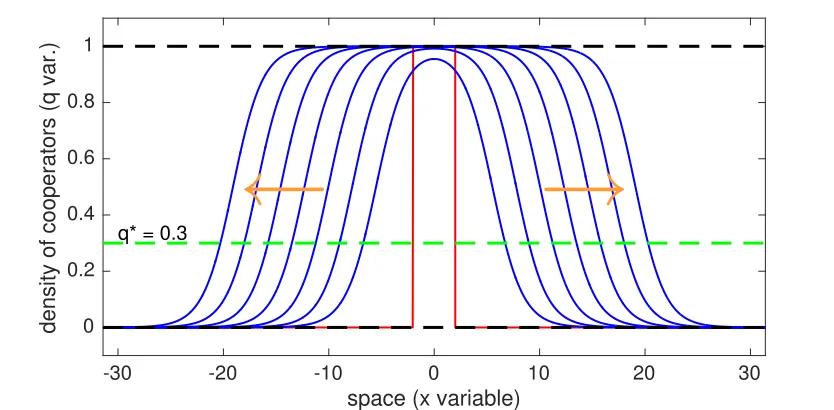
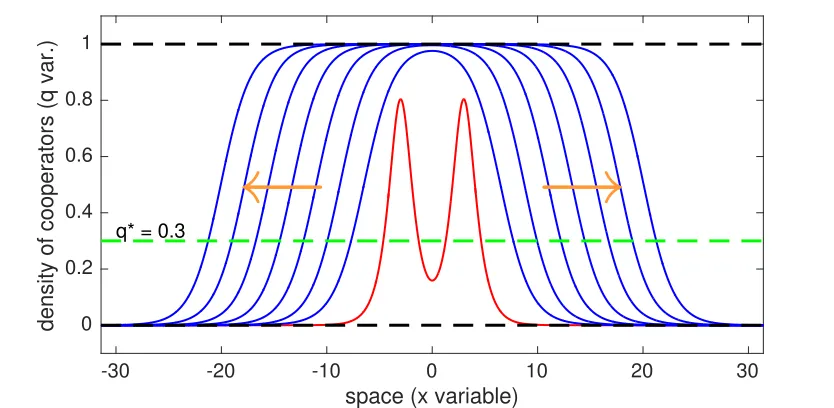
the faster is the invasion. On the contrary whenq∗ approaches the value 0,5 the initial datum needed for cooperators to invade should have a bigger and bigger support. The two figures below show two numerical simulations for which an initially concentrated cluster of preferences for cooperation (red line) slightly above the fraction q∗ = 0,3 (green dashed line) invades the whole space slowly reaching everywhere the quotaq= 1. The thin blue lines represent the time-evolution of the process (the pictures are taken every 8 units of time) and the orange arrows show the direction of the invasion. We can easily see how the profile of the solution resembles to the profile of the traveling wave we characterized for an infinite domain.
The first simulation uses as initial conditions the characteristic function of the interval [−2,2] while the second figure has as an initial datum a two picked cluster of cooperators. In this latter case, we show that even when in a certain interval of the initial cluster’s domain cooperators are below the critical non spatial thresholdq∗ they can still invade the whole space.
[figure 6 about here]
6
Conclusion
the conditions for a culture of cooperation to invade the whole spatial population and we characterize the determinants of its asymptotic speed. We then endogeneize the assortative matching institution assuming that it is set at the community level accord-ing to the proportion and political power of the cooperators. When the technology of institution building is relatively efficient, a protective institution can appear in new places thanks to the spatial random diffusion of cooperation. Along the spatial diffu-sion process of the cooperation trait, local assortative matching institutions follow a life-cycle process by which the degree of assortativeness first gradually grows and then declines as the preference for cooperation becomes majority inside the community.
Figures
0 1 q
f(q)
q∗
Figure 1: Representation of the bistable case where f(q) =q(1−q)[δ+ 2(ρG−(1−ρ)L) + 2(1−ρ)(G+L−B)q]
c
1
ξ0
Figure 2: Profile of the traveling wave resulting from Proposition 2. Here we have changed
the convention, imposing ξ0 =x−ct to find a traveling wave moving from left to right. The
dominant invading state is q = 1, under the previous assumptions on the parameters of the
q
q*(0)
1
ρ( q)
q*(ρ)
~
ρ
0 qs
ρ s
ρ
^ 1/2
Figure 3: Graphic of ˜ρ(q) and q∗(ρ)
0 1 q
˙
q
qs
Figure 5: Qualitative illustration of the dynamics of the endogenous institution when coop-erators are able to invade. The x axis represents the space while the orange arrow gives the direction of the time-evolution
-30 -20 -10 0 10 20 30
space (x variable)
0 0.2 0.4 0.6 0.8 1
density of cooperators (q var.)
q* = 0.3
←
→
Figure 6: The figure shows a numerical simulation in one dimension where an initially
concentrated cluster of cooperators (red line) above the fractionq∗ (green dashed line) invades
the whole space slowly reaching everywhere the quota q = 1. The thin blue lines represent
-30 -20 -10 0 10 20 30
space (x variable)
0 0.2 0.4 0.6 0.8 1
density of cooperators (q var.)
q* = 0.3
←
→
Figure 7: The figure shows another numerical simulation in 1D where the initial datum is
a two picked cluster, namely: q0 =
0,8
cosh(x−3) +
0,8
cosh(x+ 3). Even if in a certain interval
of the initial datum’s domain cooperators are below the threshold they can still invade the whole space.
q
ρ 1
0
1
ρ* ρ(α)
ρ (α)
max
Figure 8: This figure compares the case where the level of the institution is exogenously
settled at ρ∗ to the case where the population can decide endogenously the degree of social
References
Alger, Ingela, and J¨orgen W Weibull. 2012. “A generalization of Hamilton’s ruleLove others how much?” Journal of Theoretical Biology, 299: 42–54. Elsevier.
Alger, Ingela, and Jorgen W Weibull. 2013. “Homo moralis preference evo-lution under incomplete information and assortative matching.” Econometrica, 81(6): 2269–2302. Wiley Online Library.
Ammerman, Albert J.1973. “A population model for the diffusion of early farming in Europe.” The Explanation of Culture Change, edited by Colin Renfrew, 343–357. Duckworth, London.
Ammerman, Albert J, and Luigi L Cavalli-Sforza.1971. “Measuring the rate of spread of early farming in Europe.” Man, 674–688. JSTOR.
Ammerman, Albert J, and Luigi Luca Cavalli-Sforza.2014.The Neolithic
tran-sition and the genetics of populations in Europe. Princeton University Press.
Aronson, Donald G, and Hans F Weinberger.1978. “Multidimensional nonlinear diffusion arising in population genetics.” Advances in Mathematics, 30(1): 33–76.
Berestycki, Henri, and Louis Nirenberg. 1992. “Travelling fronts in cylinders.” Vol. 9, 497–572. Annales de l’Institut Henri Poincare (C) Non Linear Analysis.
Bergstrom, Theodore C. 2003. “The algebra of assortative encounters and the evolution of cooperation.”International Game Theory Review, 5(03): 211–228. World Scientific.
Bisin, Alberto, and Thierry Verdier. 2000. “Beyond the melting pot: cultural transmission, marriage, and the evolution of ethnic and religious traits.”The
Quar-terly Journal of Economics, 115(3): 955–988. MIT Press.
Bisin, Alberto, and Thierry Verdier. 2001. “The economics of cultural transmis-sion and the dynamics of preferences.” Journal of Economic theory, 97(2): 298–319. Elsevier.
Bisin, Alberto, Giorgio Topa, and Thierry Verdier. 2004. “Cooperation as a transmitted cultural trait.” Rationality and Society, 16(4): 477–507. Sage Publica-tions.
Bowles, Samuel, and Herbert Gintis.1998. “The moral economy of communities: Structured populations and the evolution of pro-social norms.”Evolution and Human
Behavior, 19(1): 3–25. Elsevier.
Dess´ı, Roberta, and Sheilagh Ogilvie.2003. “Social capital and collusion: the case of merchant guilds.” CESifo Working Paper Series 1037, CESifo Group Munich.
Edmonson, Munro S. 1961. “Neolithic diffusion rates.” Current Anthropology, 2(2): 71–102.
Eshel, Ilan, Larry Samuelson, and Avner Shaked. 1998. “Altruists, egoists, and hooligans in a local interaction model.” American Economic Review, 157–179. JSTOR.
Ferriere, R´egis, and Richard E Michod. 1999. “Wave patterns in spatial games and the evolution of cooperation.”The Geometry of Ecological Interactions: Simpli-fying Spatial Complexity, by Ulf.Dieckmann, Richard Law,and Johan A.J. Metz eds,
chap. 17, 318–332. Cambridge University Press.
Gelderblom, Oscar, and Regina Grafe.2010. “The Rise, Persistence and Decline of Merchant Guilds. Re-Thinking the Comparative Study of Commercial Institutions in Pre-Modern Europe.” Journal of Interdisciplinary History, 40: 477–511.
Greif, Avner. 2006. Institutions and the path to the modern economy: Lessons from
medieval trade. Cambridge University Press.
Greif, Avner, Paul Milgrom, and Barry R Weingast. 1994. “Coordination, commitment, and enforcement: The case of the merchant guild.”Journal of political
economy, 102(4): 745–776. The University of Chicago Press.
Helbing, Dirk. 2009. “Pattern formation, social forces, and diffusion instability in games with success-driven motion.” The European Physical Journal B, 67(3): 345– 356. Springer.
Katrini, Eleni.2018. “Sharing Culture: On definitions, values, and emergence.” The
Sociological Review, 66(2): 425–446. SAGE Publications Sage UK: London, England.
Keener, James, and James Sneyd. 1998. “Mathematical Physiology, Interdisci-plinary Applied Mathematics 8.” Springer-Verlag, New York.
Kolmogorov, Andrei Nikolaevitch, Ivan G Petrovskii, and Nikola¨ı S Piskunov. 1937. “A study of the equation of diffusion with increase in the quan-tity of matter, and its application to a biological problem.” Bjul. Moskovskogo Gos. Univ, 1(7): 1–26.
Langer, Philipp, Martin A Nowak, and Christoph Hauert. 2008. “Spatial invasion of cooperation.” Journal of theoretical biology, 250(4): 634–641. Elsevier.
Mauro, Fr´ed´eric. 1990. “Merchant Communities, 1350-1750.” The rise of merchant
empires: Long-distance trade in the early modern world, by James. Tracy (ed),
Murray, JD.2002. “Mathematical Biology I: An Introduction, Interdisciplinary Ap-plied Mathematics, Mathematical Biology.” Springer, NY.
Nowak, Martin A.2006. Evolutionary dynamics.Harvard University Press.
Tarnita, Corina E, Tibor Antal, Hisashi Ohtsuki, and Martin A Nowak.2009. “Evolutionary dynamics in set structured populations.” Proceedings of the National
Academy of Sciences, 106(21): 8601–8604. National Acad Sciences.
Weibull, J¨orgen W. 1998. “Evolution, rationality and equilibrium in games.”
Appendices
A
Cultural Transmission
We provide here some microfoundations for our cultural replicator in (3).
Following Bisin and Verdier (2001), we endogenize the vertical transmission ratesτti
by assuming that parents have a motivation to spend resources to transmit their own trait to their offspring (to simplify notations from here onward we omit time superscript whenever there is no risk of confusion).
More precisely we assume that a parent of type i∈ {C, N C} is paternalistic and chooses his socialization rate τi in order to maximize the following utility function:
Vi =PiiVii+PijVij−C(τi) (13)
whereVii is the expected payoff obtained by a child that takes the same trait ias his parent, and Vij is the expected payoff obtained by a child taking the other cultural trait j 6= i in the group, but as perceived through the filter of the preferences of his parent of trait i. Finally, C(τi) represents the cost of socialization, i.e. the cost of
the resources (time, money etc.) that the parent has to spend to transmit his trait to his child. According to the payoffs of the previous game and our assortative matching hypothesis, the utilities for a cooperator and a defector having a child like themselves will be:
VC,C=δ+G[ρ+ (1−ρ)q]−L(1−ρ)(1−q)
VN C,N C = (1−ρ)qB
and
∆VC =VC,C−VC,N C =δ+G[ρ+ (1−ρ)q]−L(1−ρ)(1−q)−(1−ρ)qB
∆VN C =VN C,N C−VN C,C = (1−ρ)qB−[G[ρ+ (1−ρ)q]−L(1−ρ)(1−q)]
The standard Bisin and Verdier (2001) model assumes acultural substitution
mech-anism of transmission of the cooperative trait whereby minorities do a greater effort
to purposefully socialize their offspring. Such effect always leads to long turn cultural heterogeneity. As we are interested in the diffusion of a cultural trait rather than its long run persistence, we abstract here from such effect by considering a form of so-cialization costs that neutralizes cultural substituability. Specifically we assume the following socialization cost functions:
C(τC) =
τ2C
2d(1−q), C(τN C) = τ2N C
2d q
Solving parents’ maximization problem (13), we obtain:
τC =d·∆VC, τN C =d·∆VN C.
Since we want the two previous endogenous probabilitiesτC andτN C to be positive, we
impose thatG > B−Landρ < B−G
B . The evolutionary dynamics of the cooperators
thus writes
˙
q=q(1−q)(DeltaVC −DeltaVN C)
=q(1−q)[δ+ 2(ρG−(1−ρ)L) + 2(1−ρ)(G+L−B)q]. (14)
B
Proofs of Propositions
B.1
Proof of Proposition 1
We first need to show that the set of hypothesis (4) imply the ones we had made before to have a social dilemma with positive endogenous probabilities. While all the hypothesis concerning the social dilemma game and theτc are implied trivially by (4),
the last hypothesis concerning the endogenous probability for defectors τN C deserves
some computations. Since
B−G
B >
B−G
B+L
hypothesis (4) guarantees also that
B−G
B >
L−δ/2
G+L :=ρmax (15)
Therefore assumingρ < ρmax implies thatρ <(B−G)/B
We now want to study the equilibria of equation (3) and their stability. In order to simplify the notation we will denote its right-hand side by f(q). Equation (3) admits two trivial fixed pointsq = 0 andq = 1. We now want to prove that under hypothesis (4) it admits also an interior fixed point,q∗∈(0,1). Imposing the condition f(q∗) = 0 we find
q∗= δ/2 +ρG−(1−ρ)L
−(1−ρ)(G+L−B)
In order to haveq∗>0 andq∗ <1 we have to impose
G≥B−L
L−δ/2
G+L :=ρmax > ρ > ρmin:=
B−G−δ/2
B .
Such aρ exists if and only if ρmax > ρmin, i.e.
(L−δ/2)B >(B−G−δ/2)(G+L) (16)
We have thus shown that the conditions (4) are sufficient to have the existence of the interior equilibriumq∗.
We can now easily show that under the same conditions we are in a classical bistable case. The bistable case is characterized by the presence of three equilibria (in our case
q = 0, q = 1 and q∗) of which two ( q = 0 and q = 1) are stable, i.e. attractive, and one (the interior oneq∗) is unstable, i.e. if we move slightly away from q∗ we are going to converge either to the state q = 0 or to q = 1. In order to have a bistable case we need that ∂qf(0)<0 and∂qf(1)<0. The first condition writes
∂qf(0) =δ+ 2(ρ(G+L)−L)<0 ⇐⇒
L−δ/2
G+L > ρ
and this is always the case under (4). The second condition writes as
∂qf(1) =−[δ+ 2(ρG−(1−ρ)L) + 2(1−ρ)(G+L−B)]<0 ⇐⇒ ρ >
B−G−δ/2
B
and this is always the case under (4).
We have thus shown that under the hypothesis (4), the problem of cooperators and defectors we presented is a bistable case where the interior equilibrium q∗ is un-stable while the two extreme equilibria, q = 0 and q = 1, are stable. Therefore, if
0≤q(0)< q∗ we will, in the long run, converge to the state q= 0 and have the
extinc-tion of cooperators, while ifq∗ < q(0)≤1 we will converge to the stateq= 1 and have the extinction of defectors.
B.2
Proof of Proposition 2
Since [(1−ρ)(G+L−B)]1/2>0, imposing the conditionc >0 we find that
ρ∗= B+L−(δ+G)
B+L+G .
The only thing we need to check is that, under the set of hypothesis (4),ρ∗< ρmax. We thus need to show that
L−δ/2
G+L >
B+L−(δ+G)
B+L+G
Developing and simplifying some terms this inequality can be rewritten as
−G(G+L−B)< δ
2(G+L−B)
and since G+L−B >0 it becomes
−G < δ
2
B.3
Proof of Lemma 3
We now want to find the conditions under which we are in a bistable case as in the exogenous institution section. We define Θ(q) = q−q∗(˜ρ(q)) and observe that Θ(0) =−q∗(˜ρ(0)) = −q∗(0) <0 and Θ(1) = 1−q∗(˜ρ(1)) = 1−q∗(0) >0. Note also that
q∗(ˆρ) = 0 ⇔ ˆρ= L−δ/2
G+L <1.
We can prove that indeed ˆρ <1/2. By contradiction if ˆρ > 1/2 we should have that
G < L−δ <0 and this is absurd since we have assumed Gto be positive.
In order to be in a bistable case we need to find conditions that ensure the existence of an uniqueqs∈(0,1) such that Θ(qs) = 0 and Θ0(qs)>0.
Θ0(qs) = 1 +
(G+δ/2)(1−2qs)
[1−˜ρ(qs)]2ψ00(˜ρ(qs))
≥1− (G+δ/2) [1−˜ρ(qs)]2ψ00(˜ρ(qs))
≥1− (G+δ/2) [1−ˆρ]2ψ00(ˆρ)
= 1− (G+L) 2
(G+δ/2)ψ00(ˆρ) >0 ⇔ ψ
00(ˆρ)> (G+L)2
(G+δ/2)
(17)
where we have used thatqs=q∗(˜ρ(qs)) and thereforeqs>0 impliesq∗(˜ρ(qs))>0 that
in turn implies ˜ρ(qs)<ˆρ.
We have thus shown that there exists a unique qs ∈ (0,1) such that Θ(qs) = 0,
Θ(q)<0∀q < qs and Θ(q)>0∀q > qs.
B.4
Proof of Proposition 4
We define
I(α) =
Z 1
0
[1−˜ρ(q, α)]q(1−q)[q−q∗(˜ρ(q, α))]dq
and we want to compute its sign.
I0(α) =
Z 1
0
[−∂α˜ρ(q, α)q(1−q)[q−q∗(˜ρ(q, α))]−[1−ρ˜(q, α)]q(1−q)∂˜ρq∗(˜ρ(q, α))∂α˜ρ(q, α)]dq
=
Z 1
0
[−∂α˜ρ(q, α)q(1−q)[q−q∗(˜ρ(q, α)) + (1−˜ρ(q, α))∂˜ρq∗]dq
Since [q−q∗(˜ρ(q, α))+(1−˜ρ(q, α))∂˜ρq∗]<0 we have thatsign[I0(α)] =sign[∂α˜ρ(q, α)]<0.
Moreover
lim
α→∞I(α) =
Z 1
0
q(1−q)[q−q∗(0)]dq= 1
12 −
q∗0
lim
α→∞I(α)>0 ⇔ q ∗
0 < 1 2.
Therefore for any q0∗ ∈(0,12) we will have that I(α)>0 ∀α∈(ˆα,∞), meaning that there will exist a traveling wave with positive speed, i.e. cooperators can invade.
For q∗0 ∈(12,1), we compute the value of I(ˆα). In order to do so, we compute the integral by substitution using the new variable ˜ρ. Since the function defining implicitly ˜
ρis not monotonic in the intervalq ∈(0,1) we split the integral in two partsq ∈(0,1/2) and q∈(1/2,1). We therefore define
˜
ρmax=
ψ00
G+L−B
4α
−1
and observe that when α= ˆα we have that ˜ρmax = ˆρ. In order to do the substitution of variables we now computeq as a function of ˜ρ in the two intervals. We have
q1 =
1−
q
1−G+4Lα−Bψ00(˜ρ)
2 q2 =
1 +
q
1− G+4Lα−Bψ00(˜ρ) 2
dq= αψ
00
0(˜ρ) d˜ρ (G+L−B)(1−2q)
And using that ˆα= G+L−B
4ψ00(ˆρ) we have that
dq|α=ˆα=
ψ000(˜ρ) d˜ρ
4ψ00(ˆρ)(1−2q)
and
q(1−q)|α=ˆα =
ψ00(˜ρ)
4ψ00(ˆρ). and
q1|α=ˆα=
1−
r
1−ψ
0
0(˜ρ)
ψ00(ˆρ)
2 q2|α=ˆα =
1 +
r
1−ψ
0
0(˜ρ)
ψ00(ˆρ) 2
Therefore
I(ˆα) =
Z 1
0
[1−ρ˜(q,αˆ)]q(1−q)[q−q∗(˜ρ(q,αˆ))]dq
=
Z ˆρ
0
[1−˜ρ]ψ
0
0(˜ρ)
4ψ00(ˆρ)[q1−q
∗(˜ρ)] ψ
00
0(˜ρ) d˜ρ 4ψ00(ˆρ)(1−2q1)
+
Z 0
ˆ
ρ
[1−˜ρ]ψ
0
0(˜ρ)
4ψ00(ˆρ)[q2−q
∗(˜ρ)] ψ
00
We substitute and integrate by parts and after tedious but straightforward computa-tions we obtain
I(ˆα) =
Z ˆρ
0
ψ00(˜ρ)
[4ψ00(ˆρ)]2
ψ000(˜ρ)
r
1−ψ
0
0(˜ρ)
ψ00(ˆρ)
(G+L+B) (G+L−B)(˜ρ−ρ
∗
)dρ˜
where we have defined, as in the previous exogenous section,ρ∗ = B+L−G−δ
G+L+B . We
can easily see that a sufficient condition forI(ˆα) to be positive isG+δ > B+L and
it is equivalent toq0 <1/2. We now observe that since
(G+L+B)
(G+L−B)[4ψ00(ˆρ)]2 >0 the sign ofI(ˆα) is given by the sign of
˜
I(ˆα) =
Z ˆρ
0
ψ00(˜ρ) ψ
00
0(˜ρ)
r
1−ψ
0
0(˜ρ)
ψ00(ˆρ)
(˜ρ−ρ
∗)d˜ρ
and
∂BI˜(ˆα) =
Z ˆρ
0
−ψ00(˜ρ) ψ
00
0(˜ρ)
r
1−ψ
0
0(˜ρ)
ψ00(ˆρ)
2G+L+δ
(G+L+B)2d˜ρ <0.
Since for B = G+δ −B we have that I(ˆα) > 0 and ∂BI˜(ˆα) < 0 there exists a
Bmax > G+δ−B such that I(ˆα, Bmax) < 0. Moreover Bmax ≤ G+L since when
B =G+Lwe have
˜
I(ˆα) =
Z ˆρ
0
ψ00(˜ρ) ψ
00
0(˜ρ)
r
1−ψ
0
0(˜ρ)
ψ00(ˆρ)
(˜ρ−
L−δ/2
G+L )dρ˜
=
Z ˆρ
0
ψ00(˜ρ) ψ
00
0(˜ρ)
r
1−ψ
0
0(˜ρ)
ψ00(ˆρ)
(˜ρ−ˆρ)d˜ρ <0.
B.5
Proof of Proposition 5
Assume G+δ−L < B < Bmax. We want to look at the sign ofI(α∗) whereα∗ is
defined asρmax(α∗) =ρ∗. We have that
ψ00(ρmax(α∗)) = G+L−B
4α∗ =ψ
0
0(ρ∗)
Thereforeα∗= G+L−B
4ψ00(ρ∗) >αˆ and
I(α∗) =
Z ρ∗
0
ψ00(˜ρ) [4ψ00(ρ∗)]2
ψ000(˜ρ)
r
1− ψ
0
0(˜ρ)
ψ00(ρ∗)
(G+L+B) (G+L−B)(˜ρ−ρ
SinceG+δ−L < B < Bmax we know that it exists ˜α < α∗such that∀α∈(ˆα,α˜) there
exists a positive traveling wave and cooperators may invade. Moreover, ρmax(˜α)> ρ∗, meaning that starting from zero, the institution will grow and reach a higher level than the one required for invasion in the case of an exogenous institution.
C
Derivation of the laplacian as the limit of a
local random walk in 1 dimension
Since here we will limit our attention to the one dimensional case we will indicate with ∆ the time/ spatial increment while the 1 dimensional laplacian will be simply
denoted by ∂ 2
∂x2.
Let’s consider a particle that moves with a random walk and denote p(x, t) the probability that a particle released at x = 0 at timet = 0 reaches locationx at time
t. At time t−∆t the particle was at x+ ∆x or x−∆x. Thus if α and β are the probabilities that a particle will move to the right or to the left
p(x, t) =αp(x−∆x, t−∆t) +βp(x+ ∆x, t−∆t), α+β= 1. (18)
If there is no bias in the random walkα=β= 1/2. Expanding the right-hand side of (18) in Taylor series we get
∂p
∂t =
(∆x)2 2∆t
∂2p
∂x2 +
∆t
2
∂2p
∂t2 +...
If we now let ∆x→0 and ∆t→0 such that
lim ∆x→0,∆t→0
(∆x)2
2∆t =D (19)
we get
∂p
∂t =D
∂2p
∂x2 (20)
The random wlak derivation of the laplacian we have done strongly relies on the assumption that the limit (19) exists and is finite. Less restrictive hypothesis could be made to derive the laplacian but the version presented here is the most intuitive one.
D
Numerical simulations: varying the value of
q
∗(q0 = 1 on [−2,2]). We then show that as q∗ grows from q∗ = 0,1 to q∗ = 0,375 the wave of advance of the cooperators slows its speed and at a certain point the initial datum we have fixed is not sufficient anymore to invade and cooperators disappear.
-30 -20 -10 0 10 20 30
space (x variable)
0 0.2 0.4 0.6 0.8 1
density of cooperators (q var.)
q* = 0.1
→
←
-30 -20 -10 0 10 20 30
space (x variable)
0 0.2 0.4 0.6 0.8 1
density of cooperators (q var.)
q* = 0.2
→
←
-30 -20 -10 0 10 20 30
space (x variable)
0 0.2 0.4 0.6 0.8 1
density of cooperators (q var.)
q* = 0.3
←
→
-30 -20 -10 0 10 20 30
space (x variable)
0 0.2 0.4 0.6 0.8 1
density of cooperators (q var.)
q* = 0.35
←
→
-30 -20 -10 0 10 20 30
space (x variable)
0 0.2 0.4 0.6 0.8 1
density of cooperators (q var.)
q* = 0.3625
←
→
-30 -20 -10 0 10 20 30 space (x variable)
0 0.2 0.4 0.6 0.8 1
density of cooperators (q var.)
q* = 0.36875
←
→
-30 -20 -10 0 10 20 30 space (x variable)
0 0.2 0.4 0.6 0.8 1
density of cooperators (q var.)
q* = 0.3725
←
→
-30 -20 -10 0 10 20 30 space (x variable)
0 0.2 0.4 0.6 0.8 1
density of cooperators (q var.)
q* = 0.375
←
→
Figure 9: starting from the left up going to the right and then to the following row, the values
chosen here are: q∗ = 0,1;q∗ = 0,2;q∗ = 0,3;q∗ = 0,35;q∗ = 0,3625;q∗ = 0,368975;q∗ =
E
Reaction-diffusion equations, definitions and
main theorems
We will here briefly state some classical definitions and results in reaction-diffusion equations that are useful in order to understand the analysis we have made.
Traveling waves
Let’s consider a basic, homogeneous, reaction-diffusion equation:
∂tu−∆u=f(u)
and assume that
f(0) =f(1) = 0; f Lipschitz.
Definition E.1. A traveling front (TF) is a solution of the form u(x, t) =v(x−ct) that solves
(
−v00−cv0 =f(v)
v(−∞) = 1; v(+∞) = 0 (21)
The function f could be classified into three main categories
CASE 1: Monostable
0 1 s
f(s)
when f is positive (f(s)>0∀s ∈ (0,1)).
We have a particular subcase calledKPP typewhenfisC1near 0 andf(s)< f0(0)s∀s ∈ [0,1].
CASE 2: Combustion or ignition type
0 θ 1 s
when ∃θ ∈ (0,1) such that
(
f(s) = 0∀s ∈ [0, θ]
f(s)>0∀s ∈ (θ,1).
In this case the reaction needs a certain threshold to start.
CASE 3: Bistable
0 1 s
f(s)
θ
when ∃θ ∈ (0,1) such that
(
f(s)<0∀s ∈ (0, θ)
f(s)>0∀s ∈ (θ,1).
A classical theorem in reaction diffusion equation regarding the existence of travel-ing waves is the followtravel-ing
Theorem. In cases wheref is of the Ignition type or bistable (CASES 2 and 3), there
exists a unique speed c for which there exists a solution v of (21). This solution v is
unique (up to shifts) andc has the sign of R1
0 f(s)ds.
In the monostable case (CASE 1) there existsc∗ >0 such that (21)has a solution v if
and only if c > c∗. For fixed c the solution is unique (up to shifts).
In the the KPP case (CASE 1bis)c∗ = 2pf0(0).
![Figure 1: Representation of the bistable case where2(1 f(q) = q(1 − q)[δ + 2(ρG − (1 − ρ)L) + − ρ)(G + L − B)q]](https://thumb-us.123doks.com/thumbv2/123dok_us/8053773.1342021/19.612.193.422.396.484/figure-representation-bistable-case-where-rg-l-b.webp)