288 |
P a g e
COLOR IMAGE IMPLEMENTATION OF GUIDED FILTER
DERIVED BY LOCAL LINEAR MODEL
Aparna Lahane
1, Dr.V.B.Malode
21,2Electronics, MGM’s Jawaharlal Nehru Engineering College, 9India)
ABSTRACT
Filtering is widely used in image processing for various applications now. The guided filter has been proposed
and became one of the popular filtering methods. Derived from a local linear model, the guided filter generates
the filtering output by considering the content of a guidance image, which can be the input image itself or
another different image .Image Enhancement is one of the most important and difficult techniques in digital
image Processing. Image Enhancement is used for improve the quality. Guided filter uses the color images for
implementation because color guidance image can better preserves the edges that are not distinguishable in
gray-scale. Guided filter simulation done using MATLAB. We demonstrate that the guided filter is both effective
and efficient in a great variety of computer vision and computer graphics applications including noise
reduction, detail smoothing/enhancement. And then calculating its PSNR value using VHDL.
Keywords –
Color image, Image Enhancement, Image Smoothing, MATLAB, VHDL.
I.INTRODUCTION
289 |
P a g e
reverse Fourier transform is performed to get the concomitant image. The most common benefit of image smoothing is to remove the noise from the image. Different edge preserving image smoothing methods are used for preserving the important features or structures or salient edges in the image, so as to lead the improvement in the visual quality of the image. This is a method for edge preserving smoothing, which is related to the previous methods like bilateral filter and fast bilateral filter for the display of high dynamic range images signal processing approach, edge preserving decompositions, multi-scale image decomposition based on local extreme, histogram based image smoothing, L0 gradient minimization. Mean filtering is easy to implement. It is used as a method of smoothing images, reducing the amount of intensity variation between one pixel and the next resulting in reducing noise in images. For simulation of guided filter Matlab is used. Matlab is set of numerical analysis and high-performance computing software. Matlab language provides for matrix arithmetic operators, relational operators, logical operators, conditional operators and assignment operator. Matlab is high level language. It gives simple programming. Matlab is easy to use and flexible. System generator is used for model generation in Matlab.II.EXISTING METHODS
1.Bilateral Filter The bilateral filter was perhaps the simplest which computed the filtering output at each pixel as the average of near-by pixels, weighted by the Gaussian of both range and spatial distance. The bilateral filter smooth‟s the image while preserving edges. Constraint of the bilateral filter was it endure from “gradient reversal” artifacts. The reason was that when a pixel (often on an edge) has few similar pixels around it, the Gaussian weighted average is unstable. Efficiency was another problem regarding the bilateral filter.
2. Non-average Filter Edge-preserving filtering could also be achieved by non-average filters. The median filter was a familiar edge-aware operator, and was a special case of local histogram filters. Histogram filters had O(N) time implementations in a way as the bilateral grid. The non-average filters were often computationally expensive.
III. ALGORITHM
Here we are working on parameters image enhancement and image smoothing, PSNR. Guided filter produces filtered output „q‟ by using guidance image „I‟ and input image „p‟. Based on the application, guidance image
can be input image itself or different image. And calculating the PSNR value.
qi is a local linear transform of guidance image I in a window ωk centered at pixel k as shown in Fig .below
which can be given as
𝑞𝑖=𝑎𝑘𝐼𝑖+𝑏𝑘,∀𝑖∈𝜔𝑘 ……..(1)
290 |
P a g e
Guided filter algorithm
1. Read the image say I (color image) which acts as the guidance image. 2. Take p=I, where p is filtering image (color image).
3. Take the values for r and ε where r is radius of window and ε is regularization parameter. 4. Compute following mean values by applying averaging filter „fmean‟:
meanI = fmean(I)
meanp = fmean(p)
meanIp = fmean(I .* p)
meanII = fmean(I .* I)
5. Compute covariance of (I,p) using formula: covIp = meanIp –meanI.* meanp
6. Compute variance using formula: varI = meanII –meanI.* meanI
7. Compute linear coefficients a and b as: a = covIp/ (varI + ε )
b = meanp – a .* meanI
8. Compute mean of a and b as: meana = fmean(a)
meanb = fmean(b)
9. Compute filtered output as: q = meana .* I + meanb
291 |
P a g e
IV.
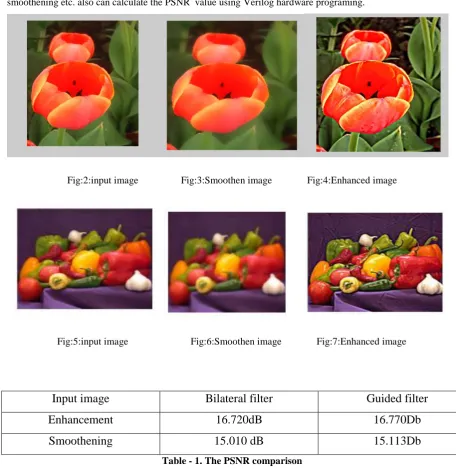
RESULTS AND DISCUSSIONIn this paper, we have presented a novel explicit image filter which can be used in various image processing applications. Guided filter is generic concept for edge preserving smoothing and structure transferring filtering. It is more effective as compared to other existing approaches in aspects such as detail enhancement, image smoothening etc. also can calculate the PSNR value using Verilog hardware programing.
Fig:2:input image Fig:3:Smoothen image Fig:4:Enhanced image
Fig:5:input image Fig:6:Smoothen image Fig:7:Enhanced image
Table - 1. The PSNR comparison
V
.
CONCLUSIONIn this paper, we have presented a novel explicit image filter which can be used in various image processing applications. Guided filter is generic concept for edge preserving smoothing and structure transferring filtering. It is more effective as compared to other existing approaches in aspects such as detail enhancement; image smoothening etc. also can calculate the PSNR value using Verilog hardware programing.
Input image
Bilateral filter
Guided filter
Enhancement
16.720dB
16.770Db
292 |
P a g e
VI. ACKNOWLEDGEMENTS
I would like to thank the anonymous referees for their helpful guidance that has improved the quality of this paper. Also I would like to thank my Project Guide, Dr. V.B.MALODE for her valuable guidance.
VII.
REFERENCES
[1] Chieh-chi kao, Jui-hsinlai, “VLSI architecture design of guided filter for 30 frames/s FULL-HD video”, IEEE transactions oncircuits and systems for video technology, vol. 24, no. 3,March 2014, pp.513- 524 .
[2] Kaiming He, Jian Sun, “Guided Image Filtering”, IEEE Transactions On Pattern Analysis and Machine
Intelligence, vol. 35, no. 6, ,June 2013, pp.1397-1409. [3] Tomasi, C., Manduchi, R.: Bilateral filtering for gray and color images. ICCV (1998)C. Liu, W. Freeman, R.
Szeliski, and S. B. Kang, “Noise estimation from a single image,” in Proc. IEEE CVPR, vol. 1, 2006, pp.
901–908.
[4] F. Durand and J. Dorsey, “Fast bilateral filtering for the display of highdynamic- range images,” ACM
Trans. Graph., vol. 21, no. 3, Jul. 2002, pp. 257–266.