Vol. 6, Issue 3, March 2017
Boiler Automation Using PLC & SCADA
AnkitaSoni
1, Bivas Ray
2, Kumar Gaurav
3,Rashmita Gouda
44thyear Student, Dept. of Applied Electronics and Instrumentation Engineering, GIET, Gunupur, Odisha, India1,2,3
Lecturer, Dept. of Electronics and Engineering, GIET, Gunupur, Odisha, India 4
ABSTRACT: The boiler is a fundamental part of almost all industries. It varies in application from low pressure to high pressure. The paper outlines the various stages of operation involved in the conversion of a manually operated boiler towards a fully operated boiler. The boiler control which is the most important part of any power plant, and its automation is the precise effort of this paper. In order to automate a power plant and minimize human intervention, there is a need to develop a SCADA (Supervisory Control and Data Acquisition) system that monitors the plant and helps reduce the errors caused by humans. While the SCADA is used to monitor the system, PLC (Programmable Logic Controller) is also used for the internal storage of instruction for the implementing function such as logic, sequencing, timing, counting and arithmetic to control through digital or analog input/output modules various types of machines processes. Systems are used to monitor and control a plant or equipment in industries such as telecommunications, water and waste control, energy, oil and gas refining and transportation. The initial phase of the paper focuses on passing the inputs to the boiler at a required temperature, so as to maintain a particular temperature in the boiler, and shows the temperature/pressure relationship. To achieve desired steam pressure (2Bar) at certain temperature, the Properties of Steam Table analysis is done. A proper boiler design and modelling and safety precautions are taken into consideration. Focusing on level, pressure, temperature parameters are constantly monitored using SCADA screen which is connected to the PLC.
KEYWORDS: Automation, PLC-SCADA, Boiler, DC and AC Supply, Relay, Temperature Sensor,Analog Module
I. INTRODUCTION
Over the years the demand for high quality, greater efficiency and automated machines has increased in the industrial sector of power plants. Power plants require continuous monitoring and inspection at frequent intervals. There are possibilities of errors at measuring and various stages involved with human workers and also the lack of few features of microcontrollers. Thus this paper takes a sincere attempt to explain the advantages the companies will face by implementing automation into them. In order to automate a power plant and minimize human intervention, there is a need to develop a SCADA (Supervisory Control and Data Acquisition) system that monitors the plant and helps reduce the errors caused by humans. While the SCADA is used to monitor the system, PLC (Programmable Logic Controller) is also used for the internal storage of instruction for the implementing function such as logic, sequencing, timing, counting and arithmetic to control through digital or analog input/ output modules various types of machines processes.
II. PURPOSE OF BOILERAUTOMATION
Vol. 6, Issue 3, March 2017
III. BOILER AUTOMATION USING PLC AND SCADA
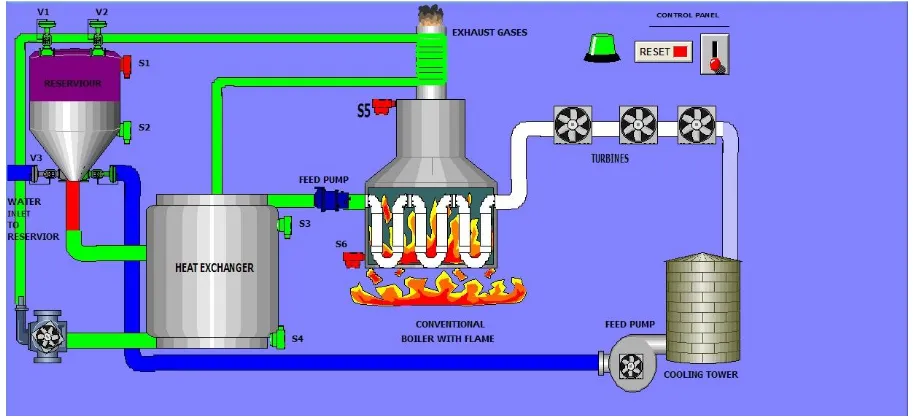
In order to automate a power plant and minimize human intervention, there is a need to develop a PLC &SCADA system that helps to reduce the errors caused by humans. PLC and SCADA interfaced through communication cables. SCADA is used to monitor the boiler temperature, pressure and water level using different sensors and the corresponding output is given to the PLC which controls the boiler temperature, pressure and water level. The figure shows the block diagram of boiler Automation which consists of PLC, SCADA and sensors to monitor and control the entire operation of boiler. Here Resistive Temperature detector Pt 100 (RTD PT 100) is used to measure the temperature, RT pressure switch is used to measure the pressure inside the boiler and float switches are used to detect the feed water level inside the boiler.Its temperature is measured. In one pump the flow rate is maintained at 130% and in another it is 75%. Thus the failure of any one pipe does not affect the boiler operation. Heater is switched ON by using PLC. The corresponding temperature and pressure are measured by sensors.
Water plays a major part in the generation of steam. Initially Pushbutton is switched ON then the PLC, SCADA, different sensors are switched ON. Feed water pump is switched ON by using feed water pump switch.The water from the water tank is allowed to pass through two parallel pipes to boiler and passed through economizer, thus the heat in the outgoing gases is recovered, by transferring its heat to the water. Then the heated water is made to flow through steam and water drum. In this, water should be maintained at least at 50%. For sensing water level Float switches are used. When the level is lesser than or greater than 50%, Float switches senses the level change and sends the appropriate control signal to the PLC. Thus, in spite of any changes in disturbance variable, the water level can be maintained at 50% by proper tuning of PID controller. Water in the water drum is maintained at more than 75%.When the water is less than 2000 litres then motor will be switched ON. If the temperature and pressure inside boiler exceeds then entire system will be in OFF state. The corresponding automated check valves are opened to avoid catastrophic failure.
Fig 2: Run time visualisation of Boiler operation in IntouchWonderware SCADA Software
B. Control parameters: Temperature Control:-
Steams drum temperature, underbed boiler temperature, Force draft temperature, Flue gas temperature, Induced draft temperature, feed water temperature.
Pressure Control:-
Force draft pressure, Induced draft pressure, Steam drum pressure, Turbine inlet steam pressure, and flue gas pressure. Level Control
Vol. 6, Issue 3, March 2017
C. Boiler:
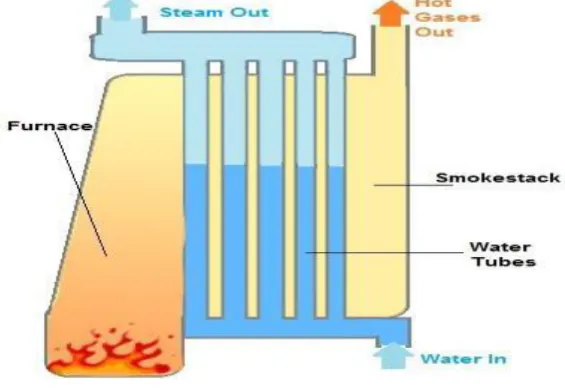
Boiler is essentially a closed vessel into which water is heated until the water is converted into steam at required pressure. There are mainly two types of boiler – water tube boiler and fire tube boiler. At first Fuel (generally coal) is burnt in a furnace and hot gasses are produced which is shown in Fig.2. These hot gasses come in contact with water vessel where the heat of these hot gases transfer to the water and consequently steam is produced in the boiler. Then this steam is piped to the turbine of thermal power plant. There are many different types of boiler used for different purposes like running a production unit, sterilizing equipment, sanitizing some area, to warm up the surroundings etc.
B. Control parameters: Temperature Control:-
Steams drum temperature, underbed boiler temperature, Force draft temperature, Flue gas temperature, Induced draft temperature, feed water temperature.
Pressure Control:-
Force draft pressure, Induced draft pressure, Steam drum pressure, Turbine inlet steam pressure, and flue gas pressure. Level Control
Steam Drum level, Water level
C. Boiler:
Boiler is essentially a closed vessel into which water is heated until the water is converted into steam at required pressure. There are mainly two types of boiler – water tube boiler and fire tube boiler. At first Fuel (generally coal) is
burnt in a furnace and hot gasses are produced which is shown in Fig.2. These hot gasses come in contact with water vessel where the heat of these hot gases transfer to the water and consequently steam is produced in the boiler. Then this steam is piped to the turbine of thermal power plant. There are many different types of boiler used for different purposes like running a production unit, sterilizing equipment, sanitizing some area, to warm up the surroundings etc.
Fig 3: Water tube boiler
D. Temperature sensor:
Vol. 6, Issue 3, March 2017
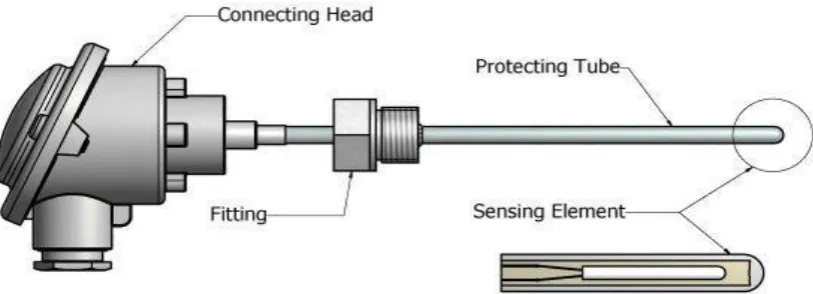
Fig 4: Resistance Temperature Detector
E. Pressure Sensor
RT pressure switch is used to sense the pressure inside the boiler. RT Series pressure switches utilize a seamless bellows as sensing element. The bellows can be either phosphor bronze or stainless steel to suit various kinds of process medium. The mechanism is enclosed in a weather proof (IP66) enclosure which can be of either DMC (Die Cast Aluminium).Pressure ranges between -1 to 30 bar [8].
F. Float switches
A float switch is a device used to detect the level of liquid within a tank which is illustrated in Fig.4. The switch may be used in a pump, an indicator, an alarm, or other devices. Float switches range from small to large and may be as simple as a mercury switch inside a hinged float or as complex as a series of optical or conductance sensors producing discrete outputs as the liquid reaches many different levels within the tank [7].
E. Pressure Sensor
RT pressure switch is used to sense the pressure inside the boiler. RT Series pressure switches utilize a seamless bellows as sensing element. The bellows can be either phosphor bronze or stainless steel to suit various kinds of process medium. The mechanism is enclosed in a weather proof (IP66) enclosure which can be of either DMC (Die Cast Aluminium).Pressure ranges between -1 to 30 bar [8].
F. Float switches
Vol. 6, Issue 3, March 2017
outputs as the liquid reaches many different levels within the tank [7].
Fig 5: Float switches
VII. CONCLUSION
In this paper, Boiler Automation using PLC and SCADA was designed and implemented. Different sensors are used to measure the temperature, pressure and water level. SCADA is used to monitor the parameters and PLC used to control the operation. If the temperature and pressure exceed predefined value then the entire setup will shut down and automatic check valves are opened to release the steam and pressure. In case of emergency alarm was energized and automatic check valves are opened to avoid catastrophic failure. Ladder diagram of Delta PLC is simulated using WPL soft and the SCADA design of boiler automation is simulated using Intouchwonderware software. The future research is to focus on the application oriented implementation of remote monitoring of boiler Automation by SCADA internet access.
ACKNOWLEDGMENT
We are grateful to our Dept. Hod sir Prof.SubrajitPradhan and weacknowledge with gratitude to our supervisor Prof.Rashmita Gouda, Department of Electronics Engineering, and all staff members for their innovative thinking, continuous guidance, genius role and encouragement throughout the whole project period.
REFERENCES
[1] HjaltiKristinsson and Sofie Lang, “Boiler Control”,Springer, Berlin, 2010. [2] M.V.Radhakrishnan “Modern Boiler Design”, ISATrans., 2000.
[3] Dale E.Seborg,ThomasF.Edgar,DuncanA.Mellichamp and Francis J.Doyle “Process Dynamics and Control”, Process Automation, 2011. [4] George Stephanopoulos, “Chemical Process Control”, 1984.
[5] Bela G. Liptak,‟Process Control Handbook‟,Radnor, Pennsylvania 1995.
[6] Gary Dunning, “Introduction to programmable logic controllers”, Control Eng Practice, engage learning, 2011.
[7] Ezell, Barry, “Supervisory Control and DataAcquisition Systems for Water Supply and ItsVulnerability to Cyber Risks”, 1997. [8] Boyer, Stuart „SCADA: Supervisory Control and Data Acquisition”, Instrument Society of America, Research Triangle, NC. 1993
BIBLIOGRAPHY
Vol. 6, Issue 3, March 2017
Mr.Bivas Ray is currently in his final year of pursuing his bachelor in Applied Electronics & Instrumentation Engg.from GIET, Gunupur, Odisha , India. His interest field of research is Electronics, Automation and Instrumentation.
Mr.Kumar Gaurav is currently in his final year ofpursuing his bachelor in Applied Electronics & Instrumentation Engg.from GIET, Gunupur, Odisha, India. His interest field of research is Electronics,Automation and Embedded System.
Ms. Rashmita Gouda has completed her bachelor degree degree and Master degree in Applied Electronics & Instrumentation Engg. Presently she is working as a Lecturer in Department of Electronics & Instrumentation Engg in GIET, Gunupur, Odisha, India. Her interested field of research is Signal Processing & Biomedical Instrumentation and Automation etc