Charm quark effects on the strong coupling extracted from the
static force
SalvatoreCalì1,2,,FrancescoKnechtli2,TomaszKorzec2, andHaralambosPanagopoulos1 1University of Cyprus, P.O. Box 20537, 1678 Nicosia, Cyprus
2University of Wuppertal, Gaußstr. 20, 42119 Wuppertal, Germany
Abstract.We compute the fermionic contribution to the strong couplingαqqextracted from the static force in Lattice QCD up to orderg4 in perturbation theory. This allows us to subtract the leading fermionic lattice artifacts from recent determinations ofαqq produced in simulations of two dynamical charm quarks.
Moreover, by using a suitable parametrization of theβqq-function, we can evaluate the charm loop effects onαqqin the continuum limit.
1 Introduction
Many simulations of QCD are carried out with 2+1 dynamical quarks, taking into account only the
effects of light sea quarks (up, down, strange). So far, this kind of approach has provided really good
results and its simulation costs are affordable with modern computer facilities.
However, the discovery of new charm-states in experiments like Belle, CLEO and BABAR has made charm physics really appealing in the last few years and including a dynamical charm quark in Lattice QCD simulations could help us understand better the properties of these new states.
Although nowadays new supercomputers allow to simulate the 2+1+1 flavor theory, we know
[1,2] that the effects of a dynamical charm quark are small on low energy quantities, thus a high
statistical precision is needed to disentangle them. Moreover, to resolve the small correlation length associated with a charm quark, really fine lattices are required to control the extrapolation to zero lattice spacing. Therefore it is interesting to understand for which kind of observables it is more worthwhile including a charm quark in simulations of QCD.
In this work, we evaluate the charm loop effects on the strong couplingαqq, whose definition is
αqq(r)≡ 1
CFr
2V(r), (1)
whereCF =4/3,ris the distance between a static quark-antiquark pair andV(r)≡ dVdr is the derivative
of the static potentialV(r) with respect to the distance. The static forceF(r)=V(r) can also be used
to measure a hadronic scaler0 defined throughr2F(r)|r=r0 =1.65 [3]. Our first results about these
studies can be found in [4], where we saw that charm loop effects onαqqbecome significant at about 2
Talk given at the 35th International Symposium on Lattice Field Theory, 18-24 June 2017, Granada, Spain. The title of the talk at the conference was “Computation ofαqqin QCD (Nf =2) using Lattice Perturbation Theory”.
GeV. Here we extend our previous results, considering an additional dynamical ensemble, subtracting the leading fermionic lattice artifacts from our non-perturbative data and taking the continuum limit ofαqqthrough a convenient parametrization of theβqq-function.
2 Numerical setup
To evaluate the dynamical charm effects onαqq, we compare QCD (Nf =2), with two heavy
degen-erate quarks having the charm massMc, to quenched QCD, namely QCD (Nf =0).
As a lattice discretization, we consider Wilson’s plaquette gauge action [5] and a clover improved doublet of twisted mass Wilson fermions [6,7]. At maximal twist, the inclusion of a clover term is not needed forO(a) improvement of physical observables, but it reduces theO(a2) lattice artifacts
[8]. Moreover, we choose open boundary conditions in the time direction and periodic boundary conditions in spatial directions.
To generate the dynamical ensembles, the bare couplinggis chosen such that the lattice spacings
cover the range 0.23 fm <a < 0.36 fm, whereas the hopping parameterκis set to its critical value
to achieve maximal twist. Finally, the twisted mass parameterµis chosen such that the RGI mass in
our simulations corresponds to the charm massMc. The pure gauge theory is simulated at similar or
smaller lattice spacings, setting the scale through the hadronic quantityr0as described in [9].
In particular, we study1 three quenched ensembles at β = 6/g2 = 6.34,6.672,6.90 and three
dynamical ensembles atβ = 5.70,5.88,6.00 and M/Λ = 4.87, where M/Λis the ratio of the RGI
mass to theΛparameter. All the simulation parameters of these ensembles are listed in Table 1 of
Ref. [11]. For further details we refer to [4,11].
3 Computation of the static force
In this section we summarize the main steps that lead us to the computation of the strong couplingαqq
in QCD (Nf =2) atM=Mcand QCD (Nf =0).
3.1 Non-perturbative calculation
From the definition ofαqqin the continuum, given in Eq. (1), it is clear that a lattice regularization of
the derivative of the static potentialV(r) is needed. The most natural choice would be
F(rnaive)= 1
a(V(Ra)−V(Ra−a)),
rnaive
a =R−
1
2, (2)
where the static potentialV(Ra) can be extracted from the expectation value of a rectangular Wilson loopW(R,T) in the limit of infinite time separation,T → ∞. However, it has been shown [3,9] that it is better to introduce an improved distancerI such that the static force has no cutoffeffects at the
tree-level in perturbation theory, namely
F(rI)=1
a(V(Ra)−V(Ra−a))=CF g2
4πr2I +O(g
4a2). (3)
A table of the improved distances for unsmeared links is provided in [9].
1Both quenched and dynamical ensembles have been produced using the program openQCD [10], available athttp://luscher.
GeV. Here we extend our previous results, considering an additional dynamical ensemble, subtracting the leading fermionic lattice artifacts from our non-perturbative data and taking the continuum limit ofαqqthrough a convenient parametrization of theβqq-function.
2 Numerical setup
To evaluate the dynamical charm effects onαqq, we compare QCD (Nf =2), with two heavy
degen-erate quarks having the charm massMc, to quenched QCD, namely QCD (Nf =0).
As a lattice discretization, we consider Wilson’s plaquette gauge action [5] and a clover improved doublet of twisted mass Wilson fermions [6,7]. At maximal twist, the inclusion of a clover term is not needed forO(a) improvement of physical observables, but it reduces theO(a2) lattice artifacts
[8]. Moreover, we choose open boundary conditions in the time direction and periodic boundary conditions in spatial directions.
To generate the dynamical ensembles, the bare couplinggis chosen such that the lattice spacings
cover the range 0.23 fm <a <0.36 fm, whereas the hopping parameterκ is set to its critical value
to achieve maximal twist. Finally, the twisted mass parameterµis chosen such that the RGI mass in
our simulations corresponds to the charm massMc. The pure gauge theory is simulated at similar or
smaller lattice spacings, setting the scale through the hadronic quantityr0as described in [9].
In particular, we study1 three quenched ensembles at β = 6/g2 = 6.34,6.672,6.90 and three
dynamical ensembles atβ = 5.70,5.88,6.00 and M/Λ = 4.87, where M/Λis the ratio of the RGI
mass to theΛparameter. All the simulation parameters of these ensembles are listed in Table 1 of
Ref. [11]. For further details we refer to [4,11].
3 Computation of the static force
In this section we summarize the main steps that lead us to the computation of the strong couplingαqq
in QCD (Nf =2) atM=Mcand QCD (Nf =0).
3.1 Non-perturbative calculation
From the definition ofαqqin the continuum, given in Eq. (1), it is clear that a lattice regularization of
the derivative of the static potentialV(r) is needed. The most natural choice would be
F(rnaive)= 1
a(V(Ra)−V(Ra−a)),
rnaive
a =R−
1
2, (2)
where the static potentialV(Ra) can be extracted from the expectation value of a rectangular Wilson loopW(R,T) in the limit of infinite time separation,T → ∞. However, it has been shown [3,9] that it is better to introduce an improved distancerI such that the static force has no cutoffeffects at the
tree-level in perturbation theory, namely
F(rI)=1
a(V(Ra)−V(Ra−a))=CF g2
4πrI2 +O(g
4a2). (3)
A table of the improved distances for unsmeared links is provided in [9].
1Both quenched and dynamical ensembles have been produced using the program openQCD [10], available athttp://luscher.
web.cern.ch/luscher/openQCD/.
Here, in order to reduce the typical gauge noise which affects the measurements of V(Ra) at
large distances we follow Ref. [12]. In particular, before we measure the Wilson loops, all the gauge links are replaced by HYP2-smeared ones [13], which correspond to the following choice of the smearing HYP-parameters: α1 =1.0,α2 =1.0, α3 = 0.5. The static potentialaV(Ra) is extracted with great accuracy by smearing the initial and final lines of rectangular Wilson Loops up to four levels of HYP-smearing and then solving a generalized eigenvalue problem [14]. Since the improved distancesrI depend on the static quark action, we make use of the values ofrI for HYP2-smeared
links listed in Table 2 of [12]. Wilson loops have been computed using B. Leder’s program available athttps://github.com/bjoern-leder/wloop/.
3.2 Perturbative calculation
One of the goals of this work is to subtract the leading fermionic lattice artifacts from the non-perturbative measurements ofαqqrealized on our dynamical ensembles.
For this purpose, first we compute the fermionic contribution to the static force up to orderg4
in perturbation theory. Then we extract the leading lattice artifacts comparing our calculations to the one-loop predictions of the continuum theory [15]. Such a computation has been performed in [16,17] for clover improved Wilson fermions using unsmeared links. Here we adopt the same strategy, but we have to consider a clover improved doublet of twisted mass Wilson fermions and HYP2-smeared links. We just summarize the main ideas and we refer to [16,17] for further details.
The perturbative expansion of a Wilson loopW(R,T) can be written as
W(R,T)=1−g2W2(R,T)−g4W4(R,T)+O(g6). (4)
W2(R,T) involves only gluons, whilstW4(R,T) can be splitted into two terms
W4(R,T)=W4g(R,T)+W4f(R,T), (5)
whereWg
4(R,T) comes from the pure-gauge theory andW4f(R,T) is a purely fermionic contribution.
OnceW2(R,T) andW4(R,T) have been calculated, it is possible to access the perturbative
expan-sion of the static potential and the static force up to orderg4. Finally, converting to the MS scheme we can rewriteF(rI) as
F(rI)=CFαMS(1/rI)
r2 I
1+f1(z,a/rI)αMS(1/rI)+O(α2MS)
, (6)
with
f1(z,a/rI)= f1,g(a/rI)+ Nf
i=1
f1,f(zi,a/rI), zi=z=rImi, (7)
whereNf is the number of flavors andmiare the quark masses. Since the corresponding continuum
expressionsf1,g(0) and f1,f(z,0) are known [15,17], it follows that the relative lattice artifacts can be
written as
F(rI)−Fcont(rI)
Fcont(rI) =
δ(1F,g)(a/rI)+ Nf
i=1
δ(1F,f)(zi,a/rI)
g2MS(1/rI)+O(g4MS), (8)
where
4 6 8 10 12 14 16 0.15
0.2 0.25 0.3 0.35 0.4 0.45 0.5
0.2 0.25 0.3 0.35 0.4 0.45 0.5 0.55
-0.2 -0.15 -0.1 -0.05 0 0.05 0.1 0.15
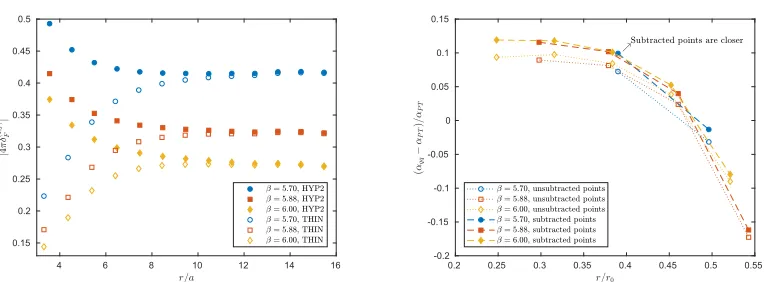
Figure 1:The left panel shows the calculation of 4πδ(1F,f)for unsmeared (empty markers) and HYP2-smeared links (full markers) choosing the same lattice discretization as our dynamical ensembles. In the right panel we subtract the leading lattice artifacts from our non-perturbative data ofαqq (full
markers) and we compare to the unsubtracted ones (empty markers). αPT is a perturbative 4-loop
calculation ofαqqin QCD (Nf =0), using theΛparameter from [19].
In this work we only focus on the fermionic term 4πδ(1F,f) of Eq. (9), as the calculation of the
gluonic term becomes much more intricate when using HYP-smeared links and it would need some extra care2. Moreover, as we will see in Section 4, our continuum extrapolation of αqq is already
accurate enough and allows to clearly distinguish the charm-loop effects onαqqat high energies. This
part of the calculation has been carried out using our computer package written in Mathematica. The fermionic contribution to the static force has been calculated for a sequence of finite lattice sizes (L=[16,64]) and then extrapolated to infinite volume.
3.3 One-loop cutoff effects
In this section we summarize our numerical results concerning the extraction of the leading fermionic lattice artifacts. The calculation has been realized for unsmeared and HYP2-smeared links, in order to see what are the main differences between these two cases.
On the left hand side of Figure1we show the calculation of 4πδ(1F,f)using the lattice parameters of
our dynamical ensembles. We see clearly that at large distances in lattice units unsmeared and HYP2-smeared links produce similar effects, while at small distances using HYP2-smeared links gives rise to
larger lattice artifacts. Moreover, as we expect, these unwanted effects become smaller whenβ→ ∞. To obtain the relative size of the lattice artifacts, 4πδ(1F,f)must be multiplied byg2MS (see Eq. (8)) and
this means, at our lattice spacings, that we observe around 5% effects.
The second step is to subtract the leading lattice artifacts from our non-perturbative data ofαqq.
The result of this procedure is depicted in Figure1(r.h.s), where also a comparison with the unsub-tracted data is shown. The most evident effect of this subtraction is that data corresponding to similar
physical distances are closer to each other compared to the unsubtracted ones, as we can see clearly from the measurements ofαqqat around 0.38r/r0. This is encouraging because it is a signal that the
size of the lattice artifacts has been reduced considerably.
4 6 8 10 12 14 16 0.15 0.2 0.25 0.3 0.35 0.4 0.45 0.5
0.2 0.25 0.3 0.35 0.4 0.45 0.5 0.55
-0.2 -0.15 -0.1 -0.05 0 0.05 0.1 0.15
Figure 1:The left panel shows the calculation of 4πδ(1F,f)for unsmeared (empty markers) and HYP2-smeared links (full markers) choosing the same lattice discretization as our dynamical ensembles. In the right panel we subtract the leading lattice artifacts from our non-perturbative data ofαqq (full
markers) and we compare to the unsubtracted ones (empty markers). αPT is a perturbative 4-loop
calculation ofαqqin QCD (Nf =0), using theΛparameter from [19].
In this work we only focus on the fermionic term 4πδ(1F,f) of Eq. (9), as the calculation of the
gluonic term becomes much more intricate when using HYP-smeared links and it would need some extra care2. Moreover, as we will see in Section 4, our continuum extrapolation of αqq is already
accurate enough and allows to clearly distinguish the charm-loop effects onαqqat high energies. This
part of the calculation has been carried out using our computer package written in Mathematica. The fermionic contribution to the static force has been calculated for a sequence of finite lattice sizes (L=[16,64]) and then extrapolated to infinite volume.
3.3 One-loop cutoff effects
In this section we summarize our numerical results concerning the extraction of the leading fermionic lattice artifacts. The calculation has been realized for unsmeared and HYP2-smeared links, in order to see what are the main differences between these two cases.
On the left hand side of Figure1we show the calculation of 4πδ(1F,f)using the lattice parameters of
our dynamical ensembles. We see clearly that at large distances in lattice units unsmeared and HYP2-smeared links produce similar effects, while at small distances using HYP2-smeared links gives rise to
larger lattice artifacts. Moreover, as we expect, these unwanted effects become smaller whenβ→ ∞. To obtain the relative size of the lattice artifacts, 4πδ(1F,f)must be multiplied byg2MS (see Eq. (8)) and
this means, at our lattice spacings, that we observe around 5% effects.
The second step is to subtract the leading lattice artifacts from our non-perturbative data ofαqq.
The result of this procedure is depicted in Figure1(r.h.s), where also a comparison with the unsub-tracted data is shown. The most evident effect of this subtraction is that data corresponding to similar
physical distances are closer to each other compared to the unsubtracted ones, as we can see clearly from the measurements ofαqqat around 0.38r/r0. This is encouraging because it is a signal that the
size of the lattice artifacts has been reduced considerably.
2For the calculation of the gluonic term with unsmeared links, we refer to [18].
4 Continuum limit
The last part of this work is aimed at extracting the continuum limit ofαqqin QCD (Nf =2) atM=Mc
and QCD (Nf =0), in order to evaluate how large the charm loop effects are on this observable.
4.1 Strategy
Studying thestep scaling functionσ[20] can provide a powerful tool to reach this purpose. If f is a fixed scale factor,σ(f,u) measures how much the coupling changes when the distance scale changes
by a factorf
σ(f,u)=g2qq(f ×r)|g2qq(r)=u. (10)
Then, from the definition of theβqq-function
βqq=−r∂gqq
∂r , (11)
one arrives at the exact relation
log (f)=−
√σ(f,u)
√u
dx
βqq(x). (12)
Eq. (12) is only true in the continuum, but following [21] we parametrizeβqqand the cutoffeffects in
such a way that the continuum limit ofαqqcan be easily extracted from our lattice simulations.
Let us introduce the following parametrization of βqq, which is not motivated by perturbation
theory, but it allows to parametrize our data really well:
βqq =− g3qq
P(g2qq)
, P(gqq)=p0+p1g2qq+p2g4qq+· · ·. (13)
This choice permits to rewrite Eq. (12) as
log (f)=−p0
2
1
σ(f,u)−
1
u
+ p1
2 log
σ(f,u)
u
+ nmax
n=1 pn+1
2n
σn(f,u)−un, (14)
where 2×(nmax+1) is the degree of the polynomialP(gqq).
However, on a lattice one can only measure an approximationΣ(f,u,a/r0) of the step scaling
functionσ(f,u) such that
lim
a→0Σ(f,u,a/r0)=σ(f,u). (15)
This means that if we want to extract the coefficientsp0,p1, . . . ,pnmax+1of our parametrization ofβqq
from lattice simulations, instead of Eq. (14) we have to use
log (f)+h=−p0
2
1
Σ(f,u,a/r0)−
1
u
+p1
2 log
Σ(f,u,a/r0) u
+ nmax
n=1 pn+1
2n
Σn(f,u,a/r
0)−un, (16)
whereh≡h(f,u,a/r0) is a particular function that depends, other than f andu, on the lattice spacing a. Since we expect cutoffeffects proportional toa2/r2
0, we choose to parametrizeh(f,u,a/r0) as
h(f,u,a/r0)=ρ(f,u)×a 2
r2 0
, ρ(f,u)= nρ−1
i=0
Thus, we can estimate the coefficientspiofβqqperforming a global best-fit to our data at different
lattice spacings through the Eqs. (16) and (17). The continuum extrapolation ofαqqcan be realized
solving the ODE which follows from the definition of theβqq-function (Eq. (11)). Since this requires
the choice of an initial condition (or the value of theΛparameter for both theories), we need to know
the value ofαqqat a reference distancerre f in the continuum limit. This can be achieved by using an
interpolation function for the static force [9]
F(rre f)= f1+f2r−re f2 (18)
between the two neighboring points. Settingrre f = 0.75r0 and taking the continuum limit of the
interpolations realized at different lattice spacings we obtain
• Nf =0:αqq(0.75r0)=0.7947(28), χ2/Ndo f =0.13 (constant fit);
• Nf =2:αqq(0.75r0)=0.8076(20), χ2/Ndo f =0.27 (constant fit).
4.2 Results of the best-fits
Before showing our final results, we begin this section with a few remarks. Using improved distances
rI, it is not possible to keep the factor f exactly constant. However, we have seen that choosing
f ∈[2.03,2.10] and f ∈[1.94,2.10] for our quenched and dynamical ensembles respectively produces acceptable best-fits for a large number of parametrizations ofβqqandρ(u), see Eqs. (13), (17). The
widths of these ranges depend in some manner on the lattice spacings and on the explored distances, therefore some attempts were needed before arriving at the ranges above-mentioned.
We tried different types of (correlated) best-fits, varying the number of parameters both in the
parametrization of theβqq-function and in the functionρ(u) that parametrizes the cutoffeffects. We
only show the parametrizations that provide an acceptable chi-squared using the minimum number of parameters, underlining that we obtain compatible results for different best-fits.
Theory p0 p1 p2 p3×102 p4×103 p5×105 ρ0 χ
2 Ndo f
Nf =0 16.07(78) −3.33(44) 0.610(86) −4.04(71) 1.21(25) −1.32(31) 0.96(43) 2120.31
Nf =2 14.64(50) −1.99(22) 0.308(32) −1.32(18) 0.192(33) 0.85(26) 2424.67 Nf =2
(subtr.) 15.84(52) −2.25(23) 0.329(33) −1.38(18) 0.198(33) 0.22(25) 18.17 24
Table 1:Results of the continuum extrapolation inNf =0 andNf =2 theories. In the second row
we show the results obtained with the original non-perturbative data, while in the third row the ones obtained subtracting the leading fermionic lattice artifacts.
Table1summarizes the results of our continuum extrapolations. The numbers listed in the table have been produced using 6 parameters forβqqand 1 forρ(u) in quenched QCD (thus 6+1 parameters
on the whole), whilst 5+1 parameters have been used in QCD (Nf =2). For equal number of
param-eters, subtracting the leading fermionic lattice artifacts for the 2 flavor theory produces a bit smaller relative errors and a better chi-squared. Moreover, we can see that the coefficientρ0, introduced to
parametrize the cutoffeffects, is compatible with zero when the one-loop fermionic lattice artifacts are
Thus, we can estimate the coefficientspiofβqqperforming a global best-fit to our data at different lattice spacings through the Eqs. (16) and (17). The continuum extrapolation ofαqqcan be realized
solving the ODE which follows from the definition of theβqq-function (Eq. (11)). Since this requires the choice of an initial condition (or the value of theΛparameter for both theories), we need to know the value ofαqqat a reference distancerre f in the continuum limit. This can be achieved by using an interpolation function for the static force [9]
F(rre f)=f1+f2r−re f2 (18)
between the two neighboring points. Settingrre f = 0.75r0 and taking the continuum limit of the interpolations realized at different lattice spacings we obtain
• Nf =0:αqq(0.75r0)=0.7947(28), χ2/Ndo f =0.13 (constant fit); • Nf =2:αqq(0.75r0)=0.8076(20), χ2/Ndo f =0.27 (constant fit).
4.2 Results of the best-fits
Before showing our final results, we begin this section with a few remarks. Using improved distances
rI, it is not possible to keep the factor f exactly constant. However, we have seen that choosing
f ∈[2.03,2.10] and f ∈[1.94,2.10] for our quenched and dynamical ensembles respectively produces acceptable best-fits for a large number of parametrizations ofβqq andρ(u), see Eqs. (13), (17). The widths of these ranges depend in some manner on the lattice spacings and on the explored distances, therefore some attempts were needed before arriving at the ranges above-mentioned.
We tried different types of (correlated) best-fits, varying the number of parameters both in the parametrization of theβqq-function and in the functionρ(u) that parametrizes the cutoffeffects. We only show the parametrizations that provide an acceptable chi-squared using the minimum number of parameters, underlining that we obtain compatible results for different best-fits.
Theory p0 p1 p2 p3×102 p4×103 p5×105 ρ0 χ
2
Ndo f
Nf =0 16.07(78) −3.33(44) 0.610(86) −4.04(71) 1.21(25) −1.32(31) 0.96(43) 2120.31 Nf =2 14.64(50) −1.99(22) 0.308(32) −1.32(18) 0.192(33) 0.85(26) 2424.67
Nf =2
(subtr.) 15.84(52) −2.25(23) 0.329(33) −1.38(18) 0.198(33) 0.22(25) 18.17 24
Table 1: Results of the continuum extrapolation inNf =0 andNf =2 theories. In the second row
we show the results obtained with the original non-perturbative data, while in the third row the ones obtained subtracting the leading fermionic lattice artifacts.
Table1summarizes the results of our continuum extrapolations. The numbers listed in the table have been produced using 6 parameters forβqqand 1 forρ(u) in quenched QCD (thus 6+1 parameters on the whole), whilst 5+1 parameters have been used in QCD (Nf =2). For equal number of param-eters, subtracting the leading fermionic lattice artifacts for the 2 flavor theory produces a bit smaller relative errors and a better chi-squared. Moreover, we can see that the coefficientρ0, introduced to parametrize the cutoffeffects, is compatible with zero when the one-loop fermionic lattice artifacts are subtracted. Expanding (13) in powers ofgqq, we can rewriteβqqin a way similar to the one motivated
0 0.2 0.4 0.6 0.8 1 1.2
0 0.2 0.4 0.6 0.8 1 1.2 1.4 1.6 1.8
0.2 0.3 0.4 0.5 0.2
0.3 0.4 0.5
0 0.2 0.4 0.6 0.8 1 1.2
0 0.2 0.4 0.6 0.8 1 1.2 1.4 1.6 1.8
0 0.1 0.2 0.3 0
0.1 0.2 0.3
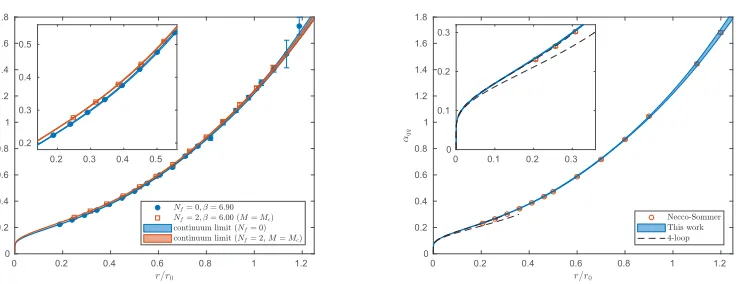
Figure 2: In the left panel a comparison ofαqq in QCD (Nf = 2) at M = Mc and quenched QCD is shown. The blue circles and the red squares denote the measurements ofαqq produced with our finest lattices inNf = 0 and Nf = 2 theories respectively. The blue and red bands stand for the continuum extrapolations obtained using three different lattice spacings for both theories. The widths of the bands originate from the errors on the data and their correlation is taken into account. The right panel shows instead a comparison between our continuum extrapolation ofαqqin quenched QCD (the blue band) and the one obtained in a previous work [9] (the red circles) using a different strategy. The dashed black lines are the predictions in perturbation theory up to four loops. The spread of the lines comes from the uncertainty in theΛparameter.
by perturbation theory. In particular, the first two coefficients are given by
βqq =−g3qq
1
p0 − p1 p2 0
g2qq
+O(g7qq)≡ −g3qq
b0+b1g2qq
+O(g7qq). (19)
This allows us to identifyb0 ≡ 1/p0 andb1 ≡ −p1/p20. From our continuum extrapolation of the quenched theory we obtainb0 =0.062(3) andb1 =0.013(3). These estimates deviate a bit from the perturbative results forNf = 0 (b0 = (411π)2 ≈ 0.070 andb1 = (4102π)4 ≈ 0.004), but this is something that we could expect because the parameters pi have been estimated in a range which is far away from the domain of validity of perturbation theory (αqq <0.20 in case of a 4-loop calculation). Once
we know the parameters of theβqq-function, the continuum limit ofαqqcan be easily extracted and
our final results are depicted in Figure 2. On the left hand side a comparison ofαqq in Nf = 0 andNf = 2 (subtracting the leading fermionic lattice artifacts) theories is shown, where we use r/r0(Mc) on the x-axis for the dynamical points. We see that the continuum limits are accurate enough to distinguish the dynamical charm effects on αqq at distances r/r0 0.5. In the right panel we compare our continuum extrapolation ofαqqin quenched QCD to the one obtained in Ref. [9] and the predictions of perturbation theory up to four loops. We observe a really good agreement with [9] and with perturbation theory atαqq0.20.
5 Conclusions and Outlook
We have also tried to extract the continuum limit ofαqq studying the step scaling functionσ.
This strategy allowed us to evaluate the dynamical charm effects onαqq and for quenched QCD we
find a really good agreement with perturbation theory at high energies and Ref. [9] at low energies. Our continuum extrapolations also indicate that the dynamical charm effects onαqqare significant at
distancesr/r00.5.
In future we plan to extend these measurements to other values of quark masses to study the mass-dependence of the strong couplingαqq.
Acknowledgments
We gratefully acknowledge the Gauss Centre for Supercomputing (GCS) for providing computing time on the supercomputers JURECA and JUQUEEN at Jülich Supercomputing Centre (JSC). S.C. acknowledges support from the European Union’s Horizon 2020 research and innovation programme under the Marie Skłodowska-Curie grant agreement No. 642069.
References
[1] M. Bruno, J. Finkenrath, F. Knechtli, B. Leder, R. Sommer (ALPHA), Phys. Rev. Lett.114, 102001 (2015),1410.8374
[2] F. Knechtli, M. Bruno, J. Finkenrath, B. Leder, R. Sommer (ALPHA), PoSLATTICE2015, 256 (2016),1511.04914
[3] R. Sommer, Nucl. Phys.B411, 839 (1994),hep-lat/9310022
[4] T. Korzec, F. Knechtli, S. Cali, B. Leder, G. Moir, PoS LATTICE2016, 126 (2017),
1612.07634
[5] K.G. Wilson, Phys. Rev.D10, 2445 (1974), [,45(1974)] [6] B. Sheikholeslami, R. Wohlert, Nucl. Phys.B259, 572 (1985)
[7] R. Frezzotti, P.A. Grassi, S. Sint, P. Weisz (Alpha), JHEP08, 058 (2001),hep-lat/0101001
[8] P. Dimopoulos, H. Simma, A. Vladikas, JHEP07, 007 (2009),0902.1074
[9] S. Necco, R. Sommer, Nucl. Phys.B622, 328 (2002),hep-lat/0108008
[10] M. Luscher, S. Schaefer, Comput. Phys. Commun.184, 519 (2013),1206.2809
[11] F. Knechtli, T. Korzec, B. Leder, G. Moir (2017),1706.04982
[12] M. Donnellan, F. Knechtli, B. Leder, R. Sommer, Nucl. Phys.B849, 45 (2011),1012.3037
[13] A. Hasenfratz, F. Knechtli, Phys. Rev.D64, 034504 (2001),hep-lat/0103029
[14] B. Blossier, M. Della Morte, G. von Hippel, T. Mendes, R. Sommer, JHEP04, 094 (2009),
0902.1265
[15] M. Melles, Phys. Rev.D62, 074019 (2000),hep-ph/0001295
[16] A. Athenodorou, H. Panagopoulos, Nucl. Phys.B799, 1 (2008),hep-lat/0509039
[17] A. Athenodorou, R. Sommer, Phys. Lett.B705, 393 (2011),1109.2303
[18] G.S. Bali, P. Boyle (2002),hep-lat/0210033
[19] S. Capitani, M. Lüscher, R. Sommer, H. Wittig, Nucl. Phys.B544, 669 (1999), [Erratum: Nucl. Phys.B582,762(2000)],hep-lat/9810063
[20] M. Luscher, P. Weisz, U. Wolff, Nucl. Phys.B359, 221 (1991)
[21] M. Dalla Brida, P. Fritzsch, T. Korzec, A. Ramos, S. Sint, R. Sommer (ALPHA), Phys. Rev.