477 | P a g e
Artificial Bee Colony Algorithm with Flower Pollination
(ABCAFP) for Cluster Formation in MANET
D. Gopinath
1,
Dr. K. K. Savitha
2 1Ph.D Research Scholar, Bharathiar University, Coimbatore, TamilNadu.(India)
2Assistant Professor, Department of Computer Application,
Bharathiar University PG Extension Center, Erode, TamilNadu.(India)
ABSTRACT
A MANET is much more vulnerable to attacks when compared to a wired network due to factors such as being
an open medium, possessing dynamically reconfigurable network topology and functioning in the absence of a
centralized authority, with no prior security associations. Furthermore, as MANET nodes are fully mobile the
network topology can change rapidly and unpredictably. As a result, malicious nodes are also free to move
arbitrarily and communicate with other nodes using multi-hop wireless technology. Routing in MANET is a
paramount significance and the limited battery power of nodes in MANET is a crucial factor while establishing
routes. In cluster based MANET, the Cluster Head selection and Cluster Member selection should be considered
as important aspects. The Cluster Head manages nodes of their own region and Cluster Member plays an
important role in transferring information to particular destination during data transmission. In this paper, the
Cluster Member Selection is carried to form effective clusters for providingreliable data transmission. In this
work, Enhanced Artificial Bee Colony Algorithm with Flower Pollination (ABCAFP) is proposed for effective
Cluster Member Selection and Member Replacement in a cluster. Member replacement is based on node failure
and current status of the particular node.
Keywords: Ad-hoc networks, Clusters, ABCAFFP, ABC Algorithms, Flower Pollination.
I. INTRODUCTION
Mobile ad hoc networks are formed by the co-ordination of mobile wireless devices in the “ad hoc” mode of
operation. Mobile Ad hoc Networks (MANETs) are extensively used for on-the-move applications and remain
as a promising technology. The network is formed using autonomous nodes used over links that are bandwidth
constrained. The network topology may change rapidly and unpredictably over time because of the node
mobility. All nodes are autonomous, who can take decisions regarding the operations among the nodes
478 | P a g e
Architecture of MANETs
One of the main advantages of MANETs is the decentralized architecture, where each and every node is
independent to make its own decisions. In order to understand the decentralized architecture of MANETs the
centralized and decentralized architectures of a general system are described.
Node - any device (router or host) that implements IP.
Router - a node that forwards IP packets not explicitly addressed to itself.
Host - any node that is not a router, i.e. it does not forward packets addressed to others.
Link - A communications facility at a layer below IP, over which nodes exchange IP packets directly
without decrementing IP TTL (Hop Limit).
Asymmetric Reachability - A link where non-reflexive and/or non-transitive reachability is part of normal
operation. Non-reflexive reachability means packets from X reach Y but packets from Y don't reach X.
Nontransitive reachability means packets from X reach Y, and packets from Y reach Z, but
packets from X don't reach Z. Many radio/ wireless interfaces exhibit these properties.
Neighbor
o If node X can directly exchange IP packets with node Y, then node
o Y is node X's neighbor. Packet reception characteristics are often used to assist devices in determining the
quality of neighbors' communication.
Interface - A node's point of attachment to a communication link.
Broadcast Interface
o
An interface supporting many attached nodes, together with the capability to address a single link layermessage to all of the attached nodes
(broadcast). The set of nodes receiving a given physical
broadcast message are the neighbors of the node originating the message.
Full-Broadcast Interface (FBI)
o A broadcast interface with reflexive and transitive reachability.
o All nodes on the interface can send and receive IP packets directly, all nodes are symmetric neighbors. An
Ethernet segment is an example of a FBI.
Semi-Broadcast Interface (SBI)
o A broadcast interface that may exhibit non-reflexive and/or non- transitive reachability. A FBI is a special
case of SBI.
o Multiple access wireless radio interfaces are often SBI.
Site - a set of one or more links.
479 | P a g e
II. BACKGROUND STUDY
2.1Artificial Bee Colony Algorithm
Artificial bee colony (ABC) algorithm was first proposed by Karaboga in 2005 [1]; this algorithm imitates the
foraging behaviors of a honey bee swarm in nature. It has been widely utilized for solving unconstrained and
constrained optimization problems in numerous fields, such as some benchmark functions [2–5], composite
functions [6], data clustering [7], job scheduling [8] and numerical optimization [9,10]. In addition, a number of
researchers have improved ABC algorithm to obtain a global optimum by using numerous techniques such as
the Gbest-guided technique for solving the numerical function problem [11], improved searching function
[12,13], quick local search [14], and memory mechanism [15]. Those results demonstrated that ABC and
improved ABC algorithms are more efficient and robust than the compared metaheuristic algorithms.
A conceptual flow of the ABC algorithm the steps are:
Step 1 - Generate PN initial solutions randomly until the solutions are in accord with the ACI code. The cross
section and number of reinforcing bars are set randomly in the design variable ranges. A solution corresponds to
a bee; it contains the design variables of beams and columns of RC frame.
Step 2 - FN new solutions are generated depending on the difference between the previous solution and a
neighbor. We call a new solution, a food source, which contains the same set of design variables as a bee.
Step 3 - For scout bees, we create new solutions as in Step 1.
Step 4 - The solutions from Step 2 through 3 will be evaluated by Pi.
Step 5 - The new solutions will be selected depending on rand (0,1) and Pi. One bee can select only one solution
and it cannot select another.
Step 6 - Memorize recent food positions and report the best food source
Step 7 - Repeat Steps 2 through 6 until the termination criteria is reached.
2.2Flower Pollination Algorithm (FPA)
In 2012, Yang proposed a natural inspired algorithm called FPA [13] , which is inspired by the pollination
process of flowering plants. The objective of this algorithm is the survival of the best and the optimal
reproduction of plants, which is, in fact, an opti- mization process of plant species. The FPA is governed by the
four basic rules [13] bellow:
Rule1: Biotic and cross-pollination can be considered as a process of global pollination process, and
pollen-carrying pollinators move in a way that obeys Lévy flights.
Rule2: For local pollination, a biotic and self-pollination are used.
Rule3: Pollinators such as insects can develop flower constancy, which is equivalent to a reproduction
480 | P a g e
Rule4: The interaction or switching of local pollination and global pollination can be controlled by a switchprobability, with a slight bias toward lo-cal pollination.
Flower Pollination Algorithm ABC Algorithm
1: Objective min or max f (x ) , x = (x 1 , . . . , x n ) ; 2:
Initialize a population of n flowers/pollen gametes
with random solutions;
3: Find the best solution g in the initial population;
4: Define a switch probability p ∈ [0 , 1] ;
5: while ( t < MaxGeneration ) do
6: for i = 1 : n (all n flowers in the population) do 7: if
rand < p, then
8: Draw a ( d -dimensional) step vector L which obeys
a Lévy flight distribution;
9: Global pollination ;
10: else
11: Draw from a uniform distribution in [0,1];
12: Randomly choose j and k among all the solutions;
13: Do local pollination via ;
14: end if
15: Evaluate new solutions;
16: if new solutions are better, update them in the
population;
17: end for
18: Find the current best solution g ;
19: end while
//Initialization Phase
1: Setup the parameters, such as limit and parameter t
in Algorithm 2 .
2: Produce the initial solutions using Eq. 3 .
3: Calculate fitness of the solutions.
4: while termination condition is not met do
//Employed Bee Phase
5: for each Employed Bee do
6: Search_new_solution( t)
7: end for //Onlooker Bee Phase
8: Calculate selection probabilities of the employed
beesusing Eq. 2 .
9: for each Onlooker Bee do
10: Use the calculated selection probability to select
anemployed bee.
11: Search_new_solution( t)
12: end for
13: Save the best solution obtained so far. //Scout Bee
Phase
481 | P a g e
15: Produce a new solution by using Eq. 3 .16: Calculate fitness of the produced solution.
17: Reset its limit to 0. 18: end if 19: end while
For strengthening the global searching and local searching abilities, three optimization strategies are applied to
the basic flower pollination algorithm (FPA). As we all know that honey bees usually act as pollinators of
flower plants in nature. And there exists a discard solution opera-tor in artificial bee colony algorithm (ABC). In
this paper, that operator is selected to enhance the global searching ability of proposed Flower Pollination
Algorithm with Bee Pollinator. Other two optimization strategies (Elite Based Mutation Operator and Crossover
Operator) used in local search process to enhance its local searching ability.
III. PROPOSED SYSTEM MODEL:
ABSAFP ALGORITHM
The cluster based network is formed in the proposed work. The Cluster Head selection should be our upcoming
work. In this work, Cluster Member selection for data transfer should be considered as main aspect, because the
information transfer should be in trusted and manageable node. The ABSAFP is a based on nature inspired
metaheuristic algorithm. The main aim is to find better node for communication.
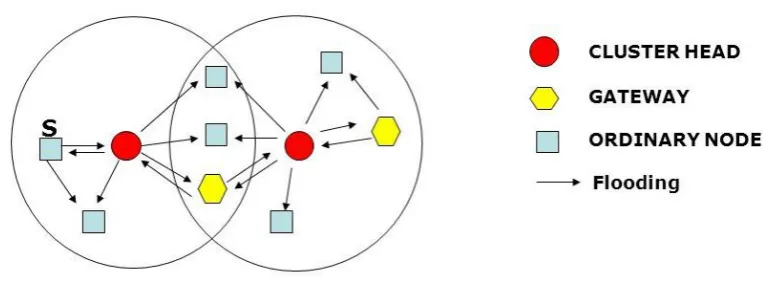
Fig. 1 Nodes in a clustered MANET with Head and Gateway node.
Black circles indicate the cluster nodes inside the region (before select the cluster member). Yellow marks
482 | P a g e
3.1Artificial Bee Colony Algorithm with Flower Pollination (ABCAFP)
3.1.1Parameters of ABCAFP
While solving a problem with ABCAFP, an initial set of „„n” solutions are randomly chosen. Note that, each
„„scout bee” represents a solution to the problem in question. The problem is solved using a neighborhood
search approach. This search is carried out by changing the values of some of the variables in the objective
function.
In this way some alternative but close solutions around the existing one can be generated. Once defined, „„n”
solutions are evaluated and ranked according to fitness for purpose (an objective function). The rating process
ends with identifying „„e” very best solutions, and „„m” best solutions of the first iteration.
This process results with a series of neighborhood solutions around „„(e) + (m-e)” points neighborhood search is
respectively defined for the problem depending on the type and variables of the objective function. The number
of neighborhood search around „„e” solutions is „„nep” and the number of neighborhood search around „„m-e” solutions is „„nsp”. The best solution found during a neighborhood search is passed onto the next iteration and
this process is repeated until the stopping criterion is met.
The ABCAFP requires a number of parameters to be set. These may include;
Ranking Procedure (Apply ABC Algorithm for Ranking)
number of scout bees so called solutions (n), are randomly sent to the solution space, so that (n) sites
(alternative solutions, points, vectors, etc.) are dealt with in the solution space.
number of sites (solutions) selected out of n alternatives (m), where each site is ranked and (m) site at
the top is selected.
number of best sites out of m selected sites (e) so called elite sites, which are the number sites selected
from (m) sites that are of minimum (or the maximum) solution values in the order.
number of bees recruited for best e sites (nep), which are the number of scout bees that will be seeking
if there is a better solution around (e) solutions achieved up to that moment.
number of bees recruited for other (m-e) selected sites (nsp), which are responsible to find out if there
is a better solution around the remaining (m-e) solutions.
483 | P a g e
The parameters required for ABC algorithm with Flower Pollination are the number of bees (PN), number offood sources (FN), number of trial limit (Ti), Flower Pollination (FP) and termination criterion.
Step 1 - Before starting, the ABC algorithm parameters such as PN, FN, maximum of Ti, FA and termination
criteria are defined.
Step 2 - The initial employed bee is generated.
Step 3 - The initial employed bee is evaluated by calculating the load capacity and the fitness value is calculated
by the objective function.
Step 4 - Provisions are employed to evaluate the design variables of the initial employed bee. If the design
variables of the initial employed bee are in agreement with the provisions, it will be passed, and we go to Step 6.
If they are not in agreement, we go back to Step 2.
Step 5: To get center point apply Flower pollination. Global pollination and Local pollination are calculated.
Step 6 - Evaluating the number of initial employed bee: If the number of initial employed bee is equal to the
maximum number of bees, the generation of employed bees is complete, and we go to Step 7. Otherwise, we go
back to Step 2.
Step 7 - Evaluating a type of bee: In the case of scout bee type, we go to Step 9; in the other cases, we goes to
Step 7.
Step 8 - Local search: A new solution is generated and we go to Step 10.
Step 9 - Global search: A new solution is generated by , and we go to Step 10.
Step 10 - A new solution is evaluated in terms of the load capacity, provision, and objective function.
Step 11 - Evaluating the numbers of new solutions, if the number of new solutions is equal to the maximum
food source limit, we go to Step 12. In the other cases, we go to Step 7.
Step 12 - The information exchange probability of a new solution is evaluated and Ranking is proceed.
Step 13 - A threshold value is generated as a random number between 0 and 1, which is compared with the Pi
value. If the Pi value is higher than the threshold value, we go to Step 17; if the Pi value is less than the
threshold value, we go to Step 14.
Step 14 - Evaluating the number of trial limits, if the number of trial limits is equal to the number of
unimproved current solutions, we go to Step 15. Otherwise, we go to Step 16.
Step 15 - An employed bee becomes a scout bee if it is not feasible to determine a new solution that is an
improvement over the current solution.
Step 16 - The number of the unimproved current solution is increased by a level.
Step 17 - The information on current food sources is replaced by the information on new food sources. The
number of the unimproved current solution is set as zero.
Step 18 - Evaluating the number of new solutions, if all the new solutions have been evaluated, we go to Step
19, and for the other cases, we go to Step 12.
Step 19 - Evaluating the termination criteria, if the termination criteria are achieved, the optimal design process
484 | P a g e
Step 20- Finally, the optimum solution is reported.Fig3. Cluster formation
Cluster Based Network Formation - The cluster count should be based on the number of nodes on the network.
Maximum number of nodes in the cluster should be based on the trusted level of nodes.
Cluster Head (CH) Selection - The Cluster Head (CH) Selection is based on some criteria that should be my
future work.
Selection of Cluster Member (CM) - Based on fitness the cluster member should be selected.
Collection Nodes in a Region - In a cluster there are number of nodes should be collected together in a region.
Fitness Calculation – Calculation of fitness is based on Environmental distance, Clustering stability
enhancement, Load balancing clustering scheme, Energy consumption, Remaining battery energy and
Combined Weight.
Performing Ranking - The Ranking should be based on fitness level.
Final Cluster Member Selection – Based on raking the number of nodes should be participated for data transfer.
Node Replacement Based on Newly Arrived Nodes - Failed node was found at the time of updating and
Re-Ranking is initialized.
IV. CONCLUSION
In this paper, the Artificial Bee Colony Algorithm with Flower Pollination (ABCAFP) algorithm has been
discussed. In this work, ABCFP is proposed for effective Cluster Formation and Member Replacement in a
cluster. The above algorithm is possible to apply on Member replacement based on node failure and current
status of the particular node.The above framework can be enhanced and implemented for the real time
485 | P a g e
REFERENCE
[1] Karaboga D. An idea based on honey bee swarm for numerical optimization, Technical Report TR06.
Erciyes University, Engineering Faculty, Computer Engineering Department; 2005.
[2] Karaboga D, Basturk B. A powerful and efficient algorithm for numerical function optimization: artificial
bee colony (ABC) algorithm. J Glob Optim 2007;39(3):459–71.
[3] Karaboga D, Basturk B. On the performance of artificial bee colony (ABC) algorithm. Appl Soft Comput
2008;8(1):687–97.
[4] Karaboga D, Akay B. A comparative study of artificial bee colony algorithm. Appl Math Comput
2009;214(1):108–32.
[5] Karaboga D, Ozturk C. A novel clustering approach: Artificial Bee Colony (ABC) algorithm. Appl Soft
Comput 2011;11(1):652–7.
[6] Akay B, Karaboga D. A modified artificial bee colony algorithm for realparameter optimization. Inf Sci
2012;192(1):120–42.
[7] Zhang C, Ouyang D, Ning J. An artificial bee colony approach for clustering. Expert Syst Appl
2010;37(7):4761–7.
[8] Taheri J, Lee YC, Zomaya AY, Siegel HJ. A Bee Colony based optimization approach for simultaneous job
scheduling and data replication in grid environments. Comput Oper Res 2013;40(6):1564–78.
[9] Xiang WL, An MQ. An efficient and robust artificial bee colony algorithm for numerical optimization.
Comput Oper Res 2013;40(5):1256–65.
[10] Das S, Biswas S, Kundu S. Synergizing fitness learning with proximity-based food source selection in
artificial bee colony algorithm for numerical optimization. Appl Soft Comput 2013;13(12):4676–94.
[11] Zhu G, Kwong S. Gbest-guided artificial bee colony algorithm for numerical function optimization. Appl
Math Comput 2010;217(7):3166–73.
[12] Gao WF, Liu SY. A modified artificial bee colony algorithm. Comput Oper Res 2012;39(3):687–97.
[13] X. Yang , Flower pollination algorithm for global optimization, in: J. Durand- Lose, N. Jonoska (Eds.),
Unconventional Computation and Natural Computation, S pringer, Berlin Heidelberg, 2012, pp. 240–249 .
[14] D.Gopinath, Dr.K.K. Savitha. Enhanced Levy-Flightcuckoo Search Algorithm (ELCSA) for cluster
member selection and member replacement, International Journal of Advanced Research in Science and
Engineering. ISSN(Online) 2319-8354, ISSN(Print) 2319-8346
486 | P a g e
Mr.D.Gopinath received his B.Sc, M.Sc and M.Phil degree in Computer Science from theBharathiar University. He is currently working as a Assistant Professor in Kongu Arts and
Science College. He has presented papers at various National and international conferences.
His area of interest includes Wireless sensor Network Security, Network Security, Ad Hoc
Network, especially design and implementation of security metrics.
Dr.K.K.Savitha is currently working as an Assistant Professor at the Department of
Computer Applications, Bharthiar University PG Extension Centre, Erode and also holds
B.Sc, MCA and M.Phil degrees. She completed her PhD from Anna University, Chennai
in2013. Her research interest includes mobile computing, Cloud Computing and Soft