IJEDR1601075
International Journal of Engineering Development and Research (www.ijedr.org)459
An Efficient Multicast Routing Protocol Using Angle
between Forwarding Nodes in Wireless Mesh
Networks
1Sujitha P, 2B.Thenral, 3A.Manimegalai 1PG Student, 2Assistant Professor, 3Professor
Department of ECE,
1Ganadipathy Tulsi’s Jain Engineering college, Vellore, India
________________________________________________________________________________________________________ Abstract - The paper put forward the ideas about improving the routing parameters like delay, throughput and packet loss ratio during the transfer of data in forwarding nodes. The parameters can be improved by reducing the number of hops a data packet traverses to reach the destination. The hop count can be optimized by measuring the angle between the nodes which forwards the data. This angle based algorithm works well in dense areas and dense networks like wireless Mesh networks also. Wireless Mesh networks is a special type of wireless network in which every of the node will be connected to every other nodes participating in data transfer.
IndexTerms - Angle, Mesh, Delay, Throughput, Packet loss
________________________________________________________________________________________________________
I. INTRODUCTION
A wireless mesh network is a unique type of Wireless Adhoc network which consists of radio nodes that are connected in mesh topology i.e. there will be connection between one node and every other nodes that are participating in the data transfer [1]. There are three types of routing in wireless networks namely Unicast routing and multicasting which falls in the same category that can be used for transfer of data packets and broadcasting falls in different category which is used normally to send control packets but can be used in data transfer also.
Multicasting is the transfer of data packets from one node to many nodes or many nodes to many nodes. Both cases are possible in any type of network. This multicasting is very much complicated in wireless communication than wired communication because of mobile nature of the nodes participating in the data transfer. Multicasting is done by constructing routing trees or creating mesh from sources to reach destination. It can also be done by flooding the packets. The flooding approach is a simple approach that gives out more control packets in the wireless network environments. On the other hand, tree-based approach produces minimal traffic in the network. Here, tree maintenance and updates require huge number of control message packets over the network. Both approaches have an extensibility problem [2]. The multicast routing protocols for the Wireless Mesh Networks vary in terms of routing, maintaining state, depends on unicast and other points. The problem of multicast in the WMN is combination of the node mobility, which results in conflicting goals. Frequent updates are required which needs extensive use of the bandwidth. This results in more control message packets, power and wastage of the bandwidth. The common metric which is to be considered is the cost, which is used to find a route in name of shortest delay/least number of hops [3].
In this paper an optimized multicast routing protocol is used to reduce the delay, increase throughput and reduce the packet loss ratio in the wireless mesh networks by considering the angle between the forwarding nodes. These parameters are plotted for various angles and the angle with most efficient parameters is determined.
II. MULTICAST ROUTING PROTOCOL IN WIRELESS MESH NETWORKS
IJEDR1601075
International Journal of Engineering Development and Research (www.ijedr.org)460
weighted parameter in which Weighted parameter varies with different load condition. Hence relative parameter of weight for various routes has to be found. The mesh can be maintained using the Heart-beat and PushJoin control packet as given in [8]. It needs correct routing protocols to work effectively at the time of node failures. The traffic can be further reduced by measuring the angle between the forwarding nodes as mentioned in [9].III. MULTICAST ROUTING BASED ON ANGLE BETWEEN INTERMEDIATE NODES
An efficient multicast routing algorithm based on angle between intermediate forwarding present between the source node and destination nodes is put forward. The main task of this algorithm is to minimize the number of hops while casting the data packets to multiple destinations. The currently present method of data transmission from one source to many destinations using multicast routing algorithm is explained as follows. The current method uses many different routes for sending the same information from single node which acts as source to multiple nodes termed as destinations or multiple nodes which acts as sources to multiple nodes termed as destinations. Let the source ‘s’ wants to send data to destinations ‘d1’, ‘d2’, ‘d3’ and ‘d4’. The source‘s’ finds separate routes to different destinations using the intermediate nodes. This way of transmitting data to destination needs more time and it requires more number of hops. For all the routes, separate RouteReq and RouteReply packets are to be transmitted before data transmission. This results in much overhead among the intermediate nodes in the communication network. There is a chance to retrace the path which was been used already. This makes the communication more complex which resulting in lesser efficiency.
The above drawbacks can be overcome by the new multicast routing protocol based on angle between the forwarding nodes is proposed. The idea behind is reduction of the number of hops using the metric called angle in multicast routing. It can be done by forming multicast meshes within the nodes participating in the data transfer to the destinations.
The angle is calculated between the intermediate nodes with which data is transmitted through to arrive at the destination with the 2D co-ordinates (x1,y1) and (x2,y2) which are old and new positions of forwarding nodes respectively and is given in equations (1) and (2),
𝑑𝑥 = 𝑥2− 𝑥1 (1)
𝑑𝑦 = 𝑦2− 𝑦1 (2)
𝑎𝑛𝑔𝑙𝑒 = 𝐴 tan 2(𝑑𝑦, 𝑑𝑥) ×180
𝜋 (3)
Where A tan = Arc tan.
The algorithm is applied for ranges angles calculated from the above formula and the corresponding parameters are found out. The various steps involved in the process of finding angles are as follow.
IV. PERFORMANCE ANALYSIS
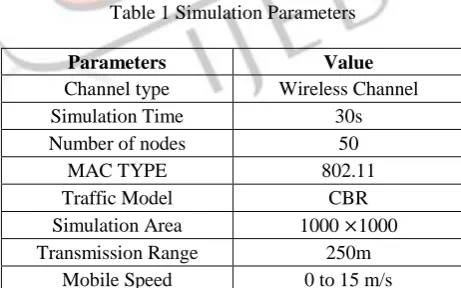
The rendition of the scheme put forward is analyzed by using the Network Simulator (NS2). The Network Simulator version-2 widely known as NS-2 is an open source programming language. The script for the NS-2 can be written in both C++ and OTCL. OTCL is nothing but Object Oriented Tool Command Language. NS2 is a discrete time event driven simulator which is used mainly to model the network routing and scheduling protocols. The simulation parameters used for the purpose of proposed angle based routing is given as follows.
Table 1 Simulation Parameters
Parameters Value
Channel type Wireless Channel
Simulation Time 30s
Number of nodes 50
MAC TYPE 802.11
Traffic Model CBR
Simulation Area 1000 ×1000
Transmission Range 250m
Mobile Speed 0 to 15 m/s
Average Delay
The average delay can be defined as the time difference between the currently received packets and the packet received previously. It can be calculated using the following equation (4).
Time PRT PST Delay
n
0
(4)
Where
IJEDR1601075
International Journal of Engineering Development and Research (www.ijedr.org)461
PRT=Packet Received TimeFig.1 Average delay at ranges of angles
The Figure (1) shows the ranges of angles and the delays corresponding to the various ranges of angles. From the plot, it is clear that the range of angles from 30-60 and 60-90 have considerably less delay. Hence now, the delay is been plotted for the constant angles which are 30°, 60°, 90°, 120°, 180°. The Figure (2) shows that the angle 60° have the least delay which is much efficient and helps in improving the QoS.
Fig.2 Average delay at constant angles Throughput
Throughput is the average successful packets delivered to the destination. It can be estimated using the following formula.
1000
0
nPS
PR
Throughput
(5)Where,
PR=No of packets Received PS=Packet Size
The Figure (3) below shows the ranges of angles and the throughput corresponding to the various ranges of angles. From the plot, it is clear that the range of angles from 30-60 and 60-90 have considerably good throughput. Hence now, the throughput is been plotted for the constant angles which are 30°, 60°, 90°, 120°, 180° is shown in Figure (4). The Figure (4) shows that the angle
0 1 2 3 4 5 6 7 8
2 4 6 8 10 12
D
e
lay
(m
s)
Simulation time(s)
0-30 30-60 60-90 90-120 120-180
0 0.250.5 0.751 1.251.5 1.752 2.252.5 2.753 3.253.5 3.754 4.254.5 4.755 5.255.5 5.756
0 5 10 15 20 25 30
D
e
lay
(m
s)
Simulation time(s)
IJEDR1601075
International Journal of Engineering Development and Research (www.ijedr.org)462
60° have the supreme throughput when compared to other angles which is much efficient and helps in improving the QoS drastically.Fig.3 Throughput at ranges of angles
Fig.4 Throuput at constant angles Packet Loss Rate
The packet loss rate is the ratio of the total number of packets lost or dropped to the number of packets being sent. It can be calculated using the formula given below.
TPS
TPD
PLR
(6)Where,
TPD=Total Packet Delivered TPS=Total Packet Sent
0 20 40 60 80 100 120 140 160 180 200
2 4 6 8 10 12
Th
ro
u
gh
p
u
t(
B
yte
s)
Simulation time(s)
0-30 30-60 60-90 90-120 120-180
0 50 100 150 200 250 300
5 10 15 20 25 30
Th
ro
u
gh
p
u
t(
B
yte
s)
Simulation time(s)
IJEDR1601075
International Journal of Engineering Development and Research (www.ijedr.org)463
The Figure (5) shows the plot between various angles and the packet loss ratio to the corresponding angles. Form the various ranges of angles the rages 30°-60° and 60°-90° have the least packet loss ratio and hence the graph is now plotted between the constant angles and the corresponding packet loss ratio.Fig.5 Packet Loss Ratio at ranges of angles
From Figure (6), it is clear that if the angle 60° between the forwarding nodes, then the packet loss ratio is minimum. The parameters mentioned above i.e. the Average delay, Throughput and the packet loss ratio decides the Quality of service in a network. Hence by this routing algorithm, there is a considerable reduction in the delay and packet loss ratio and there is also a good improvement in the throughput. Hence these improvements lead to the improvement in the Quality of Service also.
Fig.6 Packet Loss Rate at constant angles V. CONCLUSION AND FUTURE WORK
Hence an efficient multicast routing protocol using angle between forwarding nodes in Wireless Mesh Networks is presented in this paper. Performance evaluation of this routing protocol shows that the throughput is been supreme and there is a down flow of the delay and packet loss rate at 60° angle. These improvements in the routing parameters have improved the QoS correspondingly.
0 5 10 15 20 25 30 35
2 4 6 8 10 15
Pack
e
t
Loss R
ate
(B
p
s)
Simulation time(s)
0-30 30-60 60-90 90-120 120-180
0 0.2 0.4 0.6 0.8 1 1.2 1.4 1.6 1.8 2 2.2 2.4
0 5 10 15 20 25 30
Pack
e
t
Loss(B
p
s)
Simulation Time(s)
IJEDR1601075
International Journal of Engineering Development and Research (www.ijedr.org)464
This multicast routing algorithm can be further enhanced to improve the overhead produced during the time of data transfer in a multicast fashion in a dense network like Wireless Mesh Network and also in networks with mobile nodes i.e. MANETS.REFERENCES
[1] Ian F. Akyildiz.,Xudong Wang., “A Survey on Wireless Mesh Network” , IEEE Radio Communications in September 2005. [2] Luo Juhan, Ye Danxia, Xue Liu and Fan Mingyu., “A Survey of Multicast Routing Protocol for Mobile Ad-Hoc Networks”,
IEEE Communications Surveys & Tutorials in First Quarter 2009.
[3] Ajish Kumar K.S., Saumya Hegde., “Multicasting in Wireless Mesh Networks: Challenges and Opportunities”, IEEE Conference on Information management and Engineering in 2009.
[4] Ling Chen, Kaining Lu, Zhigang, Jin Bing Liang.,” Enhancement of the On-Demand Multicast Routing protocol in the Ad hoc Network”, IEEE 2003.
[5] Mangai S.,Tamilarasi.A.,Venkatesh C., “Dynamic Core Multicast Routing protocol Implementation using Ant Colony Optimization in Ad hoc Wireless networks”, International Conference on Computing, Communication and Networking in 2008.
[6] Zhang X.Quan.,Niu D.Zhen.,Jin S.Fu.,”Multicast Forwarding Group Routing protocol for Ad hoc” International Conference on Machine Learning and Cybernetics in 2008.
[7] Lee S.,Kim C., “Neighbour Supporting Ad hoc Multicast Routing protocol” in IEEE 2000.
[8] J.J.Garcia-Luna-Aceves.,Ewerton L.Madruga.,” The Core-Assisted Mesh Protocol”, IEEE Journal on Selected Areas in Communications in 1999.