Article
Emergence at the Fundamental Systems Level:
Existence Conditions for Iterative Specifications
Bernard P. Zeigler 1,2,* and Alexandre Muzy 3
1 Arizona Ce nte r for Integrative Mode ling and Simulation (ACIMS), Unive rsity of Arizona, Tucson, AZ 85721, USA
2 RTSync Corp. 12500 Park Potomac Ave . #905-S, Potomac, MD 20854, USA 3 I3S, CNRS, Unive rsité Côte d'Azur, France; [email protected]
* Corre spondence: ze [email protected]
Abstract: Conditions under which compositions of component systems form a well-defined system-of-systems here are formulated at a fundamental level. Statement of what defines a well -defined composition and sufficient conditions guaranteeing such a result offers insight into exemplars that can be found in special cases such as differential equation and discrete event systems. For any given global state of a composition, two requirements can be stated informally as: 1) the system can leave this state, i.e., there is at least one trajectory defined that starts from the state, and 2) the trajectory evolves over time without getting stuck at a point in time. Considered for every global state, these conditions determine whether the resultant is a well-defined system and if so, whether it is non-deterministic or non-deterministic. We formulate these questions within the framework of iterative specifications for mathematical system models that are shown to be beha viorally equivalent to the Discrete Event System Specification (DEVS) formalism. This formalization supports definitions and proofs of the afore-mentioned conditions. Implications are drawn at the fundamental level of existence where the emergence of a system from an assemblage of components can be characterized. We focus on systems with feedback coupling where existence and uniqueness of solutions is problematic.
Keywords: emergence; uniqueness; existence of solutions; input/output system; system specifications; discrete event system specification
Introduction
Emergence has been characterized as taking place in strong and week forms [5,12]. Mittal [6] pointed out that strong emergent behavior results in generation of new knowledge about the system representing previously unperceived complex interactions. This can occur in the form of one or more of new abstraction levels and linguistic descriptions, new hierarchical structures and couplings, new component behaviors, and new feedback loops. Once understood and curated, the behavior returns to the weak form, as it is no longer intriguing, and then can begin to be treated in regularized fashion. Emergent behavior is likely an inherent feature of any complex system model because abstracting a continuous real-world system (e.g. any complex natural system) to a constructed system -model must leave gaps of representation that may diverge in unanticipated directions Mittal [7] Philosophically, following Ashby [1] and Foo and Zeigler [4], the perceived global behavior (holism) of a model might be characterized as: components (reductionism) + interactions (computation) + higher -order effects where the latter can be considered as the source of emergent behaviors [5,12].
In this paper, we formulate conditions under which a composition of component systems form a defined system-of-systems at a fundamental level. Formal statement of what defines a well-defined composition and sufficient conditions guaranteeing such a result offer insight into exemplars that can be found in special cases such as differential equation and discrete event systems. Informally stated, we show that for any given global state of a composition, two requirements can be stated as: 1) the system can leave this state, i.e., there is at least one trajectory defined that starts from the state, and 2) the trajectory evolves over time without getting stuck at a point in time. Considered for every global state, these conditions determine whether the resultant is a well-defined system and if so, whether it is non-deterministic or deterministic. We formulate these questions within the framework of iterative specifications for mathematical system models that are shown to be behaviorally equivalent to the Discrete Event System Specification (DEVS) formalism. This formalization supports definitions and proofs of the afore-mentioned conditions and allows us to exhibit examples and counter-examples of condition satisfaction. Drawing on Turing machine halting decidability, we investigate the probability of legitimacy for randomly constructed DEVS models. We close with implications for further research on the emergence of new classes of well-defined systems.
Figure 1 Turing Machine decomposition and modular composition
Let’s start with a well-known concept, the Turing Machine (TM) [https://en.wikipedia.org/wiki/Turing_machine]. Usually it is presented in a holistic, unitary manner but as in Figure 1a, we can decompose it into two stand-alone independent systems the TM Control, S1 and the Tape System, S2. Foo and Zeigler [4] argued that the re-composition of the two parts was an easily understood example of emergence wherein each standalone system has very limited power but their composition has universal computation capabilities. Examining this in more depth, the Tape system shown in Figure 1b is the dumber of the two, serving a memory with a slave mentality, it gets a symbol (sym) and a move (mv) instruction as input, writes the symbol to the tape square under the head, moves the head according to the instruction, and outputs the symbol found at the new head location. The power of the Tape system derives from its physicality – its ability to store and retrieve a potentially infinite amount of data – but this only can be exploited by a device that can properly interface with it. The TM Control by contrast has only finite memory but its capacity to make decisions (i.e., use its transition table to jump to a new state and produce state-dependent output) makes it the smarter executive. The composition of the two exhibits “weak emergence” in that the resultant system behavior is of a higher order of complexity than those of the components (logically undecidable versus finitely decidable), the behavior that results can be shown explicitly to be a direct consequence of the component behaviors and their essential feedback coupling – cross-connecting their outputs to inputs as shown by the dashed lines of Figure 1b. We are going to use this example to discuss the general issues in dealing with such compositions.
The interdependent form of the interaction between the TM control and the tape system illustrates a pattern found in numerous information technology and process control systems and recognized early on by simulation language developers [13]1. In this interaction, each component
system alternates between two phases, active and passive. When one system is active the other is passive - only one can be active at any time. The active system does two actions: 1) it sends an input
to the passive system that activates it (puts it into the active phase), and 2) it transits to the passive phase to await subsequent re-activation. For example, in the re-composed Turing Machine, the TM control starts a cycle of interaction by sending a symbol and move instruction to the tape system then waiting passively for a new scanned symbol to arrive. The tape system waits passively for the sym,mv pair. When it arrives it executes the instruction and sends the symbol now under the head to the waiting control.
Such active-passive compositions provide a class of systems from which we can draw intuition and examples for generalizations about system emergence at the fundamental level. We will employ the modeling and simulation framework based on system theory formulated in [13] especially focusing on its concepts of iterative specification and the Discrete Event Systems Specification (DEVS) formalism. Special cases of memory-less systems and the pattern of active-passive compositions are discussed to exemplify the conditions resulting ill-definition, deterministic, and non-deterministic as well as probabilistic systems. We provide sufficient conditions, meaningful especially for feedback coupled assemblages, under which iterative system specifications can be composed to create a well-defined resultant and that moreover can be simulated in the DEVS formalism.
However, to address more fundamental issues we need to start with a more primitive and perhaps more intuitive notion of a system. As in Figure 2, consider a concept of system with states, transitions, and times associated with transitions. For example there are transitions from state S1 to state S3 and from S3 to S4 which each takes1 time unit and there is a cycle of transitions involving S4…S7 each of which take zero time. There is a self-transition involving S2 which consumes an infinite amount of time (signifying that it is passive, remaining in that state forever.) This is distinguished from the absence of any transitions out of S8. A state trajectory is a sequence of states following along existing transitions, e.g., S1, S3, S4 is such a trajectory.
Figure 2 System with tuned transitions
This example gives us a quick understanding of the conditions for system existence at the fundamental level:
We say that the system is
not defined at S8 because there is no trajectory emerging from it
non-deterministic at S1 because there are two distinct outbound transitions defined for it
deterministic at S2 and S4 because there is only one outbound transition for each.
state, we let the system evolve following existing transitions and advancing the clock according to the time advances on the transitions. If we then ask what the state of the system will be at some time later, we will always be able to answer if the system is well-defined and progressive. A well-defined system that is not progressive signifies that the system gets stuck in time and after some time, it becomes impossible to ask what the state of the system is in after that time. Zeno’s paradox offers a well-known metaphor where the time advances diminish so that time accumulates to a point rather than continue to progress and offers an example showing that the pathology does not necessarily involve a finite cycle. Our concept of progressiveness generalizes the concept of legitimacy for DEVS [13] and deals with the “zenoness” property which has been much studied in the literature [9]. We return to it in more detail later.
Thus we have laid the conceptual groundwork in which a system has to be well-defined (static condition) and progressive (temporal dynamic condition) if it is to have achieved independent existence when emerging from a composition of components.
Formal background
As presented in [14], a Discrete Event System Specification (DEVS) is a structure
M =<X, S, Y, δint , δext , λ, ta>
where
X is the set of input values S is a set of states,
Y is the set of output values
δδint::S → S is the internal transition function
δext : Q ×X → S is the external transition function, where
Q = {(s,e)| sϵS, 0 ≤ e ≤ ta(s)} is the total state where e is the time elapsed since last transition
λ: S → Y is the output function ta: S → R+
0 is the time advance function
In the Turing machine example of Figure 1, the tape system and control engine are each atomic DEVS. For the tape system, a state is a triple
(
tape pos mv
,
,
)
where the tape is an infinite sequence of zeros and ones (symbols),pos
represents the position of the head, andmv
is a specification for moving left or right. An external transition accepts a symbol, move pair, writes the symbol in the square of the current head position and stores the move for the subsequent internal transition that executed the specified move. For the control engine, a state is a pair( ,
st sym
)
wherest
is a control state andsym
is a stored symbol. An external transition stores the received symbol for subsequent use. An internal transition applies the TM transition table to the( ,
st sym
)
pair and transitions to the specified control state. Appendix 1 provides more detail for this example.The core of this concept simplifies when the system is input-free (or autonomous, i.e., not responding to inputs) and outputs are not considered. Then we have a transition system
0
, ,
:
M
Q
ta
Q Q
ta Q Q
R
For example, in Figure 2, we have
{ 1, 2, 3, 4, 5, 6, 7},
{( 1, 3), ( 3, 4),...}
( 1, 3) 1, ( 3, 4) 1,...
Q
S S
S
S
S
S
S
S S
S
S
ta S S
ta S
S
not defined at S8 because there is no transition pair with S8 as the left member in
non-deterministic at S1 because it is a left member of two transition pairs (S1,S2) and (S1,S3)
deterministic at S2 and S4 because there is only one transition pair involving each one as a
left member.
Coupled DEVS Models
DEVS models can be coupled to form coupled models that themselves are DEVS models manifesting closure under coupling. To keep the presentation as straightforward as possible in this paper we will limit the discussion to coupling of two components without external inputs or outputs. This is illustrated in Figure 1b) where the coupling recipe maps the output of the control engine (symbol, move pair) to the input of the tape system and likewise, the output of the tape system (symbol) to the input of the control engine. This mapping is assumed to take zero time (any delay in a real manifestation can be modeled by inserting delay components.) To sketch the way the resultant of coupling is computed and show that it is expressed as a DEVS, let
M =<X, S, Y, δint , δext , λ , ta>
M’ =<X’, S’, Y’, δ’int , δ’ext , λ’, ta’>
Then the resultant is a DEVS:
0
,
,
'
:
:
coup coup coup coup
coup
coup coup
coup coup coup
M
Q
ta
where
Q
Q Q
ta
Q
R
Q
Q
(( , ), ( ', '))
min{ ( )
,
'( ')
'}
ta s e
s e
ta s
e ta s
e
To explain, the next event will occur according the time advance and will be driven by the imminent component (whose next event time is the minimum of the two - neglecting ties for simplicity here.) For illustration, let t* be the time advance and let the second component be imminent. This component generates its output and sends it to the first via the coupling which reacts to it using its external transition function establishing its next state
ext( , *, '( '))
s t
s
; at the same time the imminent component applies its internal transition function to establish its next state
' ( ')
ints
. Thuswe have
int
(( , ), ( ', '))
(
( , *, '( ')), ' ( '))
coup
s e
s e
exts t
s
s
Having briefly reviewed the basics of DEVS we are ready to consider the general case of iterative specification of which DEVS is an example.
Iterative System Specifications
We briefly review an approach to Iterative Specification of Systems that was introduced in [14] and provide more detail in Appendix 2. I/O systems describe system behavior with a global transition function that determines the final state given the initial state and the applied input segment. Since input segments are left segmentable and closed under composition, we are able to generate the state and output values along the entire input interval. However, such an approach is not very practical. What we need is a way to generate state and output trajectories in an iterative way going from one state along the trajectory to the next.
Iterative specification of systems is a general scheme for defining systems by iterative applications of
generator segments. These are elementary segments from which all input segments of a system can be
state transitions constitute the state trajectory for the input segment resulting from the composition of the generator segments. The general scheme of iterative specification forms a basis for more specialized types of specifications of systems. System specification formalisms are special forms of iterative specifications with their special type of generator segments and generator state transition functions.
Consider (Z, T) the set of all segments {ω: <0, t1> → Z | t1 ∈T. For a subset Γ of (Z, T), the concatenation
closure of Γ is denoted Γ+. Example generators are bounded continuous segments, and constant
segments of variable length generating bounded piecewise continuous segments piecewise constant segments, resp. Unfortunately, if Γ generates Ω, we cannot expect each ω ∈Ω to have a unique decomposition by Γ. A single representative, or canonical decomposition can be computed using a
maximal length segmentation (MLS). First we find ω1, the longest generator in Γ that is also a left
segment of ω. This process is repeated with what remains of ω after ω1 is removed, generating ω2,
and so on. If the process stops after n repetitions, then ω = ω1ω2 . . . ωn,. We say that Γ is an admissible
set of generators for Ω if Γ generates Ω and for each ω∈Ω, a unique mls decomposition of ω by Γ exists. The following is the basis for further analysis in this paper:
Sufficient Conditions for Admissibility
If Γ satisfies the following conditions, it admissibly generates Γ+:
1. Existence of longest initial segments: ω ∈Γ+ ⇒ max {t ωt > ∈Γ} exists
2. Closure under right segmentation: ω ∈Γ ⇒ ω<t ∈Γ for all τ ∈dom (ω)
An iterative specification of a system is a structure
G =T X,,ΩG,Y Q, ,δ λ ,
where T, X, Y, Q have the same interpretation as for I/O systems, ΩG is an admissible set of input
segment generators, δ: Q × ΩG →Q is the single segment state transition function, λ: Q × X →Y is
the output function..
An iterative specification G= <T, X, ΩG, Y, Q, δG, λ>specifies a time invariant system, SG =<T, X, Ω+G,
Y, Q, δG+ , λ>The system is well-defined if δG+, the extension of δG, has the composition property i.e.,
δG+ (q,ω1 • ω2 ) = δG+ ( δG+ (q,ω1),ω2 ), for all ω1 and ω2 in Ω+G.
For more details see Appendix 2.
DEVS Simulation of Iterative Specification
As reviewed in Appendix 2, the notion of iterative specification was introduced to characterize diverse classes of systems such as differential equation systems and discrete time systems. With the motivation of including discrete event systems under the same umbrella as more familiar systems, DEVS was defined using iterative specification. Here we show that the converse is also true, namely, that DEVS can directly represent iterative specifications.
Given an iterative specification G= <T, X, ΩG, Y, Q, δG, λ>, we construct a DEVS model M =<X, S, Y, δint , δext , λ, ta> that can simulate it in a step-by-step manner moving from one input segment
Figure 3 DEVS Simulation an Iterative Specification
Details of the construction are provided in Appendix 3. We note that the key to the proof is that iterative specifications can be expressed within the explicit event-like constraints of the DEVS formalism, itself defined through an iterative specification. Thus DEVS can be viewed as the computational basis for system classes that can be specified in iterative form satisfying all the requirements for admissibility.
Coupled Iterative Specification
Figure 4 Input and output trajectories of coupled systems
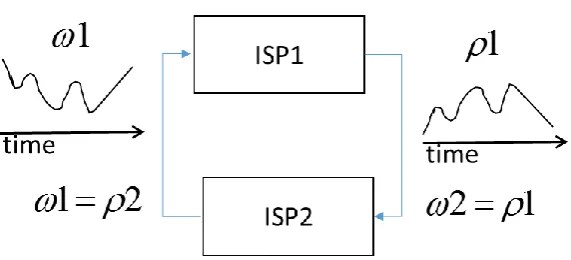
Although closure of coupling holds for DEVS, the generalization to iterative specification does not immediately follow. The problem is illustrated in Figure 4 where two iterative system specifications, ISP1 and ISP2, are cross-coupled such as exemplified by the Turing machine example in Figure 1. The cross-coupling introduces two constraints shown by the equalities in the figure, namely, the input of ISP2,
2
must equal the output of ISP1,
1
, and the input of ISP1,
1
must equal the output of ISP2,
2
. Here we are referring to input and output trajectories over time as suggested graphically in Figure 4. Since each system imposes its own constraints on its input/output relation, the conjunction of the four constraints (2 coupling-imposed, 2 system-imposed) may have zero, one, or multiple solutions.Definition:
A Coupled Iterative Specification is a network specification of components and coupling where the
components are iterative specifications at the I/O System level.
As indicated, in the sequel we deal with the simplified case of two coupled components. However, the results can be readily generalized with use of more complex notation.
Definition:
it specifies. Formally, let SG =<T, X, Ω+G, Y, Q, δG+ , λ> be the system specified by G= <T, X, ΩG, Y, Q,
δG, λ>. Then the I/O Functions associated with G is
:
,
( , )
( ( , ))
Q
where for q
Q
q
q
Ω
Ω
Ω
Let
1 and 2
represent the I/O functions of the iterative specifications, ISP1 and ISP2, resp. Applying the coupling constraints expressed in the equalities above, we make the:Definition:
A pair of output trajectories ( 1, 2)
is a consistent output trajectory for the state pair (q1, q2) if1 1( 1, 2)q
and
2
2( 2, 1)q
.Definition
A Coupled Iterative Specification has unique solutions if there is a function,
: 1
2
where
( 1. 2)
( 1, 2)
F Q
Q
F q q
p
where there is exactly one consistent pair ( 1, 2)
with infinite domain for every initial state (q1,q2). Infinite domain is needed for convenience in applying segmentation.Definition:
A Coupled Iterative Specifications is admissible if it has unique solutions. The following theorems are proved in Appendix 4.
Theorem: An admissible Coupled Iterative Specification specifies a well-defined Iterative Specification
at the I/O System level
Theorem: The set of Iterative Specifications is closed under admissible coupling
Theorem
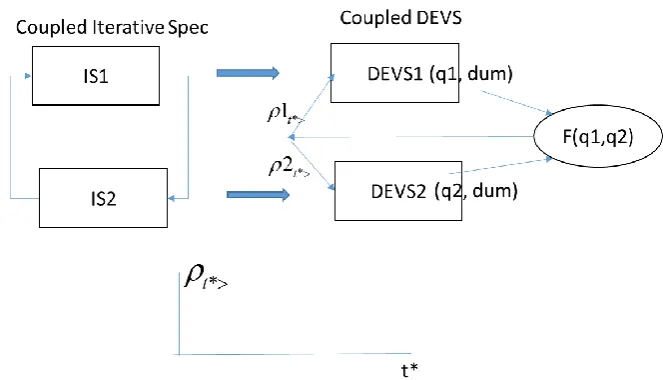
DEVS coupled model can component-wise simulate a coupled Iterative Spec. Proof:
Figure 5 DEVS Component-wise simulation of Coupled Iterative Specifications
The solution function F represents an idealization of the fixed point solutions required for DESS and the local solution approaches of DTSS and Quantized DEVS. GDEVS polynomial representation of trajectories is the closest realization but the approach opens the door to realization by other trajectory prediction methods.
Special case: Memoryless Systems
Consider the case where each component’s output does not depend on its state but only on its input. Let
gr
represent the ground state in which the device is always found (all states are represented by this state since output does not depend on state.1
1
1
1(
, 1)
( 1, 1)
1
2
2(
, 2)
( 2, 2)
2
2
1
1
2
2
2( 2, 2)
( 1, 1)
2
( 1, 1)
2
. ., ( 2, 1)
( 2, 1)
1
2
gr
R
gr
R
q
R
R
i e
is consistent
R
R
1 11
1( 1, 2)
( 2)
2
2( 2, 1)
( 1)
1
( 2)
( ( 1))
( 1. 2)
( 1,
( 1))
q
f
q
g
so
f
f g
so
g
f
(considered as a relation)
and
F q q
f
has no solutions if
f
1 does not exist, yielding no resultant has a unique solution for every input if
f
1 exists, yielding a deterministic resultant and has multiple solutions for a given segment
if
f
1( )
is multivalued, yielding a non-deterministic resultantFor examples consider an adder that always adds 1 to its input, i.e,
(
, )
( )
1
. .,
, (
, )( )
( ) 1
gr
f
p
i e
t
T
gr
t
p t
Cross-coupling a pair of adders does not yield a well-defined resultant because
f
1( )
p
1
f
. However, coupling an adder to a subtracter, its inverse
(
gr
, )
p
1
, would yield a well-defined deterministic system.
For other examples, consider combinatorial elements whose output is a logic function of the input and consider a pair of gates of the same type connected in a feedback loop:
an AND gate with one of its input held to 0 always maps the other input into 0 so has a solution only for inputs of 0 to each component, , i,e,, F gr gr( , )(0, 0), yielding a deterministic system.
an AND gate with a stuck-at input of 1 is the identity mapping and has multiple solutions i,e,, F gr gr( , ){(0, 0), (1,1)}, yielding a non-deterministic system.
Active-Passive Systems
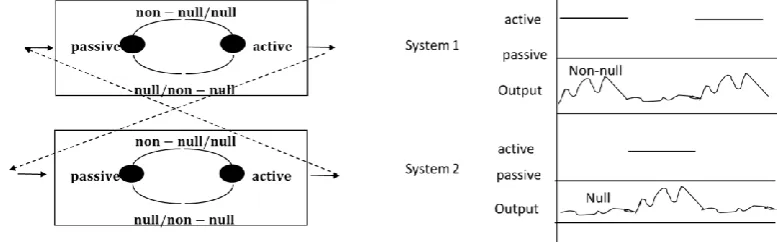
We now show that active-passive systems as described earlier offer a class of systems for which the iterative specifications of components satisfy the admissibility conditions specified in the above Theorem. As in Figure 6a consider a pair of cross-coupled systems each having input generators that represent null and non-null segments.
Figure 6 Active-Passive Example of Admissible Progressive Coupled Iterative Specifications
A null generator represents the output of a passive system whereas a non-null generator represents the output of an active system. For example in the TM case, a non-null generator is a segment that represents transmission of a symbol by the tape unit and of a symbol,move pair for the TM control. As in Figure 6b let S1 and S2 start as active and passive, respectively. Then they output non-null and null generators respectively. Since the null generator has infinite extent, the end-time of the non-null generator determines the time of next event, t* (as defined earlier) and we apply the transition functions in Figure 6a to find that at t* the systems have reversed phases with S1 in passive and S2 in active.
Define a triple
Q
,
G,
by{
.
} {
.
}
Q
active passive
active passive
endtime of the non-null generator segment
an
*(
,
)
(
,
)
d
F
(
-
,
).
t
active passive
active passiv
e
non null
null
* *
(
,
)
( (
,
), (
,
-
))
= (
,
)
G
t t
active passive
active null
passive non null
passive active
(active passive, ) (non null null- , )
Let the non-null and null generators stand for sets of concrete segments that are equivalent with respect to state transitions and outputs. Then such a scheme can define a deterministic or non-deterministic resultant depending on the number of consistent pairs of (non-null,null) generator segments are possible from the (active, passive) state.
And mutatis-mutandis for the state (passive, active)
Temporal Progress: Legitimacy, Zenoness
legitimacy of the simulating DEVS is reflective of the temporal progress character of the original coupling of specifications. We see that the time advance has a value provided that the function F is defined for current state. However, as in the case of zenoness, a sequence of such values may accumulate at a finite point thus not allowing the system to progress beyond this point. Consequently, we need to extend the requirements for coupled iterative specifications to include temporal progress in order to fully characterize the resultant composition of systems. Thus we can extend the definitions:
Definition: An Iterative Specification is progressive if every sequence of time advances diverges in sum.
Definition: A Coupled Iterative Specification is progressively admissible if its components are each
progressive and the resultant Iterative Specification at the I/O System level is progressive,
Theorem:
A progressive Iterative Specification can be simulated by a legitimate DEVS.
A progressively admissible Coupled Iterative Specification can be component-wise simulated by a legitimate DEVS.
Ref. 14 showed that the question of whether a DEVS is legitimate is undecidable. The approach was to express a Turing Machine as a DEVS and showing that solving the halting problem is equivalent to establishing legitimacy for this DEVS. We can transfer this approach to the formulation of the TM in Figure 1 by setting the time advances of both components to zero except for a halt state which is a passive state (has an infinite time advance). Then a TM DEVS is legitimate just in case the TM it implements ever halts. Since there is no algorithm to decide whether an arbitrary TM will halt or not the same is true for legitimacy. Since DEVS is an iterative specification, the problem of determining whether an Iterative Specification is progressive is also undecidable. Likewise, the question of whether a coupled iterative specification is progressive is undecidable.
Fundamental Systems Existence: Probabilistic Characterization of Halting
The existence of an iteratively specified system requires temporal progress and there is no algorithm to guarantee in a finite time that such progress is true. The underlying point is that, given an arbitrary TM, we have to simulate it step-by-step to determine if it will halt. And importantly, if a TM has not halted after some time, however long, this gives us no further information on its potential halting in the future. However, while this is true for individual TMs, the situation may be different for the statistics of subclasses of TMs. In other words, for a given class of TMs, the probability of an instance halting may be found to increase or decrease for the future given that it has not yet halted.
We performed an empirical study of randomly generated TMs described in Appendix 6. The results seem to show that TMs break into two classes – those that halt within a small number of steps (e.g.16) and those that do not halt. Indeed, the data suggest that approximately one-third of the sampled TMs halt, while 2/3 do not. For those that halt, the probability of halting at the first step is greatest and then decreases exponentially and so is well-described by a geometric distribution with probability of success approximately 1/6. In other words the probability of halting is 1/6 at each step given the TM has not halted earlier for the set that will eventually halt.
Summarizing, the existence of an iteratively specified system is not algorithmically decidable but there may be useful probabilistic formulations that can be applied to sub-classes of such specifications. For example, it seems to be that with high probability the halting of a 2-symbol, 3-state TM can be decided within 16 simulation steps. Therefore, it might be tractable for an assemblage of components to find a way to solve its composition problems in a finite time for certain classes of components couplings.
Discussion: Future Research
compositions generalizing the statement of consistent assignments to finite and perhaps, infinite sets of components.
Further, when extending to arbitrary composition sizes, the analysis revealing fundamental conditions for the emergent existence of systems from component systems suggests new classes of systems that can be defined using iterative specifications. For example, we might consider the active-passive systems in a more general setting. First allowing any finite number of them in a coupling can satisfy the requirement for at most one active component at any time by restricting the coupling to a single influencer for each component. In fixed coupling exhibiting feedback, this amounts to a cyclic formation in which activity will travel around the cycle from one component to the next. Another common pattern is a single component (root) influencing a set of components (branches) each of which influences only the root. Several possibilities for interaction of the root with the branches can result in admissible compositions. For example, the root might select a single branch to activate to satisfy the single active component requirements. Or it might activate all branches and count the number of branches as they successively go passive, becoming active when all the branches have become passive. These alternative configuration require knowledge of the protocol underlying the interaction but this only means that proofs of emergent well-defined resultants will be conditioned to narrower sub-classes of systems rather than to broad classes such as all differential equation systems.
After much progress in understanding how dynamic structure can be managed in DEVS-based simulations [2,3,11], a framework that incorporates several insights has recently been developed [8]. This framework, formulated in the DEVS formalism, can be extended to iterative specifications and investigated for conditions of existence as done here. The extension will probably increase the complexity required to state and establish the conditions but would, if successful, bring us closer to understanding the emergence of systems from assemblages of components in the real world.
Appendix 1 DEVS Representation of TM
Tape System
A state is a triple
(
tape pos mv
,
,
)
wheretape I
:
{0.1}
,pos
I
,mv
{ 1,1}
andI
is the integers; in other words the tape an infinite sequence of bits,pos
represents the position of the head, andmv
is a specification for moving left or right.An internal transition moves the head as specified; an external transition accepts a symbol, move pair, stores the symbol in the current position of the head and stores the move for subsequent execution. The slot for storing the move also can be null which indicates that a move has taken place.
int
t
(
,
,
)
(
,
(
,
),
)
((
,
,
), , (
,
))
(
(
,
,
),
,
)
(
,
,
) 1
(
,
,
)
(
,
,
)
(
,
)
(
.
)
ex
tape pos mv
tape move pos mv null
tape pos null e sym mv
store tape pos sym pos mv
ta tape pos mv
ta tape pos null
tape pos mv
getSymbol tape pos
where
move pos mv
pos
mv
sto
(
,
,
)
'
'(
)
,
'( )
( )
(
,
)
(
)
re tape pos sym
tape where tape pos
sym tape i
tape i
getSymbol tape pos
tape pos
TM Control
A state is a pair
( ,
st sym
)
wherest
is a control state andsym
is a stored symbol.An external transition stores the received symbol for subsequent use.
int
t
( ,
)
(
( ,
),
)
(( ,
), ,
)
( ,
)
( ,
) 1
( ,
)
( ,
)
( ,
)
( ,
)
'
( ,
)
'
ex
st sym
TMState st sym null
st null e sym
st sym
ta st sym
ta st null
st sym
TMOutput st sym
where
TMState st sym
st
TMOutput st sym
sym
Appendix 2: Iterative Specification of Systems
The following is extracted from [14] Chapter 5.
Generator Segments
Consider (Z, T) the set of all segments {ω: <0, t1> → Z | t1 ∈T}, which is a semigroup under
concatenation. For a subset Γ of (Z, T), we designate by Γ+ the concatenation closure of Γ (also called the
semigroup generated by Γ). Example generators are bounded continuous segments, and constant
segments of variable length generating bounded piecewise continuous segments piecewise constant segments, resp. Unfortunately, if Γ generates Ω, we cannot expect each ω ∈Ω to have a unique decomposition by Γ; that is, there may be distinct decompositions ω1, ω2, . . ., ωn and ω1′, ω 2′, . . ., ωn′
such that ω 1 • ω 2 • . . . • ωn = ω and ω1′ • ω2′ • . . . • ω′n = ω.
A single representative, or canonical decomposition can be computed using a maximal length
segmentation. First we find ω1, the longest generator in Γ that is also a left segment of ω. This process
is repeated with what remains of ω after ω1 is removed, generating ω2, and so on. If the process stops
after n repetitions, then ω = ω1ω2 . . . ωn,..
It is not necessarily the case that mls decompositions exist (i.e., that the just-mentioned processes will stop after a finite number of repetitions). Thus, we are interested in checkable conditions on a set of generators that will guarantee that each segment generated has an mls decomposition.
Fortunately, a segment can have at most one mls decomposition.
We say that Γ is an admissible set of generators for Ω if Γ generates Ω and for each ω∈Ω, a unique mls decomposition of ω by Γ exists. (We also say Γ admissibly generates Ω.) The following is proved in [14]:
Theorem 1 Sufficient Conditions for Admissibility
If Γ satisfies the following conditions, it admissibly generates Γ+:
Existence of longest initial segments: ω ∈Γ+ ⇒ max {t ωt > ∈Γ} exists
Closure under right segmentation: ω ∈Γ ⇒ ω<t ∈Γ for all τ ∈dom (ω)
Generator State Transition Systems
Having established a terminating process for obtaining mls decompositions, we wish to use these decompositions to help us generate a transition function given only that function’s action on the generators. In other words, let ΩG be an admissible generating set for Ω and suppose we have defined
Let ω1, ω2, . . ., ωn be the mls decomposition of ω. Having δ defined for each segment ωi, we wish to
piece together these parts to obtain compound transition associated with ω itself.
An iterative specification of a system is a structure
G =T X,,ΩG,Y Q,, ,δ λ ,
where T, X, Y, Q have the same interpretation as for I/O systems, ΩG is the set of input segment
generators, δ: Q × ΩG →Q is the single segment state transition function, λ: Q × X →Y is the output
function, with the restriction that ΩG ⊆ (X, T ) and, most important, ΩG is an admissible set of
generators and δ+: Q × Ω+G →Q has the composition property.
An iterative specification G= <T, X, ΩG, Y, Q, δ, λ>specifies a time invariant system, SG =<T, X, Ω+G,
Y, Q, . where δ+ is the extension of δ which is well-defined according to the following:
Theorem 2 Sufficient Conditions for Iterative Specification
Let G = T, X, ΩG, Y, Q, δ, λ be a structure as just defined. Then if the following conditions hold, G
is an iterative specification and SG is a system.
(a) Existence of longest segments:
ω ∈ΩG+ ⇒ max{tωt > ∈ΩG} exists (b) Closure under right segmentation:
ω ∈ΩG ⇒ ω<t ∈ΩG for t ∈dom( )ω (c) Closure under left segmentation:
ω ∈ΩG ⇒ ωt > ∈ΩG for t ∈dom( )ω
(d) Consistency of composition: ⇒ δ+ (q,ω1 • ω2 • . . .• ωn ) = δ δ( ( . . . δ δ( (q,ω1),ω2 ), . . . ),ωn),
Conditions (b) and (c), requiring left and right segementability in the definition of iterative specification, can be weakened while still enabling the theorem to be true. Replace (b) and (c) by
For , if max t • = max {t | ω t> ∈ΩG} and tk <t ∗< tk+1, then ω <tk,t∗> ∈ΩG and
Appendix 3
Theorem: DEVS atomic model can simulate an Iterative Spec.
Proof:
Given an iterative specification G= <T, X, ΩG, Y, Q, δG, λ>, we construct a DEVS model M =<X, S, Y, δint , δext , λ, ta>
( )
( ):
using mls
( )
:
( )
( ,
)
G DEVS
l l
G
g
g
h Q
Q
h q
q dummy
int t
( , )
(
( , ),
)
( , )
( )
(( , ), ,
')
(
( ,
),
')
( ,
)
( )
G Gex G e
G
S
Q
q
q
dummy
ta q
l
q
e
q
q dummy
q
In the Iterative Specification
( ,
')
(
( , ),
')
G
q
G Gq
In the DEVS
Let
DEVSbe the transition function of the system specified by the DEVS. We want to show:(
G( ,
'))
DEVS( ( ), (
'))
h
q
h q g
( ) ( ') ( ) ( ') ( ) ( ')int ( ) ( ')
( ( ), (
'))
(( ,
), ( ) ( '))
(( ,
),
,
'
)
(
(( ,
),
),
),
'
)
(( ,
),
),
'
)
(
( ,
),
),
'
)
((
( , ),
DEVS DEVSDEVS l l
DEVS ext l l
DEVS l l
DEVS l l
DEVS G
h q g
q dummy g
g
q dummy
q dummy
q
q
q
),
'
( '))
(
(
( , ),
'),
)
l G Gdummy
q
dummy
So(
( ,
'))
(
(
( , ),
'))
(
(
( , ),
'),
)
( ( ), (
'))
G G G G G DEVSh
q
h
q
q
dummy
h q g
Appendix 4 Theorem:An admissible Coupled Iterative Specification specifies a well-defined Iterative Specification at the I/O System level
Proof:
Given two iterative specifications, Gi and their state sets, Qi i= 1,2, let
Q
Q
1
Q
2, eventuallythe state set of the iterative specification to be constructed. For any pair (q1,q2) in Q, let ( 1, 2)
be a consistent output trajectory for (q1, q2), i.e.
1
( 1, 2)q
and
2
( 2, 1)q
( 1, 2
and
F q q
)
(
1, 2
)
.
Define an autonomous Iterative Specification
Q
,
G,
by*( 1, 2) *( 1, 2)
( 1, 2)
( ( 1, 2
), ( 2, 1
))
G
q q
q
t q qq
t q q
1 2
*( 1, 2)
min{ *, *}
where t
q q
t
t
1 2
*, *
1
2.
where t
t
are the times of the MLS for
and
earliest of the times of these segmentations for the consistent pair of output trajectories. This allows us to define a step-wise transition for the constructed transition function. Closure under composition for this transition function can be established using induction on the number of generators in the segments under consideration. Similarly, the output function is defined by:
( 1, 2)q q ( ( 1), ( 2))q q
.Theorem: The set of Iterative Specifications is closed under admissible coupling
Proof: this theorem is a corollary of the previous theorem.
Appendix 5: A statistical experiment sampling from 2-symbol, 3-state TMs
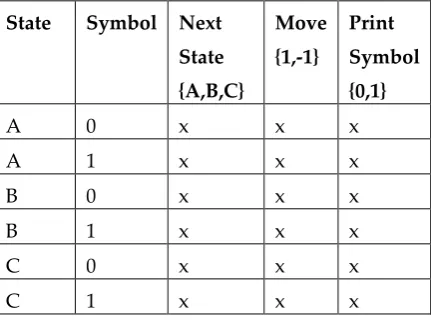
We performed a statistical experiment sampling from 2-symbol, 3-state TMs. Each sampled TM fills in the x’s in the table below with values from the sets shown, where one of the rows is chosen at random and its next state change to the halt state. The number of TMs in this class is (2*2*3)2*3=126 .
We generated 1000 samples randomly and simulated them until they halted or for a maximum of 1000 time steps.
State Symbol Next State {A,B,C}
Move {1,-1}
Print Symbol {0,1}
A 0 x x x A 1 x x x B 0 x x x B 1 x x x C 0 x x x C 1 x x x
The results are shown in the first two columns of the following table. They seem to show that TMs break into two classes – those that halt within a small number of steps (e.g.16) and those that do not halt. Indeed, the data in the table suggest that approx. one-third of the sampled TMs halt, while 2/3 do not. For those that halt, the probability of halting at the first step is greatest and then decreases exponentially. The third row shows the probabilities computed from a geometric success model using probability of success as 0.161. The agreement of the observed and predicted distributions are in close agreement. This suggests that for the set that will eventually halt, the probability of a TM halting at each step is approx. 1/6, given that it has not halted earlier.
Halts at N Frequency Geometric Model
1 0.161 0.161 2 0.1 0.09 3 0.042 0.039 4 0.023 0.022 5 0.016 0.015 6 0.005 0.00488 7 0.004 0.00390 11 0.001 0.000990 16 0.001 0.000985 10000 0.647
Summarizing, the existence of an iteratively specified system is not algorithmically decidable but there may be useful probabilistic formulations that can be applied to sub-classes of such specifications. For example, it seems to be that with high probability the halting of a 2-sysmbol, 3-state TM can be decided within 16 simulation steps. Therefore, it might be tractable for an assemblage of components to find a way to solve its composition problems in a finite time for certain classes of components couplings.
References
1. Ashby, W. An Introduction to Cybernetics, University Paperbacks, Methuen, London, 1964.
2. Barros. F.J., “Modeling and Simulation of Dynamic Structure Heterogeneous Flow Systems.” SIMULATION: Transactions of The Society for Modeling and Simulation International, Vol. 78, No. 1, 18-27, 2002.
3. Barros. F.J., “Dynamic Structure Multi-Paradigm Modeling and Simulation,” ACM Transactions
on Modeling and Computer Simulation, Vol. 13, No. 3, pp. 259-275, 2003.
4. Foo, N. Y., and Zeigler, B. P. Emergence and computation. International Journal of General Systems 10, 2-3 (1985), 163 168.
5. Kubik, A. Toward a formalization of emergence.Arti cial Life 9, 1 (2003), 41 65.
6. Mittal, S. Emergence in stigmergic and complex adaptive systems: A formal discrete event systems perspective. Cognitive Systems Research 21 (2013), 22 39. Stigmergy in the Human Domain.
7. Mittal, S., and Rainey, L. Harnessing emergence: The control and design of emergent behavior in system of systems engineering. In Proceedings of the Conference on Summer Computer Simulation, SummerSim ’15, Society for Computer Simulation International (San Diego, CA, USA, 2015), 1 10.
8. Muzy, A., and Zeigler, B. P,. Specification of dynamic structure discrete event systems using single point encapsulated control functions. International Journal of Modeling, Simulation, and Scienti c Computing 05, 03 (2014), 1450012.
9. Nutaro, J. (2011). Building Software for Simulation: Theory and Algorithms with applications in C++. Wiley.
10. Tuncer I. Ören and B.P. Zeigler, “System Theoretic Foundations of Modeling and Simulation: A Historic Perspective and the Legacy of A. Wayne Wymore,” Simulation: Trans. Soc. Model. & Sim., vol. 88, no. 9, pp. 1033-1046, September 2012.
11. Steiniger, A., and Uhrmacher, A. M. Intensional couplings in variable-structure models: An exploration based on multilevel-devs. ACM Trans. Model. Comput. Simul. 26, 2 (Jan. 2016), 9:1 9:27.
13. Uhrmacher, A. M. Dynamic structures in modeling and simulation: A reactive approach. ACM Trans. Model. Comput. Simul. 11, 2 (Apr. 2001), 206 232.
14. Zeigler, B., Praehofer, H., and Kim, T. Theory of Modeling and Simulation: Integrating Discrete Event and Continuous Complex Dynamic Systems. Academic Press, 2000.
15. Zeigler, B., Alexandre Muzy Some Modeling & Simulation Perspectives on Emergence in System-of-Systems, Proceedings of SpringSim2016, 2016.