614
THERMODYNAMIC MODELLING ON THE MUTUAL EFFECT OF COPPER,
MANGANESE AND IRON ADDITION IN AL-SI-CU FOR SEMISOLID
PROCESSING
M.S. Salleh
1M.Z. Omar
2J. Syarif
3M.N. Mohammed
4ABSTRACT
Semisolid metal (SSM) processing or Thixoforming is a new method for forming alloys in the
semisolid state to near net shaped products. All the alloys which have been used to date for
thixoforming were developed originally for either casting or forging operations. Thus, there is a
lack of specific alloys for semi solid processing that present good fluidity, low viscosity and small
grain size. Thermodynamic calculation software, such as Java-based Material Properties
(JMatPro), provides a tool for predicting thixoformability of aluminium alloys. Here, the effects of
compositional variations, in particular the effect of copper, manganese and iron additions on the
thixoformability of alloy A319 have been investigated. This software was used to determine the
processing temperature at 0.4 fraction liquid, working window temperature, fraction liquid
sensitivity, solidification range and phase diagram during semisolid processing. The alloys
modelled were divided into two groups according to their copper, manganese and iron contents. The working window temperatures (∆T0.3/0.5) for alloys in all two groups were enlarged at the
range of 8°C to 14°C while the slope of the fraction liquid versus temperature curves at 0.4
fraction liquid become less steep from 0.014°C-1 to 0.010 C-1. The processing temperatures of
modified alloys at 0.4 fraction liquid have decreased from around 558°C to 550°C and this would
benefit the thixoformability of the selected material. Phase diagram was used to show the location
of the intermetallic phases (i.e. Al5Cu2MG8Si6, α-Al(Fe,Mn)Si and Al2Cu) that dissolve in the
1 Department of Mechanical and Materials Engineering University Kebangsaan Malaysia, Malaysia. 2 Department of Mechanical and Materials Engineering University Kebangsaan Malaysia, Malaysia. 3 Department of Mechanical and Materials Engineering University Kebangsaan Malaysia, Malaysia. 4 Department of Mechanical and Materials Engineering University Kebangsaan Malaysia, Malaysia.
Journal of Asian Scientific Research
615
semisolid zone. The results indicate the suitability of these modified alloys as a potential material
for semisolid processing.
Key Words:
Thixoforming; JMatPro; thixoformability; alloy design; phase diagram.INTRODUCTION
Semi Solid Metal Processing (SSM) or Thixoforming has become one of the important
technological developments as hybrid near net shape forming method that combines the casting as
well as forging. This technology promises major advantages such as prolonged die life due to less
thermal shock, less air entrapment, weight savings in components with less porosity than
conventional die casting and also improved usage of feedstock materials (Omar et al. 2005).
Furthermore, thixoformed parts are reported to be subsequently higher in quality than die castings
but lower in cost than forgings (Birol 2008). This recently developed technology was derived from
basic studies initiated by Flemings and his co-workers in the 1970s (Flemings et al. 1976). They
found the microstructure of continuously stirred materials was spheroidal whereas the material
which was cooled into the semisolid state without stirring was dendritic. The material with the
spheroidal microstructure in the semisolid state was thixotopic, which means when it is sheared it
thins and flows and when it is allowed to stand, it thickens again (Atkinson 2010, Alfan et al. 2010,
Omar et al. 2011). All the alloys which have been used to date for thixoforming were developed
originally for either casting or forging operations. Therefore, there is a clear need to develop a
range of alloys specially tailored for the needs of semisolid processing (Paes et al. 2005).
The focus of this paper is to discuss the use of JMatPro software in order to investigate
quantitatively the effect of alloying elements particularly the effect of copper, manganese and iron
additions in A319 aluminium alloy. Thermodynamic calculations have been carried out to design
alloys based on the Al-Si-Cu system for semisolid processing. A selected alloy composition has
been assessed upon its suitability for thixoforming. This thixoformability prediction can later be
validated through experimental measurement in order to observe the microstructural evolution as
well as mechanical properties of the new alloys.
JMATPRO SIMULATION
In this work, JMatPro or Java-based Material Properties software is used to analyze the effects of
alloy compositions in A319 (shown in table 1) aluminium alloy. Solidification occurs under
non-equilibrium conditions which can be modelled using the so-called Scheil approach. Fraction liquid
sensitivity and temperature range for solidification are the critical parameters for fundamental work
of new alloys development. The compositions of modified A319 (two different groups) alloys are
616 Table-1. Chemical Composition of A319 (all in wt.%)
Chemical Composition Si Cu Mg Mn Fe Zn Al
A319 5.5-6.5 3.0-4.0 0.10 0.50 0.8 1.0 Bal
A319 (JMatPro) 6.1 3.01 0.10 0.50 0.8 1.0 Bal
Table-2. Chemical Composition of modified A319. (all in wt.%)
Chemical Composition Si Cu Mg Mn Fe Zn Al
Group 1 6.0 4.0-6.0 0.10 0.5 1.0 1.0 Bal
Group 2 6.0 4.0-6.0 0.10 1.0 1.5 1.0 Bal
RESULT AND DISCUSSION
Fraction Liquid Sensitivity, Processing Temperature and Solidification Range
Temperature sensitivity of fraction liquid (fL) at SSM processing temperature is a very important
parameter in order to ensure a wide and stable processing window during SSM processing. Fraction
liquid sensitivity can be defined from the slope (shown in Figure 1) of the fraction liquid versus
temperature curve as (dfL/dT)fL. It is necessary that the fraction liquid does not change too rapidly
with temperature in the working window and 0.3-0.5 volume fraction liquid is thought to be
desirable for thixoformability (Liu et al. 2005). In this study, 0.4 fraction liquid (fL) is chosen as a
measuring point because of this is mid-way through the working range of 30-50% liquid (Camacho
et al. 2003, Liu et al., 2005). When the temperature sensitivity is large, a slight variation in
temperature induces a large change in the fraction liquid. Hence, small changes in temperature can
lead to increase in fraction liquid and therefore non-favorable microstructure for SSM processing
due to inhomogeneous deformation and liquid segregation during mould filling (Patel 2005).
Therefore, a smaller fraction liquid sensitivity at semisolid processing temperature indicates better
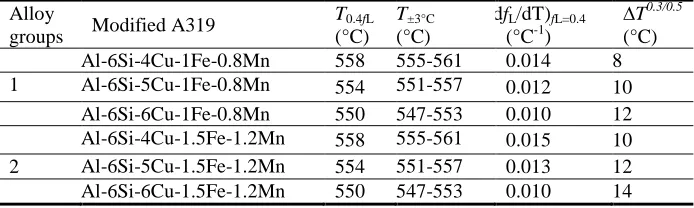
SSM processability. Tables 3 and 4 show SSM parameters for A319 and modified A319 aluminium
alloys given by JMatPro software. It can be seen clearly from these tables that the value of
(dfL/dT)fL=0.4 decreased with the range of 0.015 °C-1 to 0.010 °C-1. It also believed, for good
processability, (dfL/dT)fL=0.4 should less than 0.020 at the SSM processing temperature (T0.4 fL). This
means 2% change in fraction liquid of the slurry is permitted for every 1°C change in T0.4 fL. The
processing temperatures for alloys in all two groups at T0.4 fL are significantly decreased within the
range of 558°C to 550°C and this is good for thixoforming process. Temperature control T±3°C
during SSM processing is suitable and achievable under this processing condition.
Solidification usually defined as the temperature range between liquidus and solidus of a given
alloy (Liu et al. 2005, Patel 2005). The temperature interval between the liquidus and solidus
should not be too wide because it may lead to poor resistance to hot tearing. This means the
processing temperature T0.4 fL and solidus temperature play an important role in SSM processing.
It is proposed in this work, in order to get a good processability and high resistance to hot tearing,
617 in the curves in modified alloys above 0.4 fraction liquid. It can be seen clearly in Figure 1, when
the copper is increased, it will leads to shorter solidification times and as a consequence their respective ‘highest knees’ were also shifted to higher fraction liquid. In this region, the binary eutectic temperature at which α-solid solutions starts melting and the amount of liquid at the ‘highest knee’ represent the amount of eutectic in the structure.
Figure-1. Calculated fraction liquid vs. temperature given by JMatPro for group 1 alloys.
Table-3. SSM parameters given by JMatPro software for A319.
Alloy T0.4fL
(°C)
T±3°C (°C)
(dfL/dT)fL=0.4 (°C-1)
T0.3/0.5 fL (°C)
∆T0.3/0.5
(°C)
A319 562 559-555 0.021 558-568 10
Table-4. SSM parameters given by JMatPro software for modified A319. Alloy
groups Modified A319
T0.4fL (°C)
T±3°C (°C)
(dfL/dT)fL=0.4 (°C-1)
∆T0.3/0.5
(°C)
Al-6Si-4Cu-1Fe-0.8Mn 558 555-561 0.014 8
1 Al-6Si-5Cu-1Fe-0.8Mn 554 551-557 0.012 10
Al-6Si-6Cu-1Fe-0.8Mn 550 547-553 0.010 12
Al-6Si-4Cu-1.5Fe-1.2Mn 558 555-561 0.015 10
2 Al-6Si-5Cu-1.5Fe-1.2Mn 554 551-557 0.013 12
Al-6Si-6Cu-1.5Fe-1.2Mn 550 547-553 0.010 14
Phase Diagram of Modified A319
An intermetallic compound in cast aluminium alloys plays an important role in influencing their
mechanical properties. These compounds are formed by entering transition elements especially
iron, manganese, copper and nickel into cast Al-Si-Cu alloys in order to increase the hardness and
improve wear resistance (Shabestari et al. 2010). Phase diagram of modified alloys (shown in
618
Al2Cu in Al-Fe-Si-Cu system. The proper amount of manganese promotes the formation of α-phase
instead of β-phase which can increase the tensile strength of the modified alloys.
Figure-2. Phase diagram of Al-6Si-6Cu-1Fe-0.8Mn given by JMatPro software.
CONCLUSION
JMatPro software has been used to investigate the effects of compositional variations particularly
the effects of copper, manganese and iron addition on the thixoformability of alloy A319. This
software was used to determine the working window temperature, fraction liquid sensitivity,
processing temperature, solidification range as well as the ‘highest knee’ between 0.3 and 0.5
fraction liquid on the fraction liquid versus temperature curves. These criteria were used to develop
new aluminium alloys based on Al-Si-Cu alloys. The working window temperatures (∆T0.3/0.5) for
alloys in all two groups were enlarged at the range of 8°C to 14°C and the slope of the fraction
liquid versus temperature curves at 0.4 fraction liquid has become less steep from 0.014°C-1 to
0.010°C-1. The processing temperatures of modified alloys at 0.4 fraction liquid has decreased from
558°C to 550°C and this should benefit the thixoformability of these new alloys. The solidification
range between processing temperature and solidus temperature is decreased and this is due to the
effect of copper addition to the starting A319 aluminium alloy. The ‘highest knee’ on the fraction
liquid versus temperature curve plays an important role in order to control the liquid formation
during thixoforming process. The alloys in group 1 and 2 have fulfill the alloy design criteria and
maybe suitable for thixoforming process.
ACKNOWLEDGEMENT
The authors would like to thank Universiti Teknikal Malaysia Melaka (UTeM), Universiti
Kebangsaan Malaysia (UKM) and the Ministry of Higher Education of Malaysia for sponsoring
619
REFERENCES
Omar, M.Z., Palmiere, E.J., Howe, A.A., Atkinson, H.V., Kapranos, P. (2005) "Thixoforming of a high performance HP9/4/30 steel" Materials Science and Engineering A, Vol.395. pp.53-61.
Birol, Y. (2008) "Semisolid processing of near-eutectic and hypereutectic Al-Si-Cu alloys" Journal of Material Science, Vol.43, pp.3577-3581.
Flemings, M.C. (1991) "Behavior of metal alloys in the semi-solid state" Metallurgical Transactions B, Vol.22, No.2, pp.269-293.
Atkinson, H.V. (2010) "Semisolid processing of metallic materials" Materials Science and Technology,Vol.26, No.12, pp.1401-1413.
Alfan, A., Omar, M.Z., Syarif, J., Sajuri, Z. (2010) "Direct partial remelting of XW-42 Steel in Semisolid Zone" Journal of Applied Sciences, Vol.10, No.13, pp.1255-1262.
Omar, M.Z., Atkinson, H.V., Kapranos, P. (2011) "Thixotropy in semisolid steel slurries under rapid compression" Metallurgical and Materials Transactions A, Vol.42, pp.2807-2819.
Paes, M., Zoqui, E.J. (2005) "Semi-solid behavior of new Al-Si-Mg alloys for thixoforming" Materials Science & Engineering A, Vol.406, pp.63-73.
Liu, D., Atkinson, H.V., Jones, H. (2005) "Thermodynamic prediction of thixoformability in alloys based on the Al-Si-Cu and Al-Si-Cu-Mg systems" Acta Materialia, Vol.53, pp.3807-3819.
Camacho, A.M., Atkinson, H.V., Kapranos, P., Argent, B.B., (2003) "Thermodynamic predictions of wrought alloy compositions amenable to semisolid processing" Acta Materialia,
Vol.51, pp.2319-2330.
Patel, J.B., Liu, Y.Q., Shao, G., Fan, Z. (2005) "Rheo-processing of an alloy specifically designed for semisolid metal processing based on the Al-Mg-Si system" Material Science
Engineering A, Vol.476, pp.341-349.
Shabestari, S.G., Ghanbari, M. (2010) "Effect of plastic deformation and semisolid forming on iron-manganese rich intermetallic in Al-8Si-3Cu-4Fe-2Mn alloy" Journal of Alloys and