Moving on from Young Offender Institutions:
Expectations, Adjustment and the
Role of Social Support
HELEN J. CHAMPION
D. Clin. Psy 2001
All rights reserved
INFORMATION TO ALL USERS
The quality of this reproduction is dependent upon the quality of the copy submitted.
In the unlikely event that the author did not send a complete manuscript and there are missing pages, these will be noted. Also, if material had to be removed,
a note will indicate the deletion.
uest.
ProQuest U643991
Published by ProQuest LLC(2016). Copyright of the Dissertation is held by the Author.
All rights reserved.
This work is protected against unauthorized copying under Title 17, United States Code. Microform Edition © ProQuest LLC.
ProQuest LLC
789 East Eisenhower Parkway P.O. Box 1346
ABSTRACT 5
ACKNOWLEDGEMENTS 6
CHAPTER 1: INTRODUCTION 7
Overview 7
Youth OflFending 10
The Nature o f Youth Offending 10 Young Offenders, the Law and Policy 13 Psychological Literature on Youth Offending 15 Risk Factors for Y outh Offending 15 Persistence versus Desistence o f Young Offenders 19 Mental Health Problems in Young Offenders 23 Rates o f Mental Health Problems in Young Offenders 23 Explanations o f the Association between Offending & Mental Health 27 Young Offender Institutions 30
Bullying in YOIs 31
Self harm in YOIs 33
The YOI Experience 35
Making the Transition o f Release from YOIs 36
Rates o f Recidivism 36
The Need for more Holistic Outcomes 37 A Developmental Model o f Coping with Adolescent Challenge 41
Social Support 44
The Concept o f Social Support 44 Social Support as a Buffer against the Effects of Stress 45 Individual Differences in the Use of Social Support 48
The Current Study 51
Need for the Current Study 51
Potential Implications 54
The Approach 55
The Research Questions 55
CHAPTER 2: METHOD 56
Orientation o f Research 56
Personal Perspective 57
Overview o f the Methodology 59 Recruitment o f Participants 59 The YOI from which Participants were Recruited 60 Recruitment o f Participants for Pre-release Interviews 62 Follow up o f Participants for Post-release Interviews 64
The Sample 66
Ethical Approval 69
Post-release Interviews 73
Data Analysis 73
Validity Check 76
CHAPTER 3: RESULTS 78
Overview o f Themes and their Frequencies 78
Overview 81
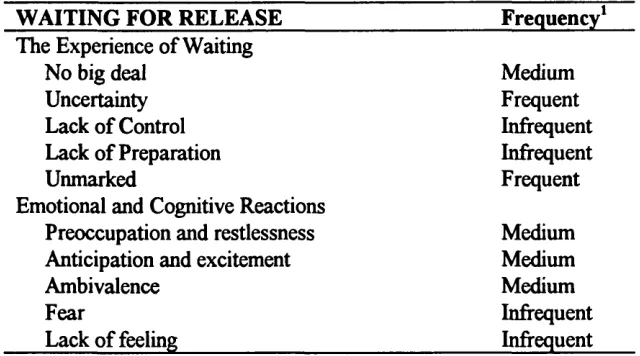
Waiting for Release 82
The Experience o f Waiting 82 Emotional and Cognitive Reactions 87
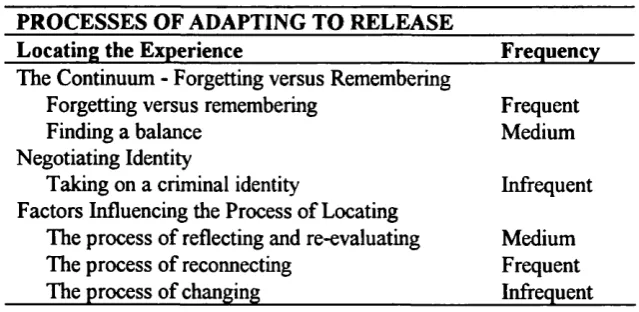
Processes o f Adaptation 89
Reflecting and Re-evaluating 89 Re-evaluating Relationships 91
Explaining Offending 97
Evaluating the Impact o f the Sentence 100 Intentions regarding Re-offending 104
Plans for the Future 106
Reconnecting 109
Initial Emotional and Cognitive Reactions to Release 110 Reconnecting with the Physical Environment 111 Reconnecting with the Social Environment 114 Re-establishing basic Routines and Skills 119
Changing 120
Taking on New Roles and Lifestyles 120 Avoiding Old Roles and Lifestyles 123
Locating the Experience 128
The Continuum - Forgetting versus Remembering 128
Negotiating Identity 131
F actors Influencing the Process of Locating 132
Social Support 136
Use o f Social Support 136
Blocks to the Use o f Social Support 144
CHAPTER 4: DISCUSSION 152
Summary o f the Findings 152
Waiting for Release 152
Processes characterising Young Offenders’ Adjustment to Release 153 Young Offenders’ Use o f Social Support in Adjusting to Release 157 Overall Model o f Young Offenders’ Adjustment to Release 159
The Findings in Context 162
Practices in Young Offender Institutions Practices in Youth Offending Teams Clinical Psychologists in YOIs and YOTs Conclusion 180 182 183 185 REFERENCES 186 APPENDICES 197
Appendix A: Letter to potential participants
Appendix B: Information sheet for potential participants Appendix C: Letter to participants’ YOT workers Appendix D: Approval from UCL / UCLH ethics board Appendix E; Approval from the Governor at the YOI Appendix F: Pre-release interview schedule
Appendix G: Post-release interview schedule Appendix H: Participant consent form
198 199 201 202 203 204 207 210 TABLES
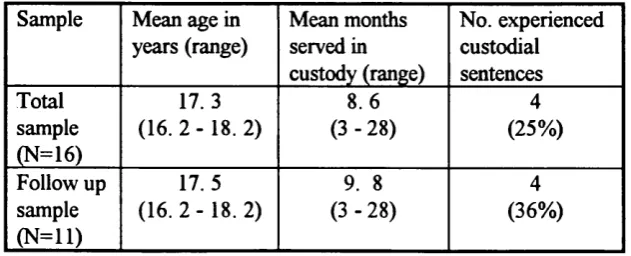
Table 1 : Participants’ ages, the duration they had served in custody at the time o f release and the number who had previous experience o f custodial sentences
Table 2; Number o f participants serving ‘short’, ‘medium’ and ‘long’ custodial sentences
66
67
Table 3; Participants’ index offences 67
Table 4: Number o f participants with documented psychiatric histories, 68 substance misuse and the number for whom their substance
misuse was documented to be implicated in their offending
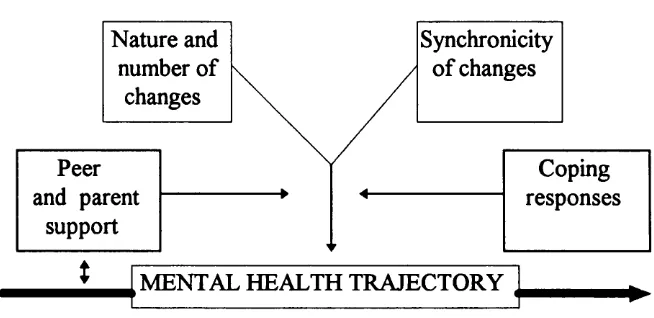
Figure 1: Rice et al’s (1993, p. 236) developmental model o f 42 coping with the challenges o f adolescence
Figure 2: Summary o f themes and their frequencies relating to the 78 experience o f waiting for release
Figure 3 : Summary o f themes and their frequencies relating to 78 the first process of adjusting to release - ‘reflecting and
re-evaluating’
Figure 4: Summary o f themes and their frequencies relating to the 79 second process of adjusting to release - ‘reconnecting’
Figure 5 : Summary o f themes and their fi-equencies relating to the 79 third process o f adjusting to release - ‘changing’
Figure 6; Summary o f themes and their frequencies relating to the 79 fourth process o f adjusting to release - ‘locating the
experience’
Figure 7: Summary o f themes and their frequencies relating to 80 social support
ABSTRACT
The current study aimed to investigate young ofifenders’ expectations and actual
experiences o f release from custody in Young Offender Institutions. Young offenders’
selective use o f social support in making this transition, including the ‘blocks’ they
perceived to seeking or making use o f it, were also explored.
Semi-structured interviews were conducted with young male offenders about their
views and experiences, both prior and subsequent to release. A total o f sixteen
participants took part in ‘pre-release’ interviews, held approximately two weeks prior
to their release from a YOI. Eleven o f these also went on to conduct follow up ‘post
release’ interviews, approximately two months after their release.
Qualitative analysis o f interviews yielded a number o f core themes, and the results are
broken into three sections. The first documents young offenders’ experiences o f
waiting for release. The second concerns processes inherent to their adjustment to
release: namely, processes o f ‘reflecting and re-evaluating’, ‘reconnecting’ with the
outside world, ‘changing’ and ‘locating the experience’. The third section describes
young offenders’ use o f social support and the blocks they perceive to actively
seeking or making use o f support. These include ‘intrapersonal’, ‘interpersonal’ and
‘contextual’ blocks.
The findings o f the study are discussed in relation to psychological literature
pertaining to offending, mental health and social support. Implications o f the study for
ACKNOWLEDGEMENTS
I would like to thank the young people who took part in the study for their time and
the openness they demonstrated. I enjoyed meeting them. I would also like to thank
the staff at H.M. Y.O.I. Huntercombe and the Youth Offending Teams (through which
participants were followed up) for their kind co-operation with the study, and the
individuals who discussed the study with me at various points. Finally, I would like to
thank my family and friends for all their support, as ever.
I am grateful to the following in particular:
Paul Manwaring, (The Governor), and Justine Pulver - for their time discussing the
proposal and agreeing access to participants at H.M. Y.O.I. Huntercombe;
John Palmer and Christine Fincham - for their assistance with the more practical
arrangements for interviews at H.M. Y.O.I. Huntercombe;
Linda Clare - for her support and help in supervising the study;
Robert Halsey, Adrian Grounds, Ron leMarechal and Diana Medlicott - for discussing
or providing comments on the proposal.
Avril MacAlees and Shelley Keane - for their comments on the resulting account o f
participants’ experiences (and Avril’s helpful comments on other parts o f the
manuscript).
Dad, Mum, Jack and Mark - for their help and support.
CHAPTER 1: INTRODUCTION
OVERVIEW
With young people responsible for an estimated 7 million crimes a year (Bailey,
1999), the rehabilitative needs o f young and juvenile offenders are significant at both
an individual and societal level. Reform o f the youth justice system has represented
one o f the key targets of the current government (Joyce Quin, M.P., 1998), including
an emphasis on early intervention. Whilst the Crime and Disorder Act (1998) outlines
a number o f community-based orders and interventions for dealing with young
offenders, a number o f young people continue to be incarcerated in Young Offender
Institutions across England and Wales.
As Sir David Ramsbotham, HM Chief Inspector o f Prisons asserts, “the limited period
in which young people are imprisoned raises two important questions: ‘in what frame
o f mind are those people going to leave custody? Following on, ‘what are you going
to do with them to try and alter that frame o f mind?”’ (Ramsbotham, 1998, p.9).
Traditionally empirical research and interventions have tended to focus largely on the
offending behaviour of such individuals. Whilst such work is clearly an essential
undertaking, authors such as Bailey (1993) have called for a broader consideration of
the impact of sentencing - not only on individuals’ propensity to re-offend, but also on
their evolving physical and mental health profiles as young adults.
The need for a wider perspective is further highlighted by recent studies which have
found the rates o f mental health problems in young offenders to be high. These
adapting to many changes, and as providing opportunities for growth and
development (Coleman & Hendry, 1999). Although many manage these challenges
successfully, others do not, and the frequency o f psychosocial problems including
criminal behaviour, suicide, self-harm, eating disorders, depression and alcohol and
drug abuse have been said to peak around this period (Royal College o f Psychiatrists,
1995).
The current study aims to investigate juvenile and young offenders’ (YOs) anticipated
and actual experiences o f release from custody in Young Offender Institutions
(YOIs), their adjustment to release and the social support they receive in making this
transition. Such a transition is clearly an important one, with potentially far-reaching
ramifications for the individual in terms o f both re-offending and broader psychosocial
functioning. Although it remains debated, social support has frequently been identified
as a potentially important buffer against the effects o f stress - facilitating healthy
adaptation to a range of transitions. Thus it would seem to be important to study
YOs’ use o f social support in relation to the transition of release, including the blocks
they perceive to seeking it.
The design was qualitative in nature, involving in-depth interviews with young people
about their experiences and views. Paul Boateng, M.P. has highlighted the
government’s view o f the importance of listening to what young people in the criminal
justice system have to say (foreword in Lyon, Dennison & Wilson, 2000). The paucity
The review o f the literature that follows will consist o f sections addressing the
following topics:
• An introduction to youth offending, including the nature of adolescent offending
and the manner in which YOs are dealt with under current criminal justice law and
policy;
• The psychological literature on youth offending - including what is known from
criminological literature about the risk factors associated with youth offending,
factors associated with the persistence versus desistance o f such offenders, and
theorising about the mechanisms by which such factors exert an influence;
• The mental health problems o f young offenders, documenting recent studies
investigating the rates o f comorbidity and possible explanations o f the apparent
association.
• What is written about young offender institutions, including what is known about
the institutional environment and its potential impact.
• The transition o f young offenders back to the community subsequent to release.
This will include findings on rates of recidivism of young offenders released from
custody, and the need to consider outcome more holistically will be discussed.
Rice, Herman & Petersen’s (1993) model conceptualising the impact o f life events
and challenges on developing adolescents will also be presented. This can be seen
to provide a useful lens through which to consider the potential impact o f such a
transition on young offenders.
• Social support - including the nature o f social support, its potential role as a buffer
against the effect o f stress and individual differences in the use o f social support.
• The need for the current research, including the specific research questions to be
YOUTH OFFENDING
The Nature o f Youth Offending
Before proceeding with the current literature review, some comment would seem
necessary on the nature o f youth offending. How common is offending in young
people? What kind o f offences do they commit? Is the offending o f adolescents just a
phase they grow out of?
Any adequate discussion of the prevalence o f youth offending is inevitably
complicated by a number o f methodological issues plaguing research. Definitions may
vary, historical trends - sometimes difficult to interpret - may exist, and different
sources o f information may be subject to various biases and distortions (Rutter, Giller
& Hagell, 1998). Official statistics in particular may vastly underestimate the amount
o f criminal activity amongst young people. Furthermore, rates o f under-reporting may
vary substantially dependent on the nature o f the offence in question. As Rutter et al
(1998) point out, a more adequate picture may be built by combining different sources
o f information, including official statistics, self-report data and victim surveys.
It should also be noted that the vast majority o f research pertains to male offenders.
Comparatively little is known about the development of offending and the course of
criminal careers o f young women. In view of the extreme paucity o f research
pertaining to female young offenders, the current literature review will concern itself
In spite o f these difficulties it seems clear that most young people may be involved at
some point in various illegal acts, such as under-age drinking, minor shoplifting or the
use o f illicit ‘soft’ drugs. Indeed, self-report studies estimate that such antisocial
behaviour occurs in 50-80% o f juveniles under the age o f 18 (Rutter et al, 1998).
Some o f these behaviours may result in informal or transient contacts with the police,
although most are said to be less serious than would merit recording in official
statistics.
Even so, a significant minority o f adolescents do go on to be dealt with by the youth
justice system. The last publication of Criminal Statistics by the Home Office in 1997
documented that 120,100 young offenders aged 1 0 - 1 7 were cautioned or found
guilty o f indictable offences that year - representing 24% o f the known offender
population (Criminal Statistics, Home Office 1997). O f these, the vast majority were
male. Similar figures for young adults (aged 18-20) included a total o f 85,600
cautioned or convicted of indictable crimes - representing 17% of all known
offenders.
Whilst these figures represented a drop since 1987, the Home Office attributed this to
the increased use of informal methods o f dealing with young people who offend,
rather than a drop in actual levels o f criminal activity for this age group.
Regarding the nature o f offences typically committed by young people, police figures
consistently suggest that much of juvenile crime consists o f theft-related offences,
including burglary. Violent crimes, including sexual crimes, on the other hand are
In order to examine the development and course o f young people’s criminal careers,
the well known ‘Cambridge study’ followed a large sample o f inner London males
longitudinally, from the age o f 7 through early adulthood (Farrington, Lambert &
West, 1998, cited in Rutter et al, 1998). The study found that the average criminal
career began between the ages o f 14 and 21, ending around the age o f 26 (in cases
where more than one offence was committed) with an average o f 4.6 offences leading
to conviction. Roughly equal proportions o f all participants’ offending was said to be
committed across age periods of 10-16, 17-20 and 21-32 years.
Considerable heterogeneity was, however, noted concerning the life course and
patterns o f individuals’ offending. Given the widespread nature o f antisocial behaviour
in young people, and the range o f behaviours involved, this is perhaps unsurprising. In
spite o f many attempts to introduce categories o f offender in response to this
heterogeneity, little agreement was reached prior to the 1990s (Rutter, Giller &
Hagell, 1998). Nevertheless, several authors have drawn an essential distinction
between what Moffitt (1993) termed ‘adolescent-limited’ and ‘life-course persistent’
antisocial behaviour. Moffit (1993) believed the former to be much more common and
this view has been confirmed by self-report data (Rutter et al, 1998). Regarding the
latter, Rutter et al (1998) suggest that an additional subgroup be distinguished, whose
antisocial behaviour shows a marked tendency to persist into adulthood and is
associated with hyperactivity.
In spite o f these often accepted distinctions, Rutter et al (1998) have warned that
caution should be taken to avoid over-interpreting apparent subgroup differences
meaningful it would need to be demonstrated that groups differed in ways other than
overall levels o f risk exposure. Some longitudinal evidence would also seem to
suggest that the so-called adolescent-limited group may actually persist with their
criminal behaviour and antisocial lifestyle habits, including heavy drinking, illicit drug
use and brawling (Nagin et al, 1995, cited in Rutter et al, 1998). Nagin’s study
suggested that the group had simply restricted their antisocial behaviour to forms with
a lower risk o f detection and consequently a reduced risk o f jeopardising their jobs
and marriages.
Such debates aside, it seems clear that a great many adolescents who offend do persist
in their behaviour, well into adulthood. This further reinforces the need for effective
interventions at an early stage.
Young Offenders^ the Law and Policy
Brief comment would therefore seem necessary at this stage regarding the manner in
which such young people are dealt with under the current youth justice system.
According to the Crime and Disorder Act 1998, children in England and Wales are
deemed criminally responsible from the age of 10 and as a result become subject to
criminal law from this age.
Youth Offending Teams - established by April 2000 within each local authority - are
intended to provide the primary vehicle through which the aims o f the Crime and
Disorder act 1998 are delivered (NACRO, 1999). Differing from the previous youth
include core staff from social work, police, probation, education and health
disciplines.
The principal aim o f the acts constitutes the prevention o f offending by children and
young people (NACRO, 1999)..Towards this end, courts have a number o f options
for community-based orders that may be brought to bear on young people. These
include parental bind-over, compensation and reparation orders, action plan orders,
curfew, supervision and probation orders and community service orders, amongst
others, as alternatives to custodial sentencing.
In spite o f this emphasis, the courts nevertheless remain free to impose custodial
sentences under certain, carefully defined circumstances (NACRO, 1999a). Broadly
speaking, such cases include young people who have committed the rare crimes o f
murder or manslaughter (under section 53 o f the Children and Young Person’s Act,
1933), or other ‘very serious’ offences (defined as those for which adults can be sent
to prison for at least 14 years). Under the current system, many o f those detained will
also be ‘persistent young offenders’, sentenced with the new Detention and Training
Order (DTO). H alf of the time for such orders (which are set at increments from 4 to
24 months) is served in a custodial setting. The remainder constitutes a period o f
supervision in the community by a YOT probation officer or social worker.
In line with the Children Act (1989), primary consideration should be given in courts
o f law as to the best interests of the child when sentencing. In ensuring this,
magistrates will usually request a pre-sentence report, or other written or verbal
include comments on the suitability of different orders for the young person in
question.
The total number of young offenders, serving a custodial sentence on a sampling date
in 1997 (when the latest prison statistics were calculated), was 7,949 (97% o f these
were male). A further 2,973 were held on remand. Compared to figures for cautions
and sentencing for indictable offences more generally, males serving custodial
sentences showed a greater proportion o f burglary, robbery and violent offences. A
total o f 748 Section 53 orders were also made in 1997 (NACRO, 1999b).
Thus, considerable numbers continue to be detained in YOIs and other secure
facilities. Debate has often raged about the efficacy o f such institutions in reducing the
offending behaviour o f young people, and the ethics o f sentencing particularly
younger adolescents to custody in such settings. Before turning to some o f the
literature on YOIs however, it would seem necessary to review what is known about
how young people come to offend in the first place. In particular, it is important to
consider what factors might predispose an individual to offend, the mechanisms by
which these factors exert an influence and how it is that some seem to ‘grow out’ of
offending whilst others persist.
PSYCHOLOGICAL LITERATURE ON YOUTH OFFENDING
Risk Factors for Youth Offending
A number o f studies have investigated the variables associated with antisocial
Giller & Hagell (1998) recently concluded that a number o f individual, psychosocial
and population-wide factors would seem to influence the development o f such
behaviour. Adequate discussion o f the review’s findings is beyond the scope o f the
current text but the conclusions are briefly summarised below.
Individual features supported by the literature include hyperactivity, cognitive
impairment, especially verbal and planning skills, and temperamental features,
especially impulsivity, sensation seeking, a lack o f control and aggressivity (Rutter et
al, 1998). Whilst no single gene is thought to be associated with criminal behaviour, it
seems that the normal variations of several different genes may be implicated, exerting
their influence via their impact on such dispositional features. Finally, Rutter et al
(1998) concluded that assertions of a distorted style of information processing,
including a tendency to wrongly attribute negative intentions in others’ behaviour, to
misinterpret social interactions and to focus on aggressive behaviour by others are
also supported.
Psychosocial risk factors supported in the literature include large family size, broken
homes and teenage parenting in particular. Rutter et al (1998) however suggest that
the risk associated with such family characteristics is more a reflection o f their
frequent association with factors such as family discord and ineffective parenting -
including coercive or hostile parenting, abuse and neglect, ineffective parenting and
poor supervision or monitoring - which are more strongly predictive o f antisocial
behaviour and associated with a more persistent course. Whilst their frequent co
facets or parenting, the greatest risk may arise from their presence in combination
(Rutter et al, 1998).
Involvement with delinquent peers, which whilst more likely to be chosen by
antisocial individuals, may also increase the chances o f their persistence in offending.
Mediated via their effects on parental depression and family conflict (which are often
associated with ineffective parenting styles) poverty and social disadvantage would
seem to indicate an increased risk. Finally, whilst experienced by much o f the
population, instability in work records and periods o f unemployment may increase the
likelihood o f offending in those already high in risk. Unemployment would seem,
perhaps predictably, to be associated with increases in acquisitive offending in
particular.
Concerning population wide influences, Rutter et al (1998) suggest that rates of
criminal offending may be dependent on the area in which people live. It would
appear, however, that the social, as opposed to the physical, environment in such
areas may be most influential in this respect (although the latter may affect
opportunities for individuals to offend). Individuals growing up in areas characterised
by a lack o f social cohesion and informal community controls may be at an increased
risk. Lack o f employment opportunities, a collective feeling o f low self-efficacy, and
the availability o f guns and drugs would also seem to exert an influence, although the
exact nature o f this remains unclear and may be indirect.
Finally, there is also some evidence, albeit limited, for an association with the qualities
o f pupils populating it (e.g. bullying, delinquent behaviour etc.) may exert an indirect
influence (Rutter et al, 1998). Small effects exerted by the media have also been noted
and, whilst their interpretation is fiercely debated, Rutter et al (1998) conclude that
there are nevertheless differences in rates o f antisocial behaviour according to
ethnicity.
Overall therefore, a considerable body o f evidence has now been amassed regarding
the factors which would seem to predispose to youth offending. Not surprisingly, few
o f these factors were found to be influential in isolation. Rather, their greatest effect
was observed when risk factors existed in combination with one another.
Furthermore, as Rutter et al (1998) note, there are huge individual differences in
response to these risk factors - with some individuals seriously and lastingly affected
and others showing more normal psychological development and social functioning in
spite o f their presence. Whilst more work is needed, some authors have thus turned
their attention to factors associated with the apparent ‘resilience’ shown by some
young people.
Rutter et al (1998) note that much o f the apparent resilience evident in research may
have resulted spuriously from crude measurements of risk (Rutter et al, 1998).
Notwithstanding this problem, the overall evidence would seem to suggest that a lack
o f genetic vulnerability, higher IQ, positive temperamental features, a stable, warm,
harmonious relationship with at least one parent in the context o f overall family
discord, parental supervision, good experiences at school (involving responsibility or
success), a prosocial peer group, experiences opening up new opportunities, a sense
seem to constitute protective factors (Rutter et al, 1998). Similarly to risk factors, few
o f these factors were found to be influential in isolation, but exerted their greatest
effect in combination with one another.
Interestingly, a qualitative study conducted recently (Liddle, 1998) found that young
offenders confirmed the importance o f many of the above factors in bringing about
their own offending. The influence and interaction o f these factors were however
complicated. As Liddle (1998, p.8) commented “ ...most described a multi-faceted,
complex series o f events or factors which led them either to engage in criminal
behaviour in the first place, or to accelerate their involvement in it. Respondents
tended to recognise that while particular factors such as school or peer pressure were
important, such factors usually interacted both with one another and with other
factors, to ‘push and pull’ young people in different directions” . This highlights the
need to explain how such risk factors work together in bringing about offending - to
which the discussion now turns.
Persistence versus Desistance o f Young Offenders
In considering the literature some years ago, Hollin (1992, p.69-70) noted:
whilst the findings o f such longitudinal surveys [o f risk] are important in describing the conditions associated with onset o f criminal behaviour, they also demand an explanation o f how they cause delinquent behaviour. In other words, we need a grand theory to explain the process by which the interaction between the young person and his or her environmental circumstances culminate in criminal behaviour”
Arguably, such a grand theory remains lacking. What is more, how such factors result
in the development of offending behaviour is not the only question that needs to be
adulthood, others apparently limit their antisocial behaviour to adolescence. Clearly,
this important variation also requires explanation. In response to this question, several
possible explanations have been proposed in the literature;
One o f the most popular concerns the possibility that the two groups differ simply in
terms o f the overall levels o f risk to which they have been exposed. The most
persistent recidivists may, for instance, show signs of disruptive and antisocial
behaviour within the early childhood years. Such persistent behaviour further seems to
demonstrate a greater association with hyperactivity and genetic factors, more
difficulties in peer relationships, somewhat below average cognitive skills and poor
scholastic achievement (Rutter et al, 1998). Others have suggested that those who
desist early do so as a result of their weaker overall propensity and various
biologically-related developmental changes. Finally, although somewhat limited, there
is evidence to suggest that qualitative as well as quantitative differences may exist
between the early predisposing experiences of the two groups. Peer group influences
may for instance be more important in the case of adolescent-limited offenders
(Patterson & Yoerger, 1997; Stattin & Magnusson, 1995 in Rutter et al, 1998).
An alternative approach to these questions, however, in line with the increased
interest in more general life course research, has emphasised the need to understand
antisocial behaviour from a perspective of developmental pathways. From this
perspective, the mechanisms involved in discontinuities as well as continuities o f
Caspi & MofiBtt (1993) were amongst the early proponents o f this view (in Rutter et
al, 1998). They suggested that adverse experiences may serve to accentuate, although
rarely alter habitual behavioural patterns. Continuity in antisocial behaviour was thus
seen to arise from the cumulative effects o f risk experiences which are themselves
influenced or indirectly selected by the individual. In one example o f this, both
incarceration and alcohol abuse were found to have an adverse effect on employment
and consequently accentuated antisocial behaviour - even when measurement error,
previous behaviours and risk experiences had all been taken into account (Sampson &
Laub, 1993).
That some experiences may serve as ‘turning points’ for individuals, as a result o f
which major changes in behaviour occur, has also been increasingly recognised
(Pickles & Rutter, 1991; Rutter, 1996; Sampson & Laub, 1993). As a general rule,
experiences with a pervasive impact may be the most influential in altering behaviour.
Lasting change as a result o f more acute, short lived events or experiences that do not
have long-term consequences is, in contrast, rare (Rutter et al, 1998).
Whilst methodologically-sound investigations remain lacking, some evidence suggests
that marriage to a supportive partner, stable employment and military experiences may
constitute turning points for offending individuals (Rutter et al, 1998). The exact
mechanisms by which such experiences exert their influence remain to be agreed
however. Hypotheses include that such experiences impose informal controls implicit
to adult social bonds, that they may entail a change to the individual’s peer group and
involvements. A shift in internal cognitions may also be implicated, including changes
to self image, attitudes and expectations (Rutter et al, 1998).
Overall, therefore, it would seem that later experiences tend to build on earlier ones -
being selected and responded to actively by the individual - but that risk is not set in
stone and a variety o f alternative developmental trajectories may exist. Some o f the
risk factors identified previously will be responsible for individual differences in
offending (e.g. early onset-hyperactivity), others will be involved in translating
liabilities into acts (e.g. peer group influences), others will account for differences in
overall levels o f crime (e.g. availability o f guns), others will relate to situational
variations (e.g. environmental differences in the local area) and finally others will be
responsible for the persistence or otherwise o f behaviour over time (e.g. an
unsupportive marriage to a deviant spouse).
As Rutter et al (1998) conclude, the many causal processes implicated are neither
simple nor unidirectional. Rather, they involve indirect chain effects that may also
reflect two-way interactions between underlying biological features and behaviour.
Attempts to examine causal processes one link at a time, as opposed to those
searching for a set o f factors operating similarly throughout the causal chain, may
prove the most beneficial in moving the field forward (Rutter et al, 1998).
Clearly, the processes involved at the time o f individuals’ release from custody may
represent one such important link in the chain o f offending behaviour. Processes
important to investigate, in view of YOs’ vulnerability to mental health problems. To
this vulnerability discussion will now turn.
MENTAL HEALTH PROBLEMS IN YOUNG OFFENDERS
Rates o f Mental Health Problems in Young Offenders
It has long been recognised that rates o f mental health problems in adolescent
populations are high. Indeed, as many as 1 in 5 children and adolescents are estimated
to be in need o f professional intervention for psychological problems at any one time
(Rutter & Smith, 1995). Furthermore, it has been suggested that most diagnosed
mental health problems may have their onset in the period o f adolescence (Kosky,
1992; Steinberg, 1987). Depression would seem to be a common diagnosis in young
people, although co-morbid conduct and/or anxiety disorders (Hunter et al, 1996)
may mask the signs in many cases (Harrington, 1995).
This picture is arguably predictable. Adolescence has been conceptualised as a time of
adapting to many changes, and as providing opportunities for growth and
development (Coleman & Hendry, 1999). Whilst many manage this successfully,
others do not, and it has been argued that a ‘mismatch’ between the needs of
developing adolescents and their experiences at school, home and other contexts may
negatively influence psychological and behavioural development (Eccles et al, 1996).
Such a mismatch may particularly impact negatively on young people who lack the
resources to cope with the challenges facing them (Petersen & Hamburg, 1986).
experience difficulties and manifest psychological disturbances during this period
(LefFert & Petersen, 1995; Rutter, 1995 in Coleman & Hendry, 1999).
In spite o f these insights, it is only relatively recently that increasing attention has been
paid to the mental health needs of young people who offend. Such studies remain few
in number and differences in samples and methodologies make it hard to generalise
across them. Evidence is nevertheless accumulating that the incidence o f mental health
problems in YOs may be high - particularly amongst persistent offenders and those
who are convicted. Rates o f substance misuse are similarly high (see Newbum, 1999).
In illustration, 19% of one sample o f YOs appearing before a large youth court in
Manchester were found to have ‘significant medical problems’ (Dolan, Holloway,
Bailey & Smith, 1999). A total of 42% had a history o f substance abuse (including
alcohol, cannabis and solvent abuse), 9% a history o f deliberate self-harm and 7% had
psychiatric problems of a nature and degree that required immediate treatment
(including psychotic illness, conduct and emotional disorders). O f note, the most
vulnerable group with the most psychosocial difficulties were most likely to be placed
in custodial remand (Dolan et al, 1999).
Following their conviction, Gunn et al (1991, in Bailey, 1999) found that a third o f
16-18 year olds sentenced by the youth court could be diagnosed with a primary
mental disorder, compared to less than a fifth in the general adolescent population. As
part o f a wider survey on the psychiatric morbidity o f prisoners in England and Wales,
the National Statistics office also produced estimates of mental disorder for young
the prison establishments in England and Wales (Lader, Singleton & Mertzer, 1998).
This study revealed rates o f personality disorders to be extremely high (predominantly
antisocial personality disorder, although paranoid personality disorder was also
prevalent) - in a total o f 84% o f remanded and 88% sentenced YOs A total o f 8% o f
remanded and 10% o f sentenced YOs had suffered functional psychosis in the past
year, and 52% o f remand and 41% o f sentenced YOs were considered to show
neurotic symptoms above the threshold on the Clinical Interview Schedule- Revised,
compared to general population estimates o f 11% for this age group.
Suicide attempts were noted in about a fifth of Lader et al’s (1998) sample during
their lifetime, many o f these within the previous year. Rates o f suicidal ideation were
even higher. Some evidence also suggests that the risk o f suicide may be significantly
raised on entrance to custody. A substantial rate o f suicide among offenders within
the first month o f their going to prison has been noted - 90% o f these by hanging
(Liebling, 1992).
Regarding rates o f substance misuse, 62% o f male remand and 70% o f male
sentenced young offenders had drinking habits in the year before coming to prison
that could be considered as hazardous. More than 70% reported using at least one
illicit drug in the year before coming to prison (including cannabis, heroin, methadone,
amphetamines, crack and cocaine powder), with 57% of those on remand and 52% o f
those sentenced demonstrating some level o f dependence (Lader et al, 1997).
Whilst figures quoted in studies are not always clear and few investigations have
the prevalence o f any psychiatric diagnosis ranged from 25-77% for those in the
Criminal Justice System but outside of custody and 46-81% for young people in
custody. Thus a conservative estimate based on these figures would suggest that rates
o f mental illness are at least three times as high for those in the Criminal Justice
System compared to the general population (Hagell, 2001).
Concerning the relative frequency o f different types o f disorder, the overall picture
showed similarities with that o f the general population. Conduct and oppositional
disorders may be amongst the most common for both the YO and the general
adolescent population. Rates o f anxiety and depressive disorders or substance misuse
typically follow. Rates o f personality disorder and psychosis on the other hand would
seem to be low compared to those for the general population. Finally, rates o f co
morbidity are typically high in YO samples (Hagell, 2001).
Some would argue that such high rates of mental health problems reflect in part the
stress associated with a custodial sentence or the threat o f it, and thus would be
expected to dissipate after such a stressor is removed. In support o f this hypothesis,
Nieland, McCluskie & Tait (2001, cited in Hagell, 2001) longitudinally investigated
whether stressful events experienced in custody (e.g. health problems, theft of
belongings etc.) were predictive o f later anxiety and depression. After controlling for
symptomatology at the time o f entry into custody, they found that this was indeed the
case. Kosky, Sawyer & Fotheringham (1996), however, found comparably high rates
o f mental health problems in a follow up o f their sample, one year subsequent to their
than those reported in community samples, and were comparable to those o f
adolescents attending mental health clinics.
In spite o f these findings, the mental health needs o f YOs have ofl;en been neglected
(Kurtz, Thornes & Bailey, 1997). The recent establishment o f YOTs under the Crime
and Disorder Act 1998 (England and Wales) - including mandatory input from health
professionals - can be seen as a reflection o f the increasing insights into the links
between adolescents’ substance misuse, physical and mental health and offending
behaviours (MACRO, 1999a). Nevertheless, services are still poorly developed in
comparison to those for adult offenders. As a result o f the Reed Report’s assertion
that mentally disordered offenders should receive care and treatment from health and
social services (Department o f Health and Home Office, 1992), for instance, a number
o f court diversion schemes have been established for adult offenders identified as
mentally disordered. In contrast to this, diversion schemes for adolescent offenders
have not been forthcoming (Dolan et al, 1999). The provision o f secure psychiatric
beds for adolescents remains similarly sparse.
Before considering the potential impact o f Youth Offending Institutions on this
already vulnerable group however, it would seem useful to consider why so many
YOs experience mental health problems more generally.
Explanations o f the Association between Offending and Mental Health
Several recent texts have noted the complexity o f the association between mental
health problems and offending behaviour in adolescents (Bailey, 1999; Kurz et al,
This gives rise to the possibility that the relationship may simply be correlational,
rather than implicating any causal mechanisms. For instance, histories o f child abuse
and loss - well known risk factors for the development of mental health problems -
were found in high rates among offenders who committed serious crimes o f violence
(Boswell, 1995; Bailey, 1996). In a similar vein, Rutter, Giller & Hagell (1998) have
raised the possibility that antisocial behaviour and other forms o f psychosocial
disturbance may not represent truly distinct disorders, but rather different
manifestations o f the same underlying liability. Certainly there may be considerable
overlap in the constructs associated with mental disorder and criminal behaviour -
most evident in case o f conduct disorder.
Alternatively, mental health problems and criminal behaviour may be causally related
in some way. For instance, it might be the case that - in some instances - mental health
problems in young people lead them to criminal behaviour. This is most clearly
illustrated in the case o f the young person who begins to commit robberies to fund his
increasing drug habit. The young man whose outbursts of aggressive behaviour mask
his depression following a bereavement might also be seen as an example o f this.
Conversely, antisocial and criminal behaviour may increase the risk o f mental health
problems in young people. This notion is in keeping with a number o f general
population epidemiological and longitudinal studies which have demonstrated that
early antisocial behaviour may also increase the risk o f later emotional disturbance in
early adulthood (e.g. Ferdinand & Verhulst, 1995; Lewinsohn, Rohde & Seeley,
1995; Rutter, 1991; Rutter, Maughan, Meyers, Pickles, Silberg, Simonoff & Taylor,
particular found to be increased and does not simply reflect earlier co-morbidity o f
emotional problems and conduct disorder in childhood (Rutter, 1991; Rutter et al,
1997).
As Rutter, Giller & Hagell (1998) pointed out, the operative causal mechanisms
responsible for this increased risk o f emotional disturbance remain to be established.
Nevertheless, they most likely involve aspects of the antisocial lifestyle and its effects
on the individual’s overall social situation. Such effects might include job troubles,
poor marital relationships and falling out with friends (Robins, 1978 in Rutter et al,
1998). Indeed, a longitudinal community study - following individuals between the
ages o f 10 and 28 - revealed that antisocial behaviour in childhood was associated
with a several-fold increase in the likelihood of acute chronic negative life events and
experiences o f the kind hypothesised by Brown & Harris (1978) to precipitate the
onset o f depressive disorders (Champion, Goodall & Rutter, 1995).
A similar increase in the risk of later suicidal behaviour has been observed following
antisocial behaviour in early life (Achenbach et al, 1995; Harrington et al, 1993).
Interestingly, the latter’s follow up of a child psychiatric clinic sample through to the
age o f 32 showed that an increased risk for suicidal behaviour was not due to the
occurrence o f major depressive disorders in adulthood. Rather it seemed to reflect the
impulsive and antisocial lifestyles of such individuals. That substance misuse may be
implicated in such cases has also been raised (Lewinsohn et al, 1995; Gould, Schaffer
However the findings are explained, such longitudinal studies (using a variety of
community and clinical samples) highlight the development, continuity or
exacerbation o f mental health problems in many antisocial young people over time.
This reinforces the notion that the high rates of depression and anxiety typically found
in remanded and imprisoned YO samples are not simply a transitory phenomenon that
might be expected to dissipate subsequent to their release. Rather such concurrent
mental health problems might be expected to persist and the need to treat - or better
still prevent - such problems is therefore clear. At present however, the particular
risks to mental health at the time o f release from custody remain unclear and require
elucidation if interventions are to be devised.
We now turn to what is known about Y d s in order to consider the possible impact of
custody on such vulnerable young people.
YOUNG OFFENDER INSTITUTIONS
The difficulties faced by the YO adjusting to a sentence in a YOI may be considerable,
and relatively little is known about the process. Equally little is known about the
impact o f the prison experience on individuals’ psychosocial functioning - particularly
in the long term. Much o f what is written remains speculative or anecdotal. What
follows therefore documents what is written more generally about the institutional
environment o f Y d s , and particularly the associated problems o f bullying, self-harm
and suicide frequently noted.
Whilst no empirical evidence exists, it has often been argued that the ethos in YOIs
Certainly, many inmates may be experiencing their first period o f incarceration,
involving the loss o f contact with family and friends, in some cases for the first time.
The YO may also experience a number of potential stressors in the institutional
context, including a loss o f liberty, social isolation and a lack o f stimulation amongst
others. The extent to which these are experienced will of course be affected by the
nature o f the regime o f the institution in question. For some, nonetheless, it seems
plausible that they may experience the removal o f some stressors to an extent - such
as conflictual family relationships or unemployment. Such potential benefits have
however rarely been considered in the literature.
Bullying in YOIs
The problem o f bullying in custodial facilities has been afforded the most space in the
psychological literature to date, although it has been noted that even this phenomenon
has been neglected until relatively recently (Connell & Farrington, 1996). Bullying has
been defined as including acts o f physical violence, threatening and teasing, extortion,
stealing or destruction o f possessions, ridiculing, name-calling and social exclusion
(Connell & Farrington, 1996), although confusion is sometimes evidenced in the
literature between this and more general experiences o f violence in prison settings.
Regarding data on the prevalence o f assaults, the 1991 National English survey found
that 15% o f prisoners under the age o f 21 had been assaulted by another prisoner in
the previous 6 months (Walmsley, Howard & White, 1992). Investigating bullying in
Young Offender Institutions more specifically. Beck (1994) found that 22% indicated
that they had been victimised in their current institution and o f the 9% who admitted
said to be most likely to be victimised. Overall, the study supported the notion that
young offenders might begin their institutional careers as victims, shifting to become
bullies as they become more experienced inmates and have more friends to gang up
with.
A study by Connell & Farrington (1996) similarly documented inmates assertions’ that
bullying took place as part o f the process o f initiation within the institution by more
‘senior’ inmates - a s a kind o f ‘rite of passage’. Whether the bullying o f a new inmate
continued depended largely on the victim’s response to it, although the reputation he
brought with him from previous facilities was also said to be influential. Bullying in
this study was more generally seen by the young offenders as a normal part o f life in
custody - helping to establish and maintain the ‘hierarchy’ and ‘jail respect’ of
individual bullies.
Unsurprisingly, bullying has been found to be most likely to occur at times when
surveillance was at a minimum and the probability o f detection was consequently low
(McGurk & McDougall, 1991). The prevalence and frequency o f bullying in custody
may vary considerably - both within and between institutions - and are said by inmates
to be greatly affected by the group dynamics and characteristics o f individual
offenders (Connell & Farrington, 1996). Facets o f the institution’s subculture may also
exacerbate the problem. For instance, subcultures in youth custody settings have been
noted to be strongly disapproving o f ‘informers’. This clearly acts to discourage many
victims from disclosing the bullying and may result in greater ostracization and
Self Harm in YOIs
The high rates o f self-harm and suicide in many prisons also remains a high profile
problem. Indeed, it has been found that around a third o f self-injuries and up to a
quarter o f suicides in prisons occur amongst prisoners under the age o f 21 - in spite of
fact that this group represent just under a fifth o f the overall prison population
(Liebling & Krarup, 1993).
It has consistently been found that suicides are more prevalent among remand
prisoners (e.g. Dooley, 1990), although Crighton & Towl (1997) have suggested that
this reflects a more general vulnerability o f inmates around the time o f reception to
institutions. Indeed, 10% of deaths were found to occur within the first 24 hours o f
arrival at an establishment, with those serving sentences over 18 months presenting an
increased risk (Crighton & Towl, 1997). Similarly, self-injurious behaviour has been
found to be more likely in the first week of imprisonment - possibly as a result of the
feelings o f trauma, isolation, shame and embarrassment often experienced by prisoners
in the first few days o f incarceration (Livingston, 1997). O f concern, the limited range
o f methods available for self-injury in the prison setting may result in YOs selecting
potentially more lethal alternatives (e.g. hanging) for lack o f choice (Wool & Dooley,
1987; Home Office, 1990).
Suicidal ideation may be triggered by bullying, fears o f sentence or conviction, fears
about another prisoner or anxieties about family, fiiends and partners - all potent
within the institutional context o f YOIs (Bailey, 1993). A similar picture emerges for
self-harm - whereby bullying (Power & Spencer, 1987), boredom and fioistration
important contributory factors. With regards to personal characteristics which may
render a young person more vulnerable, one study of suicidal YOs found that the
group showed a higher level o f background deprivation and were unable to cope with
or make constructive use o f their sentence compared to their non-suicidal peers
(Liebling, 1991; Liebling & Krarup, 1993). The most vulnerable inmates were said to
be commonly found in the worst situations in the prison - having no job or activity in
the prison, being unable to relate to peers within the institution and receiving little
contact from family.
Within such a context self-harm may represent a coping strategy for individuals -
resulting in strict observations o f them, and so protecting them from further
harassment (Power & Spencer, 1987). On the other hand, it has been noted that the
use o f the strip cell as a means o f suicide/self-injury prevention and the accompanying
isolation experienced can be extremely aversive to young people (Liebling, 1991). As
Johnson (1978 in Bailey, 1993) points out, such a measure may undermine the
habitual coping efforts o f young male offenders. Whilst adolescent males typically rely
on escape and avoidance strategies, segregation forces considerable unstructured time
on young people to reflect on the problem at hand and their inability to deal with it.
Thus whilst the self-injurious behaviour o f adolescent males in YOIs shows links with
mental health variables including depression, hopelessness and substance abuse
(Livingston, 1997) it has been argued that, for many, such behaviours are not
reflective o f a psychiatric condition. Rather, Bailey (1993) has emphasised the role of
and bullying. As such, intervention to ameliorate such problems should be aimed at an
institutional as well as individual level (Bailey, 1993).
The YOI Experience
One o f the few studies regarding the general YOI experience from the perspective o f
young people themselves is that of Lyon, Dennison & Wilson (2000). In their study,
YOs spoke o f their experience o f prison as a ‘separate world’, disconnected from
their lives outside. Many referred to having felt degraded and alienated during their
first experiences o f prison in particular, to the strains placed on families in maintaining
contact and to their ambivalence regarding relationships with other prisoners and
staff. Many felt that they had to grow up fast in prison as a result o f such experiences.
Thus the institutional experience may be an extremely stressful one for many already
vulnerable individuals. Comment is less frequently made however about potentially
positive aspects of the YOI experience for adolescents. These include the benefits
derived from a number of innovative programmes developed in individual institutions
to address problems commonly associated with offending behaviour (Sir David
Ramsbotham, HM Chief Inspector of Prisons, 1998). Young people in Lyon et al’s
(2000) study similarly viewed the education and rehabilitative courses they received in
a generally positive light (Lyon et al, 2000).Other non-specific benefits may
potentially be derived from the social networks established by institutionalised
adolescent offenders (Clarke-McLean, 1996) and the development o f positive
Clearly the possible efiFects o f such an institutional experience on YOs in the longer
term requires further elucidation. Related to this is the influence such an experience
may have on adjustment subsequent to release. Bailey (1993) has drawn attention to
the possibility that survival tactics learnt by some in YOIs (such as alienation and a
lack o f trust) may prove extremely unhelpful if transferred to new environments on
release. Nothing would seem to have been written from an empirical point o f view,
however. The transition to be made by YOs subsequent to release is nonetheless an
important one - with potential ramifications for the individual in terms o f both re
offending and broader psychosocial functioning. Thus what little can be said about the
transition, on the basis o f current literature, will now be explored.
MAKING THE TRANSITION OF RELEASE FROM YOI s
Rates o f Recidivism
Home Office statistics suggest that the rate o f reconviction for 14-16 years olds are
extremely high. O f those discharged from custody in 1996, 85% were re-convicted
within two years o f their release (NACRO, 2000). Indeed, Sampson & Laub’s (1993)
analysis o f Glueck’s data (in Rutter et al, 1998) suggests that the fact o f imprisonment
made it more likely that young people’s criminal activities would persist. This
appeared predominantly attributable to the adverse effect o f prison on employment
prospects. Although based on adult learning disabled offender populations, there has
been some suggestion that the risk o f recidivism to be highest in the year immediately
Whilst limited, there is also some evidence to suggest that the regimes o f different
institutions may play a role in determining the likelihood of re-offending. For instance,
Ditchfield & Catan (1992, in Rutter et al, 1998) compared similar groups o f section
53 offenders (those with particularly serious offences) in YOIs and local authority
community homes. The latter placed greater emphasis on maintaining family contacts,
provided greater opportunity for contact with the wider external community and
better work training and educational activities. At the follow up o f these samples, 2
years post discharge, it was found that the latter group showed a lower rate o f
recidivism, with a lower rate o f violent offences in particular.
Although more lasting benefits can be hard to achieve when individuals leave
institutions and return to their previous environments, Rutter et al (1998) summarised
the evidence pertaining to the effects of institutional characteristics more generally in
their review. They concluded that institutions most likely to have beneficial effects on
antisocial behaviour include those where the overall ethos is pro-social, educational
and work training activities are good, the development o f a more positive and
supportive social group is facilitated, and there are opportunities to exercise
responsibilities and personal decision making in ways that foster self-efficacy. As they
noted however, “Many prisons stand out as particularly likely to be damaging as
judged by these criteria” (Rutter et al, 1998, p. 364).
The Need fo r more Holistic Outcomes
Thus, whilst some reductions in rates of re-offending have been demonstrated under
some circumstances, it seems clear that as a general rule YOs leaving YOIs remain at
release. The continued investigation of rates o f recidivism and factors which impact
upon them would therefore seem a necessary undertaking. The general need to
consider outcome more holistically is also beginning to be recognised, however. As
Bailey (1993, p.355-356) asserts:
“Both the Children Act 1989 and the Criminal Justice Act 1991 (England and Wales) suggest the need fo r further exploration o f the circumstances o f young offenders remanded to security, sentenced to youth custody or experiencing a community placement as an alternative to residential care. This should lead to the rescrutinisation o f programmes within and outside residential settings and particularly a comparison between child care, education, health and penal settings, focusing on fa r more broad-based outcome measures than reoffending; looking towards the overall quality o f life o f adolescents leaving establishments; their future education, vocation, avocation, nature o f relationships with fam ily and peers and their evolving physical and mental health profiles as young adults. "
Whilst sparse, some studies have highlighted the more general vulnerability o f
offenders on release from custodial settings. As mentioned, Kosky et al (1996) found
high rates o f mental health problems and substance misuse in young offenders
subsequent to release. In addition they noted high levels o f continuing social
disruption. Many lived in refuges, reflecting their continuing poor relations with
parents. Furthermore, the vast majority were unemployed, with less than a third
having experienced any period o f employment since release from custody. Whilst
further longitudinal studies are needed to elucidate changes in YOs’ stress levels
throughout the course of their contact with the Youth Justice System, it seems
reasonable to assume that leaving a YOI may represent a crucial time for young
people. At such a time they may be particularly vulnerable to either developing or