DOI: 10.18488/journal.2/2015.5.2/2.2.111.119 ISSN(e): 2223-1331/ISSN(p): 2226-5724 © 2015 AESS Publications. All Rights Reserved.
111
FLIPPED CLASSROOM WITH POLL EVERYWHERE: ENGAGING STUDENTS
WITH ACTIVE LEARNING IN LARGE GROUP SETTINGS
Archana Singh Sikarwar
11Faculty of Medicine and Health Sciences, Human Biology Department, International Medical University, Bukit Jalil, Kuala
Lumpur, Malaysia
ABSTRACT
Large group teaching has always been the most popular way of teaching from past decades. It is
one of the most convenient and economical ways to transfer knowledge from the content expert to
the learner. Educationists have always raised concerns about active learning in this method. The
use of variety of methods would be included in classroom teaching and active learning should be
encouraged. The objective of this study was to investigate the impact of implementing flipped
classroom with the Poll Everywhere tool on student engagement in large group teaching for active
learning by students. Blended method of active learning using flipped classroom with the use of
Poll Everywhere tool has been widely accepted by learners in large group teaching. Poll
Everywhere tool is useful to get immediate feedback from learners which will help the teacher to
focus more on the difficulty level of learners. As per the feedback given by learners during large
group teaching in classroom, teaching strategies can be amended to spend more time on those
areas which needs to be addressed within a time limit of lecture. Study was conducted on the
undergraduate students of the second year (semester 4) from Biomedical Science Program at
International Medical University, Kuala Lumpur, Malaysia, between January to June 2014.
Flipped classroom was introduced to same cohort of learners who were used to attend traditional
class of learning for large group of teaching. Learners were well informed in advance with prior
information of teaching learning material in elearning portal of university. Students were grouped
in small groups and given some questions which were answered by using the Poll Everywhere tool
in smart phones. Teacher centered learning will be changed into student centered learning and
focused more on difficulty area of concepts. Combination of Poll Everywhere tool with flipped
classroom was well accepted by students though needs lots of planning by teacher and high speed
internet in university for effective learning method.
© 2015 AESS Publications. All Rights Reserved.
Keywords:
Large group teaching, Poll everywhere, Feedback, Elearning tool.Journal of Asian Scientific Research
ISSN(e): 2223-1331/ISSN(p): 2226-5724© 2015 AESS Publications. All Rights Reserved.
112
Contribution/ Originality
This study contributes in the existing literature of flip classroom which was designed and
analysed by author including literature search and the write-up of final manuscript.
1. INTRODUCTION
Large group teaching is the most common way of traditional teaching, but the core issue in this teaching style is always been a passive learning where teacher didn’t have enough time to interact with each learner personally to understand their difficulty level due to time constrain and other
factors. Dolmens define learning as a collaborative, constructive, contextual and self-directed
process [1]. Researchers found that a variety of methods would be included in teaching; active
learning was to be encouraged; relevance was important; time for self-directed study was to be
provided; opportunities were provided to pursue individual interests; time for discussion and
networking were built in; and activities to enhance transfer of new skills and knowledge were
explicit [2]. Karen Mann emphasized on inclusion of variety of teaching methods in any
instructional design [3]Flipped classroom, using poll everywhere tool will be one of the useful
option to improve interaction with learner for effective large group teaching [1, 4-6]. Large group
teaching method is a very economical way to transfer knowledge from content expert to large
group of learners in education field, but there is always a question how to engage students within
limited time frame with more opportunities to interact with teacher to make it more effective
learning method. The objective of this study was to investigate the impact of implementing flipped
classroom with the Poll Everywhere tool on student engagement in large group teaching for active
learning by students. Lecture is one of the best examples of large group teaching where the teacher
explain the concept of their respective subject/topic to large group of students, however, because of
time constrain the teacher unable to get immediate feedback about the understanding of concept
from learners. There is always an argument regarding the effectiveness of this teaching method [7,
8]. Literature provides a number of strategies for promoting the effectiveness of learning in a large
group teaching [9]. It has always been a challenge for the teacher to interact with each and every
student in a large group teaching [10-12].
Flipped classroom is a student centered learning where pre-reading material is provided a week
before class and students are supposed to come up with preparation in class and if they have any
difficulty in understanding the concept will be discussed in class with the help of provided
scenario/activities. Large group of students were divided into small groups, to discuss the concept
and participate in discussion with content expert and help their peers also to understand the concept
[4]. A Survey was conducted by Herb et al, 2011 and they revealed that over 80% learners would
recommend /highly recommend use of Poll Everywhere as they found it more comfortable and user
friendly [6].
2. METHODOLOGY
A pilot study was conducted on undergraduate students of second year, from Biomedical
© 2015 AESS Publications. All Rights Reserved.
113 Kuala Lumpur, Malaysia between January 2014 and June 2014. Verbal ethical concern was taken
from each students and study was conducted on the basis of volunteer participation. Total number
of students participated in study were thirty-three, however only twenty-four students were
responded for this study. Students were well informed about the flipped classroom and instructed
earlier to download Poll Everywhere in their devices. Prior conducting flipped class, following
steps were followed to make sure that transition from traditional teaching to flip classroom should
be smooth [13].
1. Prior declaration of date in timetable
2. Explain the Flipped Model
3. Provided prior learning material on elearning portal
4. Brainstorming of students prior lecture
5. Get students to ask questions
6. Peer learning under the supervision of lecturer
7. Make sure everyone has access to the Internet
8. Prior download Poll Everywhere software for instant answers for questions
9. Evaluation by students
During traditional classroom teaching, the lecturer taught the students using power point slides
and explained the concept in detail as this was teacher centered. Whereas, in flipped classroom the
teachers have planned the class in advance with preplanned activities in class. The teaching
material was uploaded in elearning portal a week before lecture and students were well informed
about flipped classroom concept in advance via timetable and proper instructions were given to
download Poll Everywhere tool in their electronic devices for immediate effective feedback. Large
group of students were subdivided into four small groups. They have given names for their team to
answer questions to motivate them to work in team. Students came with pre-reading material and
lecture slides. Brainstorming was done using Poll everywhere tool. If most of students answered
question wrongly then concept was clarified by explaining them with the help of videos and
activities. Students who understand the concept, explained the concept to other students in presence
of facilitator to make sure that student understand correctly. Few of incomplete lecture notes were
filled during class by students. These activities helped the teacher to interact with each student as
teacher had enough time to attend each group while students were doing their activities. Student’s
evaluated the lecture and lecturer twice for different mode of delivery of lecture (Traditional and
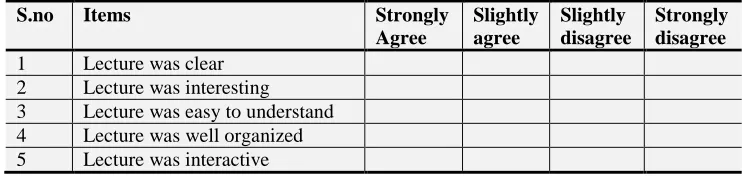
flipped class) on the basis of given items at the Likert scale of four as mentioned in Table 1 and
Table 2. Response rate of students was 72.73%.
Table-1. Student evaluation form for lecture evaluation
S.no Items Strongly
Agree
Slightly agree
Slightly disagree
Strongly disagree
1 Lecture was clear
2 Lecture was interesting
3 Lecture was easy to understand
4 Lecture was well organized
© 2015 AESS Publications. All Rights Reserved.
114
Table-2. Student evaluation form for lecturer performance.
S.no Items Strongly
Agree
Slightly agree
Slightly disagree
Strongly disagree
1 Lecturer was enthusiastic
2 Lecturer was clearly audible
3 Lecturer seemed confident
4 Lecturer gave clear explanation
5 Lecturer encouraged participation
3. RESULTS
Students showed positive response for flipped classroom using Poll Everywhere tool, which
helped teacher to get immediate feedback as well as engage students in large group teaching. This
tool is recommended by previous researchers also for student engagement and interaction which
was used to understand student’s difficulty level [13]. On the basis of learning outcomes of lecture,
questions have been asked to understand learners concept about gastrointestinal system by using
Poll Everywhere to get immediate statistical data which were shown in Figure 1,2,3,4,5.
Figure-1. Result of student response by Poll everywhere for question no 1.
© 2015 AESS Publications. All Rights Reserved.
115
Figure-3. Result of student response by Poll everywhere for question no 3.
Figure-4. Result of student response by Poll everywhere for question no 4.
© 2015 AESS Publications. All Rights Reserved.
116 On the basis of the student’s response for respective questions, the teacher spend more time to
explain specific concept to students rather than spending time on all contents which learner
understand by self-learning/prior knowledge with the help of pre reading material. This activity
also helps learner more responsible towards learning process.
3.1. Traditional Teaching
For traditional teaching class 80% students have given the highest score (Strongly agree) for
item lecturer enthusiasm, clear audibility, confidence and encouraged participation items, whereas
0% students gave the lowest score (strongly disagree) for same items. Only 30% students have
given the higher score for interesting lecture whereas 65% students slightly agreed that lecture was
interesting and 5% slightly disagree for same item. For organization of lecture, students have given
50% for both strongly agree and slightly agree. Only 40% students strongly agreed for interactive
lecture and 55% students slightly agreed for the same item which was our objective to improve in
flipped classroom. The most interesting result was recorded for clarity of lecture where 60%
students strongly agreed for clarity of lecture, however 35% participates slightly agreed and 5%
slightly disagreed for the same item.
3.2. Flipped Classroom with Poll Everywhere
Flipped classroom results were found interesting as there is a difference in all items except
clarity of lecture was same with traditional teaching though nobody disagrees as they were in
traditional teaching. In rest of other items students response for strongly agree is increased
drastically. 95% students were rated for highest score i.e. strongly agree for encouraged participation whereas 90% students were given highest score for lecturer’s enthusiasm, clear audibility and confidence. Statistical analysis of student’s feedback was carried for Mann-Whitney
U-Test and significance of items were identified for lecture and lecturer performance as mentioned
in Table 3.
Table-3. Statistical analysis of student’s feedback on lecture and lecturer evaluation
Items Content Median Inter Quartile
Range
Mann-Whitney U-Test
P-Value
1 Lecture was clear 4 3-4 260.00 0.494
2 Lecture was interesting 3 3-4 234.000 0.199
3 Lecture was easy to
understand
4 3-4 226.00 0.149
4 Lecture was well organized 4 3-4 246.00 0.314
5 Lecture was interactive 4 3-4 154.000 0.001*
6 Lecturer was enthusiastic 4 4-4 274.500 0.649
7 Lecturer was clearly audible 4 4-4 264.000 0.388
8 Lecturer seemed confident 4 3-4 276.000 0.640
9 Lecturer gave clear
explanations
4 4-4 244.000 0.228
10 Lecturer encouraged
participation
1.5 1-2 239.500 0.081
© 2015 AESS Publications. All Rights Reserved.
117
Table-4. Comparison between effective modes of delivery of lecture.
Items Mode of Delivery Mean Rank
1-Lecture was clear Traditional 23.33
Flipped Classroom 25.67
2-Lecture was interesting Traditional 22.25
Flipped Classroom 26.75
Total
3-Lecture was easy to understand Traditional 21.92
Flipped Classroom 27.08
4-Lecture was well organized Traditional 22.75
Flipped Classroom 26.25
5-Lecture was interactive Traditional 18.92
Flipped Classroom 30.08
6-Lecturer was enthusiastic Traditional 23.94
Flipped Classroom 25.06
7-Lecturer was clearly audible Traditional 23.50
Flipped Classroom 25.50
8-Lecturer seemed confident Traditional 25.00
Flipped Classroom 24.00
9-Lecturer gave clear explanation Traditional 22.67
Flipped Classroom 26.33
10-Lecturer encouraged participation Traditional 22.48
Flipped Classroom 26.52
4. DISCUSSION
In today’s world of technology, teaching has been well blended with specific tools to support teaching. Technology will be an added useful tool for visual learners to understand concept and
supports teacher to achieve learning outcomes within limited time. As per the demand of the topic,
suitable tools can be used to enhance teaching style. Now a days, to support teaching, there are lot of tools/software’s available which will be useful to get immediate feedback. Poll Everywhere is one of the tools which can be used for effective feedback. Feedback plays an important role to
improve only if it could be done immediately. Poll Everywhere tool was used with flipped
classroom concept for this pilot study which was greatly accepted by students. Advantages of using
Poll Everywhere tool in class was mainly to get timely and anonymous feedback. The disadvantage
of using Poll Everywhere tool in teaching were cost and time consuming process if internet service
is not fast. The teacher has to plan activities ahead and be good in time management as in one hour
lecture, the teacher has to spend some time to assess students understanding of pre-loaded lecture
contents and to clarify misconceptions if students are unable to understand. The teacher also needs
to dedicate some time for questions and response by students to identify their areas of difficulty.
For effective use of learning tools it is very important that the institute should have strong elearning
/IT support. If students face a problem in elearning /IT should be supported by experts and most
importantly all students should have electronic devices to vote. Teacher has a flexibility to reduce
time limit for response. Poll Everywhere is a good tool for places where universities have better
© 2015 AESS Publications. All Rights Reserved.
118 available, then Poll Everywhere software can be replaced by colored card feedback method with
some limitation for large group teaching [13].
5. CONCLUSION
This Study was started with the research question on how to engage students in large group
teaching with active learning process? To identify the impact of implementing flipped classroom
with the Poll Everywhere tool on student engagement in large group teaching for active learning by
students, student evaluation was used with ten items on mode of Interesting results were found, as
per study the mode of delivery is changed from traditional teaching (teacher centered learning) to
flipped classroom with the use of Poll Everywhere tool (Student centered learning) for feedback,
significant results were found (p value=0.001) for item 5 (Lecture was interactive) with flipped
classroom than in traditional teaching which concludes that Flipped classroom with Poll
Everywhere tool is a useful blended teaching method to enhance active learning in large group
teaching. Flipped classroom was well accepted by students though it needs lots of planning, fast
internet and IT support to conduct class by teachers to make it more interesting and effective
learning method.
6. ACKNOWLEDGEMENTS
I would like to thank elearning department of International Medical University for their
support while conducting class.
REFERENCES
[1] D. Dolmans, W. Grave De, J. Wolfhagen, and C. Van Der Vleuten, "Problem based learning: Future challenges for educational practice and research," Med. Edu., vol. 39, pp. 732-741, 2005.
[2] J. Bransford, A. Brown, and R. Cocking, How people learn. Washington DC: National Academy Press, 2001.
[3] V. Mann Karen, E. Sutton, and B. Frank, "Twelve tips for preparing residents as teachers," Medical Teacher, vol. 29, pp. 301 – 306, 2007.
[4] J. Bergmann, Flip your classroom: Talk to every student in every class every day suthor: Jonathan Bergmann, Aaron Sams, Publisher: Inte, 2012.
[5] J. Simpson Douglas, "John Dewey's concept of the student," Canadian Journal of Education/Revue Canadienne de l'Education, pp. 183-200, 2001.
[6] S. Herb and S. Laurie, "A review of poll everywhere audience response system," Journal of Technology in Human Services, vol. 29, pp. 236-245, 2011.
[7] V. L. Hoene, "Five ways to improve your teaching," Graduate Student Instructor Teaching & Resource Center, Graduate Division. UC Berkeley, 2005.
[8] C. Peter, "ABC of learning and teaching in medicine teaching large groups," BMJ, vol. 326, pp. 437-40, 2003.
© 2015 AESS Publications. All Rights Reserved.
119
[10] A. M. Bluic, P. Goodyear, and R. A. Ellis, "Research focus and methodological choices in studies into students’ experiences of blended learning in higher education," Internet and Higher Education,
vol. 10, pp. 231-244, 2007.
[11] G. Charles Prober and H. Chip, "Lecture halls without lectures — a proposal for medical education,"
N. Engl. J. Med., vol. 366, p. 3, 2012.
[12] R. Harden and J. Laidlaw, "Be FAIR to students: Four principles that lead to more effective learning," Medical Teacher, vol. 35, pp. 27-31, 2013.
[13] M. Wendi Kappers and Embry-Riddle, "Poll everywhere! Even in the Classroom: An investigation into the impact of using poll everywhere in a large-lecture classroom," presented at the American Society for Engineering Education,121st ASEE Annual Conference and Exposition, Paper ID. pp: 8854, 2014.