University of South Carolina
Scholar Commons
Theses and Dissertations
2017
An Exploration of the Availability and
Implementation of Undergraduate Degrees in
Conducting in the United States
Erik Lee Garriott
University of South Carolina
Follow this and additional works at:https://scholarcommons.sc.edu/etd Part of theOther Music Commons
This Open Access Dissertation is brought to you by Scholar Commons. It has been accepted for inclusion in Theses and Dissertations by an authorized administrator of Scholar Commons. For more information, please [email protected].
Recommended Citation
An Exploration of the Availability and Implementation of Undergraduate Degrees in Conducting in the United States
by
Erik Lee Garriott Bachelor of Arts
Point Loma Nazarene University, 2010 Master of Music
California State University Northridge, 2013
_________________________________________________________________ Submitted in Partial Fulfillment of the Requirements
For the Degree of Doctor of Musical Arts in Conducting
School of Music University of South Carolina
2017 Accepted by:
Donald Portnoy, Major Professor Cormac Cannon, Chair, Examining Committee
Andrew Gowan, Committee Member Alicia Walker, Committee Member
Kunio Hara, Committee Member
ii
iii
Dedication
This work of research is dedicated to the love of my life, Chelsea Alizabeth Oakes; my mother Alicia Garriott Ramirez; my grandparents Roger and Sandy
iv
Acknowledgements
v
Abstract
vi
Table of Contents
Dedication ... iii
Acknowledgements ... iv
Abstract ...v
List of Tables ... viii
List of Figures ... ix
Chapter 1: Introduction and Historical Background ...1
Chapter 2: Undergraduate Degrees in Conducting in Germany, Austria, and Korea ...15
Chapter 3: Undergraduate Degrees in Conducting in the United States ...32
Chapter 4: Survey Data and Analysis ...49
Chapter 5: A Discussion on the Methods, Challenges, and Benefits of Implementing a Bachelor of Music in Conducting ...54
Chapter 6: Conclusion and Recommendations for Further Study ...66
Bibliography ...70
Appendix A: Questions for Voice Interviews ...73
Appendix B: Survey on the Availability of Undergraduate Degrees in Conducting ...75
Appendix C: Responses to the Survey entitled “A Study on Undergraduate Degrees in Conducting” ...78
vii
viii
List of Tables
Table 2.1: Audition requirements and core curriculum for undergraduate conducting majors at the Hanns Eisler School of Music in Berlin, Germany. ...18 Table 2.2: Translation of the first year of recommended classes for undergraduate
conducting majors at the Hanns Eisler School of Music in Berlin, Germany ...21 Table 2.3: Audition requirements and core curriculum for undergraduate conducting majors at the School of Music and Dance in Cologne, Germany. ...23 Table 2.4: Translation of the first year of recommended classes for undergraduate
ix
List of Figures
Figure 1.1: Diagrams of Standard Conducting Patterns from Berlioz’s “The Orchestral Conductor” ...4 Figure 1.2: Berlioz’s written thoughts on an improper conducting habit and an example of one of his own unorthodox patterns. ...5 Figure 2.1: Recommended core class schedulefor first year undergraduate conducting majors at the Hanns Eisler School of Music. ...20 Figure 2.2: Recommended core class schedule for first year undergraduate conducting majors at the School of Music and Dance in Cologne, Germany. ...23 Figure 2.3: Recommended core class schedule for undergraduate conducting majors at the University of Music and Performing Arts in Graz, Austria. ...27 Figure 2.4: Recommended class schedule for undergraduate conducting majors at Korea National University of Arts in Seoul, South Korea. ...31 Figure 3.1: Course requirements for the Bachelor of Music in Performance with
x
Figure 3.6: Required courses for undergraduate music majors pursuing a music education track conducting minor at the Berklee College of Music in Boston, Massachusetts. ...48 Figure 4.1: Survey data regarding undergraduate music degrees offered at participating faculty members’ respective universities. ...51 Figure 4.2: Survey data on the question “Which of the following graduate degrees are offered at your current university?” ...53 Figure 4.3: Conducting faculty favorability towards implementing an undergraduate conducting degree program...53 Figure B.1: Survey Questions from “A Study on Undergraduate Degrees
in Conducting” ...75 Figure C.1: Survey Responses from “A Study on Undergraduate Degrees
1
CHAPTER 1:
Introduction and Historical Background
One of the first references to conducting with a baton is in the written work Il Desiderio (1594)by Bolognese poet and composer, Ercole Bottrigari (1532-1612). In this work, he described a small chamber music concert:
“You would see them enter one by one, quietly bringing their instruments, either stringed or wind. They all enter quietly and approach the table without making the least noise, and place themselves in the proper place, and some sit, who must do so in order to use their instruments, and others remain standing. Finally the Maestra of the concert sits down at one end of the table, and with a long, slender and well-polished wand (which was placed there ready for her, because I saw it), and when all the other sisters clearly are ready, gives them without noise several signs to begin, and then continues by beating the measure of the time which they must obey in singing and playing.”1
This passage is intriguing due to the fact that Ercole Bottrigari indicates the ensemble he was viewing featured a female conductor. Bottrigari’s experience occurred long before Adam Carse (1878-1958) wrote in his book, The Orchestra in the Eighteenth Century
(1940),2 that conducting with a baton truly began with Johann Reichardt (1752-1814) when he was appointed as Kapellmeister of the Berlin Court Opera. Regardless of the exact timeline of its inception, conducting with a baton quickly became a necessity in the western music world as the popularity and size of large musical ensembles grew in the classical era of music history.
2
Conductors rose to greater prominence in the early 19th century which is when some of the first written articles that mention conductors Louis Spohr (1784-1859) and Carl Maria von Weber (1786-1826) can be found in the German publication Allgemeine Musikalische Zeitung (est. 1798).3 Louis Spohr is famous for his addition of rehearsal
letters to orchestral scores and parts as well as his invention of the chin rest for violinists. Carl Maria von Weber is significant in conducting history because of his insistence on conducting without the aid of a piano or violin at the front of the orchestra. Weber was also one of the first authoritative conductors who demanded the implementation of the baton in rehearsals, though he was occasionally met with opposition:
“With active adversaries, always employed in manoeuvres, great and small, to depreciate and misrepresent every action of the new German Kapellmeister, it is not surprising to find a small, but according to modern ideas, necessary innovation brought against him, almost as a heinous crime. But any novelty was sufficient to bring down a cry of horror from the influential “pigtail” coteries of Dresden. Weber actually had the insolence to introduce the conductor’s baton into the orchestra...The innovation, however useful, however necessary, was loudly decried as such. In vain Weber argued that
whatever the requirements of the Italian opera, German music demanded a more
immediate influence on the part of the conductor. Such pretensions were ridiculed. Even among the members of the company, vocal and instrumental, grumblings were at first loud against a system which required a greater strain of attention on the part of executants.”4
Felix Mendelssohn (1809-1847) and Hector Berlioz (1803-1869) also contributed to the rise of conductors in the mid-19th century. Mendelssohn founded the Leipzig Conservatory in 1843 where he conducted various ensembles and inspired other institutions to create positions of prominence for conductors. Some examples of the conductors that were given opportunities to further their career through educational
3 Friedrich Rochlitz, Allgemeine Musikalische Zeitung (Frankfurt: Rieter-Biedermann Publishing), vols. 29
& 34.
4 Max Maria von Weber, Carl Maria von Weber. Ein lebensbild, trans. J. Palgrave Simpson (London:
3
institutions were Hans von Bülow (1830-1894) at the Munich Conservatory, Arthur Nikisch (1855-1922) at the Leipzig Conservatory, Theodore Thomas (1835-1905) at the Cincinnati College of Music, Frank Damrosch (1859-1937) at the New York Institute of Musical Art, and Howard Hanson (1896-1981) at the Eastman School of Music,5 as well
as many more. However, of all the early and mid-19th century conductors, Hector Berlioz had perhaps the greatest impact on the future of instrumental conducting education.
Berlioz was known for his large-scale compositions and for his passion for conducting orchestras. Shortly after he composed Harold en Italie (1834), Berlioz began to conduct nearly all performances of his own compositions because he grew weary of conductors who did not understand how to conduct his music. This eventually lead to one of the most prolific conducting careers in western music history. In his Treatise on
Instrumentation (1843),6 which was published in The Musical Times and Singing Class Circular, Berlioz included an essay on the art of conducting entitled“The Orchestral Conductor. Theory of his Art.” which was one of the first calls to establish higher performance and training standards for conductors worldwide. Within the essay were guidelines on score analysis, rehearsal technique, placement of instrumental sections, part assignments, and many of the nuances of conducting taught today in universities
worldwide. The following is a quote from the final paragraph of Berlioz’s essay on conducting which exemplifies his dedication to quality conducting:
“I firmly believe that a faithful, spirited and enthusiastic performance of a modern work, even by outstanding artists, can be achieved only by sectional rehearsals. Each choral part must be studied individually until the necessary security is
5 Elliott W. Galkin, A History of Orchestral Conducting in Theory and Practice (New York, NY:
Pendragon Press).
6 This text is sometimes referred to as the Treatise on Orchestration. The treatise was revised and
4
reached; only then should it be rehearsed with the other parts. One should proceed in the same fashion in rehearsing symphonies, if they are at all complicated.”7
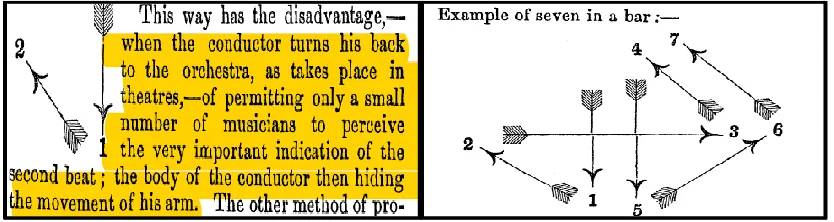
Berlioz’s essay contained some of the first written instructional material for conductors as well as detailed diagrams of clear conducting patterns and descriptions of how to correctly perform articulations and dynamics on the podium. Some of the
examples are not typical of standard patterns conductors use today. In the essay, Berlioz discusses some of the more unusual patterns presented,8 but is sure to also highlight the significance of the relevance of important foundational conducting techniques.
Figure 1.1: Diagramsof Standard Conducting Patterns from Berlioz’s “The Orchestral Conductor” 9
Richard Wagner (1813-1883) wrote a treatise on conducting entitled “Über das Dirigieren” (1869) or “On Conducting”, and Parisian conductor Edouard-Marie-Ernest Deldevez (1817-1897) wrote “L’Art du chef d’orchestre” (1878) or “The Art of the Conductor”. Wagner and Deldevez’s respective written works focused on the expressive and interpretive side of conducting more so than Berlioz’s writing, which focused on the establishment of standards of clarity and precision. Arturo Toscanini (1867-1957), a maestro who like Weber was famous for rhythmic precision, claimed that Deldevez’s
7 Hector Berlioz. A Treatise on Modern Instrumentation and Orchestration, trans. Theodore Front (New
York, NY: Edwin F. Kalmus Publishing Company, 1948).
8 See Figure 1.2
9Hector Berlioz. "The Orchestral Conductor. Theory of His Art." The Musical Times and Singing Class
5
writing was “the most perceptive if not the only worth-while analysis of the subject” available during his lifetime.10 Each of the aforementioned conductors contributed profound works of writing in order to better conducting pedagogy. This lead to significant progress for conducting education in the 20th century.
Figure 1.2: Berlioz’s written thoughts on an improper conducting habit and an example
of one of his own unorthodox patterns.11
It was not until the 20th century that many conducting students, some of whom would eventually become professional symphony orchestra conductors, began to graduate with degrees in conducting and study conducting seriously in a formal academic setting. Herbert von Karajan (1908-1989) studiedas a piano major at the Vienna Academy of Music and Performing Arts while also taking conducting classes with Alexander
Wunderer (1877-1955).12 Karajan eventually went on to conduct the Berlin Philharmonic for 35 years. Claudio Abbado’s (1933-2014) conducting career began in 1958, just a few years after his graduation from the Milan Conservatory where he studied composition, conducting and piano.13 He went on to conduct professional orchestras such as the
10 Howard Taubman, The Maestro, The Life of Arturo Toscanini (New York: Simon and Schuster, 1951),
181.
11 Hector Berlioz. "The Orchestral Conductor. Theory of His Art." The Musical Times and Singing Class
Circular, no. 159-162, 229.
12 According to the posthumous curriculum vitae of Herbert von Karajan found at:
http://www.karajan.org/jart/prj3/karajan/main.jart?rel=en&content-id=1188466703959&reserve-mode=active
13 David Ewen, "Claudio Abbado" in Musicians Since 1900: Performers in Concert and Opera (Music and
6
Chicago Symphony Orchestra, London Symphony Orchestra, and Berlin Philharmonic. In the late 20th century, conductors such as Michael Tilson Thomas (b. 1944)14 of the San Francisco Symphony Orchestra, Leonard Slatkin (b. 1944)15 of the Detroit Symphony Orchestra, and Alan Gilbert (b. 1959)16 of the New York Philharmonic all
received degrees in conducting prior to the start of their professional conducting careers. These are only a few examples of current professional orchestra conductors who hold degrees in conducting.
In the 21st century, conducting has become a staple of music education in
university schools of music. Conducting is currently classified as a performance degree in most institutions of higher education. In the United States, the most prevalent conducting degrees offered are the Master of Music in conducting and Doctor of Musical Arts in conducting. However, there are few schools that offer undergraduate degrees in conducting. Many schools only offer one or two conducting courses for undergraduate music students, even to those who may eventually have jobs that require frequent conducting of ensembles. These circumstances reveal a potential disparity in the conducting training provided to undergraduate music students compared to other undergraduate music performance degrees. A substantial amount of time and practice is required to become a confident and proficient conductor. This is similar to the
performance requirements for instrumentalists and singers. Conductors must practice the
14 Thomas earned a master's degree in conducting from the University of Southern California in 1967.
http://michaeltilsonthomas.com/1967/01/01/1967/
15 According to the article at http://www.juilliard.edu/journal/1305/slatkin-lead-orchestra, Slatkin
completed a Bachelor of Music in Orchestral Conducting at Juilliard in 1967. This is one of the only accounts of a principal conductor of a professional orchestra with an undergraduate degree in conducting that I have discovered.
16 Gilbert received a master’s degree in orchestral conducting from Juilliard in 1994.
7
physical motions of the art, understand the score in exceptional detail, be able to
recognize and detect errors within the ensemble, develop their own interpretation of the music using facts and reasoning to support those interpretations, understand the pacing of an effective rehearsal, and have a vast knowledge of standard and non-standard repertoire for their respective ensemble. These are only a partial representation of the requirements which effective conductors must master.
In general, undergraduate music students are expectedto complete at least one course in beginning conducting,17 while music education students are expected to complete two or three. Sometimes universities will separate upper-division conducting courses into choral conducting and instrumental conducting. Music students who wish to pursue further study in conducting during their time as an undergraduate may have difficulty finding opportunities to conduct a live ensemble beyond the limited time they are given in conducting classes. These opportunities are essential to gaining confidence before conducting in front of ensembles in schools, communities, and other venues. The opportunities to put score preparation techniques and conducting related knowledge to the test in a variety of situations could be valuable to any undergraduate with a strong passion and aptitude for conducting. Finally, those students who wish to pursue a graduate degree in conducting may be unable to learn the skills necessary to present a quality performance on graduate degree auditions and exams.
An undergraduate should be proficient in several areas before applying to a graduate program in conducting. An understanding of musical vocabulary in several languages is required to properly interpret a musical score. Italian, English, German, and
8
French are the most common languages found in orchestral, choral, and wind ensemble scores. Score study, which is the practice of identifying patterns in rhythm, melodic changes, transpositions, harmonic progressions, articulations, dynamics, and tempi in a musical score, is an essential skill when attempting to mark a score and prepare efficient rehearsals. A discussion about the repertoire of major composers (i.e. Mozart, Beethoven, Brahms) is often a component of the interview portion of an audition for a graduate degree in conducting. Concert programming is a skill that may not be taught to
undergraduate music students even though it is important for these students to learn that certain pieces, composers, and instrumentations may not integrate well on a program. Finding concert programming resources, such as Orchestral Music (2005) by David Daniels,18 can prove to be an arduous task for undergraduate music students if they are not given guidance. Some of these skills may be taught to undergraduate music students in beginning conducting and advanced conducting classes, but it is uncommon that undergraduate music students are able to learn each topic in detail.19 In addition, many
graduate degree programs in conducting will pre-screen applicants via recorded
rehearsals and performances with large ensembles. Unfortunately, undergraduate music students are seldom given the opportunity to conduct in front of an orchestra, band, or choir in order to produce a high quality, representative video.
Schools of music seldom offer training for undergraduate conductors beyond one or two classes. As a result, undergraduate conductors learn basic conducting techniques
18 The online database of orchestral music can be paid for and accessed at https://daniels-orchestral.com/. 19 The core music requirements from undergraduate conducting degree programs from the United States,
9
while in school, and then learn advanced techniques on their own through professional experience in the field of music. This leads to two important questions:
1. Why is conducting so infrequently offered as an undergraduate music degree? 2. What are the challenges and benefits regarding the implementation of an undergraduate conducting degree program?
Purpose of the Study
The researcher examined the viability of implementing an undergraduate
conducting degree in American universities based on the examples of already established programs in Germany, Austria, Korea, as well as Chapman University and Mannes University in the United States. This research also provides some insight into the way conducting faculty in the United States may perceive a bachelor’s degree in conducting and whether it has a place in music schools across the United States.
Need for the Study
10
According to the National Center for Educational Statistics (NCES),20 there are six schools that offer bachelor’s degrees in conducting. 21 These schools are:
1. Chapman University (Orange, California)
2. Andrews University (Berrien Springs, Michigan) 3. Aquinas College (Grand Rapids, Michigan) 4. DePauw University (Greencastle, Indiana) 5. McMurry University (Abilene, Texas) 6. Union College (Lincoln, Nebraska)
Each of the schools listed by NCES are private institutions. Unfortunately, the results of the NCES web search are erroneous or have not been updated in many years. After further exploration, I have uncovered that of the six schools listed by NCES only Chapman University offers an accredited Bachelor of Music in Conducting. While it is not listed in the NCES database, the Mannes School of Music at the New School in New York, New York also currently offers an undergraduate degree in orchestral conducting. The sparse availability of undergraduate degrees in the United States seems to indicate a clear contrast between the acceptable amount of training for a conductor and the
acceptable amount of training for any other performer before the graduate level. The National Association of Schools of Music (NASM) indicates several requirements for accreditation of a performance degree in music. While specific
expectations of competency are decided by each school, the NASM handbook contains general guidelines on important requirements. Students who complete their
undergraduate degree in music are expected to have:
(1) The ability to think, speak, and write clearly and effectively.
20 http://nces.ed.gov/collegenavigator/
21As of the year 2010 there are 129 universities that offer degrees in conducting at the master’s level or
11
(2) An informed acquaintance with fields of study beyond music such as those in the arts and humanities, the natural and physical sciences, and the social sciences. (3) A functional awareness of the differences and commonalities regarding work in artistic, scientific, and humanistic domains.
(4) Awareness that multiple disciplinary perspectives and techniques are available to consider all issues and responsibilities including, but not limited to, history, culture, moral and ethical issues, and decision-making.
(5) The ability to identify possibilities and locate information in other fields that have bearing on musical questions and endeavors.22
NASM further recommends that students have the following skills upon completion of any music degree:
1. Gain a basic understanding of the nature of professional work in their major field. Examples are: organizational structures and working patterns; artistic, intellectual, economic, technological, and political contexts; and development potential.
2. Acquire the skills necessary to assist in the development and advancement of their careers.
3. Develop teaching skills, particularly as related to their major area of study. 4. Continue to develop improvisational skills whether as an aspect of
composition, musicianship, or performance studies.
5. Experience a broad range of repertory through attendance at events such as recitals, concerts, opera and music theatre productions, and other types of performances.
6. Explore areas of individual interest related to music in general or to the major. Examples are music bibliography, notations, aesthetics, acoustics, performance practices, specialized topics in history, musicology, ethnomusicology, analysis, and technology.
7. Explore multidisciplinary issues that include music.
8. Practice synthesis of a broad range of musical knowledge and skills, particularly through independent study that involves a minimum of faculty guidance, where the emphasis is on evaluation at completion (see Standards III.G.).23
And finally, NASM suggests that all music performance bachelor’s degrees should have: (1) Standard. Curricular structure, content, and time requirements shall enable students to develop the range of knowledge, skills, and competencies expected of those holding a professional baccalaureate degree in performance as indicated below and in Standards VIII.
(2) Guidelines. Curricula to accomplish this purpose that meet the standards just indicated normally adhere to the following structural guidelines: study in the
12
major area of performance, including ensemble participation, pedagogy courses, independent study, and recitals, should comprise 25-35% of the total program; supportive courses in music, 25-35%; general studies, 25-35%. Studies in the major area and supportive courses in music normally total at least 65% of the curriculum.24
Based on the information from the NASM handbook, an undergraduate degree in conducting is a degree that could feasibly be implemented in schools of music across the United States. While the requirements of NASM appear to be achievable, finding the resources could prove to be a more arduous task. The development of teaching skills as related to conducting would likely require students to be allowed more time to conduct in front of an ensemble during their time as an undergraduate. Finding this time may be difficult for universities depending on the ensemble directors, ensemble sizes, and the number of students in the undergraduate conducting program. Research is needed to better understand the reasons conducting faculty might feel hesitant about the establishment of undergraduate conducting degree programs in the United States.
Limitations of the Study
The primary focus of this research is the availability and implementation of undergraduate degrees in conducting in the United States. The researcher compared the core music curriculum requirements for undergraduate music education students at select universities in the United States, undergraduate conducting students at Chapman and Mannes, and undergraduate conducting students in German, Austrian and Korean universities.25 Stanford University and Berklee College of Music offer conducting
24 National Association of Schools of Music Handbook, 100.
25 The list of Music Education major curriculum and audition requirements from 10 universities in the
13
concentrations for undergraduates,26 but are not discussed in great detail because they are not considered to be music performance degrees. A lengthy discussion of the conducting training received during a master’s degree or higher is not included in this study. The conclusion and discussion sections were derived from an analysis of participants’ interviews and the examination of several university schools of music. The times and dates of each interview and survey were reliant on the participants’ schedules. Chapman University and Mannes University are the primary schools with an undergraduate degree in conducting from the United States discussed in this research.
Design and Procedures
This study consists of five chapters in addition to a table of contents,
bibliography, and appendices. Chapter one is comprised of an introduction, a brief history of conducting education and significant texts, purpose of the study, need for the study, limitations of the study, literature review, research questions, and the design of the study. In Chapter two, the researcher examined the core degree requirements for undergraduate conducting majors at select European and Asian schools of music. Chapter three
examined the undergraduate degree programs in conducting at Chapman University and Mannes School of Music. A comparison of the requirements in undergraduate degree programs in music education versus undergraduate degree programs in conducting in the United States is provided in this chapter as well. Chapter four consists of survey data analysis. Chapter five contains a discussion on the cultural differences, methods, benefits, and challenges of implementing a Bachelor of Music in Conducting in American
26 Stanford offers a Bachelor of Arts with a concentration in conducting, while Berklee College of Music
14
universities. Chapter six consists of a conclusion and recommendations for further study. The appendices contain interview questions, the survey instrument, tables, figures, data charts, and interview transcriptions.
The interviews were conducted via telephone communication. Interviews of Professor Daniel Wachs (Chapman University), Professor John Koshak (Chapman University), and Professor David Hayes (Mannes School of Music) were included in this study. The interviews took place between November 2016 and February 2017. Several questions about the current state of the school’s conducting program and the professors’ conducting pedagogy philosophies were asked. Some information was gathered from the most recent undergraduate music student handbook available at each institution studied in this research. The interview questions given to Chapman University and the Mannes School of Music faculty gathered information on the foundation of the undergraduate conducting program, degree requirements, availability, acceptance, challenges, and the evolution of the degree.
The survey contained fewer questions and was designed to be less comprehensive than the phone interviews in order to limit the amount of time required to respond. The data from the survey and interviews was used to determine the similarities and
15 CHAPTER 2:
Undergraduate Degrees in Conducting in Germany, Austria, and Korea
Foreign Undergraduate Degrees in Conducting
I have included the audition and core curriculum requirements for 12 German universities, 1 Austrian university, and 5 Korean universities in Appendix D of this study.27 Including these universities in the study will help display some of the basic requirements of established undergraduate conducting programs differing cultures. Most tables and figures in Chapter 2 will be based on requirementsfor undergraduate orchestral conducting majors.28 Germany may be the country with the highest availability of
undergraduate degrees in conducting in the world.29 For this reason, I will display two undergraduate conducting programs from Germany. This chapter will explore some unique cultural aspects of the education systems in Germany, Austria and Korea, and provide some of the audition requirements and core music classes offered to
undergraduate conducting majors at select universities in each of these countries. Similar programs in the United States will not be discussed until Chapter 3.
27 Some of the Korean universities’ audition requirements could not be confirmed. Therefore, they have
been omitted from the chart in Appendix D.
28 The curriculum discussed in this study is not indicative of the entire course load of the respective
undergraduate degree program. Courses in music history, music theory, and other non-performance related courses have been redacted or omitted. Full requirements can be found in Appendices D through F.
29 European universities rarely distinguish between “wind conducting” and “orchestral conducting”. This
16 The German Education System
There are some significant cultural differences between the education systems of Germany and the United States. Primary and secondary schools in the United States tend to follow the linear progression of elementary school, middle school, and high school. American students at all levels of academic achievement also tend to be educated on one campus in the public education system. The German school system is often considered more complex than others because of the multiple educational tracks available to secondary school students. Secondary school in Germany begins near the United States equivalent of the 5th grade. German students are required by law to complete nine years of secondary school. While there are also private schools in Germany, they are less pervasive than in the United States. Most German students attend public schools.
There are three main educational tracks in German secondary school with each leading to a different career path. (1) Gymnasium is similar to an honors system in the United States. This school is meant for advanced students who are likely to attend university. (2) Realschule is a secondary school meant for students who will most likely pursue white-collar careers. (3) Hauptschule is a moderately paced education track for students who will likely enter trade school.30 Entrance to each educational track is based on the students’ primary school grades and parental choice. These tracks are typically taught at exclusive institutions, though some schools known as Gesamtschule serve students on each of the three main educational tracks. Most students are placed into an educational track by the time they are 10 years old. There are opportunities to switch tracks, but it is uncommon for students to do so.
30 David Phillips, Education in Germany: Tradition and Reform in Historical Context (Hove, United
17
The most popular universities in Germany are the classic universities that provide a broad education to students. There are also technical universities known as
Hochschulen that provide more focused training to students. Hochschulen are where most high-quality music degrees can be attained in Germany. Many of the Hochschulen also have training programs called “Jungstudium” or “Young Study” for gifted young students. German and Austrian universities follow the European Credit Transfer and Accumulation System (ECTS) which requires 60 credits to be accumulated annually by each student regardless of their major. Students are typically required to complete a total of 240 credits in a four-year degree program. In Germany and neighboring German speaking countries, undergraduate degrees in conducting are prestigious and often require a demonstration of basic conducting knowledge prior to acceptance into a university. This means that auditions are rigorous, but the conducting curriculum covered in the undergraduate degree program is comprehensive and focused on allowing undergraduates time to conduct with ensembles, singers, lab orchestras, and during private lessons. The Austrian education system mirrors many of the values and structure found in the German education system, so the two will not be differentiated.
Undergraduate Degrees in Conducting in Germany and Austria
The Hochschule für Musik Hanns Eisler in Berlin, Germany (The Hanns Eisler School of Music in Berlin, Germany) is home to one of the most prestigious
18
having both undergraduate and graduate students participate and place in international conducting competitions31 around the world. The conducting audition requirements at this institution are demanding compared to audition requirements for undergraduate music majors entering their freshman year of college in the United States.
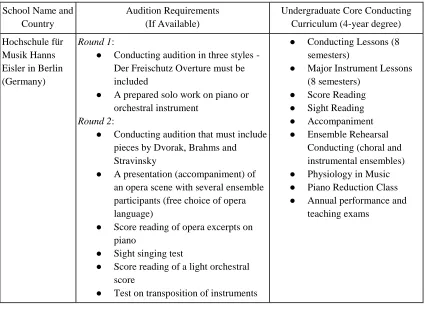
Table 2.1: Audition requirements32 and core curriculum for undergraduate conducting majors at the Hanns Eisler School of Music in Berlin, Germany.
School Name and Country
Audition Requirements (If Available)
Undergraduate Core Conducting Curriculum (4-year degree)
Hochschule für Musik Hanns Eisler in Berlin (Germany)
Round 1:
● Conducting audition in three styles - Der Freischutz Overture must be included
● A prepared solo work on piano or orchestral instrument
Round 2:
● Conducting audition that must include pieces by Dvorak, Brahms and Stravinsky
● A presentation (accompaniment) of an opera scene with several ensemble participants (free choice of opera language)
● Score reading of opera excerpts on piano
● Sight singing test
● Score reading of a light orchestral score
● Test on transposition of instruments
● Conducting Lessons (8 semesters)
● Major Instrument Lessons (8 semesters)
● Score Reading ● Sight Reading ● Accompaniment ● Ensemble Rehearsal
Conducting (choral and instrumental ensembles) ● Physiology in Music ● Piano Reduction Class ● Annual performance and
teaching exams
31 A list of recent prize winners and competition placements for the Hanns Eisler School of Music
conducting program can be found at: http://www.hfm-berlin.de/en/school/achievements-and-projects/prizewinners/?studySubject=21
32 While the requirements listed are specific to the orchestral conducting program, the choral conducting
19
There are two rounds of auditionsfor students who wish to enter the undergraduate conducting program at the Hanns Eisler School of Music.33 The
preliminary round of auditions consists of a conducting audition where to student must prepare and conduct three contrasting works for orchestra. The Overture to Der
Freischutz (1821) by Carl Maria von Weber is a required piece in the first round.34 Students are also required to prepare solo works for piano or an orchestral instrument. The second round of auditions requires students to conduct three orchestral works during a rehearsal. As of 2016, the required pieces for the second round of auditions are the 1st movement of Antonin Dvorak’s (1841-1904) Symphony No. 8 (1889), the 2nd movement of Johannes Brahms’ (1833-1897) Symphony No. 3 (1883), and Part 1 of Igor
Stravinsky’s (1882-1981) Histoire du Soldat (1918). After the orchestra rehearsal, students must undergo a sight singing and sight reading test on piano and perform an accompaniment of an opera scene in its original language. Score reading, an instrument transposition test, harmonic and melodic analysis, and the presentation of two contrasting solo piano works are the final portions of the audition.
Undergraduate conducting students begin conducting courses and lessons in their first semester at Hanns Eisler. The first year of courses includes, score reading,
accompaniment, conducting lessons, and work with a large ensemble. Figure 2.1 is a portion of the Hanns Eisler music student handbook that displays the typical first year of core classes for undergraduate conducting majors. A translation of the relevant material
33Audition requirements for undergraduate conductors at Hanns Eisler can be found at
http://www.hfm-berlin.de/en/studies/courses-offered/bachelor-of-music/ba-orchestra-conducting/
34 Der Freischutz is a commonly required audition piece for prospective undergraduate conducting students
20
from the selected portion Hanns Eisler music student handbook is provided in Table 2.2. Based on the translation seen in Table 2.2, the emphasis on conducting training from day
Figure 2.1: Recommended core class schedule35 for first year undergraduate conducting majors at the Hanns Eisler School of Music.36
one of the first semester is apparent.37 The undergraduate conducting majors at Hanns
Eisler are required to complete more conducting classes in the first semester of study than many universities in the United States offer over the course of an entire degree in music.
35 These courses are not indicative of the entire semester schedule for undergraduate conducting majors. As
stated previously, these classes only represent the music major requirements.
36 This example only represents the first year of core classes for undergraduate conductors. The complete
information on the conducting curriculum found in the Hanns Eisler student handbook is available for download at http://www.hfm-berlin.de/en/studies/courses-offered/bachelor-of-music/ba-orchestra-conducting/
37 German to English translation based on Roberto Braccini’s Dictionary of Musical Terms in Four
21
The applied teaching courses recommended for first year undergraduate conducting majors are conducting lessons (seen in Table 2.2 as “Orchestral Conducting Major Studies”), score reading, accompaniment, and conducting with an ensemble. This kind of emphasis on conducting proficiency within one semester of learning at the university level is extraordinary.
Table 2.2: Translation of the first year of recommended classes for undergraduate conducting majors at the Hanns Eisler School of Music in Berlin, Germany.38
4.22 Orchestral Conducting
Compulsory Studies
Name of the Module Requirement AEN MCODE LP
Orchestral Conducting Major I Matriculation [enrollment] 3 3000 23LP
Performance Studies Performance Test
8 teaching certificates [are given] for attending [each class]. Performance examination (20 minutes) The certificates are given for the achievement (or completion)
of the respective teaching objectives.
Applied Teaching Sem Teaching Method Contact LV 1: Orchestral Conducting Major Studies 1. KE 1.5h LV 1: Score Reading 1. KE 1h LV 1: Accompaniment 1. KE 1h LV 1: Work with Ensemble 1. P LV 2: Orchestral Conducting Major Studies 2. KE 1.5h LV 2: Score Reading 2. KE 1h LV 2: Accompaniment 2. KE 1h LV 2: Work with Ensemble 2. P
Competencies
After successful completion of the module:
-The students have mastered the fundamentals of conducting technique -The students have begun to work on creative repertoire
-The students have developed their ability to study the score
22
The “Competencies” section at the bottom of Figure 2.1 displays an outline of the concepts undergraduate conductors should learn within their first year of study. There may be debate about which techniques are considered fundamental in early conducting training, but the goal of having students begin their undergraduate conducting studies by conducting large ensemble works after intense score study is certainly admirable.
Undergraduate conducting students at Hanns Eisler are expected to show that they can retain conducting skills learned throughout the year through an annual performance test. The annual performance test is like the jury system of annual or biannual testing which is prevalent in university level schools of music across the United States.
The Hochschule für Musik und Tanz Köln in Cologne, Germany (School of Music and Dance in Cologne, Germany) is another German university that offers a Bachelor of Music in both choral and instrumental conducting. Ferdinand Hiller founded the academy of music in Cologne in 1850. At that time, it was known as the
Conservatorium der Musik in Köln. In 1972, two other schools of music were absorbed to form the Staatliche Hochschule für Musik Rheinland which eventually became the
Hochschule für Musik und Tanz Köln in 1987. The School of Music and Dance in Cologne is one of the largest schools of music in Europe.
This university has a two-round audition process for undergraduate conducting majors, but requires three piano works from different eras with no option for an alternative instrumental audition in the first round. The first round also requires
23
Amadeus Mozart (1756-1791), Carl Maria von Weber, and Giacomo Puccini (1858-1924).39 This means that the initial piano performance requirements for conducting
Table 2.3: Audition requirements and core curriculum for undergraduate conducting majors at the School of Music and Dance in Cologne, Germany.40
School Name and Country
Audition Requirements (If Available)
Undergraduate Core Conducting Curriculum (4-year degree)
Hochschule für Musik und Tanz Köln (Germany)
Round 1:
● Piano audition on pieces from three different eras
● Opera accompaniment audition on excerpts from Mozart, Weber, and Puccini
● Score reading exam Round 2:
● Conducting audition with the Bergische Symphony
● Conducting Lessons (8 semesters)
● Major Instrument Lessons (8 semesters)
● Piano Lessons ● Score Reading ● Accompaniment ● Class Voice ● Choir
Figure 2.2: Recommended core class schedule for first year undergraduate conducting majors at the School of Music and Dance in Cologne, Germany.41
auditions at the School of Music and Dance in Cologne are more strenuous than at the Hanns Eisler School of Music. In the second round of auditions at Cologne, the
39 The compositions required at each university may change depending on the audition year.
40 The full audition requirements for both choral and orchestral conducting undergraduates at the School of
Music and Dance in Cologne can be found at
http://www.hfmt-koeln.de/fileadmin/redaktion/downloads/eignungspruef_ba_orchesterdirigieren.pdf
41 All undergraduate conducting degree requirements for the University of Music and Performing Arts in
24
auditionee is required to conduct a symphonic work with the Bergische Symphony.42 The opportunity for a prospective undergraduate student to conduct a professional orchestra as part of an audition, even one of a small size, is not likely something that would occur often in the United States.
Table 2.4: Translation of the first year of recommended classes for undergraduate conducting majors at the School of Music and Dance in Cologne, Germany.43
Module Class Code Number
Subject Semester 1 Semester 2 Teaching (testing) Method
Credits
Core Area 11031-14131
11039-14139 -Orchestral Conducting -Coaching for conductors -1.50 -2.00 -1.50 -2.00 -TN -TN -25 -4 Artistic Practice 21073-24073 21059-24059 21070-24070 21086-22086 90031 21074-24074 -Class Piano -Score Reading -Piano Reduction -Class Voice -Choir -Accompaniment -0.75 -0.50 -1.00 -0.50 -2.00 -1.00 -0.75 -0.50 -1.00 -0.50 ___ -1.00 -SL -TN -TN -SL -TN -TN -4 -4 -4 -4 -2 -4
The curriculum at the School of Music and Dance in Cologne is split into two categories: core area and artistic practice. The core area of the curriculum covers
42 The Bergische Symphony is a professional symphony orchestra that represents the cities of Remscheid,
Solingen and other smaller cities in the Bergisches Land or “Mountain Country” region of Germany. These cities all have a strong tie to the cultural traditions of Cologne.
25
conducting lessons which are required each semester until graduation, and major studies where undergraduate conductors are given time to conducting with various ensembles. The artistic practice curriculum for undergraduate conducting majors requires private lessons in a major instrument, choir, class voice, and several piano courses.44 This
exemplifies the strong emphasis on keyboard performance training for young conductors that is apparent in many German universities. While nearly every university included in this study has some piano requirements, the German schools tend to require a larger number of piano specific courses including accompaniment, score reading, and private lessons. German universities also tend to encourage a substantial amount of participation in both choral and instrumental ensembles regardless of which conducting degree is being pursued.
The quality and exclusivity of the undergraduate conducting degree program at the University of Music and Performing Arts in Graz, Austria make it equivalent to even its most prestigious German counterparts. The University of Music and Performing Arts in Graz was established in 1816 primarily as a singing school. The current name for the school was adopted in 1970. The university is split into 17 institutes of learning.
Conducting is paired with composition, music theory, and music history under one institute.
The conducting portion of the audition process is only moderately difficult compared to several schools in this study, but the music theory, music history, and general music knowledge requirements are staggering. There are separate exams that test
26
melodic dictation, harmonic dictation, music theory knowledge, instrumentation, analysis of form, counterpoint, and oral sight singing skills. Prospective students must also
complete a 3-hour exam to prove acceptable skills in both English and German.
Table 2.5: Audition requirements and core curriculum for undergraduate conducting majors at the University of Music and Performing Arts in Graz, Austria.45
School Name and Country
Audition Requirements (If Available)
Undergraduate Core Conducting Curriculum (3-year degree)
University of Music and Performing Arts in Graz (Austria)
● 3 Hour German and English exam ● Melodic and harmonic Dictation ● Music Theory exam
● Instrumentation exam
● Exam on analysis of form, harmony, and counterpoint
● Oral skills exam
● Piano audition on two pieces from different eras
● Sight reading of a piano piece chosen by audition committee
● Conducting audition which must include pieces by Dvorak and Stravinsky
● Conducting exercises selected by the audition committee
● Conducting Lessons (8 semesters)
● Major Instrument Lessons (8 semesters)
● Ensemble Rehearsal Conducting (8 semesters choral and instrumental) ● Orchestral Conducting ● Choral Conducting ● Accompaniment ● Class Piano ● Score Reading ● Voice Training ● The Practice of Opera ● Choir
The Bachelor of Music in Orchestral Conducting at Graz spans over the course of 3 years as opposed to the typical 4-year program.46 The first year of suggested courses for undergraduate conducting majors at Graz includes two classes in choral conducting, two classes in instrumental conducting, and two accompaniment classes.47 After the first
45 Full audition requirements can be viewed at:
https://www.kug.ac.at/fileadmin/media/studienabteilung/documents/Zulassungspruefung/Zulassungspruefu ng_Englisch/ZP_Dirigieren_BA-Englisch.pdf
46 A portion of the degree requirements in Figure 2.3 have been omitted, for the full degree requirements
see Appendix E.
47 In this case, the German word for accompaniment is “Korrepetition”, but the English translation of this
27
year of undergraduate study, students may pursue specializations in either orchestral or choral conducting. At least four semesters of voice training and two semesters of piano
Figure 2.3: Recommended core class schedulefor undergraduate conducting majors at the University of Music and Performing Arts in Graz, Austria.48
48 This figure omits a portion of the PDF file found on the University of Music and Performing Arts in Graz
28
are required in both degree paths. Two classes on the practice of opera are recommended to be completed by the end of the second year of study. Overall, the audition
requirements at the University of Music and Performing Arts in Graz are indicative of the curriculum and expectations of undergraduate conducting majors.
The South Korean Education System
The South Korean education system is renowned for its production of quality students and professionals. As of 2014, the Organization for Economic Co-operation and Development (OECD) ranks Korea as one of the highest educated workforces in the world.49 Korean students also maintain exceptional scores in mathematics, sciences,
reading, and writing. Education is highly valued in Korean culture and is sometimes seen as a way to improve one’s social status. Education decisions and are also influential in future careers and personal relationships for Koreans. Those members of society who do not hold bachelor’s degrees, even those who pursue trade schools, are sometimes treated as outcasts.50 The high achievement of Korean students in several subjects provides a
solid example of an effective education system, but some critics may question the virtue of the Korean education system due to its rigidity which may suppress creativity.
The Korean path of education is similar to that in the United States.51 Korean primary school begins at age 8 and lasts until age 13. Middle school begins at age 13 and lasts 3 years until age 15, similar to the 7th-9th grade in the United States. Korean students complete their pre-collegiate education with 3 years of secondary school.
49 Exact statistical data can be found on the OECD website at: http://stats.oecd.org
50 Andrea Savada and William Shaw. South Korea: A Country Study (Collingdale, Pennsylvania: DIANE
publishing, July 1, 1997), 96-102.
51 Andrea Savada and William Shaw. South Korea: A Country Study. (Collingdale, Pennsylvania: DIANE
29
Students typically enter their undergraduate degree programs around age 18. Some students may choose to enter a vocational school after graduating secondary school, which allows them to pursue a trade or other specialized profession for 2 additional years. Both private and public schools are funded by the Korean government, though the private schools often receive less financial aid than their public-school counterparts.
Undergraduate Degree in Conducting in Korea
Korea National University of Arts in Seoul, South Korea offers 4-year
undergraduate degrees in choral and instrumental conducting. This is one of the most sought after undergraduate degrees in conducting in South Korea. The Ministry of Culture, Sports and Tourism of Korea created the university in 1993 specifically to develop world-class artists of all disciplines. The university is split into 6 artistic schools with conducting found in the school of music. The conducting program has its own department within the school of music and controls most large ensembles at the university.
The audition requirements for entry into the undergraduate conducting program are relatively similar to the average music undergraduate audition process at university schools of music in the United States. There is only one round of auditions for
prospective undergraduate conducting majors at Korea National University. Knowledge of music dictation, music theory, and harmony are all tested first for placement purposes. Following these music theory tests is a sight singing test that requires the students to conduct while reading the score.52 Prospective students are then required to present a
30
prepared score reading performance of the entire first movement of W.A. Mozart’s Symphony No. 39 in E-flat Major (1788) on the piano. The final requirement before the conducting portion of the audition is an impromptu sight reading presentation of a piece selected by the auditioning committee. Once the sight reading test has been completed, prospective students are given the opportunity to conduct the first movement of Mozart’s Symphony No. 39 with the university orchestra.53
Table 2.6: Audition requirements and core curriculum for undergraduate conducting majors at the Korea National University of Arts in Seoul, South Korea.54
School Name and Country
Audition Requirements (If Available)
Undergraduate Core Conducting Curriculum (4-year degree)
Korea National University in Seoul (Korea)
● Music Dictation of homophonic, two-part, and four-part works
● Theory and Harmony Test ● Sight singing and conducting the
score simultaneously ● Perform the 1st movement of
Mozart's Symphony No. 39 in E-flat major on piano
● Sight read a composition selected by the committee
● Conduct 1st movement of Mozart's Symphony No. 39
● Conducting Lessons (every semester)
● Major Instrument Lessons (8 semesters)
● Score Reading ● Orchestration ● Opera Coaching
Techniques
● Advanced Keyboard Harmony
● Voice Training ● Analysis of Symphonic
Music
The curriculum for undergraduate conducting majors at Korea National University consists of two halves. Students are suggested to enroll in orchestration, counterpoint, music analysis, and score reading within the first two years of study. In their junior and senior years, undergraduate conducting majors are expected to complete
53 I was unable to determine whether choir was an available alternative in the audition process for those
seeking the undergraduate choral conducting degree.
54 Full audition requirements with an English translation are available for download at:
31
courses in the analysis of symphonic music, opera coaching techniques and advanced keyboard studies. They must also enroll in conducting lessons, major instrument lessons, and conducting workshops each semester they attend Korea National University.
Figure 2.4: Recommended class schedule for undergraduate conducting majors at Korea
National University of Arts in Seoul, South Korea.55
55 Full music student handbook with degree requirements can be found at:
32 CHAPTER 3:
Undergraduate Degrees in Conducting in the United States
Undergraduate Degree in Conducting at Chapman University
Chapman University was founded in 1861 in Woodland, California where it was first known as Hesperian College. The school was opened to men and women of all ethnicities which made the institution unique at the time of its inception. Hesperian College merged with California Christian College in 1920. This merge moved the main campus to downtown Los Angeles. The school was officially named Chapman University in 1934 to honor the chairman of the board of trustees, Charles C. Chapman (1853-1944). The school was eventually moved to its current location of Orange, California in 1954. Chapman is now one of the largest private universities on the west coast of the United States.
The undergraduate conducting program at Chapman was founded in the late 1970’s by Professor John Koshak56 who was also a co-founder of the Conductor’s Guild.
Chapman originally offered an undergraduate degree in choral conducting alongside the instrumental conducting degree. When developing the undergraduate conducting
program, John Koshak recognized that there were few undergraduate degrees
33
in conducting offered in the United States.57 He had received many calls from prospective undergraduate students who wished to study conducting with him. This ultimately led to the creation of the undergraduate degree program in conducting at Chapman. As the program grew, more conducting-specific courses were added. A lab orchestra and conducting studio class was created to give the young conductors opportunities to learn new repertoire. The lab orchestra was typically comprised of at least two violins, one viola, one cello, one bass, and several wind players. Students would be assigned to be part of the orchestra for these conducting classes. The participating orchestra members enjoyed the classes so much that many eventually requested to be admitted to the undergraduate conducting program or as a conducting participant in the conducting lab. This prompted further growth of the conducting program, and it has been thriving ever since.
The Hall-Musco Conservatory of Music at Chapman University currently offers an undergraduate degree in conducting which is classified as a Bachelor of Music Performance with Conducting Emphasis. Undergraduate conducting majors are given opportunities to conduct an orchestra on a regular basis as part of their curriculum. Instrumental conducting students are given the opportunity to work with one or more university ensembles each semester. Students are also instructed in how to prepare orchestra parts and often intern with the music library. The goal of the program is to familiarize students with the everyday activities involved in the typical conductor’s career.
57 Professor Koshak was made aware of two other undergraduate degree programs in conducting shortly
34
There are two separate audition processes for undergraduate conducting majors at Chapman. First, a preliminary audition is required of all prospective undergraduate music students. This audition includes music theory and piano tests as well as a live audition for faculty on an instrument of the student’s choice. According to the Chapman music
student handbook:
“Students may declare an intention to pursue a B.M. in Performance, Instrumental Conducting emphasis at entrance. Formal admission to the Bachelor of Music in Performance, conducting emphasis, will normally be granted prior to the junior year, upon successful completion of the upper–division proficiency, which includes an evaluation of student preparation and demonstrated potential to achieve degree objectives.”58
Students who wish to pursue the Bachelor of Music Performance with Conducting Emphasis are first required to apply for candidacy after completing the Instrumental Conducting I and II courses as well as several music history and theory courses. Candidates to the undergraduate conducting program must also complete the Upper-Division Proficiency exam. These prerequisites exist to ensure that students have a strong understanding of basic conducting concepts and that they can correlate these concepts to music literature, music theory and music history. The students must also undergo an in-person audition with the director of the program to determine their aptitude in
conducting. The current director of orchestral studies and director of the undergraduate conducting degree program at Chapman is Associate Professor Daniel Wachs.Those accepted into the program are expected to show proficient piano skills, rehearsal skills, and an understanding of new music technology. Unfortunately, not all students who apply can be admitted into the program.
35
The program limits the number of students accepted in order to guarantee an adequate amount of time conducting in front of ensembles. There are typically two to four undergraduate conducting students in the program at the same time. Once they are fully admitted into the program, students must enroll in weekly one hour conducting lessons and a weekly conducting studio class until graduation. In the conducting studio class, students learn rehearsal techniques,59 score preparation and musical analysis of standard conducting repertoire. The conducting studio class typically provides the conducting students with a string quartet and piano accompanist. Score reading, aural skills, repertoire, gestural analysis and rehearsal techniques are also part of the instrumental conducting curriculum. Undergraduate conducting students are simultaneously required to learn and perform on an instrument of their choice.
The undergraduate conducting students must prepare a junior recital on their major instrument as well as a senior conducting recital. The junior recital may be fulfilled as a 45-minute public recital or as an accompaniment recital in a studio class for singers, instrumentalists, or other ensembles. The senior conducting recital gives undergraduate conductors an opportunity to experience all that is required to program a concert, plan rehearsals, find a venue, and transport instruments. All the planning takes place over a six-week period with two orchestra rehearsals per week. The senior recital is expected to be over an hour in length and is subject to approval by professor Wachs.
The Bachelor of Music Performance with Conducting Emphasis is designed to be a more rigorous program than other music degree programs. The Bachelor of Music in
59 Some rehearsal techniques are studied in the pre-requisite conducting classes before entry into the
36
Conducting requires more credits than many other undergraduate music degrees at Chapman. According to the Chapman music student handbook, undergraduate
conducting majors must take 69-77 music course credits, while students in the Bachelor of Arts program in music must take 47-51. Music composition undergraduates take 70-77 music course credits which is comparable because both composition and conducting undergraduates must enroll in two separate private lesson courses. The variability in music credits comes from those students who pass out of certain piano or music theory courses. Furthermore, all music classes are intended to be completed alongside the university’s general education course requirements.
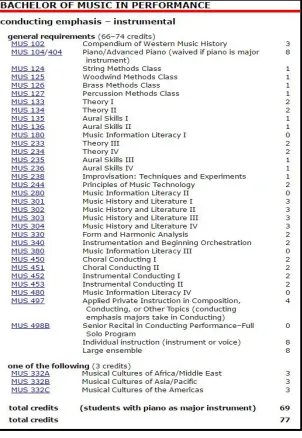
As seen in Figure 3.1, undergraduate music majors pursuing a performance degree at Chapman are required to take Music Theory I-IV, Music History and Literature I-III, Aural Skills I-IV, Music Information Literacy I-IV, and 8 credits of piano classes. These are all standard courses for every undergraduate music performance degree at Chapman. Students in the undergraduate conducting program are required to take an additional music history course. Undergraduate conducting majors must also take all instrumental methods courses.60
There are five key differences between the required courses for students pursuing a Bachelor of Music in Performance with String Emphasis (seen in Figure 3.2) and the Bachelor of Music in Performance with Conducting Emphasis.61 (1) The string
performance degree requires 4 fewer credits in piano. (2) There is an orchestral instruments class in the string performance degree that requires 16 credits. These are
60 String, percussion, woodwinds, brass.
61 String performance was selected as an example because of the repertoire similarities to the undergraduate
37
applied lessons in an instrument of the student’s choice. Each credit is the equivalent of one half-hour lesson per week. Since conducting students are not typically allowed
Figure 3.1: Course requirements for the Bachelor of Music in Performance with Conducting Emphasis at Chapman University in Orange, California.62
38
into the program until their junior year, they often enroll in four years of instrumental lessons, but only two years of conducting lessons.63 (3) Conducting students are required to take four instrumental methods courses where they learn the pedagogy and techniques of the most common orchestral instruments. (4) An orchestral literature class is required of string performance majors. This is material that is often studied in the conducting studio class. Conducting lessons also cover orchestral repertoire that would likely be studied in an orchestral literature course. (5) String performance majors must attend a weekly studio class. Professor Wachs requires his conducting students to attend a weekly studio class, though it is classified as an independent study course and is not officially part of the undergraduate conducting curriculum.64
The conducting lessons at Chapman are tailored to individual students’ needs and goals. The repertoire studied in conducting lessons can vary greatly for each student. For example, a student who may be interested in musical theatre will learn important
repertoire in that genre as well as techniques for conducting singers. These individualized lessons provide instruction in multiple career paths for undergraduate conducting majors. Standard orchestral repertoire from the 18th, 19th, and 20th centuries is studied in private lessons, studio class, and in orchestra rehearsals.
There are two main reasons the Bachelor of Music in Performance with Conducting Emphasis has flourished for nearly 40 years. (1) Chapman holds the firm belief that an undergraduate must be an adept instrumental performer before being fully admitted into the conducting program. This does not mean that students cannot begin
63 There may be exceptions for students admitted earlier than their Junior year, or if the professor Wachs
requests they enroll in lessons prior to candidacy for the undergraduate degree in conducting.
64 See Appendix G for a transcription of the interview with Professor Daniel Wachs on the undergraduate
39
learning conducting skills and gaining confidence on the podium prior to admission into the program. (2) The Upper-Division Proficiency exam and the conducting aptitude audition ensure that students entering the program possess the talent and maturity to participate in the program. These founding principles display Chapman University’s