Small And Medium-Scale Software Contracts:
From Initiation To Commissioning
Wilson Nwankwo, Kingsley E. Ukhurebor
Abstract: Software development is a core component in the academic training curriculum in various computing disciplines in universities, colleges, polytechnics, and vocational institutes respectively. In many of the said academic curricula there is often a superficial treatment of vital project management elements such as scheduling, costing, risk and quality management, and basic legal concepts of contracts. Every software developer/engineer is expected to have basic knowledge of the said elements which go a long way to boosting his/her professionalism during contract negotiations and execution of software-based contracts. The absence of the use of real-life cases during academic training undermines the extent of project management knowledge transferred to the trainee software engineer/developer. This paper is presented using a real-life software development contract involving a private secondary healthcare provider in Lagos Nigeria. This paper provides a concise but informative case study report emphasizing on basic project management methodology. This paper reflects on how project costing and analysis of return on investment is key to determining the reality of small/medium-sized software contracts.
Index Terms: Software Project Management, Return on Investment, Budgeting, Cost Benefit Analysis
—————————— ——————————
I. INTRODUCTION
Software development projects like other critical projects often require a lot of decision making [1][2][3][4][5][6] activities on the part of the project sponsor and the project team (where the project is handled in-house) or the contractor. Project management is a very important component of enterprise software development operations in both functional and projectized organizations [7][8]. Ideally, in an organization, most projects are initiated through detailed business cases [9][10][11]. A business case is a document that presents the merits of a proposed project in terms of expected economic benefits in a manner that is convincing and acceptable to the project sponsor financially, operationally, legally, and technologically. Business cases are very important project prospecting tools in project management [10]. A poorly constructed business case is likely to fall short of sponsor‘s approval. Many project failures are traced to poor technical knowhow of either the project manager or that of the project team members [12][13]. It is established that every project irrespective of the domain is affected by the following vital components: Business case analysis, project selection, planning, scheduling, risk management, budgeting/costing [14], implementation, and communication. How any of the components listed above are conducted may determine the success or failure of the project [15]. The same is true for software development projects.
A. Objectives of this paper
Over the years, many project methodologies [16] have been proposed and employed in software development. It is interesting to note that from the traditional development methodologies such as the waterfall to modern agile rapid development methodologies[18][19][20][21][22][23], one thing is usually at stake, that is, completion of a project on schedule(S) on budget(B) and on purpose(P). Thus, we can express project in terms of a function as follows:
Z=f(s,b,p) (1)
Where Zproject outcome; sscheduled time, bexpected budget; ppurpose/need.
Every software engineer or project manager in a software development team must bear in mind the concept of SBP and any deviation from any of the three parameters amounts to a loss to both the contractor and the client. To the learning and/or prospective software engineer and/or graduate software engineer/developer, understanding the peculiar nature of software project management is often an issue due to the little premium placed on this area during the regular academic training in higher institutions [17]. The mainstream software development methodologies neither emphasize nor contain sufficient details on project management. The foregoing is evident in the structure of the academic curriculum of mainstream computing programs in many higher institutions. The knowledge gap following graduation may be held as the reason for the enrolment of computing graduates into industry project management certification courses to enable them take up responsibilities in their respective places of work. This paper draws from authors‘ industrial experiences in software development contracting and is aimed at providing a functional guide to prospective software project managers and professionals alike. The presentation is concise and uses a simple case study to explain the concept of software contracts.
B. Software contract project cycle
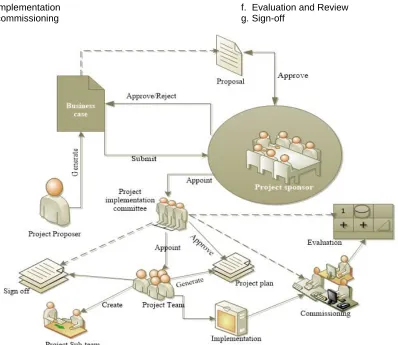
The components of a typical software project cycle in the enterprise are presented in Figure 1. They include:
a.Business case submission and approval b.Project proposal submission and approval c.Project planning
_________________________
Wilson Nwankwo is an Associate Professor at the Department of Computer Science, Edo University Iyamho, Nigeria.
E-mail: [email protected]
Kingsley Ukhurebor is Research Fellow, WASCAL and Lecturer at the Environmental & Telecoms Unit, Dept. of Physics, Edo University Iyamho, Nigeria.
1555 d.Project implementation
e.Project commissioning
f. Evaluation and Review g.Sign-off
Figure 1: Project cycle in the Enterprise
C. Software contract and project documentation
Documentation at this phase should not be confused with documentation that follows the successful implementation of a software development project (often in the form of an operating manual). Documentation is a major component of every software development projects especially projects driven through contracts. The Contractor regardless of its legal personality must be do due diligence while preparing or endorsing such documents. Though, in developing countries, the monetary value of small/medium size software development projects is considered not worth the services of an attorney/lawyer, however, it is imperative that every young IT or Software engineer who plans to or engages into contracting understands the implication of each contract document especially its ‗legal bindingness‘ i.e. the legal obligations and rights created in the documents which may be enforceable at law.
project documentation may be categorized into:
i. Pre-project documents such as Business case[10], Feasibility report[24][25][26], Memorandum of understanding[27][28], Contractual agreement, Statement of scope and objectives[29], Project plan(Requirements, Scheduling, Budgeting and Control, Risk
management, Quality management,
Implementation, Maintenance, Commissioning)
ii. Project execution documents such as Risk management report, Quality control and assurance report, Project implementation status report, etc.
iii. Post-project documents. This include: Project review and evaluation report; Maintenance reports; and Support agreement (not mandatory).
Case study: XX Specialist hospital Lagos
XX Specialist hospital is a private specialist hospital, operating a 500-bed primary, secondary, and tertiary healthcare provider located in the Lagos mainland. The name of the hospital is withheld in line with the disclosure agreement reached with the client during the preliminary contractual negotiations. The hospital wishes to provide better services through the provision of online and real-time medical and healthcare consultation.
D. Statement of Problem
expectations. The said project is negotiated in Nigerian Naira (NGN). The Project sponsor is interested in implementing cutting-edge information technology solution but is also skeptical as to the success of the project if undertaken as well as recouping its investment thereafter. E. Statement of Scope and Objectives
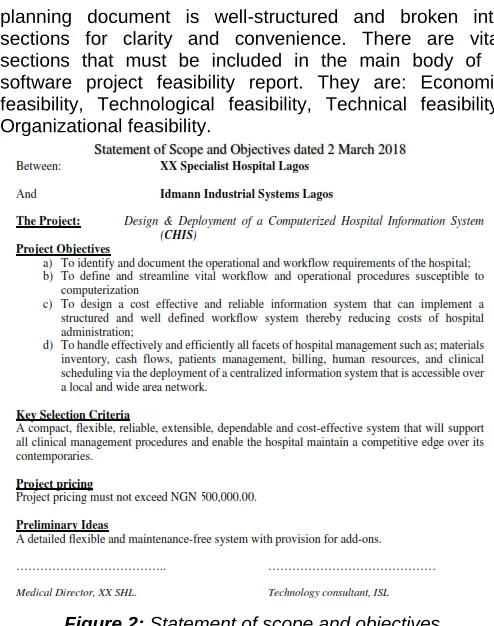
The statement of scope and objectives between the sponsor and the contractor is presented in Figure 2. It reflects the overall scope of the software contract as agreed by parties. The statement of scope and objectives is part of the contractual documents endorsed by both parties hence it is a legally binding document which could be used as a reference point in future deliberations regarding the project. Note that it is neither a feasibility report nor a project plan, however, it is a very important document to both parties and should be endorsed by both parties prior to the commencement of the contract.
F. Legal principles
Many software projects involving different parties often come into existence through a contract between the parties. The same is applicable in this case study. For there to be a valid contract[30][31] the following conditions must be satisfied: an offer is made by one party(the offeror), acceptance of offer by the other party(offeree), consideration(benefit arising from an offer and an acceptance), legal capacity of both parties[32], and the parties must intend that their agreement would be legally binding on them which implies that any party whose contractual right is breached may seek redress in any legitimate manner consistent with the terms and conditions enshrined in the agreement. The young software engineer or professional must pay attention to the content of agreement prior to endorsement and where such content is not clear enough, he/she may seek advice from a legal practitioner.
G. Feasibility Study and Preliminary Analysis
The project feasibility study is done in order to ascertain the possibility of sustaining and realizing the objectives of this project amidst identifiable challenges.
The items considered include:
i. Verification of statement of scope and objectives: this enables the contract project manager or planning officer to ascertain the extent to which the project is defined as well as to know whether the budget can carry the entire project.
ii. Preliminary study of the existing system through operating procedures, investigation, brainstorming, reference documents, etc. provided by the client. iii. Development of a high level model or prototype of
the proposed system in order to present the possible flow of information and data within the sub-systems that aggregates to the system.
iv. Definition of the problem in the light of new knowledge
v. Design and evaluation of alternative solutions vi. Preparation of a development plan
vii. Production of a feasibility report.
The project planning officer or manager must provide a detailed feasibility report as output of a feasibility study. As a matter of convention, a feasibility report like any project
planning document is well-structured and broken into sections for clarity and convenience. There are vital sections that must be included in the main body of a software project feasibility report. They are: Economic feasibility, Technological feasibility, Technical feasibility, Organizational feasibility.
Figure 2: Statement of scope and objectives
II. MATERIALS AND METHODS
The integrated project approach was adopted in this paper to buttress the interplay between core software development processes and project management operations. The basic project management tool in the case study project was Oracle Primavera P6. The system modeling follows the tenets of the enhanced waterfall method. Considering the ―not too complex nature‖ of the project it was appropriate to specify the requirements, conduct and complete a phase before the commencement of the subsequent phase hence the choice of this approach. In more complex projects, this approach would fail owing to its procedural weaknesses such as delays, absolute statement and adherence of rules, etc.
A. Hardware and Software Hardware
i. PC 2.5 GHz quad-core processor with 1TB Hard disk and 16GB RAM running Microsoft Windows 10 Pro ii. Tecno Tablet running Android 7 OS
iii.Notebook Software
i. Oracle Primavera P6 Professional or higher ii. Microsoft Visual Studio 2017(Community edition)
with Xamarin studio
iii.Android Software Development kit iv.Erwin Data Modeler 8
v.MySQL Server DBMS 6.0 Reference documents
i. Cash inflow patterns(5-year)
1557 This estimated cost benefit criteria and NPV are computed
using the Project sponsor‘s projected yearly cash flow over a projected period of ten years (see Table 1).
TABLE 1: PROJECTED CASH FLOWS OVER A PERIOD OF TEN YEARS(ESTIMATES) Year Cash inflow
per yr (NGN)
Discount rate
Initial capital
Project life cycle
1 400,000 30% -500,000 3
2 470,000 30%
3 600,000 30%
4 750,000 30%
5 500,000 30%
6 450,000 30%
7 380,000 30%
8 400,000 30%
9 700,000 30%
10 300,000 30%
NPV= -K + (sum of) [OCF/ (1+R(r))t] + [TCF/(1+R(r))n] (2)
Where:
K= initial investment
OCF= operating cash flows in year
t t= year
n= life span (in years) of the project R(r)= project required discount rate
Computing the NPV: NPV=
-500,000+(400,000/1.03)+(470,000/1.03^2)+(600,000/1.03^ 3)+(750,000/1.03^4)
)+(500,000/1.03^5) )+(450,000/1.03^6) )+(380,000/1.03^7) )+(400,000/1.03^8)
)+(700,000/1.03^9) )+(300,000/1.03^10)
NPV= NGN1, 046,754.33
Present value (PV) of expected cash flows=NGN1, 546,754.33
Interpretation
With a discount rate of 30.00% and a span of 3 years, the projected cash flows are worth NGN1, 546,754.33 as at the time of contracting, which is greater than the initial NGN500,000.00 budgeted for the project. The resulting positive NPV of the above project is NGN1, 046,754.33, which is an indication that the project is very feasible. It should be borne in mind that even though a project offers a positive NPV, the projected cash flows are still estimations. The accuracy of these projected figures depends on the skill and experience of the analyst, and the likelihood of the cash flows materializing depends on the financial risks and future outlook of operations in the hospital.
C. Procedure
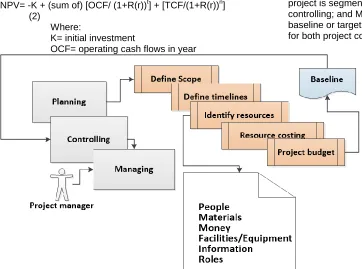
The procedure adopted is shown in figure 3. The entire project is segmented into three phases: planning;
controlling; and Managing. The planning phase produced a baseline or target schedule that serves as a reference point for both project control and management.
Figure 3: Project planning and execution procedures Scheduling
Scheduling involves defining activities (broken down as tasks), deliverables, time required to accomplish the tasks, efforts to be expended, task dependencies, and resource requirements[33]. This may be done using a work
the work breakdown structure and project timelines for this project.
Figure 4: Work Breakdown structure of project
Risk management
Like scheduling, risk management is an integral part of any software project. Project risks must be identified, analyzed, evaluated, treated, monitored and reviewed regularly. The project team must ensure that all threats (whether or not certain) identified, prioritized, assigned and communicated to owners, and strategies such as contingency plans [34]
created to address such risks (through
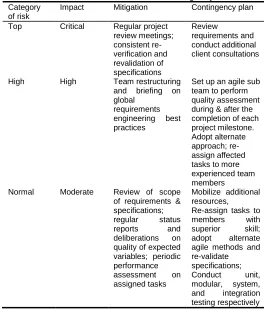
mitigation[35][36][37], prevention[38], etc.). It is important to note that there are also positive risks i.e. those that could be exploited for the betterment of the project. Figure 5 shows the risk register whereas the contingency plan is
shown in Table 1. Contingency plan defines the actions taken following the occurrence of an identified risk event [34][35]. The contingency plan emanates from the risk register.
Table 1: Risk control and Contingency Category
of risk
Impact Mitigation Contingency plan Top Critical Regular project
review meetings; consistent re-verification and revalidation of specifications
Review
requirements and conduct additional client consultations
High High Team restructuring and briefing on global
requirements engineering best practices
Set up an agile sub team to perform quality assessment during & after the completion of each project milestone. Adopt alternate approach; re-assign affected tasks to more experienced team members Normal Moderate Review of scope
of requirements & specifications; regular status reports and deliberations on quality of expected variables; periodic performance assessment on assigned tasks
Mobilize additional resources, Re-assign tasks to members with superior skill; adopt alternate agile methods and re-validate specifications; Conduct unit, modular, system, and integration testing respectively
1558 Quality management
Every project must conform to global best practices and standards. Quality assurance is important in every phase of the project hence appropriate measures must be provided especially in form of procedures and control instruments. Quality assurance mechanisms applied in this project include: validation and verification of every milestone attained. The design specifications and prototype were also validated by the hospital‘s ICT Director.
D. Analysis of the proposed system This phase involved the following:
a.Layout of a full structured picture of the objectives, scope and constraints as regards the system. b.Documentation of the overall system using more
concise pictorial representations such as data flow diagrams (DFDs), etc.(see Figure 6-10)
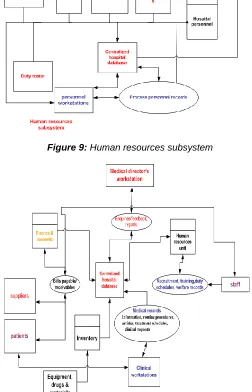
c. The proposed system is broken into various components which were appropriately identified. Notice that the entire system is expressed in terms of its subsystems. This process is often termed system decomposition.
Figure 6: Inventory control subsystem
Figure 7: Financial subsystem
Figure 8: Patient management subsystem
Figure 9: Human resources subsystem
2.5 System Design
Figure 11 shows the control centre of the enterprise
hospital management system. The control centre provides a high level overview of the entire system.
Figure 11: Control centre of the proposed system
III. RESULTS AND DISCUSSION
A. Evaluation of alternatives
Two alternatives were considered towards realizing the fully project. These were:
i. A semi-automated system whereby some key office areas are computerized and others left out.
ii. ii. An improved structured manual system without any element of automation
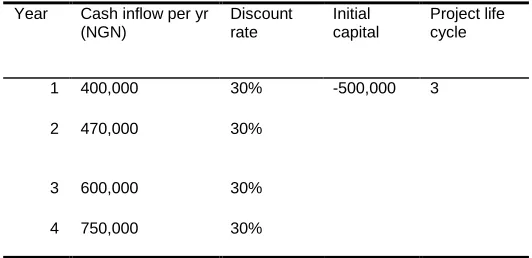
B. Cost benefit analysis of the fully automated option The cost benefit analysis with particular emphasis to NPV, IRR and PBP is presented in Table 2.
TABLE 2: COST BENEFIT ANALYSIS OF PROJECT Year Cash inflow per yr
(NGN)
Discount rate
Initial capital
Project life cycle
1 400,000 30% -500,000 3
2 470,000 30%
3 600,000 30%
4 750,000 30%
NPV= -K + (sum of) [OCF/ (1+R(r))t] + [TCF/(1+R(r))n] (3)
NPV= -500,000+ (400,000/1.03) + (470,000/1.03^2) + (600,000/1.03^3)
NPV= NGN358, 898.55
Computation of IRR
0 = - 1/(1 + r)
1
2/(1 + r) 2
n/(1 +
r)n (4)
Where r is the IRR of the project; n=3 =project life cycle, outlay=initial capital for the project; CF = cash inflow for the successive years
0 = - 500,000 + 400,000/(1 + r)1 + 470,000/(1 + r)2 + 600,000/(1 + r)3
Therefore, IRR=73.806%
Computation of PBP
The PBP is the length of time required to recover the cost of an investment. The PBP is given as the cost of project divided by annual inflows. This is summarized by the equation below:
PBP=K/nR (5) Where K=initial capital outlay.
TABLE 3: ESTIMATED CASH INFLOWS OVER A 3-YEAR PERIOD
Year Cash inflow per yr (NGN) Net cash flow
0 -500,000 -500,000
1 400,000 -100,000
2 470,000 570,000
3 600,000 1,170,000
PBP= NCFp+ NCFab/TCF
(6) Where:
NCFp =Negative Net cash flow of previous year
NCFab =Absolute value of NCF of subsequent year
TCF=Total cash flow in the following year
Thus, the Payback Period for project is computed as follows:
PBP=1+ {100,000/470,000} =1 + 0.21= 1.21 years The estimate was made following the documented historical cash inflow patterns in the hospital. With an estimated IRR of 78% and a PBP of 1.21 years the implication is that the project has a very good outlook as the hospital
management can easily recoup their investment over a short period of time all things being equal.
C. Automated Medical Office Management
The applications were written using C# with MySQL Server Database Management System as the backend. The automated system is network-ready with both client and web-based versions. The client component is installable on any Microsoft Windows PC and connects to the database server over a public network. Patients can book appointments through the web-based version but activities on the web-based version are somewhat restricted for security and confidentiality purposes.
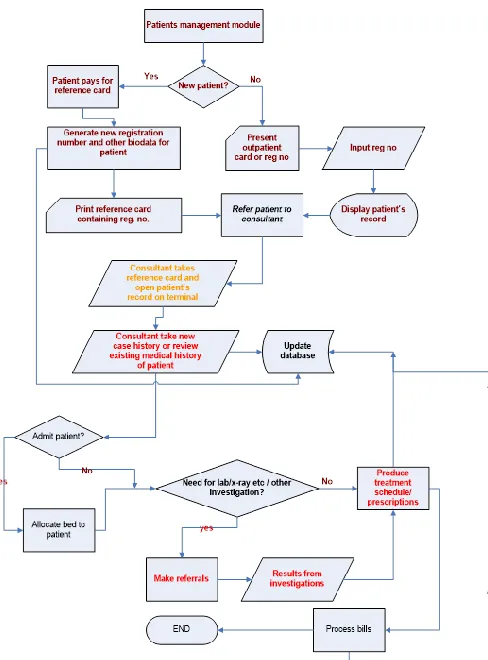
1560 The diagrams in figure 12-14 show the flow of activities and
information in the application software with respect to input, processing and output operations of the system.
Figure 12: Activity flow in the patient management component of the software
Figure 13: Billing subsystem
Figure 14: Activity flow in inventory subsystem
Figure 15-16 show the application front-end during testing. The application is user-friendly and divided into three tiers: desktop client, mobile client, and server component respectively. No web client is implemented. The Server component may be hosted on a LAN/WAN and the desktop and mobile clients can communicate with the server. Hospital staff, out-patients, and prospective patients may install the mobile clients through which communication may be maintained at all times.
Figure 16: Patient’s data capture window
Deployment
This phase involved the preparation of the physical site (at the hospital), documentation and operating procedures, installation plan as well as a detailed training plan. As the supply of equipment was not part of the contract, the hospital was responsible for setting up its LAN/WAN. However, the following specifications were given by the contractor.
Server specifications
The recommended hardware specifications for the server are;
i. Intel Xeon CPU with Quad core processor @3.00 GHz or above with at least 32 GB RAM and ITB hard disk, with Microsoft Windows 2012 Server operating system
ii. NETBIOS – compatible network adapters (NICS). iii. Internet, with dedicated public IP address
Client specifications
i. Intel CPU with corei3 processor @2.00 GHz or higher, with at least 2GB RAM and 320GB hard disk, with Microsoft Windows 7 operating system or higher
ii. Network adapter
Mobile specification
An android phone with Android froyo or higher. Installation procedures
The client and server components are distributed on a DVD-ROM. The client is lightweight and takes few minutes to install on any PC with the specifications above. The Server component is the heavyweight part of the application and is designed to explore the speed and medium to premium-sized server hardware. HP Proliant DL 580 G7 series server with two physical processors were used to deploy the server component. This Server also runs the MySQL Server 6 Database Management System.
Commissioning and Sign-off
Commissioning involved the formal announcement of the completion and activation of the deployed system. This phase involves both the contractor and the client/customer. Commissioning marks the contractor‘s re-assurance that certain fundamental terms of the contract have been fulfilled but does not relieve him of necessary liabilities at this point. At this point the system has been delivered to the sponsor/customer and perhaps undergoing or completed appreciable level of functional tests in a live environment i.e. the system is ready for productive. Following the commissioning is the sign-off meeting between the project sponsor and contractor. The sign-off marks the end of the instant project and where neither support nor ancillary services connected with the project are agreed upon, the successful sign-off would terminate the obligations of either party in the contract. In the extant project, the contractor is to provide a one-year support to the operations of the system. This is not to be confused with the main contract which terminated during the sign-off meeting wherein the
two parties endorsed copies of the termination of contract in quadruplicate.
IV. CONCLUSION
This paper articulated and presented necessary extract from a real-life software project executed based on certain cost variables. It is a reflection of the contractual approach hinged on a software contractor‘s willingness to assist his client/customer in exploring the most cost-effective alternative during small and medium size software development contract negotiations. Having regard to the objectives stated earlier, the following conclusions are made:
i. Project management knowledge of software engineers/developers and/or professionals especially on project costing and benefit analysis, evidenced by appreciable readiness to display commitment to probing into the future prospects of sponsors/clients during small/medium contract negotiation may provide a re-assurance to sponsor as per the contractor‘s skills and potentials to deliver on the contract.
ii. As a profession, software engineering like other engineering disciplines, requires requisite project management skills hence project management should not be an elective course (as it is at present in the curriculum of BSc Computer Science [17]) but should be a core or required course with theoretical and practical (hands on) component to ensure that learners are exposed to real ICT contract-like projects.
iii. Understanding the concepts of project management would improve the sustained relationship between young software contractors and their clients especially commitment on the part of the contractor eventually leads to realizing forecasted revenue following the execution of small or medium-sized software projects.
REFERENCES
[1] Burge,J.E.,Carroll,J.M., McCall,R., Mistrik, I., "Rationale-Based Software Engineering", Springer, Berlin, Heidelberg, 2008
[2] Bhattacharya,P.,"Quantitative decision-making in software engineering",Doctoral Dissertation, University of California, 2012
[3] Korkishko, I.,"Decision making by the developer", 2017. https://syndicode.com/2017/10/17/decision-making-by-the-developer/. Accessed 28 July 2019 [4] Gay, G. & Heimdahl, M., "Community-Assisted
Software Engineering Decision Making",Technical Report, University of Minnesota, 2013. https://www.cs.umn.edu/sites/cs.umn.edu/files/tech _reports/13-015.pdf. Accessed on 12 July 2019 [5] Forbrig, P.and Dittmar, A. "Supporting
1562 [6] Moe, N.B. & Aurum, A., "Understanding
Decision-Making in Agile Software Development: A Case-study",34th Euromicro Conference Software Engineering and Advanced Applications", 3-5 Septmber, 2008, Parma, Italy
[7] MARINELLI, T.,"Project Based Organization: PMP Concepts to Learn", 28 July 2017.
https://magoosh.com/pmp/project-based-organization-pmp-concepts-learn/. Accessed 18 December 2018
[8] Tahria, H. & Drissi-Kaitounib, O., IT Project Management in non-projectized organization,2nd International Conference on Leadership, Technology and Innovation Management, Procedia - Social and Behavioral Sciences, Vol.75,2013, pp.318 – 327
[9] Herman, B. & Siegelaub, J. M.,"Is this really worth the effort? The need for a business case", Paper presented at PMI® Global Congress 2009—North America, Orlando, FL. Newtown Square, PA: Project Management Institute,2009.
[10] Gomes,J. & Romão, M., "Improving Project Success: A Case Study Using Benefits and Project Management",Procedia Computer Science,Vol. 100, 2016, pp. 489-497
[11] HM Treasury & Welsh Government, "GUIDE TO
DEVELOPING THE PROJECT BUSINESS
CASE",OGL, 2018
[12] Simms, J., "Why Projects Fail: Part Five, Poor
Business Case". 17 July 2007.
https://www.cio.com.au/article/206212/why_projects _fail_part_five_poor_business_case/. Accessed on 23 April 2019
[13] KPMG, "Localgovernment:How to build a business
case", 2017.
https://home.kpmg/content/dam/kpmg/uk/pdf/2017/1 2/local-government-how-to-build-a-business-case.pdf. Accessed 20 June 2019
[14] Landau,P., "Cost Benefit Analysis for Projects – A Step-by-Step Guide",Jun 27, 2018. https://www.projectmanager.com/blog/cost-benefit-analysis-for-projects-a-step-by-step-guide. Accessed 15 July 2019
[15] IT Governance Institute,"Enterprise Value:Governance of IT Investments",2006. https://m.isaca.org/Knowledge-Center/Val-IT-IT- Value-Delivery-/Documents/VAL-IT-business-case.pdf. Accessed 12 April 2019
[16] Nwankwo, W.,"Fundamentals of Modern Database Systems(Vol. 1)", Mauritius: Lambert Academic Publishing, 2018
[17] National Universities Commission, "Benchmark Minimum Academic Standards for Computing", Abuja, Nigeria, 2018.
[18] Zhang,X., Hu,T., Dai,H. & Li, X., "Software Development Methodologies, Trends and Implications: A Testing Centric View",Information Technology Journal, Vol. 9, Issue 8,2010, pp.
1747-1753, 2010.
http://docsdrive.com/pdfs/ansinet/itj/2010/1747-1753.pdf. Accessed 12 May 2019
[19] Manawadu, C.D., Md Gapar Md Johar, Perera, S.S.N.,"An Evaluation of Software Development Methodology Adoption by Software Developer in Sri Lanka",International Journal of Computational Engineering Research, Vol, 03,Issue, 11, 2013. https://pdfs.semanticscholar.org/471e/53f2edc654d3 42441cfcde1929e44733a0ca.pdf. Accessed 14 June 2019
[20] Al-Zewairi,M., Biltawi,M., Etaiwi,W.& Shaout,A.,"Agile Software Development Methodologies:Survey of Surveys",Journal of Computer and Communications, 5,2017,pp.74-97. https://www.scirp.org/pdf/JCC_2017033115471602.p df. Accessed 12 May 2019
[21] Javanmard,M. & Alian, M.,"Comparison between Agile and Traditional software development methodologies", Science Journal (CSJ), Vol. 36, No.
3 Special Issue, 2015.
https://dergipark.org.tr/en/download/article-file/713866. Accessed 12 May 2019
[22] Nugroho,S., Waluyo,S.H.,Hakim, L., "Comparative Analysis of Software Development Methods between Parallel, V-Shaped and Iterative",International Journal of Computer Applications, Vol. 169, No.11, 2017.
https://arxiv.org/ftp/arxiv/papers/1710/1710.07014.pd f. Accessed 12 May 2019
[23] Hneif,M. & Siew Hock Ow, "Review of Agile Methodologies in Software Development" ,International Journal of Research and Reviews in Applied Sciences,Vol. 1, Issue 1, 2009
[24] Dey, P.K., "Integrated approach to project feasibility analysis: a case study",Impact Assessment and Project Appraisal,Vol. 19, Issue 3. 2001. https://www.tandfonline.com/doi/pdf/10.3152/147154 601781766989?needAccess=true. Accessed 13 June 2019
[25] Stefánsdóttir, A.O.,"Feasibility studies in construction projects in Iceland
",MSc Thesis, School of Engineering, Reykjavík University,2015.https://pdfs.semanticscholar.org/849 e/1b637028a277ef87870cad53b3f588be50d4.pdf [26] Jebrin, A.H.,"The Theoretical Strategic Approach in
the Feasibility Study",Journal of Economics, Management and Trade, Vol. 19, Issue 2, 2017, pp.1-14
[27] ChangeLabs solutions, "Contracts and MOUs:
Understanding Key Terms",
https://changelabsolutions.org/sites/default/files/MO U-vs-Contracts_FINAL_20120117.pdf. Accessed 13 March 2019
[28] Killerby, B.,"Problems with Memorandum of
Understanding and Heads of
Agreement",https://www.benkillerby.com/problems- with-memorandum-of-understanding-and-heads-of-agreement/. Accessed 20 August 2019
[29] Mirzaa,M.N. Pourzolfagharb,Z.,
722 – 729. https://core.ac.uk/download/pdf/82516027.pdf. Accessed 24 June 2019
[30] Alewo,A.J.M., "The Principle and Nature of Law of Contract in Nigeria: Formation of Binding Contract",Journal of Politics and Law; Vol. 5, No. 4; 2012
[31] NIGERIAN JURIDICAL REVIEW, Vol. 11, 2013 [32] Field,S.,"Introduction to the Law of contract",
Bookboon.http://www.kolegji-
juridica.org/new_web/wp- content/uploads/2017/04/Introduction-to-the-Law-of-Contract.pdf. Accessed 5 March 2019
[33] Ray, S., "What is project scheduling?" https://www.projectmanager.com/blog/what-is-
project-scheduling#targetText=Project%20scheduling%20is %20a%20mechanism,deliver%20the%20project%20 on%20time.Accessed 13 January 2019
[34] Heimann, J. F., "Contingency planning as a necessity", Paper presented at Project Management Institute Annual Seminars & Symposium, Houston, TX. Newtown Square, PA: Project Management Institute, 2000
[35] Elzamly,A. & Hussin, B.,"Managing Software Project Risks (Analysis Phase) with Proposed Fuzzy Regression Analysis Modelling Techniques with Fuzzy Concepts",Journal of Computing and Information Technology, 2014, 2, pp.131–144 [36] Department of Transportation, "Project Risk
Management Guide", Washington State, United States.https://www.wsdot.wa.gov/publications/fulltext /cevp/ProjectRiskManagement.pdf. Accessed 20 may 2019
[37] PMI, "Project Management Body of Knowledge"(PMBOK), 6th edition, 2017, Project Management Institute.
[38] Anca, A., Cezar,B., Adrian, U., "Risk Identification in Project Management",Procedia of Economics and Business