Review
A Switching Hybrid Dynamical System: Toward
Understanding Complex Interpersonal Behavior
Yuji Yamamoto1,‡*, Akifumi Kijima2,‡, Motoki Okumura3,‡, Keiko Yokoyama1,†,‡and Kazutoshi Gohara4,‡
1 Research Center of Health, Physical Fitness, and Sports, Nagoya University, Nagoya, Japan 1;
2 Graduate School of Education, University of Yamanashi, Kofu, Japan 2; [email protected] 3 Graduate School of Education, Tokyo Gakugei University, Tokyo, Japan 3; [email protected] 4 Nano Biotechnology, Research Faculty of Engineering, Hokkaido University, Sapporo, Japan 4;
* Correspondence: [email protected]; Tel.: +81-52-789-3964 † e-mail: [email protected]
‡ These authors contributed equally to this work.
1
2
3
4
5
6
7
8
9
10
11
12
13
14
15
Abstract: Complexhumanbehavior,includinginterlimbandinterpersonalcoordination,hasbeen studiedfrom adynamicalsystemperspective. Wereviewtheapplicationsofa dynamicalsystem approach to a sporting activity, which includes continuous, discrete, and switching dynamics. Continuousdynamicsidentifiedswitchingbetweenin-andanti-phasesynchronization,controlled by an interpersonal distance of 0.1 m during expert kendo matches, using a relative phase analysis. Asdiscretedynamics,returnmapanalysis wasappliedtothetimeseriesofmovements duringkendomatches,andsixcoordinationpatternswereclassified. Furthermore,statetransition probabilitieswerecalculatedbasedonthetwostates,whichclarifiedthecoordinationpatternsand switchingbehavior. Weintroducedswitchingdynamicswithtemporalinputstoclarifythesimple rulesunderlyingthecomplexbehaviorcorrespondingtoswitchinginputsina strikingactionasa non-autonomoussystem. Asaresult,wedeterminedthatthetimeevolutionofthestrikingaction was characterizedas fractal-like movement patterns generated by a simple Cantorset rule with rotation. Finally,weproposeaswitchinghybriddynamicstounderstandbothcourt-netsports,as stronglycoupledinterpersonalcompetition,andweaklycoupledsports,suchasmartialarts.
Keywords: interpersonal coordination, competition, dynamical systems, discrete dynamics, continuousdynamics,sportingactivity
16
1. Introduction 17
Exploring complex human behavior from the perspective of a dynamical system began with an 18
historic experiment by [1]. Three decades later, a new approach has been developed using dynamical 19
system theory and utilities to analyze and simulate complex phenomena, such as human movement, 20
with super-computers. In this article, we review the applications of a dynamical system approach 21
to human behavior, with particular regard to sports activities that require quick decision-making 22
and appropriate execution. We provide applications for continuous dynamics, discrete dynamics, 23
switching dynamics, and switching hybrid dynamics, with a short theoretical review. 24
Human behavior, particularly the behavior of rhythmic cyclical movements, can be understood 25
as continuous dynamics that can be described using differential equations. In 1665, the Dutch 26
physicist Cristiaan Huygens synchronized two pendulum clocks using the interactions of tiny 27
three frogs was analyzed as a phase oscillator model [12]. As another approach, the symmetric Hopf bifurcation theory based on group theory [13] has been applied to investigate the synchronized 37
pattern of three people during a sports activity [14]. These approaches could be regarded as oscillator 38
dynamics; that is, continuous dynamics. 39
On the other hand, discrete dynamics and/or mapping can be depicted as iterated maps; that is, 40
difference equations describing the time evolution, such as population dynamics with generations or 41
coin flips. The logistic map is a well-known map of how complex, chaotic behavior can arise from very 42
simple quadratic difference equations. A Markov chain in discrete time, which is characterized as a 43
state transition based on the probability distribution of the next state, depends only on the current 44
state as a kind of discrete dynamics, and has been applied to batting a baseball [15] and to squash 45
[16,17]. However, these studies examined predictions in competitive sports performance and did not 46
explore the underlying dynamics. We introduce examples to explore the simple rules underlying a 47
complex human behavior using a Lorenz map; that is, a first return map and a Poincaré map from 48
continuous dynamics to discrete dynamics. 49
Previous studies have been based on two nonlinear-coupled oscillators; thus, these systems are 50
closed systems with no abrupt changes in external input. We introduce a research result in which 51
switching dynamics with temporal input was applied to continuous striking movements. This model 52
also uses the idea of the Poincaré map. Finally, to explore complex human movement as a dynamical 53
system, we introduce switching hybrid dynamical systems, which include discrete and continuous 54
dynamics with a feedback loop. 55
2. Continuous dynamics 56
2.1. The HKB model 57
[1] showed that human behavior, particular rhythmic cyclical movement, is a phenomena of 58
entrainment and/or synchronization of two-coupled nonlinear oscillators. In a famous experiment, 59
participants were asked to oscillate their index fingers at a common frequency. The relative phase, 60
which is the difference between the oscillation phases of two fingers, depicts the spatiotemporal 61
pattern of coordination as an order parameter. The coordination mode shows only two steady states, 62
such as 0◦relative phase (in-phase mode) and 180◦relative phase (anti-phase mode). As movement 63
frequency increases, the anti-phase spontaneously switched to the in-phase mode; however, in-phase 64
did not switch to the anti-phase mode. Below a critical frequency, the system showed bistable 65
behavior with both in- and anti-phase modes; however, above a critical frequency the system showed 66
monostable behavior with only the in-phase mode. The HKB model was developed based on 67
synergistics [5] to explain the phase transition, including hysteresis, critical slowing down, and critical 68
fluctuations using order and control parameters [4,18]. The equation revealed the potential function 69
underlying the spontaneous transition from bistable to monostable behavior. Furthermore, the HKB 70
model for intrapersonal coordination was extended to interpersonal coordination [6,7]. 71
In the interpersonal coordination experiment, cross-spectral coherence and the distribution of 72
the relative phase region were calculated as coordination indices [19–22]. Cross-spectral coherence 73
provides a method to correlate two time series over a range of possible component frequencies. In 74
On the other hand, evaluating the relative phase distribution indicates which relative phase locations 76
are attractive by identifying the dominant kind of coordination. In this analysis, the distribution 77
of relative phase angles across nine relative phase regions between 0◦and 180◦was determined by 78
calculating the frequency of occurrence of the relative phase angles in each of these regions. 79
Both coordination indices postulate periodic movement, such as that of a hand-held pendulum 80
[21,22]. However, the behavior of competitive sports players does not always show such periodic 81
movement. A cross-spectral analysis could not be applied to this kind of time series because of the 82
abrupt changes and aperiodic behavior. In addition, the relative phase was usually calculated by 83
point estimates [23] or continuous estimates [24]; however, an aperiodic or arbitrary time series cannot 84
be calculated using these estimates. To solve this problem, the Hilbert transform [25,26] was applied 85
to the arbitrary coordination signal in competitive sports to calculate the instantaneous phase. 86
Then, a relative phase analysis using the Hilbert transform was applied to court-net sports, 87
such as tennis [27–29] and squash [30]. They reported that players’ movements frequently switched 88
between in- and anti-phase synchronization in the direction of the short axis of the court as they took 89
turns hitting the ball. In addition, [31] proposed the speed scalar product as a collective variable 90
to describe different patterns during badminton. In these court-net sports, the ball is considered 91
a physical link to constrain the opponent’s movement. These systems of two and/or more players 92
can be regarded as strongly coupled oscillators [32]. However, it remains unclear whether each player 93
and/or oscillator could be considered a self-excited oscillation or forced oscillation in court-net sports. 94
2.2. The relative phase region reveals the synchronization modes during interpersonal competition 95
As mentioned above, ball movement during court-net sports constrains player movement. 96
However, in martial arts, such as boxing or fencing, the two players are not joined together physically 97
and can move freely around, although the players must co-adapt to the opponent’s movement. 98
Consequently, the movements of players can be regarded as self-excited oscillations, and a system 99
of two players can be considered weakly coupled nonlinear oscillators [8,26,33]. We applied the 100
distribution from a relative phase analysis to Japanese fencing, which is called kendo, to examine 101
the synchronization mode during matches [34]. 102
We observed 12 kendo matches among six expert members of a university kendo team; all 103
matches followed official kendo rules. The candidate order parameter was the relative phase angle 104
of the step toward-away velocity, and the candidate control parameter was the interpersonal distance 105
between the two players. The interpersonal distance, called “ma’ai", is crucial in kendo, because a 106
player must simultaneously strike an opponent and avoid the opponent’s counterstrike. Scoring a 107
point (ippon) requires an accurate strike on an opponent. Consequently, the players must repeat step 108
toward-away movements to adjust “ma’ai", and a striking movement, which requires less than 0.4 109
seconds. 110
The results showed that anti-phase synchronization was clearly dominant at an interpersonal 111
distance<2.7 m (near distance). If player A moved toward player B, player B moved away from 112
player A. However, in-phase synchronization was dominant when interpersonal distance was>3.0 113
m (far distance). We focused on the 2.7-3.0 m distance to analyze the phase transition. The frequency 114
of the relative phase in the 0.1 m range is shown in Figure1. The results clearly show that higher 115
anti-phase synchronization occurred at 2.7-2.8 m than at other distances, and this switched to in-phase 116
synchronization at 2.9-3.0 m, setting a boundary at 2.8-2.9 m. This finding indicates that the players 117
perceived and understood the need for minute changes on a 0.1 m scale and, consequently, regularly 118
switched their movement to the appropriate direction or synchronization mode. 119
The distribution of the relative phase analysis revealed switching between the synchronization 120
modes of interpersonal competition corresponding to the interpersonal distance as the control 121
parameter. In addition, the synchronization modes changed by learning the interpersonal 122
competition task using this analysis [35]. However, in this analysis, the distribution of the relative 123
Figure 1.Abrupt changes in the interpersonal coordination pattern corresponding to an interpersonal distance of 2.7-3.0 m during kendo. The frequencies of the relative phase per 0.1 m interval at interpersonal distances of 2.7-3.0 m were calculated, and the means and standard deviations are presented. The relative phases were divided into nine ranges (20◦: 0−20◦, 100◦: 80−100◦, 180◦: 160−180◦). Anti-phase coordination was dominant at interpersonal distances of 2.7-2.8 m; however, in-phase was dominant at interpersonal distances of 2.9-3.0 m. Modified from [34].
frequencies of occurrence were calculated. Because of methodological limitations, this approach 125
cannot reveal the time evolution in time series data. In other words, the coordination modes can be 126
described, but the coordination patterns in a shorter time window cannot be described. Interpersonal 127
competition is characterized by aperiodic movements. 128
3. Continuous to discrete dynamics: Return map 129
3.1. Lorenz map 130
To describe the time evolution for interpersonal coordination, we introduce a method to explore 131
regularity by reducing the dimensionality of continuous dynamics (e.g., three-dimensional flow) to 132
discrete dynamics (e.g., two- or one-dimensional). The most popular method is the Lorenz map, 133
which was a seminal work that contributed to the foundation of chaos theory [36]. 134
The meteorologist, Edward Lorenz, developed a simplified mathematical model for atmospheric 135
convection [36]. The model is a system of three ordinary differential equations now known as the 136
Lorenz equations: 137
dx
dt = σ(y−x) (1)
dy
dt = x(r−z)−y (2)
dz
dt = xy−bz (3)
Here x, y, and z are proportional to the intensity of convection motion, proportional to the 138
temperature difference between the ascending and descending currents, and proportional to 139
distortion of the vertical temperature profile from linearity, respectively. σ,r, andbare the system 140
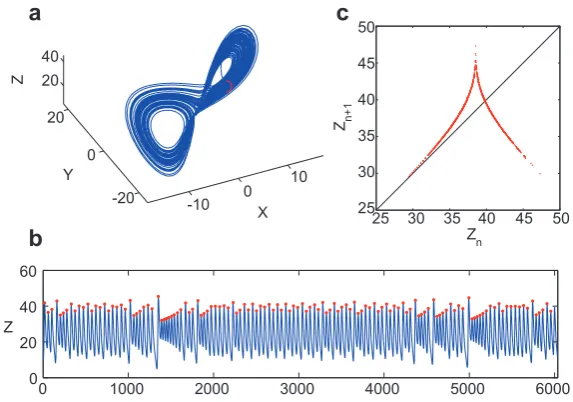
parameters. Lorenz focused on “single feature [36, p. 138]"; that is, zn, of his three-dimensional
141
strange attractor (Figure2a). Figure2b shows a time series ofz(t), and thez(t)peaks were plotted as 142
znvs. zn+1(Figure2c). The functionzn+1= f(zn)is called the Lorenz map. The Lorenz map shows
143
the road to chaos through the bifurcation [33]. 144
3.2. Return map reveals the coordination patterns during interpersonal competition 145
The first return (Lorenz) map was applied to the offensive and defensive maneuvers that occur 146
Figure 2. Lorenz attractor and Lorenz map. Each parameter isσ = 10,b= 8/3,r= 28,x0 = y0 = z0=10. (a) Lorenz attractor in three-dimensional space. (b) Time series ofz(t)and the peaks ofz(t) are shown as red dots. (c) Lorenz map plotted asznvs.zn+1.
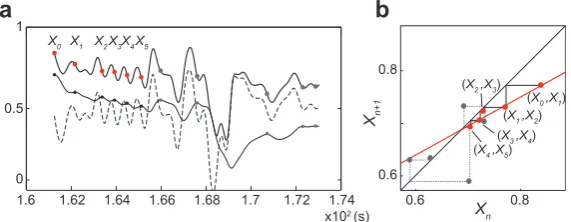
variables constituted by interpersonal distance and its velocity. We detected the peaks of the time 148
series for interpersonal distance, and the peaks of the state variables were plotted as a return map as 149
the present peakXnvs. the next peakXn+1(Figure3b). 150
The periodicities on such a plot are the intersections with the identity lineXn = Xn+1. These 151
intersections are known as attractive fixed points and repellers or saddle points. These attractive 152
fixed points are deterministically approached from a direction called the stable direction or manifold, 153
and the repellers diverge from these attractive fixed points along the unstable direction or manifold as 154
a linear function. Theoretically, we postulated the linear function,Xn+1=aXn+b. The intersections
155
can be classified into two properties depending on the absolute value ofa. When the absolute value of 156
ais<1,|a|<1, then the intersection is considered to be an attractive fixed point (i.e., an “attractor"). 157
When the absolute value ofais> 1,|a| > 1, then the intersection is referred to as a repellent fixed 158
point (i.e., a “repeller"). An attractor can be further classified into two types. When 0< a< 1, the 159
trajectories are asymptotically close to the attractor (Figure4a). When−1<a<0, the trajectories are 160
rotationally close to the attractor (Figure4b). A repeller also has two types of trajectories: 1<a, and 161
a< −1, corresponding to asymptotical and rotational trajectories, respectively, as shown in Figures 162
4c and 4d. Trajectories approach and diverge from points that do not cross the line Xn = Xn+1. 163
We postulate that this exponential function, Xn+1 = b exp(aXn) , and this logarithmic function,
164
Xn+1=a logXn+b(Figure4e), represent intermittency.
165
As shown in Figure4, all six predicted types of functions were confirmed in the kendo matches, 166
suggesting that the complex offensive and defensive maneuvers were generated by simple rules. 167
Furthermore, we detected several functions or patterns during one offensive and defensive scene 168
(Figure4f), indicating that interpersonal coordination switched among several patterns during the 169
competition. 170
3.3. State transition probability reveals the switching pattern for expertise 171
Figure 4 shows that the offensive and defensive maneuvers could be classified into six 172
coordination patterns and that these patterns switched over short time scales. To clarify the 173
characteristics of the expert and intermediate switching patterns, the histograms of the return maps 174
for each group were calculated. As a result, we identified two discrete states in each histogram: 175
the “farthest apart" high-velocity state (F) and the “nearest (closest) together" low-velocity state 176
Figure 3. Procedure for depicting the return map from the time series of state variables. (a) Gray, broken, and black lines show the time series for normalizedXIPD(t), normalizedVIPD(t), and
X(t), respectively, for a 12-s trial with more than five peaks. The red and gray circles indicate the corresponding values of X(t) for the peaks of XIPD(t). (b) Return map of the time series for the
observed data,Xnvs.Xn+1using the amplitude ofX(t)at the peaks ofXIPD(t)corresponding to the
series of points (red and gray circles) in the panel shown ina. Modified from [37].
identified four trajectories, such as{Xn=F,Xn+1=F},{Xn=N,Xn+1=N},{Xn =F,Xn+1=N}, 178
and{Xn =N,Xn+1=F}, as second-order transitions. 179
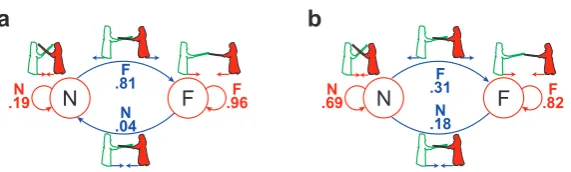
The conditional probabilities for second-order state transitions of the experts were{Pr(F|F) = 180
0.96,Pr(N|F) = 0.04}, and{Pr(N|N) =0.19,Pr(F|N) = 0.81}. The probabilities for intermediates 181
were {Pr(F|F) = 0.82,Pr(N|F) = 0.18}, and{Pr(N|N) = 0.69,Pr(F|N) = 0.31}. The transition 182
probabilities between experts and intermediates were clearly different; experts were more often in 183
the “farthest apart" high-velocity F-state. In contrast, the intermediate players remained more in the 184
“nearest (closest) together" low-velocity N-state. 185
The return map analysis revealed that the coordination patterns repeated over short time scales 186
during interpersonal competitive behavior. In addition, the state transition probability analysis 187
revealed differences in the switching patterns between experts and intermediates. Nevertheless, all 188
patterns were shown in both levels of players. However, we considered two players as one system 189
in these analyses. In other words, the two players were an autonomous, self-excited system. As a 190
result, this approach clarified how the coordination pattern between the two players behaved rather 191
than how the individuals behaved. How the individual adapts to abrupt changes in the external 192
environment must be examined for the individual perspective. 193
4. Continuous to discrete dynamics: Switching dynamics 194
4.1. Switching dynamics 195
The behavior of the individual is generated based on the behavior of other individuals during 196
interpersonal coordination. Thus, a model with temporal external input must be considered to 197
describe the behavior of the individual who adapts to changes in other individuals and/or the 198
environment. In other words, the behavior of the individual must be considered a non-autonomous, 199
excited system with external input. We applied switching dynamics to describe the behavior of the 200
individual corresponding to temporal input [38,39]. 201
A Poincaré map was used to simplify the analysis of the differential equation by reducing it to 202
an iterated map [33]. A periodic trajectory with initial conditions within a section of the phase space 203
leaves that section, and the point at which this trajectory first returns to that section is determined. 204
This section is called Poincaré section. Three-dimensional flow maps the two-dimensional Poincaré 205
section, and the Poincaré map can be analyzed to understand the characteristics of the original system. 206
A Poincaré map is a discrete dynamical system with a phase space that is one dimension smaller than 207
the original continuous dynamical system. Switching dynamics applies the Poincaré map to reduce 208
Figure 4. Examples of a well-fitted series of points by each function using the return map analysis. (a-d) Linear functions, Xn+1 = a Xn +b, with four different slopes for 0 < a < 1, −
1 < a < 0, 1 < a, anda < −1, respectively. (e) Exponential function,Xn+1=b exp(a Xn), and
logarithmic function,Xn+1 = a log(Xn) +b. (f) Examples of switching functions in one scene. Red
lines show attractors, blue lines show repellers, and cyan lines show intermittencies. Modified from [37].
Figure 6.(a) Examples of time series for three periodic inputs.IandOdenote input and output time series, respectively. The trajectories for three periodic inputs in three-dimensional cylindrical phase space, (x1,x2,θ) ∈ M : R2×S1, corresponding to the colored trajectories denoted by A1, A2 and A3cross the Poincaré section Σ : R2at ¯x1, ¯x2 and ¯x3, respectively. (b) An example of a time series for switching inputs. (d) The trajectories of randomly switching inputs and the cross points on the Poincaré section show the Sierpinski gasket as a result of the fractal transitions. Modified from, with permission, [39].
Figure6a shows the trajectories for three periodic inputs, such asI1∗, I2∗, and I3∗. These inputs 210
are changed periodically to different amplitudes with the same period. Three limit cycle attractors, 211
i.e., excited attractors, A1, A2, and A3, are observed in the cylindrical phase spaceM. When the 212
three inputs are switched stochastically into the system, the trajectories switched corresponding to the 213
input. The Poincaré section shows the Sierpinski gasket (Figure6b). All trajectories are considered to 214
represent the transition between the excited attractors, called the fractal transition between the excited 215
attractors, to characterize the dynamics of the dissipative dynamical system excited by the temporal 216
inputs. 217
4.2. The Poincaré map reveals the underlying simple rule for the complex striking action 218
We applied these switching dynamics to the striking action during tennis to understand complex 219
human movements [40]. Two kinds of trajectories occurred when the ball was launched to the 220
forehand or backhand side repeatedly as a periodic input condition, which were termed excited 221
attractors, according to the input type (Figure7a). When the ball was launched to the forehand and 222
backhand sides randomly as a switching input condition, the trajectories in the cylindrical phase 223
space were more complex (Figure7b). 224
To understand the behavior of the system, we examined the Poincaré map on the Poincaré 225
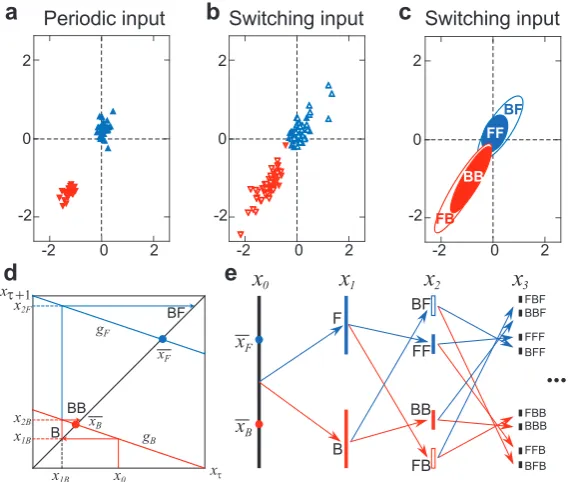
section, Σ, as discrete dynamics. Figure8a shows the set of points on the Poincaré section under 226
a periodic input condition corresponding to the Figure7a. Figure8b shows the set of points on the 227
Poincaré section during a switching input condition corresponding to the Figure7b, and Figure8c 228
shows the ellipse of the constant distance by using the mean and±1 S.D. for the switching input 229
condition. The characteristic configurations of the four clusters of sets on the Poincaré sections 230
corresponded to the Cantor set with rotation. Figure 8d shows the return map of the Cantor set 231
with rotation leaving from the initial state,x0, when the first input was the backhand side, the next 232
state, x1B, and returned to B in Figure8d. When the second input was the backhand side, the next
Figure 7.The trajectories in three-dimensional cylindrical phase space. (a) Periodic input condition, (b) switching input condition. Stick pictures show forehand and backhand striking movements at each point in time series. Modified from, with permission, [40].
state, x2B, returned to BB. In contrast, when the second input was the forehand side, the next state,
234
x2F, returned to BF. The behavior of the system was understood as the time evolution of the Cantor set
235
with rotation (Figure8e). In other words, the time evolution of the striking action corresponding to 236
the two input types was characterized as a fractal transition of the Cantor set. These findings suggest 237
that a simple rule underlying a complex human behavior can be understood as discrete dynamics by 238
reducing the continuous dynamics using a Poincaré map analysis. 239
5. Switching hybrid dynamics 240
As mentioned above, the coordination modes of interpersonal competitive behavior can be 241
examined as a synchronization phenomena of two-coupled nonlinear oscillators or as continuous 242
dynamics. However, interpersonal competitive behavior shows abrupt changes in coordination 243
modes, which differs from rhythmic interlimb coordination (e.g., [1]) or interpersonal coordination 244
(e.g., [6]). The distribution of the relative phase region analysis reveals the characteristics of the 245
global coordination mode without considering time evolution. Thus, it does not describe the local 246
coordination patterns on a shorter time scale. To solve this problem, the interpersonal competitive 247
patterns on a short time scale were classified using a return map analysis, referring to the Lorenz 248
map and reducing the dimensionality from continuous dynamics to discrete dynamics. Furthermore, 249
the switching among patterns was determined by state transition probabilities and revealed the 250
characteristics of experts. This finding suggests that continuous interpersonal competitive behavior, 251
which seem to be a complex phenomenon, includes both perception of each other and their own 252
decision making, and the two players execute their actions depending on their decisions. In other 253
words, interpersonal competitive behavior can be regarded as a continuous switching pattern on 254
a shorter time scale. In martial arts, such as boxing or fencing, the two players can move freely 255
around each other; thus, the behavior of a system comprised of two players is a weakly coupled 256
oscillator system [8,26,33]. Thus, collective variables can be defined to describe the state of the system 257
during continuous dynamics (Figure3). Underlying simple rules can be identified in interpersonal 258
competitive behavior using a return map as discrete dynamics (Figure5). This perspective shows the 259
interactive behavior as a whole system. 260
Another perspective to understand interpersonal competitive behavior is to view part of the 261
system in the whole by focusing on individual behavior. Then, other movements are regarded as 262
external input patterns or environmental changes, and the individual would generate their output 263
patterns according to their input patterns. This means that the system is considered non-autonomous. 264
The switching dynamics model suggests that the output pattern would be generated by switching 265
Figure 8. Examples of Poincaré sections Σ for the periodic and switching input conditions. (a) Periodic input, (b) switching input, and (c) the ellipse of constant distance using each mean and ±1 S.D. for switching input. (d) This shows how the Cantor set C with rotation is constructed using two iterative functions. The iterative functionsgF and gB transform the state,xτ, to the next state,
xτ+1. The transformations of the iterative functions gF and gB are rotated around the fixed points
xF andxB, respectively. (e) The hierarchical structure of the fractal corresponds to the sequence of
forehand (F) and backhand (B) inputs. Modified, with permission, from [40].
movement of the ball hit by the opponent. In this case, each individual is a non-autonomous system, 267
and the underlying simple rules could be identified as discrete dynamics (Figure8), and complex 268
individual behavior as continuous dynamics (Figure7). 269
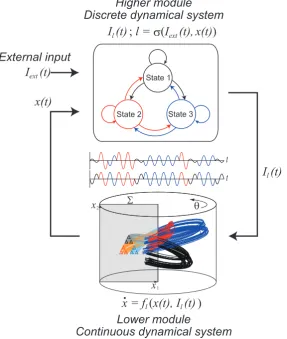
The proposed integrated model is the switching hybrid dynamical system [41]. Here, we assume 270
a system with a higher module and a lower module, which interact with each other by switching 271
inputs from the higher to the lower module, and by using a feedback signal from the lower to the 272
higher module. In addition, external input feeds into the higher module, as shown in Figure9. 273
Discrete dynamical system: Il(t);l = σ(Iext(t),x(t)) (4)
Continuous dynamical system: x˙ = fl(x(t),Il(t)) (5)
Here, the discrete dynamical system Il(t) is the higher module corresponding to the brain and
274
prefrontal cortex [42,43], and the continuous dynamical system ˙xis the lower module corresponding 275
to the human motor system. This system focuses on the individualAduring competition between 276
Aand B. The higher module transforms into human movement based on the continuous output 277
pattern from the opponentB,Iext(t)and the final state of the lower modulex(t). The higher module
278
considers one of three pattens Il(t) and transforms into movement. Thus, when the movement
279
pattern of the opponentBswitches among the three patterns, the movement patterns ofAwill show 280
three fractal trajectory subsets. However, the pattern determined byAis not always consistent with 281
the continuous output pattern from the opponentB, Iext(t). Because higher brain functions, such
282
as selective attention [44–47], the visual search strategy [48–50], and decision making [51–53] are 283
redundant due to neuronal redundancy of cell assemblies [54], the same external input Iext(t)does
284
not always generate the same decisionIl(t). This problem might be related to expertise.
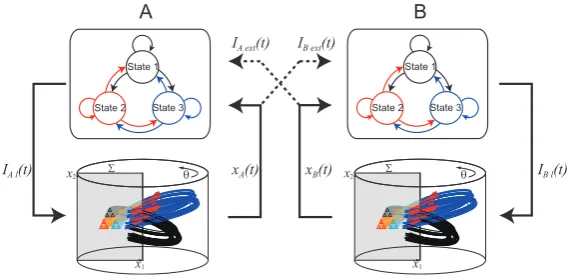
Figure 10. Schematic representation for two-coupled switching hybrid dynamics. This system is autonomous.
When the external inputs feed into the system, system outputs of the continuous dynamical 286
system are generated regularly depending on continuous switching of external inputsIext(t)and the
287
final states of the system x(t), as shown in section 4.2. This suggests that behavior of the system 288
shows hysteresis and can be used to predict the next state. However, it has been confirmed that the 289
regularities differ according to the length of time of the external input [55–57]. In this case, we focused 290
on individual behavior during an interpersonal competitive situation; that is, we regarded the system 291
as non-autonomous. 292
When these two systems are connected to each other, it is regarded as an autonomous system as 293
a whole (Figure10). That is, the final state of the other system,xA(t)inAandxB(t)inBtransforms
294
into external input for the systemIBext(t) inBand IAext(t)inA, respectively. As a result, the two
295
systems are connected through external inputs. Then, the behavior of the whole system is described 296
as: ˙X = F(X),X = (xA,xB). In the case of kendo matches, the behavior of the whole system has
297
been described as the instantaneous relative phase difference of the step toward-away movements 298
of the two players. However, six offensive and defensive maneuver patterns have been found, and 299
these patterns switch continuously during a kendo match, suggesting that the regularity underlying 300
switching among competitive patterns could be clarified if these patterns are regarded as output 301
patterns and/or external input patterns using slightly longer time windows. However, the regularity 302
remained unclear after determining the state transition probabilities for the competitive patterns. 303
Applying switching hybrid dynamics to interpersonal competitive behavior would help to clarify 304
how the behavior will be generated during the time course as a whole system. 305
6. Conclusion 306
We investigated how to examine the underlying dynamics of complex interpersonal competitive 307
behavior during sport activities using the continuous dynamical system, which was described 308
by differential equations, and the discrete dynamical system, which was described by difference 309
equations and/or iterated maps. Weakly coupled sports, such as boxing, fencing, and kendo, in which 310
the players move relatively freely regardless of the opponent’s movement, were examined using 311
a two-coupled nonlinear oscillator mode. Then, the order and control parameters were identified 312
and the coordination modes between the two players were determined. Furthermore, because these 313
continuous dynamics could be reduced to discrete dynamics using iterated maps, the coordination 314
patterns in interpersonal competitive behavior could be depicted on shorter time scales. On the other 315
hand, in strongly coupled sports, such as court-net sports in which movements of the players are 316
constrained by movement of the ball hit by the opponent, the regularities in the evolution of the 317
system were clarified using the switching dynamical system with external temporal input, which 318
The proposed switching hybrid dynamical system was applied not only to court-net sports, such 320
as tennis or table tennis, but also to weakly coupled sports, such as boxing or fencing, to understand 321
the regularities underlying the interpersonal competitive behavior. However, further theoretical and 322
behavioral examinations will be needed. Additionally, the team sports applications, which require 323
both intra-team coordination and inter-team competition, is a next step. 324
Acknowledgments: We thank Kazutoshi Kudo for helpful comments and discussions that improved the 325
manuscript. This work was partially supported by Grants-in-Aid for Scientific Research (A) 24240085 and 326
25242059 from MEXT, Japan and a Grant-in-Aid for Challenging Exploratory Research 16K12994 from the JSPS, 327
Japan. 328
Author Contributions: YY, AK, MO, KY, and KG were equally contributed to all parts of this manuscript; the 329
ideas, theoretical frameworks and writing. 330
Conflicts of Interest:The authors declare no conflict of interest.The founding sponsors had no role in the design 331
of the study; in the collection, analyses, or interpretation of data; in the writing of the manuscript, and in the 332
decision to publish the results. 333
References 334
1. Kelso, J.A.S. Phase transitions and critical behavior in human bimanual coordination.American Journal of 335
Physiology1984,246, R1000–R1004. 336
2. Bennett, M.; Schatz, M.F.; Rockwood, H.; Wiesenfeld, K. Huygens’ clock. Proceedings of the Royal Society 337
A: Mathematical, Physical and Engineering Sciences2002,458, 563–579. 338
3. Strogatz, S.SYNC: The emerging science of spontaneous order; Hyperion Books: New York, 2003. 339
4. Haken, H.; Kelso, J.A.S.; Bunz, H. A theoretical model of phase transitions in human hand movements. 340
Biological Cybernetics1985,51, 347–356. 341
5. Haken, H. Synergetics: An introduction, non-equilibrium phase transitions and self-organization in physics, 342
chemistry and biology, 2nd ed.; Springer: Berlin, 1978. 343
6. Schmidt, R.C.; Carello, C.; Turvey, M.T. Phase transitions and critical fluctuations in the visual 344
coordination of rhythmic movements between people. Journal of Experimental Psychology: Human 345
Perception and Performance1990,16, 227–247. 346
7. Schmidt, R.C.; Turvey, M.T. Phase-entrainment dynamics of visually coupled rhythmic movements. 347
Biological Cybernetics1994,70, 369–376. 348
8. Kuramoto, Y.Chemical oscillations, waves, and turbulence; Springer-Verlag: Berlin, 1984. 349
9. Néda, Z.; Ravasz, E.; Brechet, Y.; Vicsek, T.; Barabási, A.L. Self-organizing processes: the sound of many 350
hands clapping. Nature2000,403, 850–851. 351
10. Frank, T.D.; Richardson, M.J. On a test statistics for the Kuramoto order parameter of synchronization: 352
an illustration for group synchronization during rocking chairs. Physica D2010,239, 2084–2092. 353
11. Richardson, M.J.; Garcia, R.L.; Frank, T.D.; Gergor, M.; Marsh, K.L. Measuring group synchrony: a 354
cluster-phase method for analyzing multivariate movement time-series. Frontiers in Physiology2012, 355
3, 405. 356
12. Aihara, I.; Takeda, R.; Mizumoto, T.; Otsuka, T.; Takahashi, T.; Okuno, H.G.; Aihara, K. Complex and 357
transitive synchronization in a frustrated system of calling frogs. Physical Review E2011,83, 031913. 358
13. Golubitsky, M.; Stewart, I. The symmetry perspective: from equilibrium to chaos in phase space and physical 359
space; Birkhäuser Verlag: Basel, Switzerland, 2002. 360
14. Yokoyama, K.; Yamamoto, Y. Three people can synchronize as coupled oscillators during sports activities. 361
PLoS Computational Biology2011,7, e1002181. 362
15. Gray, R. ‘Markov at the bat’: A model of cognitive processing in baseball batters. Psychological Science 363
2002,13, 542–547. 364
16. McGarry, T.; Franks, I.M. A stochastic approach to predicting competition squash match-play. Journal of 365
Sports Sciences1994,12, 537–584. 366
17. McGarry, T.; Franks, I. Development, application, and limitation of a stochastic Markov model in 367
explaining championship squash performance. Research Quarterly for Exercise and Sport1996,67, 406–415. 368
18. Kelso, J.A.S. Dynamic patterns: The self-organization of brain and behavior; The MIT Press: Cambridge, MA, 369
23. Yamanishi, J.; Kawato, M.; Suzuki, R. Two coupled oscillators as a model for the coordinated finger 380
tapping by both hands. Biological Cybernetics1980,37, 219–225. 381
24. Scholz, J.P.; Kelso, J.A.S. A quantitative approach to understanding the formation and change of 382
coordinated movement patterns. Journal of Motor Behavior1989,21, 122–144. 383
25. Pikovsky, A.; Rosenblum, M.; Kurths, J. Phase synchronization in regular and chaotic system: a tutorial. 384
International Journal of Bifurcation and Chaos2000,10, 2291–2306. 385
26. Pikovsky, A.; Rosenblum, M.; Kurths, J. Synchronization: a universal concept in nonlonear sciences; 386
Cambridge University Press: New York, 2001. 387
27. Carvalho, J.; Araújo, D.; Travassos, B.; Esteves, P.; Pessanha, L.; Pereira, F.; Davids, K. Dynamics of players 388
relative positioning during baseline rallies in tennis.Journal of Sports Sciences2013,31, 1596–1605. 389
28. Lames, M. Modelling the interaction in game sports - relative phase and moving correlations. Journal of 390
Sports Science and Medicine2006,5, 556–560. 391
29. Palut, Y.; Zanone, P.G. A dynamical analysis of tennis: concepts and data. Journal of Sports Sciences2005, 392
23, 1021–1032. 393
30. McGarry, T. Identifying patterns in squash contests using dynamical analysis and human perception. 394
International Journal of Performance Analysis in Sport2006,6, 134–147. 395
31. Chow, J.Y.; Seifert, L.; Hérault, R.; Chia, S.J.Y.; Lee, M.C.Y. A dynamical system perspective to 396
understanding badminton singles game play.Human Movement Science2014,33, 70–87. 397
32. Yamamoto, Y.; Okumura, M.; Yokoyama, K.; Kijima, A. 13. Interpersonal Coordination in Competitive 398
Sports Contexts: Martial Arts. InInterpersonal Coordination and Performance in Social Systems; Passos, P.; 399
Davids, K.; Chow, J.Y., Eds.; Routledge: Oxford, UK, 2016; pp. 179–194. 400
33. Strogatz, S.H.Nonlinear dynamics and chaos; Westview Press: Cambridge, MA, 1994. 401
34. Okumura, M.; Kijima, A.; Kadota, K.; Yokoyama, K.; Suzuki, H.; Yamamoto, Y. A critical interpersonal 402
distance switches between two coordination modes in kendo matches. PLoS ONE2012,7, e51877. 403
35. Kijima, A.; Kadota, K.; Yokoyama, K.; Okumura, M.; Suzuki, H.; Schmidt, R.C.; Yamamoto, Y. Switching 404
dynamics in an interpersonal competition brings about ‘Deadlock’ synchronization of players.PLoS ONE 405
2012,7, e47911. 406
36. Lorenz, E.N. Deterministic nonperiodic flow.Journal of Atmospheric Sciences1963,20, 130–141. 407
37. Yamamoto, Y.; Yokoyama, K.; Okumura, M.; Kijima, A.; Kadota, K.; Gohara, K. Joint action syntax in 408
Japanese martial arts. PLoS ONE2013,8, e72436. 409
38. Gohara, K.; Okuyama, A. Dynamical systems excited by temporal inputs: Fractal transition between 410
excited attractors. Fractals1999,7, 205–220. 411
39. Gohara, K.; Okuyama, A. Fractal transition: Hierarchical structure and noise effect. Fractals1999, 412
7, 313–326. 413
40. Yamamoto, Y.; Gohara, K. Continuous hitting movements modeled from the perspective of dynamical 414
systems with temporal input. Human Movement Science2000,19, 341–371. 415
41. Nishikawa, J.; Gohara, K. Automata on fractal sets observed in hybrid dynamical systems. International 416
Journal of Bifurcation and Chaos2008,18, 3665–3678. 417
42. Miller, E.K. The prefrontal cortex and cognitive control. Nature Reviews Neuroscience2000,1, 59–65. 418
43. Sakagami, M.; Tsutsui, K. The hierarchical organization of decision making in the primate prefrontal 419
cortex.Neuroscience Research1999,34, 79–89. 420
44. Ditzinger, T.; Haken, H. Oscillations in the perception of ambiguous patterns. Biological Cybernetics1989, 421
45. Drew, T.; Võ, M.L.H.; Wolfe, J.M. The invisible Gorilla strikes again: sustained inattentional blindness in 423
expert observers.Psychological Science2013,24, 1848–1853. 424
46. Gregoriou, G.G.; Gotts, S.J.; Zhou, H.; Desimone, R. High-frequency, long-range coupling between 425
prefrontal and visual cortex during attention.Science2009,324, 1207–1210. 426
47. Neisser, U.; Becklen, R. Selective looking: attending to visually specified events. Cognitive Psychology 427
1975,7, 480–494. 428
48. Alder, D.; Ford, P.R.; Causer, J.; Williams, A.M. The coupling between gaze behavior and opponent 429
kinematics during anticipation of badminton shots.Human Movement Science2014,37, 167–179. 430
49. Vaeyens, R.; Lenoir, M.; Philippaerts, R.M.; Williams, A.M. Mechanisms underpinning successful decision 431
making in skilled youth soccer players: an analysis of visual search behaviors. Journal of Motor Behavior 432
2007,39, 395–408. 433
50. Williams, A.M.; Ward, P.; Knowles, J.M.; Smeeton, N.J. Anticipation skill in a real-world task: 434
measurement, training, and transfer in tennis.Journal of Experimental Psychology: Applied2002,8, 259–270. 435
51. Araújo, D.; Davids, K.; Serpa, S. An ecological approach to expertise effects in decision-making in a 436
simulated sailing regatta. Psychology of Sport and Exercise2005,6, 671–692. 437
52. Araújo, D.; Davids, K.; Hristovski, R. The ecological dynamics of decision making in sport. Psychology of 438
Sport and Exercise2006,7, 653–676. 439
53. Thura, D.; Cos, I.; Trung, J.; Cisek, P. Context-dependent urgency influences speed-accuracy trade-offs in 440
decision making and movement execution. Journal of Neuroscience2014,34, 16442–16454. 441
54. Buzsáki, G. Neural syntax: cell assemblies, synapsembles, and readers. Neuron2010,68, 362–385. 442
55. Hirakawa, T.; Suzuki, H.; Okumura, M.; Gohara, K.; Yamamoto, Y. Switching dynamics between two 443
movement patterns varies according to time interval. International Journal of Bifurcation and Chaos2016, 444
26, 1630026. 445
56. Hirakawa, T.; Suzuki, H.; Gohara, K.; Yamamoto, Y. Inverse proportional relationship between 446
switching-time length and fractal-like structure for continuous tracking movement. International Journal 447
of Bifurcation and Chaos2017,27, 1730040. 448
57. Suzuki, H.; Yamamoto, Y. Robustness to temporal constraint explains expertise in ball-over-net sports. 449