996
Performance Analysis On Channel Estimation Of
OFDM Reception In Multipath Fast Fading
Channels Using PSO
Braj Bhushan Tiwari, Sukhjinder Kaur
Abstract:Vehicle to everything communication introduced (ITS) intelligent Transport System and safety of the vehicles. It has become a prominent trend in which researchers prefer to do work. Various schemes are proposed for the channel estimation but these schemes lack in various factors such as improper definition of filter coefficients, complexity and results were not efficient. Thus, a novel technique of Channel estimation i.e. Decision feedback Channel estimation is proposed in this paper by applying QPSK modulation in the system and Particle swarm Optimization algorithm to obtain effective results. Simulation results are carried out by using MATLAB software and evaluation is compared with existing system (DFCE-AD) i.e. Antenna diversity used by DFCE. From the results, the proposed system (DFCE-PSO) outperformed the traditional DFCE technique.
Index Terms:V2X, WAVE, Channel Estimation, packer error rate (PER), GWO.
————————————————————
1
I
NTRODUCTIONWITH the advancements in Information and Communication Technology (ICT), vehicles are linked to surrounding infrastructure of vehicles and road through wireless connectivity. The V2X (vehicle to everything) communication system is a significant part of the Intelligent Transport System (ITS) future architecture [1]. V2X is a wireless technology which has centered aim to enhance the safety of roads and to make better strategies for managing the traffic by developing a new idea of ITS.
Fig..1 V2X Communication Network Diagram
This concept is implemented to lessen the various impacts of environment. V2X includes different fields such as V2V (vehicle–to-vehicle), V2I (vehicle-to-Infrastructure), V2R (where ―R‖ denotes new dedicated vehicular access sites), and most generally, vehicle-to-universe (including satellite, GPS, public safety, pedestrian, etc.) modes in Intelligent Transportation Systems area. [2].
Fig..2 Block Diagram of OFDM Communication [2]
Wireless Access in Vehicle Environment (WAVE) communication adopted OFDM modulation with 10 MHz Channel Spacing and increasing RF energy for extending radio coverage. OFDM block chart is illustrated in fig. 2. OFDM uses the Binary Phase Shift Keying system (BPSK), the Quadrature Phase Shift Keying, 16 or 64 Quadrant Amplitude Modulation and a convolution method of coding [3]. The obtained OFDM signal via multipath fading of NLOS will have rapid changes in the amplitude and stage range. Many signal assessment methods have been researched to enhance the efficiency of OFDM delivery.
2
C
HANNELE
STIMATIONChannel estimation is an imperative task in coherent communication systems. Moreover, for consistent OFDM scheme, channel estimation is a significant problem. In comparison with SISO systems, it is difficult to perform ____________________________________
Braj Bhushan Tiwari is currently pursuing Masters Degree program in Electronics and Communication Engineering in Shri Sukhmani Institute of Engineering and Technology, Dera Bassi, Punjab, India. E-mail: [email protected]
channel estimation due to increased channels are needed to be determined. The channel estimation technique is created on the basis of the signal correlation and extraction of MAI. The wave amplitude estimation and the rate of propagation of each device are carried out. Moreover, the effect of channel estimation is used in the diversity combination and optimizing the effectiveness of receiver. The quality of the channel estimation approach has a huge impact on the receiver's overall efficiency of Bit error rate (BER) [4], [10],]12]. In an OFDM system, method of channel estimation plays a significant role. It is used to increase the capacity of OFDMA systems in n by enhancing system performance in respect of bit error rate [5]. There are various methods of estimating the channel, but the key concepts are similar. The method is performed according to the given process: A mathematical model is determined for the correlation of the "signal transmitted" with the "signal obtained" through channel matrix. A know signal (reference signal or the pilot signal) is transmitted and detection phase is performed for the signal that is received. By combining the signal transmitted and the signal obtained, channel matrix components can be determined. OFDM schemes can be divided into two classifications [18] of the channel estimation methods: blind and non-blind. In latest years the blind channel estimate has been an effective field of studies for MIMO-OFDM schemes. According to Zhou et al[8] a blind channel estimation method uses a statistical component of the collected data, while the non-blind channel estimation method uses some or all parts of the transferred data, i.e. pilot sounds or sections of practice that can be used for the signal evaluation by the receiver[6],[7]. However, channel estimation is done by using various approaches that have been developed for the better V2X communication. But still there are some limitations in which these schemes are lacking such as[14]: The filter coefficients used in these estimation techniques were not defined properly due to which the attained output is not better to some extent. Additionally, no algorithm is used in traditional techniques, where the algorithms are used to provide more accuracy to the system Conversely, there is a need to propose a new technique by taking these limitations into consideration that is used to define the filter coefficients of the estimation technique as well as to provide more accuracy to the system.
3 P
RESENTW
ORKIn order to decrease the congestion, traffic accident a CO2 emission, the wireless association of vehicle will contribute to it. In urban, as well as highway environments, the V2X connectivity offers vehicle to anything communication. As illustrated in the above section, a novel method is required to be developed in the proposed work in order to conquer the issues of traditional techniques. It is necessary to define the filter coefficients of Decision Feedback Estimation Channel method and also to offer accuracy to the method. In fast fading channel the Decision Feedback Estimation Channel method has tremendous performance than several channel estimation techniques. The decision feedback channel estimation scheme has excellent estimation performance in fast fading channel among many channel estimation techniques. Therefore the major concern of this work is demonstrated below as: First of all the coefficients of the estimation channel technique are defined in order to offer an improved output in this work
Because an optimization technique is more efficient to provide accuracy and better results compared to an algorithm therefore a Particle Swarm Optimization technique is used in this work in order to offer accuracy to the system, as well as better results, than the traditional technique. The following are some advantages of the method of PSO technique:
3.1 Characteristics of Self-organization
Self organization is a key component of the SI system. This is the method by which the local links between the parts of a collectively disordered system result in global order. This is a voluntary method; that is, no agent within or outside the scheme controls it. Three fundamental components interpret self-organization in swarms as follows[13], [17]: Strong nonlinearity (often with favorable and adverse reviews): positive feedback enables to build comfortable structures, and adverse feedback balance the beneficial and stabilizing input. Balance of exploitation and exploration: SI defines an adequate equilibrium to provide a valuable approach of average synthetic intelligence strategy. Multiple activities: cluster agents use data from neighboring agents to spread the data over the network.
3.2 SI characteristics
Furthermore, SI must fulfill the five principles which are defined as follows: Principle of proximity: The swarm should be capable of performing simple computations of time and space computations[15], [16]. Principle of performance: swarm should be prepared to react to environmental performance factors. Various rules of reaction: The swarm should not operate on too narrow channels. Principle of stability: the tornado is not supposed to alter its conduct every moment the climate shifts. Concept of adaptability: when the computing cost applies to the tornado, it should be prepared to alter its method of conduct.
4
M
ETHODOLOGY998 START Initially, in the transmitter section the Input signal is fed
to the OFDM modulation for the modulation process, After modulation the signal is transferred on the channel, which in turn transmits the signal to the receiver to which Additive White Gaussian Noise is added. Then the signal with AWGN is received by the OFDM demodulation in order to perform demodulation on the signal to get original signal back. The demodulated signal is then transmitted to the Received resource grid which transmits the signal to the channel estimator and to the output block. The Decision feedback channel estimator is used to provide better and accurate output with the help of particle swarm optimization technique. Ultimately the final output is received from the last block. END
5
R
ESULTS ANDD
ISCUSSIONSIn this paper, a novel system for channel estimation is proposed in order to reduce the traffic, congestion on the road infrastructure. Decision Feedback Channel Estimation (DFCE) is the effective approach. In the proposed method optimization of this existing scheme is performed Particle Swarm Optimization algorithm. The novel system is simulated using MATLAB tool. PER is calculated for the given signal to noise (SNR) ratio with different sizes of packet sizes such as 300 bytes and 1000 bytes. The comparisons are also made with respect to the traditional works done on this scheme.
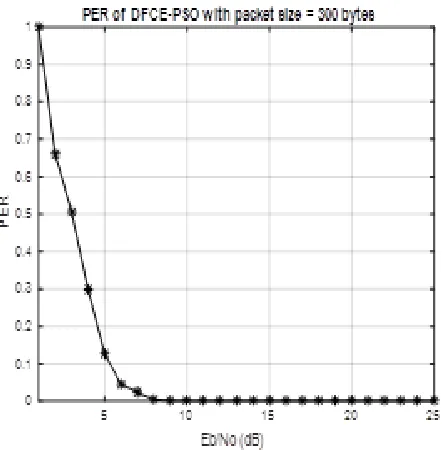
Fig. 4: PER of proposed DFCE with packet size = 300 bytes in 140 km/h mobility
Fig. 5: PER of proposed DFCE with packet size = 1000 bytes in 140 km/h mobility
Fig. 4 shows the results of proposed DFCE system for QPSK modulation and PS algorithm at the speed of 140 km/hr. The graph shows PER which lies between 0 and 1 and SNR ratio varies from 0 to 25. It is observed that PER value is effective. Fig. 5 represents the same results for the packet size with 1000 bytes. In this graph shown in fig. 5, the PER value is gained with more effectiveness.
Fig. 6: PER of proposed DFCE and traditional DFCE with modulation schemes
Fig. 7: PER of proposed DFCE and traditional DFCE with modulation schemes
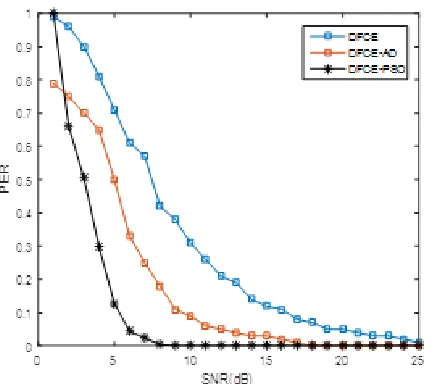
Also, the comparison is made in which no modulation schemes are used for channel estimation. The simulation is performed and the results for (DFCE, AD and proposed DFCE-PSO) are shown in fig. 7. The proposed system attain low values of PER at different SNR ratios that resulted in effective estimation of channel using particle swarm optimization.
Fig. 8: PER of proposed DFCE and traditional DFCE with modulation schemes
Fig. 8 represents the outcomes of traditional QPSK and anticipated work (QPSK-PSO) with different packet sizes of 300 bytes and 1000 bytes. The graph demonstrates the values of PER with respect to SNR. It is observed that PER values obtained from QPSK-DFCE-PSO are very low as compared to existing system in terms of both packet sizes. From the obtained simulation results, the proposed system using particle swarm optimization gives effective channel estimation for efficient vehicle to everything communication.
6
C
ONCLUSIONIn this paper, a novel technique is proposed for effective vehicular communication. V2X communication is made better by enhancing the traditional work [9]. Channel estimation technique used previously is not much effective. PSO algorithm is used for the optimization of DFCE to obtain the more accurate system. QPSK modulation scheme is implemented in this system. The simulation is performed for two different sizes 300 byte and 1000 bytes. System is evaluated using MATLAB software. Simulation results are determined and the results of the traditional are proposed system are obtained. The comparison show that proposed system is surpasses the traditional approach. In future, the channel estimation technique can be enhanced by applying different optimization algorithms and methods and parameters considered for this technique can be extended.
R
EFERENCES[1] Retrieved online at https://www.qorvo.com/design-hub/blog/v2x-in-the-connected-car-of-the-future
[2] Zainudin, Ahmad & Sudarsono, Amang & Astawa, I Gede. (2014). Performance Analysis of an OFDM PHY Scheme with Zero Forcing Equalizer Using Software Defined Radio Platform and USRP. EMITTER International Journal of Engineering Technology. Vol. 2., PP: 26-38..
[3] Madhu gandha V Sisodiya, 2 K N Pawar ―A Review On Channel
Estimation Methods In Mimo-Ofdm, Volume 4, Issue 4, pp 431-434 2015
[4] Retrived online at:
http://www.sharetechnote.com/html/Communication_ ChannelEstimation .html
[5] Retrieved online at:
https://in.mathworks.com/help/lte/ug/channel-estimation.html
[6] F. Gao And A. Nallanathan, ―Blind Channel Estimation For Ofdm Systems Via A Generalized Precoding‖ Ieee Trans. Vehicular Technol., 56(3):1155–1164, May 2007.
[7] S. Zhou, B. Muquet, And G. B. Giannakis, ―Subspace-Based (Semi-) Blind Channel Estimation For Block Precoded Space-Time Ofdm,‖ Ieee Trans. Signal Process., Vol. 50, No. 5, Pp. 1215–1228, May 2002.
[8] Oh, H.S. & Kang, D.W., ―Wireless Pers Commun‖ (2018) 103:
2423. Https://Doi.Org/10.1007/S11277-018-5919-7
[9] Prithu Roy, R. K. Vishwakarma, Akshay Jain, Rashmi Singh, ―Multiband Millimeter Wave Antenna Array For 5g Communication‖, Iceteses, Pp 102-105, 2016.
[10] Bogdan Antonescu, Miead Tehrani Moayyed, Stefano Basagni, ―Mmwave Channel Propagation Modeling For V2x Communication Systems‖, Ispimrc, Pp 1-6, 2017.
[11] Norbert Varga, László Bokor, András Takács, József Kovács, László Virág, ―An Architecture Proposal For V2x Communication -Centric Traffic Light Controller Systems‖, Icitst, Pp 1-7, 2017.
[12] Igor Kabashkin, ―Reliable V2x Communications For Safety-Critical Intelligent Transport Systems‖, Rtuwo, Pp 251-255, 2017.
[13] Igor Kabashkin, ―Reliability Of Bidirectional V2x Communications In The Intelligent Transport Systems‖, Rtuwo, Pp 159-163, 2015.
1000
[15] Jeongwook Seo, Kyungwon Park, Wongi Jeon, Jaemin Kwak, Dong Ku Kim, ―Performance Evaluation Of V2x Communications In Practical Small-Scale Fading Models‖, Iispimrc, Pp 2434-2438, 2009.
[16] Yuke Li, Linyao Yang, Shuangshuang Han, Xiao Wang, Fei-Yue Wang, ―When Lpwan Meets Its: Evaluation Of Low Power Wide Area Networks For V2x Communications‖, Itsc, Pp 473-478, 2018.
[17] Konstantinos Manol Kis, Wen Xu, ―Time Synchronization For
Multi-Link D2d/V2x Communication‖, Vtc-Fall, Pp 1-6, 2016.