743
Volume LXI 82 Number 3, 2013
http://dx.doi.org/10.11118/actaun201361030743
STRENGTH OF COFFEE BEANS UNDER
STATIC AND DYNAMIC LOADING
Šárka Nedomová, Jan Trnka, Pavla Stoklasová, Jaroslav Buchar
Received: February 3, 2013
Abstract
NEDOMOVÁ ŠÁRKA, TRNKA JAN, STOKLASOVÁ PAVLA, BUCHAR JAROSLAV: Strength of coff ee beans under static and dynamic loading. Acta Universitatis Agriculturae et Silviculturae Mendelianae Brunensis, 2013, LXI, No. 3, pp. 743–749
Paper deals with experimental research on the crushing of coff ee beans of diff erent kinds under quasi-static and dynamic compression. The process of the crushing is described in details. It has been shown that there is variability in the crushing strength values. A relation between crushing strength and the coff ee grain shape is also studied. Roasted Arabica coff ee (Coff ea arabica) beans were used for analyses. Arabica coff ees were produced in diff erent countries. All Arabica samples were submitted to a light roast. The detail analysis of the experimental data shows that there is no signifi cant relation between parameters describing the fracture behaviour of the grains and grain geometry. These parameters are also independent on the grain weight. Compression of the coff ee grains leads to their crushing. The fracture force is diff erent for the diff erent kinds of the coff ee. The same is fact valid also for the strain at the fracture and for the energy absorbed during the grain crushing. Dynamic loading leads to the increase in the fracture force of coff ee grains in comparison with the quasi static loading. coff ee beans, compression loading, strength, impact loading
The knowledge of the strength and toughness of the coff ee beans is necessary in order to evaluate their brittleness. The reaching of a certain degree of brittleness is very important for the grinding to which coff ee beans have to be subjected to before brewing. The uniformity of the product of the grinding process depends on various factors including the brittleness of the roasted coff ee bean and it aff ects the extraction of soluble solids to obtain the coff ee brew (Clo and Voilley, 1983; Clarke and Macrae, 1987). Even though the changes in the textural and mechanical characteristics to which the coff ee bean undergo during roasting play a relevant role in the quality of the roasted beans, these properties have been scarcely studied until now.
The textural changes of coff ee beans during their roasting have been studied e.g. by Pitia et al. (2001) using of the static compression of the coff ee beans. The same technique has been used for the study of the infl uence of the moisture content and water activity on the mechanical properties of the coff ee beans (Pitia et al., 2007). This technique has been also used for the study of mechanical properties of
many others beans, see e.g. (Tran et al., 1981, Borges and Peleg, 1997; Al Salah and Galland, 1985). In our previous paper (Nedomova, 2010) results on the coff ee grain compression has been presented. These results have been obtained for the quasi static loading.
The grinding of the coff ee represents a loading process which is dynamic rather than static. It means the mechanical properties like crushing strength should be evaluated at the dynamic loading. In the given paper an experimental method for the study of the coff ee beans response to the dynamic (impact) loading developed by Nedomová et al. (2010). The experimental data have been obtained for 20 diff erent beans of the Arabica coff ee. Results are compared with the results of the static loading.
MATERIAL AND EXPERIMENTAL
METHODS
[E], Guatemala [G], Honduras [H], Indonesia [I], Kenya [K], Mexico [M], Panama [P], Papua New Guinea [P-NG], Peru [PE], and Tanzania [T]. The abbreviations in square brackets indicate the coff ee type and it is used in the text hereina er. For the sake of simplicity these abbreviations are also substituted by number. The beans were ordered from a commercial distribution network in the Czech Republic. All analyses were performed for samples of 20 beans randomly selected from each lot.
Dimensions in the main axes (D1, D4, D7 – see Fig. 1) were measured using a digital caliper SOMET (Germany). With regard to measurement accuracy and relevance, one decimal number was considered. According to indication by other authors (Ghosh
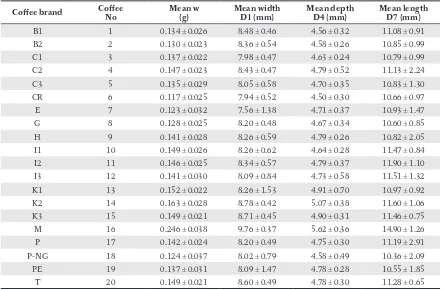
and Gacanja, 1970) D1, D4, and D7 dimesnsions correspond to W (width), D (depth) and L (length), respectively. Remaining dimensions (D2, D3, D5, D6 – see Fig 1) were determined from digital images using Corel DRAW X3 (Corel Corporation, USA). The detail analysis of the bean’s shapes is given in (Severa et al., 2012). In this paper only some main geometric characteristics are used. Their values are given in the Tab. I. Together with the weight of the beans – average from 1000 beans.
A TIRA Universal Testing Machine, equipped with a 200 N load cell was used. For the measurements, 20 beans of each sample were taken at random, and then positioned individually on its longest side and with the fl at side up between two metal parallel plates of the dynamometer. Compression force was applied at
1: Illustration of measuring sides for coffee beans
I: Selected physical characteristics of diff erent coff ee brands
Coff ee brand Coff eeNo Mean w(g) Mean widthD1 (mm) Mean depthD4 (mm) Mean lengthD7 (mm)
a rate of 20 mm/min until failure occurred; working temperature was 25 °C. Beans were loaded along the D4 axis. Owing to the diffi culty to calculate the true stress and strain, the mechanical properties of the coff ee beans were characterized with the following empirical measurements carried out in the force-displacement curve (Borges and Peleg, 1997): • Breaking force (Fs) corresponding to force at the
major failure event. It was considered as empirical measure of the crushing strength;
• Strain at fracture (f) corresponding to the
deformation at the fi rst breaking point and used as index of the deformability; it was expressed as percentage to keep into account the actual dimensions of the diff erently heat treated beans; • Work (W) corresponding to the area under the
force – displacement curve until the fi rst breaking event occurred. This parameter has been used as empirical index of toughness. This work
represents an absorbed energy during the grain crushing.
Twenty grains have been tested for every coff ee type.
Schematic of the experimental device used for the dynamic loading is shown in the Fig.2. Coff ee bean is placed on the wood rod and impacted by the falling bar. The bar is made from aluminium alloy. Its length is 200 mm, diameter of the bar is 6 mm. The bar is allowed to fall freely for a pre – selected height. The instrumentation of the bar by the strain gauges (semiconducting, 3 mm in length) enables to record time history of the force at the area of bar – coff ee bean contact. The same instrumentation is used for the supporting wood bar. It enables to record a force transmitted by the coff ee bean to the bar.
The height of the bar fall can be increased up to value at which the coff ee bean damage is observed. The experimental method enables to record the loading force (at the bar and coff ee bean) and the force transmitted into the supporting bar. The time histories of both forces can be evaluated in time as well as in the frequency domain. From these histories the breaking force of the coff ee beans can be evaluated.
EXPERIMENTAL RESULTS
In the Fig. 3. an example of the experimental record of the force F vs displacement p obtained at the quasi static compression is shown. This record exhibits several peaks of the force. The peak corresponds to the specimen fracture. The fi rst peak is taken as the breaking force of the coff ee grain. The following peaks of the loading forces correspond to the process of the repeated grain crushing into several fragments.
The values of breaking force exhibit a signifi cant scatter as shown in the Fig. 4.
Average values of the coff ee beans strength are displayed in the Fig. 5.
Strength of diff erent branch of coff ee changes between about 30 and 60 N. These values are
2: Schematic of the experimental device for the impact testing
comparable with those reported by Pitia (2001) for well roasted beans. The remaining textural characteristics mentioned in the section 2.3 are shown in the Figs. 6 and 7.
The values of absorbed energy correspond with those reported by Pitia et al. (2001) for high yield coff ee. At the same time the values of fracture strain achieved in this paper are signifi cantly lower than
those given in (Pitia et al., 2001). The values of these mechanical characteristics are dependent on the loading orientation. The orientation used in this paper leads to the maximum of the breaking force, Fs.
Example of the time histories both impact force and the force transmitted into the wood bar is displayed in the Fig. 8. With the increasing height,
4: Values of breaking strength of the single coffee beans
5: Static strength of the coffee beans
h, of the bar impact, i.e. with the impact velocity, the shape of this time history changes. The qualitative features of the changes are nearly the same as in
the case of the eggshells dynamically loaded by the impact (Nedomová et al., 2009).
7: Absorbed energy during the bean crushing
8: Time history of the forces during the coffee bean loading (Coffee grains produced in Brazil)
For the value of h = 90 mm the coff ee bean has been completely broken. The dependence of the maximum of the forces on the height, h, is shown in the Fig. 9.
The dependence of the maximum of the loading (impact) force on the height h enables to evaluate the force at which the bean is fractured. The procedure has been outlined e.g. in (Nedomová et al., 2009). The values of this dynamic breaking force (strength) are plotted in the Fig. 10 as function of the breaking force (strength) obtained at the static compression. One can see that the coff ee beans resistivity against to fracture is higher at the dynamic (impact) loading. The experimental points can be fi tted by a linear function with a relatively good correlation.
The increase the strength at transition from static to dynamic loading is very o en observed for many technical materials including metals and their alloys, polymers etc. This increase can be explained in
terms of material structure. It means the explanation of this phenomenon in coff ee beans must be based on the detail study of the microstructure of this material.
CONCLUSSIONS
In the given paper a new experimental method for the testing of impact behaviour of coff ee beans has been used. This procedure enables to evaluate the dynamic strength of these beans. Results obtained for 20 coff ee brands showed the higher values of the dynamic strength than strengths evaluated at the static compression. The dependence of the dynamic strength is linear function of the static strength. The dynamic forces recorded at the impact loading show diff erent features from those obtained at the static compression. At the same time the dynamic force time histories are very similar to those obtained for other brittle biological materials (eggshells).
10: The dependence of the dynamic strength on the static one
SUMMARY
The deformation and fracture behaviour of the twenty types of the Arabica coff ee grains have been studied. In the fi rst step the tested coff ee beans have been loaded in compression using of TIRATEST testing machine. Cross – head velocity was 20 mm.min−1. This velocity is generally accepted as static
loading. From the given test the following quantities have been evaluated:
• Breaking force (N) corresponding to force at the major failure event. It was considered as empirical measure of the crushing strength;
• Strain at fracture (%) corresponding to the deformation at the fi rst breaking point and used as index of the deformability; it was expressed as percentage to keep into account the actual dimensions of the diff erently heat treated beans;
• Work (J) corresponding to the area under the force - displacement curve until the fi rst breaking event occurred. This parameter has been used as empirical index of toughness. This work represents an absorbed energy during the grain crushing.
In the next step a new method of impact loading of coff ee beans has been used. The procedure of the bean fracture evaluation under dynamic loading has been applied. It has been shown that the dynamic strength is higher than the static one. The dynamic strength seems be linear function of the static one.
REFERENCES
AL SALEH, A., GALLANT, D. J., 1985: Rheological and ultrastructural studies of wheat kernel behaviour under compression as a function of water content. Food Microstruct, 4, 2: 199–211. ISSN 0730-5419.
BORGES, A., PELEG, M., 1997: Eff ect of Water Activity on the Mechanical Properties of Selected Legumes and Nuts. J Sci Food Agr, 75, 4: 463–471. ISSN 0022-5142.
CLARKE, R. J., MACRAE, R., 1987: Coff ee, Vol. 2: Technology. London: Elsevier Applied Science, 321 s. ISBN 978-185-1660-346.
CLO, G., VOILLEY, A., 1983: Evaluation of ground coff ee particle size for optimum extraction. Lebensm Wiss Technol, 16, 1: 39–42. ISSN 0023-6438. GHOSH, B. N., GACANJA, W., 1970: A study of the shape and size of wet parchment coff ee beans. J Agr Eng Res, 15, 2: 91–99. ISSN 0021-8634.
GUTIERREZ, C., ORTOLAE, M. D., CHIRALT, A., FITO, P., 1993: Analisis for MEB de la porosidad del cafe tostado. In: Proceedings 15thInternat. Scientifi c Colloquium on Coff ee Vol. 2, Montpellier: ASIC, 661– 671. ISBN 2-900212-14-6.
MASSINI, R., NICOLI, M. C., CASSARA, A., LERICI, C. R., 1990: Study on physical and physicochemical changes of coff ee beans during roasting. Note 1. Ital J FoodSci, 2, 2: 123–130. ISSN 1120-1770.
NEDOMOVÁ, Š., TRNKA, J., DVOŘÁKOVÁ, P., BUCHAR, J., 2009: Hen’s eggshell strength under impact loading. J Food Eng, 94, 3–4: 350–357. ISSN 0260-8774.
NEDOMOVÁ, Š., 2010: Crushing of Roasted Arabica Coff ee Beans. Acta univ. agric. et silvic. Mendel. Brunen., 58, 4: 177–181. ISSN 1211-8516.
PITTIA, P., DALLA ROSA, M., LERICIS, C. R., 2001: Textural Changes of Coff ee Beans as Aff ected by Roasting Conditions. Lebensm Wiss Technol, 34, 3: 168–175. ISSN 0023-6438.
ROOS, Y. H., 1995: Mechanical properties. In: Phase transitions in foods. San Diego: Academic Press, 247– 270. ISBN 01-259-5340-2.
SEVERA, L., BUCHAR, J., NEDOMOVÁ, Š., 2012: Shape and Size Variability of Roasted Arabica Coff ee Beans. Int J Food Prop, 15, 2: 426–437. ISSN 1094-2912.
TRAN, T. L., DEMAN, J. M., RASPER, V. F., 1981: Measurement of corn kernel hardness. Can I Food Sc Tech J, 14, 1: 41–48. ISSN 0315-5463.
Address