The Impact Of Stop Words Processing For
Improving Extractive Graph-Based Arabic Text
Summarization
Reda Elbarougy, Gamal Behery, Akram El KhatibAbstract: Text summarization is one of the natural language processing’s applications. It is used to reduce the amount of the input text to get the important information, to save the user’s time. Text summarization composed of four stages: preprocessing, features extraction, building the summarization model, and finally applying the summarization algorithms to extract the summary. This paper uses graph-based algorithm which used in many researches before in summarization of Arabic text graph-based procedure still have low performance, due to the complexity of Arabic language. In the pre-processing stage stop-words are deleted relying upon a pre-characterized list. This paper investigates the impact of the stop words in the summarization performance. So, this research done in two phases the first phase is with stop words and the second phase is without stop words. Then the summarization ranking algorithms is applied, then the summary is extracted according to predefined compression ratio with redundancy removal. This research using the following features: nouns, term frequency and inverse document frequency. To evaluate the system EASC corpus is used. The performance of the summarization is increased when stop words are removed.
Index Terms: Natural Language Processing, Stop Word, Features Extraction, Morphological Analyzer, Text Summarization.
————————————————————
1
I
NTRODUCTIONTHIS Paper discussed the impact of using the stop words removal in the pre-processing stage on summarization process performance. Text summarization done in three major stages preprocessing stage, then features extraction and building the summarization model stage, and finally applying the summarization ranking algorithms and extracting the summary stage. The first stage is the pre-processing stage which used to enhance the results of text summarization. Syntax in Arabic language is very complex, so it's hard to deal with it. Arabic language complexity comes from its complex morphology that allows the writer to switch between positions of words in the sentence, while retaining the same meaning. Also, the structure of the word in Arabic is mind boggling, making standardization progressively troublesome. In Arabic there are no uppercase letters or lowercase letters so, it’s difficult to find distinguish names. In addition, abandoning diacritics in the written text is another problem in Arabic which can influence in the procedure of defining what the word position in this sentence is. The Arabic letter format varies based to the letter location in the word (beginning, middle or end of the word), which adds some complexity to the processing [1]. The preprocessing stage in Arabic include the following steps: tokenization, normalization, deletion of stop-words, stemming, morphological analyses and Part-of-Speech (POS) tagging [2]. In features extraction and summarization model building stage, features like term frequency and inverse document frequency which labeled with TF-IDF [3], sentence position in the document, number of nouns in the sentence, the relation between the sentence and the title of the text etc…. The number of nouns appearing in sentences means there is extra information in this sentence compared with other sentences.
So, this approach is focused on using the power of using proper nouns in the feature extraction process and the weighing process [4]. Therefore, to collect more information for the document you should take into your account the appearance of nouns [4]. The final stage is applying the summarization ranking algorithms and building the summary. This stage can be divided into three steps; the first step is applying the ranking algorithm. The second step is extracting the summary’s sentences which depends in two factors: (1) compression ratio, and (2). After that the summary is build up and the sentences is order depending on its order in the original text. This paper discusses the impact of stop words in the performance of the summary, the research done into two major phase, in the first phase the summarization process is applied and keeping the stop words in the sentences. In the second phase the summarization is done with removing the stop words from the sentences. Generally, when stop words are removed the performance of the summary is increased. The rest of this paper is organized as the following: section 2 talks about literature review, section 3 discuss the motivation and problem statement, section 4 discuss the stop words, section 5 discuss the proposed approach, then section 5 discuss the used summarization algorithms. Then section 6 describes the experimental results. And finally section 7 is the conclusion.
2
L
ITERATURER
EVIEWSince the second half of the twentieth century, many researches have been done on text summary. In this regard, different summarization techniques were classified into various grouping on specific features of each approach. Hovy and Lin [5], define a text summary as a text based on a document or more. This summary contains the most important information of the main texts and its content is to the extent of half of the main texts. Mani and Maybury [6] defines the text overview as “a method of discovering the primary source of data, discovering important material, and displaying it as a concise document”. Abu El-Khair [7] discuss the effect of stop words elimination for Arabic information retrieval, he used different data sets, and three different types of stop words list: general, _____________________________
Reda Elbarougy, Gamal Behery, Akram El Khatib
2135 1000 documents with different categories was used. Those
documents comprise of Arabic text a statistical method was used to generate the list. Earlier research in text summarization was done by using statistical features of text only to calculate the importance of sentences. Douzidia [9] is one of the scientists who suggested a statistical system of text summarization using distinct requirements to calculate the weight of sentences. In the pre-processing methods stop-words are removed based on a particular list. Another approach was released which is by using linguistically processing methods. Many researches are done in this approach. Hadni et, al. [10] proposed a combination of linguistics and a statistical approach used as a hybrid technique for extraction of Arabic multiword term. The researcher is using text segmentation and speech part tagging as techniques of pre-processing. Sawalha and Atwell [11] found that Khoja stemmer was more accurate than other analyzers in the words having roots containing three characters. 80-85% of Arabic words are formed of a three-letter root, while the rest of the words are formed of four, five and six-letter roots [12]. Al-Taani and Al-Omour [13] is another approach for extracting Arabic text summarization based on graph theory, in this approach PageRank algorithm is used alongside multiple basic units like word, stem and n-gram to determine the final score for each sentence. Also in [13], they did not use nouns in the initial rank for the algorithm. On the other hand, they used EASC corpus as a standard data set and the following performance metrics: precision, recall and f-measure. Malallah and Ali [14] proposed an approach for text summarization based on Linear Discriminant Analysis (LDA) and Modified PageRank, this approach is for multilingual documents contains on the Arabic and English language, this approach done by applying the LDA classifier first to classify sentences to important and non-important according to a specified threshold, then the page rank algorithm is applied on the class of important sentences. TAC-2011 was used as a dataset in the training and testing process. Al-Abdallah and Altaani [15] proposed a single document graph-based approach using the Firefly algorithm for the extraction of summaries. Finally, according to the previous researches the text summarization pre-processing can have started with the process getting data, tokenization, normalization and stop-words removal. Some research is using morphological and structural analysis. The process of Arabic text summarization can go through many steps, starting with techniques of text pre-processing such as normalization, stemming and morphological analyzing, and then features extraction, followed by applying scoring methods and finally extracting the summary.
3 Motivation and Problem of Statement
The Arabic language is one of the most complex language in its structure, so the processing of the language takes more time than any other language. in another hand, stop words or functional words used to combine sentences to give the right meaning, but in weighting process it takes an extra time to calculate because the stop words appear in all sentences, and it may lead to false estimation for the sentence score. So, this research discusses the effect of removing stop words from the text in the performance of graph-based Arabic text summarization.
4 Stop words
Stop words or functional words are words appearing frequently in the Arabic text it is used to connect between sentence to make the text readable and more understandable. Arabic is a rich language which means its contains a high amount of vocabularies, that means stop-words are available in big quantities. There are many properties describes the stop words in Arabic which can conclude as the following [16]:
If stop words used separately it have no specific meaning, it must use in the sentence to get its meaning.
Stop words appear many times in the sentences of the text.
Without it, the meaning of the sentence may be not understandable.
Not used as a search keyword.
Stop-words can be categorized into many categories [14]: adverbs, units of measurement, coin names, conditional pronouns, interrogative pronouns, prepositions, pronouns, referencenames/determinants, relative pronouns, transformers (verbs, letters), and verbal pronouns etc.
In the text summarization process, stop-words are non-informative. In addition, they make the document's length larger, it is also affecting the weighing process [17]. Moreover, they do not help identifying document topics and reducing features [18]. So, in text summarization stop words are removed, to minimize the text size as possible as we can, and to make the summarization process more accurate. Table 1 shows examples of Stop-words.
TABLE 1STOP WORDS LIST
يه ىلإ ىلع لاك ىاك ىإ
فٍك ماع يدلاٍه ًف ماهأ اذإ
Algorithm 1 displays the process of removing stop-words.
Algorithm 1: Stop Words Removal Algorithm. Input: Single Document
Output: Sentences without Stop Words 1. For Each Sentence in Document 2. For Each Word in Sentence 3. If (Word Is Stop Word ) 4. remove(); 5. End If 6. End For 7. End For
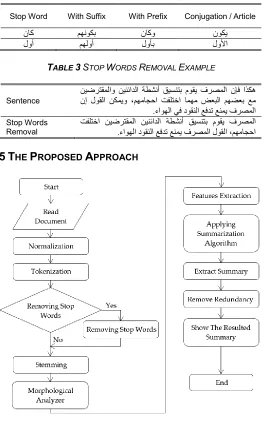
TABLE 2 STOP WORDS WITH SUFFIXES AND PREFIXES
Stop Word With Suffix With Prefix Conjugation / Article
ىاك نهًىكب ىاكو ىىكٌ
لوأ نهلوأ لوأب لولأا
TABLE 3 STOP WORDS REMOVAL EXAMPLE
Sentence
ىإف اركه يٍضرتقولاو يٌٍئادلا ةطشًأ قٍسٌتب مىقٌ فرصولا ىإ لىقلا يكوٌو ،نههاجحا تفلتخا اوهه ضعبلا نهضعب عه
ءاىهلا ًف دىقٌلا عفدت عٌوٌ فرصولا
. Stop Words
Removal
تفلتخا يٍضرتقولا يٌٍئادلا ةطشًأ قٍسٌتب مىقٌ فرصولا ءاىهلا دىقٌلا عفدت عٌوٌ فرصولا لىقلا ،نههاجحا
.
5
T
HEP
ROPOSEDA
PPROACHFig. 1. Proposed Approach.
In this section the proposed approach is discussed. Fig. 1 shows the flow charts of the proposed approach which starts with reading the text from document then do the pre-processing steps, and features extraction then applying summarization algorithm and extract the summary. The proposed approach discussed in more details in the following lines.
5.1 Read Document:
An Arabic utf-8 encoded Arabic document is read.
5.2 Preprocessing Stage:
In this stage the input text is processed and prepared to the summarization process, the pre-processing done in the following steps:
5.2.1 Normalization:
Normalization is the process of making a text more consistent by replacing and unifying some character’s shapes like “أ”
5.2.2 Tokenization:
Tokenization, is the process of splitting text into its basic units. This unit may be paragraphs, sentences, words, characters, numbers or any other appropriate unit [19]. The main basic units in tokenization are paragraph, sentence, and words [20].
5.2.3 Stop Words Removal:
According to the proposed approach, the dealing with stop words goes through two options: (1) removing stop words, (2) keeping stop words. So, the system worked into two ways, removing stop words and extract the summary then evaluate it. The second way is keeping the stop words then extract and evaluate the summary. and finally compare the results.
5.2.4 Structured Preprocessing:
Some structures and NLP techniques are used in this stage to enhance the text summary results. In stemming process, the word returned to its root. Khoja stemmer [21] is used in as a root stemmer in this research.
5.2.5 Morphological Analysis and Part of Speech Tagging:
Arabic is one of the most complex morphological languages. There are no capital and small letters in Arabic as an example, so we cannot distinguish between nouns and non-nouns words. Each word in the sentence has its own part of speech that matches its position in the sentence and the connection between the sentences and the sentence root. AlKhalilMorpho [22] is used as morphological analyzer in this research. After morphological analysis is done, each words in the sentence is tagged with its position.
5.3 Features Extraction:
There are many features to be extracted from the text depending on the used summarization approach. The used features in this paper are:
i. Term Frequency –Inverse Document Frequency
Salient terms are important in the summarization process, it is used as main feature in the statistical approach, these words are occurring repeatedly in the text. The calculation of term frequency done by counting the number of times where this term appears in the sentences. Term frequency always calculated in associate with inverse document frequency measure, which labeled with TF-IDF [23]. TF-IDF for a term (word) in the sentence is calculated as in Equations (1), (2) and (3). Where “t” is the specified word, TF is term frequency which is the number of times this term appears in the document divided by the number of all terms in the document; is used to define the importance of this term in the document, IDF is inverse document frequency. IDF used to define the amount of information this term provided. IDF equals the log of number of sentences where this term appears divided by the number of all sentences in the document. The TF-IDF for the sentence is the summation of TF-IDF for every word in this sentence as shown in Equation (4).
ii. Cosine Similarity
Is also an important feature. The cosine similarity between two sentences is calculated according to Equation 5.
Number of occurrences of term t in document TF( )
Total number of all terms in the document
t (1)
2137
TF-IDF( )=TF( )*IDF( )t t t (3)
TF-IDF( )=s
t sTF-IDF( )t (4)Equation (5) is used to compute the cosine similarity between sentence (Si) and (Sj). where “m” is the count of mutual words between the two sentences and “k” is the offset of the word in the mutual list. TF-IDF(tik): is the TF-IDF of the term number k in the mutual list in (Si), TF-IDF(tjk): is the TF-IDF of the term number k in the mutual list in (Sj). in another word to calculate the cosine similarity between sentence Si & (Sj) we do the following steps: (1) calculate TF-IDF for every single term in the both sentences according to Equation (3). (2) find the list of mutual words between the two sentences, the length of this list is “m”. (3) we iterate on the mutual list and applying Equation (3).
1
2 2
1 1
TF-IDF( ) *TF-IDF( ) Cosine_Similarity( , )
TF-IDF( ) * TF-IDF( )
m
ik jk
k
m m
ik jk
k k
t t
Si Sj
t t
(5)iii. Nouns Extraction
Arabic nouns are words describing a person, a thing, a place, or an idea. When nouns appear in sentences, the sentence weight is increased with presence of extra information in this sentence compared to other sentences. Therefore, this approach is focused on the power of using proper nouns in the process of feature extraction and weighing process [4]. To extract the nouns from the text. Morphological analysis is applied, then POS tagging is also used. Equation (6) shows the calculation of nouns measure by getting the count of mutual nouns between two sentences then divided it by the total number of nouns in the two sentences.
Nouns_List( ) Nouns_List( ) Nouns_Measure( , )
Nouns_List( ) Nouns_List( )
Si Sj
Si Sj
Si Sj
(6)
5.4 Summarization Models:
The summarization model is the template or the shape were the document will be describing as. In this research the model is the graph model. In this research the document is presented as a graph and the sentences is the graph nodes and the weight of the edges is the summation of cosine similarity between the two sentences and the noun measures that is calculated as in Equation (5) and (6) respectively.
5.5 Summarization Algorithm
In this step minimum spanning tree [24] is applied to find the spanning tree, then the node is ranking according to its number of children.
5.6 Summary Extraction
After applying the summarization algorithm and ranking sentences according to its number of children, then the summary is extracted according to pre-defined compression ratio which in this research equals to 30%.
5.7 Removing Redundancy
In the resulted summary the redundant sentences is removed according to the overlapping between the selected sentence and the sentences is already joined in the summary.
6
E
XPERIMENTATION AND RESULTS:
6.1 Dataset (Corpus):
Essex Arabic Summaries Corpus (EASC) [25] is used as dataset to evaluate the system. EASC includes 10 subjects: art, music, environment, politics, sports, health, finance, science and technology, tourism, religion, and education.
6.2 Evaluation metrics:
Precision, Recall and F-measure are used as summary's performance measurement indicator. The value of Precision recall and F-measure will be calculated as in Equation (7), Equation (8) and Equation (9) respectively.
• Precision: To metric the correct text size that is returned by the system.
Extracted Summary Provided Summary Precision=
Extracted Summary
(7)
• Recall: The metric coverage system reflects the ratio of the extracted relevant sentences.
Extracted Summary Provided Summary Recall=
Provided Summary (8)
• F-measure: Works a balance relation among recall metric and precision metric.
2*Precision*Recall F-measure
Precision+Recall
(9)
6.3 Experiment Setup:
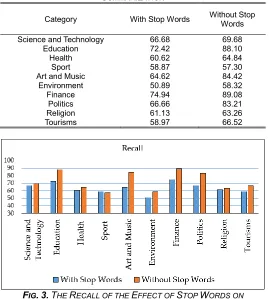
In this section EASC corpus is used to evaluate the system. The results done using AL Khalil morphological analyzer [26]. The effect of stop words is discussed here. The experiment is done using stop words removal and without using stop words removal. Table 4 and Fig 2 show the results of precision when removing stop words from the text, and when keeping the stop words from the text, the results are categorized according to its content's category. obviously, when removing the stop words from the text, the summary precision is better .Table 5 and Fig 3 show the results of recall as performance measure metric. The results show when removing the stop words from the text, the recall is enhanced. Also the f-measure is enhanced when using stop words removal as shown in table 6 and Fig 4.
TABLE 4THE PRECISION OF THE EFFECT OF STOP WORDS ON
SUMMARIZATION
Category With Stop Words Without Stop Words Science and Technology 65.88 73.86
Education 66.10 61.80
Health 64.42 61.66
Sport 47.83 61.77
Art and Music 61.60 59.71
Environment 54.65 54.62
Finance 67.27 74.07
Politics 61.06 65.68
Religion 56.19 59.75
Fig. 2. The Precision of the Effect of Stop Words on Summarization.
TABLE 5THE RECALL OF THE EFFECT OF STOP WORDS ON
SUMMARIZATION
Category With Stop Words Without Stop Words Science and Technology 66.68 69.68
Education 72.42 88.10
Health 60.62 64.84
Sport 58.87 57.30
Art and Music 64.62 84.42
Environment 50.89 58.32
Finance 74.94 89.08
Politics 66.66 83.21
Religion 61.13 63.26
Tourisms 58.97 66.52
FIG.3. THE RECALL OF THE EFFECT OF STOP WORDS ON
SUMMARIZATION
Table 6 The F-measure of the Effect of Stop Words on Summarization
Category With Stop Words Without Stop Words Science and Technology 66.28 71.71
Education 69.12 72.64
Health 62.46 63.21
Sport 52.78 59.45
Art and Music 63.07 69.95
Environment 52.70 56.41
Finance 70.90 80.88
Politics 63.74 73.41
Religion 58.56 61.45
Tourisms 57.98 64.55
FIG.4. THE F-MEASURE OF THE EFFECT OF STOP WORDS ON
SUMMARIZATION
As explained previously stop words make more calculation without any important in the sentences so removing it improves the results of summary metrics. This improvement came from reducing the amount of text to be analyzed, and keeping only the words that affect directly on the weighting process.
7
C
ONCLUSION:
This Paper discussed the effects of stop words removal process from the system on the performance of summarization process. In this research, a graph-based algorithm is built and AlKhalil morphological analyzer used as morphological analyzer. The process of text summarization goes through multiple stages: pre-processing stage, features extraction and building summarization model stage, and finally applying the summarization algorithm and extracting the summary stage. Stop-words removal is one of pre-processing techniques used in the summarization process. The algorithm using nouns count as a feature, which extracted from the text as a result of structural analysis. The number of nouns in the sentence is used to improve the quality of text summary. The other used features is TF-IDF and sentence similarity. After applying summarization algorithm, the summary is extracted depending on two factors: (1) compression ratio, and (2) removing redundancy. After that the summary is build up and the sentences is order depending on its order in the original text. The EASC corpus used as dataset to discuss the results of stop words removal. Finally, when stop words is removed the results is better than keeping them in the text.
R
EFERENCE:
[1] Alami, N., Meknassi, M., Ouatik, S. A., & Ennahnahi, N. (2016, October). Impact of stemming on Arabic text summarization. In 2016 4th IEEE International Colloquium on Information Science and Technology (CiSt) (pp. 338-343). IEEE.
[2] Haywood, J. A., Nahmad, H. M., & Thatcher, G. W. (1965). A new Arabic grammar of the written language. London: Lund Humphries.
[3] Abu-Errub, A. (2014). Arabic Text Classification Algorithm using TF.IDF and Chi Square Measurements. International Journal of Computer Applications IJCA., 93: 40-45.
2139 arabic language. In International conference on IT,
Thailand.
[5] Hovy, E., & Lin, C. Y. (1999). Automated text summarization in SUMMARIST. Advances in automatic text summarization, 14.
[6] Mani, I., & Maybury, M. T. (2001). Automatic summarization John Benjamin’s publishing Co.
[7] El-Khair, I. A. (2006). Effects of stop words elimination for Arabic information retrieval: a comparative study. International Journal of Computing & Information Sciences, 4(3), 119-133.
[8] Alajmi, A., Saad, E. M., & Darwish, R. R. (2012). Toward an ARABIC stop-words list generation. International Journal of Computer Applications, 46(8), 8-13.
[9] Douzidia, F.S. (2004). Automatic summarization of Arabic text. Memory presented at the Faculty of Graduate Studies, University of Montreal.
[10] Hadni, M., Lachkar, A., & Ouatik, S. A. (2014). Multi-Word Term Extraction based on New Hybrid Approach for Arabic Language.
[11] Sawalha, M., & Atwell, E. (2008). Comparative evaluation of Arabic language morphological analysers and stemmers. Colling 2008: Companion volume: Posters, 107-110.
[12] Eldin, S. (2007). Development of a computer-based Arabic Lexicon. In the Int. Symposium on Computers & Arabic Language, ISCAL, Riyadh, KSA.
[13] Al-Taani, A. T., & Al-Omour, M. M. (2014). An extractive graph-based Arabic text summarization approach. In The International Arab Conference on Information Technology, Jordan.
[14] Malallah, S., & Ali, Z. H. (2019). Multilingual Text Summarization based on LDA and Modified PageRank. Iraqi Journal of Information Technology, 9(3), 161-131.
[15] Al-Abdallah, R. Z., & Al-Taani, A. T. (2019, February). Arabic Text Summarization using Firefly Algorithm. In 2019 Amity International Conference on Artificial Intelligence (AICAI) (pp. 61-65). IEEE.
[16] B. Alhadidi, and M. Alwedyan, (2008, January). Hybrid Stop-Word Removal Technique for Arabic Language, Egyptian Computer Science Journal, 30 (1), 35-38. [17] El-Khair, I. A. (2006). Effects of stop words elimination
for Arabic information retrieval: a comparative study. International Journal of Computing & Information Sciences, 4(3), 119-133.
[18] Gharib, T. F., Habib, M. B., & Fayed, Z. T. (2009). Arabic Text Classification Using Support Vector Machines. IJ Comput. Appl., 16(4), 192-199.
[19] Alotaiby, F., Alkharashi, I., & Foda, S. (2009). Processing large Arabic text corpora: Preliminary analysis and results. In Proceedings of the second international conference on Arabic language resources and tools (pp. 78-82).
[20] Attia, M. A. (2007, June). Arabic tokenization system. In Proceedings of the 2007 workshop on computational approaches to Semitic languages: Common issues and resources (pp. 65-72). Association for Computational Linguistics.
[21] Khoja, S. (2001, June). APT: Arabic part-of-speech tagger. In Proceedings of the Student Workshop at NAACL (pp. 20-25).
[22] Boudchiche, M., Mazroui, A., Bebah, M. O. A. O., Lakhouaja, A., & Boudlal, A. (2017). AlKhalil Morpho Sys 2: A robust Arabic morpho-syntactic analyzer. Journal of King Saud University-Computer and Information Sciences, 29(2), 141-146.
[23] Abu-Errub, A. (2014). Arabic Text Classification Algorithm using TF.IDF and Chi Square Measurements, International Journal of Computer Applications IJCA, 93(6), 40-45.
[24] Cormen, T.H. (2009). Introduction to algorithms, MIT press.
[25] El-Haj M, Kruschwitz U, Fox C. (2010). Using Mechanical Turk to Create a Corpus of Arabic Summaries. Language Resources and Evaluation conference (LREC), May 17-23, Malta, p. 36-39. [26] Buckwalter, T. (2004, August). Issues in Arabic