Type of the Paper (Article)
Parameterisation and Optimisation of a Hand-Rake
Sweeper: Application in Olive Picking
Hidalgo-Fernández R.E. 1, Carranza-Cañadas P. 1, García-Salcedo F.J. 2 and Triviño-Tarradas P. 1,* 1 Department of Graphic Engineering and Geomatics, University of Cordoba, Campus de Rabanales, 14071
Córdoba, Spain. [email protected]; [email protected]; [email protected] 2 Independent Scholar: [email protected]
* Correspondence: [email protected]
Abstract: Olive picking is one of the most common social agricultural activities in many regions of Andalusia where the predominant crop is the traditional olive grove. The machinery used includes shakers, blowers and an essential low-cost type: hand-rake sweepers. The latter are generally used by the women of the squads to sweep the olives that fall from the trees. This article is focused on the design and optimisation of a hand-rake sweeper, in terms of durability and cost, for the picking of olives and other fruits, such as almonds, which are currently the main alternative to non-perennial crops in Andalusia.
A parametric design of a hand-rake sweeper was created for this application using the design software CATIA, and its most vulnerable points were analysed in terms of effectiveness with varying design parameters, conducting usage simulations with ANSYS for a light material such as polypropylene. The maximum von Mises stress of the whole structure was 155.81 MPa. Using ANSYS, the dimension parameters of the hand-rake sweeper structure were optimised. The modified design was analysed again, showing a reduction of maximum tensions of 10.06%, as well as a decrease in its maximum elongations (0.0181 mm).
Keywords: parametric design, rake, picking, static analysis, CATIA, ANSYS, von Mises stress.
1. Introduction.
The olive grove is one of the most important crops in Andalusia, occupying 47.24% of its cultivated surface area [1]; in fact, in some regions this is the only crop grown. It is also one of the most social crops, especially during the harvest, where the workforce employed is the most important expense, with an average of 13.83 wages per ha [1]. Picking represents 54.27% of the total wages required for the olive grove [2]. It is a job performed mostly by men, although women play a relevant role in the lighter tasks [3]. The machinery used includes manual shakers for branches, shakers coupled to the tractor’s power take-off for the tree trunks, blowers and bale pickers. On the other hand, there are other light weight tools, such as rods and hand-rake sweepers, which are used by part of the squad [3]. The latter are normally used by women to pile the olives that fall from the trees and facilitate their collection, preventing them from getting covered in dirt, which does not occur when carrying out this task using blowers [23].
Another crop, currently competing with the olive grove in the semiarid Mediterranean regions due to their profitability, is the almond grove [4]. Its harvest, although very mechanised, also poses
a high cost due to the number of wages required [5-6]. In such harvesting process, the use of the hand-rake sweeper is of special relevance [7]. The cost and durability of these hand-rakes is an important expense to take into account, since they tend to break easily and, thus, they must be replaced very often. The aim of this paper is to obtain the parameterised design and subsequent optimisation of a hand-rake sweeper, considering both the strains it can withstand and its cost. With the parameterisation of the hand-rake sweeper, it will be possible to simulate particular conditions, such as the different materials with which it can be manufactured and its use, depending on the different olive varieties. In addition, this will also allow extrapolating the application of this new tool to the harvest of other products, such as almonds.
2. Materials and Methods 2.1. Study object
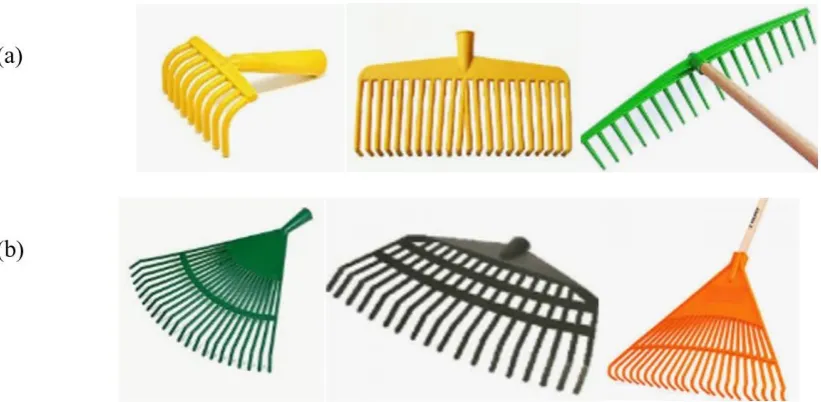
The hand-rake sweeper consists of one arm, traditionally made of wood (although nowadays it is usually made of metal), and a base of teeth or spikes, which were traditionally made of metal and are currently being replaced with plastic. Figure 1 shows some of the rakes that are commercialised these days: rectangular rakes (Figure 1a), which are formed with a directrix that sets all the teeth with the arm; and triangular rakes (Figure 1b), which open like a hand fan up to the length of the sweep, with transversal teeth that hold the main teeth/spikes together.
Figure 1. Types of rakes in the market: a) rectangular b) triangular.
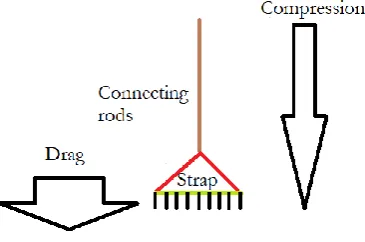
Figure 2. Stress diagram in rake operation.
The work applied by the rake during its use can be described as an action of thrust against the ground, plus a drag-in action (Figure 2). This operation is analysed using the structural “strut
-and-tie” model [8]. Such model consists in discretising a system of internal strains that shows compression and traction lines. This helps to separately “study” the functioning of each part of the target
instrument to be analysed. Figure 2 shows these traction and compression lines. The rake works by compression and dragging. The compression, that is, the “push” toward the ground, is transmitted through the handle of the rake, which works as a connecting rod, whereas its ends, which are resistant elements that transmit the force toward the ground, act as tie rods (Figure 3) [8].
The rake that was parameterised and analysed in this study is triangular, and the material used for its manufacture was polypropylene since it is currently the most widely used material. The rake is fabricated by the injection of molten plastic in a steel mould. Some advantages of using plastic are related to production, in addition to other reasons, such as being environmentally friendly, since plastic materials require lower energy consumptions for their manufacture. Moreover, they also show advantages in terms of durability, since plastic packages are practically unbreakable, which prevents spilling or damage to the food products, and in terms of hygiene, as they do not rust. For the design of the rake, polypropylene and wood were chosen for the base of the body and the handle, respectively. A parametric design was developed using the CATIA software.
2.2. Parametric design of the rake
A parametric design was developed using the CATIA software. Since it is a relatively flat object, without stiffeners, there will be a low risk of undesired shrinkages and manufacturing defects derived from contractions during solidification [9].
Figure 3. Strain scheme.
For the parameterisation of the rake, this was considered to be solid inside. To observe the
behaviour of each of the elements that make up the rake, the “strut-and-tie” model was used, which
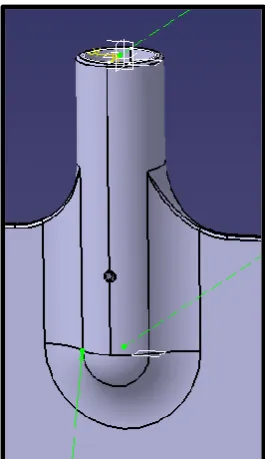
Figure 4. CATIA representation of the section for coupling the handle to the main body of the rake.
The next part is flat, in order to transmit the push and compression tensions from the handle, where the strain is applied down to the teeth/spikes. The teeth cannot be placed directly at the level of the handle, since a space of around 45º is required to allow for the correct action of the connecting rod. This design is based on models that are already in the market. Applying the “strut-and-tie”
model, a compression direction of 45º from the handle to the teeth/spikes was designed (Figure 5). The brand or commercial identity of the rake does not have a mould release (draft), since it is 0.3 mm thick and it was thus considered unnecessary. The next area in the parametric design is the teeth of the rake, which expand to the final zone, where they are curved.
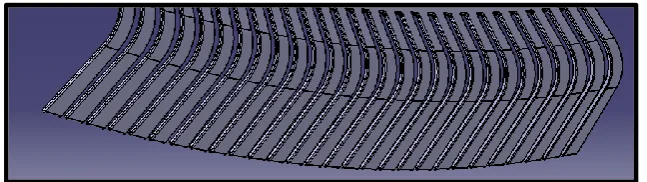
Figure 6. CATIA representation of the area of the teeth/spikes of the rake.
In the design, a certain tooth-to-tooth distance was set according to the objects to be swept, i.e., olives in this case, which could vary depending on the olive variety or the type of fruit, to prevent them from passing through the space between teeth. The two stiffening arches shown in Figure 6 strengthen the rake to prevent it from widening during sweeping. These act as tie rods that “sew”
the main directrices. Lastly, the end of the teeth/spikes are curved inwards to facilitate the sweeping (Figure 7). Figure 8 shows the posterior part of the rake.
Figure 7. Representation of the end of the teeth/spikes.
Figure 8. Representation of the posterior part of the rake.
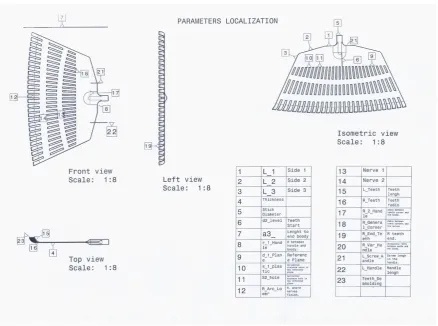
There are three types of parameters that can and cannot be modified in the design of the rake, influencing its optimisation. The optimisation of the design requires the minimisation of the traction tensions in the flexed area and the reduction of the volume. Table 1 shows the classification of such parameters according to a colour code. Figure 9 shows the description of each parameter.
Table 1. Colorimetric classification of the parameters for the design of a hand-rake sweeper.
FIXED PARAMETERS: fundamentally, they depend on the type of fruit to be swept. They are set at the beginning of the design and are not modified. For
example, “total rake width”, that is, the length to be swept per sweep.
MODIFIABLE PARAMETERS WITH NO REPERCUSSION IN THE STRUCTURAL OPTIMISATION OF THE MODEL: these parameters do not influence the optimisation of the design. For example, “tooth radius” and “draft angle”.
STUDY PARAMETERS: these must be modified to influence the optimisation of the design.
Figure 9. Description of the parameters of the hand-rake sweeper.
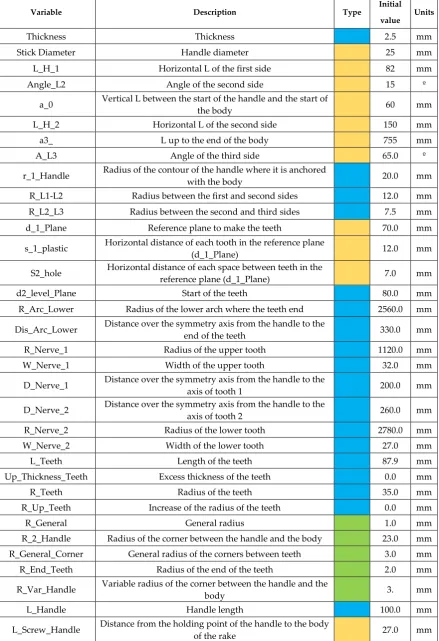
Table 2. Design parameters and their initial values.
Variable Description Type Initial
value Units
Thickness Thickness 2.5 mm
Stick Diameter Handle diameter 25 mm
L_H_1 Horizontal L of the first side 82 mm
Angle_L2 Angle of the second side 15 º
a_0 Vertical L between the start of the handle and the start of
the body 60 mm
L_H_2 Horizontal L of the second side 150 mm
a3_ L up to the end of the body 755 mm
A_L3 Angle of the third side 65.0 º
r_1_Handle Radius of the contour of the handle where it is anchored
with the body 20.0 mm
R_L1-L2 Radius between the first and second sides 12.0 mm
R_L2_L3 Radius between the second and third sides 7.5 mm
d_1_Plane Reference plane to make the teeth 70.0 mm
s_1_plastic Horizontal distance of each tooth in the reference plane
(d_1_Plane) 12.0 mm
S2_hole Horizontal distance of each space between teeth in the
reference plane (d_1_Plane) 7.0 mm
d2_level_Plane Start of the teeth 80.0 mm
R_Arc_Lower Radius of the lower arch where the teeth end 2560.0 mm
Dis_Arc_Lower Distance over the symmetry axis from the handle to the
end of the teeth 330.0 mm
R_Nerve_1 Radius of the upper tooth 1120.0 mm
W_Nerve_1 Width of the upper tooth 32.0 mm
D_Nerve_1 Distance over the symmetry axis from the handle to the
axis of tooth 1 200.0 mm
D_Nerve_2 Distance over the symmetry axis from the handle to the
axis of tooth 2 260.0 mm
R_Nerve_2 Radius of the lower tooth 2780.0 mm
W_Nerve_2 Width of the lower tooth 27.0 mm
L_Teeth Length of the teeth 87.9 mm
Up_Thickness_Teeth Excess thickness of the teeth 0.0 mm
R_Teeth Radius of the teeth 35.0 mm
R_Up_Teeth Increase of the radius of the teeth 0.0 mm
R_General General radius 1.0 mm
R_2_Handle Radius of the corner between the handle and the body 23.0 mm R_General_Corner General radius of the corners between teeth 3.0 mm
R_End_Teeth Radius of the end of the teeth 2.0 mm
R_Var_Handle Variable radius of the corner between the handle and the
body 3. mm
L_Handle Handle length 100.0 mm
L_Screw_Handle Distance from the holding point of the handle to the body
D_Screw_Handle Diameter of the handle screw 1.5 mm
Teeth_Drafting Drafting of the teeth 25.0 º
Handle_Drafting Drafting of the inside of the handle 3.0 º
General_Drafting General drafting 1.5 º
2.3. Design optimisation
The worker applies a drag and compression strain toward the ground when piling the olives, which is transmitted to the body of the rake, moving the teeth backwards and pushing them against the ground (Figure 10).
Figure 10. Strain scheme of the rake in action.
The rake is subjected to two types of flection (Figure 11): one in the line of teeth, which are curved backwards, and another one in the body of the rake, which is curved with the teeth/spikes. The wooden handle remains embedded while the body of the rake works. The teeth flex backwards. There is a maximum flexion at the start of the teeth in the central body.
The flexion of the teeth can be divided into two areas: one subjected to traction strains in the area to be swept, and another one subjected to compression in the swept area. Since it is a plastic material, the compressed area will plastify, whereas the tractionated area will stretch until it brakes [10].
Figure 12. Flexion-traction scheme in a beam [11].
There is a neutral fibre, represented with a dotted line in the middle of the object, that is not subjected to any strain. The side that curves suffers a traction (side A), and thus the fibre flexes to open and the failure occurs. In side B, the fibre compresses, suffering a crush in such area (Figure 12). To optimise the product, the values of the design variables will be modified after their parameterisation. There are several options to improve the product:
- Strengthening the flexed area with more material to reduce the tensions.
- Re-dimensioning the parameters of the entire set, in a way that the tensions decrease in the
failure area.
Minimising the volume of the object and designing with the smallest amount of material possible is fundamental for the product to be economical. Using the ANSYS finite element program, an analysis of von Mises tensions was carried out to optimise the design of the rake from specific contour, strain and displacement conditions [12]. The Finite Element Method (FEM) is a suitable analysis to examine these aspects in a quantitative way for optimisation purposes [13-15]. This software, ANSYS, allows conducting strain simulations to analyse the most favourable distribution of tensions and optimising it according to the finite element analysis. ANSYS has a special module for the optimisation of the structural design of objects. A scripting language is used, using a parametric model in term of variables, in order to enable variables changes over the optimisation process [16]. The hand-rake sweeper stress patterns depend on the structure geometry, the magnitude of the loads, the mechanical properties of the materials, and the physical conditions of use [13]. Thus, the flow of tensions through the body of the rake was observed, and each parameter was modified in order to minimise its total volume, reducing the tractions in the breaking area, that is, in the anchoring of the teeth with the body.
Figure 11 shows the strains to which the working rake is subjected. These loads are continuous, but not cyclic. When lifting the rake to move it backwards, there is a relaxation time in which it recovers its initial position. A static analysis was conducted to optimise all the variables except two: thickness and strengthening in the flexed area. In the dynamic analysis, these two variables were adjusted. Table 3 shows the initial and modified values of the design parameters to be optimised.
Table 3. Design parameters of the rake. Modified values.
Parameter
No.
tests Description Type
Initial value (mm)
Modified value (mm)
r_1_Handle
2 Radius of the contour of the handle where it is anchored to the
body 20.0 40.0
R_L1-L2
2 Radius between the first and
second sides 12.0 20.0
R_L2_L3
2 Radius between the second and
third sides 7.5 20.0
W_Nerve_2 3 Width of the bottom spike 27.0 40.0
L_Teeth 4 Tooth length 87.9 30.0
R_Up_Teeth 4 Increase of tooth radius 0.0 3.0
R_End_Teeth 6 Final tooth radius 2.0 1.5
For the distribution of tensions, the “strut-and-tie” model was used. The plastic material considered for the rake was polypropylene, with the following mechanical properties: Young’s
modulus (E = 1400 MPa) and Poisson ratio (ν = 0.42).
The von Mises stress or equivalent tensile stress can be formulated as a scalar value of stress that can be computed from the Cauchy stress tensor. A certain material is said to start yielding when the von Mises stress reaches its yield strength. The von Mises stress is used to predict yielding of materials under complex loading from the results of uniaxial tensile tests. Von Mises stress, total deformation and the safety factor values are calculated by conducting static structural analysis with the ANSYS software [17]. This analysis is applicable for the study of ductile materials undergoing plastic deformation [14]. The von Mises stress fulfils the singularity where two stress states with equal distortion energy have an equal von Mises stress. A high von Mises stress value is understood as an indicator of high possibility of failure [18].
Equivalent stress: the equal stress portrays the direct components. It is based on standard load failure criteria.
Total deformation: this is the change in an object when there is a force applied. Authors such as Punarselvam et al. [19] stated that this is the most valuable parameter to analyse the stresses.
Design optimisation consists in modifying certain parametric variables and conducting an ANSYS analysis in an iterative way, in order to calculate the total deformation and the maximum von Mises stress reductions of the final modified design [12].
3. Results and discussion
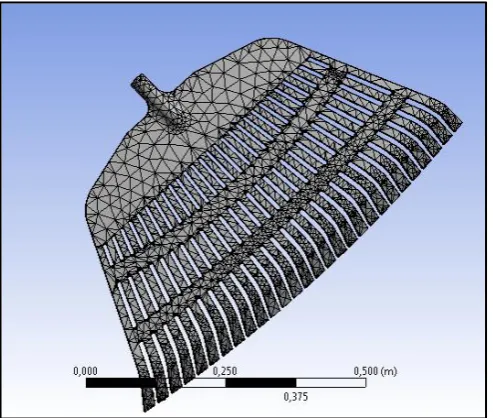
To study the flow of tensions using the ANSYS software, neither the brand of the commercial product nor the hole in the handle were considered. These two “Bodiess”, so called by ANSYS, do not influence the tension level of the body, and thus their removal simplifies the study. Firstly, the behaviour of the tensions with the initial design values was observed, in order to obtain a first idea on how to improve the rake. Figure 13 shows the non-structured triangular mesh provided by this software by default. Using the “Refinement” command, it was possible to apply a condensation of triangles in the area where the handle is embedded with the body. Then, in a first static test, a “push”
and 0 mm in the vertical direction. The ambient temperature considered was 8ºC, as an illustrative average of the temperature at which the rake is used in the time of olive harvest. An average sweep duration of 0.4 s was considered.
Figure 13. Non-structured triangular mesh created with ANSYS.
Von Mises stress, deformation and factor of safety plots were obtained by conducting static structural analyses. Figure 14 shows the factor of safety obtained in this first static test. It is the ratio of the yield to the maximum stress developed. The minimum factor of safety obtained was 1.6045 (≥
1), which suggests that the hand-rake sweeper model is safe [20-21].
Figure 14. ANSYS factor of safety.
Figure 15. Total deformations obtained with ANSYS - initial situation (test 1).
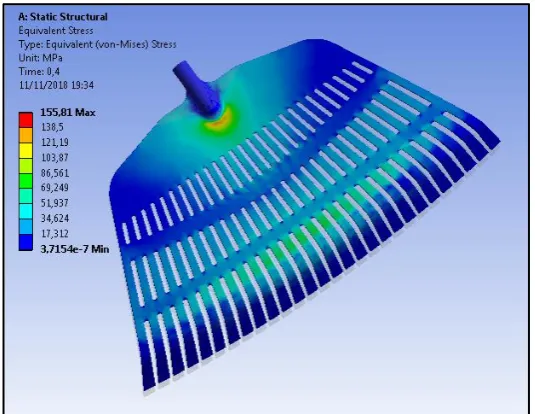
The result of the static test was 5.0197 mm of maximum deformation, which was concentrated in the final area of the teeth of the rake (Figure 15). As is shown in Figure 16, the areas with greater tension were located at the start of the final sections of the central teeth and the adjacent area where the handle is embedded in the main body of the rake, which needed to be strengthen by adding more material. The following values were obtained: 3.71x10⁻⁷ MPa (minimum equivalent stress) and 155.81 MPa (maximum equivalent stress).
Figure 16. ANSYS von Mises tensions of the rake – initial level (test 1).
3.1. Design optimisation
Table 4. Rake design modified parameters (test 2).
Parameter Initial value (mm) Modified value (mm)
r_1_Handle 20.0 40.0
R_L1-L2 12.0 20.0
R_L2_L3 7.5 20.0
Figure 17. Modified design parameters (r_1_ Handle; R_L1_L2; R_L2_L3), (test 2).
Figure 18. ANSYS von Mises tensions with modified design parameters (test 2).
Figure 19. ANSYS total deformations (test 2).
However, the modification of such design parameters did not influence the deformation results of the test, obtaining a maximum total deformation of 5.0222 mm (Figure 19).
Next, to continue with the optimisation of the design, the width of the lower spikes was modified, which is a parameter related to the teeth (test 3). This parameter (W_Nerve_2) was increased from 27 to 40 mm to gather the tensions of the embedment of the teeth (Table 5). That is, the start of the teeth was modified, changing from a plane to an arch (Figure 20). This modification was performed at the end of the optimisation. The other parameters were not modified since they were considered to be of little or no relevance in the optimisation.
Table 5. Modified rake design parameter (test 3).
Parameter Initial value (mm) Modified value (mm)
W_Nerve_2 27.0 40.0
Figure 21. ANSYS von Mises tensions (test 3).
Figure 21 shows that the maximum von Mises tensions increased to 212.15 MPa, which is a 46.84% increase from the value obtained in test 2 (144.47 MPa) and 36.16% with respect to the first test. Therefore, it is deduced that the increase in nerve width 2 was not relevant for the optimisation. However, the minimum von Mises tensions decreased 6.94% with respect to the improvement achieved in test 2. Similarly, Arcar et al. [24], in one of their optimisation tests for an automobile torque arm, managed to maintain the maximum tension while decreasing the minimum tensions by 53.88%, although the optimal achievement in design optimisation is to decrease both the maximum and minimum tensions [25-26].
Figure 22. ANSYS total deformations (test 3).
Table 6. Modified rake design parameters (test 4).
Parameter Initial value (mm) Modified value (mm)
L_Teeth 87.9 30.0
R_Up_Teeth 0.0 3.0
Figure 23. Modified design parameters (R_Up_Teeth, L_Teeth) (test 4).
In the third modification (test 4), the maximum tension decreased again, down to 144.87 MPa (Figure 24), although it is still slightly higher than that obtained in test 2. The maximum von Mises tensions decreased by 7.02% and the minimum tensions decreased by 74.64% with respect to the first test (initial level). However, in test 4, the obtained results are less promising than the ones obtained in test 2, in which the values of both tensions (maximum and minimum) were optimal.
Figure 24. ANSYS von Mises tensions (test 4).
Figure 25. ANSYS total deformations (test 4).
Another improvement of the design of the rake, achieved in test 5, resulted from strengthening the lower embedment area of the handle where the tensions accumulate, designing it with excess thickness (Figure 26). Using ANSYS, a “Face Sizing” was applied to the strengthened area, in order to facilitate the capture of the points (Figure 27).
Figure 26. Concentration of tensions in the handle.
Figure 28. ANSYS von Mises tensions (test 5).
In test 5, there were significant decreases in maximum von Mises tension (140.13 MPa), around 3.00% with respect to the value obtained in test 2, which makes it the optimal design. Moreover, there was a 47.58% decrease in the minimum tensions with respect to test 2 (Figure 28). The tension accumulation areas that were strengthened showed lower tension values, between 62 and 77 MPa. By strengthening the lower embedment area of the handle, it was possible to reduce the maximum von Mises tension by 10.06% with respect to the initial test.
Figure 29. ANSYS total deformations (test 5).
with respect to the initial situation. The total deformation decreased by 0.36% with respect to the initial test.
3.2. Possible future improvements
Another improvement worth studying consists in reducing the volume of the material required to manufacture the object. To this end, it is proposed to reduce the general thickness of the plastic (polypropylene) to 1.8 mm. In this improvement simulation, it is also proposed to reduce the final tooth radius to 1.5 mm (Table 7).
Table 7. Rake design parameters to modify in future research lines for its optimisation.
Parameter Initial value (mm) Modified value (mm)
Thickness 2.5 1.8
R_End_Teeth 2.0 1.5
Figure 30 (a and b) show the development and location of the teeth.
Figure 30. Development (a) and location (b) of the teeth.
5. Conclusions
The most widely used rakes in olive harvest is a model of plastic injection. In this study, it was possible to parameterise such rake using the CATIA software. The parameters that must be established for its optimisation are the following:
- Sweep distance: the distance between the ends. This usually ranges between 50 and 70 cm.
- A compression direction of 45º from the handle to the teeth, creating two lines at 45º from the two ends toward the embedment area of the handle.
Regarding the optimisation, once the main scheme was designed, interesting results were obtained by strengthening the lower embedment area of the handle, with excess thickness or stiffeners, where the tensions accumulate. The von Mises tensions were reduced by 10.06%, and the
total deformation by 0.36%. The increase of the radius of the contour of the handle where it anchors to the body of the rake, as well as the radius between the first and second sides and between the second and third sides, reduced the maximum tensions by 7.28%. Once the part where the greatest tensions accumulate is strengthened, it suffices to shape the teeth (curved or straight) depending on the product to be swept, to fix the final distance between teeth. Lastly, it is also convenient to design the corresponding union arches.
6. Future improvements
By considering the internal functioning of the rake, according to the strut-and-tie model, the possible improvements regarding the design must be explored based on such knowledge related to the behaviour of the strain of the rake fibres. Firstly, the areas at risk of failure, that is, the tractionated areas, must be strengthened with greater thickness (in this study, this was the area of the final teeth where they are anchored to the body of the rake). Secondly, the posterior part of the teeth must be strengthened in the area where they are bound to the traction strengthening strap.
Author Contributions: conceptualisation, F-J.G-S. and R-E.H-F.; methodology, F-J.G-S., R-E.H-F and P.T-T.; validation, F-J.G-S. and R-E.H-F.; investigation, F-J.G-S., R-E.H-F. and P.T-P.T-T.; resources, F-J.G-S.; data curation, F-J.G-S., P.C-C and P.T-T.; writing—original draft preparation, F-J.G-S., P.T-T. and P.C-C.; writing—review and editing, R-E.H-F., P.C-C. and P.T-T.; supervision, P.T-T and P.C-C.
Funding: This research received no external funding. Conflicts of Interest: The authors declare no conflict of interest.
References
1. MAPAMA, 2019. Encuesta sobre superficies y rendimientos de cultivos. Ministerio de Agricultura, Pesca y Alimentación. Available in: https://www.mapa.gob.es/es/estadistica/temas/estadisticas-agrarias/boletin2019_tcm30-536911.pdf (accessed on 20/06/2020).
2. Consejería de Agricultura, 2002. El Olivar Andaluz. Unidad de Prospectiva. Available in: http://www.juntadeandalucia.es/agriculturaypesca/prospectiva/Olivar4_doc_sinAnexo.pdf (accessed on 24/06/2020).
3. Anta-Félez, J.L.; Peinado-Rodríguez, M. Women in Andalusian olive grove. New and old forms in agricultural work. Methaodos.revista de ciencias sociales. 2019, 7 (2): 302-313. http://dx.doi.org/10.17502/m.rcs.v7i2.285
4. Romero, P.; García, J.; Botía, P. Cost-benefit analysis of a regulated deficit-irrigated almond orchard under subsurface drip irrigation conditions in Southeastern Spain. Irrigation Science 2006, 24: 175-184. DOI: DOI 10.1007/s00271-005-0008-6.
5. Birger, R.; Abd-ElHadi, F.; Ronen, A.; Cohen, E.; Ankorion, Y.; Najjar, A.; Moreno, J. Olive HarvesVant, a new harvest-aid formulation for improving fruit abscission and mechanical harvesting. Proceedings of the Fifth International Symposium on olive growing, Vol 1 and 2. Ozkaya, MT; Lavee, S.; Ferguson, L. DOI: 10.17660/ActaHortic.2008.791.36
6. Morales-Sillero, A.; Rallo, P.; Jimenez, M.R.; Casanova, L.; Suarez, M.P. Suitability of Two Table Olive Cultivars ('Manzanilla de Sevilla' and 'Manzanilla Cacerena') for Mechanical Harvesting in Superhigh-density Hedgerows. Hortscience 2014, 49 (8), 1028-1033. DOI: 10.21273/HORTSCI.49.8.1028
phenolic and volatile compounds of oils from intensive and super-intensive olive orchards. Sci. Hortic. 2020, 263, 109045.
8. ACHE Comisión 1 GT1/3. El modelo de bielas y tirantes. Monografía M-6, Ed. 2002, ACHE.
9. Loizaga, A.; Serturcha, J.; Suárez, R. Defectos metalúrgicos generados por la presencia de gases en el metal fundido. An. Quim 2008, 104(2), 111-119.
10. Patel, D.K.; kalidindi, S.R. Correlation of spherical nanoindentation stress-strain curves to simple compression stress-strain curves for elastic-plastic isotropic materials using finite element models. Acta Mater 2016, 112. 295-302.
11. Ingeniería y Construcción, 2020. Available in:
https://civilgeeks.com/2011/10/23/la-plastificacion-de-la-seccion-transversal-de-una-viga-respuesta-a-la-pregunta-de-estructuras-metalicas/
(Accessed on 25/05/2020).
12. Yao, K.T.; Chen, C.S.; Cheng, C.K.; Fang, H.W.; Huang, C.H.; Kao, H.C.; Hsu, M.L. Optimization of the Conical Angel Design in Conical Implant-Abutment Connections: A Pilot Study Based on the Finite Element Method. Journal of Oral Implantology 2018. 44 (1): 26-35.DOI: 10.1563/aaid-joi-D-17-00149 13. Hedia, H.S.; Barton, D.C.; Fisher, J.; Elmidany, T.T. A method for shape optimization of a hip prothesis
to maximize the fatigue life of the cement. Med. Eng. Phys 1996, 18 (8): 647-654.
14. Ghosh, T.; Roy, A.; Mishra, R.; Kamlesh, S.S. Structural optimization of a CT guided robotic arm based on static analysis. Materialstoday: Proceedings 2018, 5: 19586-19593.
15. Wang, X.; Li, B.; Yang, Z. Finite Element Analysis and Lightweight Optimization Design on main Frame Structure of Large Electrostatic Precipitator. Advances in Materials Science and Engineering 2018, 9:1-11. DOI: 10.1155/2018/4959632
16. Javidinejad, A. Theory in parametric design optimization approach via finite element analysis. Adv Theor Appl Mech 2012, 5: 217-224.
17. Ramesh, B.T.; Koppad, V.; Raju, H. Analysis Optimization of Connecting Rod With Different Materials. World Journal of Research and Review 2017, 4 (1): 33-39.
18. Ozkurt-kayahan, Z.; Turgut, B.; Akin, H.; Kayahan, M.B.; Kazazoglu, E. A 3D finite element analysis of stress distribution on different thicknesses of mineral trioxide aggregate applied on various sizes of pulp perforation. Clin Oral Invest 2020, 1-7. https://doi.org/10.1007/s00784-020-03218-3
19. Punarselvam, E., Sikkandar, M.Y., Bakouri, M., Parakash, N.B., Jayasankar., T., Sudhakar, S. J Ambient Intell Human Comput 2020. https://doi.org/10.1007/s12652-020-01939-7.
20. Budynas, R.G.; Nisbett, J.K. Shigley’s Mechanical Engineering Design, 9th edn. (McGraw-Hill Publisher, New York, 2011).
21. Jahanbakhshi, A.; Heidarbeigi, K. Simulation and Mechanical Stress Analysis of the Lower Link Arm of a Tractor Using Finite Element Method. J Fail. Anal. and Preven. 2019, 19: 1666-1672.
https://doi.org/10.1007/s11668-019-00763-2.
22. Yang, Y.; Zeng, Q.; Wan, L.; Wang, C.; Gao, K. Optimization of Slider-Type Hydraulic Powered Support (SHPS) using FEA and Response Surface Methodology. Technical Gazette 2020, 27, (2): 497-505. https://doi.org/10.17559/TV-20180622033958
23. Yu, X.; Pang, X., Zou, Z.; Zhang, G.; Hu, Y.; Dong, J.; Song, H. Lightweight and high-Strength of an Excavator Bucket under Uncertain Loading. Mathematical Problems in Engineering 2019. (1): 1-12. DOI: 10.1155/2019/3190819
24. Arcar, E.; Tútem, N.; Güler, M.A. Design optimization of an automobile torque arm using global and successive surrogate modeling approaches. Journal of Automobile Engineering, 2018. 1-13.
25. Chethan, K.N.; Mohammad Z.; Shyamasunder B.N.; Sattish, S.B. Static structural analysis of different stem designs used in total hip arthroplasty using finite element method. Heliyon 2020. 6.

![Figure 12. Flexion-traction scheme in a beam [11].](https://thumb-us.123doks.com/thumbv2/123dok_us/8077144.1347566/9.595.188.429.141.264/figure-flexion-traction-scheme-beam.webp)