R E V I E W
Polyester vs polypropylene, do mesh materials
matter? A meta-analysis and systematic review
This article was published in the following Dove Press journal: Medical Devices: Evidence and Research
Crystal Totten1
Patrice Becker2
Mathilde Lourd2
J Scott Roth1
1Division of General Surgery,
Department of Surgery, University of Kentucky, College of Medicine, Lexington, KY 40536-0298, USA; 2Medical Affairs, Medtronic, Sofradim
Production, Trevoux 01600, France
Purpose: Controversy exists regarding the outcomes following ventral hernia repair with polypropylene (PP) or polyester (PET) mesh. Monofilament PP less frequently requires extraction in the setting of contamination compared to multifilament PET mesh. The purpose of this systematic review and meta-analysis was to analyze the clinical outcomes of ventral hernia repair with PP and PET mesh.
Patients and methods:A comprehensive literature search was performed using the Ovid search platform. Criteria included ventral hernia repair publications using either PP or PET mesh with a minimum follow-up duration of one year. Included studies were subject to data extraction including mesh position, weight, recurrence rates, infection, and complications. Random effect meta-analysis was run to provide pooled event rate and 95% CI.
Results:Ninety-seven studies including a total of 10,022 patients were included in thefinal analysis. Hernia recurrence rates are similar (4.8%, 95% CI [3.5–6.5] vs 4.7%, 95% CI [3.7– 6.0]) as well as mesh infection rates (3.5%, 95% CI [2.5–4.9] vs 5.0%, 95% CI [3.9–6.3]) between PET and PP, respectively. Mesh infections occurred less frequently in laparoscopic repair compared to open (1.6%, 95% CI [0.9–2.6] vs 5.2%, 95% CI [4.3–6.3]).
Conclusion:This study suggests that mesh material does not affect recurrence or infection in ventral hernia repair and that surgery can be safely performed with both PP and PET mesh. A laparoscopic approach is associated with a decreased infection rate compared to open repair independent of mesh type.
Keywords:polyester, polypropylene, ventral hernia, recurrence, infection
Introduction
The safest and most effective implant for ventral hernia repair has been debated repeatedly since the advent of prosthetic mesh in the 1940s. The existing literature report varying results for infection rates and hernia recurrence with meshes placed in a myriad of positions. In particular, there has been longstanding controversy regard-ing the use of polypropylene (PP) versus polyester (PET) mesh. A landmark study in 1998 compared comparing hernia outcomes between PP, PET, and ePTFE meshes
demonstrated a significantly greater incidence of enterocutaneousfistula formation,
mesh infections, and recurrences with multifilament PET mesh compared to other
materials.1This paper launched a debate regarding the efficacy of PET mesh that has
spanned decades, resulting in a shift toward PP and ePTFE meshes.
Subsequent studies reported good outcomes with low morbidity following PET
mesh hernia repair.1,2Placing PET mesh in an extraperitoneal location was identified
as essential in the prevention of enterocutaneousfistulas.3In the prior study, PET had
been placed within the peritoneal cavity, with nothing to protect the viscera from
Correspondence: J Scott Roth
Division of General Surgery, Department of Surgery, University of Kentucky Medical Center, 800 Rose Street, C-226 UKMC, Lexington, KY 40536, USA Tel +1 859 323 6346
Fax +1 859 323 6840 Email [email protected]
Medical Devices: Evidence and Research
Dove
press
open access to scientific and medical research
Open Access Full Text Article
Medical Devices: Evidence and Research downloaded from https://www.dovepress.com/ by 118.70.13.36 on 24-Aug-2020
contact with the mesh. In the largest retrospective review of PET mesh hernia repairs with retrorectus or preperitoneal positioning, the overall recurrence rate was 1.5% and com-plication rate of 6.3%.3,4
In the decades to follow, numerous mesh products have been developed, including coated and composite meshes that allow for intraperitoneal mesh placement while minimizing risk of erosion of mesh into viscera. Colon et al reported no difference in postoperative complications and recurrence rates at 12 months following laparoscopic ventral hernia repair
between PET composite and ePTFE mesh materials.5
Advancements in engineering have also allowed for variations
in mesh weight and pore size.6Heavyweight (HW) meshes
generally have smaller pore sizes, but greater tensile strength due to the material itself, which activates a profound tissue
reaction and dense scarring.7Smaller pore sizes may also limit
bacterial clearance in the setting of infection. Alternatively, lighter weight products are reported to have greater tissue integration, more elasticity with retained tensile strength, and larger pore size meshes have greater likelihood to integrate in the setting of postoperative infections.7The durability of light-weight (LW) mesh implanted in ventral hernia repairs has been debated repeatedly. However, multiple studies have found no difference in recurrence rate based on mesh weight with follow-up greater than 2 years.6,8–10While most of the studies evaluating outcomes between LW and HW mesh evaluated PP materials, a 2015 study reported poor outcomes with LW PET mesh. In this study of 36 patients with LW PET mesh placed in the retro-rectus position, 8 (22%) recurrent hernias were
iden-tified. On reoperation, the authors reported that 7 of the 8
recurrences were due to a mechanical failure or fracturing of
the mesh itself.11This study further fueled the debate
regard-ing the efficacy of both LW mesh materials and PET.
The majority of studies comparing mesh materials are limited in patient numbers and often have inadequate follow-up to accurately determine long-term outcomes. In an effort to determine if mesh weight or material impacted hernia out-comes, we performed a systematic literature review and descriptive meta-analysis of ventral and incisional hernia
repair studies specifically focused on estimating the risk of
recurrence and infection in ventral hernia repair using PP and PET mesh.
Materials and methods
Search criteria
A comprehensive literature search was performed using the Ovid search platform. This platform encompassed 12
databases: Journals@Ovid Full Text, EBM Reviews –
Cochrane Database of Systematic Reviews, EBM Reviews–
ACP Journal Club, EBM Reviews–Database of Abstracts of
Reviews of Effects, EBM Reviews – Cochrane Central
Register of Controlled Trials, EBM Reviews – Cochrane
Methodology Register, EBM Reviews–Health–Cochrane
Central Register of Controlled Trials, EBM Reviews –
Cochrane Methodology Register, EBM Reviews – Health
Technology Assessment, EBM Reviews – NHS Economic
Evaluation Database, BIOSIS Previews, Embase, Inspec, and MEDLINE.
Databases were searched using the keywords “ventral
AND hernia AND mesh AND recurrence AND
(place-ment OR overlap OR position)” and “Ventral hernia
mesh repair.”The literature was searched for articles
dis-cussing polyethylene terephthalate (PET) or polypropylene (PP) mesh used in ventral, incisional, or parastomal hernia
procedures. Both generic PET/PP mesh terms and specific
product terms were included in the search. No date filter
was applied to this search.
Inclusion and exclusion criteria
Studies that met the above search criteria were considered for analysis. From these studies, those written in English
or French, with a sample size of ≥25 patients, a mean
follow-up ≥1 year, and an Oxford Classification of level
1, 2, or 3 were included in thefinal analysis. Studies that
provided no clinical data or did not describe recurrence rate were excluded either for recurrence risk estimations.
Additionally, studies that included Parietex™ and
Parietene™ ProGrip™ self-gripping polyester (as the
PLA grip provides fixation that can influence the
recur-rence results), studies that included Adhesix™ (that
includes adherent properties) and studies with multiple meshes where it was not possible to clearly assign the results to the mesh were also excluded.
Data extraction
For comparative studies, each arm was assessed individu-ally and inclusion/exclusion criteria were implemented for each arm. When prospective or retrospective papers reported different kinds of meshes, the subgroups were included only if the results were detailed enough to be able to assign the complications to different meshes with certainty and if each subgroup met inclusion criteria. When mesh weight was not described in the paper, but
either the brand or the mesh was identified with certainty,
Medical Devices: Evidence and Research downloaded from https://www.dovepress.com/ by 118.70.13.36 on 24-Aug-2020
mesh weight was obtained from the company website, brochures, or publications.
The extracted data included the following: First author, year of publication, mesh studied, mesh weight, material, manufacturer, surgical approach, number of
patients, hernia type, Oxford classification, methodology,
mesh positioning, fascial closure, number of hernias trea-ted, mean follow-up, previous ventral repair, number of recurrences, number of mesh-related recurrences, number of non-mesh-related recurrences, number of unknown recurrences, patient comorbidities, and patient preopera-tive medical history. Mesh weight was considered to be the weight of the mesh following absorption of the
com-posite component. A LW mesh is defined as a mesh
weighing 35–50 g/cm2.12 A HW mesh is defined as any
mesh above 50 g/cm2. Parameters with limited data were
not analyzed.
Outcomes of interest
The primary outcome was to describe recurrence rates in ventral PET and PP hernia repair. The secondary outcome was to describe infection rates in ventral PET and PP hernia repair.
Statistical analysis
Primary and secondary outcomes were measured using incidence rate reported in individual groups from each single-arm study. Pooled estimation of risk was calcu-lated using random effect model, as data come from literature review from heterogeneous and mainly non-randomized studies, using different methods and designs on various populations. An overlap between event rate
confidence intervals from different groups suggests that
there was no apparent trend in the results in favor of one group or the other. Sub-group analyses were performed on the basis of surgical approach (laparoscopic or open) and mesh weight (light or heavy). Summary of effect size and the associated forest plots were generated using
Comprehensive Meta-Analysis software version 2.2
(Biostat, Inc.; Englewood, NJ, USA). All data are reported as pooled estimations of risk for hernia recur-rence or infection. Results obtained on less than 5 studies are not reported.
Results
One-hundred and nine articles were identified of which 81
articles satisfied all inclusion criteria. A total of 10,022
patients operated for ventral hernia repairs were included
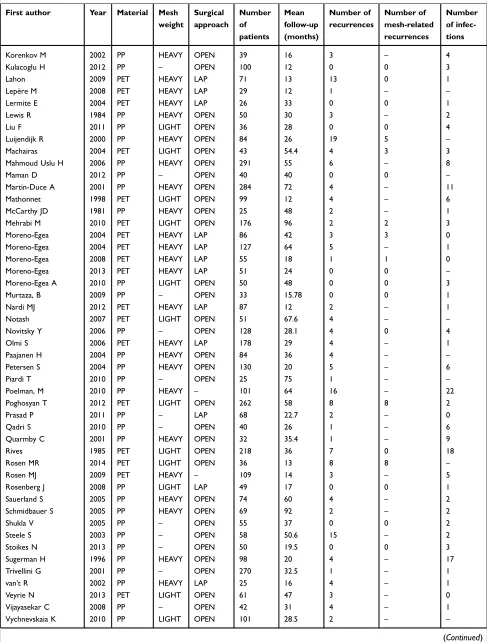
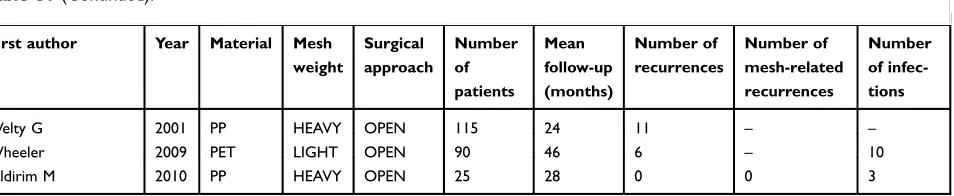
in the analysis.Table S1provides a descriptive summary
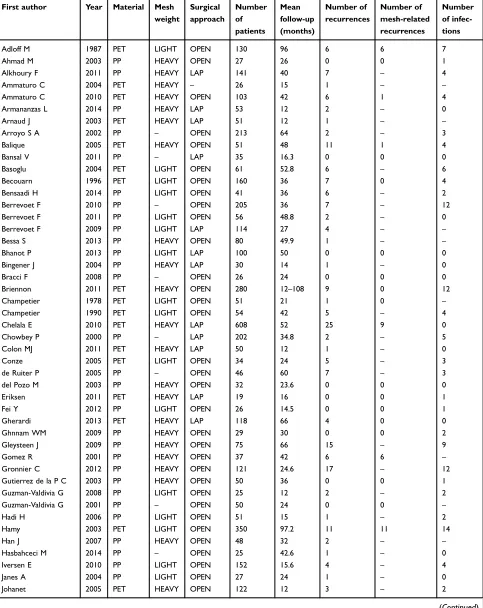
of the included studies. Studies containing separate data on multiple subset populations are segregated in the appendix and treated as separate studies. In total, 81 studies resulted in 97 individual study data sets.
Analyses were performed to evaluate the pooled recurrence rate in ventral PET and PP hernia repair. Studies were separated based on mesh material (ie, PET or PP), approach (ie, open or laparoscopic), and
mesh weight (ie, LW or HW). Due to insufficient papers
and data, we were unable to report results on the fol-lowing categories: recurrence rate in laparoscopic pro-cedures using LW PET or PP meshes, recurrence rate using HW PP mesh, and seroma formation for both PET and PP mesh.
Recurrence rate
Overall recurrence rates are comparable between PET and
PP with a recurrence rate of 4.8%, 95% CI [3.5–6.5] versus
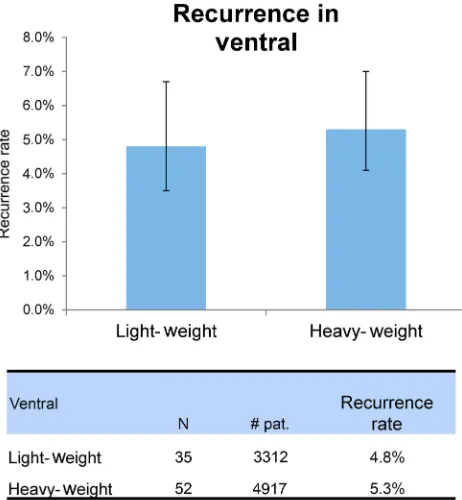
4.7%, 95% CI [3.7–6.0] (Figure 1). Mesh weight did not
have a significant impact on recurrence. Recurrence rates
following hernia repair with LW PET mesh were 5.6%,
95% CI [3.7–8.5] compared to a 3.9%, 95% CI [2.4–6.4]
rate with LW PP. (Figure 2). HW PET hernia repair
recur-rence rates were 4.0%, 95% CI [2.6–6.2] compared to 6.3%,
95% CI [4.5–8.8] with PP (Figure 3). Surgical approach did
not have an impact on recurrence rate between laparoscopic
and open repairs (3.3%, 95% CI [2.2–5.0] versus 5.2%,
95% CI [4.29–6.4] versus 4.9%, 95% CI [3.9–5.7],
respec-tively). Recurrence rates among laparoscopic procedures were similar between PET and PP mesh (3.5%, 95% CI
[2.0–6.0] and 3.0%, 95% CI [1.6–5.7]). Additional details
are provided inTable 1.
Infection
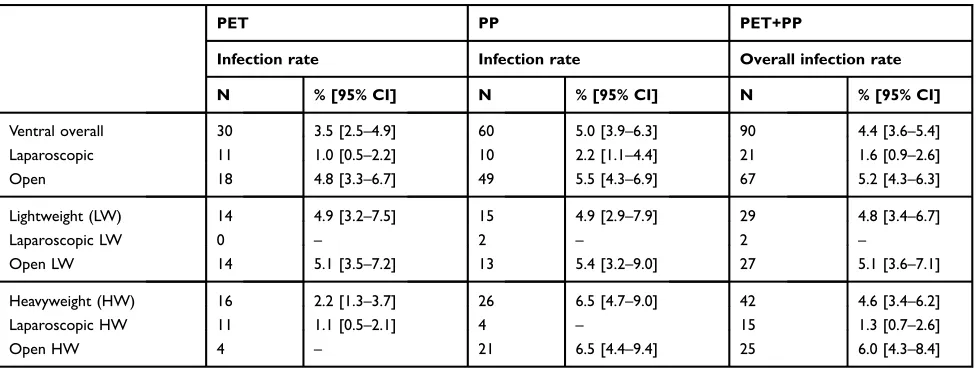
The aggregate infection rate for PET and PP mesh was
similar (3.5%, 95% CI [2.5–4.9] vs 5.0%, 95% [3.9–6.3]).
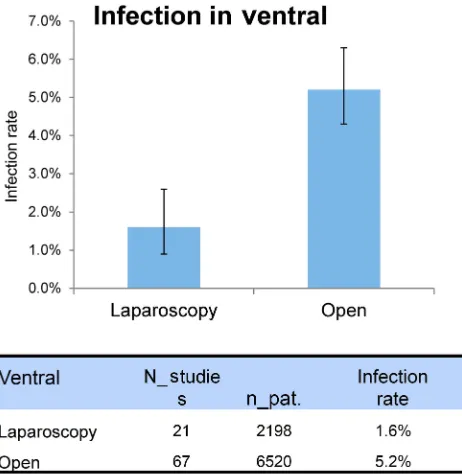
The infection rate for laparoscopic procedures (1.6%, 95%
[0.9–2.6]) was markedly lower than open procedures (5.2%,
95% [4.3–6.3]) when using either mesh (Figure 4). Mesh
weight did not appear to have an impact on infection rates (4.8% LW vs 4.6% HW). Additional details are provided in
Table 2.
Other complications
Other complications, including hematoma and seroma,
were not reported due to lack of data identified during
the meta-analysis.
Medical Devices: Evidence and Research downloaded from https://www.dovepress.com/ by 118.70.13.36 on 24-Aug-2020
Discussion
Mesh materials differ in manufacturing process, composi-tion, density, weave, and pore size. Despite these variations,
there is no significant difference in recurrence or infection
rates in ventral hernia repairs using either multifilament PET
or monofilament PP mesh. Previously reported
complica-tions and variacomplica-tions in outcomes were not identified when
comparing larger numbers of patients. Furthermore, there were no differences in recurrence rates or infections rates
identified between mesh materials or within a subgroup
analysis evaluating LW and HW meshes independently. Despite some variability in published recurrence rates among published studies, with occasional outliers, the rate
of hernia recurrence for LW PET and LW PP is similar.11
Patient selection, hernia characteristics, and patient comor-bidities are likely to impact hernia repair outcomes beyond
the influence of the mesh material alone and are likely to
contribute to the variability in recurrence rates among stu-dies. Nevertheless, mesh materials must have strength great enough to withstand physiologic intra-abdominal pressures,
particularly when utilized as a bridge.6 The etiologies of
primary mesh failure with central hernia recurrence include mesh degradation, trauma during implantation, or use in situations in which abdominal forces exceed mesh strength.
Hernia repair techniques are likely to impact hernia out-comes as well. Prior studies have demonstrated differences in hernia reoperation rates based upon mesh location with
retro-rectus meshes demonstrating the lowest reoperation rates.13
Mesh location is equally important to mesh choice. This study was not able to evaluate the impact of mesh location on hernia repair outcomes due to the inability to clearly detect mesh location in the majority of patients.
Figure 1Recurrence rate according to material.
Figure 2Recurrence according to mesh weight.
Figure 3Recurrence rate according to material and mesh weight.
Medical Devices: Evidence and Research downloaded from https://www.dovepress.com/ by 118.70.13.36 on 24-Aug-2020
Laparoscopic hernia repair has been previously shown to be associated with a reduced incidence of mesh infec-tions with similar hernia recurrence rates to open hernia
repair.14Our overall infection rate using PET and PP mesh
laparoscopically was 1%, 95% [0.5–2.2] and 2.2%, 95%
[1.1–4.4], respectively, with overlapping confidence
inter-vals. A comparative analysis of 79 laparoscopic PET mesh hernia repairs and 30 open extraperitoneal retrorectus PET mesh repairs reported infection rates less than 1% in
laparoscopic cases and 13% for open procedures.15
Regardless of mesh type, laparoscopic repairs are asso-ciated with fewer mesh infections than open repairs, likely
related to the avoidance of a laparotomy incision directly overlying the mesh.
The inherent limitations of this study are related to the quality and heterogeneity (in terms of design, follow-up, popu-lation, period, etc.) of the included studies. Studies including randomized controlled trial but also single-arm cohort studies with a minimum of 1-year follow-up were included to capture the incidence of both hernia recurrence and mesh infection. Prior studies have demonstrated that the majority of hernias occur within 2 years, and recurrence rates continue to increase
beyond the 2-year postoperative interval.16In the current
ana-lysis, inclusion of studies with follow-up duration of 1 year may underestimate the incidence of long-term recurrence. However, the similarity in recurrences seen in each of the mesh type would lead the authors to believe that long-term recurrence rates would also be similar. Publications including
results in figure form without infection or recurrence rates
stated within the text of the publication were not included within the analysis. Analyses for mesh brand, weight, or
surgi-cal approach were not performed due to insufficient number of
studies. Various mesh brands are included in analyses, grouped by material type and mesh weight. Although similarity exists between mesh materials, the manufacturing processes for each product include unique weaves, pore size, and properties that may impact outcomes. Furthermore, this study was unable to evaluate the impact of mesh position location upon outcomes. Variability in reporting of mesh location in the included studies did not allow for us to evaluate the impact of mesh location upon hernia recurrences based upon mesh type. Accordingly, this study was unable to assess the impact of mesh location upon hernia mesh infection rates. The impact of factors such as
Table 1PET and PP recurrence rate. Study arms with less than N=5 papers were excluded from subgroup analysis
PET PP PET+PP
Recurrence rate Recurrence rate Overall recurrence rate
N % [95% CI] N % [95% CI] N % [95% CI]
Ventral overall 37 4.8 [3.5–6.5] 72 4.7 [3.7–6.0] 109 4.7 [3.9–5.7]
Laparoscopic 14 3.5 [2.0–6.0] 12 3.0 [1.6–5.7] 26 3.3 [2.2–5.0]
Open 21 5.7 [3.9–8.3] 59 4.9 [3.9–5.7] 80 5.2 [4.2–6.4]
Lightweight (LW) 17 5.6 [3.7–8.5] 18 3.9 [2.4–6.4] 35 4.8 [3.5–6.7]
Laparoscopic LW 0 – 4 – 4 –
Open LW 17 5.6 [3.7–8.6] 14 4.6 [2.6–7.8] 31 5.2 [3.7–7.3]
Heavyweight (HW) 20 4.0 [2.6–6.2] 32 6.3 [4.5–8.8] 52 5.3 [4.1–7.0]
Laparoscopic HW 14 3.5 [2.0–6.1] 4 – 18 4.0 [2.5–6.5]
Open HW 4 – 27 6.0 [4.1–8.6] 31 6.0 [4.3–8.4]
Abbreviations:LW, Lightweight; HW, Heavyweight; PET, Polyester; PP, Polypropylene.
Figure 4Infection rate according to the surgical technique.
Medical Devices: Evidence and Research downloaded from https://www.dovepress.com/ by 118.70.13.36 on 24-Aug-2020
undermining skin flaps or subcutaneous mesh placement, which has been associated with poor outcomes, could not be
addressed.17Additional known risk factors for hernia
recur-rence and complications including smoking status, history of COPD, diabetes, and BMI were unable to be addressed in this review due to inconsistent reporting. Finally, the literature review was quality controlled, and some manuscripts were excluded from using the same data. However, the analysis datasets may contain some patient data in duplicate though the authors believe this would only be in a very limited number of patients.
Conclusion
Ventral hernia repairs can be safely performed using either
monofilament PP or multifilament PET mesh with
compar-able rates of mesh infection and hernia recurrences. Each
device has characteristics that require the identification of
proper surgical technique (ie, laparoscopic versus open: retrorectus versus underlay or onlay) in an effort to bal-ance the risk of infection and recurrence. Mesh selection should be tailored to each patient, subpopulation, and situation, with a continuation of head-to-head device trials to garner more long-term data.
Acknowledgments
Medical writing and editorial support was provided by Nicholas Paquette, PhD of Medtronic based on content and conclusions determined by the authors. The abstract of this paper was presented at the American Hernia Society 2016 and 36th Annual Meeting of the Surgical Infection Society conferences as poster presentations. The
posters’ abstracts were published in the 18th Annual
Hernia Repair and Program and Abstracts 36th Annual Meeting of the Surgical Infection Society Palm Beach, Florida, May 18-21, 2016.
Disclosure
PB and ML are both employed by Medtronic (Trevoux, France; formerly Covidien). PB also reports being a med-tronic employee. This literature review is comparing mesh materials, medtronic like other manufacturers is selling Polypropylene and polyester meshes. Dr Scott Roth reports grants, personal fees from Bard, personal fees from Allergan, stock options from Miromatrix, during the con-duct of the study; grants, personal fees from Bard, personal fees from Allergan, stock options from Miromatrix, outside
the submitted work. The authors report no other conflicts of
interest in this work.
References
1. Gilbert AI, Graham MF. Infected grafts of incisional hernioplasties. Hernia.1997;1(2):77–81. doi:10.1007/BF02427666
2. Gilbert AI, Graham MF. Problems associated with prosthetic repair of incisional hernias.Arch Surg.1998;133(10):1137.
3. Wantz GE. Incisional hernioplasty with polyester mesh.Arch Surg.
1998;133(10):1137.
4. Wantz GE. Incisional hernioplasty with Mersilene. Surg Gynecol Obstet.1991;172(2):129–137.
5. Colon MJ, Telem DA, Chin E, Weber K, Divino CM, Nguyen SQ. Polyester composite versus PTFE in laparoscopic ventral hernia repair. JSLS.2011;15(3):305–308. doi:10.4293/108680811X13125733356350 6. Moreno-Egea A, Carrillo-Alcaraz A, Soria-Aledo V. Randomized
clin-ical trial of laparoscopic hernia repair comparing titanium-coated light-weight mesh and medium-light-weight composite mesh. Surg Endosc.
2013;27(1):231–239. doi:10.1007/s00464-012-2425-y
7. Brown CN, Finch JG. Which mesh for hernia repair?Ann R Coll Surg Engl.2010;92(4):272–278. doi:10.1308/003588410X12664192076296
Table 2PET and PP infection rates. Subgroups with less than N=5 papers were excluded from analysis
PET PP PET+PP
Infection rate Infection rate Overall infection rate
N % [95% CI] N % [95% CI] N % [95% CI]
Ventral overall 30 3.5 [2.5–4.9] 60 5.0 [3.9–6.3] 90 4.4 [3.6–5.4]
Laparoscopic 11 1.0 [0.5–2.2] 10 2.2 [1.1–4.4] 21 1.6 [0.9–2.6]
Open 18 4.8 [3.3–6.7] 49 5.5 [4.3–6.9] 67 5.2 [4.3–6.3]
Lightweight (LW) 14 4.9 [3.2–7.5] 15 4.9 [2.9–7.9] 29 4.8 [3.4–6.7]
Laparoscopic LW 0 – 2 – 2 –
Open LW 14 5.1 [3.5–7.2] 13 5.4 [3.2–9.0] 27 5.1 [3.6–7.1]
Heavyweight (HW) 16 2.2 [1.3–3.7] 26 6.5 [4.7–9.0] 42 4.6 [3.4–6.2]
Laparoscopic HW 11 1.1 [0.5–2.1] 4 – 15 1.3 [0.7–2.6]
Open HW 4 – 21 6.5 [4.4–9.4] 25 6.0 [4.3–8.4]
Abbreviations:LW, Lightweight; HW, Heavyweight; PET, Polyester; PP, Polypropylene.
Medical Devices: Evidence and Research downloaded from https://www.dovepress.com/ by 118.70.13.36 on 24-Aug-2020
8. Bringman S, Conze J, Cuccurullo D, et al. Hernia repair: the search for ideal meshes.Hernia.2010;14(1):81–87. doi:10.1007/s10029-009-0587-x 9. Ladurner R, Chiapponi C, Linhuber Q, Mussack T. Long term out-come and quality of life after open incisional hernia repair–light versus heavy weight meshes.BMC Surg. 2011;11:25. doi:10.1186/ 1471-2482-11-25
10. Schopf S, von Ahnen T, von Ahnen M, Schardey H. Chronic pain after laparoscopic transabdominal preperitoneal hernia repair: a ran-domized comparison of light and extralight titanized polypropylene mesh.World J Surg.2011;35(2):302–310. doi:10.1007/s00268-010-0850-4
11. Petro CC, Nahabet EH, Criss CN, et al. Central failures of light-weight monofilament polyester mesh causing hernia recurrence: a cautionary note.Hernia.2015;19(1):155–159. doi:10.1007/s10029-014-1237-5
12. Deeken CR, Abdo MS, Frisella MM, Matthews BD. Physicomechanical evaluation of polypropylene, polyester, and polytetrafluoroethylene meshes for inguinal hernia repair.J Am Coll Surg.2011;212(1):68–79. doi:10.1016/j.jamcollsurg.2010.09.012
13. Helgstrand F, Rosenberg J, Kehlet H, Jorgensen LN, Bisgaard T. Nationwide prospective study of outcomes after elective incisional hernia repair.J Am Coll Surg.2013;216(2):217–228. doi:10.1016/j. jamcollsurg.2012.10.013
14. Forbes SS, Eskicioglu C, McLeod RS, Okrainec A. Meta-analysis of randomized controlled trials comparing open and laparoscopic ven-tral and incisional hernia repair with mesh. Br J Surg. 2009;96 (8):851–858. doi:10.1002/bjs.6668
15. Rosen MJ. Polyester-based mesh for ventral hernia repair: is it safe? Am J Surg.2009;197(3):353–359. doi:10.1016/j.amjsurg.2008.11.003 16. Singhal V, Szeto P, VanderMeer TJ, Cagir B. Ventral hernia repair: outcomes change with long-term follow-up.JSLS.2012;16(3):373– 379. doi:10.4293/108680812X13427982377067
17. Liang MK, Goodenough CJ, Martindale RG, Roth JS, Kao LS. External validation of the ventral hernia risk score for prediction of surgical site infections. Surg Infect (Larchmt). 2015;16(1):36–40. doi:10.1089/sur.2014.115
Medical Devices: Evidence and Research downloaded from https://www.dovepress.com/ by 118.70.13.36 on 24-Aug-2020
Supplementary materials
Table S1Full list of study data sets
First author Year Material Mesh weight
Surgical approach
Number of patients
Mean follow-up (months)
Number of recurrences
Number of mesh-related recurrences
Number of infec-tions
Adloff M 1987 PET LIGHT OPEN 130 96 6 6 7
Ahmad M 2003 PP HEAVY OPEN 27 26 0 0 1
Alkhoury F 2011 PP HEAVY LAP 141 40 7 – 4
Ammaturo C 2004 PET HEAVY – 26 15 1 – –
Ammaturo C 2010 PET HEAVY OPEN 103 42 6 1 4
Armananzas L 2014 PP HEAVY LAP 53 12 2 – 0
Arnaud J 2003 PET HEAVY LAP 51 12 1 – –
Arroyo S A 2002 PP – OPEN 213 64 2 – 3
Balique 2005 PET HEAVY OPEN 51 48 11 1 4
Bansal V 2011 PP – LAP 35 16.3 0 0 0
Basoglu 2004 PET LIGHT OPEN 61 52.8 6 – 6
Becouarn 1996 PET LIGHT OPEN 160 36 7 0 4
Bensaadi H 2014 PP LIGHT OPEN 41 36 6 – 2
Berrevoet F 2010 PP – OPEN 205 36 7 – 12
Berrevoet F 2011 PP LIGHT OPEN 56 48.8 2 – 0
Berrevoet F 2009 PP LIGHT LAP 114 27 4 – –
Bessa S 2013 PP HEAVY OPEN 80 49.9 1 – –
Bhanot P 2013 PP LIGHT LAP 100 50 0 0 0
Bingener J 2004 PP HEAVY LAP 30 14 1 – 0
Bracci F 2008 PP – OPEN 26 24 0 0 0
Briennon 2011 PET HEAVY OPEN 280 12–108 9 0 12
Champetier 1978 PET LIGHT OPEN 51 21 1 0 –
Champetier 1990 PET LIGHT OPEN 54 42 5 – 4
Chelala E 2010 PET HEAVY LAP 608 52 25 9 0
Chowbey P 2000 PP – LAP 202 34.8 2 – 5
Colon MJ 2011 PET HEAVY LAP 50 12 1 – 0
Conze 2005 PET LIGHT OPEN 34 24 5 – 3
de Ruiter P 2005 PP – OPEN 46 60 7 – 3
del Pozo M 2003 PP HEAVY OPEN 32 23.6 0 0 0
Eriksen 2011 PET HEAVY LAP 19 16 0 0 1
Fei Y 2012 PP LIGHT OPEN 26 14.5 0 0 1
Gherardi 2013 PET HEAVY LAP 118 66 4 0 0
Ghnnam WM 2009 PP HEAVY OPEN 29 30 0 0 2
Gleysteen J 2009 PP HEAVY OPEN 75 66 15 – 9
Gomez R 2001 PP HEAVY OPEN 37 42 6 6 –
Gronnier C 2012 PP HEAVY OPEN 121 24.6 17 – 12
Gutierrez de la P C 2003 PP HEAVY OPEN 50 36 0 0 1
Guzman-Valdivia G 2008 PP LIGHT OPEN 25 12 2 – 2
Guzman-Valdivia G 2001 PP – OPEN 50 24 0 0 –
Hadi H 2006 PP LIGHT OPEN 51 15 1 – 2
Hamy 2003 PET LIGHT OPEN 350 97.2 11 11 14
Han J 2007 PP HEAVY OPEN 48 32 2 – –
Hasbahceci M 2014 PP – OPEN 25 42.6 1 – 0
Iversen E 2010 PP LIGHT OPEN 152 15.6 4 – 4
Janes A 2004 PP LIGHT OPEN 27 24 1 – 0
Johanet 2005 PET HEAVY OPEN 122 12 3 – 2
(Continued)
Medical Devices: Evidence and Research downloaded from https://www.dovepress.com/ by 118.70.13.36 on 24-Aug-2020
Table S1(Continued).
First author Year Material Mesh weight
Surgical approach
Number of patients
Mean follow-up (months)
Number of recurrences
Number of mesh-related recurrences
Number of infec-tions
Korenkov M 2002 PP HEAVY OPEN 39 16 3 – 4
Kulacoglu H 2012 PP – OPEN 100 12 0 0 3
Lahon 2009 PET HEAVY LAP 71 13 13 0 1
Lepère M 2008 PET HEAVY LAP 29 12 1 – –
Lermite E 2004 PET HEAVY LAP 26 33 0 0 1
Lewis R 1984 PP HEAVY OPEN 50 30 3 – 2
Liu F 2011 PP LIGHT OPEN 36 28 0 0 4
Luijendijk R 2000 PP HEAVY OPEN 84 26 19 5 –
Machairas 2004 PET LIGHT OPEN 43 54.4 4 3 3
Mahmoud Uslu H 2006 PP HEAVY OPEN 291 55 6 – 8
Maman D 2012 PP – OPEN 40 40 0 0 –
Martin-Duce A 2001 PP HEAVY OPEN 284 72 4 – 11
Mathonnet 1998 PET LIGHT OPEN 99 12 4 – 6
McCarthy JD 1981 PP HEAVY OPEN 25 48 2 – 1
Mehrabi M 2010 PET LIGHT OPEN 176 96 2 2 3
Moreno-Egea 2004 PET HEAVY LAP 86 42 3 3 0
Moreno-Egea 2004 PET HEAVY LAP 127 64 5 – 1
Moreno-Egea 2008 PET HEAVY LAP 55 18 1 1 0
Moreno-Egea 2013 PET HEAVY LAP 51 24 0 0 –
Moreno-Egea A 2010 PP LIGHT OPEN 50 48 0 0 3
Murtaza, B 2009 PP – OPEN 33 15.78 0 0 1
Nardi MJ 2012 PET HEAVY LAP 87 12 2 – 1
Notash 2007 PET LIGHT OPEN 51 67.6 4 – –
Novitsky Y 2006 PP – OPEN 128 28.1 4 0 4
Olmi S 2006 PET HEAVY LAP 178 29 4 – 1
Paajanen H 2004 PP HEAVY OPEN 84 36 4 – –
Petersen S 2004 PP HEAVY OPEN 130 20 5 – 6
Piardi T 2010 PP – OPEN 25 75 1 – –
Poelman, M 2010 PP HEAVY – 101 64 16 – 22
Poghosyan T 2012 PET LIGHT OPEN 262 58 8 8 2
Prasad P 2011 PP – LAP 68 22.7 2 – 0
Qadri S 2010 PP – OPEN 40 26 1 – 6
Quarmby C 2001 PP HEAVY OPEN 32 35.4 1 – 9
Rives 1985 PET LIGHT OPEN 218 36 7 0 18
Rosen MR 2014 PET LIGHT OPEN 36 13 8 8 –
Rosen MJ 2009 PET HEAVY – 109 14 3 – 5
Rosenberg J 2008 PP LIGHT LAP 49 17 0 0 1
Sauerland S 2005 PP HEAVY OPEN 74 60 4 – 2
Schmidbauer S 2005 PP HEAVY OPEN 69 92 2 – 2
Shukla V 2005 PP – OPEN 55 37 0 0 2
Steele S 2003 PP – OPEN 58 50.6 15 – 2
Stoikes N 2013 PP – OPEN 50 19.5 0 0 3
Sugerman H 1996 PP HEAVY OPEN 98 20 4 – 17
Trivellini G 2001 PP – OPEN 270 32.5 1 – 1
van’t R 2002 PP HEAVY LAP 25 16 4 – 1
Veyrie N 2013 PET LIGHT OPEN 61 47 3 – 0
Vijayasekar C 2008 PP – OPEN 42 31 4 – 1
Vychnevskaia K 2010 PP LIGHT OPEN 101 28.5 2 – –
(Continued)
Medical Devices: Evidence and Research downloaded from https://www.dovepress.com/ by 118.70.13.36 on 24-Aug-2020
Medical Devices: Evidence and Research
Dove
press
Publish your work in this journal
Medical Devices: Evidence and Research is an international, peer-reviewed, open access journal that focuses on the evidence, technol-ogy, research, and expert opinion supporting the use and application of medical devices in the diagnosis, monitoring, treatment and management of clinical conditions and physiological processes. The identification of novel devices and optimal use of existing devices
which will lead to improved clinical outcomes and more effective patient management and safety is a key feature of the journal. The manuscript management system is completely online and includes a very quick and fair peer-review system. Visit http:// www.dovepress.com/testimonials.php to read real quotes from pub-lished authors.
Submit your manuscript here:https://www.dovepress.com/medical-devices-evidence-and-research-journal
Table S1(Continued).
First author Year Material Mesh weight
Surgical approach
Number of patients
Mean follow-up (months)
Number of recurrences
Number of mesh-related recurrences
Number of infec-tions
Welty G 2001 PP HEAVY OPEN 115 24 11 – –
Wheeler 2009 PET LIGHT OPEN 90 46 6 – 10
Yildirim M 2010 PP HEAVY OPEN 25 28 0 0 3
Abbreviations:PET, Polyester; PP, Polypropylene; LAP, Laparoscopic.
Medical Devices: Evidence and Research downloaded from https://www.dovepress.com/ by 118.70.13.36 on 24-Aug-2020