www.technology.matthey.com
14th Ulm Electrochemical Talks
Towards next generation technologies for a sustainable electric future
Reviewed by Carmen Salcianu
Johnson Matthey Technology Centre, Blounts Court, Sonning Common, RG4 9NH, UK
Email: [email protected]
The Ulm Electrochemical Talks are held annually in Ulm, Germany. The 14th meeting, held from 23rd–26th June, 2014, focused on the topic of “Next Generation Electrochemical Energy Technologies”. Fuel cells and batteries are described as the dominant technologies to deliver the e-mobility vision within the next few decades. This selective review will focus on battery technologies and supercapacitors; although there was also plenty of material on the equally important topic of fuel cells which is not covered here.
Next Generation Materials for Lithium Ion Batteries
Andreas Fischer (BASF, Germany) talked through BASF’s battery material portfolio that includes mainly cathode materials and electrolytes, although some
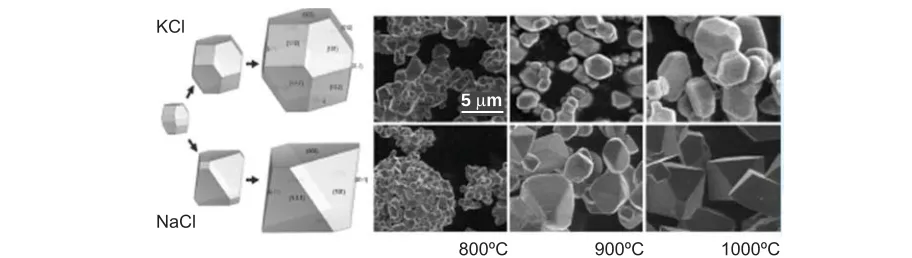
work on next generation silicon and tin-based material was also discussed in regards to dynamical formation and dissolution of the solid electrolyte interphase (SEI) during cycling. For high energy applications layered oxide and high voltage spinel materials are preferred, nickel cobalt manganese (NCM) for high power and lithium iron phosphate (LFP) for plug-in hybrid electric vehicles (PHEV) and grid storage. The talk was geared towards tailoring particle size and morphology and layer porosity to meet power requirements. By varying the experimental conditions different shaped NCM particles can be obtained as for example in Figure 1 (1).
In terms of electrodes, as a general rule, smooth layers are preferred for electric vehicles (EV) and porous layers for hybrid electric vehicles (HEV) as this directly affects diffusion paths. Also, a narrow particle size distribution results in decreased cycle life and poor rate capabilities. The drop in voltage at 10 C was used as a measure of lithium diffusion. On the electrolyte side, the aim was to fi nd a suitable solvent that decomposes in the initial stages of cycling to form a protective surface on the cathode side, to stop manganese migration to the anode at high operating voltages.
Fig. 1. Morphology of NCM materials synthesised with fl ux fi red with alkali chlorides at various temperatures (Reprinted with permission from (1). Copyright (2013) American Chemical Society )
800ºC 900ºC 1000ºC KCl
NaCl
Maria Assunta Navarra (Sapienza University, Italy) pointed out that production of large scale cells for energy storage and vehicle applications requires replacement of graphite and of lithium cobalt oxide with alternative, higher energy density, lower cost anode and cathode materials, but also replacement of the organic carbonate liquid solutions with safer and more reliable electrolyte systems. A 3 V cell comprised of tin/ carbon composite as anode and LFP as cathode in a 1-butyl-1-ethylpyrrolidinium bis(trifl uoromethanesulfonyl)-imide (Py24TFSI)–lithium bis(trifl uoromethane sulfonyl)-
imide (LiTFSI) ionic liquid (IL) electrolyte displayed a capacity of 140 mAh g–1 at C/10. This is lower than
in organic electrolytes due to the IL’s higher viscosity resulting in larger ohmic drop and poor wettability (2). Approaches to tackle reduced capacity include: add alkyl carbonates to help SEI formation and reduce viscosity and/or fabrication of lithium-conducting gel-polymer membranes. Lower diffusion was observed in gel polymer membranes and that decreases even more with LiTFSI salt addition.
Bernt Ketterer (SGL Carbon, Germany) talked about carbon/silicon as the next generation anode material for lithium-ion batteries (LIBs). The main challenges facing this electrode material are loss of interparticle contact due to volume expansion during lithiation and formation of a stable SEI. As pure nanoparticulate silicon forms an unstable SEI, its use in either an active matrix (carbon or graphene) or inactive matrix (by alloying or using silicon suboxides) is usually performed. Elastic binders are usually employed to accommodate silicon expansion in Si-based anodes. The most important criteria for developing the best battery materials are material properties such as capacity, coulombic effi ciency and charge/discharge potentials. This is followed by electrode properties (porosity, loading and binder) and fi nally at the full-cell level comes positive/negative balancing, fading rate and electrolyte.
Daniel Lemordant (Université François Rabelais Tours, France) presented an electroless method of making dense, aligned silicon nanowires (diameter 0.5 m). It is a two-step process where a p-type silicon is initially chemically etched in silver nitrate/hydrogen
fl uoride that is subsequently post-treated in an alkaline solution in order to dissolve the mesoporous material.
Most research articles on lithium titanate (LTO) as anode material date from the 1970s and 1980s. Clariant’s work on LTO started in 2000 at the Sud Chemie Labs, now part of Clariant. Andreas Laumann (Clariant SE, Germany) presented LTO’s advantages
over graphite including higher capacities at lower temperatures and no SEI formation (cycling voltages are inside the electrolytes’ stability window: 1–4.3 V). Hence Mn dissolution at high operating voltages is not a problem, and there is excellent cycling stability and increased safety (due to no lithium plating). The big disadvantages are gassing during cycling, lower energy density (1.5 V reaction) and cost. Two grades of LTO were presented: T2 (10 m particle size, 200 nm primary particle size) and an unagglomerated version of the same material known as EXM5002. For half-cell testing a loading of 10 mg cm–2 of active
material was used. The rest of the talk contained back-of-the-envelope cost calculations on the choice of anode/cathode vs. high energy/high power (E/P) application requirements. As a general rule two-thirds of the cost of LIBs come from the active materials, both anode and cathode. For a 48 V system the NCM-graphite system is favoured over the LFP-LTO system as the price per Wh is doubled in the latter case. For a 12 V system only LTO can be used due to the requirement for high charge rates that are problematic for graphite.
Beyond Lithium Ion Batteries
Bruno Scrosati (Helmholtz-Institute Ulm, Germany) discussed possible chemistries beyond lithium-ion: lithium-sulfur, lithium-air, sodium-ion and graphene. Challenges facing one of the two most researched conversion chemistry systems, Li-S, include low cathode conductivity, solubility of LiS and use of lithium metal as anode. Li-O2 on the other hand suffers from
irreversibility of the oxygen reduction reaction (ORR)/ oxygen evolution reaction (OER) (slow kinetics, high overvoltages), electrolyte instability, carbon corrosion and also problems associated with the use of lithium metal as anode. Due to sodium’s higher abundance, this system also receives a lot of attention. Graphene brings high conductivity and high surface area, however the view is that this material will play no signifi cant role in batteries, but should be considered for supercapacitors.
A good paper quantifying the promise of Li-O2 batteries
overpotentials. Na-oxygen batteries show much smaller overvoltages compared to their lithium counterparts. Although the highest theoretical energy is obtained from Li2O and Na2O, only Li2O2 and Na2O2 showed some
reversibility (4).
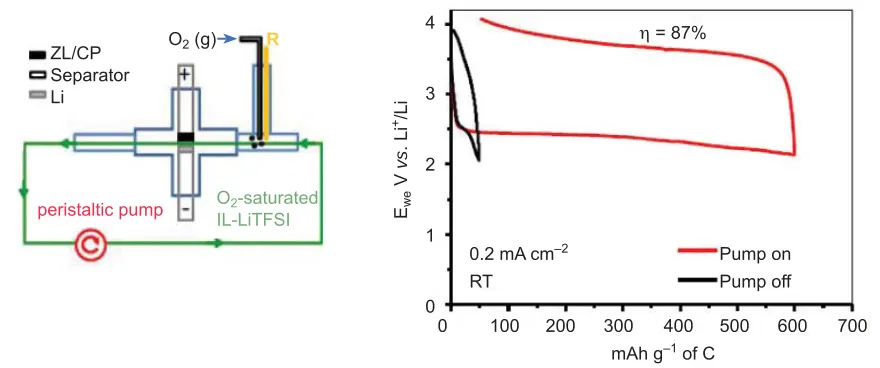
Stefano Passerini (Helmholtz-Institute Ulm, Germany) presented a fl owing electrolyte cell (Figure 2) which was designed and built during the EU Lithium-Air Batteries with split Oxygen Harvesting and Redox processes (LABOHR) Project. An O2-saturated
electrolyte is circulating in and out of the cell resulting in improvements in the redox reaction (5). Another paper in press to look out for is Elia et al. in Nano Letters (6) showing only 600 mV gap between discharge and charge voltages using an uncatalysed electrode.
Margret Wohlfahrt-Mehrens (Centre for Solar Energy and Hydrogen Research (ZSW), Germany) discussed new electrode materials for batteries and capacitors. Three materials were discussed in particular: lithium manganese phosphate (LMP) and lithium manganese nickel phosphate (LMNO) as high voltage cathode materials for batteries and Li2V2(PO4)3 for
supercapacitors. The position of the redox potential can be tuned by partial substitution of other metals into the LiCo(1–x)MxPO4 matrix, where M can be Ni, Mg or
Fe. LMNO obtained by a continuous coprecipitation method results in low surface area material, ideal for good transport inside the particle. Effects of particle
size, shape, morphology and stoichiometry were discussed.
Unusual Electrochemical Energy Technologies
Chemistries discussed by Jürgen Garche (ZSW, Germany) include: (a) lead-acid, which have an electrode distance of about 1–3 mm, compared to LIBs’ 15–35 m, therefore have less tough requirements; (b) Li metal polymer, used by Autolib′ (France) to provide a 250 km range and charge at C/4 with operation temperature in excess of 70ºC; (c) liquid metal batteries, on which a good American Chemical Society review paper by H. Kim et al. (7) was presented; (d) aqueous hybrid ion, a 1.7 kWh, 48 V system patented by Aquion Energy (USA) (8); (e) electric double-layer capacitors, which offer dual use as they can both store energy and withstand static and dynamic mechanical stresses (9); (f) self-charging Li-ion cells, using polyvinylidene
fl uoride (PVDF) with piezoelectric properties and could be for example sandwiched between LTO and lithium cobalt oxide (LCO) and used in shoes.
Maximilian Fichtner (Helmholtz-Institute Ulm, Germany) talked about secondary batteries based on alternative anionic and cationic shuttles in order to obtain higher volumetric effi ciencies. An example of an anionic shuttle system is the fl uoride-ion battery using BaF2 doped LaF3
obtained by mechanical milling. Liquid electrolytes have
Fig. 2. Schematic of the fl ow IL-based Li/O2 battery (Reprinted with permission from (5). Copyright (2013) American Chemical Society)
0 100 200 300 400 500 600 700 mAh g–1 of C
Ewe
V
vs
. Li
+ /Li
4
3
2
1
0
= 87%
0.2 mA cm–2 Pump on
RT Pump off
peristaltic pump OIL-LiTFSI2-saturated
ZL/CP Separator Li
the potential to increase the effi ciencies of fl uoride ion batteries (10). Another member of the rechargeable family, the chloride ion battery is based on the metal chloride/metal electrochemical couple and an electrolyte composed of binary ionic liquids that allows chloride ion transfer at room temperature (11).
For cationic shuttle systems, magnesium has the advantage that it does not form dendrites during cycling, however suitable electrolytes for Mg2+ are
harder to fi nd than the lithium equivalent. Magnesium electrolytes may also be compatible with a sulfur cathode to produce a Mg/S battery, as discussed by H. S. Kim (12).
Peter Notten (Eindhoven University of Technology, the Netherlands) introduced the concept of an all solid-state battery for medical applications such as drug-delivery. An in situ method based on neutron depth profi ling was used to probe lithium transport in all-solid-state Li-ion batteries in collaboration with Delft University of Technology, the Netherlands. Preliminary experiments have shown a linear decrease/increase in lithium concentration during cycling (13). Future experiments will include diffusion concentration monitoring in all parts of the battery: anode, electrolyte and cathode .
Aqueous Systems and Redox Flow Batteries for Energy Storage
The main advantages of aqueous electrolytes are safety and cost. Battery systems currently using aqueous electrolytes include lead-acid batteries, redox
fl ow batteries and alkaline batteries such as NiMH used in automotive applications (for example in the Toyota Prius). Lead-acid batteries have the disadvantage of slow charge, low specifi c energy and contain a toxic active material.
Redox fl ow batteries with their low energy and low specifi c density fi nd use in large scale electricity storage. Huamin Zhang (Dalian Rongke Power Co, Ltd, China) discussed three redox fl ow battery technologies for stationary applications: vanadium fl ow batteries, Zn-Ni hybrid fl ow and Li(Zn) bromine hybrid fl ow batteries. Oliver Osters (Next Energy, Germany) talked about degradation in bipolar plates of redox
fl ow batteries due to V5+/V4+ which is corrosive. Ageing
effects were analysed using electrochemical impedance spectroscopy (EIS) and linear sweep voltammetry combined with micr o-computed tomography (CT).
David Ensling (Varta Microbattery GmbH, Germany) presented his company’s portfolio of hybrid energy storage systems with aqueous electrolytes. This included: (a) symmetric supercapacitors based on activated carbon (AC)/carbon; (b) asymmetric supercapacitors based on Ni(OH)2/AC; and (c) ultra
high power (UHP) NiMH. Varta’s hybrid supercapacitors are under further development.
Battery Systems
Oliver Weinmann (Vattenfall Europe AG, Germany) presented the idea of using second life LIBs for stationary applications. Vattenfall buys off used BMW batteries that no longer meet the requirements for automotive use and fi nds new applications such as acting as a buffer between grid usage and demand or storing photovoltaic (PV) energy.
Kent Snyder (Ford Motor Company, USA) presented an extensive study of various types of cells (cylindrical, pouch, prismatic) and their use in the automotive industry (light duty) with the aim of devising a standardised matrix. For example, Ford uses a laminated pouch for EVs and a metal can prismatic unit for PHEV and HEV. Although some trends are observed, the conclusion is that cell selection is based on independent criteria and timing needs, therefore at this point standardisation is not possible.
Marc Sämann (ads-tec GmbH, Germany) discussed two lithium-polymer cell technologies used for battery modules: (a) LTO-based, 2–4 kWh with up to 1500 cycles; and (b) NMC-based, 4.2–8.3 kWh and up to 7000 cycles .
Conclusions
This review covers some interesting talks on a wide range of electrochemical energy technologies, from state-of-the-art Li-ion, next generation and beyond to energy storage materials and systems and unusual electrochemical energy storage technologies. This comes in the context of rapid increases in the number of electric cars on the road and at the same time the beginning of major interest in electrical energy storage technologies in combination with renewable energy. Therefore there is a need for next generation technologies for a sustainable market growth beyond the
References
1. Y. Kim, ACS Appl. Mater. Interfaces, 2012, 4, (5), 2329
2. J. Hassoun, A. Fernicola, M. A. Navarra, S. Panero and B. Scrosati, J. Power Sources, 2010, 195, (2), 574
3 . K. G. Gallagher, S. Goebel, T. Greszler, M. Mathias, W. Oelerich, D. Eroglu and V. Srinivasan, Energy Environ. Sci., 2014, 7, (5), 1555
4. P. Hartmann, C. L. Bender, M. Vračar, A. K. Dürr, A. Garsuch, J. Janek and P. Adelhelm, Nature Mater., 2013, 12, (3), 228
5. S. Monaco, F. Soavi and M. Mastragostino, J. Phys. Chem. Lett., 2013, 4, (9), 1379
6. G. A. Elia, J. Hassoun, W.-J. Kwak, Y.-K. Sun, B. Scrosati, F. Mueller, D. Bresser, S. Passerini, P. Oberhumer, N. Tsiouvaras and J. Reiter, Nano Lett., 2014, 14, (11), 6572
7. H. Kim, D. A. Boysen, J. M. Newhouse, B. L. Spatocco, B. Chung, P. J. Burke, D. J. Bradwell, K. Jiang, A. A. Tomaszowska, K. Wang, W. Wei, L. A. Ortiz, S. A. Barriga, S. M. Poizeau and D. R. Sadoway, Chem.
Rev., 2013, 113, (3), 2075
8 . J. Whitacre, Aquion Energy Inc, ‘High Voltage Battery Composed of Anode Limited Electrochemical Cells’, World Appl. 2013/012,830
9. A. S. Westover, J. W. Tian, S. Bernath, L. Oakes, R. Edwards, F. N. Shabab, S. Chatterjee, A. V. Anilkumar and C. L. Pint, Nano Lett., 2014, 14, (6), 3197
10 . F. Gschwind, Z. Zao-Karger and M. Fichtner, J. Mater. Chem. A, 2014, 2, (5), 1214
11 . X. Zhao, S. Ren, M. Bruns and M. Fichtner, J. Power Sources, 2014, 245, 706
12 . H. S. Kim, T. S. Arthur, G. D. Allred, J. Zajicek, J. G. Newman, A. E. Rodnyansky, A. G. Oliver, W. C. Boggess and J. Muldoon, Nature Commun., 2011,
2, 427
13 . J. F. M. Oudenhoven, F. Labohm, M. Mulder, R. A. H. Niessen, F. M. Mulder and P. H. L. Notten, Adv. Mater., 2011, 23, (35), 4103
The Reviewer