Holocene Prehistory
of the Northwestern
Subarctic
Ben A. Potter
The northwestern Subarctic region of North America comprises a generally homo-geneous Holocene record of human material culture, and can be treated as a culture area for the purposes of this review. The geographic area of this discussion encom-passes the boreal forest interior regions of Alaska and Yukon Territory, including northern British Columbia to the edges of the Canadian Plateau. The regional record is anthropologically important for a number of reasons, including potential for exam-ining human adaptive strategies in marginal environments, adaptive responses to major episodes of climate change, colonization of the Americas, and elucidation of Athapaskan prehistory.
Pottery and art, two categories of material culture important for social and politi-cal inferences, are rare to nonexistent throughout this region. Pottery occurs only very late in the Holocene sequence, with little evidence for diffusion of ceramics from earlier Paleoeskimo groups (e.g., Norton). Protohistoric and historic Western interior Alaskan ceramics in the lower Yukon valley (Yukon line- dot), particularly among the Koyukon and Ingalik (De Laguna 1947) were likely diffused from neighboring Eskimo groups. Rainey’s Lower Tanana informants noted pottery traded from the Rampart area (Rainey 1939:376). Prehistoric art is also very rare, consisting of engraved designs on portable artifacts and pictographs (Holmes 1986).
Because of these empirical limitations, archaeologists typically rely on a few well- preserved stratified sites, widely spaced in geographic space, to develop culture histo-ries and explore subsistence economy and technology. These sites (e.g., Onion Portage, Dry Creek, Broken Mammoth, Charlie Lake Cave; see below) tend to dominate discus-sions of regional prehistory, to the near exclusion of the vast majority of archaeological remains, small surface sites or buried sites with limited testing. Fladmark’s (1979) review of an influential proceedings volume (The Athapaskan Question, edited by Helmer et al., 1977) is salient, and many researchers have stressed the limits of the data and the neces-sarily exploratory nature of interpretations for the northwestern Subarctic, a consider-ation I stress again here.
Human remains in this region are very rare, as expected for highly mobile high- latitude foragers. Late Holocene remains of a mummified body of a 18– 19- year- old male, termed Kwäday Dän Ts’ínchi, were discovered in northern British Columbia, about 80 km from the coast (Beattie et al. 2000). Isotopic analyses indicate extreme reliance on marine animals for most of his life, then a shift to terrestrial or freshwater resources in the last months of life. Recently, a cremated three- year- old and two infant burials have been found at Upward Sun River, all three dating to 11,500 cal b.p. (Potter et al. 2011, 2014). Other late Holocene remains have been found (e.g., Lake Minchumina; Holmes 1986), typically in cremated contexts, consistent with the earliest known Athapaskan mortuary practices (VanStone 1974:84– 85).
An important new dataset was introduced in 1997: well- preserved organic remains from alpine ice patches in the southwest Yukon (Hare et al. 2004) and Alaska (Dixon et al. 2005; VanderHoek et al. 2007). Perishable artifacts like bow, arrow, and dart parts, feathers, and moccasins have been recovered, allowing for an unprecedented view into alpine caribou- hunting behaviors and technological change. Results indicate a sharp technological transition from primarily lithic bifacial projectile points (lanceolate and notched forms) mounted in dart shafts from ~9400 to ~1300 cal b.p. to primarily antler or bone projectile points mounted in arrow shafts from ~1300 to the present (Hare et al. 2004). This break coincides roughly with the emergence of the Athapaskan tradition or Aishihik phase (Dixon 1985; Workman 1978).
Cultural Chronology
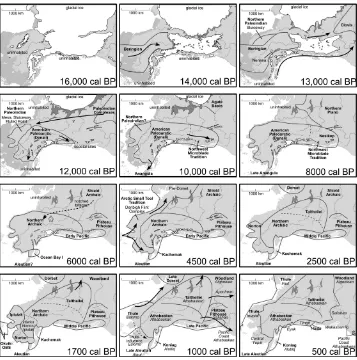
While there remains considerable debate about the nature of the terminal Pleistocene occupations of the region (Bever 2001a; chapters in Goebel and Buvit 2011), there is less debate regarding Holocene affiliations, partially due to lack of information and perhaps less academic interest. Cultural historical sequences that are widely accepted, or at least widely used, are Workman (1978; see Hare et al. 2008) for the southwest Yukon Territory and Dixon (1985) for central Alaska. Other influential cultural chronologies include Cook and McKennan (1970), Holmes (2001), and Gotthardt (1990). Of interest is the relative homogeneity of these cultural groupings, with broad similarities from western Alaska through southwest Yukon Territory and interior northern British Columbia, particularly for early and middle Holocene assemblages. These sequences largely agree on basic traditions and chronology, but disagree on details like the presence or absence of certain technologies and the nature of transitions between the traditions. Figure 22.1 is a heuristic illustration of archaeological groupings for the northwestern Subarctic and adjacent regions. The boundaries of these groupings are debatable, and largely fall in areas with little archaeological investigation.
(1) Terminal Pleistocene complexes without (or with) microblades include Chindadn, Nenana, Sluiceway complexes, East Beringian, and Northern Cordilleran traditions (Clark 1983: Holmes 2001; Powers and Hoffecker 1989; Rasic 2011). Chindadn and Northern Cordilleran sites extend into the early Holocene. These groups encompass wide technological and typological variabil-ity, and their relationships and general ecology are not well understood (Bever 2001a; Cook 1969; Powers and Hoffecker 1989).
The Mesa and Sluiceway complexes, defined largely by smaller or thinner and larger or thicker lanceolate bifacial point forms, respectively, spurred gravers (more common among Mesa assemblages), but with variable presence or absence of micro-blade technology, are represented by sites in the Brooks Range at ~12,000 cal b.p., though a Tuluaq hearth dates to 13,000 cal b.p. (Kunz et al. 2003; Rasic 2011), and may be linked to a broader Paleoindian tradition (Bever 2001b). Hoffecker (2011) argues for Mesa- like bifaces Dry Creek Component 2 (distinct from microblade- rich areas of the component) and Moose Creek, suggesting a more widespread Paleoindian tra-dition presence in interior Alaska. Dixon (1999) postulated a Northern Paleoindian tradition incorporating various nonmicroblade early Holocene sites like Carlo Creek,
Houdini Creek, and Jay Creek Ridge, though others have argued for their inclusion into the Denali complex (Bowers 1980; Mason et al. 2001). These Paleoindian- related complexes may extend to about ~8000 cal b.p. in northern and interior Alaska (Bever 2001b; Rasic 2011).
(3) The middle Holocene culture associated with notched bifaces is broadly termed the Northern Archaic tradition (Palisades, Portage, Taye Lake, and Aishihik phases), and variants include Minchumina and Brooks Range traditions and Tuktu complex (Esdale 2008; Holmes 1986; Schoenberg 1995). Microblades have been variably assigned to this complex (Ackerman 2004; Anderson 1988; Dixon 1985; Esdale 2008; Holmes 1986; Potter 2008b; Schoenberg 1995; Workman 1978). While some have argued for a “pure” (i.e., nonmicroblade) Northern Archaic (Palisades complex) and a “mixed” Northern Archaic (with microblades) (Tuktu complex) (Ackerman 2004; Anderson 1988; Clark 1994), recent analyses of large site samples suggest a single cultural tradition with variable presence of micro-blade technology (Esdale 2008; Potter 2008b). Associated artifacts include notched, stemmed, and lanceolate projectile points, large asymmetrical semilu-nar bifacial knives, notched cobbles (presumed net- sinkers), and wedge- shaped and tabular microblade cores. The Annie Lake complex (defined by concave- based lanceolate points) may be related to this middle Holocene group (Greer 1993; Hare 1995). The Northern Archaic is geographically distributed throughout interior regions of northwest North America as well as coastal sites in northern and northwest Alaska. Associated artifact types extend across the Northwest Territories, Canada, linked with the Taltheilei tradition (Gordon 1996) and per-haps with Pointed Mountain and Mackenzie complexes (Morrison 1987). Thus, the Northern Archaic tradition is geographically isomorphic with the preced-ing Denali complex/ Paleoarctic tradition, except for absence of the former in southern coastal areas. There appears to be more regional variation than with the preceding traditions; variants include Palisades and Portage phases in north-west Alaska (notched and oblanceolate points respectively along with absence of microblades), Taye Lake phase in southwest Yukon (with tabular microblade cores and notched bifaces), and Julian complex in Northwest Territories (with blade cores, notched and triangular points).
(4) The late Holocene culture, related to northern Athapaskans, has been termed Athapaskan and Taltheilei traditions, Aishihik phase, and/ or Late Prehistoric period (Cooper 2007; Dixon 1985; Shinkwin 1979; Workman 1977, 1978). Associated artifacts include diminutive bifacial Kavik or Klo- kut tanged points, cold- hammered copper points and awls, and a predominance of bone and ant-ler hunting weapons and domestic tools. Important late Holocene components include Healy Lake Village and Garden sites (Cook 1969), Lake Minchumina (Holmes 1986), Nenana River Gorge (Plaskett 1977), Dixthada, Dakah Denin’s Village (Shinkwin 1979), Ringling site (Workman 1976), Birches Site (West 1978) in Alaska and Klo- kut (Morlan 1973), Rat Indian Creek (Le Blanc 1984), KdVo- 5 (MacKay 2008), and Ta’tla Mun (Thomas 2003) in northwest Canada.
Cultural historical approaches have limited explanation of key behavioral elements of early Subarctic populations (e.g., settlement systems, land- use strategies), and have resulted in inconsistencies in affiliation of specific sites to cultural constructs, partic-ularly early Holocene nonmicroblade sites like Eroadaway, Carlo Creek, Owl Ridge Component 2, and Jay Creek Ridge (Potter 2011). Alternative strategies, focused on technological organization, behavioral, and ecological approaches, have been more common in recent years (Esdale 2008, 2009; Potter 2005, 2008a, 2008b; Rasic 2011; Wygal 2009, 2011). Potter (2008a, 2008b) held cultural affiliation constant and exam-ined multiple technological and economic variables in 1,000- year intervals in central Alaska, and found major transitions at 6000 and 1000 cal b.p., consistent with middle and late Holocene material culture transitions (Northern Archaic and Athapaskan tra-ditions). Esdale (2009) and Wygal (2009) found that differences in early and middle Holocene technologies related to raw- material access and position of sites within reduc-tion sequences.
There remains fundamental disagreement about the nature of the cultural transition between the late Pleistocene and early Holocene. Some archaeologists argue for mul-tiple cultural groupings co- occurring in central Alaska during this period (Dixon 2001; Goebel et al. 1991; Hoffecker 2011; Hoffecker et al. 1993). Other archaeologists argue for a broad technological tradition with variation due to land use and mobility patterns (Cook 1969; Holmes 2001; Potter 2011; West 1996). Current data are ambiguous, and more work on land- use modeling, site structure and organization, geochemical lithic sourcing, and technological organization are needed to test competing explanations.
in interior Alaska (Potter 2008b), suggesting Northern Archaic sites with and without microblade or burin technology extend from ~6000 to ~1000 cal b.p. Magne and Fedje (2007) show long sequences of microblade technology in northwest Canada, arguing for correspondence of microblades and Na- Dene speakers (see below).
The last major cultural transition before the arrival of Europeans or Euroamericans occurred at ~1300– 800 cal b.p. This period is associated with a dramatic decrease in for-mal flaked stone technology (including the loss of microblades), a concomitant increase in organic tools, the first appearance of copper, and the appearance of widespread vil-lages, summer fishing camps, and seasonal storage sites (Dixon 1985; Shinkwin 1979). Because of this clear technological break (Holmes 1986; Shinkwin 1977; Workman 1977), continuity (or lack thereof) between Northern Archaic and Athapaskan traditions is difficult to establish. However, the extensive late- prehistoric records at Healy Lake, Klo- Kut, Lake Minchumina, and sites in the southwest Yukon have suggested local continu-ity of Athapaskan- speaking populations (Cook 1969, 1989; Holmes 1986; Morlan 1973; Thomas 2003; Workman 1978).
Three models for this transition have been posited by Potter (2008a): technologi-cal and economic change among existing populations, population replacement, and taphonomic bias, with most of the evidence supporting the first model; essentially a lowland- bison hunting system collapsed following the introduction of bow- and- arrow technology, leading to a shift to increased salmon and caribou procurement and the importance of stored foods overwinter. This resulted in a reduction of mobility and access to high- quality toolstone, increased reliance on locally available organic imple-ments, and increased importance of trading networks for other resources (e.g., copper).
Technologies and Typologies
Notched bifaces (with varied morphologies, which may represent knives as well as projectile points, but see Rasic and Slobodina 2008) are considered a diagnostic of the Northern Archaic tradition. They appear over much of Alaska and southwest Yukon after 6000 cal b.p., though three shallowly buried sites in the Brooks Range may have earlier associated dates (Esdale 2009). Notched forms vary considerably, and no comprehensive typological analysis has been completed on large multisite samples to date to elucidate function(s), subgroupings, level of resharpening, and recycling. Several notched forms were identified as dart points associated with caribou- hunting areas in alpine ice patches, and none have been found associated with bow- and- arrow technology (Hare et al. 2004).
The late Holocene Kavik points (along with unilaterally barbed bone and ant-ler arrowheads) have been used to define Late Prehistoric complexes associated with northern Athapaskans. These points are widespread geographically in northwest North America with some local variability, including Klo- Kut and Aishihik phases (Le Blanc 1984; Workman 1978) and Kavik complex (Campbell 1968) (see also Magne and Matson 2008). Most associated assemblages conformably fit within the Athapaskan tradition (Dixon 1985).
Typological approaches (in research orientation and methods) still predominate the literature, but analyses from technological organization perspectives have become more common (Esdale 2009; Goebel and Buvit 2011; Potter 2005; Rasic 2011), and some (Potter, Rasic) have suggested that within constrained regions (e.g., Tanana valley, Noatak valley), substantial technological variability exists in the context of single pre-historic cultural systems. This type of behavioral flexibility is consistent with findings from Paleoindian contexts in central North America.
functioned as spear tips, dart tips, and arrow tips respectively. Further experimental research is needed to rigorously test these hypotheses.
There remains much ambiguity regarding tool stylistic and functional variation, and this remains a much- needed area of research. Without detailed typological stud-ies of large samples from multiple sites, this ambiguity is likely to persist. Extant early and middle Holocene sites contain a wide variety of formal bifacial and unifacial tools, including end- and sidescrapers (made on flake and blade blanks), convergent scrapers, transverse and dihedral burins, and other flake tools. Bifacial forms include lanceolate, triangular, spatulate, and notched knives and points with concave, straight, and convex bases. Microblade cores include wedge- shaped forms, generally made on flakes, as well as conical or subconical varieties. Boulder spall artifacts (termed “tci- thos”) have been found throughout the early to late Holocene record.
Middle Holocene artifact types generally show a continuity with earlier periods, including lanceolate point forms, end- and sidescrapers, burins, and flake tools, but new forms are found, including notched bifaces (discussed above), notched cobbles, interpreted to be net sinkers (Anderson 1988), and large asymmetrical bifacial knives (Dixon 1985). Microblade technology persists, including continuity of wedge- shaped microblade cores rejuvenated through core tablet removal, in good contexts at Broken Mammoth and Tok Terrace Northeast (Holmes 1996). Tabular microblade core forms are limited to the middle or late Holocene, providing a rare temporal diagnostic. The addition of notched cobbles is suggestive of increased fishing (or at least net fishing) (Anderson 1988; Workman 1978), though harpoons or barbed points remain rare to absent in most interior assemblages, even during periods where they are ubiquitous in adjacent coastal regions.
During the late Holocene, larger bifacial projectile points are replaced (in part) by diminutive “Kavik” stemmed points, but mostly by barbed and unbarbed antler or bone arrow- points (Shinkwin 1979). Other late Holocene flaked stone tool types include wedges (pièces esquillées), endscrapers, and expedient boulder spall artifacts (Workman 1977). Organic industries are underrepresented in the earlier record due to generally poor preservation in the region, and many late Holocene assemblages include bone or antler awls, beamers, scrapers, knives, and drinking tubes, as well as birch bark used for trays and cache pit liners. While formal flaked stone industries were unknown to recent central Alaskan Athapaskans (McKennan 1959), most late Holocene material culture is linked with historic Athapaskans (Shinkwin 1979).
found that Northern Archaic technological organization was internally varied, but not substantially different during its temporal span.
Major unresolved questions relate to use of technology in specific contexts, the role of raw- material availability and accessibility in conjunction with mobility strategies in con-ditioning lithic assemblage variability, gender divisions of labor and contexts of tool use, the emergence and relative importance of storage through time, and the relative nature and intensity of nutritional stress through time, and strategies of risk minimization prac-ticed by these ancient populations, and adaptive strategies used by foragers to accommo-date major environmental changes from the late Pleistocene to the recent period.
Subsistence Economy
Faunal remains are rarely encountered in modern boreal forest sediments due to acidic soils, and many analyses have focused on a few well- preserved site- based assemblages (Ketz 1982; Potter 2007; Yesner 1996). Late Pleistocene or early Holocene sites with excel-lent faunal preservation include Broken Mammoth (Yesner 1996), Mead (Potter et al. 2013), and Little John (Easton et al. 2011), in the Tanana River basin. These assemblages show a wide range of resources, including large and small mammals, birds (primarily waterfowl), and fish. Pleistocene megafauna (excluding bison and wapiti) do not appear in archaeological assemblages, except possibly horse at Swan Point (Holmes 2011) and mostly curated mammoth ivory at Swan Point, Broken Mammoth, Mead (Dilley 1998), and Gerstle River (Potter 2005), though some specimens from the first two sites date to the occupation (Holmes 2011). Fauna from the Upward Sun River site show a narrower focus on small mammals, birds, and fish remains (Potter et al. 2011). For the Denali com-plex, Mason et al. (2001) suggested reliance on caribou, though intersite analyses indi-cated reliance on bison and wapiti (Potter 2008b). Denali complex components at Gerstle River indicate specialized hunting strategies, containing multiple individuals of adult bison and wapiti; analyses indicate primary processing onsite, consumption of marrow, and removal of high meat- yield portions for transport to a residential base camp (Potter 2007). Additional terminal Pleistocene and early Holocene evidence of bison exploita-tion is found at Mead Cultural Zones 3, 4, and 5 (Potter et al. 2013), Teklanika West com-ponents 1 and 2 (Coffman and Potter 2011) and Charlie Lake Cave (Driver et al. 1996).
assemblages. Technologies were differentially associated with specific environments and taxa: bifacial points were positively associated with caribou and sheep, particularly notched points; caribou in upland contexts; while microblade technology (composite points) was positively associated with bison, wapiti, and moose in lowland contexts. Thus, a dichotomy of upland small ungulates and bifacial points, and lowland large ungulates and composite points is represented by the data, and this relationship does not change from the early to middle Holocene. Holmes and Bacon (1982) suggested that microblade persistence in central Alaska may be related to bison hunting, and this link has been strengthened by these technological associations (Potter 2008a) and later work on Holocene bison distributions (Stephenson et al. 2001).
The continuity of most animal resources even though periods of dramatic climate and vegetational change (e.g., Younger Dryas, Holocene Thermal Maximum, and expansion of the boreal forest) is interesting and not well understood (Potter 2011; see also Graf and Bigelow 2011). The clearest transition in subsistence economy was between early and middle Holocene, when bison became much less common and wapiti disappeared. Bison and wapiti persist in the southwest Yukon, with ice- patch finds dating to 2900 and 1400 cal b.p. (Hare et al. 2004). Bison and wapiti are not found in late Holocene sites like Healy Lake, Lake Minchumina, Dixthada, Dakah- Denin’s Village, Nenana River Gorge, Klo- kut, Rat Indian site, and Ta’tla Mun, which are dominated generally by caribou, beaver, and hare, fish, and birds (Cook 1969; Holmes 1986; Le Blanc 1984; Morlan 1973; Plaskett 1977; Shinkwin 1979; Thomas 2003). Moose apparently did not play a major eco-nomic role (Yesner 1989). Late Holocene and historic upland sites include caribou, Dall sheep, black bear, and marmot (Ketz 1982; Plaskett 1977). At Ta’tla Mun, central Yukon, large faunal datasets (n = 2755, 1227 number of identified specimens) for components below and above the eastern lobe of the White River Ash (~1140 cal b.p.) indicate sub-stantially similar subsistence economies (Thomas 2003).
In terms of overall characterization of western Subarctic prehistoric subsistence economies, broad- spectrum foraging of large, medium, and small mammals, water-fowl and terrestrial birds, and anadramous and nonanadramous fish appears commonly throughout the record (e.g., Broken Mammoth, Mead, Upward Sun River, Little John, Ta’tla Mun). At the same time, some sites have evidence of logistically organized special-ized big- game hunting activities (e.g., Dry Creek, Gerstle River) (Potter 2007; Powers et al, 1983). The organization of economic activities allowing for both strategies in cer-tain contexts remains unclear.
Settlement Patterns
and Site Structure
given the problems inherent in most Subarctic contexts inhibiting the recovery of organic artifacts, fauna, and features (e.g., acidic soils), and many inferences of site activities are derived from lithic analyses. The most common site structural elements in the region are outdoor hearths; these are typically used to infer temporary or spike camps (Guthrie 1983). Site structure varies, with residential structures (semisubter-ranean houses) present at Upward Sun River and at several sites dating to after 1300 cal b.p. (Shinkwin 1979), tent rings inferred to represent temporary tent structures recovered at Agiak Lake, dating to the middle Holocene (Wilson and Rasic 2008), and cache pits widespread after 1300 cal b.p. (Arndt 1977). The shift from (apparently) rare habitation sites or residential base camps to widespread villages near clear- water streams and food storage coincides with the technological transition between the Northern Archaic and Athapaskan traditions. While these patterns could indicate much higher residential mobility during earlier periods, the discovery of the Upward Sun River structure suggests sampling bias. Athapaskan tradition house pits and cache pits are typically visible from the surface, while the Upward Sun River site find is not. The apparent disparity between early and middle Holocene versus late Holocene residential mobility could also be explained by shifts in residential locations from the middle to late Holocene.
Early prehistoric settlement system models have been proposed by Guthrie (1983:268– 273), Potter (2008b), and Wygal (2009). Guthrie (1983) posited a system of base or residential camps (unknown at the time of Guthrie’s writing) and associated hunting “spike” camps (e.g., Dry Creek). Potter (2008b) posited a system of upland land use in the summer (targeting sheep and caribou) and lowland land use in fall, win-ter, and spring (targeting bison, wapiti, waterfowl, small game, and fish). Residential base camps (Upward Sun River C3, Mead CZ3) and temporary hunting camps (e.g., Dry Creek, Gerstle River) were almost certainly linked (see discussion in Potter et al. 2011), with logistically organized hunting parties and local foraging groups operating within a complex subsistence- settlement system. Given general technological and eco-nomic similarities from the early to middle Holocene, this type of system could extend to later periods. The role (and degree) of storage in this hypothetical system remains unknown. Expectations for residential base camps (e.g., high diversity and number of tool types, high number of lithic raw- material types, location relative to a wide range of resources; see Binford 1980) may be found at sites like Healy Lake Village, Garden, and Lake Minchumina (Cook 1969; Holmes 1986); and these may represent another class of residential sites.
Athapaskan Prehistory
The prospect of attempting to link ancient languages or proto- languages with recurring sets of material culture is daunting if not impossible (cf. Renfrew 2000). A number of proposed linkages may be consistent with the data but difficult to test; data in this region tend to be coarse- grained, limited to supposed stylistic attributes of lithic technology. Recently, Dumond (2010), Ives (2010), and Potter (2010) summarized and evaluated Na- Dene prehistory in the context of Vajda’s (2010) linguistic connection between Na- Dene (Athapaskan- Eyak- Tlingit) and Yeniseian languages. Potter (2010) focused on patterns of material culture continuity and discontinuity, identifying contemporaneous archaeological groups with separate material culture traditions, and evaluating antiq-uity of language groups from the present (direct historical approach). Dumond, Ives, and Potter agreed that evidence for migration and discontinuities was present in the northeast Asian and northwest North American record at 14,000– 12,000 cal b.p. (initial colonization), 6000– 4800 cal b.p., and 1000 cal b.p. It is plausible that Na- Dene ances-tors migrated to North America as part of late Pleistocene or middle Holocene popu-lation expansions from northeast Asia, but a specific material cultural correlate with Na- Dene speakers is unclear. Microblade technology, argued by a number of research-ers to be associated with Na- Dene or Athapaskan ancestors (Borden 1968; Dumond 1969; Matson and Magne 2007), is ubiquitous across northeast Asia, including Japan and northern China, while it is generally more isomorphic with Na- Dene speakers in northern North America.
Early attempts to isolate Athapaskan- specific identity markers in material cul-ture, such as Kavik points, have had equivocal results (Helmer 1977; Workman 1977). Matson and Magne (2007) analyzed projectile- point stylistic variability to demarcate Athapaskan and Salishan- speaking populations in British Columbia. Matson and Magne (2007) provide a detailed model for later Athapaskan migrations (after 1200 cal b.p.), with the White River Ash eastern lobe pushing Athapaskan populations east and south (following Derry 1975), leading to recent Pacific, Washington, and Apachean Athapaskan distributions. Ives’s (2008) review of this model is largely supportive, but is critical of the use of lexicostatistics and oral histories, and the notable lack of language- material culture correlates, particularly in the south and east. (e.g., lack of microblades and Kavik points).
at ~1800 cal b.p. (Hobler 1990), and Salishan has been linked with Marpole (to 2400 cal b.p.) and possibly Locarno Beach (to 3500 cal b.p.) phases (Matson and Coupland 1994; Mitchell 1990). Arctic Small Tool tradition (ASTt) or Norton tradition has been linked with proto- Eskimo- Aleut speakers (Dumond 1987) or possibly Na- Dene speak-ers (Dumond 2010). Dumond (1984) linked Kachemak tradition (~4000 cal b.p.) with Eskimo- related groups. For Na- Dene speakers, Gordon (1996) has linked with Taltheilei tradition with Canadian Athapaskans (2900– 200 cal b.p.), and Moss et al. (1989) have identified Tlingit settlement patterns on Admiralty Island to 1500 cal b.p. Matson and Magne (2007) suggest Pacific Coast and Apachean Athapaskan move-ments at ~1000– 800 cal b.p. In general, Potter (2010) summarized a number of regional sequences along the northern Pacific Rim from ~3800 to 6000 cal b.p. that extend into the historic period and have been linked by archaeologists to specific language groups. These data suggest Na- Dene prehistory likely extends beyond the ~1000 cal b.p. Athapaskan tradition (sensu Dixon 1985) and may perhaps be associated with the Northern Archaic material culture tradition (Workman 1978).
Scott and O’Rourke (2010) reviewed biological data on northeast Asian and northwest North American population affiliation and found no genetic link between Na- Dene and Yeniseian populations, which are more closely affiliated with their respective neighbor-ing groups. Genetic evidence from ancient human remains in the late Pleistocene and early Holocene is sparse, represented at only two sites in northwest North America, Upward Sun River and On- Your- Knees Cave (Potter et al. 2011, 2014; Kemp et al. 2007). Of these, only On- Your- Knees Cave has yielded DNA— which is not closely affiliated with any northern group, including Na- Dene, but is related to groups throughout Pacific coastal North and South America (Kemp et al. 2007). Ancient mtDNA from middle Holocene Paleoeskimo contexts (ASTt) are from haplogroup D2a1 (Gilbert et al. 2008; Hayes et al. 2005; Rasmussen et al. 2010), which is very distinct from Na- Dene (fixed or nearly fixed for haplogroup A) (Scott and O’Rourke 2010), suggesting ASTt and related groups (Choris, possibly Norton and Ipiutak) are not ancestral to Na- Dene- speaking populations.
All of these data, perhaps ambiguous when considered in isolation, suggest a pattern of deeper antiquity of Na- Dene populations in northwest North America. Kari (2010) provides linguistic arguments for geographic conservatism, slow rates of language change, and deep antiquity for Athapaskan languages within the western Subarctic. However, the nature of the northwestern Subarctic archaeological record on this point is just as ambiguous as to questions relating to technology, settlement, and social orga-nization discussed above. Recent efforts on a number of fronts suggest that some of these questions may be resolved with integrated multidisciplinary research in the coming years.
References Cited
Ackerman, Robert E.
1996 Cave 1, Lime Hills. In American Beginnings: The Prehistory and Palaeoecology of Beringia, edited by Frederick Hadleigh West, pp. 470– 477. University of Chicago Press, Chicago. 2001 Spein Mountain: A Mesa Complex Site in Southwestern Alaska. Arctic Anthropology
38(2):81– 97.
2004 The Northern Archaic Tradition in Southwestern Alaska. Arctic Anthropology
41(2):153– 162.
2011 Microblade Assemblages in Southwestern Alaska: An Early Holocene Adaptation. In From the Yenisei to the Yukon: Interpreting Lithic Assemblage Variability in Late Pleistocene/ Early Holocene Beringia, edited by Ted Goebel and Ian Buvit, pp. 255– 269. Texas A&M University Press, College Station.
Anderson, Douglas D.
1988 Onion Portage: The Archaeology of a Stratified Site from the Kobuk River, Northwest Alaska. Anthropological Papers of the University of Alaska 22(1– 2):1– 163.
Arndt, Katherine L.
1977 The Structure of Cache Pits at GUL- 077, a Late Prehistoric Archaeological Site Near Gulkana, Alaska. Unpublished MA thesis, University of Alaska Fairbanks.
Beattie, Owen, Brian Apland, Erik W. Blake, James A. Cosgrove, Sarah Gaunt, Sheila Greer, Alexander P. Mackie, Kjerstin E. Mackie, Dan Straathof, Valerie Thorp and Peter M. Troffe
2000 The Kwäday Dän Ts’ínchi Discovery from a Glacier in British Columbia. Canadian Journal of Archaeology 24:129– 147.
Betts, Robert C.
1987 Archaeological Investigations at Butte Lake, Alaska: A Report to the University of Alaska Museum Geist Fund. Report on file at the Alaska Office of History and Archaeology, Anchorage.
Bever, Michael R.
2001a An Overview of Alaskan Late Pleistocene Archaeology: Historical Themes and Current Perspectives. Journal of World Prehistory 15:125– 191.
2001b. Stone Tool Technology and the Mesa Complex: Developing a Framework of Alaskan Paleoindian Prehistory. Arctic Anthropology 38(2):98– 118.
Bigelow, Nancy H., and W. Roger Powers
2001 Climate, Vegetation, and Archaeology 14,000– 9000 cal yr B.P. in Central Alaska.
Binford, Lewis R.
1980 Willow Smoke and Dogs’ Tails: Hunter- Gatherer Settlement Systems and Archaeological Site Formation. American Antiquity 45:4– 20.
2001 Constructing Frames of Reference: An Analytical Method for Archaeological Theory Building Using Ethnographic and Environmental Data Sets. University of California Press, Berkeley.
Borden, Charles E.
1968 New Evidence of Early Cultural Relations between Eurasia and Western North America. In Proceedings of the 8th International Congress of Anthropological and Ethnological Sciences, 1968, Tokyo and Kyoto. Vol. 3, Ethnology and Archaeology, Section 11, Northern Eurasia and Northern America, pp. 331– 337. Science Council of Japan, Tokyo.
Bowers, Peter M.
1980 The Carlo Creek Site: Geology and Archaeology of an Early Holocene Site in the Central Alaska Range. Anthropology and Historic Preservation, Cooperative Park Studies Unit, University of Alaska, Fairbanks.
Campbell, John M.
1968 The Kavik Site of Anaktuvuk Pass, Central Brooks Range. Anthropological Papers of the University of Alaska 14(1):33– 42.
Carlson, Roy L., and Martin P. R. Magne (editors)
2008 Projectile Point Sequences in Northwestern North America. Archaeology Press, Simon Fraser University, Burnaby, British Columbia.
Cinq- Mars, Jacques, and Richard E. Morlan
1999 Bluefish Caves and Old Crow Basin: A New Rapport. In Ice Age Peoples of North America: Environments, Origins, and Adaptations of the First Americans, edited by Robson Bonnichsen and Karen L. Turnmire, pp. 200– 212. Oregon State University Press, Corvallis. Clark, Donald W.
1977 Hahanudan Lake: An Ipiutak- Related Occupation of Western Interior Alaska. National Museum of Man Mercury Series, Archaeological Survey of Canada Papers No. 71. National Museum of Canada, Ottawa.
1983 Is There a Northern Cordilleran Tradition? Canadian Journal of Archaeology 7:23– 48. 1994 The Archaic in the Extreme Northwest of North America. Revista de Arqueología
Americana 5:71– 99.
Clark, Donald W., and Ruth M. Gotthardt
1999 Microblade Complexes and Traditions in the Interior Northwest as Seen from the Kelly Creek Site, West- Central Yukon. Occasional Papers in Archaeology No. 6. Yukon Heritage Branch, Whitehorse.
Coffman, Sam, and Ben A. Potter
2011 Recent Excavations at Teklanika West: A Late- Pleistocene Multicomponent Site in Denali National Park and Preserve, Central Alaska. Current Research in the Pleistocene
29: 29– 32. Cook, John P.
1969 The Early Prehistory of Healy Lake, Alaska. Unpublished PhD dissertation, Department of Anthropology, University of Wisconsin, Madison.
1989 Historic Archaeology and Ethnohistory at Healy Lake, Alaska. Arctic 42:109– 118. Cook, John Paul, and Robert Addison McKennan
Cooper, H. Kory
2007 The Anthropology of Native Copper Technology and Social Complexity in Alaska and the Yukon Territory: An Analysis using Archaeology, Archaeometry, and Ethnohistory. Unpublished PhD dissertation, University of Alberta, Edmonton.
De Laguna, Frederica
1947 The Prehistory of Northern North America as Seen from the Yukon. Memoirs of the Society for American Archaeology 3, Supplement to American Antiquity 12(3), part 2. Society for American Archaeology, Menasha, Wisconsin.
Derry, David E.
1975 Later Athapaskan Prehistory: A Migration Hypothesis. Western Canadian Journal of Anthropology 5:134– 147.
Dilley, Thomas E.
1998 Late Quaternary Loess Stratigraphy, Soils, and Environments of the Shaw Creek Flats Paleoindian Sites, Tanana Valley, Alaska. PhD dissertation, Department of Geosciences, University of Arizona, Tucson.
Dixon, E. James, Jr.
1985 Cultural Chronology of Central Interior Alaska. Arctic Anthropology 22(1):47– 66. 1999 Bones, Boats, and Bison: Archeology and the First Colonization of Western North America.
University of New Mexico Press, Albuquerque.
2001 Human Colonization of the Americas: Timing, Technology and Process. Quaternary Science Reviews 20:277– 299.
Dixon, E. James, George S. Smith, William Andrefsky, Jr., Becky M. Saleeby, and Charles J. Utermohle
1985 Susitna Hydroelectric Project Cultural Resource Investigations, 1979– 1985. Report Prepared for the Alaska Power Authority by University of Alaska Museum, University of Alaska, Fairbanks. APA document no. 2718.
Dixon, E. James, William F. Manley, and Craig M. Lee
2005 The Emerging Archaeology of Glaciers and Ice Patches: Examples from Alaska’s Wrangell– St. Elias National Park and Preserve. American Antiquity 70:129– 143.
Driver, Jonathan C., Martin Handly, Knut R. Fladmark, D. Erle Nelson, Gregg M. Sullivan, and Randall Preston
1996 Stratigraphy, Radiocarbon Dating, and Culture History of Charlie Lake Cave, British Columbia. Arctic 49:265– 277.
Dumond, Don E.
1969 Toward a Prehistory of the Na- Dene, with a General Comment on Population Movements among Nomadic Hunters. American Anthropologist 71:857– 863.
1984 Prehistory of the Bering Sea Region. In Arctic, edited by David Damas, pp. 94– 105. Handbook of North American Indians, Vol. 5, William C. Sturtevant, general editor. Smithsonian Institution Press, Washington, DC.
1987 A Reexamination of Eskimo- Aleut prehistory. American Anthropologist 89:32– 56. 2010 The Dene Arrival in Alaska. In The Dene- Yeniseian Connection, edited by James M.
Kari and Ben A. Potter, pp. 335– 346. Alaskan Native Language Center, Fairbanks. [Originally published in Anthropological Papers of the University of Alaska NS 5(1– 2).]
Dyke, Arthur S., Andrew Moore, and Louis Robertson
Easton, Norman Alexander, Glen R. MacKay, Patricia Bernice Young, Peter Schnurr, and David R. Yesner
2011 Chindadn in Canada? Emergent Evidence of the Pleistocene Transition in Southeast Beringia as Revealed by the Little John Site. In From the Yenisei to the Yukon: Interpreting Lithic Assemblage Variability in Late Pleistocene/ Early Holocene Beringia, edited by Ted Goebel and Ian Buvit, pp. 289– 307. Texas A&M University Press, College Station. Esdale, Julie A.
2008 A Current Synthesis of the Northern Archaic. Arctic Anthropology 45(2):3– 38.
2009 Lithic Production Sequences and Toolkit Variability: Examples from the Middle Holocene, Northwest Alaska. Unpublished PhD dissertation, Brown University, Providence.
Fladmark, Knut R.
1979 Review of “The Athapaskan Question.” Canadian Journal of Archaeology 3:250– 254. Gilbert, M. Thomas P., Toomas Kivisild, Bjarne Grønnow, Pernille K. Andersen, Ene Metspalu,
Maere Reidla, Erika Tamm, Erik Axelsson, Anders Götherström, Paula F. Campos, Morten Rasmussen, Mait Metspalu, Thomas F. G. Higham, Jean- Luc Schwenninger, Roger Nathan, Cees- Jan De Hoog, Anders Koch, Lone Nukaaraq Møller, Claus Andreasen, Morten Meldgaard, Richard Villems, Christian Bendixen, and Eske Willerslev
2008 Paleo- Eskimo mtDNA Genome Reveals Matrilineal Discontinuity in Greenland.
Science 320(5884):1787– 1789. Goebel, Ted, and Ian Buvit (editors)
2011 From the Yenisei to the Yukon: Interpreting Lithic Assemblage Variability in Late Pleistocene/ Early Holocene Beringia. Texas A&M University Press, College Station. Goebel, Ted E., W. Roger Powers, and Nancy H. Bigelow
1991 The Nenana Complex of Alaska and Clovis Origins. In Clovis Origins and Adaptations, edited by Robson Bonnichsen and Karen L. Turnmire, pp. 49– 79. Center for the Study of the First Americans. Oregon State University Press, Corvallis.
Gordon, Bryan C.
1996 People of Sunlight, People of Starlight: Barrenland Archaeology in the Northwest Territories of Canada. National Museum of Man Mercury Series, Archaeological Survey of Canada Papers No. 154. Canadian Museum of Civilization, Gatineau, Quebec. Gotthardt, Ruth M.
1990 The Archaeological Sequence in the Northern Cordillera: A Consideration of Typology and Traditions. Occasional Papers in Archaeology No. 1. Yukon Heritage Branch, Whitehorse.
Graf, Kelly E., and Nancy H. Bigelow
2011 Human Response to Climate during the Younger Dryas Chronozone in Central Alaska.
Quaternary International 242:434– 451. Greer, Sheila. C.
1993 Annie Lake: A Southern Yukon Mid- Holocene Cultural Complex. Canadian Journal of Archaeology 17:26– 42.
Guthrie, R. Dale
Hare, P. Gregory
1995 Holocene Occupations in the Southern Yukon: New Perspectives from the Annie Lake Site. Occasional Papers in Archaeology No. 5. Yukon Heritage Branch, Whitehorse.
Hare, P. Gregory, Sheila Greer, Ruth Gotthardt, Richard Farnell, Vandy Bowyer, Charles Schweger, and Diane Strand
2004 Ethnographic and Archaeological Investigations of Alpine Ice Patches in Southwest Yukon, Canada. Arctic 57:260– 272.
Hare, P. Gregory, Thomas J. Hammer, and Ruth M. Gotthardt
2008 The Yukon Projectile Point Database. In Projectile Point Sequences in Northwestern North America, edited by Roy L. Carlson and Martin Paul Robert Magne, pp. 321– 332. Archaeology Press, Simon Fraser University, Burnaby British Columbia.
Hayes, M. Geoffrey, Joan Brenner Coltrain, and Dennis H. O’Rourke
2005 Molecular Archaeology of the Dorset, Thule, and Sadlermiut: Ancestor- Descendant Relationships in Eastern North American Arctic Prehistory. In Contributions to the Study of the Dorset Palaeo- Eskimos, edited by Patricia D. Sutherland, pp. 11– 32. National Museum of Man Mercury Series, Archaeological Survey of Canada Papers No. 167. Canadian Museum of Civilization, Gatineau, Quebec.
Helmer, James W.
1977 Points, People and Prehistory: A Preliminary Synthesis of Culture History in North Central British Columbia. In Problems in the Prehistory of the North American Subarctic: The Athapaskan Question, edited by James W. Helmer, Stanley Van Dyke, and François J. Kense, pp. 90– 97. University of Calgary Archaeological Association, Calgary.
Hobler, Philip M.
1990 Prehistory of the Central Coast of British Columbia. In Northwest Coast, edited by Wayne Suttles, pp. 298– 305. Handbook of North American Indians, Vol. 7, William C. Sturtevant, general editor. Smithsonian Institution Press, Washington, DC.
Hoffecker, John F.
2011 Assemblage Variability in Beringia: The Mesa factor. In From the Yenisei to the Yukon: Interpreting Lithic Assemblage Variability in Late Pleistocene/ Early Holocene Beringia, edited by Ted Goebel and Ian Buvit, pp. 165– 178. Texas A&M University Press, College Station.
Hoffecker, John F., W. Roger Powers, and Ted E. Goebel
1993 The Colonization of Beringia and the Peopling of the New World. Science
259(5091):46– 53. Holmes, Charles E.
1986 Lake Minchumina Prehistory: An Archaeological Analysis. Aurora Monograph Series No. 2. Alaska Anthropological Association, Anchorage.
1996 Broken Mammoth. In American Beginnings: The Prehistory and Palaeoecology of Beringia, edited by Frederick Hadleigh West, pp. 312– 318. University of Chicago Press, Chicago.
2001 Tanana River Valley Archaeology circa 14,000 to 9000 B.P. Arctic Anthropology
38(2):154– 170.
Holmes, Charles.E., and Glenn H.Bacon
1982 Holocene Bison in Central Alaska: A Possible Explanation For Technological Conservatism. Paper presented at the 9th Annual Meeting of the Alaska Anthropological Association, Fairbanks.
Ives, John W.
2008 Review of “Athapaskan Migrations: The Archaeology of Eagle Lake, British Columbia.”
Canadian Journal of Archaeology 32:153– 159.
2010 Dene- Yeniseian, Migration, and Prehistory. In The Dene- Yeniseian Connection, edited by James M. Kari and Ben A. Potter, pp. 324– 334. Alaskan Native Language Center, Fairbanks. [Originally published in Anthropological Papers of the University of Alaska NS 5(1– 2).] Kari, James M.
2010 The Concept of Geolinguistic Conservatism in Na- Dene Prehistory. In The Dene- Yeniseian Connection, edited by James M. Kari and Ben A. Potter, pp. 194– 222. Alaskan Native Language Center, Fairbanks. [Originally published in Anthropological Papers of the University of Alaska NS 5(1– 2).]
Kari, James M., and Ben A. Potter
2010 The Dene- Yeniseian Connection: Bridging Asia and North America. In The Dene- Yeniseian Connection, edited by James M. Kari and Ben A. Potter, pp. 1– 24. Alaskan Native Language Center, Fairbanks. [Originally published in Anthropological Papers of the University of Alaska NS 5(1– 2).]
Kemp, Brian M., Ripan S. Malhi, John McDonough, Deborah A. Bolnick, Jason A. Eshleman, Olga Rickards, Cristina Martinez- Labarga, John R. Johnson, Joseph G. Lorenz, E. James Dixon, Terence E. Fifield, Timothy H. Heaton, Rosita Worl, and David Glenn Smith 2007 Genetic Analysis of Early Holocene Skeletal Remains from Alaska and its Implications for
the Settlement of the Americas. American Journal of Physical Anthropology 132:605– 621. Ketz, James A.
1982 Paxson Lake: Two Nineteenth Century Ahtna Sites in the Copper River Basin, Alaska. Unpublished MA thesis, University of Alaska Fairbanks, Fairbanks.
Kunz, Michael, Michael Bever, and Constance Adkins
2003 The Mesa Site: Paleoindians above the Arctic Circle. BLM- Alaska Open File Report 86. US Department of the Interior, Bureau of Land Management, Anchorage.
Larsen, Helge
1968 Trail Creek: Final Report on the Excavation of Two Caves on Seward Peninsula, Alaska.
Acta Arctica 15:7– 79. Le Blanc, Raymond J.
1984 The Rat Indian Creek Site and the Late Prehistoric Period in the Interior Northern Yukon.
National Museum of Man Mercury Series, Archaeological Survey of Canada Papers No. 120. National Museum of Man, Ottawa.
Le Blanc, Raymond J., and John W. Ives
1986 The Bezya Site: A Wedge- Shaped Core Assemblage from Northeastern Alberta.
Canadian Journal of Archaeology 10:59– 98. Lobdell, John E.
1981 The Putuligayuk River Delta Overlook Site: Fragile Traces of Early Man at Prudhoe Bay, Beaufort Sea, Alaska. Environmental Conservation Department, ARCO Alaska, Anchorage.
MacKay, Glen R.
2008 The Nì˛i’ìi’ Hunting Stand Site: Understanding Technological Practice as Social Practice in Subarctic Archaeology. Occasional Papers in Archaeology No. 15. Yukon Heritage Branch, Whitehorse.
McKennan, Robert A.
1959 The Upper Tanana Indians. Yale University Publications in Anthropology No. 55. Yale University Press, New Haven, Connecticut.
Magne, Martin P. R., and Daryl W. Fedje
2007 The Spread of Microblade Technology in Northwestern North America. In Origin and Spread of Microblade Technology in Northern Asia and North America, edited by Yaroslav V. Kuzmin, Susan G. Keates, and Chen Shen, pp. 171– 188. Archaeology Press, Simon Fraser University, Burnaby British Columbia.
Magne, Martin P. R., and Richard Ghia Matson
2008 Projectile Points of Central and Northern Interior British Columbia. In Projectile Point Sequences in Northwestern North America, edited by Roy L. Carlson and Martin P. R. Magne, pp. 273– 292. Archaeology Press, Simon Fraser University, Burnaby British Columbia.
Manley, William F.
2002 Postglacial Flooding of the Bering Land Bridge: A Geospatial Animation. INSTAAR, University of Colorado, v1. http:// instaar.colorado.edu/ QGISL/ bering_ land_ bridge/ . Mason, Owen K., and Nancy H. Bigelow
2008 The Crucible of Early to Mid- Holocene Climate in Northern Alaska: Does Northern Archaic Represent the People of the Spreading Forest? Arctic Anthropology 45(2):39– 70. Mason, Owen K., Peter M. Bowers, and David M. Hopkins
2001 The Early Holocene Milankovitch Thermal Maximum and Humans: Adverse Conditions for the Denali Complex of Eastern Beringia. Quaternary Science Reviews
20:525– 548.
Matson, Richard Ghia, and Gary Coupland
1994 The Prehistory of the Northwest Coast. Academic Press, San Diego. Matson, Richard Ghia, and Martin P. R. Magne
2007 Athapaskan Migrations: The Archaeology of Eagle Lake, British Columbia. University of Arizona Press, Tuscon.
Mitchell, Donald H.
1990 Prehistory of the Coasts of Southern British Columbia and Northern Washington. In
Northwest Coast, edited by Wayne Suttles, pp. 340– 358. Handbook of North American Indians, Vol. 7, William C. Sturtevant, general editor. Smithsonian Institution Press, Washington, DC.
Morlan, Richard E.
1973 The Later Prehistory of the Middle Porcupine Drainage, Northern Yukon Territory. National Museum of Man Mercury Series. Archaeological Survey of Canada Papers No. 11. National Museum of Man, Ottawa.
Morrison, David A.
1987 The Middle Prehistoric Period and the Archaic Concept in the Mackenzie Valley.
Canadian Journal of Archaeology 11:49– 74.
Moss, Madonna L., Jon M. Erlandson, and Robert Stuckenrath
Plaskett, David C.
1977 The Nenana River Gorge Site: A Late Prehistoric Athapaskan Campsite in Central Alaska. Unpublished MA thesis, University of Alaska Fairbanks, Fairbanks.
Potter, Ben A.
2005 Site Structure and Organization in Central Alaska: Archaeological Investigations at Gerstle River. Unpublished PhD dissertation, University of Alaska, Fairbanks.
2007 Models of Faunal Processing and Economy in Early Holocene Interior Alaska.
Environmental Archaeology 12:3– 23.
2008a. Exploratory Models of Intersite Variability in Mid to Late Holocene Central Alaska.
Arctic 61:407– 425.
2008b. Radiocarbon Chronology of Central Alaska: Technological Continuity and Economic Change. Radiocarbon 50:181– 204.
2010 Archaeological Patterning in Northeast Asia and Northwest North America: An Examination of the Dene- Yeniseian Hypothesis. In The Dene- Yeniseian Connection, edited by James M. Kari and Ben A. Potter, pp. 138– 167. Alaskan Native Language Center, Fairbanks. [Originally published in Anthropological Papers of the University of Alaska NS 5(1– 2).]
2011 Late Pleistocene and Early Holocene Assemblage Variability in Central Alaska. In From the Yenisei to the Yukon: Interpreting Lithic Assemblage Variability in Late Pleistocene/ Early Holocene Beringia, edited by Ted Goebel and Ian Buvit, pp. 215– 233. Texas A&M University Press, College Station.
Potter, Ben A., Charles E. Holmes, and David R. Yesner
2013 Technology and Economy among the Earliest Prehistoric Foragers in Interior Eastern Beringia. In Paleoamerican Odyssey, pp. 81– 103. Texas A&M University Press, College Station.
Potter, Ben A., Joel D. Irish, Joshua D. Reuther, and Holly J. McKinney
2014 New Insights into Eastern Beringian Mortuary Behavior: A Terminal Pleistocene Double Infant Burial at Upward Sun River. Proceedings of the National Academy of Science 111:17060– 17065.
Potter, Ben A., Joel D. Irish, Joshua D. Reuther, Carol Gelvin- Reymiller, and Vance T. Holliday 2011 A Terminal Pleistocene Child Cremation and Residential Structure from Eastern
Beringia. Science 331(6020):1058– 1062. Powers, W. Roger, and John F. Hoffecker
1989 Late Pleistocene Settlement in the Nenana Valley, Central Alaska. American Antiquity
54:263– 287.
Powers, W. Roger, and Howard E. Maxwell
1986 Lithic Remains from Panguingue Creek, an Early Holocene Site in the Northern Foothills of the Alaska Range. Studies in History No. 189. Alaska Historical Commission, Anchorage. Powers, W. Roger, R. Dale Guthrie, and John F. Hoffecker (editors)
1983 Dry Creek: Archeology and Paleoecology of a Late Pleistocene Alaskan Hunting Camp. Report submitted to the US National Park Service, Anchorage.
Rainey, Froelich G.
1939 Archaeology in Central Alaska. Anthropological Papers of the American Museum of Natural History Vol. 36, Pt. 4, New York.
Rasic, Jeffrey T.
Alaska. In From the Yenisei to the Yukon: Interpreting Lithic Assemblage Variability in Late Pleistocene/ Early Holocene Beringia, edited by Ted Goebel and Ian Buvit, pp. 128– 164. Texas A&M University Press, College Station.
Rasic, Jeffrey T., and Natalia S. Slobodina
2008 Weapon Systems and Assemblage Variability during the Northern Archaic Period in Northern Alaska. Arctic Anthropology 45(2):71– 88.
Rasmussen, Morten, Yingrui Li, Stinus Lindgreen, Jakob Skou Pedersen, Anders Albrechtsen, Ida Moltke, Mait Metspalu, Ene Metspalu, Toomas Kivisild, Ramneek Gupta, Marcelo Bertalan, Kasper Nielsen, M. Thomas P. Gilbert, Yong Wang, Maanasa Raghavan, Paula F. Campos, Hanne Munkholm Kamp, Andrew S. Wilson, Andrew Gledhill, Silvana Tridico, Michael Bunce, Eline D. Lorenzen, Jonas Binladen, Xiaosen Guo, Jing Zhao, Xiuqing Zhang, Hao Zhang, Zhuo Li, Minfeng Chen, Ludovic Orlando, Karsten Kristiansen, Mads Bak, Niels Tommerup, Christian Bendixen, Tracey L. Pierre, Bjarne Grønnow, Morten Meldgaard, Claus Andreasen, Sardana A. Fedorova, Ludmila P. Osipova, Thomas F. G. Higham, Christopher Bronk Ramsey, Thomas V. O. Hansen, Finn C. Nielsen, Michael H. Crawford, Søren Brunak, Thomas Sicheritz- Pontén, Richard Villems, Rasmus Nielsen, Anders Krogh, Jun Wang, and Eske Willerslev
2010 Ancient Human Genome Sequence of an Extinct Palaeo- Eskimo. Nature 463:757– 762. Renfrew, Colin
2000 At the Edge of Knowability: Towards a Prehistory of Languages. Cambridge Archaeological Journal 10:7– 34.
Schoenberg, Kenneth M.
1995 The Post- Paleoarctic Interval in the Central Brooks Range. Arctic Anthropology
32(1):51– 61.
Scott, G. Richard, and Dennis H. O’Rourke
2010 Genes across Beringia: A Physical Anthropological Perspective on the Dene- Yeniseian Hypothesis. In The Dene- Yeniseian Connection, edited by James M. Kari and Ben A. Potter, pp. 119– 137. Alaskan Native Language Center, Fairbanks. [Originally published in Anthropological Papers of the University of Alaska NS 5(1– 2).]
Shinkwin, Anne D.
1977 The “Archaeological Visibility” of Northern Athapaskans in the Tanana River Area, Central Alaska: A Discussion. In Problems in the Prehistory of the North American Subarctic: The Athapaskan Question, edited by James W. Helmer, Stanley Van Dyke, and François J. Kense, pp. 40– 45. University of Calgary Archaeological Association, Calgary.
1979 Dakah De’nin’s Village and the Dixthada Site: A Contribution to Northern Athapaskan Prehistory. National Museum of Man Mercury Series, Archaeological Survey of Canada Papers No. 91. National Museum of Man, Ottawa.
Skarland, Ivar, and Charles J. Keim
1958 Archaeological Discoveries on the Denali Highway. Anthropological Papers of the University of Alaska 6(2):79– 87.
Steffian, Amy F., Elizabeth Pontti Eufemio, and Patrick G. Saltsonstall
2002 Early Sites and Microblade Technologies from the Kodiak Archipelago.
Anthropological Papers of the University of Alaska NS 2(1):1– 38.
2001 Wood Bison in Late Holocene Alaska and Adjacent Canada: Paleontological, Archaeological and Historical Records. In People and Wildlife in Northern North America: Essays in Honor of R. Dale Guthrie, edited by S. Craig Gerlach and Maribeth S. Murray, pp. 124– 158. BAR International Series 944. British Archaeological Reports, Oxford.
Stryd, Arnoud R., and Michael K. Rousseau
1996 The Early Prehistory of the Mid Fraser- Thompson River Area. In Early Human Occupation in British Columbia, edited by Roy L. Carlson and Luke Dalla Bona, pp. 177– 204. University of British Columbia Press, Vancouver.
Thomas, Christian Daniel
2003 Ta’Tla Mun: An Archaeological Examination of Technology, Subsistence Economy and Trade at Tatlmain Lake, Cental Yukon. Occasional Papers in Archaeology No. 13. Yukon Heritage Branch, Whitehorse.
Vajda, Edward J.
2010 A Siberian Link with Na- Dene Languages. In The Dene- Yeniseian Connection, edited by James M. Kari and Ben A. Potter, pp. 33– 99. Alaskan Native Language Center, Fairbanks. [Originally published in Anthropological Papers of the University of Alaska NS 5(1– 2).] VanderHoek, Richard, Randolph M. Tedor, and J. David McMahan
2007 Cultural Materials Recovered from Ice Patches in the Denali Highway Region, Central Alaska, 2003– 2005. Alaska Journal of Anthropology 5(2):185– 200.
VanStone, James W.
1974 Athabaskan Adaptations: Hunters and Fishermen of the Subarctic Forests. Worlds of Man. Aldine, Chicago.
West, C. Eugene
1978 Archeology of the Birches Site, Lake Minchumina Alaska. Unpublished MA thesis, University of Alaska Fairbanks, Fairbanks.
West, Frederick Hadleigh
1967 The Donnelly Ridge Site and the Definition of an Early Core and Blade Complex in Central Alaska. American Antiquity 32:360– 382.
1996 Beringia and New World Origins II: The Archaeological Evidence. In American Beginnings: The Prehistory and Palaeoecology of Beringia, edited by Frederick Hadleigh West, pp. 537– 559. University of Chicago Press, Chicago.
Wilson, Aaron K., and Jeffrey T. Rasic
2008 Northern Archaic Settlement and Subsistence Patterns at Agiak Lake, Brooks Range, Alaska. Arctic Anthropology 45(2):128– 145.
Wilson, Aaron K., and Natalia S. Slobodina
2007 Two Northern Archaic Tent Ring Settlements at Agiak Lake, Central Brooks Range, Alaska. Alaska Journal of Anthropology 5(1):43– 59.
Workman, William B.
1976 Archeological Investigations at GUL- 077: A Prehistoric Site near Gulkana, Alaska. Unpublished report. Manuscript on file at Alaska Office of History and Archaeology, Anchorage.
1978 Prehistory of the Aishihik- Kluane Area, Southwest Yukon Territory. National Museum of Man Mercury Series, Archaeological Survey of Canada Papers No. 74. National Museums of Canada, Ottawa.
Wright, James V.
1981 Prehistory of the Canadian Shield. In Subarctic, edited by June Helm, pp. 86– 96. Handbook of North American Indians, Vol. 15, William C. Sturtevant, general editor. Smithsonian Institution Press, Washington DC.
Wygal, Brian T.
2009 The Prehistoric Colonization of Southcentral Alaska: Human Adaptations in a Post Glacial World. PhD dissertation, Department of Anthropology, University of Nevada, Reno. 2011 The Microblade/ Non- Microblade Dichotomy: Climatic Implications, Toolkit
Variability, and the Role of Tiny Tools in Eastern Beringia. In From the Yenisei to the Yukon: Interpreting Lithic Assemblage Variability in Late Pleistocene/ Early Holocene Beringia, edited by Ted Goebel and Ian Buvit, pp. 234– 254. Texas A&M University Press, College Station.
Yesner, David R.
1989 Moose Hunters of the Boreal Forest? A Re- examination of Subsistence Patterns in the Western Subarctic. Arctic 42:97– 108.
1996 Human Adaptation at the Pleistocene– Holocene Boundary (circa 13,000 to 8,000 bp) in Eastern Beringia. In Humans at the End of the Ice Age: The Archaeology of the Pleistocene– Holocene Transition, edited by Lawrence Guy Straus, Berit Valentin Eriksen, Jon M. Erlandson, and David R. Yesner, pp. 255– 276. Plenum, New York.
Yi, Seonbok, and Geoffrey A. Clark
1985 The “Dyuktai Culture” and New World Origins. Current Anthropology 26:1– 20. Younie, Angela M., Raymond J. Le Blanc, and Robin J. Woywitka
2010 Little Pond: A Microblade and Burin Site in Northeastern Alberta. Arctic Anthropology