Designing a transparent and fair promotion
process
Master thesis
Date 14-05-2008
Author Sjoerd Messersmid
Faculty Management & Governance
Instructors University of Twente:
Dr. M.J.T. van Velzen
Dr. D.L.M. Faems
Tempo-Team Group:
Preface (in Dutch)
Het document dat voor u ligt is het tastbare eindproduct van mijn afstudeerperiode binnen de human
resource development afdeling van Tempo-Team. Na 3 jaar kwam ik weer in contact met deze organisatie waarin ik in het verleden een praktijkstage heb doorlopen. Dit weerzien voelde, ondanks dat het overgrote deel van de toenmalige collega’s de organisatie hadden verlaten, toch vertrouwd. De Tempo-Team cultuur die ik typeer als persoonlijk, informeel en prestatiegericht bleek gelukkig onveranderd. In dit voorwoord zou ik graag alle collega’s van de vestiging Almelo en iedereen van
Tempo-Team die zijn of haar medewerking aan dit onderzoek heeft verleend willen bedanken. In het bijzonder Remco de Ruig en Nicolette Basch voor de uitstekende begeleiding tijdens de stageperiode. Ik heb er vertrouwen in dat jullie inspanningen zullen worden beloond en dat TOP een succes gaat worden! Naast mensen van Tempo-Team wil ik bij deze Sander Tijhuis bedanken voor de humorvolle klankbordmomenten gedurende de onderzoeksperiode. Ik ben van mening dat het afstuderen, voor ons allebei nadrukkelijk toegevoegde waarde heeft gehad.
Tot slot wil ik in bij deze Martijn van Velzen en Dries Faems van de Universiteit Twente bedanken. Ik
heb onze bijeenkomsten tijdens de onderzoeksperiode prettig en bovenal zeer leerzaam ervaren.
Management Summary
IntroductionTempo-Team, the second largest temporary work agency in the Netherlands currently (2008) experiences problems with attracting new employees and maintaining present staff. Moreover the organization struggles with a high rate of employee turnover, which is expensive. To overcome these problems the management whishes to introduce a ‘talent management strategy’. Tempo-Team’s human resource development (HRD) department is concerned with developing this strategy, which they call the
talent development program (TDP). One of the objectives of the TDP is to improve the self motivation of (new) consultants to develop themselves within Tempo-Team. But in order to achieve this objective some problems have to be solved. By means of exit interview it was found out that the primary reason for employees to leave the company is the lack of clear career perspectives, which is mainly caused by the absenteeism of a clear promotion process for consultant to senior consultant. The function as staffing consultant can be considered as ‘the port of entry’ of Tempo-Team and the transfer to senior consultant must be made in order to become a manager. So to overcome the problems, a new promotion process for
consultants must be introduced, as part of the TDP program. The objective of this research is focused on designing this new promotion process. The process must be transparent, fair and fit within the organization. Therefore the following central question is formulated and answered during the research:
‘How can the promotion process from consultant to senior consultant at Tempo-Team become more
transparent and fair?’
In order to answer the central question, four manageable sub-questions are formulated and a design-strategy is applied. With use of this design-strategy, practical elements and decisions made by Tempo-Team and theoretical insights are integrated into a new promotion process, which is tested by means of a
one-group pretest-posttest. This resulted in a new promotion process.
The new promotion process
The new promotion process includes three phases in which a consultant is selected, monitored and appraised. The indicative timeline of this procedure is 6 months. There are three criteria for becoming a senior consultant, which end-users perceived as more clear. The capabilities and performance of a
matrix is designed which instructs managers how to use the 360° feedback tool and prevents problems with monitoring the behavior of a consultant.
Conclusion
The intention of designing a promotion process for Tempo-Team that is perceived by consultants as transparent and fair is partly achieved. Because of the design-oriented character of the research and the
context in which it was conducted, the research objective is not fully achieved. Due to the whishes of Tempo-Team not all of the theoretical findings that have a positive influence on the perception of
transparency and fairness could be integrated in the process. Moreover, the process includes pragmatic elements that do not have a proven value for increasing a consultant’s perception on transparency and fairness. Furthermore this research was part of the TDP project and the deadline for this program had to be taken into consideration. This time pressure hindered thorough testing and evaluation of the new
design. Besides these limitations, the research did results in an acceptable design. The promotion process is an improvement and innovation for Tempo-Team, because it does include several theoretical aspects that have a positive effect on a consultant’s perception of transparency and fairness and is perceived by the test population as an improvement.
The research also resulted into four recommendations for Tempo-Team. These recommendations are: 1. Tempo-Team should adequately inform and instruct all end-users about the new promotion
process (in addition to the process manual and decision matrix).
2. The management should reconsider introducing ‘real’ 360° feedback assessments for monitoring the performance and behavior of employees.
3. The new promotion process should be tested more thoroughly during real life situations,
which could lead to improvements to the original design.
4. Tempo-Team ought to apply one uniform unambiguous policy for appraising employees
Table of content
3.6 Overview of criteria new promotion process ...23
Chapter 4 Theoretical background ... 24
4.1 Promotion systems designs ...24
4.2 Promotion criteria...26
4.3 Changed organizational context...27
4.4 Measuring & assessing behavior ...28
4.5 Overall theoretical model for appraising a promotion...31
Chapter 6 Consequences for transparency & fairness ... 45
6.1 The local situation...45
6.2 Role of the manager ...46
6.3 Monitoring ...48
6.4 Conclusion...49
Chapter 7 Conclusion & Discussion... 51
7.1 Conclusion...51
7.2 Recommendations...52
7.3 Considerations ...53
7.4 Future research possibilities...54
Chapter 1 Introduction
1.1 Introduction
Attracting new employees and maintaining a stable workforce is, according to a survey by the Boston
Consulting Group among 1,355 HR executives from 27 countries, the main challenge for European companies in the next 15 years (appendix 1). In order to maintain a stable workforce and attract new employees, organizations must have a clear strategy. Talent management is the most recent strategy, which organizations adopt in order to reach this objective. Talent management gained popularity in the late 1990s after publication of a rapport by McKinsey & Company and it refers to the process of
developing and fostering new workers through onboarding, developing and keeping current workers and attracting highly skilled workers to work for your company. Talent management’s focus on developing and fostering is not randomly chosen. In a survey by the Intelligence Group among 662 employees, 32% of the respondents indicated that adequate information about career development perspectives is the
most important factor for switching-over (press release Intelligence Group, 7 February 2008). This survey shows how job seekers value career development perspectives, next to wages and other
incentives.
Tempo-Team, the second largest temporary work agency in the Netherlands, is an organization, which decided in June 2007 to adopt a talent management strategy (this choice was not made as a fashion
statement, but as a necessity). Tempo-Team, a HR-specialist in helping other companies with their staffing problems (appendix.2), experiences problems to attract new employees and maintain current staff for their internal organization. Tempo-Team struggles with a high rate of employee turnover among its permanent staff. This high turnover is caused by a high introduction employee turnover (49%). In case of Tempo-Team this concerns the function of staffing consultant1, which can be considered as the “port of entry” (Doeringer & Piore, 1971) of the company. The high rate of employee turnover at consultant level has not only as consequence that the so-called “ports of entry” jobs remain vacant, but also the remainder of jobs within the internal labor market (Doeringer & Piore, 1971)2, cannot be filled-in by promotion. For Tempo-Team this high turnover rate among consultants is expensive, because a consultant who leaves the company after nine months is still in the learning phase
and enrolled in an in-house training program, but is at this stage not yet fully profitable for the organization. Moreover this high turnover leads to a disruption of the supply of well-trained, ambitious
1
The function of staffing consultant will in this paper be referred to as consultant.
2“Rules and procedures characterize work practices that secure job rights, restrict hiring to particular jobs, classify job
candidates who can grow to managerial functions. As a consequence Tempo-Team has to deal with a lot of vacancies throughout the organization and must therefore try to attract managers from the external labor market. This is not in line with Tempo-Team’s internal policy, which states that 80 % of its
managers should be recruited inside the company. Insiders tend to be less expensive, better skilled and experienced specifically to the company.
Although the problem with the high employee turnover occurred during times of a tight labor market3, the unusual high rate of employee turnover and especially the associated high costs made
Tempo-Team’s management realize that something had to be changed. To find out what caused the high turnover, exit-interviews were examined. This resulted in a top-ten list of departing reasons (appendix 3). The three main departing reasons are: lack of career development perspectives, the scarcity of education and training opportunities and absenteeism of support from the management. This research focuses on the primary departing reason: the problem with the lack of clear career development
perspectives.
The human resource development department (HRD) of Tempo-Team started, on the basis of the
top-ten departing reasons, with the development of a talent management strategy, called talent development program (TDP). One of the objectives of the TDP is to improve the self-motivation of (new) consultants to develop their talents (in their own pace) within Tempo-Team. This way Tempo-Team hopes that (new) consultants will remain longer within the organization (by means of psychological contracting,
Schein, 1978, Kotter, 1973, Herriot & Pemberton, 1995) and that the employee turnover reduces from 49% to at least 30%.
In order to improve the career perspectives the TDP presents (new) consultants with the possibility to join a career development plan. During this career development plan consultants will be able to initiate
their own career development by making use of several personal training facilities. In this manner the consultants should be able to develop themselves more purposefully, which enhances the opportunities to successfully grow into more senior and management roles. In order to obtain the desired personal career plan, a supervisor will be appointed to each employee. But to accomplish this goal, the discrepancy about the lack of career perspective must be overcome. The HRD department concluded that the main cause of the lack of career perspectives is the absenteeism of a clear promotion process
from consultant to senior consultant. This transfer is important, because most employees of Tempo-Team are consultants and all (new) employees with ambition for managerial functions have to become senior consultant before they get promoted to a sales, account or office manager.
Nowadays, Tempo-Team’s promotion policy consists of vague descriptions like ‘a consultant must have the will to win, display passion for results and must be an example for colleagues’ (appendix 4). Thus
there is in fact no real policy. The result of these vague descriptions is a lot of disturbance and irritation among employees. Consultants are clueless about what it takes to become a senior and in their opinion the qualification for a promotion is too subjective and based on favoritism of the manager rather than on objective criteria (more info in top-ten departing reasons, appendix 3).
1.2 Problem definition
In order to overcome the problems with the promotion process, the HRD department wishes to introduce a new promotion process for consultants, as part of the TDP. Their desire is to promote consultants to
senior on the basis of criteria that measure a consultant’s capabilities and performance. This means that every capable consultant must have the chance to become a senior. In scientific terms, it can be concluded that Tempo-Team currently lacks institutional rules, which regulate movement within internal market and award members of internal labor markets certain rights concerning job security and
career perspective that outsiders cannot claim (Doeringer and Piore, 1971). This means that a new promotion process must be designed. This new promotion process must be transparent, fair and fit
within the organization. Transparency means that the actual promotion decision is understandable to every member of the organization and also uniformly practices (more in definition of concepts, Section 2.2). Moreover, the problems with Tempo-Team are not only caused by a lack of transparency, but are also related to organizational justice. Organizational justice (also referred to as fairness, terms are used
interchangeably) is widely accepted with Greenberg’s (1987) definition of “peoples perceptions of fairness in organizations”. Concerns about organizational justice are reflected in several different facets of employees’ working lives. Workers are for example concerned about the fairness of distributions, like the outcome of a promotion process. This is known as distributive justice (Homans; 1961, Adams, 1963,
Deutsch, 1975; and Leventhal, 1975). People are also attending to the fairness of the decision–making procedures that lead to those outcomes. This is referred to as procedural justice (Thibaut & Walker, 1975l; Leventhal, 1980 and Karuza & Fry, 1980). Finally, individuals are also concerned with the nature of the interpersonal treatment received from others, especially key organizational authorities. This is called interactional justice (Bies & Moag, 1986 and Greenberg, 1993).
The problems with the promotion process at Tempo-Team can be divided into these facets of organizational justice. There are complaints about the process itself (vagueness: procedural justice) and
laboratory studies described that procedural justice and distributive justice are related, but are also separate constructs ((Walker et al., 1974; Folger et al., 1979; Sweeney & McFarlin, 1993; Greenberg 1987; Cohen-Charash and Spector, 2001; Colquitt et al, 2001; Bies, 2001; Bobocel & Holmvall, 2001).
When people experience the procedure to be fair, they are also more positive about the outcome of the decision. Or as Brockner and Wiesenfeld (1996, p189) summarized: “The effects of what you do depend on how you do it”. With this knowledge of organizational justice in mind this research will focus on improving the consultant’s perception about fairness of the promotion process itself (procedural justice),
which should consequently improve their perception of fairness about the outcome (the promotion decision). To summarize this section, the research will focus on designing a transparent and fair promotion process that fits the organization of Tempo-Team.
1.3 Relevance
This research can be characterized as a design-oriented research (Verschuren & Doorewaard, 2005),
which is focused on finding a solution for a problem. The result of this research is a new promotion process for consultant to senior consultant within Tempo-Team. This process must be perceived as more transparent and fair. Moreover this process might possibly contribute, in association with the other elements of the talent development program, to a reduction of the employee turnover, because “when
employees view their work organizations as operating and treating them in procedurally fair ways, they infer that the organization is one that they can be proud of and that they are respected members of the organization” (Greenberg & Colquitt, 2005). This cannot however be tested during this research due to the rime restrictions.
The research concerns a ‘real world’ topic, but also attempts to answers a question which has scientific
value.4 This research attempts to answer the question of “how to design a transparent and fair promotion process”. Because a standard format for improving transparency and fairness of a promotion process does not exist, multiple theoretical insights of other disciplines will be applied to answer this question. These theoretical insights are derived from: human resource management related theories on the disciplines of performance appraisal; selection processes, promotion processes; organizational
psychology and organizational behavior in the context of human resource management on topics like organizational justice and procedural fairness in selection and appraisal context; social psychology related theories on topics like impression management; self-assessment and self-monitoring.
to the organization of Tempo-Team. There are probably numerous organizations that struggle with transparency and fairness problems in the context of a promotion process. This research can be used as an example for other organizations to overcome these problems.
Chapter 2
Research Design
In this chapter the research design is described. The research design structures the research and
consists of a research objective, a definition of concepts, research questions, research method and the
data collection method. All these components of the research design will be outlined in the next
sections.
2.1 Research Objective
On the basis of the problem definition a research objective is formulated. The main objective of this research is: ‘to design a promotion process for Tempo-Team that will improve the consultants’ perception of transparency and fairness”
In order to evaluate if the promotion process is transparent and fair the definition of these words must be known. The next section will therefore focus more on the definition of a transparent and fair promotion process.
2.2 Definition of concepts
An effective research objective should be clear and informative (Verschuren & Doorewaard, 2005) and for this reason, three components in the research objective need further explanation.
Promotion process
In this research a promotion process concerns the entire procedure that a consultant has to follow to become a senior. This is more than just the promotion decision. A promotion process is the total time
frame, which starts by determining if a consultant qualifies for a promotion and finishes with the actual promotion decision. Bilikopf (1997) distinguishes two types of promotions. A promotion based on time: an employee gets promoted after a certain amount of time, and a promotion based on merits. Merits in the context of a promotion refer to relevant qualifications as well as effectiveness of past performance. This research focuses on developing a merits-based promotion process (more in Chapter 4, Section 4.1)
Transparent
The objective to develop a transparent promotion process is extracted from the problems with the current vague criteria for promotion. The word transparent is chosen by the HRD-department. Transparent, according to the HRD department, refers to uniformity and clarity. The promotion process
Although these descriptions are comprehensive, they are also meaningful. The promotion process can therefore also be considered as transparent when it is understandable and clear for every member of the company.
Fair
This research focuses on procedural fairness, which refers to Thibaut & Walker (1975) psychology and law study toward third part decision-making and legal procedures. Leventhal (1980) explored the
construct of procedural justice during allocative processes in the organizational context. According to this author an allocative process is deemed to be fair when it exhibit six criteria. These six criteria are:
§ Consistency, the allocative procedure must be applied consistently for every member of the
organization
§ Bias suppression, the allocative procedure must include a mechanism that thwarts the ease of
faking (also Greenberg & Colquit 2005)
§ Accuracy, information on which the allocation is based must be accurate and right
§ Correctability, the allocative procedure must include a mechanism that can make wrong decisions
undone.
§ Representativeness, all interested parties must be involved
§ Ethical and moral, the procedure must be ethical and morally justified.
The new promotion process is considered as fair, when its exhibits these six characteristics.
In order to obtain the research objective, research question are formulated. These research questions will be outlined in the next section.
2.3 Research Questions
To get manageable and operational research components, the research objective is divided into a central research question and five sub-questions. These research questions are based on the basic cycle for designing of Roozenburg & Eekels (2003) (see Figure 2.1, page 17), which formed the foundation of
this research design.
The central research question of this research is:
‘How can the promotion process from consultant to senior consultant at Tempo-Team become
transparent and fair?’
In the problem definition was stated that the promotion process must fit within Tempo-Team. This
were made prior and during this research period (TDP started in July 2007 and this research begun in October 2007) must be taken into account. For that reason the first sub-question is:
1. ‘Which practical adaptations and decisions derived from Talent Development Program
must be taken into consideration before designing a new promotion process?’
With these adaptations and decision from the talent development program in mind, the next research phase focuses on finding scientific insights which can be used to answer the central research question.
Consequently the second research question is:
2. ‘What insights from literature can be used to develop a more transparent and fair
promotion process?’
The findings of the situation of Tempo-Team and the literature must be combined in order to result in a
new promotion process. This process will be evaluated by means of the definitions of transparency and fairness. As outcome the next research question focuses on:
3. ‘How can the criteria from the talent development program and the insights from the
literature be combined into a new promotion process that is transparent and fair?’
The new promotion process is an integration of theoretical and practical elements. Combining these elements will probably have consequences for the perception of transparency and fairness, which must
be taken into account when using the process. The goal is to describe each consequence and if possible propose a solution how to overcome the negative effects on the perception of transparency and fairness. Therefore the last sub-question is:
4. ‘What are the consequences for the perception of transparency and fairness and how can
these be overcome?
Sub-questions 3 and 4 will result in the development of an instruction manual and a decision matrix for managers. These elements are part of the promotion process and help to prevent transparency and fairness problems.
2.4 Research method
The purpose of a research design is to structure the research process (Verschuren & Doorewaard, 2003).
An important part of this research design is the research strategy, which gives direction to the research. Vennix (2001) distinguishes three types of empirical research strategies: a case study, a survey and an experiment. Roozenburg & Eekels (2003) propose in addition the so-called design focused research strategy. The characteristics of this research display the most similarities with a case study and a design focused research. This has consequences for the structure of the research process is. The graduation
assignment is focused on one element, namely the organization Tempo-Team. This element is investigated for getting an understanding of the talent management program and its influence on the promotion process. These characteristics have many similarities with the definition of a case study of Yin (1989).
The design-focused research strategy of Roozenburg & Eekels (2003) is used for structuring the design
of a ‘new product’. Developing of a promotion process can be compared to designing a ‘new product’. According to these authors the objective of this strategy is to solve a ‘practical problem’ by preparing an intervention for a problematic situation. This intervention is carried out by going through several design steps and attempts to solve the discrepancy between the desired and current situation. Because the cycle
is intended for designing a ‘real’ product, not all phases were exactly followed during this research. The analysis phases in the design cycle, in which the designer tries to map all problems and basic criteria, focuses on formulating criteria by gaining insights in the practical components of the TDP and literature insights. During the synthesis phase, referring to the critical process of combining separate elements into a new product, the practical TDP components and the literature insights are combined and described for
the first time. The simulation phase, when the preliminary design or idea is tested, will results in collecting data regarding the opinion of the end-users about the preliminary design. During the evaluation phase, data from the simulation will be compared to the predetermined criteria. In this research the evaluation of the test data will not only result changes to the preliminary design, but also to the development of an instruction manual. The decision phase is the last phase of the design cycle and
Figure 1.2 The basic design cycle of Roozenburg & Eekels (2003, p120)
2.5 Data Collection
Because of the iterative character of designing, multiple data collection methods are used throughout the research. The following paragraphs will describe these data collection techniques and outline their contribution to the research.
Content analysis
In order to get an understanding of the adaptations and decision made during the first 4 months of TDP, several internal documents are studied by means of a content analysis. The internal documents that are subjected for analysis are: TDP objective form, job description of a (senior) consultant, appraisal methods, new job ladders and the appraisal form.
Literature study
The purpose of the literature study is to find theoretical insights that will improve the transparency and fairness of a promotion process. In order to extract the necessary insights the literature study is subject-focused and data is collected from books, articles and other scientific sources using search engines like JSTOR and journals like the journal of HRM, journal of career development, HRM magazine and HRM
issue papers, journal of management inquiry, journal of business ethics and the European journal of work & organizational psychology. The literature study focuses on subjects related to the research problem. The used theories are extracted from literature sources concerning business administration, organizational psychology and social psychology. The main subjects of the literature study are: internal
Analysis
Synthesis
Simulation
Evaluation
Decision
labor markets; promotion systems; career development; procedural fairness and performance appraisal methods.
Interviewing
Two ‘face-to-face interviews’ (Emans, 2002) were conducted with the manager corporate recruitment and an HR-manager of Tempo-Team. These interviewees are internally considered as experts on the subject of a promotion and within a’ semi structured’ interview setting (Baarda & de Goede, 2000) they
answered questions for the purpose to extract detailed information about feasible promotion systems and appraisal methods within the context of Tempo-Team. A memo recorder was used and the results noted down (results interviews, appendix 6).
Walking the floor
This research is part of the TDP project and during this project, information is gathered which contribute to and affect the development of a promotion process. This method called walking the floor (Yin, 1989) and is applied throughout the research (as member of TDP project). The walking-the-floor
technique consists of talking to interested parties, observing their actions and join meetings related to the topic of this research. The most remarkable citations derived from these actions are noted down en can be found in appendix 7.
Testing
In order to collect data about the opinion of the end-users regarding the preliminary design (do consultants and manager experience the preliminary design as improvement) as well as the content and arrangement of the design, a one-group pretest posttest design (Shadish, Cook & Campbell, 2002) is
applied. This quasi-experimental test includes a single pretest observation on a sample of 18 consultants (selection made by Tempo-Teams HR-department) across the Netherlands, which are operational for at least one year at Tempo-Team, treatment than occurs and a single posttest observation on the same measures and same group of consultants follows.
The pretest and posttest (appendix 5) test included (the same) direct measures (Lind and Tyler, 1988) of
These questions are extracted from the insights of the situation of Tempo-Team and the literature review (chapter 2 & 3). The questions cannot be considered valid questions for measuring perceptions on
procedural justice and transparency, but do give a considerable reliable impression about the consultant’s opinion in the current situation and the situation outlined in the preliminary design (the
reason for using this test and associated questions will be discussed in the conclusion of this chapter). Beside consultants, a sample of six managers is also part of the test procedure, but they do not fill-in the pretest, because they already received information about the TDP program. This prevented internal validity problems like selection & maturation (Campbell, 1957, 1986), which could influence the results
of the pretest posttest. The managers filled-in a posttest questionnaire in which their opinion was asked about usability and the content and structure of the preliminary design. The practical construct and all results of the tests can be found in appendix 5, 8 & 9. Remarkable results will also be referred to
Chapter 3
Situation at Tempo-Team
This chapter presents an overview of the collected data at Tempo-Team, which must be taken into
account before insights from the literature are discussed (chapter 4). This data can be considered as
practical predetermined criteria that a researcher formulates during the analysis phase (Roozenburg &
Eekels, 2003). The collected data concerns the addition of two job levels, a modification in the
appraisal system and decisions regarding the promotion appraisal authority new promotion process
that were made prior and during this research. These topics will be discussed in the next sections and
the chapter finishes with an overview of these elements.
3.1 Job levels
As mentioned in the problem statement, Tempo-Team would like to overcome the problems that consultants experience with the current promotion process by introducing a uniform promotion process in which every consultant is promoted on the basis of criteria that measure their qualifications and performance. Therefore HRD department introduced three (uniform) criteria, which a consultant must meet in order to qualify for a promotion. These criteria are outlined in Section 3.3, 3.4 and 3.5. Before these three criteria are addressed the introduction of two new job levels is described.
The sub goal of the talent development program (TDP) is to develop consultants in a transparent and uniform way. This goal required fundamental changes regarding the career-paths and appraisal system of consultants. The latter will be discussed in Section 3.3-3.5. The major change in career-paths is the
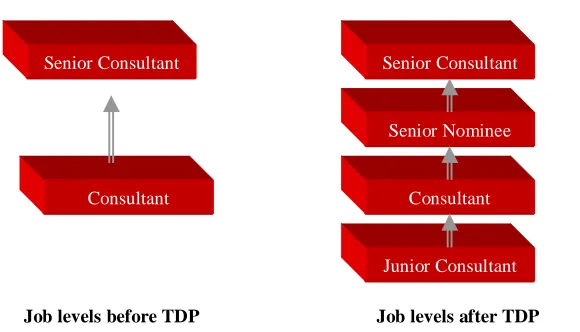
introduction of two extra job-levels in the job-ladder of a consultant (Figure 3.1). In the former situation Tempo-Team distinguished a consultant and senior consultant level. In the new situation two extra levels, the junior consultant and senior consultant level are added. The junior phase refers to the training- phase in which a consultant does not have a permanent contract. The senior nominee level is the phase in which a consultant has qualified for a promotion, but a promotion is not yet granted. This senior nominee level is considered as more of a transition phase than an actual job-level. The purpose of these two new levels is to provide (new) consultants more career perspective and clarity about the
phases in which he or she operates. This will, according to the HRD department, enhance the feeling of transparency5 and must therefore be part of the new promotion process.
5
Figure 3.1 Changed job levels TDP
Appended with the two additional job levels the HRD department presented an indicative timeline of 2.5 years for the entire process and a maximum of six months for the transfer of consultant to senior
consultant (the senior nominee phase). This research focuses strictly on this transfer and therefore the senior nominee level and the maximum of six months must be included in the new promotion process.
The HRD department also introduced three criteria that consultants must meet in order to qualify for a promotion to senior nominee and a senior nominee to be promoted to senior consultant. The first criteria, key performance indicators (KPI) will be discussed in the next section. In Sections 3.4, 3.5 the
other criteria will be outlined.
3.3 Key performance indicators
Tempo-Team uses key performance indicators (KPI) as performance measures (Neely et al. 1995)6, for measuring the performance of a consultant. The HRD department wants KPI to be part of promotion criteria, because “these key performance indicators represent in quantitative terms the effort and success of a consultant”. A consultant qualifies for a promotion by achieving excellent results (10%-15% above target) on the KPI and a senior nominee gets promoted to senior consultant when these
excellent results are continued. The next paragraph will further explore the nature of these KPI.
Tempo-Team distinguishes KPI at managerial level, agency level and unit level. The performance of consultants is determined on unit level. A unit at Tempo-Team refers to the specific industry in which the local office (the employment agency) and consultant operates. Although KPI are uniform as a
6 “A performance measure can be defined as a metric used to quantify the efficiency and/or effectiveness of Job levels after TDP
Job levels before TDP
Consultant
Senior Consultant Senior Consultant
Senior Nominee
Consultant
measure, every six months a (office) manager and a consultant determine new and personal KPI-targets for next six months. These KPI-targets are determined by means of backward planning. This method uses statistics of earlier periods in order to determine new targets. The following KPI are used to
determine the personal targets: operational revenue/ turnover; number of vacancies; percentage of filled-in vacancies; number of active customers; number of busfilled-iness appofilled-intments; number of offers made to potential customers; turnover temporary employees at unit level; total market share (account process).
To illustrate, a consultant and a manager can decide that the KPI: ‘number of active customers, number of business appointments and turnover of temporary employees’ need extra attention in the next six months. Then personal targets by means of back planning are set, which will be evaluated after another period of six moths.
The second criterion for a promotion that the HRD department introduced is: displaying desired
behavior on the basis of behavior profiles. This subject will be elaborated in the next section.
3.4 Behavior Profiles
Because Tempo-Team desires promoting consultants on the basis of capabilities, these capabilities must be known. Therefore HRD department developed behavior profiles in which all the desired behavior of a consultant is described. The ‘perfect’ consultant meets all the required behavior. The HRD department developed three separate profiles containing 95 to 120 detailed behavioral
aspects for the junior consultant, consultant and senior consultant level. Because the senior nominee level is considered as more of a transition phase, this job level does not have an own profile. The desired behavior in the profile is divided into three roles and six work processes that cover all the activities of a consultant. These three roles are: Sales leader; focuses at being the sales
leader in the market, Process manager; focuses at improving efficiency of internal processes, reducing costs, People manager; focuses at development and improving the performance of colleagues and temporary employees.
The six work processes are: acquisition & relation management, purchase of temporary workers, tuning of market needs and whishes, administrative effectiveness, managing temporary workers and activities at the office The behavior profile of a senior consultant also includes five aspects
concerning overall behavior.
But how can these behavior profiles be applied as promotion criteria? For this purpose the HRD department and the management decided that a consultant qualifies for a promotion to senior nominee
(appendix 10). During the nominee phase a consultant must develop oneself at weaker behavioral aspects. Or as the HR-manager argued: “a senior nominee must be promoted to senior consultant on the factor in which the employee of subject develops oneself (on basis of the behavior) during the promotion
process.” Besides this citation of the HR-manager both interviewed experts have the same opinion in which they state that displaying the desired behavior and develop oneself on this behavior is the most important measure of a promotion decision.
The question how can this uniform standard of ‘displaying behavior and development on behavior’ be
measured and how does it contributes to improving transparency and fairness are one of the important topics of this research. Moreover the above uniform standards need more clarity (e.g. what is meant with regularly displaying some behavior?) and an additional measuring method. The insights of the literature review, in chapter 4 will further explore these topics.
The third criterion concerns personal objectives that a manager and consultant determine after a consultant has qualified for the senior nominee level. These personal objectives will be discussed next.
3.4 Personal objectives
Besides KPI and displaying desired behavior from the profiles, Tempo-Team’s management insists that
a senior nominee (the qualified consultant) joins a special project or receives a personal assignment during the promotion process. Before starting with the project or assignment the manager and consultant must agree on personal objectives which they evaluate at the end of the promotion process. These personal objectives must be part of the actual promotion decision.
Next to the introduction of two new job levels and three criteria, the management also has certain demands regarding the appraisal authority. These demands must be taken into account during the development of a new promotion process and will therefore be explored in more detail in Section 3.6.
3.5 Appraisal authority
Tempo-Team’s management desires managers to retain final authority for a promotion decision. This means that the manager is authorized to give a good reference to a higher operational manager, which grants the actual promotion. This supervisor-system was also present in the former situation. Regarding
recruitment: “the promotion appraisal must not be used by means of an excuse for poor communication in an earlier phase”. This topic will also be discussed in chapter 4, 5 and 6.
The decision that a manager retains final authority for the actual promotion is the last element derived from the talent management program. The next section will give a comprehensive overview of all the elements discussed in this chapter.
3.6 Overview of criteria new promotion process
The first sub-question of this chapter was: ‘Which practical adaptations and decisions derived from
Talent Development Program must be taken into consideration before designing a new promotion
process?’ The answer to this question is given in the next paragraph which summarizes the main
findings of this chapter:
§ Tempo-Team desires a promotion process in which a consultant is promoted on the basis
of qualifications and performance, and the HRD department added an explicit senior nominee phase with an indicative timeline of 6 months
§ A consultant qualifies for a promotion by displaying good performance results, measured
by key performance indicators (KPI). A senior nominee gets promoted when the results are
continued
§ When a consultant is regularly displaying behavior of a senior, according to the detailed
behavior profile of a senior consultant, he should be promoted to senior nominee. A senior nominee gets promoted on the development of the points of improvement
§ A senior nominee must join a special project or receives an assignment, which is evaluated
by means of personal objectives
§ The (office) manager retains the final authority for the appraisal of the consultant and
senior nominee.
Chapter 4
Theoretical background
The fourth chapter of this research presents an overview of the data gathered during the literature
study. The objective of this literature review is to provide feasible (regarding the findings from the
previous chapter), theoretical insights in order to design a promotion process that exhibits the
characteristics which of transparency and fairness (described in definition of concepts). Therefore this
chapter describes how such promotion process must be designed as well as how the perception on
transparency and fairness can be improved. First the required type of promotion process and promotion
criteria are addressed. Subsequently the appraisal of the behavior criterion is outlined and an overall
theoretical model for a new promotion process is discussed. This chapter finishes with an overview of
the main findings.
4.1 Promotion systems designs
In the introduction of this paper was mentioned that Tempo-Team’s internal labor market (Doeringer & Piore, 1971) lacks institutional rules for career movement. This first section will further explore this topic and discuss how a promotion system designs can improve an individual’s perception on transparency and fairness.
In the context of a promotion process Osterman (1987) refers to Doeringer and Priore’s institutional
rules as career development rules. He argues that these rules provide guidelines by which more senior or more rewarding jobs are reserved for insiders to provide some basis of career development or career expectations. The way organizations interpret these career development rules and elements differ and result into several promotion system designs (empirical findings). The next paragraph focuses on these promotion systems. It will discuss Tempo-Team’s former promotion process and how transparency and
fairness can be improved by introducing a different promotion system design.
The current vague promotion process of Tempo-Team displays similarities with the promotion system design of rank-order tournaments to elicit effort, which was proposed by Lazear and Rosen (1981). In such a rank-order tournaments design, a firm attaches higher wages to higher jobs and workers compete for future positions on the current job and exert optimal levels of effort in their strive for a promotion to
of other employees. Consultants at Tempo-Team also felt that a promotion was often based on favoritism rather then objective criteria (results pretest, appendix 5).
The objective of this research is to prevent competition-based problems by introducing a transparent and fair promotion process in which employees are promoted on the basis of their capabilities and performance. What kind of promotion system design matches with this desire? And will such a promotion system design prevent problems that occurred during the current promotion system design?
The following paragraphs will further explore these questions.
The promotion system design of Gibbons & Waldmann (1999) states that the assignment of a worker to a different position, which initiates career mobility only occurs when candidates meet the knowledge and skill requirements for the new positions. This design matches closest to the desire of Tempo-Team
and appears to more ethically (characteristic of fairness, Leventhal, 1980) than a rank-order tournament design. A consultant can earn a promotion when he or she is capable, which excludes favoritism of a manager. In case of Tempo-Team this can be considered as ethically, because Tempo-Team is an
organization that depends on making profit in order to survive and therefore some form of competition on capabilities and performance is essential. An internal market with a promotion system design in which no standard for capability and performance is determined can results in a distortion known as the Peter Principle7, which is not an option for Tempo-Team.
Thus the promotion system design proposed by Gibbons & Waldmann (1999) is the best alternative for Tempo-Team, but this design also has some associated conditions that must be taken into account in order to exhibit the characteristics of transparency and fairness. First the introduction of this promotion system design must be explicitly communicated. Every consultant in the organization must become
aware that they can qualify for a promotion on basis of qualification and performance and every consultant must have the possibility to speak-out his ambition in order to qualify for a promotion. Moreover the organization must provide employees assistance, like coaching to help individual’s reach their career development goals. These two conditions prevent transparency and fairness problems like a lack of clarity, uniformity and consistency.
Furthermore a firm must bases its staffing decision on a judgment of relative capabilities and
productivity of potential job candidates (Gibbons & Waldmann, 1999). In other words, the firm has to
7
determine which worker is best suited for a particular job. This not only requires uniform, accurate measurements of relative capabilities and productivity, but also a measuring method that suppresses biasness, has a mechanism of correctability and is representative (like mentioned in the definitions of
concepts).
Measurements in the context of a promotion are referred to as promotion criteria (London & Stumpf, 1980, Osterman 1987) and will simultaneously with the associated measuring methods be discussed in
the next section.
4.2 Promotion criteria
In 1980, London & Stumpf already identified that an effective promotion policy is based on criteria that
include the employee’s future performance (capabilities) and past performance, like the organizational unit's success along such dimensions as profitability, growth, technological leadership, and return on
investment. This is similar to Bilikopf’s (1997) description of a merit-based promotion. Defining effective promotion criteria are important for improving an individual’s perception on a transparent and fair promotion process. Campbell (1980) outlined the influence of missing clear transparent goals by stating: “if you don’t know where you are going, you’ll probably end up somewhere else”. An employee
does end up somewhere else when vague promotion criteria are used. “Terms like no-team player, no risk-taker or no assertive person will not help someone to understand what he must develop” (McCall jr., 1998 p157). Clear measurable promotion criteria are therefore crucial, because employees are likely to view a decision with a greater sense of fairness if they understand the factors that went into the decision (Kovnovsky & Brockner, 1993).
But can the three promotion criteria brought forward by Tempo-Team be considered as clear effective promotion criteria that positively influence a consultant’s perceptions of transparency and fairness? The next paragraph will focus on this question.
The KPI (as past performance measures) can be considerate as accurate performance measures and the measuring method as fair. Managers and consultants can effortlessly measure, check and judge if a consultant achieves excellent results (10%-15% above target). The KPI also suppress biasness, because
consultants cannot fake their performance on the indicators (Chapter 3, Section 3.1). KPI are also representative because both consultant as well as manager is involved during the determination of the targets.
The personal objectives for an assignment or a project do not exhibit the characteristics of transparency and fairness, especially not the requirement of uniformity and consistency. Although the criteria will be consistently and uniformly applied for every senior nominee (goal of Tempo-Team’s management), the nature of the project and assignment can vary. This means that the assignment and projects will not be evenly complex for every consultant during the senior nominee phase. This problem is difficult to
exclude, but can be minimized by signifying less priority to these personal objectives during the actual promotion decision. These personal objectives are also subjected to biasness and accuracy problems. This can be partly overcome by instructing managers to formulate “clear concrete objectives that
prevent vagueness” (McCall jr., 1998 p157) and are difficult to fake.
The future performance criterion, displaying desired behavior according to the profile of a senior consultant, was indicated as high priority criterion (Chapter 3, Section 3.3). But this criteria brought
forward by Tempo-Team is not a criterion at all. It is just a set of papers with the desired behavior written on it. Because Tempo-Team wants displaying desired behavior to be a uniform determinative criterion for qualification to the senior nominee phase and for the actual promotion decision to senior (development of behavior), other theoretical insights are necessary. This topic concerns behavior and
therefore insights were found in literature concerning competency management and assessment methods, which will be discussed in Section 4.4. Before these insights are outlined, is first the changed organizational context discussed. This changed context will explain the choice for applying insights from competency management and assessment theories, and will therefore be addressed first.
4.3 Changed organizational context
Empowered project teams, decentralization and self-regulations characterize the new organizational context. This trend towards decentralization and self-regulation started during the 1990’s in the Netherlands and has lead to the development of an organization that provides career-driven jobs with associated training and education. In this way, organizations create opportunities for a “gradual
2002 p4). In such a work environment employees have a manager who functions as their coach and mentor, but employees are responsible for the “recognition of their own development needs and take advantage of the resources that the organization provides to them” (De Rijke & Vloeberghs, 2002).
According to Cappelli (1999, p3) “new young workers ask for an employer that ensures their future employability by providing learning experiences that can be added to their resumes”. Personal development has therefore become the responsibility of the individual himself and it is the responsibility of an individual to take advantage of the provided organizational learning context. Or as Campbell
(1998) argues: “Personal development is not the responsibility of someone else, but it helps when an organization or other people show interest. The individual must make choices that influence their own development and make use of the context in which these choices take place”. For this reason organizations introduced tools that are used to measure and stimulate development of an employee. Competency management outlined by authors like De Rijke & Vloeberghs (2002) is one of those tools.
Although Tempo-Team’s profile of desired behavior of a senior consultant cannot be considered as traditional competency management (with the four levels of competence: roles, competencies, behavior and person, described in the literature by authors like Hamel et al., Gilbert, Byham and Boyatis), the
competency management theory does provide useful insights for transforming the profile into a promotion criterion for measuring the capabilities of a consultant. Moreover theoretical insights from related assessment theories describe how behavior must be measured in order to improve the perception on transparency and fairness of the promotion process. What these assessing methods comprehend and
what it can do in order improve the perception on transparency and fairness will be outlined in the next two sections.
4.4 Measuring & assessing behavior
The main advantage of competency management according to Seegers (2006) is that competencies make skills, behavior and capabilities of employees discussable. This however requires an additional measuring method. This additional measuring method is called the assessment center method. Traditional assessment center method, in which candidates are judged by trained assessors on the basis
of their specific behavior in various simulations, have been changed and are frequently used by managers on the work-floor (Vloeberghs,1997). This integrated (on the work-floor) assessment approach means that employees are more often confronted with self-assessments, 360˚ feedback and self-appraisal and that “monitoring and assessing yourself is becoming a people skill” (Miller & Cardy, 2000 p611).
assessment is present. Vloeberghs (2002) does describe some guidelines for the promotion assessment. These guidelines are: the decision should concern a yes / no decision, so both a promotion as well as a rejection are possible outcomes, the assessment must assess predetermined clear objectives, after the
assessment there must be some form of feedback.
In case of promotion assessments, there is also a noticeable trend of 'other' to 'self-assessment'. Employees themselves take the initiative in order to qualify for a promotion and are judging their own performance(De Rijke & Vloeberghs, 2002).
Before Vloeberghs (2002) guidelines are related to the situation of Tempo-Team, first the advantages of a self-assessment will be addressed.
The main advantage of a promotion process including a self-assessment component is that it allows
managers to give feedback and employees to participate in the decision-making process by expressing their view. The latter is in organizational justice terms referred to as the “voice effect” (Folger, 1975). Feedback and the voice effect improve the perception of transparency and especially fairness, which
will be discussed in the next paragraphs. Subsequently these topics will be related to Tempo-Team’s behavior profile.
Generating feedback about the behavior of a consultant in the context of a promotion requires a
“systematical method of gathering the views of several assessors in the workplace” (De Rijke & Vloebergs, 2002, p6). 360º feedback is a tool that can be applied to generate this feedback. 360º feedback makes use of evaluators that assess daily behavior over a longer period. Evaluators are: the employee of subject (self-monitoring), the manager, colleagues and sometimes even customers. The
advantage of 360º feedback is that “the acceptance of the several opinions is often greater, because the individual is assessed over a longer time period” (Van der Woude, 1996) and moreover “a self-appraisal-component represents a valued additional perspective on performance and may serve to increase employee involvement in the appraisal process” (Wilson, 1994). This involvement will improve an individual’s perception on Leventhal’s (1980) fairness characteristic of representativeness. Furthermore 360º feedback allows employees to give their opinion about a promotion decision. In
performance appraisal (Korsgaard & Robertson, 1995). This means that even when people do not agree with a promotion decision, the opportunity to express themselves and involvement in the decision-making process will increase their feeling of fairness about that decision. Individual perception or ‘the
eye of the beholder’ (Adams, 1965) must therefore always be taken into account during an allocative process like a promotion process.
In order for Tempo-Team to make use of the advantages of feedback and the voice-effect, the profile
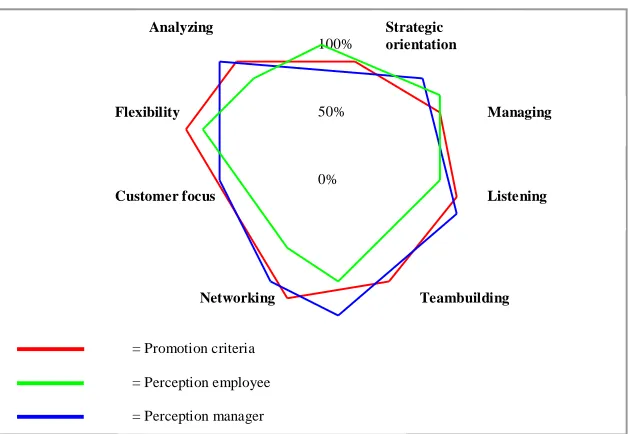
containing the desired behavior of a senior consultant must become a 360º feedback instrument. This tool must be according to Vloeberghs (2002) job-specific and include predetermined objectives. Therefore the profile must be transformed into a questionnaire containing the behavioral aspects (subdivided in the six work process and the three roles) in which feedback is generated by systematically gathering the views of assessors. The questionnaire enables assessors to give a score on
each of the behavioral aspects and will result into a structured overview of the opinions of the assessors (like example Figure. 4.1). In order to give a judgmental decision and discuss these scores (the actual behavior), a standard uniform score (as criterion) for qualifying for senior nominee and senior
consultant must be determined.
When the behavioral profile of a senior consultant is transformed into a 360º feedback instrument and a standard score for qualification to senior nominee and promotion to senior is determined, the criterion
can be considered as more transparent and fair. Subsequently the criterion and tool must be uniformly applied to every consultant (also fairness characteristic: consistency) and communicated explicitly. The 360º feedback instrument improves a consultant’s perception of fairness because it suppresses biased outcomes, thwarts the ease of faking and represents the opinion of all interested parties. This is because
Figure 4.1 Example of an overview of 360 º feedback
So far separate elements of a promotion process are described, but an overall theory, which leads to a complete promotion process, is missing. The next section will describe the performance management
model of Seegers (2006) that can serve as basis for a new promotion process in which all separate elements can be integrated.
4.5 Overall theoretical model for appraising a promotion
This section will focus on the management of performance model of Seegers (2006). This model (Figure 4.2) is not focused on a promotion process, but on performance appraisal process. Although there are
differences between these processes, the model of Seegers (2006) is useful because it includes the elements that are described throughout this chapter. The integration of these elements within the model will be described in the next paragraphs.
In section 4.2 the importance of clear promotion criteria was described. London & Stumpf (1980) argued that an effective promotion policy consists of future (potential) and past performance measures.
But is the description of an effective promotion policy by London & Stumpf still useable in the new organizational context? Seegers (2006) study of competency management & performance improvement can provide an answer to this question. Seegers (2006) emphasizes that future-performance can be measured by using a competency assessment and past-performance with use of performance
measurements. Both components are related and affect each other. Seegers (2006) perceives competencies of the employee as input for performance. The behavior of the employee during work-
stimulated by means of coaching by the manager (in accordance with the new organizational context). Finally, the actual behavior and performance is appraised by means of performance measurements (output). The overall process is called management of performance.
Figure 4.2 Seegers (2006) management of performance model
But how can the model of Seegers (2006) that is focused on performance appraisal, be used as a promotion process for Tempo-Team? The following paragraphs will answer this question by relating each phase of the model of Seegers to the situation of Tempo-Team and the theoretical insights
discussed in this chapter (will be described in more detail in chapter 5).
The input phase in a new promotion process
As mentioned earlier (Section 4.2) the behavior profile of senior manager cannot be considered as
traditional competency management, but this profile is useful for measuring future performance (capabilities, as in promotion system of Gibbons and Waldmann). Therefore a job-specific 360º feedback instrument (Vloeberghs 1997) that has positive influence on transparency and fairness should
who each give a score on the behavioral aspects mentioned in the behavior profile of a senior consultant (by means of a 360º feedback tool) and the results the consultant achieves on the KPI (as one of the criteria proposed by Tempo-Team).
Throughput phase in a new promotion process
The throughput phase can be compared to Tempo-Team’s senior nominee phase and is influenced by cultural & organizational values. These values must stimulate self-management in which a manager
operates as mentor/ coach (as mentioned in Section 4.3). The consultant is responsible for his or her own development during this phase. This means that the consultant is responsible for continuing excellent results on the KPI (10-15% above target), develop oneself on weaker behavioral aspects and work on a assignment or in a project to achieve the personal objectives.
The output phase in a new promotion process
During the output phase consultants are appraised for a promotion on the basis of their performance during the throughput phase. In case of Tempo-Team this will concern the KPI, the behavior
development (personal development on weaker behavioral aspects) and the personal objectives and the development (paragraph 4.2 and chapter 3, paragraphs 3.2, 3.4). These measures are the output of the work activities and personal development of the consultant during the throughput phase.
4.6 Overview of criteria from literature insights
The five previous sections of this chapter discussed all theoretical findings and answered the second research question (‘What insights from literature can be used to develop a more transparent and fair
promotion process?’) This paragraph provides a summarized overview of these findings:
§ The promotion process model of Gibbons & Waldmann 1999 in which employee are
promoted on bases of capabilities and performance matches closest to the desires of Tempo-Team
§ This promotion system can only be used when effective promotion criteria are used for
the promotion decision.
§ According to London & Stumpf, 1980 an effective promotion policy consist of future
(desired behavior) and past promotion (KPI and personal objectives) criteria. Clear criteria improve the perception of transparency and fairness
§ The changed organization context also led to the development of tools like 360°
§ Insights regarding 360º feedback and promotion assessment showed that when
Tempo-Team’s profile of desired behavior is transformed to a job specific 360º feedback tool, it can measure the capabilities of a consultant and this will have positive influence on
transparency and fairness
§ The insight of promotion criteria, changed organizational context and 360º feedback
assessment are integrated in the model of Seegers (2006), which can serve as foundation for the new promotion process
Chapter 5
The new promotion process
This chapter covers the synthesis and test phase of the research design (Roozenburg & Eekels, 2003).
This means that the adaptations and decisions made during the talent development program and the
insights from the literature are combined into a new promotion process and that this promotion process
is tested for its structure (preliminary design) and function (does it exhibit the characteristics of
transparency and fairness). First an overview of the new promotion process is outlined. Subsequently
the components of this promotion process are described. After that, the results of the process is
evaluated.
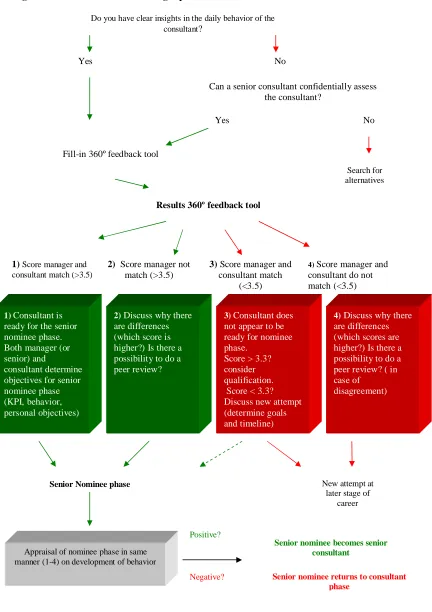
5.1 Overview new promotion process
The new promotion process (Figure 5.1) is based on Seegers (2006) model of performance management and consists of an input phase, throughput phase and output phase. These three phases are described as the consultant phase, the nominee phase and senior phase. As mentioned (Chapter 4, Section 4.5), the model of Seegers focusses on performance appraisal and therefore several elements of the new promotion process differ from this model. Besides an overview, the new promotion process is associated with a process manual (appendix 12). The elements of the overview and the process manual