Is this NE tagger getting old?
Cristina Mota, Ralph Grishman
L2F (INESC-ID) & IST & NYU, New York University Computer Science Department Rua Alves Redol 9 1000-029 Lisboa Portugal, New York NY 10003 USA
[email protected], [email protected]
Abstract
This paper focuses on the influence of changing the text time frame on the performance of a named entity tagger. We followed a twofold approach to investigate this subject: on the one hand, we analyzed a corpus that spans 8 years, and, on the other hand, we assessed the performance of a name tagger trained and tested on that corpus. We created 8 samples from the corpus, each drawn from the articles for a particular year. In terms of corpus analysis, we calculated the corpus similarity and names shared between samples. To see the effect on tagger performance, we implemented a semi-supervised name tagger based on co-training; then, we trained and tested our tagger on those samples. We observed that corpus similarity, names shared between samples, and tagger performance all decay as the time gap between the samples increases. Furthermore, we observed that the corpus similarity and names shared correlate with the tagger F-measure. These results show that named entity recognition systems may become obsolete in a short period of time.
1.
Introduction
A recent survey by (Nadeau et al., 2007), covering the last 15 years of research in named entity recognition (NER), shows that the field has been growing significantly, in terms of the number of languages processed, textual genres and domains covered. As the authors describe, the availability of large amounts of data motivated researchers to gradu-ally abandon the early hand-crafted rule systems, and adopt (supervised and semi-supervised) machine learning tech-niques.
The performance of these systems is usually measured by testing the system on unseen texts, which will be compared to a gold standard or key, to assess precision, recall and F-measure in the identification and classification of the named entities (NE). In general, the training and test conditions are similar, i.e., the system is trained with texts that are comparable in terms of genre, topic and language to the test texts; otherwise the performance will most certainly decrease. What if we keep the same genre, topic and lan-guage, but change the time frame of test texts? Do texts vary over time in a way that will affect the performance of a name tagger? Such issues are important in selecting the training data for a tagger.
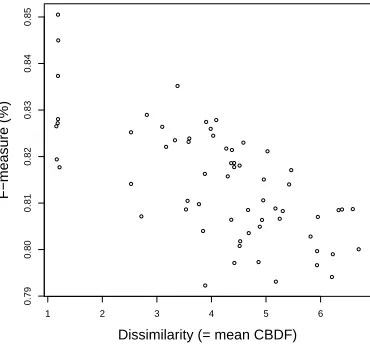
In this paper we show that as the time gap between training and test texts increases (i) the similarity between the two texts decreases, (ii) the name lists of those texts overlap less; and (iii) the performance of an NE tagger also decays. Furthermore, we will show that the results of the corpus analysis and the system performance correlate over time.
The paper is structured as follows: we begin by a brief dis-cussion on how time has been dealt with in natural language processing; then we characterize the task we are assessing and the corpus used in our experiments; in sections 4. and 5., we present, respectively, the methodology to analyze the corpus, and the name tagger architecture; finally, we show the results of our experiments over time and conclude, pointing to future directions.
2.
The influence of time in NLP
Time in natural language processing can be viewed through two different perspectives: as a relevant object that can be processed or as a system variable that conditions its per-formance. The former has been by far more explored, and consists in recognizing and relating temporal information in texts (e.g., identification of temporal expressions, identifi-cation of when an event took place, ordering events chrono-logically and novelty detection).We are more interested in the second perspective that sees time as a system variable, i.e., there are changes in texts over time (either due to language changes or to topic and sub-topic shifts) that affect the performance of natural lan-guage systems and, hence, systems should be conceived time-aware.
and Church, 1994) when comparing different probability estimators for English bigrams, split a one year corpus into training and test by assigning each bigram starting at an even-numbered word to the former, and those starting at odd-numbered words to the latter. In this way, they were aiming at obtaining closer training and test samples, avoid-ing temporal bias (they had observed measurable differ-ences over the period of one month). (Church, 1995) stud-ied the correlation between word variants (singular/plural, adjective/adverb, lower case/upper case) by comparing the correlation estimates obtained in one year of the Associated Press corpus with the estimates obtained on different years of the same news agency. He observed that the estimates were highly reliable over a period of five years (from 1988 to 1992), but since the estimates degraded over time, he suggested that in order to predict the correlation between two word forms in one year one should use the estimates of the previous year instead of the estimates obtained ten years before.
As in this latter work, we trained our name tagger in one time frame and then tested the tagger with texts within other time frames. Moreover, we also compared the texts over time in different ways, relating the results of the corpus analysis with the results of the tagger performance.
3.
Experimental Conditions
In this section we begin by characterizing the task our name tagger was developed for, and the data used in our experi-ments.
3.1. Task definition
The first evaluation for named entity recognition in Por-tuguese, HAREM, took place in 2004 (Cardoso and Santos, 2007). We adopted the HAREM NE annotation scheme, but simplified the classification task to approximate the MUC named entity task (Grishman and Sundheim, 1995): (i) we are only interested in proper names of people, orga-nizations and locations; (ii) assignment of type and mor-phological attributes is not considered; (iii) the classifica-tion gives preference to the classificaclassifica-tion of the base form rather than to the name function, as in the “form over func-tion” approach (Johannessen et al., 2004). This last deci-sion means that, for instance, Portugal is classified as loca-tion in both of these contexts:
Portugal is located in Europe
Portugal voted against the proposal
In HAREM, these references should be classified as loca-tion and organizaloca-tion, respectively. For a thorough compar-ison between MUC and HAREM tasks cf. (Seco, 2007).
3.2. Data description
We conducted the experiments on samples of the Politics articles of the Portuguese corpus CETEMP´ublico (Rocha and Santos, 2000). The corpus has 180 million words and spans 8 years, from 1991 to 1998, divided into semesters. The original newspaper articles were fragmented by the corpus builders into extracts (typically 2 paragraphs each, which in Politics resulted in about 5 sentences per extract),
and then randomly shuffled to comprise the final corpus. This means that within a semester, two adjacent extracts most likely don’t belong to the same article and that they are not sorted temporally.
The Politics section of the corpus corresponds to about one quarter of the corpus. From this section, we created a golden collection (key) of 16 texts by manually annotating with NE the first 400 extracts in each semester; from those we used the first 192 extracts to collect the tagger seeds and the remaining 208 as test sets; the following 7856 extracts of each semester are also used by the NE tagger as unla-beled data. We grouped these subsets by year.
91 92 93 94 95 96 97 98
Time frame (year)
Number of seeds
0
200
400
600
800
1000
1200
PEOPLE ORGANIZATION LOCATION
Figure 1: Seeds distribution by topic and category
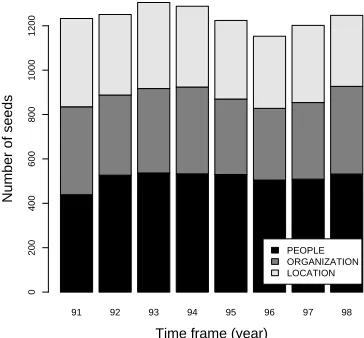
The tagger seeds correspond to the set of different names obtained after collecting the first 2500 name instances of each year in the golden collection. Figure 1 shows the dis-tribution of seeds by category in each time frame. Even though, there are more seeds classified as people (about 40% of the different seeds are people names, and the re-maining names are equally distributed by organizations and locations), people names are less frequent: in average, each name occurs about 1.6 times, whereas organization and location names occur about 2.29 and 2.34, respectively. Hence, in terms of name instances the category distribu-tion is 32.2%, 34.81% and 32.99% for people, organizadistribu-tion and location, respectively.
From the 7856 unannotated extracts of each semester, the tagger uses the first 82456 unlabeled names and corre-sponding surrounding context as pairs of unlabeled exam-ples to bootstrap. Those names occur in one of the contexts mentioned in section 5.
4.
Corpus comparison
Raw TEXT
POS Tagging + Parsing
Shallow Parsed TEXT
NE Identification TEXT with NE
List of Examples (NE,context)
NE Classification Name seeds
List of Labeled Examples (NE, context, label)
NPROP Update + NE Propagation
TEXT classified with NE ?
?
?
?
-?
?
?
?
?
Figure 2: NE tagger architecture
step the most frequent features which co-occur with labeled examples of each NE type are examined; if the strength,
h(x, y)(an estimate of the conditional probabilityP(y|x) of seeing labelywhenxis in the example feature set) ex-ceeds a threshold (0.95), this feature/label pair is added to the new set of rules, forming a decision list. In the last step all possible rules (both spelling and contextual) are added to the final decision list. This final decision list is used to label a test set obtained by applying the same sequence of operations as for the training set: POS tagging, parsing, NE identification, and NE feature extraction.
In our implementation, we modified the identification stage. We used NooJ (Silberztein, 2004) to do local parsing and extract the NEs occurring in the following contexts: head of noun phrase, complement of noun phrase, left or right context of a verb, coordination, and age context; in the classification stage, we used five of the features proposed by the authors (namely, full string, contains, allcaps1, con-text type and concon-text) and also used the length of the NE. Moreover, we integrated an additional propagation stage to boost recall, i.e., the classified names will be used to recog-nize in the text other instances of the same names occurring in contexts that were not identified by the first stage.
The overall architecture of our name tagger is depicted in Figure 2.
5.2. Tagger evaluation
Before analyzing the performance over time, by training and testing the system within different time frames, we evaluated our system in order to understand how well it per-formed within each time frame.
(Collins and Singer, 1999) evaluated their tagger by mea-suring accuracy and clean accuracy1 on a sub-set of 1000 examples they manually labeled, and randomly selected from the 90000 examples they had identified, obtaining 83.3% and 91.3%, respectively. We evaluated our tagger by measuring the precision, recall and F-measure regarding each text in the golden collection.2
We compared the performance of our tagger to the perfor-mance of a baseline tagger. Since the classification algo-rithm uses seeds to bootstrap, our baseline consisted in sim-ply looking up the seeds and assigning to the name in the test text the most frequent label of that name in the seed set. The baseline was also applied to each text in the golden col-lection.
91 92 93 94 95 96 97 98
70
75
80
Time frame (year)
F−measure (%)
baseline overall.class
Figure 3: Classification F-measure for co-training and baseline taggers
As can be seen in Figure 3, the baseline classification F-measure is lower than 71.06% for all texts within the golden collection, averaging 69.08%, whereas our tagger classifi-cation is above 80.95% for all texts, achieving in average 82.36%.
6.
Results
In the following experiments, we denote bySi,UiandTi,
respectively, the seed, unlabeled and test texts, byN E(t) the names extracted by the tagger from text t, and by (Si=91...98,Ui=91...98,Tj=91...98) a training-test configura-tion.
For each text (indexed byk) in the time interval from 91 to 98, we ran the NE tagger with the configuration (Sk,Uk,
1Contrarily to accuracy, clean accuracy doesn’t take into
ac-count examples that were incorrectly identified, i.e., which do not belong to one of the categories people, organization or location
2
0 1 2 3 4 5 6 7
0.79
0.80
0.81
0.82
0.83
0.84
0.85
Time gap (year)
F−measure (%)
(a) F-measure for (Sk=91...98,Uk=91...98,Tj=91...98)
0 1 2 3 4 5 6 7
1
2
3
4
5
6
Time gap (year)
Dissimilarity (= mean CBDF)
(b) Dissimilarity for (Uk=91...98,Uj=91...98)
0 1 2 3 4 5 6 7
4.0
4.5
5.0
5.5
6.0
Time gap (year)
Name type overlap (%)
(c) Name type overlap for (N E(Uk=91...98),
N E(Tj=91...98))
0 1 2 3 4 5 6 7
1.7
1.8
1.9
2.0
2.1
2.2
Time gap (year)
Name token overlap (%)
(d) Name token overlap for (N E(Uk=91...98),
N E(Tj=91...98))
1 2 3 4 5 6
0.79
0.80
0.81
0.82
0.83
0.84
0.85
Dissimilarity (= mean CBDF)
F−measure (%)
(e) F-measure compared to dissimilarity
Heng Ji and Ralph Grishman. 2006. Data selection in semi-supervised learning for name tagging. In
Proceed-ings of the Workshop on Information Extraction Beyond The Document, pages 48–55, Sydney, Australia, July.
Association for Computational Linguistics.
Janne Bondi Johannessen, Kristin Hagen, Asne Haaland, Andra Bjork Jansdottir, Anders Naklestad, Dimitris Kokkinakis, Paul Meurer, Eckhard Bick, and Dorte Hal-trup. 2004. Named entity recognition for the mainland scandinavian languages. Literary and Linguistic
Com-puting, 20(1):91–102.
Adam Kilgarriff. 2001. Comparing corpora. International
Journal of Corpus Linguistics, 1(6):1–37.
Nadeau, David, Sekine, and Satoshi. 2007. A survey of named entity recognition and classification. Linguisticae
Investigationes, 30(1):3–26, January.
Paulo Rocha and Diana Santos. 2000. Cetemp´ublico: Um corpus de grandes dimens˜oes de linguagem jornal´ıstica portuguesa. In Maria das Grac¸as Volpe Nunes, editor,
Actas do V Encontro para o processamento computa-cional da l´ıngua portuguesa escrita e falada PROPOR 2000, pages 131–140, Atibaia, S˜ao Paulo, Brasil.
Diana Santos, Nuno Cardoso, and Nuno Seco. 2007. Avaliac¸˜ao no harem: M´etodos e medidas. In Diana San-tos and Nuno Cardoso, editors, HAREM, a primeira
avaliac¸˜ao conjunta de sistemas de reconhecimento de entidades mencionadas para portuguˆes: Documentac¸˜ao e actas do encontro. Linguateca.
Nuno Seco. 2007. MUC vs HAREM: a contrastive per-spective. In Diana Santos and Nuno Cardoso, editors,
HAREM, a primeira avaliac¸˜ao conjunta de sistemas de reconhecimento de entidades mencionadas para por-tuguˆes: Documentac¸˜ao e actas do encontro. Linguateca.
Max Silberztein. 2004. Nooj: A cooperative, object-oriented architecture for nlp. In INTEX pour la
Linguis-tique et le traitement automaLinguis-tique des langues, Cahiers
de la MSH Ledoux. Presses Universitaires de Franche-Comt´e.
Mark Stevenson and Robert Gaizauskas. 2000. Using corpus-derived name lists for named entity recognition. In Proceedings of 6th Applied Natural Language