Automatic extraction of subcategorization frames for Italian
Dino Ienco, Serena Villata, Cristina Bosco
Dipartimento di Informatica - Universit`a di Torino Corso Svizzera 185, Torino, Italy
{ienco,villata,bosco}@di.unito.it Abstract
Subcategorization is a kind of knowledge which can be considered as crucial in several NLP tasks, such as Information Extraction or parsing, but the collection of very large resources including subcategorization representation is difficult and time-consuming. Various experiences show that the automatic extraction can be a practical and reliable solution for acquiring such a kind of knowledge.
The aim of this paper is at investigating the relationships between subcategorization frame extraction and the nature of data from which the frames have to be extracted, e.g. how much the task can be influenced by the richness/poorness of the annotation. Therefore, we present some experiments that apply statistical subcategorization extraction methods, known in literature, on an Italian treebank that exploits a rich set of dependency relations that can be annotated at different degrees of specificity. Benefiting of the availability of relation sets that implement different granularity in the representation of relations, we evaluate our results with reference to previous works in a cross-linguistic perspective.
1.
Introduction
Subcategorization specifies the number and syntactic category of verb arguments, and describes the predicate-argument structure associated with it. It is essential in various theoretical linguistic frameworks, such as Head-Driven Phrase Structure Grammar and Lexical Functional Grammar, where subcategorization consists in more or less fine-grained distinctions among verbal arguments, i.e. between complements and adjuncts, as in dependency grammars.
Moreover, verb sucategorization is a fundamental issue in several NLP tasks, for instance, in parsing where the availabity of knowledge related to Subcategorization Frames (SCFs) and the complement/adjunct distinction meaningfully increases the accuracy of results. In particu-lar, when the language which is processed is a free word order, where complements can freely appear on the left or right side of the verbal head also mixed with adjuncts (Collins, 2003).
Therefore, the representation of subcategoriza-tion plays an important role in treebank annota-tion. And treebanks usually annotate subcatego-rization, both for free word order languages, like TIGER Corpus for German (http://www.ims.uni-stuttgart.de/projekte/TIGER/), Alpino Dependency Tree-bank for Dutch (http://www.let.rug.nl/˜vannoord/trees/), and Italian Syntactic Semantic Treeebank (Montemagni et al., 2003), and for fixed word order, like the English and Chinese Penn Treebanks ((Marcus et al., 1993) and (Xue, 2006)) that associate the resource with a repository, i.e. PropBank1, where SCFs are collected.
The collection of SCFs is a very time-consuming task, in particular, because of the relative unportability of SCFs across corpora featuring different kinds of text and literary genres. Therefore, various scholars proposed
1
For PropBank see also at
http://verbs.colorado.edu/˜mpalmer/projects/ace.html and http://www.cis.upenn.edu/˜chinese/
the development of automatic systems for the extraction of subcategorization knowledge from linguistic corpora. For instance, meaningfull examples of works with the aim to automatically extract subcategorization frames by means of statistical methods exist for French (Chesley and Salmon-Alt, 2006), for Modern Greek (Maragoudakis et al., 2001), for Czech (Sarkar and Zeman, 2000) and for Italian (Basili et al., 1997), as we will see in Section 3.1. In this paper, we present a set of experiments known in literature concerning the automatic extraction of SCFs from annotated sentences. On the one hand, our goal consists in investigating the complexity of the task for a free word order language, namely Italian, for which similar experiments have never previously tried2.
On the other hand, we would like to evaluate how much and in which way the task is influenced by the features of the annotated data, from which the SCFs have to be extracted. Therefore, we selected for the development of our experiments an existing Italian treebank that features a very rich dependency-based annotation centered on a notion of predicate-argument structure, and allows for a representation of grammatical relations also scalable at different degrees of specificity.
The paper is organized as follows. In the next section, we present the data extracted from the treebank for the training. Then in the following, we describe the related works, the experiments we performed on our data and a discussion of results. We conclude with the work we planned for the next future.
2.
Training data
The data set consists of 2,000 Italian sentences from a dependency-based treebank, i.e. the Turin Univer-sity Treebank (TUT, download and more details at http://www.di.unito.it/˜tutreeb). The half part of the sentences included in the TUT corpus are from Civil law
2
Figure 1: TUT representation for ’La Piazza della Bandiera`ededicata a Ismail Kemal, il patriota’ - The Place of the Flag is dedicated to Ismail Kemal, the patriot.
Figure 2: TUT’s tree for the same sentence of Figure 1
3.1. Related works
In (Maragoudakis et al., 2001), the authors present a method for acquiring verb SCFs for Modern Greek, automatically from chunked corpora by using statistic metrics such as Log Likelihood Statistic and T-score as a measure to discover the frames. They estimate that using a free error chunker and eliminating the problem of the conjunction phrases, it is possible to achieve an accuracy higher than 75%.
In (Chesley and Salmon-Alt, 2006), the subcategoriza-tion frames for French have been acquired via VISL (a dependency-based parser), whose verb lexicon is currently incomplete with respect to subcategorization frames. The automatic extraction of French subcategorization frames is performed using binomial hypothesis testing. They obtain good results with a precision of 86.8% and a token recall rate of 54.3%. The precision is the fraction of the obtained correct SCFs divided by the total number of SCFs obtained
while the recall is the fraction of the obtained correct SCFs divided by the total number of the correct SCFs.
(Sarkar and Zeman, 2000) presents some machine learning techniques for the identification of subcategorization for Czech. They compare the three different statistical techniques of T-scores, Log Likelihood Statistic and Binomial Models of Miscue Probabilities applied to this problem. The shown learning algorithm can be used to discover previously unknown SCFs from the Prague Dependency Treebank labeling dependents of a verb as either complements or adjuncts. Using these techniques, they are able to achieve 88% precision on unseen parsed text.
In all the presented cases, the automatic extraction of SCFs allows for the recovery of the real frames used in the language and provides the relative frequency of different SCFs for a given predicate.
subcat-egorization patterns from corpora is proposed for Italian language. The basic idea of this work is that a lexicon of any quality can be used as a starting point because it is improved by corpus-driven unsupervised learning from a corpus. Conceptual clustering techniques are applied to the results of surface parsing in order to extract relevant domain typical senses and automatically build a lexicon of subcategorization frames. A core of lexico-grammatical knowledge suitable to support more sophisticated parsing strategies to be applied in a NLP application is learnt from some italian corpora.
Previous experiments for non statistics-based extraction of SCFs are also based on TUT. They are reported in (Bosco and Lombardo, 2006) where is developed a comparison among data extracted from TUT and those extracted from a manually constructed commercial Italian dictionary. In this works, 3,711 active forms are extracted from a portion of the treebank and classified in 830 lemmas. The annotation of TUT is especially centered on the predicate-argument structure and features a detailed representation of verbal complements and adjuncts. The results showed that with the relational information (i.e. dependencies) annotated in TUT 94,77% of tokens match with the data extracted from the dictionary.
3.2. Experiments
We calculated on our data measures related to the T-Score and verb environment with a variable size of the window.
3.2.1. T-Score
Making the hypothesis that the distribution of a particular framef in the data is independent from the distribution of a verbv, we can use the T-Score statistic to detect frames highly associated to verbs. The measure of T-score can be computed by using the following equation:
T = √ p1−p2
σ2(n1,p1)+σ2(n2,p2)
It represents how much a particular framef is linked with particular verbv. This measure can be normalized by the root of the sum of variances, as used in (Sarkar and Ze-man, 2000). Based on this metrics, we observed that if the candidatef scored high T-Score with verbv, it should be considered as a valid argument ofv.
In our experiment, we applied the measure to a version of the TUT corpus where the annotation of relations in-cludes only the functional-syntactic component rather than the original TUT relations. We selected 50 verbs with a fre-quency greater than 5 occurrences and evaluate the corre-sponding 2,452 subcategorization frames. These 50 verbs with their 2,452 subcategorization frames are the knowl-edge acquired from our training set.
We tried a generalization of the knowledge acquired from the treebank on a test set composed by 226 sentences. These sentences are new with respect to the training set since not included in the TUT corpus. The half part of these sentences are from the civil law code, and the other part from italian literature for youngs. They have been selected on the basis of the fact that they include one or
more occurrences of the above mentioned 50 more frequent verbs. Then they have been manually annotated according the TUT schema.
On the contrary of (Sarkar and Zeman, 2000), we do not achieve satisfactory results from this experiment. The mo-tivations can be various, but, in our opinion mainly the fol-lowing. First, we applied this evaluation on sentences from different literary genres with respect of the genres used in TUT (see section 2.). Second, our data format could be too complex because there are many relations to take in account (in the TUT schema there are 74 relationships) to be han-dled with trivial measures such as the T-score methods. In fact the T-Score absolute value is always under 6∗10−2, this means that it is not statistically significant.
3.3. Experiments over Verb Environment
Using the same version of TUT corpus where only the functional-syntactic component of relations is annotated, we have also carried out a number of experiments concern-ing the environment of the verb. The environment of a verb can be described by windows whose dimensions represent the number and the type of dependents preceding and fol-lowing the verb itself. In practice, a windoww(n, m) rep-resents the environment of a verb within a dependency tree, wheren is the number of left dependents of the verb, and
mthe number of the right dependents of the verb.
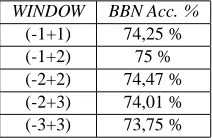
We tested our data on the basis of different sizes of the verb environment: w(-2, +3), i.e. two dependents preced-ing the verb and three dependents followpreced-ing it, and onw(-3, +3), w(-2, +2), w(-1, +2) andw(-1, +1). For almost ev-ery environment, only a subset of these is a correct frame of the verb. We use dependents as features of the verb and the verb as a class. Over this representation, we use a Bayesian Belief Network (BBN)(Cooper and Herskovits, 1992), as used in (Kermanidis et al., 2001). A Bayesian Belief network (BBN) is a directed acyclic graphs whose nodes represent variables, and whose arcs encode condi-tional independencies between the variables. Nodes can represent any kind of variable, be it a measured parame-ter, a latent variable or a hypothesis. In fact, under con-ditions of uncertainty, a BBN is a relevant measure that, given a set of variablesD =< X1, X2...Xn >, describes the probability distribution over this set. Each variable Xi of the set D is dependent only on its parents. The joint probability distribution overD can be computed us-ing:PB(X1...XN) =QNi=1P(xi|parents(Xi)).
For this experiment, we choose 10 among the more frequent verbs that occur in TUT. In the table 4, we show the results for the window size (-2, +2) as the better representation of the environment for the selected verbs. This result posi-tively compares with (Kermanidis et al., 2001), confirming that the windoww(-1,+2)can be considered as an adequate dimension to capture SCFs in a relatively free word order language, like Italian or Modern Greek.
Frame Occurrences
MOD MOD MOD V ARG 10
ARG MOD MOD V ARG MOD 11
MOD MOD V ARG MOD 11
ARG ARG V ARG MOD 12 ARG ARG MOD V MOD 12 ARG V ARG ARG MOD 13
MOD V 14
ARG V MOD MOD 15
ARG ARG V 16
ARG MOD V MOD 16
V MOD MOD 17
ARG V ARG MOD MOD 19
ARG MOD V 23
ARG V 24
MOD V ARG MOD 26
ARG MOD MOD V ARG 26
ARG ARG V ARG 28
ARG ARG V MOD 29
MOD MOD V ARG 29
ARG MOD V ARG ARG 33
ARG V ARG ARG 36
V ARG MOD MOD 39
MOD V ARG ARG 39
V ARG ARG MOD 43
ARG V MOD 44
ARG MOD V ARG MOD 61
MOD V ARG 86
V MOD 92
V ARG ARG 110
ARG V ARG MOD 112
empty V empty 137
ARG MOD V ARG 144
V ARG MOD 160
ARG V ARG 310
V ARG 527
Frame Occurrences
ARG V MOD MOD MOD 1
MOD MOD V ARG MOD MOD 1
ARG ARG V MOD MOD 1
ARG ARG MOD V MOD MOD MOD 1
ARG ARG ARG V 1
ARG ARG ARG V MOD 1
ARG MOD MOD V ARG MOD MOD 1
ARG ARG V ARG ARG 1
MOD MOD MOD V MOD MOD 1 ARG ARG MOD V ARG MOD MOD 1 ARG MOD MOD V MOD MOD 1 MOD MOD V ARG ARG MOD 1 ARG MOD MOD V ARG ARG 2
MOD MOD V MOD 2
ARG MOD V MOD MOD MOD 2 ARG ARG V ARG MOD MOD 2 ARG ARG V MOD MOD MOD 2
MOD MOD V 2
V ARG ARG ARG 2
ARG MOD V MOD MOD 3
ARG MOD MOD V ARG ARG MOD 3
ARG ARG MOD V 5
ARG MOD MOD V MOD 5
ARG ARG MOD V MOD MOD 5
V MOD MOD MOD 5
MOD V ARG MOD MOD 5
MOD V ARG ARG MOD 5
ARG MOD V ARG ARG MOD 6 ARG ARG MOD V ARG MOD 6
ARG MOD MOD V 6
MOD MOD MOD V ARG MOD 6
MOD V MOD 7
ARG ARG V MOD MOD 8
ARG ARG MOD V ARG 9
ARG MOD V ARG MOD MOD 9
MOD MOD V ARG ARG 9
Figure 3: SCFs extracted by out system from TUT (with the only distinction between arguments ARG and modifiers MOD)
WINDOW BBN Acc. %
(-1+1) 74,25 % (-1+2) 75 % (-2+2) 74,47 % (-2+3) 74,01 % (-3+3) 73,75 %
Figure 4: Application of BBN for various window size
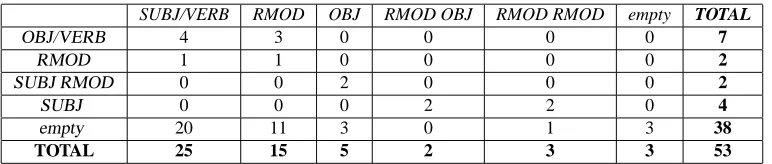
As an example, the table 6 shows the result of the extrac-tion of the SCFs for a specific verb. Among the more frequent verbs of the corpus, we selected the verb stabilire (to establish), and we show the scores obtained by using a windoww(-3,+3). The tabular columns give complements and adjuncts associated to the right side of the window while the tabular rows give complements and adjuncts associated to the left side. The count of each cell [n,m]
gives the number of occurrences in which the left side (the row) appears with the right side (the column) with this verb. The total on the rows represents the number of occurrences of the selected left side with the verb stabilire and the same
Precision Recall F-Measure Verb
0.96 0.923 0.941 DIVENTARE
0.684 0.433 0.531 DOVERE
0.903 0.933 0.918 APPARTENERE 0.844 0.794 0.818 RENDERE 0.805 0.917 0.857 APPLICARE
0.75 0.615 0.676 TROVARE
0.467 0.525 0.494 DIRE
0.818 0.614 0.701 TENERE 0.827 0.843 0.835 SERVIRE 0.614 0.86 0.717 STABILIRE
Figure 5: Result with environment window size (-2+2) for a selection of verbs
thing for columns. This type of computation give an idea of the distribution of complements and adjuncts for the verb taken into account, and it is similar to the work of (Ushioda et al., 1993) for English.
extrac-SUBJ/VERB RMOD OBJ RMOD OBJ RMOD RMOD empty TOTAL
OBJ/VERB 4 3 0 0 0 0 7
RMOD 1 1 0 0 0 0 2
SUBJ RMOD 0 0 2 0 0 0 2
SUBJ 0 0 0 2 2 0 4
empty 20 11 3 0 1 3 38
TOTAL 25 15 5 2 3 3 53
Figure 6: Occurrences of frames for verb STABILIRE (to establish) using w(-3,3).
A. Sarkar and D. Zeman. 2000. Automatic extraction of subcategorization frames for Czech. In Proceedings of ACL’00.
A. Ushioda, D. Evans, T. Gibson, and A. Waibel. 1993. The automatic acquisition of frequencies of verb subcat-egorization frames from tagged corpora. In Proceedings of SEGLEX ACL’93.
L. van der Beek, G. Bouma, R. Malouf, and G. van der No-ord. 2001. The Alpino Dependency Treebank. In Pro-ceedings of CLIN’01.