http://wrap.warwick.ac.uk
Original citation:
Bhalerao, Abhir and Wilson, Roland, 1949- (2005) Warplets : an image-dependent
wavelet representation. In: IEEE International Conference on Image Processing (ICIP
2005), Genoa, Italy, SEP 11-14, 2005. Published in: IEEE International Conference on
Image Processing, 2005. ICIP 2005., Volume 2
Permanent WRAP url:
http://wrap.warwick.ac.uk/32638
Copyright and reuse:
The Warwick Research Archive Portal (WRAP) makes this work by researchers of the
University of Warwick available open access under the following conditions. Copyright ©
and all moral rights to the version of the paper presented here belong to the individual
author(s) and/or other copyright owners. To the extent reasonable and practicable the
material made available in WRAP has been checked for eligibility before being made
available.
Copies of full items can be used for personal research or study, educational, or not-for
profit purposes without prior permission or charge. Provided that the authors, title and
full bibliographic details are credited, a hyperlink and/or URL is given for the original
metadata page and the content is not changed in any way.
Publisher’s statement:
“© 2005 IEEE. Personal use of this material is permitted. Permission from IEEE must be
obtained for all other uses, in any current or future media, including reprinting
/republishing this material for advertising or promotional purposes, creating new
collective works, for resale or redistribution to servers or lists, or reuse of any
copyrighted component of this work in other works.”
A note on versions:
The version presented here may differ from the published version or, version of record, if
you wish to cite this item you are advised to consult the publisher’s version. Please see
the ‘permanent WRAP url’ above for details on accessing the published version and note
that access may require a subscription.
WARPLETS: AN IMAGE-DEPENDENT WAVELET REPRESENTATION
Abhir Bhalerao and Roland Wilson
Department of Computer Science, University of Warwick, Coventry, UK
{
abhir|rgw
}
@dcs.warwick.ac.uk
ABSTRACT
A novel image-dependent representation, warplets, based on self-similarity of regions is introduced. The represen-tation is well suited to the description and segmenrepresen-tation of images containing textures and oriented patterns, such as fingerprints. An affine model of an image as a collection of self-similar image blocks is developed and it is shown how textured regions can be represented by a single prototype block together with a set of transformation coefficients. Im-ages regions are alligned to a set of dictionary blocks and their variability captured by PCA analysis. The block-to-block transformations are found by Gaussian mixture mod-elling of the block spectra and a least-squares estimation. Clustering in the Warplet domain can be used to determine a warplet dictionary. Experimental results on a variety of images demonstrate the potential of the use of warplets for segmentation and coding.
1. INTRODUCTION
Many natural scenes, biological images, or images contain-ing repetitions, often have a tilcontain-ing of some image ‘patch’ or texton. Image models that have exploited image self-similarity for image analysis are the fractal image coding methods of Jacquin and others [1], and warping methods first reported by Volet [2] for texture. Syntactical or struc-tural approaches attempt to capture the repetition and self-similarity of a texture by picking a texton and defining rules for its placement to synthesize the entire texture. For some types of texture, a structural model alone is unsuitable, so statistical texture models, such as MRFs, have been used to parameterize the randomness of the texture. With com-bined structural and random models [3] a stochastic element is ‘added’ to a purely deterministic local texton model to account for the effects of texture variation due to surface properties, lighting or noise in the imaging process. Natu-ral textures, however, differ fundamentally from man-made textures by a degree of randomness, syntactical errors or faults, that is inherent at the structural level. A way to com-pactly represent such imagery for the purposes of segmen-tation and content-based image retrieval is desirable.
Using Gaussian Mixture Modelling (GMM), we build on the work of Hsu, Calway and Wilson [4, 5], whose two-component affine texture model combined a structural
tex-ton plus stochastic residual that enabled the synthesis of a range of textures from periodic to random. Moreover, this affine placement model itself can accurately model small structural variations which seem important in natural tex-ture. All image blocks are affine-warped to the coordinate frame of a representative texton and a PCA is done. The mean plus modes of the eigen image analysis, and the set of block-to-block transformations make up our warplet sentation. Feature clustering is used to determine a repre-sentative set of prototypes for the image. We thus obtain a concise way to describe the image and perform image seg-mentation using image features which are small representa-tive patches from the image. Clustering is invariant to local affine transformations of these patches, and the accuracy of the representation can be measured by image reconstruc-tion.
2. IMAGE WARPLETS
Image regions are modeled as sets of repeating texture patches, assuming that each region can be adequately represented by affine coordinate transformations of some prototypical patch (the source texton) and an intensity scaling. Denoting the coordinates of a target patch,fj, byy = (p, q)T,0 ≤
p, q,≤N, the target patch estimate is
ˆ
fj(y) =αijfi(Tij(x)), Tij(x) =Aijx+tij (1)
α2ij =
X
x
fi2(x)/
X
x
fj2(x) (2)
whereTijis a 2D affine transformation of the coordinates of some source patchfiandαijis a scaling for image intensity changes. The transformation consists of a linear part,Aij, and a translation,tij. It is convenient to use overlapping square image patches (blocks) as warplets of sizeB, such as16×16,32×32etc. By using a squared cosine window function centred on the block,w(y) = cos2[πp/B] cos2[πq/B]
and having the blocks overlap by 50%, it is possible to sum the transformed patches,w(y)fj(y), without blocking arti-facts being introduced.
transformation,
Fj(u) =
1
|detAij|
exp(iuTtij)|Fi(|ATij|−1u)| (3)
such that the linear part, Aij, affects only the amplitude spectrum and the the translationtij is exhibited as a phase gradient. The amplitude spectrum,|Fi(u)|, is modelled as a two-dimensional,M component Gaussian mixture
Gi(u) = M
X
m
amexp(−uTCm−1u/2), (4)
having centroids fixed on the origin of the spectrum and co-ordinatesu= (r, s)T. The Gaussian parameters,{a
m, Cm} are then estimated by minimizing the residual error,
X
u
(|Fi(u)| −Gi(u;am, Cm))2, (5)
using a standard non-linear optimization method, Levenberg-Marquardt (LM). LM is a conjugate gradient descent method which requires the gradient with respect to the fitting param-eters to be known:
dGi(u)
dam
=Gi(u)/am, dGi( u) dC−1
m
=Gi(u)uuT/2.
(6)
In the experiments presented below, we have found that a mixture with 2 components is sufficient to model the general shape and amplitude of oriented and periodic patches so that a linear transformation of the model can be uniquely fit to the amplitude spectrum of a target image block.
The second step of the affine transformation estimation uses the mixture model of the source block spectrum and searches for a linear transformation that minimizes the squared residuals,Pu(Gi(Aij(u))− |Fj(u)|)
2. This search can be
again performed by the LM method. This time the gradients ofHi(u) = Gi(A(u))w.r.t. the parameters of the linear transformation matrix are needed:
dHi(u)
dA =−Hi(u)
M
X
m
C−1
m AuuT (7)
The final step is to estimating the translation,tij, which is exhibited in the phase spectrum of the block DFT. An esti-mate of a transformed blockfˆj(y), can be synthesized by the applying the linear transformation: y = Aijx. The translation, tij, is then taken as the peak location of the cross-correlation i.e.arg maxt[ ˆfj? fj].
The Image Warplet,Wi, is defined as the set of all im-age blocksjtransformed to the coordinate frame of blocki
usingT−1 ij ,
Wi={wij(x) = ˆfji(x),x=A−ij1(y−tij)∀j} (8)
PCA (or harmonic analysis) of the warplet blocks, wij is used to encode their variability. Then, any image block is represented by the mean warplet plus an appropriate num-ber of modes of variation in the Warplet domain, and the corresponding block-to-block affine warps,Tij.
3. SELF-SIMILARITY CLUSTERING
To discover a set of prototypical warplets, ideally one for each image region that appropriately ‘span’ the image, a clustering approach is used. In the supervised case, we clus-ter not just to the representative (given) clusclus-ter centroids, but to an extended family of cluster centres which are created by taking a finite sub-group from the group(Aij,tij)fl, where
l is a given prototypical block. As with the GMM model estimation described above, we extrapolate the sub-group of rotations and scaling from the amplitude spectrum proto-type block. In our experiments we have restricted these pro-totype transformations to a sub-group of rotations and scal-ings offland ignored shears. We have used 8 rotations and 8 scalings to create a cluster familyflk,0≤k <64. Hav-ing applied each transformation,k, these prototype blocks giveB2dimensional vectors:f
lk(x)→flk. The remaining image blocks are then clustered using a nearest neighbour criterion. We can imagine that the data feature vectors clus-ter closest points on manifolds represented by thek rota-tion/scaling family of each prototype. Thus each data block is labelled as the closest family member which have already taken into account the affine group invariance. Sch¨olkopf has suggested this same idea but for extending SVM vec-tors [6].
Unsupervised clustering can take place directly in the Warplet domain on the warped blocks,wijsince the warp-ing will have eliminated the local shape variability and al-low the data vectorswijto be directly compared. A natural extension to modelling the class variability, is to perform a set of local PCA’s on each resulting cluster.
4. EXPERIMENTAL RESULTS
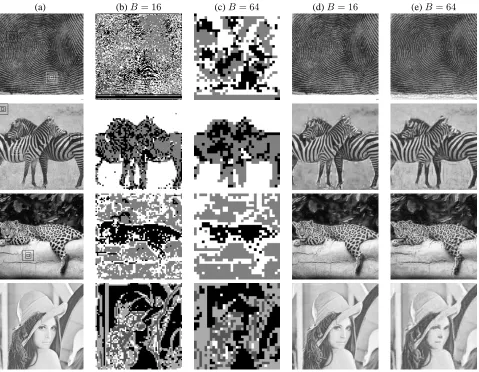
Figure 1 shows results of self-similarity image modelling and reconstruction on a fingerprint and two wild-life images with zebras and a jaguar, and the Lena image. The mixture modelling analysis was performed on pre-whitened (Lapla-cian pyramid) version of the original (see [4] for details) and coarse version of the low-pass information was added back at the end. The number of parameters per pixel for these images is related to the block size,Band the image sizeN
and can be estimated by:P(B) = (B/112)2 + (B/N)
2. This
(a) (b)B= 16 (c)B= 64 (d)B= 16 (e)B= 64
Fig. 1. Supervised self-similarity clustering results: (b)-(c): results on fingerprint, zebras, jaguar and Lena images grouping image blocks (B = 16,64) that are related by an affine-group transformation. (d)-(e) Image reconstructions using 3 prototype texton blocks selected by self-similarity clustering results using (a).
Params/pixel B= 8 B= 16 B= 32 B= 64
P(B) 0.688 0.173 0.047 0.026
The results demonstrate that the chosen warplet is able to describe and reconstruct well the original data includ-ing the cuts and minutiae of the finclud-ingerprint and the multi-directional and bifurcating stripes of the zebra. Even the re-constructions at the largest size (the lowest ‘rate’, atP(64)), exhibit the essential structural features of the image, yield-ing a ‘painted’ effect. In the zebra reconstructions, the back-ground has no obvious deterministic component and is mod-elled largely by the amplitude scalingαij of (2). Where there is a structural texture present such as in the jaguar im-age the prototype, taken from the back of the jaguar con-taining the jaguar ‘print’, can be transformed adequately to become the leaves of the forest behind the animal as well as the bark of the log. Different blocks sizes were used to perform the clustering and subsequent reconstructions:
B= 16,64results are shown in figure 1 for the fingerprint,
PSNR dB
Block size 16 32 64
Params/pixel 0.688 0.173 0.047
finger 29.0 28.7 24.6 24.8 21.2 21.5
zebra 27.6 28.0 23.6 (21.4) 19.9 20.4
jaguar 25.9 26.2 21.5 21.7 17.8 18.3
[image:5.595.335.521.71.274.2]Lena 28.7 32.2 25.0 28.6 22.7 24.8
Table 1.Estimates of reconstruction quality. Results based on 1 or more chosen prototypes using affine invariant block based texture model. The PSNR in first column for each given block size (e.g.16×16) is for single prototype recon-structions. The second column shows the errors (again for each block size), for multi-prototype reconstruction using the self-similarity clustering, figure 1.
representing grass but the reconstructions show some am-plitude modelling errors. This is partly caused by the user specified prototype block on the back of the right-hand ze-bra falling on a white stripe: it does not contain any black to properly reconstruct the belly of the right-hand zebra. With the Lena image, the visual results are hard to interpret as it is difficult to manually select a representative compact set of prototypes. Table 1 presents a quantitative compar-ison of the single and multiple prototype reconstructions (guided by the self-similarity clustering). These results con-firm the qualitative findings that the reconstructions based on the clustering are marginally better.
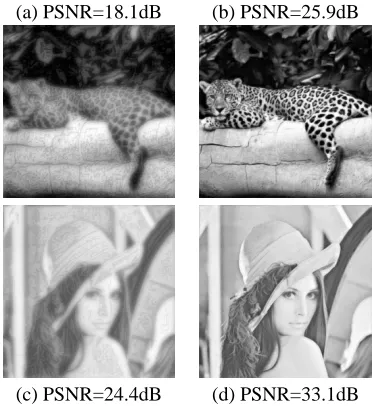
Image Warplet reconstruction results are presented in figure 2. The results show that the eigen-mode reconstruc-tions of the warplet blocks are markedly better in quality with a little as 6% of the modes (15 out of a possible of
162 = 256). In this way, it is possible to code the image by a set of warplets plus variations from the mean warplet block.
5. CONCLUSIONS
A new image-dependent wavelet image model has been in-troduced which can be used to synthesize image regions from representative image patches with good accuracy. It is particularly adept at compactly representing regions con-taining natural textures but can be shown to be work on other image types. The Image Warplet is built by searching for affine transformations of each image block to a given representative block or texton and then performing a PCA or harmonic analysis. The image is reconstructed by pro-jecting all transformed blocks on to the PCA model and ap-plying the inverse affine-transformations. We have shown how a clustering approach can be used to discover, i.e. seg-ment, these prototypical image patches which can be used to construct a warplet dictionary for the image. The crux of supervised method is the underlying affine-invariant group model of the patch that allows us to extend the given clus-ter centre to its immediate affine-group family simplifying the clustering process. Unsupervised clustering can take
(a) PSNR=18.1dB (b) PSNR=25.9dB
[image:5.595.48.299.71.158.2](c) PSNR=24.4dB (d) PSNR=33.1dB
Fig. 2.Warplet reconstructions (B= 16): (a),(c) using mean warplet, (b),(d) using mean plus 15 eigen-modes. Each ad-ditional eigen-mode requires162/(5122)additional
parame-ter/pixel.
place directly in the Warplet domain. Preliminary results are encouraging and the affine-group mixture modelling to-gether with the wavelet self-similarity reconstruction may provide the applications such image segmentation, content based image retrieval and data compression.
6. REFERENCES
[1] A. Jacquin, “Image Coding Based on a Fractal Theory of Iter-ated Contractive Image Transformations,” IEEE Trans. Image
Proc., vol. 1, pp. 18–30, 1991.
[2] P. Volet and M. Kunt, “Synthesis of Natural Structured Tex-tures,” in Signal Processing III: Theories and Applications, pp. 913–916. 1986.
[3] F. Liu and R. W. Picard, “Periodicity, Directionality, and Ran-domness: Wold Features for Image Modeling and Retrieval,”
IEEE Transactions on Pattern Analysis and Machine Intelli-gence, vol. 18, no. 7, pp. 722–733, 1996.
[4] T-I Hsu and R. Wilson, “A Two-Component Model of Texture for Analysis and Synthesis,” IEEE Trans. on Image
Processs-ing, vol. 7, no. 10, pp. 1466–1476, October 1998.
[5] A. D. Calway, “Image Representation Based on the Affine Symmetry Group,” in Proc. ICIP 1996, 1996, pp. 189–192. [6] B. Sch¨olkopf and C. Burges and V. Vapnik, “Incorporating
Invariances in Support Vector Learning Machines,” in
”Arti-ficial Neural Networks, ICANN’96”, 1996, vol. 1112, pp. 47–