Flourishing in the Now: Creation and initial Validation of a
Present-Eudaimonic Time Perspective Scale.
by J. C. Vowinckel | University of Twente | February 2014
Supervised by G. J. Westerhof and E. T. Bohlmeijer
In cooperation with J. D. Webster (Langara college, Vancouver)
Abstract
INTRODUCTION: Despite increasing attention for Time Perspective (TP) research and its theoretical and philosophical implications, no operationalization of a present-positive time perspective scale has been conducted yet. The present, as the only time-zone, which we experience directly as well as permanently, can be assumed to be at least as relevant as past and future concerning subjective well-being and the operationalization of a Balanced Time Perspective (BTP). The present-directed concepts of Mindfulness and Flow, both essential elements of positive psychology, and intrinsically linked to mental well-being were analysed and combined to conceptualize the Present-Eudaimonic time perspective scale (PE), which will complete the Balanced Time Perspective Scale (BTPS) by supplementing a present-factor. METHOD: 130 participants filled in a pre-version of PE, the BTPS (TP), the ZTPI (TP), the FFMQ-SF (mindfulness), the SFPQ (flow-propensity), the MHC-SF (mental health/MH) and a social desirability instrument. BTP was operationalized using the Deviation from Balanced Time Perspective (DBTP) coefficient. RESULTS: The final PE scale showed good psychometric properties including internal consistency (α = .88), factor structure of PE and the new BTPS, and concurrent validity (significant correlations with mindfulness [r=.51], flow-propensity [r=.46] and present-hedonistic [r=.38]). PE explained an additional 12,4 percent of variance in MH beyond the other time perspective scales. The DBTP of the BTPS significantly correlated stronger with MH (r=-.59) than the DBTP of the ZTPI (r=-.42) (ZH=2.06, p=0.039). CONCLUSIONS: The creation of a present-positive time perspective scale fills a great gap in the assessment of TP; the new BTPS is a promising alternative operationalization of BTP.
Keywords
Introduction
Whether time is a fundamental, observer-independent, universe-inherent structure of existence (Newton) or ‘merely’ a fundamental structure of our perceiving of the universe (Kant), or something between (Einstein) is less important from a psychological viewpoint, since, whether past, present and future exist ontologically does not affect our subjective perception of them as qualia. Temporality is a crucial predisposition for probably all strategies of making sense of the world that we can imagine; irrespective of the question whether or not past, future or present possess own ontological reality independent of human, subjective reality.
Since the hard science of physics and the methodology of mathematics can neither provide us with knowledge concerning the observer-independent structure of time, nor with answers whether past, present and future exist observer-independently, it seems adequate to choose a phenomenological approach to deal with psychological time. Husserl (1917/1991) identified the analysis of time as the ‘most difficult of all phenomenological problems’ (p. 286), since every phenomenon has an aspect of temporality (see also Heidegger, 1927/2006).
Time Perspective psychology, which is concerned with operationalizing individual relations to past, present and future and investigating their psychological and behavioural implications and consequences, has become a flourishing field of modern psychology. Nonetheless, no attempt to operationalize an exclusively positive relation to the present has been conducted yet. With this in mind, the present study aims at the creation and initial validation of an instrument, which is intended to measure a positive or eudaimonic relation with the present.
Firstly, we will point out some difficulties concerning the operationalization of psychological present. Subsequently, since, a positive relation to the present addresses the very relation between consciousness and experience, we will shortly introduce Husserl’s conception of consciousness, which describes this relation. After briefly describing the concepts of time perspectives, balanced time perspective, mindfulness, flow, eudaimonia and positive mental health, we will present the newly developed present-eudaimonic scale.
Scientifically operationalizing present-related aspects of reality is to some extent paradoxical, since the paradigm of science demands the pursuit of objectivity, however, the present is by definition a perceptual and therefore subjective phenomenon. Alike experiencing being conscious, experiencing ‘presentness’ is an inevitable precondition of our subjective sense of being, which makes it probably impossible to externalize and objectify the present, since these actions would presuppose separating ourselves from the present. In contrast to the present, according to direct experience, we are separated from the past and the future, which enables us to mentally objectify them.
consequences of individually differing manners and modes of reminiscing (for an overview see: Webster, Bohlmeijer, & Westerhof, 2010). Regarding the functions of reminiscence, Webster et al. (2010) state that ‘by remembering salient information, we connect with others, feel good about ourselves, overcome negative emotions, render current problems manageable, and consolidate a developing autobiographical narrative and sense of identity, among myriad other purposes’ (p. 543).
Whereas consequences of past events appear empirically manifested within the experience of the present situation, the future can be characterized as being empirically empty. The possibility of physically interacting with objects deriving from another time-zone than the present is not given for entities located in the future, which makes the future a more abstract concept than the past. However, despite the ‘empirical emptiness’ of the future, its (mental) presence (future consciousness) is a central factor of the human condition (Lombardo, 2006). Sools and Mooren (2012) state that ‘without too much exaggeration, one could say that the future is always and everywhere’ (p. 207), since crucial aspects of our life, such as education or psychological development, as well as essential emotions, such as hope or desire presuppose the future.
As Webster (2013) points out, past and future share some common characteristics, such as ‘indefinite extension, cognitive construction, and even neuroanatomical circuits and pathways’ (p. 53). Another similarity between psychological past and future is that they are not constantly obligatory parts of subjective experience. It is possible to be present-focused without simultaneously being mentally directed on the past or the future, which gives the opportunity to compare various effects of current degrees of ‘pastness’ and ‘futureness’.
Objectifying the present, however, is not as easily accomplished since its givenness is the source and inevitable precondition of all experience, which implies that we can neither imagine experiencing ‘unpresentness’, nor are we capable of creating (mental) distance between ourselves and the present. While we reminisce, we reconstruct a present we experienced, while we anticipate the future, we imagine a possible present. Thus, from the subjective standpoint, the past and the future can be described as mental constructs of an alternative present, made in the present. Concerning happiness, Zimbardo and Boyd (2008) point out that ‘whether you look for happiness in the past, the present or the future, you experience happiness only in the present. A happy event may have occurred in the past, but you call it to mind in the present. […] Thoughts of the past and the future can bring you happiness, but they do so by bringing happiness into the present state of mind’ (pp. 253-254). The present is the only time zone, which phenomenologically ‘possesses full reality, and our existence lies in it exclusively’ (Schopenhauer, 1890/1999, p. 19). Ontologically, all three might be mind-made illusions (Barbour, 1999; Hameroff, 2003).
functioning’ (Zimbardo & Boyd, 1999, p. 1271) and as ‘one of the most powerful influences on virtually all aspects of human behavior’ (Boniwell & Zimbardo, 2003). Probably, the individual relation to the present is the core factor of time perspective, since, ‘experiencing’ the past (reminiscing) and ‘experiencing’ the future (anticipating) takes place in the present. Therefore, phenomenologically, the past and the future are imbedded in the present.
Time Perspective
Lewin (1951) defined time perspective as ‘the totality of the individual's views of psychological future and psychological past existing at a given time.’ (p. 75, cited in Zimbardo & Boyd, 1999). The most widely used instrument for the assessment of time perspectives is the Zimbardo Time Perspective Inventory (ZTPI: Zimbardo & Boyd, 1999), which consists of five sub scales measuring affective impact of one’s past (past positive and past negative), coping style regarding future-related responsibilities (future) and propensity to apply a hedonistic (present hedonistic) and a fatalistic attitude (present fatalistic) toward the present.
Zimbardo and Boyd (1999) introduced the concept of an optimal or Balanced Time Perspective (BTP), which is a relatively specific composition of time perspectives, characterized as ‘most psychologically and physically healthy for individuals and optimal for societal functioning’ (p. 1285), and Zimbardo (2002) states that ‘in an optimally balanced time perspective, the past, present and future components blend and flexibly engage, depending on the situation’s demands and our needs and values’ (p. 62). Zimbardo suggested operationalizing BTP by having specific score patterns on the ZTPI, namely high past positive scores, low scores on the past negative and the present fatalistic scale, and moderately high scores on the future and the present hedonistic scale. Zimbardo later specified the most desirable scores per sub-scale to a certain value (Stolarski, Bitner, & Zimbardo, 2011). Sub-scales of the ZTPI, and/or the construct of a BTP (which is a particular composition of scores) predictably correlate with various constructs, including specific behaviour (Zimbardo & Boyd, 1999; Epel, Bandura, & Zimbardo, 1999), mood (Stolarski, Matthews, Postek, Zimbardo, & Bitner, 2013), subjective well-being (Zhang, Howell, & Stolarski, 2013; Boniwell, Osin, Linley, & Ivanchenko, 2010), happiness (Drake, Duncan, Sutherland, Abernethy, & Henry, 2008), mindfulness (Drake et al., 2008), life-satisfaction (Zhang & Howell, 2011), emotional intelligence (Stolarski et al., 2011) and aspects of psychopathology (Van Beek, Berghuis, Kerkhof, & Beekman, 2011).
develop a present-factor for the BTPS, which contributes to the existing sub scales by supplementing a present-scale, which is intended to represent a healthy relation to the present that is also assumed to foster positive relations to the past and the future.
By now there is no exclusively healthy present-related time perspective scale available. The present hedonistic scale measures propensity of being hedonistic, therefore, it is associated to risky behaviour and can, if at all, merely partly, be used to indicate eudaimonic aspects of happiness. The present fatalistic scale might be a proper indicator for a present-negative time perspective, however, firstly its present-directedness is arguable and secondly it strongly interferes with religious or spiritual assumptions about after-life, the time-zone Boyd and Zimbardo (1997) refer to as ‘transcendental-future’. E.g. Buddhists tend to score higher on the negatively connoted present fatalistic scale than non-Buddhists (Zimbardo & Boyd, 2008, p. 174), while ‘Buddhist thinking’ might actually have positive or neutral impact on the subject's life. This indicates that the present fatalistic scale is not interculturally valid, when being related to mental health.
For the conceptualization of a positive relation to the now, two concepts central to positive psychology were used in the present study, since both are present-oriented concepts, which are intrinsically linked to mental well-being: 1) Mindfulness is a mode of consciousness, which is directed on the present moment and characterized by a non-judgmental, open awareness of awareness itself and of internal and external sensations (e.g. Kabat-Zinn, 1990), accompanied by ‘enhanced sensory processing, and reflective awareness of sensory experience’ (Kilpatrick et al., 2011). 2) Flow is a state of being ‘absorbed in the now’, which is referred to as ‘optimal functioning’ (Csikszentmihalyi, 1990).
Mindfulness
problems, which impeding impact on one's life decreases when they are treated as if they were children or old friends (Hanh, 2012). Evidence suggests that mindfulness is linked to increased subjective well-being and self-regulated behaviour (Keng, Smoski, & Robins, 2011; Brown & Ryan, 2003), enhanced attention abilities and working memory capacity (Chiesa, Calati, & Serretti, 2011), and improved psychological flexibility (Fledderus, Bohlmeijer, Smit, & Westerhof, 2010).
Mindfulness is furthermore effective in the treatment of depression (e.g. Williams, 2008), anxiety (e.g. Hofmann, Sawyer, Witt, & Oh, 2010) addiction (Breslin, Zack, & McMain, 2006; Westbrook et al., 2011), psychosis, borderline personality disorder and suicidal behaviour (Ivanovski & Malhi, 2007).
In comparison to traditional Cognitive Behavioural Therapy’s approach of changing the content of dysfunctional thoughts, the (therapeutic) mindfulness approach increases meta-cognitive awareness and therefore changes the (general) relation to the thought. By fostering conscious, non-judging moment to moment experience rather than elaborative and conceptual thinking, automatic affective processing is reduced (Farb, Anderson, & Segal, 2012). This opens up possibilities for exploring one’s personal manners of relating to physical and abstract objects in general and to time in particular. A mindful state can be assumed to be helpful while exploring one's noeses and noemata associated to past and future, and their interplay, since mindfulness provides ‘freedom from reflexive conditioning and delusion’ (Shapiro & Carlson, 2009, p. 556). Concerning developing a positive relation to the present, as well as a BTP, mindfulness can play a major role in the first step, which is beginning to understand the mechanisms involved in the genesis, development and consequences of one's own time perspectives.
Flow
cognitive functioning of the psyche in the present can be assumed to be minimized. Flow can occur during almost every kind of situation.
Csikszentmihalyi and colleagues confirmed the positive impact of flow by studying flow experiences of rock-climbers, dancers, chess masters, composers (Csikszentmihalyi, 1975), flow in the aesthetic experience (Csikszentmihalyi & Robinson, 1990), and flow in business contexts (Csikszentmihalyi, 2003) among others. Evidence shows that flow is associated with life satisfaction (Asakawa, 2010; Bassi, Steca, Monzani, Greco, & Delle Fave, 2013) and psychological well-being (Steele & Fullagar, 2009; Bassi et al., 2013).
Relation between Mindfulness and Flow
Mindfulness, partly defined as a mode of increased self-awareness could be interpreted as being contradictory with the state of flow, since flow is associated to loss of self-consciousness. Therefore, whether mindfulness and flow are likely to occur simultaneously remains unclear. However, it is arguable whether a voluntary (probably conscious) switch to a flow-state, originating from the starting point of a mental state which is accompanied by increased mindfulness should be more arduously induced than (probably unconsciously) switching to a flow-state from a mental state which is not explicitly linked to mindfulness. Evidence suggests that mindfulness might be a fruitful context for fostering flow-experiences. Research in the field of sport psychology shows that mindfulness practice increases levels of state flow (Kaufman, Glass, & Arnkoff, 2009) and that high mindfulness is correlated with aspects of flow such as challenge-skill balance, clear goals and concentration, as well as with the ostensibly contradicting aspects of flow: action-awareness merging and loss of self-consciousness (Kee & Wang, 2008).
Assuming that mindfulness and flow support and supplement each other, rather than being antagonists, we decided to use these concepts as starting-points for the conceptualization and operationalization of a positive relation to the present or a present-eudaimonic time perspective.
Eudaimonia
Eudaimonia means living life in a ‘full and deeply satisfying way’ (Deci & Ryan, 2008), including personal expressiveness and self-realization (Waterman, 1993). The basis of cultivating eudaimonia, which traces back to Aristotle, is being true to and living in accordance to one's inner self (daimon), identifying and manifesting one’s virtues and talents, and using them for greater goods like the welfare of one's (social) environment, including one's direct associates, local communities and mankind in general (Peterson, Ruch, Beermann, Park, & Seligman, 2007). The tradition of eudaimonia was among others carried on by Rogers in his theory of the fully-functioning person (1951) and in Maslow's concept of self-actualization (1970). Eudaimonia is often contrasted with hedonia or hedonism (Waterman, 1993; Ryan, & Deci, 2001), which in modern terms is characterized by the presence of positive affect and the absence of negative affect (Deci & Ryan, 2008), which are likely to be dependent on the presence or absence of materialistic or action opportunities (Kraut, 1979). As Westerhof and Bohlmeijer (2010) point out, eudaimonic well-being is not about avoiding things that are perceived as negative, instead the eudaimonic approach tries to integrate positive as well as negative aspects of life, in order to find ways to cope with them, and ideally to use them for personal growth (p. 99). Given the complexity of the concept of eudaimonia, operationalizing hedonic well-being (e.g., Kahnemann, Diener, Schwartz, 1999) is more easily accomplished than making eudaimonic happiness measurable. While hedonic happiness merely relies on short-term emotional well-being, eudaimonia further presupposes psychological, social, and probably spiritual well-being. Ryan, Huta and Deci (2008) characterized eudaimonia by being associated to four motivational concepts: Pursuing intrinsic goals and values for their own sake, behaving autonomously, being mindful, and behaving in ways that satisfy basic psychological needs. Waterman (1990) pointed out that flow among other concepts relates to or is even synonymous with eudaimonia.
Positive mental health
A narrow perspective on mental health, which reduces it to the absence of mental disorder has dominated psychology for a long time and can still be met nowadays. However, this limited view, which neglects crucial parts of mental health, such as well-being, meaningfulness, talent, personal responsibility, quality of relationships and wisdom among many other aspects, has frequently been challenged by social scientists (e.g. Jahoda, 1958; Seligman & Csikszentmihalyi, 2000; Maddux, 2009; Westerhof & Bohlmeijer, 2010). Keyes (2002; 2005) showed that positive mental health (including emotional, psychological and social well-being) is a psychological dimension, distinct from mental illness, and therefore cannot be reduced to being the opposite of mental illness on a single measurement continuum. Keyes (2002) developed the Mental Health Continuum (MHC), and the Mental Health Continuum-Short From (MHC-SF: Keyes et al., 2008), an instrument covering the assessment of emotional well-being, which is also important for the tradition of hedonistic happiness, as well as psychological well-being (optimal individual functioning) and social well-being (optimal societal functioning). Therefore, the MHC(-SF) can be seen as a proper instrument for the assessment of great parts of eudaimonia/flourishing.
Purpose
The purpose of the present study is to create an instrument, measuring a ‘eudaimonic relation’ to the present. The lack of a ‘present-positive’ scale in the BTPS as well as in the ZTPI is a big shortcoming in the field of Time Perspective. By creating and validating a positive present scale this gap will be filled and construct validity of the concept of a balanced time perspective (BTP) will increase.
Both mindfulness and flow represent an engaged, present-focused manner of approaching one's (inner and outer) environment and are associated to profound and sustainable, eudaimonic subjective well-being. Therefore, a combination of these two concepts seems predestined to fill the gap of an adequate positive present scale in time perspective assessment. Integrating mindfulness into time perspective assessment is not a new idea. Zimbardo and Boyd (2008) stated that with a mindful present perspective, which they called present holistic, ‘[...] the past, the present, the future, the physical, the mental, and the spiritual elements in life are not separate but closely interconnected [...]’ (p. 110). They did not include the present holistic time perspective into the ZTPI, since they considered it to be ‘less common in western than eastern cultures’ and to be ‘rather vague in its components’ (p. 53).
state of consciousness which is aware of the constitution of all present noemata, as well as of consciousness itself. On a less extreme level, the skill of autonomously, voluntarily handling one’s attention might be helpful for developing a BTP by being more profoundly aware of the ‘situation’s demands and our needs and values’ so that the ‘past, present and future components’ are more likely to ‘blend and flexibly engage’ (quotes from Zimbardo, 2002, p. 62).
Since the present is the only time-zone, which we experience directly and permanently, a positive relation with the now can be assumed to be a core-factor of human flourishing. Finally, the present eudaimonic scale will be merged with the past and future sub-scales of the current BTPS, resulting in three sub-scales that are intended to match Seligman’s and Csikszentmihalyi’s quote (2000) on what positive psychology is about: ‘well-being, contentment, and satisfaction (in the past); hope and optimism (for the future); and flow and happiness (in the present)’ (p. 5).
Hypotheses
1 – The initial item-set of 23 items, intended to measure a eudaimonic relation with the present, can be reduced to a half as long scale with good general psychometric properties, including clear factor structure, good internal consistency, and no social desirability bias. Furthermore, the whole BTPS (past-, future-, and present-scale) will have a clear factor structure with three components (past, future and present).
2 – Since the concepts of eudaimonia and hedonic happiness overlap, the present-eudaimonic scale and the present-hedonistic scale will be positively correlated. Due to the central relevance of mindfulness and flow for the conceptualization of the present-eudaimonic time perspective, the present-eudaimonic scale will be more strongly associated with mindfulness and flow than all other time perspectives.
3 – Since eudaimonic happiness includes emotional, psychological and social well-being, in comparison to hedonic happiness, which merely covers (short-term) emotional well-being, the present-eudaimonic time perspective will be more strongly associated with positive mental health than the present-hedonistic scale. Given the central relevance of the present, as compared to the past and the future, the present-eudaimonic time perspective will be more strongly associated with positive mental health than the positive past- and future-scales from the ZTPI (PP) and the BTPS (past and future).
Method Item generation and pilot test
In total about 30 items were created. Jeffrey Dean Webster provided an initial item-pool of 15 items (which in the end constituted the lion's share of the final present-eudaimonic scale). Another 15 items were created by the other researchers. Two pre-tests, one in Canada and one in the Netherlands, with about 50 participants in total, mainly psychology students, were conducted to reduce items.
Eleven participants scored a pen and paper version of a 26 item pre-version of the present-eudaimonic scale while thinking aloud. Four respondents were female, seven male. Participants differed in age between 24 and 68 with a mean age of 36. Five respondents were Dutch, six were German. Two participants have been diagnosed with a psychological disorder and were therefore successfully treated in the past. Two participants are mindfulness professionals, working with MBSR- and MBCT-techniques and two are flow professionals, one giving workshops in Tai-Chi and one giving workshops in rap. The other participants were art- and psychology students, one student of museology and one pensioner. The interviews were technically based on the Three-Step Test-Interview (TSTI: Hak, van der Veer, Jansen, 2008). These interviews took between 15 and 70 minutes (M=42), which is a mean time of approximately 1,5 minutes per item. All interviews were recorded and analysed. Three items were rejected due to comparability related issues or individual differences in interpretation of specific wordings. The interpretation of the wording “being in the now” turned out to be heavily dependent on particular situations respondents thought of. Hence, respondents frequently stated that how they score an item is dependent on which concrete situation they think of. Therefore the response format was changed from 1= Strongly Disagree, 2= Disagree, 3= Slightly Disagree, 4= Slightly Agree, 5= Agree, 6 = Strongly Agree into 1= (almost) never; 2= very rarely; 3= rarely; 4= sometimes; 5= often; 6= very often (always).
Participants
Measures
Present-Eudaimonic Scale. The present-eudaimonic scale (PE) was created to complete the BTPS by adding a present-factor. In contrast to the present-hedonistic time perspective of the ZTPI, which relation to (mental) health is ambiguous, the present-eudaimonic time perspective was designed to be exclusively positively correlated to mental health. The items are intended to predict mindfulness and flow-propensity. All items are expected to correlate with mindfulness and flow-propensity, with some items focusing on (applied) mindfulness (“Concentrating on what is happening to me as it happens sharpens my senses”), some on flow-propensity (“To be absorbed in the present makes me feel vital”) and some on mindfulness and flow (“I feel connected to my environment when I just stay in the moment”). Other examples of items are “I feel a certain peace and harmony when I stay focused on the flow of the present” and “I feel connected to myself when I stay in the moment”. Respondents rated on a 6-point Likert-type scale how often each item is true to them with answer options ranging from 1 = '(almost) never' to 6 =' very often (always)'. The pre-version contained 23 items.
Balanced Time Perspective Scale. The BTPS (Webster, 2011) consists of 28 items, 14 addressing the past and 14 addressing the future. It has been suggested as an alternative to the ZTPI for measuring a balanced time perspective (BTP). The respondents rate on a six-point scale how true each statement is to them. In the present study the respondents rated on a 6-point scale how often each item is true to them (1 = '(almost) never'; 6 = 'very often (always)'). Every item connects the addressed time zone (past or future) to the present. Examples of items are ‘Reminiscing about my past gives me a sense of purpose in life’, ‘Remembering happier times from my past helps energize me in the present’, concerning the past and ‘I enjoy thinking about where I’ll be a few years from now’ and ‘Achieving future dreams is something that motivates me now’ concerning the future. The BTPS showed excellent psychometric qualities (Webster, 2011). Cronbach’s alpha in this study was .92 for the past scale and .93 for the future scale.
measure EW, five items measure SW and six items measure PW. Examples of items are: ‘happy’ (EW), ‘that you had something important to contribute to society’ (SW) and ‘that you had experiences that challenged you to grow and become a better person’ (PW). Answer options range from 1 = ‘Never’ to 6 = ‘Every Day’. The MHC-SF showed reliability and validity (Keyes et al., 2008; Lamers, Westerhof, Bohlmeijer, ten Klooster, & Keyes, 2010; Westerhof & Keyes, 2010). Cronbach’s alpha in this study was .88 for the whole scale, .81 for EW and PW, and .73 for SW.
Marlowe-Crowne Social Desirability Scale. We used seven items from the MC-SDS (Crowne & Marlowe, 1960) to assess social desirability bias. We used the items ‘It is sometimes hard for me to go on with my work if I am not encouraged’, ‘I sometimes feel resentful when I don’t get my way’, ‘No matter who I’m talking to I’m always a good listener’, ‘There have been occasions when I took advantage of someone’, ‘I am always courteous even to people who are disagreeable’, ‘I have never been irked when people expressed ideas very different from my own’, ‘I have never deliberately said something that hurt someone’s feelings’. Answer options are 1 = ‘true’ and 2 = ‘false’. Some answers were reverse scored, so that option 1 represented the ‘true’ answer and option 2 the social desirable option. The scores were added, resulting in an overall score between 7 and 14. Cronbach’s alpha was .57, indicating poor internal consistency.
Analyses
Rotated (varimax) Principal Components Analyses (PCAs) were conducted to select items and explore the factor structure of the present-eudaimonic scale (PE), as well as to determine the factor structure of the complete BTPS (past-, future-, and present-scale). Cronbach’s alpha was calculated for the PE scale to investigate its internal consistency and the Pearson correlation with the selection of the Marlowe-Crowne scale items was calculated to examine whether the PE scale is vulnerable to social desirability biased answering. Pearson correlations and hierarchical regression analyses were utilized to investigate the relations between time perspectives (especially the PE scale) and mindfulness, flow-propensity and positive mental health.
and mindfulness, flow, and positive mental health were calculated. Steiger’s Z was utilized to test whether the correlation of the DBTP of the BTPS with positive mental health was significantly higher than the correlation of the DBTP of the ZTPI with positive mental health. Hierarchical regression analyses were conducted to explore whether the DBTP of the BTPS explains additional variance in positive mental health beyond the DBTP of the ZTPI and reverse.
Results
Hypothesis 1 – The initial item-set of 23 items, intended to measure a eudaimonic relation with the present, can be reduced to a half as long scale with good general psychometric properties, including clear factor structure, good internal consistency, and no social desirability bias. Furthermore, the whole BTPS (past-, future-, and present-scale) will have a clear factor structure with three components (past, future and present).
Factor structure of the present-eudaimonic scale
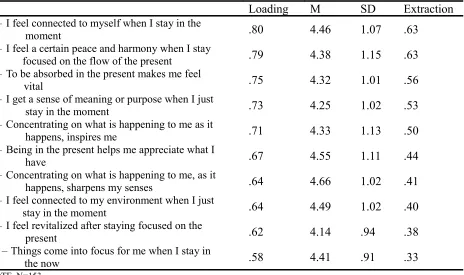
Table 1
Present-eudaimonic Scale. Loadings, Means, Standard Deviations and Communalities.
Loading M SD Extraction
1 – I feel connected to myself when I stay in the
moment .80 4.46 1.07 .63
2 – I feel a certain peace and harmony when I stay
focused on the flow of the present .79 4.38 1.15 .63 3 – To be absorbed in the present makes me feel
vital .75 4.32 1.01 .56
4 – I get a sense of meaning or purpose when I just
stay in the moment .73 4.25 1.02 .53
5 – Concentrating on what is happening to me as it
happens, inspires me .71 4.33 1.13 .50
6 – Being in the present helps me appreciate what I
have .67 4.55 1.11 .44
7 – Concentrating on what is happening to me, as it
happens, sharpens my senses .64 4.66 1.02 .41
8 – I feel connected to my environment when I just
stay in the moment .64 4.49 1.02 .40
9 – I feel revitalized after staying focused on the
present .62 4.14 .94 .38
10 – Things come into focus for me when I stay in
the now .58 4.41 .91 .33
NOTE. N=153.
Reliability and social desirability
Cronbachs’ alpha for the 10-item scale was .88, 95% CI, (.85, .91). In terms of social desirability, the present-eudaimonic scale did not correlate with the selection of items from the Marlowe-Crowne scale, [r(129) = -.02, p = .80].
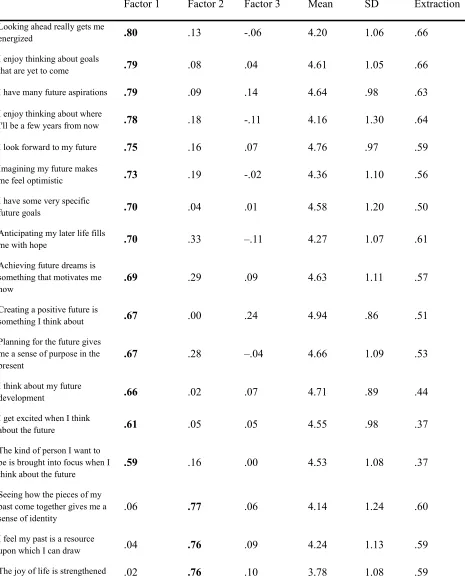
Factor structure of the whole BTPS
Concentrating on what is happening to me as it happens, inspires me
.06 .05 .68 4.35 1.07 .47
Being in the present helps me
appreciate what I have .07 .17 .67 4.57 1.14 .49 Concentrating on what is
happening to me, as it happens, sharpens my senses
.11 –.10 .62 4.75 .94 .41
Things come into focus for me
when I stay in the now .06 .10 .62 4.41 .91 .40 I feel connected to my
environment when I just stay in the moment
.09 .04 .61 4.52 .96 .38
I feel revitalized after staying
focused on the present –.03 .15 .58 4.12 .93 .36 NOTE. N=129.
Summary (hypothesis 1)
The PE scale has a clear factor structure, good internal consistency and no significant correlation with the selection of items from the Marlowe-Crowne Social Desirability scale. The full BTPS has a clear factor structure with acceptable cross-loadings.
Validity
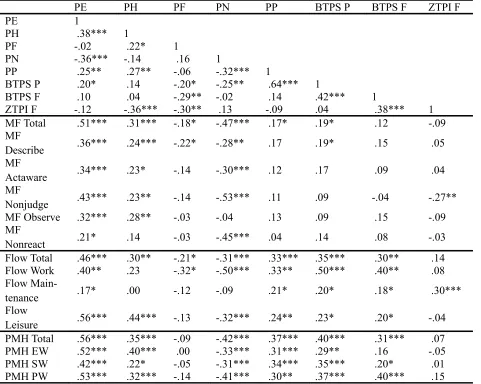
Hypothesis 2 – Since the concepts of eudaimonia and hedonic happiness overlap, the present-eudaimonic scale and the present-hedonistic scale will be positively correlated. Due to the central relevance of mindfulness and flow for the conceptualization of the present-eudaimonic time perspective, the present-eudaimonic scale will be more strongly associated with mindfulness and flow than all other time perspectives.
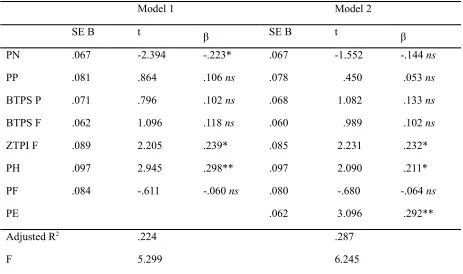
analysis with all existing time perspective scales from the ZTPI and the BTPS were conducted to predict flow-propensity. The existing seven ZTPI and BTPS scales were entered in the first step. A significant model emerged, F (7, 97) = 5.299, p = .000, explaining 22,4 % of variance in flow-propensity. As can be seen in Table 5, the second model including PE, F (8, 96) = 6.245, p = . 000, explained 28,7 % of variance in flow-propensity.
Hypothesis 3 – Since eudaimonic happiness includes emotional, psychological and social being, in comparison to hedonic happiness, which merely covers (short-term) emotional well-being, the present-eudaimonic time perspective will be more strongly associated with positive mental health than the present-hedonistic scale. Given the central relevance of the present, as compared to the past and the future, the present-eudaimonic time perspective will be more strongly associated with positive mental health than the positive past- and future-scales from the ZTPI (PP) and the BTPS (past and future).
Table 3
Intercorrelations of Time Perspectives and Time Perspective’s correlations with (facets of) Mindfulness, (aspects of) Positive Mental Health and (domains of) Flow-propensity.
PE PH PF PN PP BTPS P BTPS F ZTPI F
PE 1
PH .38*** 1
PF -.02 .22* 1
PN -.36*** -.14 .16 1
PP .25** .27** -.06 -.32*** 1
BTPS P .20* .14 -.20* -.25** .64*** 1
BTPS F .10 .04 -.29** -.02 .14 .42*** 1
ZTPI F -.12 -.36*** -.30** .13 -.09 .04 .38*** 1
MF Total .51*** .31*** -.18* -.47*** .17* .19* .12 -.09
MF
Describe .36*** .24*** -.22* -.28** .17 .19* .15 .05
MF
Actaware .34*** .23* -.14 -.30*** .12 .17 .09 .04
MF
Nonjudge .43*** .23** -.14 -.53*** .11 .09 -.04 -.27**
MF Observe .32*** .28** -.03 -.04 .13 .09 .15 -.09
MF
Nonreact .21* .14 -.03 -.45*** .04 .14 .08 -.03
Flow Total .46*** .30** -.21* -.31*** .33*** .35*** .30** .14 Flow Work .40** .23 -.32* -.50*** .33** .50*** .40** .08 Flow
Main-tenance .17* .00 -.12 -.09 .21* .20* .18* .30***
Flow
Leisure .56*** .44*** -.13 -.32*** .24** .23* .20* -.04
PMH Total .56*** .35*** -.09 -.42*** .37*** .40*** .31*** .07
PMH EW .52*** .40*** .00 -.33*** .31*** .29** .16 -.05
PMH SW .42*** .22* -.05 -.31*** .34*** .35*** .20* .01
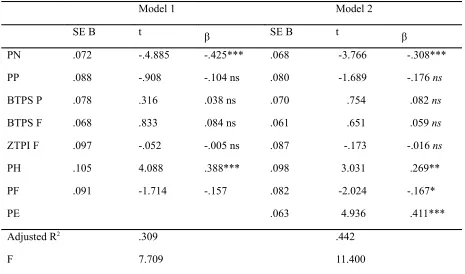
Table 4
Hierarchical Regression Analysis. Independent Variables: Time Perspectives. Dependent variable: Overall Mindfulness.
Model 1 Model 2
SE B t β SE B t β
PN .072 -.4.885 -.425*** .068 -3.766 -.308***
PP .088 -.908 -.104 ns .080 -1.689 -.176 ns
BTPS P .078 .316 .038 ns .070 .754 .082 ns
BTPS F .068 .833 .084 ns .061 .651 .059 ns
ZTPI F .097 -.052 -.005 ns .087 -.173 -.016 ns
PH .105 4.088 .388*** .098 3.031 .269**
PF .091 -1.714 -.157 .082 -2.024 -.167*
PE .063 4.936 .411***
Adjusted R2 .309 .442
F 7.709 11.400
Table 5
Regression Analysis. Independent Variables: Time Perspectives. Dependent variable: Flow-propensity.
Model 1 Model 2
SE B t β SE B t β
PN .067 -2.394 -.223* .067 -1.552 -.144 ns
PP .081 .864 .106 ns .078 .450 .053 ns
BTPS P .071 .796 .102 ns .068 1.082 .133 ns
BTPS F .062 1.096 .118 ns .060 .989 .102 ns
ZTPI F .089 2.205 .239* .085 2.231 .232*
PH .097 2.945 .298** .097 2.090 .211*
PF .084 -.611 -.060 ns .080 -.680 -.064 ns
PE .062 3.096 .292**
Adjusted R2 .224 .287
F 5.299 6.245
NOTE. N=104. * p < .05. ** p < .01. *** p < .001. PN: Past Negative; PP: Past Positive; BTPS P: BTPS Past; BTPS F: BTPS Future; ZTPI F: ZTPI Future; PH: Present Hedonistic; PF: Present Fatalistic; PE: Present Eudaimonic.
Summary hypothesis 2
Table 6
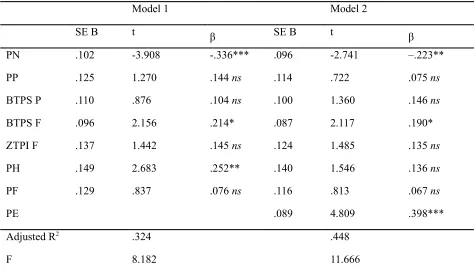
Hierarchical Regression Analysis. Independent Variables: Time Perspectives. Dependent variable: Positive Mental Health.
Model 1 Model 2
SE B t β SE B t β
PN .102 -3.908 -.336*** .096 -2.741 –.223**
PP .125 1.270 .144 ns .114 .722 .075 ns
BTPS P .110 .876 .104 ns .100 1.360 .146 ns
BTPS F .096 2.156 .214* .087 2.117 .190*
ZTPI F .137 1.442 .145 ns .124 1.485 .135 ns
PH .149 2.683 .252** .140 1.546 .136 ns
PF .129 .837 .076 ns .116 .813 .067 ns
PE .089 4.809 .398***
Adjusted R2 .324 .448
F 8.182 11.666
NOTE. N=105. * p < .05. ** p < .01. *** p < .001. PN: Past Negative; PP: Past Positive; BTPS P: BTPS Past; BTPS F: BTPS Future; ZTPI F: ZTPI Future; PH: Present Hedonistic; PF: Present Fatalistic; PE: Present Eudaimonic.
Summary hypothesis 3
The PE scale correlated to (Pearson) and predicted (regression analysis) positive mental health more strongly than all other time perspectives, including PH, as well as the positive past- and future-scales from the ZTPI (PP) and the BTPS (past and future). The model including PE, explained an additional 12,4 % of variance in positive mental health beyond the other time perspective scales.
Balanced Time Perspectives
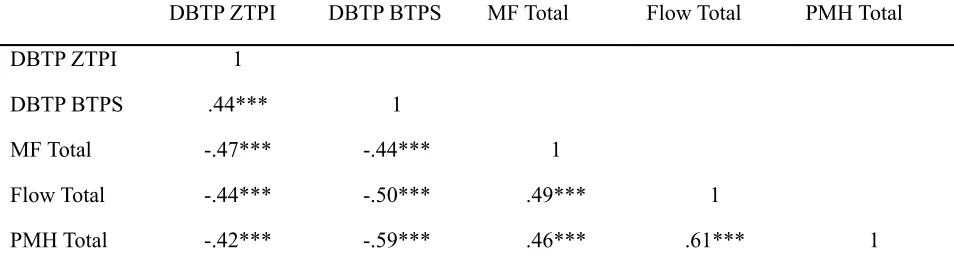
As hypothesized, as can be seen in Table 7, BTP, operationalized with the BTPS correlated more strongly with positive mental health (MHC-SF), [r(118) = -.59, p < .001], than BTP, operationalized with the ZTPI [r(120) = -.42, p < .001]. The BTPS' correlation with the MHC-SF was significantly higher than the ZTPI's correlation with the MHC-SF, [ZH = 2.06, p = 0.039].
Table 7
Pearson Correlations of the DBTPs with Mindfulness, Flow-propensity and Positive Mental Health.
DBTP ZTPI DBTP BTPS MF Total Flow Total PMH Total
DBTP ZTPI 1
DBTP BTPS .44*** 1
MF Total -.47*** -.44*** 1
Flow Total -.44*** -.50*** .49*** 1
PMH Total -.42*** -.59*** .46*** .61*** 1
NOTE. N=108(DBTP ZTPI/DBTP BTPS) to 136(MF Total/PMH Total). *** p < .001. MF: Mindfulness; PMH: Positive Mental Health.
Table 8
Hierarchical Regression analyses with DBTPs predicting Positive Mental Health.
Step 1 β
Step 2 β
Step 1 β
Step 2 β
DBTP ZTPI -.37*** -.14 -.14
DBTP BTPS -.53*** -.59*** -.53***
Adjusted R2 .131 .352 .343 .352
F 16.800 29.547 55.729 29.547 NOTE. N=105. *** p < .001.
Summary (hypothesis 4)
The DBTP of the ZTPI could explain hardly any additional variance in positive mental health beyond the DBTP of the BTPS. The DBTP of the BTPS significantly correlated stronger with the MHC-SF than the DBTP of the ZTPI.
Discussion
In the field of time perspective (TP) assessment, there is no scale available, which measures a positive relation with the present. The purpose of the present study was to fill this gap by creating and initially validating a ‘present-eudaimonic’ time perspective scale (PE). To conceptualize a eudaimonic relation to the present, we draw on the concepts of mindfulness and flow, since both represent present-oriented states of mind and are considered to be associated with positive mental health and eudaimonia/flourishing.
The PE scale showed reliability and validity. Two principal components analyses (PCA) were conducted that produced one factor. A PCA was conducted with all 38 items of the new BTPS, including the past-, the future-, and the present-scale. All past-, future-, and present-items strongly loaded on only one factor respectively, with weak cross-loadings, indicating that three distinct time perspectives are measured by the new BTPS. The past- and the future sub-scale had excellent internal consistency, the PE scale had good internal consistency. Concerning concurrent validity, as hypothesized, the PE scale correlated significantly with mindfulness, flow-propensity and the present-hedonistic scale from the ZTPI.
which is always existent in subjective experiencing (Schopenhauer, 1890/1999, p. 19), we assume a positive relation to the present to be at least as relevant for mental well-being as psychological past and future. Therefore, we hypothesized that a positive relation to the present is more strongly associated with positive mental health, than a positive relation to the past and the future. This hypothesis was supported, since the PE scale explained more variance in positive mental health than the other existing time perspective scales included in this study (ZTPI and BTPS).
Given the paramount importance of a positive relation to the present, which is the only time-zone in which we can experience happiness (Zimbardo & Boyd, 2008, pp. 253-254), we hypothesized that the construct of a balanced time perspective (BTP), would more strongly correlate with and predict positive mental health, when its operationalization includes a representation of a positive-present time perspective. This hypothesis was supported, since BTP, operationalized with the BTPS (including the PE scale) correlated significantly stronger with positive mental health and clearly explained more variance in positive mental health than the ZTPI (which lacks a positive-present time perspective).
These results show that the new present factor of the BTPS is a reliable and valid sub-scale and that the BTPS measures three distinct time-zones (past, present and future). The present study was not an attempt to discredit the ZTPI. The ZTPI is a valid and important instrument for the assessment of a broader spectrum of individual time perspective characteristics. Also, although PE had the strongest positive association with mindfulness among time perspectives, in this study the DBTP of the ZTPI correlated slightly stronger with mindfulness than the DBTP of the BTPS, while the DBTP of the BTPS correlated slightly stronger with flow-propensity. However, due to its significantly stronger association with positive mental health, the BTPS is probably the more adequate instrument for the measurement and indication of aspects of human flourishing, including the assessment of BTP.
A weakness of the present study is its small sample size, which relativizes the generalizability of the results. Furthermore, due to problems with the online-survey provider 'Thesistools.com', respondents could skip items, which were labelled as mandatory, which led to missing data. The instrument measuring social desirability bias performed poorly. Hence, it remains possible that the PE scale might be vulnerable to social desirability biased scoring. A strength of the present study is its synthetic character. Bringing together mindfulness and flow, which are central factors of positive psychology, and introducing them into TP assessment, can be an important step for the further development of the field of positive time psychology.
truth and refers to the subjects’ ‘responsibility for the configuration of the concrete situation’ (p. 19). When scientists could finally reject the dogma of striving after independence from our own subjectivity in order to maximize ostensible objectivity, we could instead integrate YES as a variable in our research formula. Practically this would lead to more transparency in reporting outcomes, providing the reader with valuable information regarding the subject-dependent process of producing theories and research results.
These considerations should be kept in mind when the validity of an attempt to operationalize something as basal and all-embracing as a positive relation to the present is evaluated. Despite philosophical and practical limitations, the present study showed that the present-eudaimonic scale, and the whole BTPS are promising instruments, which can enrich (positive) time psychology and can help broadening the predominant view on psychological present, which is often limited to being associated to hedonism.
References
Asakawa, K. (2010). Flow experience, culture, and well-being: How do autotelic Japanese college students feel, behave, and think in their daily lives? Journal of Happiness Studies, 11, 205–223.
Baer, R. A., Smith, G. T., Hopkins, J., Krietemeyer, J., & Toney, L. (2006). Using self-report assessment methods to explore facets of mindfulness. Assessment, 13(1), 27-45.
Baer, R. A., Smith G. T., Lykins, E., Button, D., Krietemeyer, J., Sauer, S. et al. (2008). Construct validity of the Five Facet Mindfulness Questionnaire in meditating and nonmeditating samples. Assessment, 15(3), 329-342.
Barbour, J. (1999). The End of Time — The Next Revolution in Physics. Oxford: University Press.
Bassi, M., Steca, P., Monzani, D., Greco, A., Delle Fave, A. (2013). Personality and Optimal Experience in Adolescence: Implications for Well-Being and Development. Journal of Happiness Studies, 14(3).
Bishop, S. R., Lau, M., Shapiro, S. L., Carlson, L., & Anderson, N. D. et al. (2004). Mindfulness: A proposed operational definition. Clinical Psychology: Science and Practice, 11, 230–241.
Bodhi, B. (1984). The noble eightfold path. Kandy, Sri Lanka: Buddhist Publication Society.
development of a short form. Assessment, 8(3), 308-320.
Boniwell, I., Osin, E., Linley, P. A., & Ivanchenko, G. V. (2010). A question of balance: Time perspective and well-being in British and Russian samples. The Journal of Positive Psychology, 5(1), 24-40
Boniwell, I., & Zimbardo, P. G. (2003). Time to Find the Right Balance. The Psychologist, 16, 129–131.
Boniwell, I., & Zimbardo, P. G. (2004). Balancing one’s time perspectivein pursuit of optimal functioning. In Linley, P. A. & Joseph, S. (Eds.), Positive psychology in practice (pp. 165–179). Hoboken, NJ: Wiley.
Boroditsky, L. (2000). Metaphoric structuring: understanding time through spatial metaphors. Cognition, 75, 1 – 28.
Bowen, S., Witkiewitz, K., Dillworth, T. M., Chawla, N., Simpson, T. L., Ostafin, B. D., Larimer, M. E., Blume, A. W., Parks, G. A., Marlatt, G. A. (2006). Mindfulness meditation and substance use in an incarcerated population. Psychology of Addictive Behaviors, 20(3), 343-347
Bowerman, M. (1983). Hidden meanings: the role of covert conceptual structures in children’s development of language. In D. Rogers & J. Sloboda (Eds.), The acquisition of symbolic skills (pp. 445–470). New York, NY: Plenum Press.
Boyd, J. N., & Zimbardo, P. G. (1997). Constructing Time After Death. The Transcendental-Future Time Perspective. Time & Society, 6(1), 35-54.
Breslin, F. C., Zack, M., McMain, S. (2006). An Information-Processing Analysis of
Mindfulness: Implications for Relapse Prevention in the Treatment of Substance Abuse. Clinical Psychology: Science and Practice, 9(3), 275-299.
Broad, C. D. (1923). Scientific Thought. London: Routledge and Kegan Paul.
Brown, K. W., & Ryan, R. M. (2003). The benefits of being present: Mindfulness and its role in psychological well-being. Journal of Personality and Social Psychology, 84(4), 822-848.
Cai, Z. G., & Connell, L. (2012). Space-time interdependence and sensory modalities: Time affects space in the hand but not in the eye. In N. Miyake, D. Peebles, & R. P. Cooper (Eds.), Proceedings of the 34th Annual Conference of the Cognitive Science Society. Austin, TX: Cognitive Science Society.
Casasanto, D., & Boroditsky, L. (2008). Time in the mind: Using space to think about time.
Casasanto, D., Fotakopoulou, O., & Boroditsky, L. (2010). Space and Time in the Child's Mind: Evidence for a Cross-Dimensional Asymmetry. Cognitive Science, 34, 387-405.
Chiesa, A., Calati, R., & Serretti, A. (2011). Does mindfulness training improve cognitive abilities? A systematic review of neuropsychological findings. Clinical Psychology Review, 31, 449–464.
Clark, E. (1974). On the acquisition of the meaning of “before” and “after”. Journal of Verbal Learning and Verbal Behavior, 10, 266–275.
Clark, H. (1973). Space, time, semantics and the child. In T. Moore (Ed.), Cognitive development and the acquisition of language (pp. 28–63). New York, NY: Academic Press.
Clay, E. R. (1882). The Alternative: A Study in Psychology. London: Macmillan and Co.
Crowne, D. P., & Marlowe, D. (1960). A new scale of social desirability independent of psychopathology. Journal of Consulting Psychology, 24(4), 349-354.
Csikszentmihalyi, M. (1975). Beyond boredom and anxiety. San Francisco: Jossey-Bass.
Csikszentmihalyi, M. (1990). Flow: The psychology of optimal experience. New York: Harper & Row.
Csikszentmihalyi, M. (2003). Good Business: Flow, Leadership and The Making of Meaning. New York: Viking.
Csikszentmihalyi, M. & Robinson, R. (1990). The Art of Seeing. Malibu, Ca: J. Paul Getty Museum and the Getty Center for Education in the Arts.
Deci, E. L., & Ryan, R. M. (2008). Hedonia, Eudaimonia, and Well-Being: An Introduction. Journal of Happiness Studies, 9, 1–11.
Deng, Y. Q., Liu, X. H., Rodriguez, M., & Xia, C. Y. (2011). The Five Facet Mindfulness Questionnaire: Psychometric properties of the Chinese version. Mindfulness, 2, 123-128.
Drake, L., Duncan, E., Sutherland, F., Abernethy, C., & Henry, C. (2008). Time Perspective and Correlates of Wellbeing. Time & Society, 17(1), 47–61.
Eliasson, O. (2009). Your Engagement has Consequences. In E. Ridgway (Eds.), Experiment Marathon: Serpentine Gallery (pp. 18-21). Reykjavik: Reykjavik Art Museum.
Erber, E. (2011). Achtsamkeit und Intersein: Der Buddhismus bei Thich Nhat Hanh. Wien/Berlin: Lit Verlag.
Exner, S. (1875). Experimentelle Untersuchungen der einfachsten psychischen Processe. Pflügers Archiv, 11, 403–432.
Farb, N. A. S., Anderson, A. K., & Segal, Z. V. (2012). The Mindful Brain and Emotion Regulation in Mood Disorders. Can J Psychiatry. 57(2), 70–77.
Fledderus, M., Bohlmeijer, E. T., Smit, F., & Westerhof, G. J. (2010). Mental Health Promotion as a New Goal in Public Mental Health Care: A Randomized Controlled Trial of an Intervention Enhancing Psychological Flexibility. American Journal of Public Health, 100(12), 2372.
Fraisse, P. (1984). Perception and estimation of time. Annual Review of Psychology, 35, 1-36.
Fredrickson, B. L. (1998). What good are positive emotions? Review of General Psychology, 2, 300–319.
Fredrickson, B. L., & Losada, M. F. (2005). Positive affect and the complex dynamics of human flourishing. American Psychologist, 60(7), 678 – 686.
Grossman, P., Niemann, L., Schmidt, S., & Walach, H. (2004). Mindfulness-based stress reduction and health benefits. A meta-analysis. Psychosom Res, 57, 35-43.
Hak, T., van der Veer, K., Jansen, H. (2008). The Three-Step Test-Interview (TSTI): An observation-based method for pretesting self-completion questionnaires. Survey Research Methods 2(3), 143-150.
Hameroff, S. (2003). Time, consciousness and quantum events in fundamental spacetime geometry. The Nature of Time: Geometry, Physics and Perception. In Buccheri, R., Saniga, M., Stuckey, W. M. (Eds.) (pp. 77-89). Dordrecht: Kluwer Academic..
Hanh, T. N. (1976). The miracle of mindfulness: A manual for meditation. Boston: Beacon.
Hạnh, T. N. (1988). The Heart of Understanding. Commentaries on the Prajñāpāramitā Heart Sutra. Berkeley: Parallax Press.
Hạnh, T. N. (1998). Schritte der Achtsamkeit. Eine Reise an den Ursprung des Buddhismus. Freiburg: Herder.
Hanh, T. N. (2002). No Death, No Fear: Comforting Wisdom for Life. New York: Riverhead Books.
Heidegger, M. (1927/2006). Sein und Zeit. Tübingen: Max Niemeyer Verlag.
Hofmann, S. G., Sawyer, A. T., Witt, A. A., Oh, D. (2010). The effect of mindfulness-based therapy on anxiety and depression: A meta-analytic review. Journal of Consulting and Clinical Psychology, 78(2), 169-183.
Hou, J., Wong, S. Y.-S., Lo, H. H.-M., Mak, W. W.-S., Ma, H. S.-W. (2013). Validation of a Chinese Version of the Five Facet Mindfulness Questionnaire in Hong Kong and Development of a Short Form. Assessment, Online Apr 2013.
Hirsh, I. J., Sherrick, C. E. (1961). Perceived order in different sense modalities. J. Exp. Psych., 62, 423-432.
Husserl, E. (1913/1983). Ideas Pertaining to a Pure Phenomenology and to a Phenomenological Philosophy. The Hague: Martinus Nijhoff Publishers.
Husserl, E. (1917/1991). On the Phenomenology of the Consciousness of Internal Time (1893-1917). Dordrecht: Kluwer Academic Publishers.
Ivanovski, B., & Malhi, G. S. (2007). The psychological and neurophysiological concomitants of mindfulness forms of meditation. Acta Neuropsychiatrica, 19, 76–91.
Jahoda, M. (1958). Current concepts of positive mental health. New York: Basic Books.
James, W. (1890). Principles of psychology (Vol. 2). New York: Henry Holt.
Kabat-Zinn, J. (1982). An outpatient program in behavioral medicine for chronic pain patients based on the practice of mindfulness meditation: Theoretical considerations and preliminary results. General Hospital Psychiatry, 4(1), 33–47.
Kabat-Zinn, J. (1990). Full catastrophe living: Using the wisdom of your body and mind to face stress, pain and illness. New York: Hyperion.
Kahneman, D., Diener, E., & Schwarz, N. (Eds.). (1999). Wellbeing: The foundations of hedonic psychology. New York: Russell Sage.
Kaufman, K. A., Glass, C. R., Arnkoff, D. B. (2009). Evaluation of Mindful Sport Performance Enhancement (MSPE): a new approach to promote flow in athletes. Journal of Clinical Sport Psychology, 3(4).
Keng, S. L., Smoski, M. J., & Robins, C. J. (2011). Effects of mindfulness on psychological health: A review of empirical studies. Clinical Psychology Review, 31(6), 1041–1056.
Keyes, C. L. M. (2002). The mental health continuum: From languishing to flourishing in life. Journal of Health and Social Behavior, 43, 207-222.
Keyes, C. L. M. (2005). Mental illness and/or mental health? Investigating axioms of the complete state model of health. Journal of Consulting and Clinical Psychology, 73, 539-548.
Keyes, C. L. M., Wissing, M., Potgieter, J. P., Temane, M., Kruger, A., & van Rooy, S. (2008). Evaluation of the Mental Health Continuum Short Form (MHC-SF) in Setswana speaking South Africans. Clinical Psychology and Psychotherapy, 15, 181–192.
Kilpatrick, L. A., Suyenobu B. Y., Smith S. R., Bueller, J. A., Goodman, T., et al. (2011). Impact of mindfulness-based stress reduction training on intrinsic brain connectivity. Neuroimage. 56 (1). 290–298.
Kraut, R. (1979). Two conceptions of happiness. Philosophical Review, 87, 167-196.
Lamers, S.M.A., Westerhof, G.J., Bohlmeijer, E.T., ten Klooster, P.M., & Keyes, C.L.M. (2010). Evaluating the psychometric properties of the Mental Health Continuum-Short Form (MHC-SF). Journal of Clinical Psychology, 67(1), 99-110.
Lewin, K. (1951). Field theory in the social sciences: Selected theoretical papers. New York: Harper
Lilja, J. L., Frodi-Lundgren, A., Hanse, J. J., Josefsson, T., Lundh, L. G., Skold, C., & Broberg, A. G. (2011). Five Facets Mindfulness Questionnaire—Reliability and factor structure: A Swedish version. Cognitive Behaviour Therapy, 40, 291-303.
Lombardo, T. (2006). The evolution of future consciousness. The nature and historical development of the human capacity to think about the future. Bloomington, Milton Keynes: Authorhouse.
Lyotard, J.-F. (1991). Phenomenology. New York: State University of New York Press.
Maddux, J. (2009). Stopping the 'madness': Positive Psychology and deconstructing the illness ideology and the DSM. In S.J. Lopez & C.R. Snyder (Eds.), Oxford handbook of positive psychology (2nd ed.) (pp.61-69). New York: Oxford University Press.
Maslow, A. H. (1970). Motivation and personality (2nd ed.). New York: Harper & Row.
Peterson, C., Ruch, W., Beermann, U., Park, N., & Seligman, M. E. P. (2007). Strenghts of character, orientations to happiness, and life satisfaction. The Journal of Positive Psychology: Dedicated to furthering research and promoting good practice, 2(3), 149-156.
Piaget, J. (1927 ⁄ 1969). The child’s conception of time. New York: Ballantine Books.
Pierre, J. (2010). "Intentionality", The Stanford Encyclopedia of Philosophy (Fall 2010 Edition), Zalta, E. N. (Eds.), URL = <http://plato.stanford.edu/archives/fall2010/entries/intentionality/>
Pöppel E. (1997). A hierarchical model of temporal perception. Trends Cogn. Sci., 1(2), 56-61.
Rogers, C. R. (1951). Client-centered therapy: Its current practice, implications, and theory. Boston: Houghton Mifflin.
Rosa, H. (2005). Beschleunigung. Die Veränderung der Zeitstrukturen in der Moderne. Frankfurt am Main: Suhrkamp.
Ryan, R. M., & Deci, E. L. (2001). On happiness and human potentials: A review of research on hedonic and eudaimonic well-being. Annual Review of Psychology, 52, 141-166.
Ryan, R. M., Huta, V., & Deci, E. L. (2008). Living Well: A Self-Determination Theory on Eudaimonia. Journal of Happiness Studies, 9, 139-170.
Schopenhauer, A. (1890/1999). Parerga und Paralipomena (Vol. 1). Essen: Mundus Verlag.
Seligman, M. E. P., & Csikszentmihalyi, M. (2000). Positive psychology: An introduction. American Psychologist, 55, 5–14.
Shapiro, S. L., & Carlson, L.E. (2009). The Art and Science of Mindfulness: Integrating Mindfulness Into Psychology and the Helping Professions. Washington, DC: American Psychological Association.
Sools, A. & Mooren, J. H. M. (2012). Towards narrative futuring in psychology: Becoming resilient by imagining the future. Graduate Journal of Social Science, Vol 9(2), pp. 203-226.
Steele, J. P., & Fullagar, C. J. (2009). Facilitators and outcomes of student engagement in a college setting. The Journal of Psychology, 143(1), 5-27.
Stolarski, M., Bitner, J., & Zimbardo, P. G. (2011). Time perspective, emotional intelligence and discounting of delayed awards. Time & Society, 20(3), 346-363.
Strauss, L. (1989). An Introduction to Political Philosophy: Ten Essays by Leo Strauss. Detroit: Wayne State University Press.
Sweetser, E. (1991). From etymology to pragmatics: Metaphorical and cultural aspects of semantic structure. Cambridge: Cambridge University Press.
Ullén, F., de Manzano, Ö., Almeida, R., Magnusson, P., K., E., Pedersen, N., L., Nakamura, J., Csikszentmihalyi, M., Madison, G. (2011). Proneness for psychological flow in everyday life: Associations with personality and intelligence. Personality and Individual Differences, 52, 167– 172.
Van Beek, W., Berghuis, H., Kerkhof, A., & Beekman, A. (2011). Time perspective, personality, and psychopathology: Zimbardo’s time perspective inventory in psychiatry. Time & Society, 20(3), 364–374.
Veehof, M. M., Ten Klooster, P. M., Taal, E., Westerhof, G. J., & Bohlmeijer, E. T. (2011). Psychometric properties of the Dutch Five Facet Mindfulness Questionnaire (FFMQ) in patients with fibromyalgia. Clinical Rheumatology, 30, 1045-1054.
Waterman, A. S. (1990). The relevance of Aristotle’s conception of eudaimonia for the psychological study of happiness. Theoretical & Philosophical Psychology, 10(1), 39-44.
Waterman, A. S. (1993). Two conceptions of happiness: Contrasts of personal expressiveness (eudaemonia) and hedonic enjoyment. Journal of Personality and Social Psychology, 64, 678– 691.
Webster, J. D. (2011). A new measure of time perspective: Initial psychometric findings for the Balanced Time Perspective Scale (BTPS). Canadian Journal of Behavioural Science/Revue canadienne des sciences du comportement, 43(2), 111-118.
Webster, J. D. (2013). Is it Time to Reminisce About the Future? The International Journal of Reminiscence and Life Review, 1(1), 51-54.
Webster, J. D., Bohlmeijer, E. T., & Westerhof, G. J. (2010). Reminiscence: Recent progress in conceptual understanding, empirical study and implications for practice. Ageing & Society, 30, 697–721.
Westbrook, C., Creswell, J. D., Tabibnia, G., Julson, E., Kober, H., Tindle, H. A. (2011). Mindful attention reduces neural and self-reported cue-induced craving in smokers. Social Cognitive & Affective Neuroscience, 8(1), 73-84.
Westerhof, G. J., & Keyes, C. L. M. (2010). Mental illness and mental health: The two continua model across the lifespan. Journal of Adult Development, 17(2), 110–119.
Williams, J. M. G. (2008). Mindfulness, Depression and Modes of Mind. Cognitive Therapy and research, 32(6), 721-733.
Zhang, J. W., & Howell, R. T. (2011) Do time perspectives predict unique variance in life satisfaction beyond personality traits? Personality and Individual Differences, 50, 1261 – 1266.
Zhang, J. W., Howell, R. T., & Stolarski, M. (2013). Comparing Three Methods to Measure a Balanced Time Perspective: The Relationship between a Balanced Time Perspective and Subjective Well-Being. Journal of Happiness Studies, 14, 169-184.
Zimbardo, P. G. (2002). ‘Just think about it: Time to take our time’. Psychology Today, 35, 62.
Zimbardo, P. G., & Boyd, J. N. (1999). Putting time in perspective: A valid, reliable individual difference metric. Journal of Personality and Social Psychology, 77(6), 1271–1288.