179
Tangible User Interface based Descriptor for Appliances
Faraz Bagwan
1, Divya Bias
2, Rahul Ahuja
3, Lakhan Bagde
4Email: [email protected], [email protected],
3[email protected], 4[email protected]
Pravin Khandare Assistant Professor
5Email: [email protected] Computer Engineering1, 2, 3, 4, 5,
Vishwakarma Institute of Information Technology1, 2, 3, 4, 5
Abstract - Tangible User Interface (TUI) is an interface which acts as an intermediary between a person and
digital information thus forming a tangible-physical environment. The TUI-based descriptor offers a novel and versatile approach to describe the configuration of objects. This application consists of objects which are perceptible by touch. Commerce concerned and engaged people are apt for using this descriptor. It self-educates the subject about the product in one single step. The object, when placed on the interactive area, triggers the system to exhibit the corresponding details. We have built a working prototype and tested it. The proposed system serves as an initial proof-of-concept that demonstrates how TUI proves beneficent to the intended.
Index Terms - Tangible User Interface (TUI); Human Computer Interaction (HCI); ReacTIVison; TUI Objects;
fiducial markers; Descriptor; physical objects; virtual objects.
1. INTRODUCTION
“I differ to think that necessity is the mother of invention. The invention, in my opinion, arises directly from idleness, possibly also from laziness - to save oneself trouble.”
-Agatha Christie. An Autobiography.
The intent of this application is to increase one’s productivity in work and time, and at the same time making it effortless and enjoyable.
HCI: Human Computer Interaction is a domain for all the interfaces that requires a human to interact with a machine. TUI is a subset of HCI. HCI encompasses the design, implementation, and evaluation of user interfaces.
The components of HCI are, • Humans
The human is the person who uses the system and who communicates or works with other people.
• Computer
Computer is the machine and other networked machines that run the system.
• Interface
The Interface allows the user to interact with the system. The better the interface, the better the communication.
Often, the best-designed interface becomes invisible after frequent use. When an interface becomes subconscious by practice, by design, and especially by a combination, our attention shifts from operating an interface to accomplishing a task. It is similar to a blind person who has to use a stick. Here the
blind-stick is the interface enabling calculated-visuals in the mind of the blind. After years of practice, they no longer feel the stick. It becomes a part of their body, allowing them to experience the world. That attentional shift is what happens when an interface becomes intuitive. Designing great user interfaces requires immense creativity and a lot of work. But designing pretty good user interface is pretty easy. This paper uses one such interface pertaining tangible peculiarity. HCI acts as a base for TUI.
A TUI is an interactive display intended to provide collaboration among multiple users.
The characteristics of such a table are,
• It provides multiple users to use the interactive area equally, as if dedicated to a single user. [3], [4] • The user can manipulate the physical objects as well as the virtual objects on the surface which would depict collaborative capabilities of the table. [4] The objective of TUIs is to create an unmediated link between the system and the way you control it through physical manipulation of objects by having an underlying meaning or the direct correlation which associates the physical manipulations to the behaviors which they trigger in the system. [1]
This paper elucidates the design and development of a TUI based descriptor, a tangible tabletop interface in which the user manipulates physical objects to obtain deeper insights into a specific commercial product. Our goal is to use physical objects itself as an interactive tool.
180 Figure 1 gives a Basic Overview of Tangible User
Interface Based system.
Requisite components to attain tangibility are, • Object with markers
• Semi-transparent surface • A light source
• Processor • Camera
• Client Application
Marked-objects are unique. They trigger a particular instance of the programmed application. When placed on the semi-transparent surface they are captured by
the camera situated underneath it. This image then is converted into a tangible object and provided to the client application by the processing engine. The application maps the object to trigger a certain event which is displayed to the user using a display device.
We propose an approach where the client application is designed to act as a descriptor for commercial products. Our system uses fiducials for marked-objects, ReacTIVision Engine as the
processing engine, Illuminating LEDs as light source, acrylic glass for better interaction and transparency, and processing programming language to program the application.
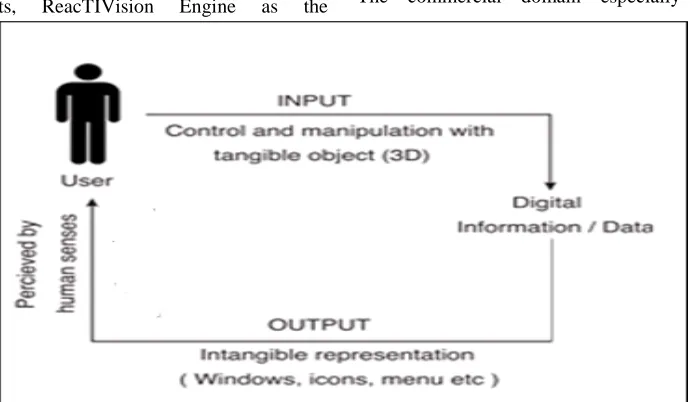
Figure 2 shows the method of operation providing
a clear insight into tangible interaction.
The user provides input using object. These objects are tangible. Unlike regular objects (icons or menus) they can be controlled and manipulated directly. Also, they are 3D in nature. The tangible-input is turned into digital information or data using tangible-interaction logic. The output is the plain-intangible representation which might be windows or icons or menu, etc. The output can also be made
tangible; it requires multi-touch recognition hardware and algorithms. The human senses then perceive the output.
2. MOTIVATION
The commercial domain especially the people
Figure 1: Overview of Tangible User Interface System
181 involved in sales of electronic devices and other
appliances face immense-overhead which involves, • Attending a crowd of customers
• Providing impartial and uniform service to each customer
• Experiencing shortage of manpower further leading to security issues
• Difficulty in providing accurate details for each product.
• Time-consuming user-seller interaction
• Being left with unconvinced, undecided customers subsequently affecting the sales percentage.
A TUI based descriptor makes a difference by making the users-seller interaction process independent, intriguing and cost-effective.
• Independent?
Customers can self-educate themselves and need not be dependent on the seller.
• Intriguing?
The interactive table provides on-demand information of the product just by placing it on the display area giving the user the essence of smart technology. • Cost effective?
No need for the seller to hire many sales people. A couple of employees is enough to manage exceptional situations.
2.1. Participatory Design Study
We began by conducting several semi-structured interviews with the customers and also some enthusiast vendors. We found that most customers were,
• Not able to conceive full information about the product provided by the service guy.
• Not able to comprehend some technicalities.
• Tend to forget some aspects of the products as they proceeded to explore the next product.
• Weren’t decisive and end up getting confused. • Queries were not entertained right away because of the large group of people in the shop.
• Time-consuming, etc.
Also, vendors were facing some loss due to the indecisiveness of the buyer ending up confused and not buying any product. Also, it was very inconvenient to provide equal attention to every customer especially when the manpower was less. Based on these explorations, we designed a custom-made tabletop with tangible objects that buyers could manipulate to express and explore such problems.
3. LITERATURE SURVEY
Bertrand Schneider, Paulo Blikstein, and Wendy Mackay designed Combinatorix, which offers a novel approach that combines tangible-objects with an interactive table-top to help students explore, solve and understand probability problems. Java was used to create the application. Along with marked-objects, a Wiimote was used too, which required additional library wrj4P50 to communicate with the virtual objects. [4]
Motoki Miura and Susumu Kunifu developed a cardhandling activity environment and a tabletop interface. A glass tabletop whose transparency can be managed to improve surface scanning and the display of supplemental data. Basically, the aim is to augment paper card-handling activity without attaching any new devices to either the cards or the user’s hands. Makes use of phidgets Interface Kit and a UMU Smart Screen to control glass transparency for better clarity and accurate results. ARMToolkitplus, Visual C++, Java and Java Native Interface (JNI) was used in combination to create the application.
TanPro-Kit 2.0 is a programming tool used by Danli Wang, Lan Zhang, Yunfeng Qi, and Fang Sun for children aged 6 to 8, is based on TUI. It consists of programming blocks and an LED pad. The pad offers multimedia feedback according to the arrangement of programming blocks with which children construct programs to play a maze game. [12]
Table 1 shows a related systems table.
182
Table 1: Related Systems Table
4. TUI BASED DESCRIPTOR:
ARCHITECTURE AND REQUIREMENTS
4.1.TUI based Descriptor Architecture
Figure 3 depicts the architecture of TUI based
Descriptor. [1], [2]
The system consists of the following components. • Tangible objects using which the user interacts with the system
• Table-top which forms the physical aspect of the system
• An underlying platform which adds to the digital aspect.
The user interacts with the system using a tangible object. The object is programmed for its tangibility. When placed on the table top, its location is detected using a capturing device. The captured physical
aspects of the object are traced to its digital object. The respective digital parameters are then triggered, subsequently which calls for the programmed action. The user perceives the resultant action.
4.2.TUI based Descriptor Requirements
Figure 4 depicts a pictorial view of the components
required.
Sr. No.
Author Related System Application Used
1. Wolfgang Spreice
Tangible
interfaces as a chance for higher technology acceptance by the elderly. [14]
Rapid technology learning application using TUI for aged-people.
2. Zhiying Zhou, Adrian Cheok
3D story cube: an inter-tangible
UI for
storytelling with 3D graphics and audio. [5]
The storytelling application is manipulated using a marked-cube when placed on the interactive table. Consists of audio and video too. 3. Bert S. Interaction
design for
musical-electronic interfaces. [6]
Studies the interaction between musicians and the technology they use, by designing novel musical interfaces. 4. Andreas
Butz, Markus Grob
TUISTER: a tangible UI for hierarchical structures. [8]
Tuister is used to browse and access hierarchical
structures using TUI with multiple embedded displays and sensors.
Figure 3: TUI based descriptor Architecture. [1]
184
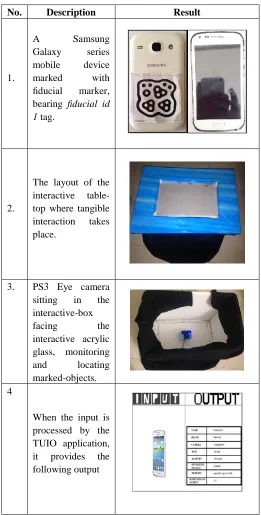
6. EXPERIMENT RESULT
Table 2: TUI based descriptor: An Experiment
No. Description Result
1.
A Samsung Galaxy series mobile device marked with fiducial marker, bearing fiducial id
1 tag.
2.
The layout of the interactive table-top where tangible interaction takes place.
3. PS3 Eye camera sitting in the interactive-box facing the interactive acrylic glass, monitoring and locating marked-objects. 4
When the input is processed by the TUIO application, it provides the following output
7. PROPOSED SYSTEM
In this paper, we described a working prototype of a TUI-based descriptor for appliances which would act as an inspirational-milestone for further implementation. We successfully implemented an application which provides a description of marked devices when placed on the interactive surface. A database of devices description was stored in the application created using Processing 2.0. The ReacTIVison engine traced the input provided by the camera and then forwarded it to the application where the output related to the given input is triggered and displayed on the screen.
Shortly, we will be attempting to recognize finger-taps [10], [11], [13] on the interactive screen, to provide better interaction with additional data or other virtual objects.
REFERENCES
[1] Hiroshi Ishii (2008): Tangible Bits-Beyond Pixels, In Proceedings of the Second International Conference on Tangible and Embedded Interaction (TEI’08), Germany, ACM 978-1-60558-004-3/08/02, pp. xv-xxv
[2] Hiroshi, I; Brygg, U. (1997): Tangible Bits-
Towards Seamless Interfaces between People, Bits, and Atoms, In Proceedings of CHI ’97, USA,
ACM 0-89791-802-9/97/03, pp. 1-8.
[3] Ben, P.; Hiroshi, I.; et al. (2002): Illuminating
Clay: a 3-D tangible interface for landscape analysis, In Proceeding CH02 of the SIGCHI
Conference on Human Factors in Computing Systems, USA, ISBN:1-58113-453-3, pp. 355-362.
[4] Bertrand, S.; Paulo, B.; et al. (2012):
Combinatorix: a tangible user interface that supports collaborative learning of probabilities,
In ITS ’12 Proceedings of the 2012 ACM international conference on Interactive tabletops and surfaces, USA, ISBN: 978-14503-1209-7, pp. 129-132.
[5] Zhiying, Z.; Adrian, C.; et al. (2004): 3D story
cube: an interactive TUI for storytelling with 3D graphics and audio, In Journal Personal and
Ubiquitous Computing Volume 8 Issue 5, UK, doi: 10.1007/s00779-004-0300-0, pp. 374-376. [6] Bert, S. (2004): Interaction design for electronic
musical interfaces, In Proceeding CHI EA ’04
CHI ’04 Extended Abstracts on Human Factors in Computing Sys, USA, ISBN:1-58113703-6, pp. 1549-1549.
[7] Milena, M. (2013): How does the tangible object
affect motor skill learning?, In Proceeding TEI
185 London UK, 2013, ISBN: 978-1-4503-2635-3, pp.
305-308.
[8] Andreas, B.; et al. (2004): TUISTER: a tangible
UI for hierarchical structures, In Proceeding IUI
’04 of the 9th international conference on Intelligent user interfaces, NY USA, ISBN: 1-58113-815-6, pp. 223-225.
[9] Geoff, N.; James, Y.; et al. (2015): Are Tangibles
Really Better? : Keyboard and Joystick Outperform TUIs for Remote Robotic Locomotion Control, In Proceeding HRI’15 Extended Abstracts of the 10th Annual ACM IEEE International Conference on Human-Robot Interaction Extended Abstracts, NY USA, ISBN: 978-1-4503-33184, pp. 41-42.
[10]Tangible Media Group (2006): Tangibles at play, In Proceeding SIGGRAPH ’06 ACM SIGGRAPH 2006 Emerging technologies Article No. 32, NY USA, ISBN:1-59593-364-6
[11]Wolfgang, B.; et al. (2014): T4 - transparent and
translucent tangibles on tabletops, In Proceeding
AVI ’14 of the 2014 International Working Conference on Advanced Visual Interfaces, NY USA, ISBN: 978-1-4503-2775-6, pp. 81-88. [12] Danli, W.; et al. (2015): A TUI-based
Programming Tool for Children, In Proceeding
ITiCSE ’15 of ACM Conference on Innovation and Technology in Computer Science, NY USA, ISBN:978-1-45033440-2, pp. 219-224.
[13]Paul, I.; et al. (2014): A portable interface for
tangible exploration of volumetric data, In
Proceeding VRST ’14 of the 20th ACM Symposium on Virtual Reality Software and Technology, NY USA, ISBN: 978-1-4503-3253-8, pp. 209-210
[14]Wolfgang, S. (2011): Tangible interfaces as a
![Figure 3: TUI based descriptor Architecture. [1]](https://thumb-us.123doks.com/thumbv2/123dok_us/1056725.1131966/4.595.304.562.165.382/figure-tui-based-descriptor-architecture.webp)