2.2. Syntax trees
This approach requires parsers for both languages to be considered. The parse tree of the sentence to be trans-lated is compared to the parse trees of all source language sentences in the translation memory. If an identical parse tree is found, it is assumed that the parse tree of the cor-rect translation should be identical to the parse tree of the corresponding target language sentence retrieved from the translation memory (Maruyama & Watanabe, 1992). The main problem with this approach is that high quality pars-ers for unrestricted language are not available for many languages. Also, the disambiguation of semantically am-biguous words is not always possible by considering syn-tax only.
2.3. Thesauri
The problem of ambiguity is better accounted for in the thesaurus-method (Sata & Nagao, 1990; Sumita et al., 1990). By use of a thesaurus it is determined in how far one word of a language can replace another one in a sentence without changing the meaning of the sentence. In addition, sentence structure is taken into account by considering dependency trees. Thus, two sentences or sentence fragments can be compared by comparing the similarity of the words at corresponding positions of their dependency trees. The construction of a suitable thesaurus can be facilitated or possibly replaced by corpus-based automatic methods for computing word similarities as suggested by Grefenstette (1994), Ruge (1995), Schütze (1997), Lin (1998) and others.
2.4. Neural networks
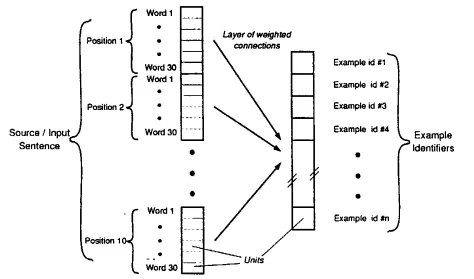
McLean (1992) suggested the use of a neural network for EBMT (see fig. 2). The network is supposed to learn the relations between the sentences of a source language
and their corresponding translations in the target language. Hereby, the source language sentences are applied to the input layer of the neuronal network in such a way that each word relates to one of 30 neurons. Each of the 30 neurons corresponds to one word of a vocabulary, i.e. the vocabulary is restricted to 30 words and a localistic representation is used in the input layer. The representa-tion in the output layer is also localistic, but in this case not a word but a target language sentence corresponds to each neuron.
The network is trained by applying a source language sentence to the input layer and the corresponding target language translation to the output layer of the network and by adjusting the weights between the two layers using the delta-rule (Rumelhart & McClelland, 1986). When this process of supervised learning is repeated with many sen-tence pairs, it is hoped that the network will be able to generalize correctly. This means that if during recall a sentence different from any of the trained sentences is applied to the input layer, in the output layer the neuron corresponding to the best fitting translation should be activated.
Although the model is reported to work in principle, there are a number of serious problems with it. First, the number of neurons in the input layer increases quadrati-cally with sentence length and vocabulary size. Secondly, the system puts too much emphasis on the absolute posi-tioning of words in the source sentence, i.e. insignificant omitions or insertions of words tend to lead to overreac-tions. Third, since the relations between source- and tar-get-sentences are coded only internally, the system does not give any indication as to what changes should be made to a target sentence when there is a discrepancy between the source sentence to be translated and the most similar trained sentence.
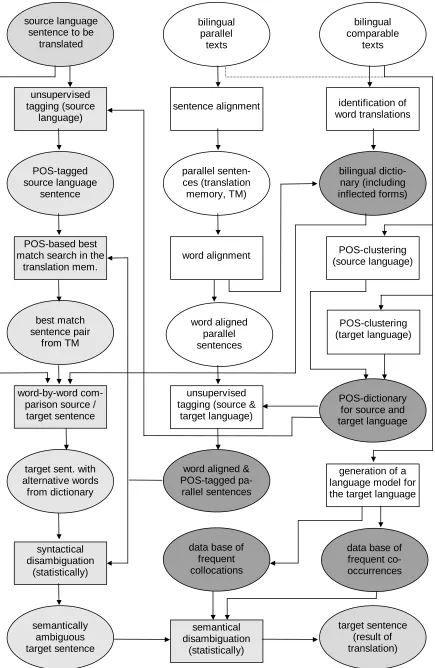
sentence alignment bilingual
parallel texts
word alignment parallel senten-ces (translation
memory, TM)
bilingual comparable
texts
word aligned parallel sentences
identification of word translations
bilingual dictio-nary (including inflected forms)
unsupervised tagging (source &
target language)
word aligned & POS-tagged pa-rallel sentences unsupervised
tagging (source language)
POS-tagged source language
sentence
POS-based best match search in the
translation mem.
best match sentence pair
from TM
word-by-word com-parison source /
target sentence
target sent. with alternative words
from dictionary
syntactical disambiguation
(statistically)
semantically ambiguous target sentence
semantical disambiguation
(statistically)
target sentence (result of translation) POS-dictionary
for source and target language
POS-clustering (source language)
POS-clustering (target language)
data base of frequent collocations
data base of frequent co-occurrences generation of a language model for the target language source language
sentence to be translated
4.3. POS-tagging
Although successful implementations of rule-based (Samuelson & Voutilainen, 1997) or neural-network-based (Schmid, 1994) types of taggers exist, we want to concentrate here on the popular statistical taggers, since they probably offer the best compromise between devel-opment effort and tagging accuracy.
Statistical taggers need information on the transition probabilities between tags, which can – for example – be derived from a manually tagged corpus. When tagging a new text it is assumed that ambiguities should be resolved in such a way that the tag transition probabilities are maximised. This approach is rather successful, in particu-lar if the so called lexical probabilities are also taken into account, i.e. the probability that a certain word form as-sumes a particular tag (without considering context).
Since large enough tagged corpora to derive the prob-abilities from are not always available, algorithms for unsupervised tagging have been suggested (Cutting et al., 1992; Merialdo, 1994). Simply speaking, they iteratively improve the tagging of a corpus by changing the tags of ambiguous words in such a way that observed patterns of tag sequences are emphasized. The bootstrapping works because many words are unambiguous and chances of correct guesses for the others are good.
4.4. Possible search results
As mentioned above, our POS-based search in the translation memory may not always lead to the desired result. Possible outcomes are:
• Exactly one matching sentence is found • Several matching sentences are found • No matching sentence is found
If we have exactly one match, the retrieved translation can directly serve as the pattern for the new translation. Likewise with several matches, except that we now have the choice between several patterns that may be appropri-ate. The selection can – for example – be based on the number of identical words, on the degree of orthographic similarity (see 2.1.) or on word similarities derived from a thesaurus or a vector space model (see 2.3.).
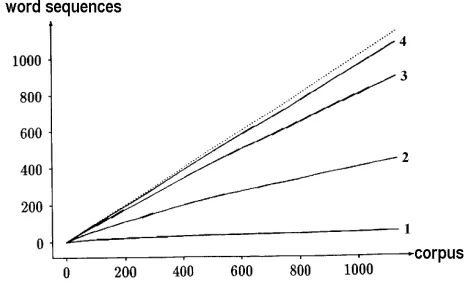
Figure 4. Number of different word sequences of length 1, 2, 3, and 4 in the Brown corpus depending on corpus size (all coordinates × 1000). The almost linear curves indicate
a very large number of possible word sequences.
Figure 5. Number of different tag sequences of length 1, 2, 3, and 4 in the Brown corpus depending on corpus size (all coordinates × 1000). The asymptotical curves indicate
a limited number of possible tag sequences.
If no full match is found at all, the search can be ex-tended to matches of partial sentences, where punctuation or conjunctions can serve as delimiters. Of course, the use of several partial translation patterns involves the risk that the parts do not fit together properly, i.e. that the resulting translation will be ungrammatical. However, the fact that our search mechanism is based on parts of speech instead of words greatly improves the chances of getting a full match. This is confirmed by figures 4 and 5, which present statistics derived from the American Brown corpus on the observed number of different word- or tag-sequences depending on corpus size. (Please note the different vertical scales of both figures.)
5. Translation and disambiguation
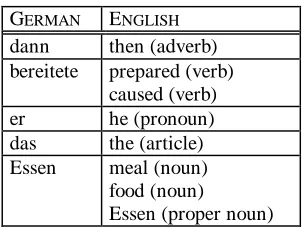
In the example from the beginning of the previous section we wanted to translate the sentence “dann berei tete er das Essen” (then he prepared the meal) into Eng -lish. Our search in the translation memory gave us an appropriate tag sequence for the target sentence together with word order information.5.1. Dictionary lookup and generation
What is further needed is a dictionary based on word forms that also includes part of speech-information. Let us assume by looking up the words of the source sentence we obtained the data from the dictionary as shown in table 1. Please note that the verb bereitete is twofold and the noun or proper noun Essen is threefold ambiguous. By taking into account the information on word alignment from the translation memory we can construct six possible trans-lations:
1. then he prepared the meal
(adverb - pronoun - verb- article - noun) 2. then he caused the meal
(adverb - pronoun - verb - article - noun) 3. then he prepared the food
(adverb - pronoun - verb - article - noun) 4. then he caused the food
(adverb - pronoun - verb - article - noun) 5. then he prepared the Essen
(adverb - pronoun - verb - article - proper noun) 6. then he caused the Essen
(adverb - pronoun - verb - article - proper noun)
Rapp, R. (1998). Wortartenorientierte Suche in Transla-tion Memories. In: J. Strässler: Tendenzen europäischer Linguistik. Akten des 31. Linguistischen Kolloquiums, Bern 1996. 176–181.
Ruge, G. (1995). Wortbedeutung und Termassoziation. Hildesheim: Olms.Sato, S.; Nagao, M. (1990). Toward memory-based translation. Proceedings of COLING 1990, 247–252.
Rumelhart, D.E., McClelland, J.L. (eds.) (1986). Parallel Distributed Processing. (2 Vols.) Cambridge, MA: MIT Press.
Samuelson, C.; Voutilainen, A. (1997). Comparing a Linguistic and a Stochastic Tagger. Proceedings of the ACL 1997, Madrid.
Sato, S.; Nagao, M. (1990). Toward memory-based trans-lation. Proceedings of COLING 1990, 247–252. Schmid, H. (1994). Part-of-speech tagging with neural
networks. In: Proceedings of the International Con-ference on Computational Linguistics, Kyoto, 172–176. Schütze, H. (1997). Ambiguity Resolution in Language
Learning: Computational and Cognitive Models. Stan-ford: CSLI Publications.